coolant CHEVROLET CAMARO 1997 4.G Owner's Manual
[x] Cancel search | Manufacturer: CHEVROLET, Model Year: 1997, Model line: CAMARO, Model: CHEVROLET CAMARO 1997 4.GPages: 404, PDF Size: 20.96 MB
Page 232 of 404
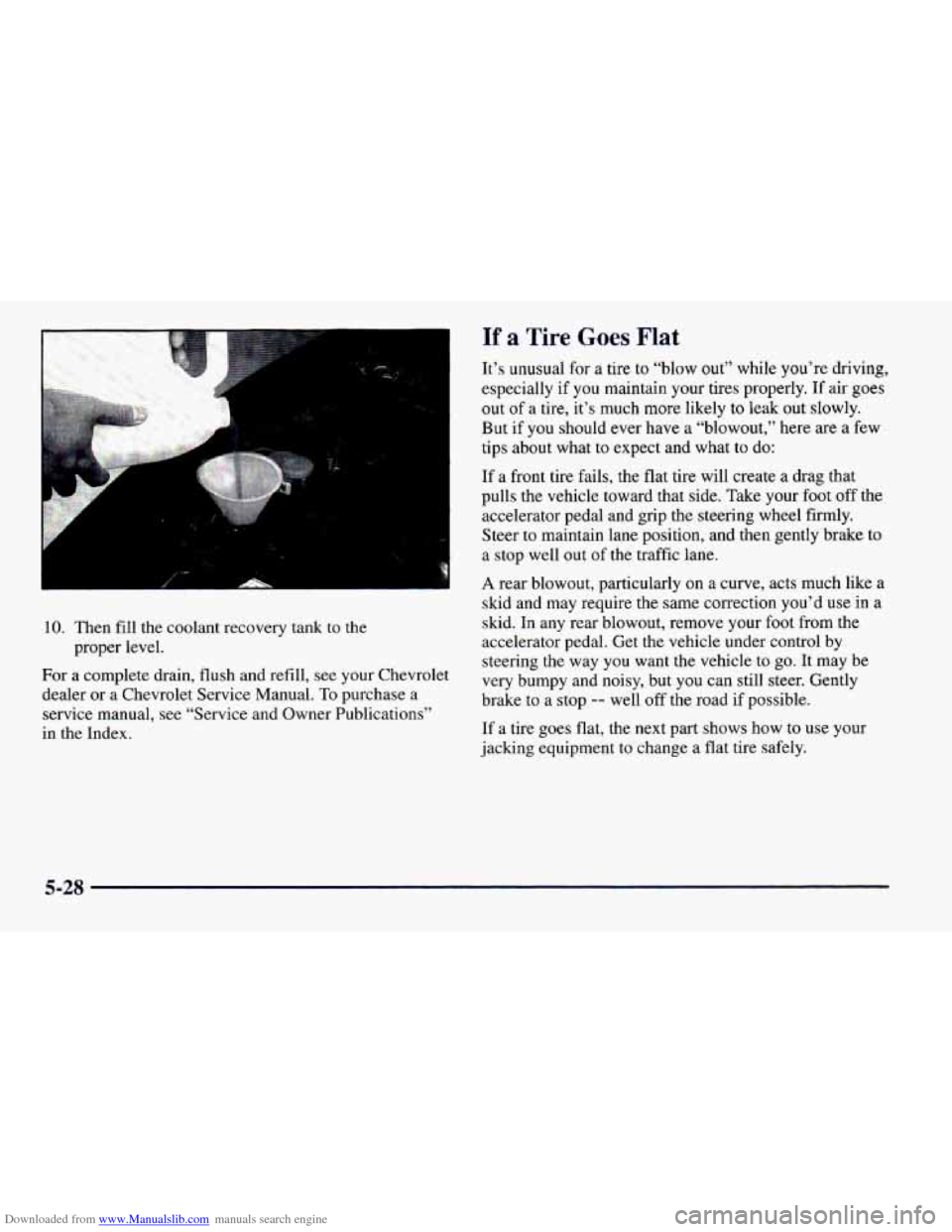
Downloaded from www.Manualslib.com manuals search engine 10. Then fill the coolant recovery tank to the
For a complete drain, flush and refill,
see your Chevrolet
dealer or a Chevrolet Service Manual.
To purchase a
service manual, see “Service and Owner Publications”
in the Index. proper
level.
If a Tire Goes Flat
It’s unusual for a tire to “blow out” while you’re driving,
especially if you maintain
your tires properly. If air goes
out of a tire, it’s much more likely to leak out slowly.
But if you should ever have a “blowout,” here
are a few
tips about what to expect and what to do:
If a front tire fails, the flat tire will create
a drag that
pulls the vehicle toward that side. Take your foot off the
accelerator pedal and grip the steering wheel firmly.
Steer to maintain lane position, and then gently brake to
a stop well
out of the traffic lane.
A rear blowout, particularly on a curve, acts much like a
skid and may require the same correction you’d
use in a
skid. In any rear blowout, remove your foot from the
accelerator pedal. Get the vehicle under control by
steering the way you want the vehicle to
go. It may be
very bumpy and noisy, but you can still steer. Gently
brake to a stop
-- well off the road if possible.
If a tire goes flat, the next part shows how to use your
jacking equipment to change a flat tire safely.
5-28
Page 247 of 404
Downloaded from www.Manualslib.com manuals search engine 0 Section 6 Service and Appearance Care
Here you will find information about the care of your Chevrolet. This section begins with service and fuel
information, and then it shows how to check important fluid and lubricant levels. There is also technical information
about
your vehicle, and a part devoted to its appearance care.
6- 2
6-3'
6-5
6-6
6-8
6- 12
6-18
6-2
1
6-25 6-28
6-32
6-33
6-35
6-39
6-40 Service
Fuel
Fuels
in Foreign Countries
Filling Your Tank
Checking Things Under
the Hood
Engine Oil
Air Cleaner Automatic Transmission Fluid
Manual Transmission Fluid
Engine Coolant
Power Steering Fluid
Windshield Washer Fluid
Brakes
Battery
Bulb Replacement
6-50
6-58
6-59
6-62
6-62
6-63
6-65
6-66
6-67
6-68
6-68 6-68
6-74
6-74
6-76 Tires
Appearance Care
Cleaning the Inside of Your Chevrolet
Care of Safety Belts
Glass
Cleaning the Outside of Your Chevrolet
Aluminum or Chrome Wheels
Underbody Maintenance
Appearance Care Materials Chart
Vehicle Identification Number (VIN)
Service
Parts Identification Label
Electrical System
Replacement Bulbs
Capacities and Specifications
Air Conditioning Refrigerants
Page 254 of 404
Downloaded from www.Manualslib.com manuals search engine When you put the cap back on, turn it to the right
(clockwise) until you hear a clicking sound. Make sure
you fully install the cap. The diagnostic system can
determine
if the fuel cap has been left off or improperly
installed. This would allow fuel to evaporate into the
atmosphere. See “Malfunction Indicator Lamp” in
the Index.
NOTICE:
If you need a new cap, be sure to get the right
type. Your dealer can get one for you.
If you get
the wrong type,
it may not fit or have proper
venting,
and your fuel tank and emissions system
might be damaged.
Checking Things Under the Yood
- -
An electric fan under the hood can start up and
injure you even when the engine
is not running.
Keep hands, clothing and tools
away from any
underhood electric fan.
I /A CAUTION:
Things that burn can get on hot engine parts and
start a fire. These include liquids like gasoline,
oil, coolant, brake fluid, windshield washer and
other fluids, and plastic or rubber. You or others
could be burned. Be careful not
to drop or spill
things that will burn onto
a hot engine.
Page 256 of 404
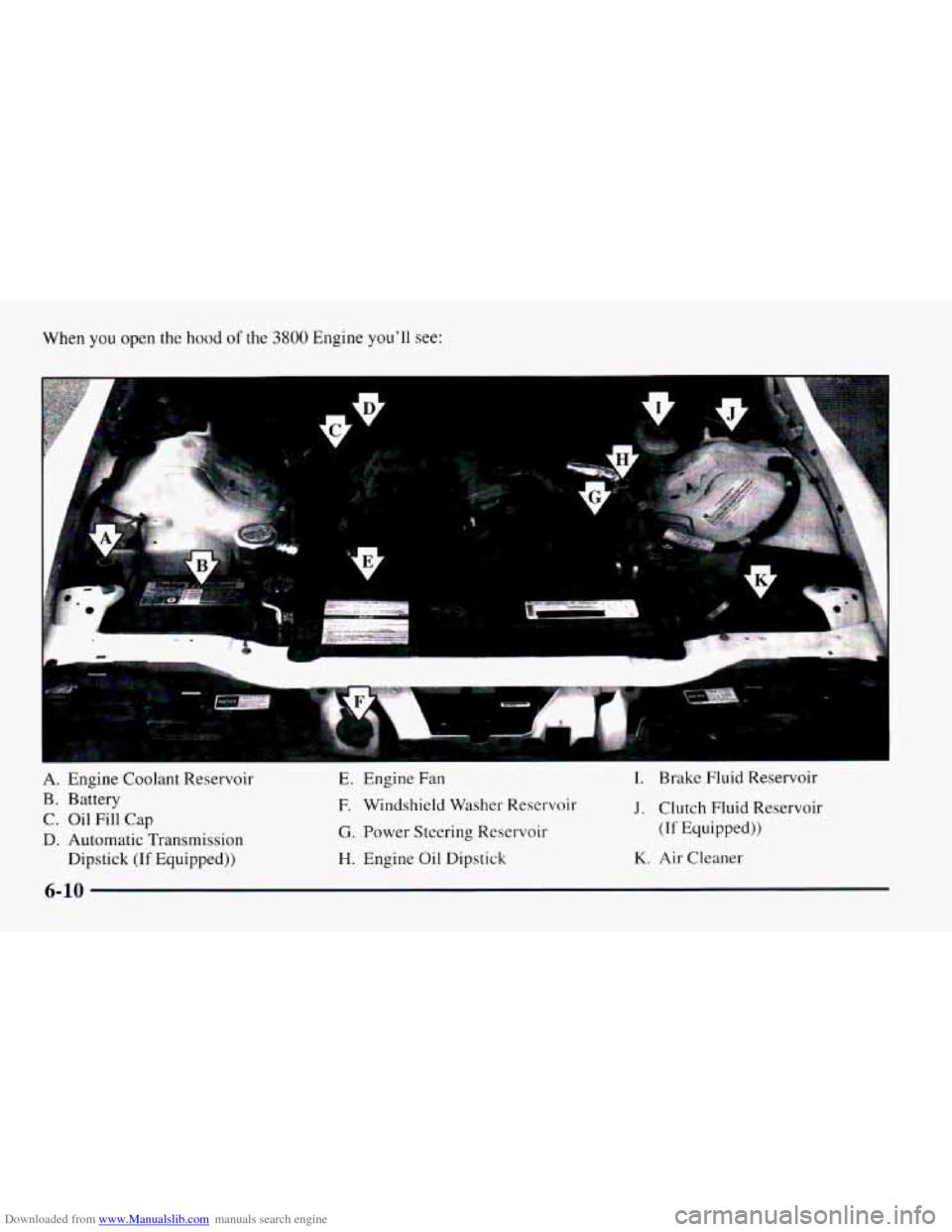
Downloaded from www.Manualslib.com manuals search engine When you open the hood of the 3800 Engine you'll see:
.. > .. - k
A. Engine Coolant Reservoir
B. Battery
C. Oil Fill Cap
D. Automatic Transmission Dipstick
(If Equipped))
E. Engine Fan I. Brake Fluid Reservoir
F. Windshield Washer Reservoir J. Clutch Fluid Reservoir
G. Power Stee.ring Reservoir (If Equipped))
H. Engine Oil Dipstick K. Air Cleaner
6-10
Page 274 of 404
Downloaded from www.Manualslib.com manuals search engine Engine Coolant
The cooling s stem in your vehicle is filled with
DEX-COOL engine coolant. This coolant is designed
to remain
in your vehicle for 5 years or 150,000 miles
(240 000 km) whichever occurs first, if you add only
DEX-COOL’ extended life coolant.
The following explains your cooling system and how to
add coolant when it
is low. If you have a problem with
engine overheating or
if you need to add coolant to your
radiator, see “Engine Overheating” in the Index.
d
A 50/50 mixture of water and DEX-COOL@
coolant will:
0 Give freezing protection down to -34°F (-37°C).
0 Give boiling protection up to 265 “F (1 29°C).
0 Protect against rust and corrosion.
0 Help keep the proper engine temperature.
0 Let the warning lights and gages work as
they should.
NOTICE:
When adding coolant, it is important that you use
only
DEX-COOL@ (silicate-free) coolant.
If silicated coolant is added to the system,
premature engine, heater core
or radiator
corrosion may result. In addition, the engine
coolant
will require change sooner -- at
30,000 miles (50 000 km) or 24 months,
whichever occurs first.
6-28
Page 275 of 404
Downloaded from www.Manualslib.com manuals search engine What to Use
Use a mixture of one-half clean water (preferably
distilled) and one-half
DEX-COOL@ coolant which
won’t damage aluminum parts. Use
GM Engine Coolant
Supplement (sealer)
(GM Part No. 3634621) with any
complete coolant change.
If you use this mixture, you
don’t need to add anything else.
CAUTION:
Adding only plain water to your cooling syste.m
can be dangerous. Plain water, or some other
liquid like alcohol, can boil before the proper
coolant mix will. Your vehicle’s coolant warning
system is set for the proper coolant mix. With
plain water or the wrong mix, your engine could
get too hot but
you wouldn’t get the overheat
warning. Your engine could catch fire and you or
others could be burned.
Use a 50/50 mix of clean
water and
DEX-COOL@ coolant.
NOTICE:
If you use an improper coolant mix, your engine
could overheat and be badly damaged. The
repair cost wouldn’t be covered by your
warranty. Too much water in the mix can freeze
and crack the engine, radiator, heater core and
other parts.
[f you have to add coolant more than four times a year,
lave your dealer :ck your cooling system.
NOTICE:
If you use the proper coolant, you don’t have to
add extra inhibitors or additives which claim to
improve the system. These can be harmful.
6-29
Page 276 of 404
Downloaded from www.Manualslib.com manuals search engine Checking Coolant
5.7L Engine Only
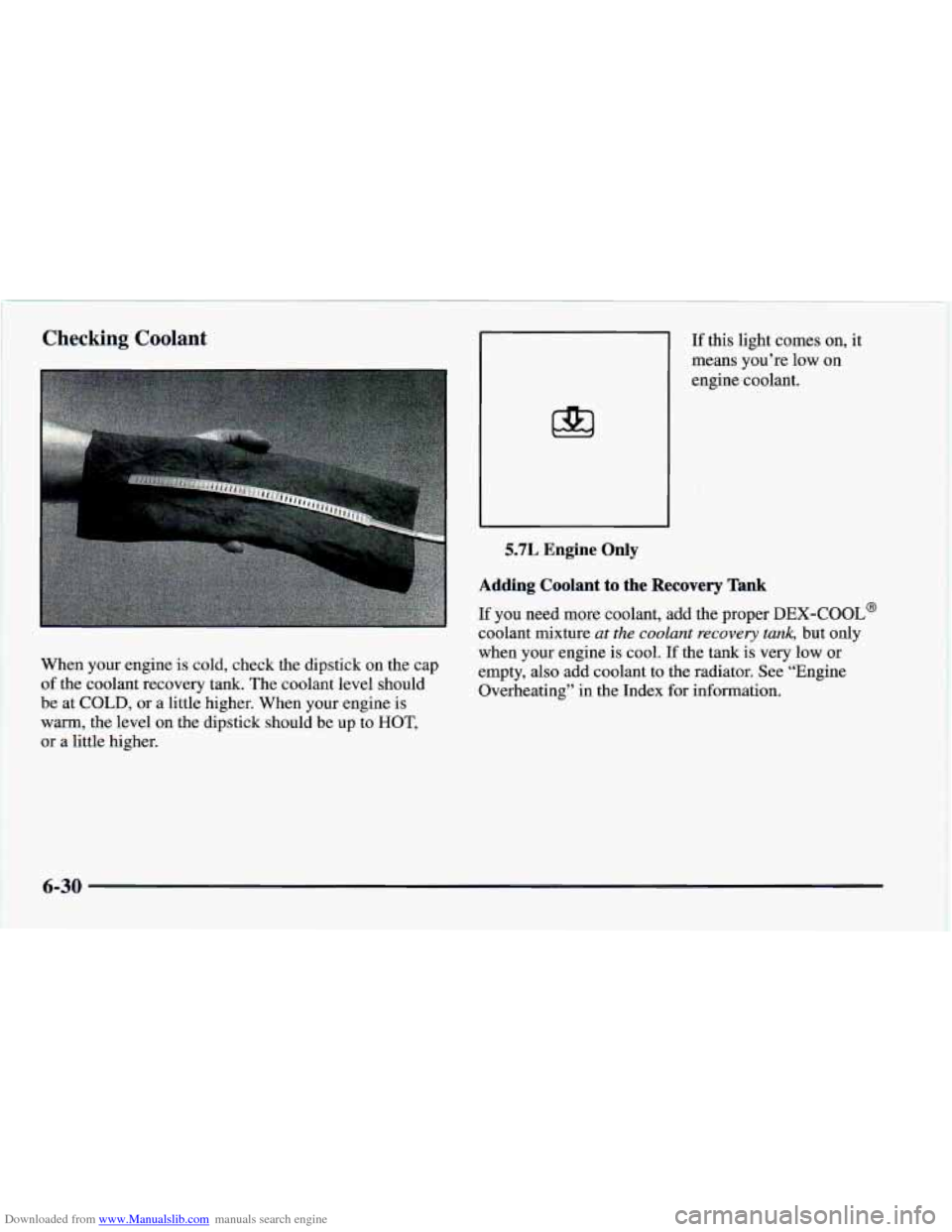
When your engine is cold, check the dipstick on the cap
of the coolant recovery tank. The coolant level should
be at
COLD, or a little higher. When your engine is
warm, the level on the dipstick should be up to HOT,
or a little higher.
If this light comes on, it
means you’re low on
engine coolant.
Adding Coolant to the Recovery Tank
If you need more coolant, add the proper DEX-COOL’
coolant mixture at the coolant recovery tank, but only
when your engine is cool.
If the tank is very low or
empty, also add coolant to the radiator. See “Engine
Overheating” in the Index for information.
Page 277 of 404
Downloaded from www.Manualslib.com manuals search engine A CAUTION:
Turning the radiator pressure cap when the
engine and radiator are hot can allow steam
and scalding liquids
to blow out and burn you
badly. Never turn the pressure cap
-- even a
little -- when the engine and radiator are hot.
Add coolant mixture at the recovery tank, but be careful
not to spill it.
'
A CAUTION:
You can be burned if you spill coolant on hot
engine parts. Coolant contains ethylene glycol,
and
it will burn if the engine parts are hot
enough. Don't spill coolant on a hot engine.
Radiator Pressure Cap (All Engines)
NOTICE:
Your radiator cap is an 18 psi (124 kPa)
~ pressure-type cap and must be tightly installed to
~ prevent coolant loss and possible engine damage
from overheating. Be sure the arrows on the cap
line up with the overflow tube on the radiator
filler neck.
When you replace your radiator pressure cap, an AC@
cap
is recommended.
Thermostat
Engine coolant temperature is controlled by a thermostat
in the engine coolant system. The thermostat stops the
flow of coolant through the radiator until the coolant
reaches a preset temperature.
When you replace your thermostat, an AC@ thermostat
is recommended.
6-31
Page 353 of 404
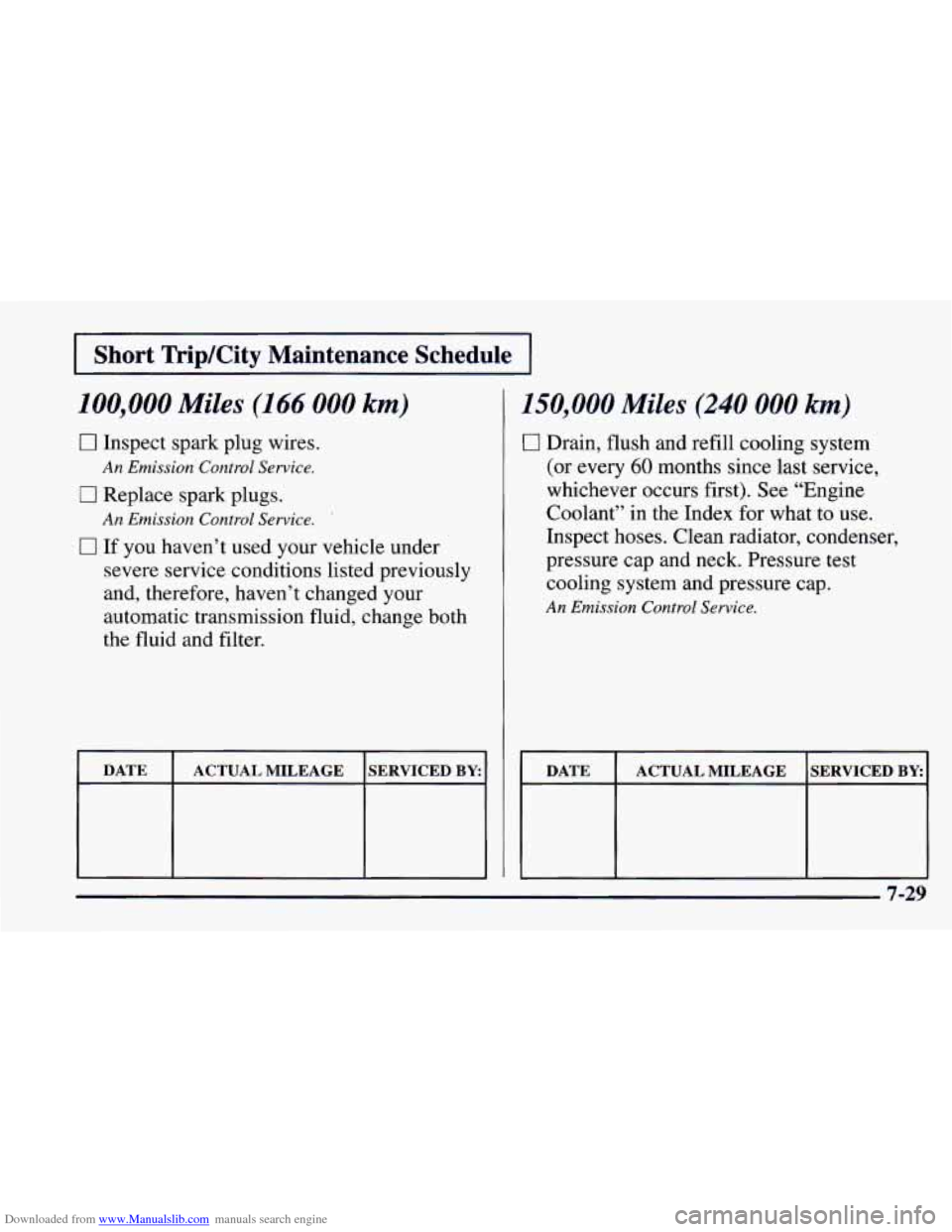
Downloaded from www.Manualslib.com manuals search engine Short TripKity Maintenance Schedule
100,000 Miles (166 000 km)
0 Inspect spark plug wires.
0 Replace spark plugs.
An Emission Control Service.
An Emission Control Service.
0 If you haven’t used your vehicle under
severe service conditions listed previously
and, therefore, haven’t changed your
automatic transmission fluid, chanee both
the fluid and filter.
U
150,000 Miles (240 000 km)
0 Drain, flush and refill cooling system
(or every
60 months since last service,
whichever occurs first). See “Engine
Coolant” in the Index for what
to use.
Inspect hoses. Clean radiator, condenser,
pressure cap and neck. Pressure test
cooling system and pressure cap.
An Emission Control Sewice.
I I
DATE ACTUAL MILEAGE
I
SERVICED BY: DATE SERVICED BY: ACTUAL MILEAGE
7-29
Page 366 of 404
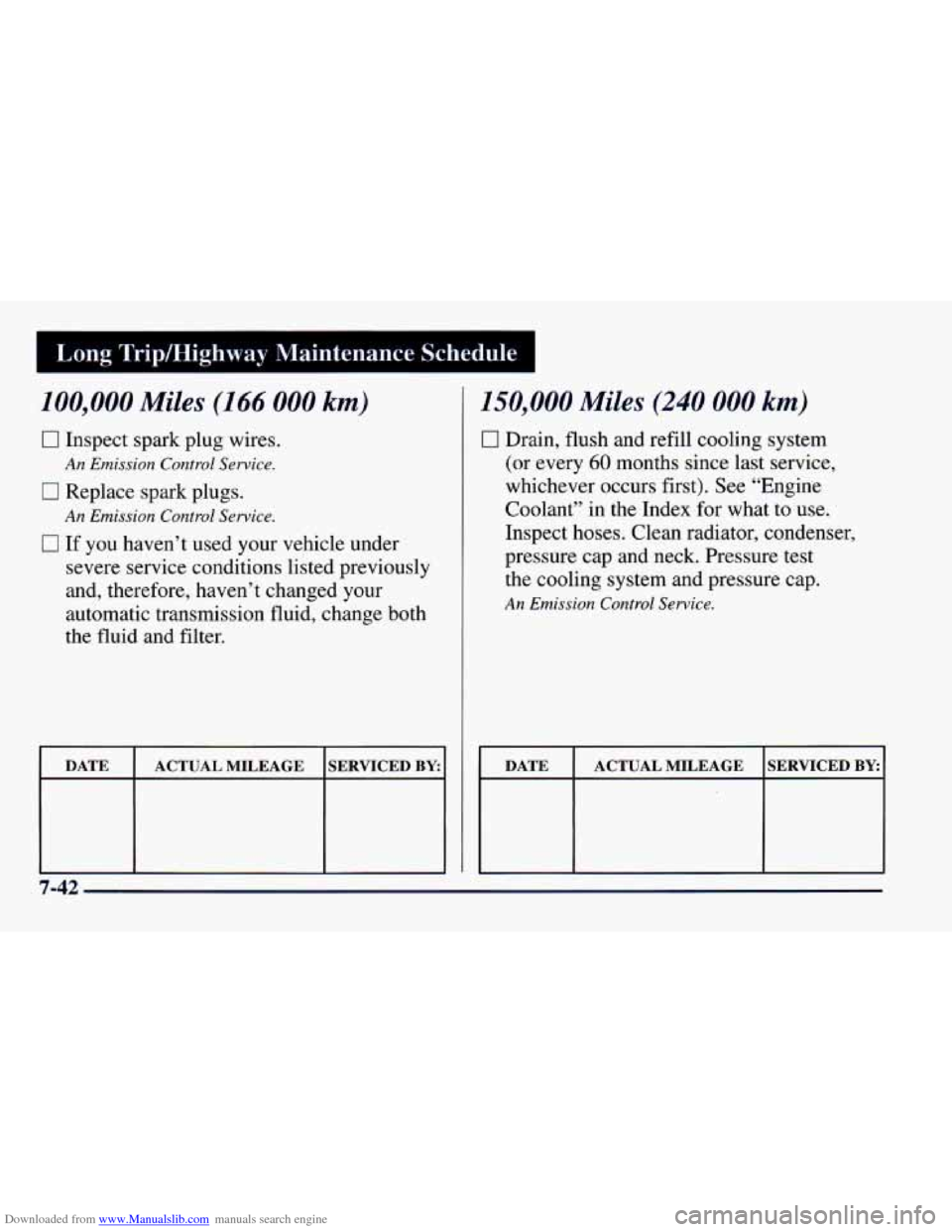
Downloaded from www.Manualslib.com manuals search engine Long Trip/Highway Maintenance Schedule
100,000 Miles (166 000 km)
0
cl
0
Inspect spark plug wires.
An Emission Control Service.
Replace spark plugs.
If you haven’t used your vehicle under
severe service conditions listed previously
and, therefore, haven’t changed your
automatic transmission fluid, change both
the fluid and filter.
An Emission Control Service.
150,000 Miles (240 000 km)
0 Drain, flush and refill cooling system
(or every
60 months since last service,
whichever occurs first). See “Engine
Coolant” in the Index for what to use.
Inspect hoses. Clean radiator, condenser,
pressure cap and neck. Pressure test
the cooling system and pressure cap.
An Emission Control Service.
r I I I
DATE
SERVICED BY ACTUAL MILEAGE
7-42