check engine CHEVROLET CAMARO 1997 4.G Workshop Manual
[x] Cancel search | Manufacturer: CHEVROLET, Model Year: 1997, Model line: CAMARO, Model: CHEVROLET CAMARO 1997 4.GPages: 404, PDF Size: 20.96 MB
Page 268 of 404
Downloaded from www.Manualslib.com manuals search engine NOTICE:
Too much or too little fluid can damage your
transmission.
Too much can mean that some of
the fluid could come out and fall on hot engine
parts or exhaust system parts, starting a fire. Be
sure to get an accurate reading if you check your
transmission fluid.
Wait at least 30 minutes before checking the
transmission fluid level if
you have been driving:
When outside temperatures are above 90°F (32°C).
0 At high speed for quite a while.
In heavy traffic -- especially in hot weather.
0 While pulling a trailer.
To get the right reading, the fluid should be at normal
operating temperature, which is 180°F
to 200°F
(82°C to 93°C).
Checking Transmission Fluid Hot
Get the vehicle warmed up by driving about 15 miles
(24 km) when outside temperatures are above 50°F
( 10" C). If it's colder than 50°F (lO"C), drive the
vehicle in
DRIVE (D) until the engine temperature gage
moves and then remains steady for 10 minutes. Then
follow the hot check procedures.
Checking Transmission Fluid Cold
A cold check is made after the vehicle has been sitting
for eight hours or more with the engine
off and is used
only as a reference. Let the engine run at idle for five
minutes if outside temperatures are
50°F (10°C) or
more. If it's colder than
50°F (lO°C), you may have
to idle the engine longer. Should the fluid level be low
during a cold check, you
must perform a hot check
before adding fluid. This will give you
a more accurate
reading of the fluid level.
Checking the Fluid Hot or Cold
0 Park your vehicle on a level place. Keep the
0 With the parking brake applied, place the shift lever
0 With your foot on the brake pedal, move the shift
engine
running.
in PARK
(P).
lever through each gear range, pausing for about
three seconds in each range, Then, position the shift
lever in
PARK (P).
0 Let the engine run at idle for three minutes or more.
6-22
Page 270 of 404
Downloaded from www.Manualslib.com manuals search engine 1
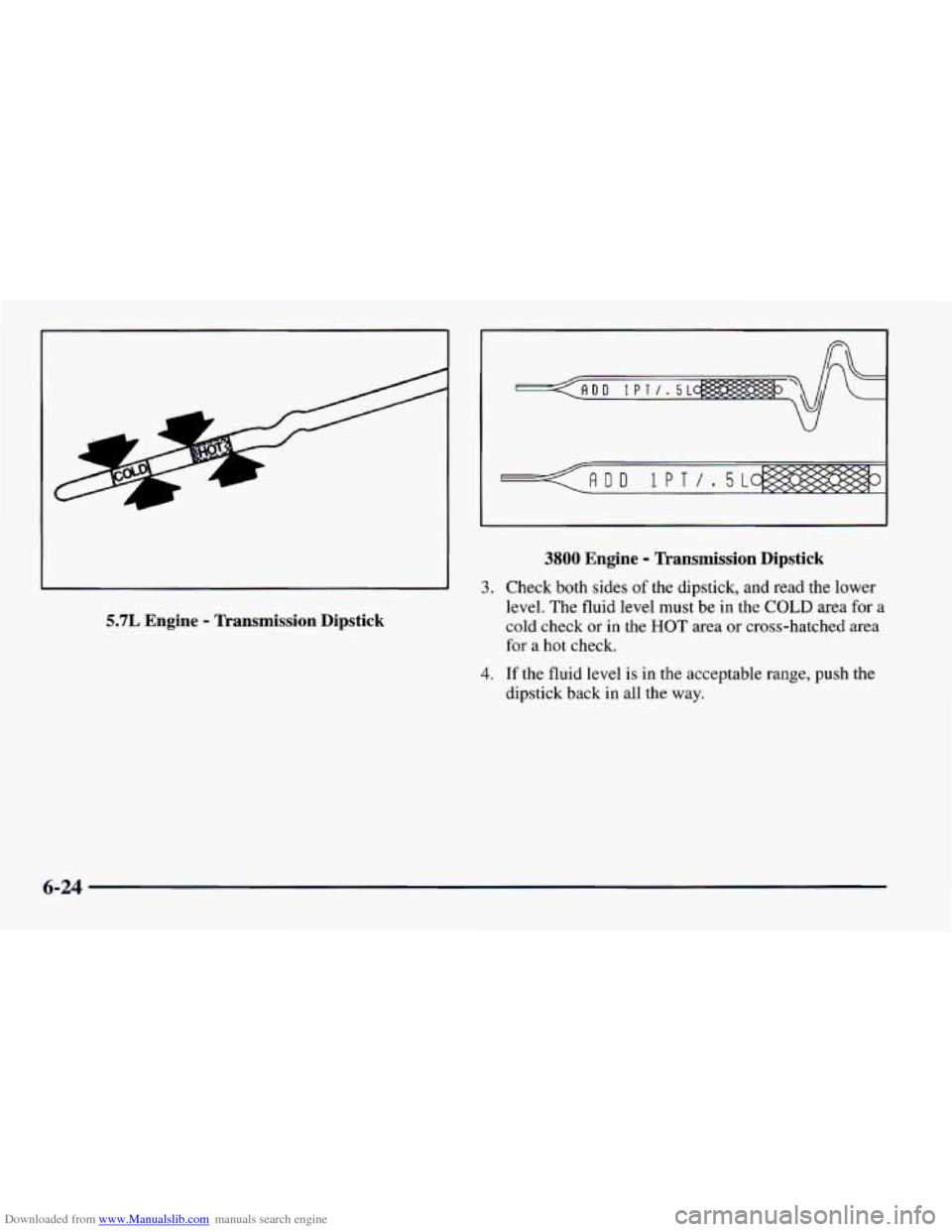
5.7L Engine - Tkansmission Dipstick
3.
4.
3800 Engine - Transmission Dipstick
Check both sides of the dipstick, and read the lower
level. The fluid level must be in the
COLD area for a
cold check or in the HOT area or cross-hatched area
for a hot check.
If the fluid level is in the acceptable range, push the
dipstick back
in all the way.
6-24
Page 271 of 404
Downloaded from www.Manualslib.com manuals search engine How to Add Fluid
Refer to the Maintenance Schedule to determine what
kind of transmission fluid to use. See “Recommended
Fluids and Lubricants”
in the Index.
Add fluid only after checking the transmission fluid
HOT. (A COLD check is used only as a reference.) If the
fluid level is low, add only enough
of the proper fluid to
bring the level up
to the HOT area for a hot check. It
doesn’t take much fluid, generally less than
one pint
(0.5 L). Don’t ove ZZ. We recommend you use only fluid
labeled DEXRON -111, because fluid with that label is
made especially for your automatic transmission. Damage
caused by fluid other than DEXRON-I11
is not covered
by your new vehicle warranty.
%!
After adding fluid, recheck the fluid level as
When the correct fluid level is obtained, push the
described
under
“How to Check.”
dipstick back
in all the way.
Manual Transmission Fluid
When to Check
A good time to have it checked is when the engine oil is
changed. However, the fluid in your manual
transmission doesn’t require changing.
How to Check
Because this operation can be difficult, you may
choose
to have this done at your Chevrolet dealership
Service Department.
If
you do it yourself, be sure to follow all the
instructions here, or
you could get a false reading.
NOTICE:
Too much or too little fluid can damage your
transmission.
Too much can mean that some of
the fluid could come out and fail on hot engine
parts or exhaust system parts, starting a fire. Be
sure
to get an accurate reading if you check your
transmission fluid.
6-25
Page 272 of 404
Downloaded from www.Manualslib.com manuals search engine Check the fluid level only when your engine is off, the
vehicle is parked on a level place and the transmission is
cool enough for you
to rest your fingers on the
transmission
case.
Then, follow these steps:
1. Remove the filler plug.
2. Check that the lubricant level is up to the bottom of
the filler plug hole.
3. If the fluid level is good, install the plug and be sure
it is fully seated. If the fluid level is low, add more
fluid as described in the
next steps.
How to - ~ ~ Fluid A.
Here’s how to add fluid. Refer to the Maintenance
Schedule to determine what kind
of fluid to use. See
“Recommended Fluids and Lubricants” in the Index.
1. Remove the filler plug.
2. Add fluid at the filler plug hole. Add only enough
fluid to bring the fluid level up to the bottom of the
filler plug hole.
3. Install the filler plug. Be sure the plug is fully seated.
Hydraulic Clutch
The hydraulic clutch linkage in your vehicle is
self-adjusting. The clutch master cylinder reservoir is
filled with hydraulic clutch fluid.
It isn’t a good idea
to “top off’ your clutch fluid. Adding
fluid won’t correct a leak.
A fluid loss in this system could indicate
a problem.
Have
the system inspected and repaired.
6-26
Page 273 of 404
Downloaded from www.Manualslib.com manuals search engine When to Check and What to Use
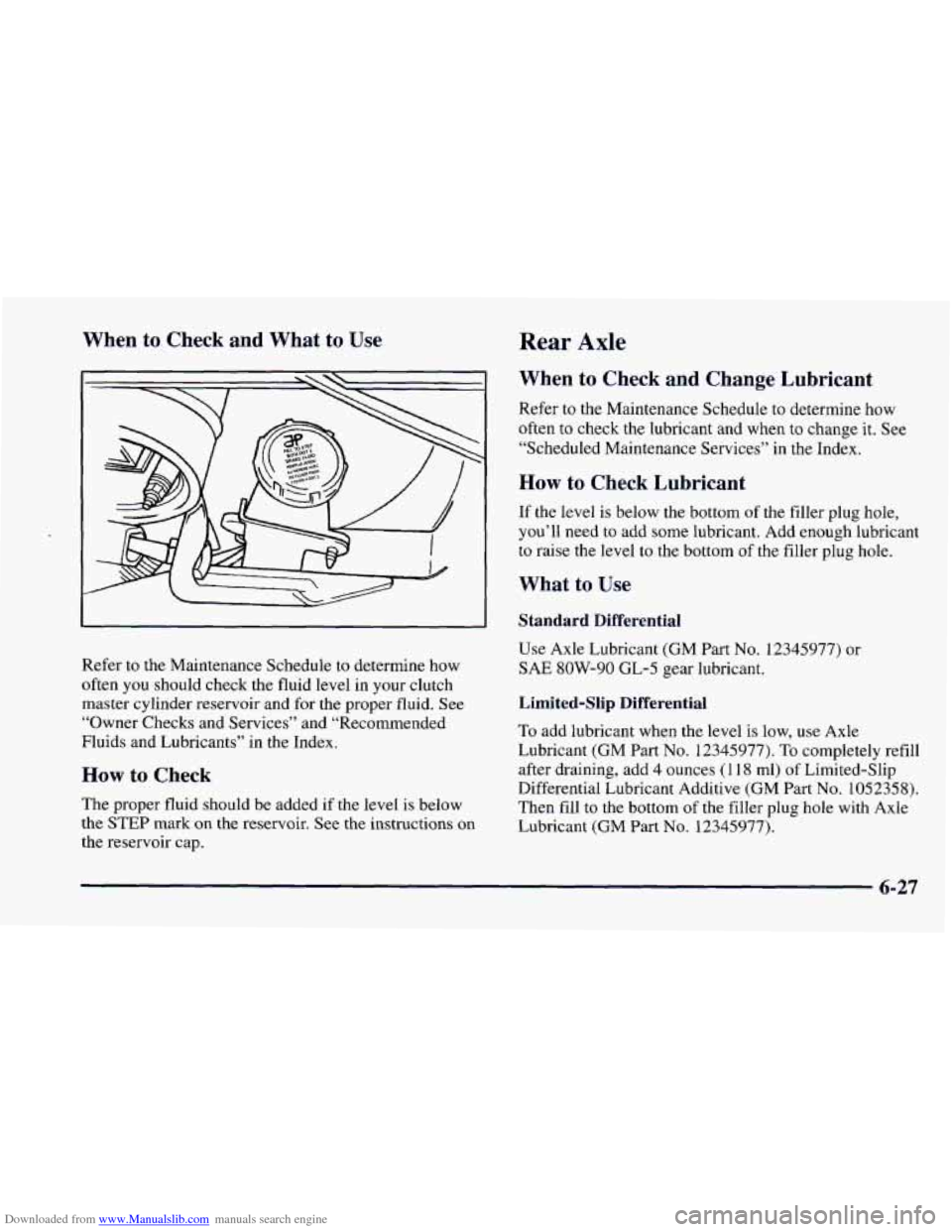
Refer to the Maintenance Schedule to determine how
often you should check the fluid level in your clutch
master cylinder reservoir and for the proper fluid. See
“Owner Checks and Services” and “Recommended
Fluids and Lubricants’’ in the Index.
How to Check
The proper fluid should be added if the level is below
the
STEP mark on the reservoir. See the instructions on
the reservoir cap.
Rear Axle
When to Check and Change Lubricant
Refer to the Maintenance Schedule to determine how
often
to check the lubricant and when to change it. See
“Scheduled Maintenance Services” in the Index.
How to Check Lubricant
If the level is below the bottom of the filler plug hole,
you’ll need to add some lubricant. Add enough lubricant
to raise the level to the bottom of the filler plug hole.
What to Use
Standard Differential
Use Axle Lubricant (GM Part No. 12345977) or
SAE 8OW-90 GL-5 gear lubricant.
Limited-Slip Differential
To add lubricant when the level is low, use Axle
Lubricant (GM Part
No. 12345977). To completely refill
after draining, add 4 ounces (1 18 ml)
of Limited-Slip
Differential Lubricant Additive
(GM Part No. 1052358).
Then fill to the bottom
of the filler plug hole with Axle
Lubricant
(GM Part No. 12345977).
6-27
Page 276 of 404
Downloaded from www.Manualslib.com manuals search engine Checking Coolant
5.7L Engine Only
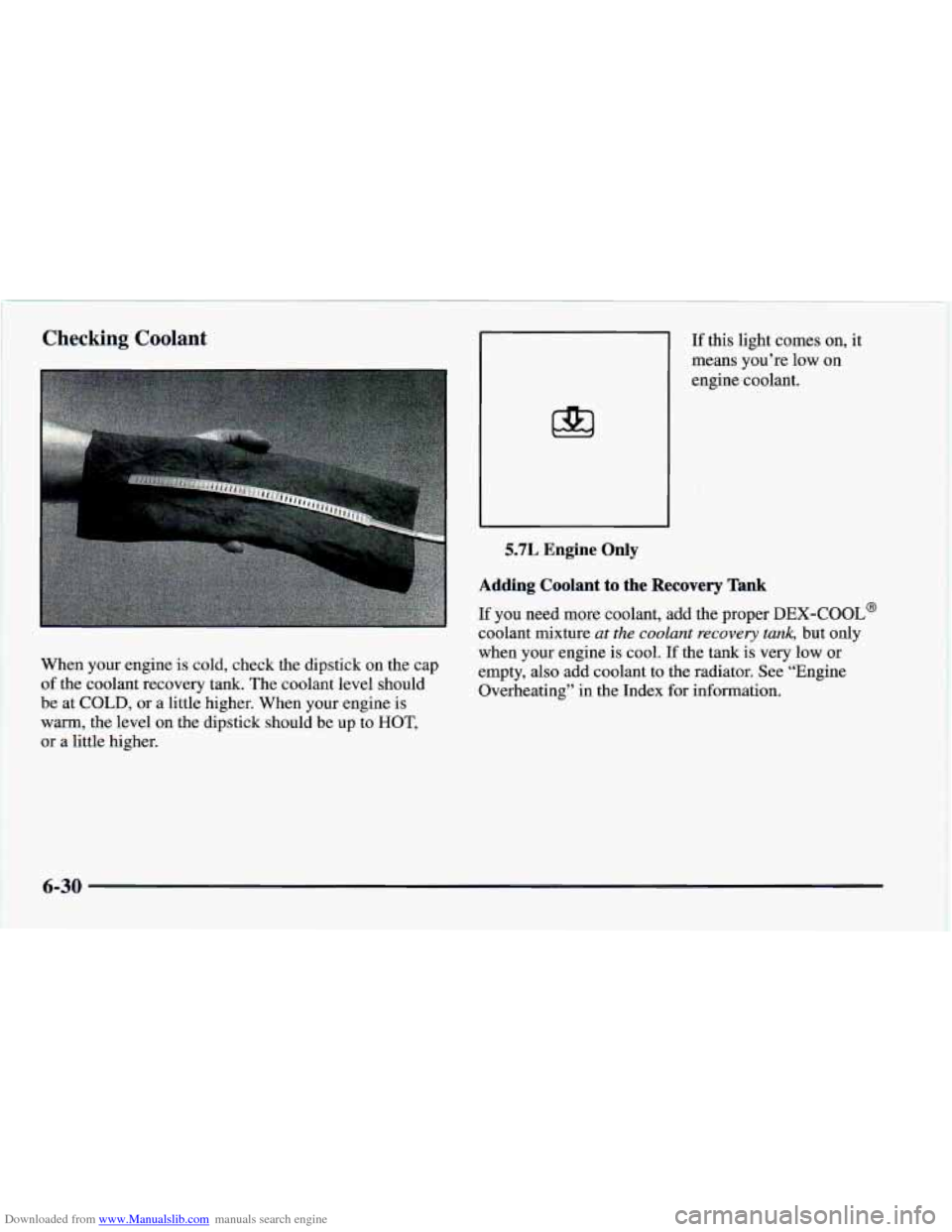
When your engine is cold, check the dipstick on the cap
of the coolant recovery tank. The coolant level should
be at
COLD, or a little higher. When your engine is
warm, the level on the dipstick should be up to HOT,
or a little higher.
If this light comes on, it
means you’re low on
engine coolant.
Adding Coolant to the Recovery Tank
If you need more coolant, add the proper DEX-COOL’
coolant mixture at the coolant recovery tank, but only
when your engine is cool.
If the tank is very low or
empty, also add coolant to the radiator. See “Engine
Overheating” in the Index for information.
Page 278 of 404
Downloaded from www.Manualslib.com manuals search engine Power Steering Fluid
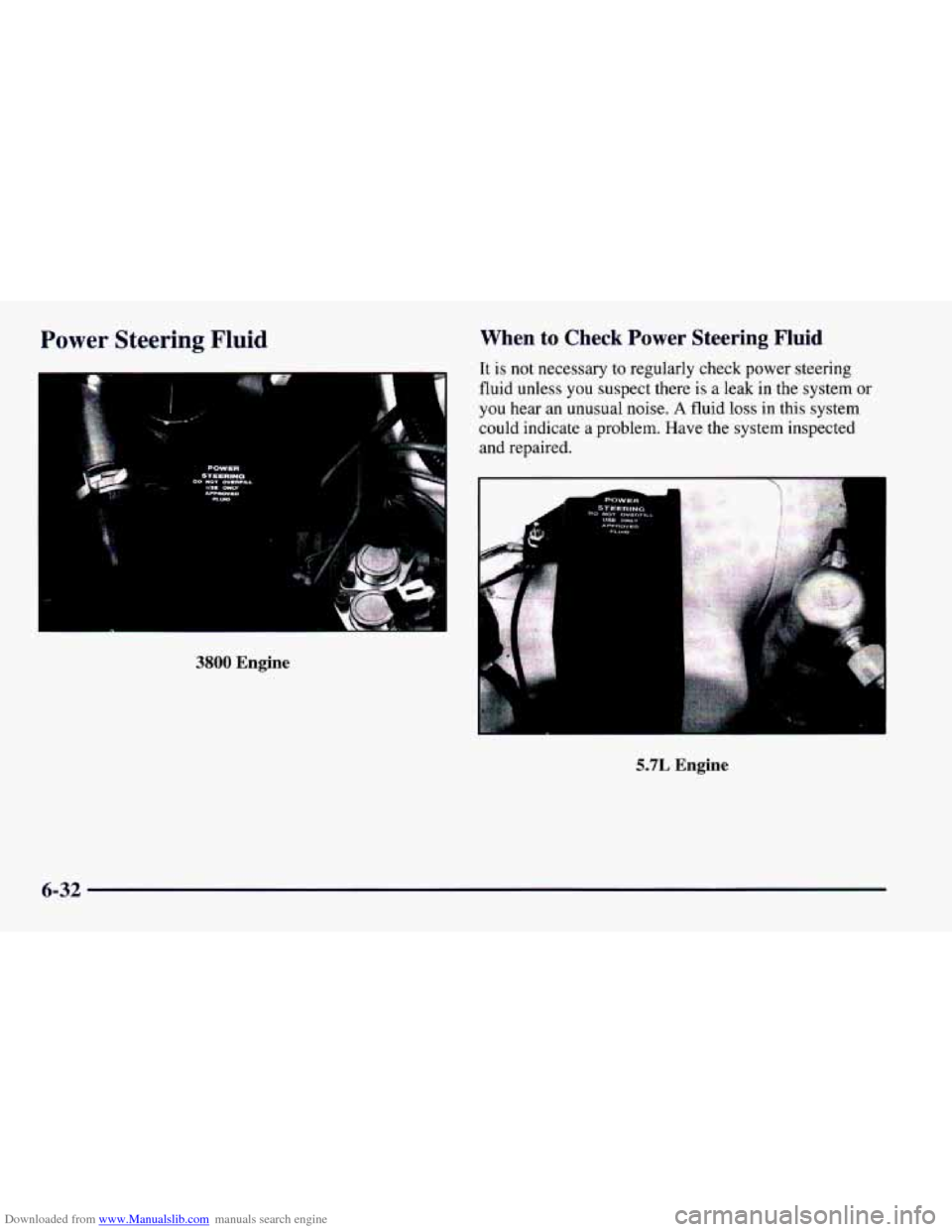
3800 Engine
When to Check Power Steering Fluid
It is not necessary to regularly check power steering
fluid unless you suspect there is a leak in the system or
you hear an unusual noise. A fluid loss in this system
could indicate a problem. Have the
system inspected
and repaired.
5.7L Engine
6-32
Page 279 of 404
Downloaded from www.Manualslib.com manuals search engine How To Check Power Steering Fluid
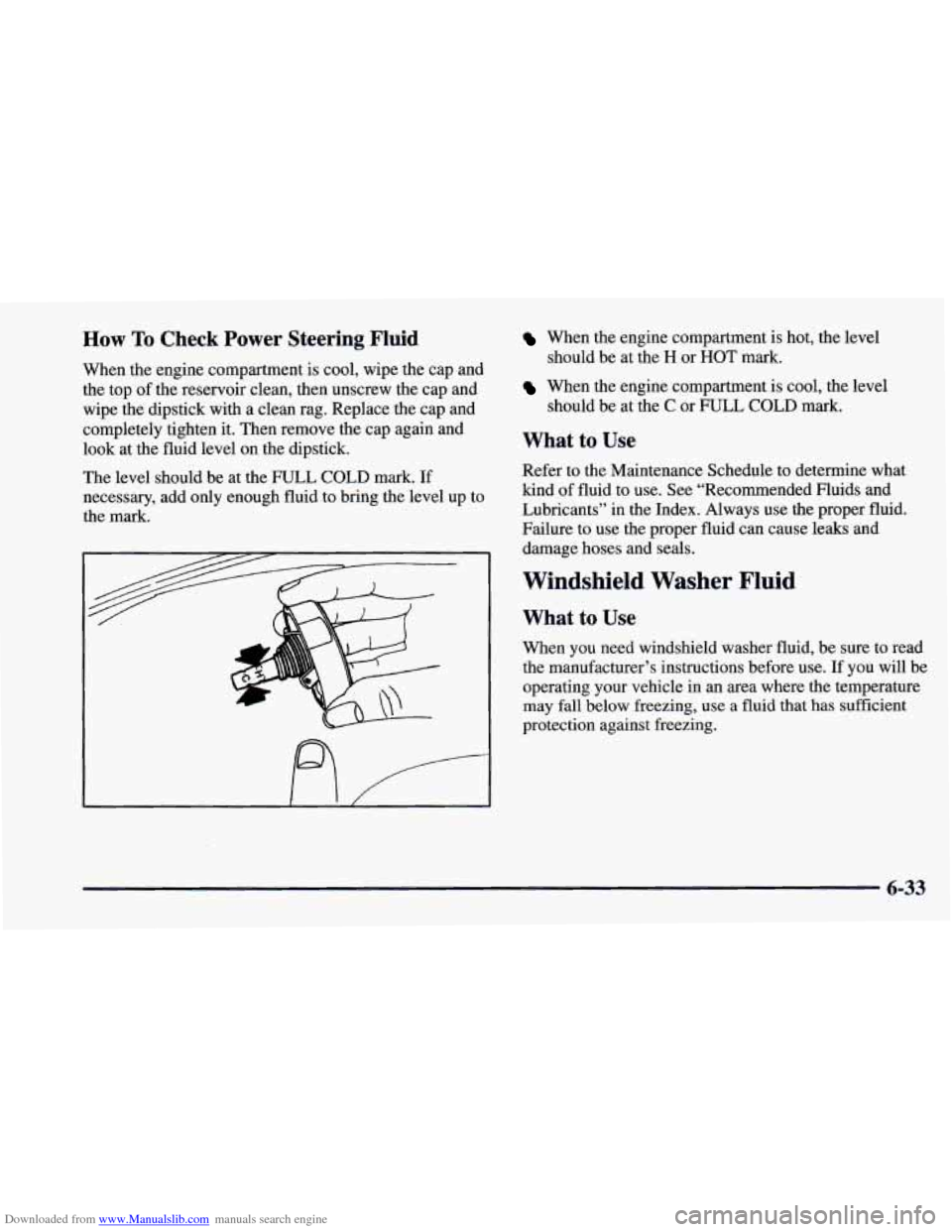
When the engine compartment is cool, wipe the cap and
the top of the reservoir clean, then unscrew the cap and
wipe the dipstick with a clean rag. Replace the cap and
completely tighten it. Then remove the cap again and
look at the fluid level on the dipstick.
The level should be at the FULL COLD mark.
If
necessary, add only enough fluid to bring the level up to
the mark.
I > ...... -.
When the engine compartment is hot, the level
When the engine compartment is cool, the level
should
be at the
H or HOT mark.
should be at the
C or FULL COLD mark,
What to Use
Refer to the Maintenance Schedule to determine what
kind of fluid to use. See “Recommended Fluids and
Lubricants” in the Index. Always use the proper fluid.
Failure to use the proper fluid can cause leaks’and
damage hoses and seals.
Windshield Washer Fluid
What to Use
When you need windshield washer fluid, be sure to read
the manufacturer’s instructions before use. If you will be
operating your vehicle in an area where the temperature
may fall below freezing, use a fluid that has sufficient
protection against freezing.
6-33
Page 281 of 404
Downloaded from www.Manualslib.com manuals search engine Brakes
Brake Fluid
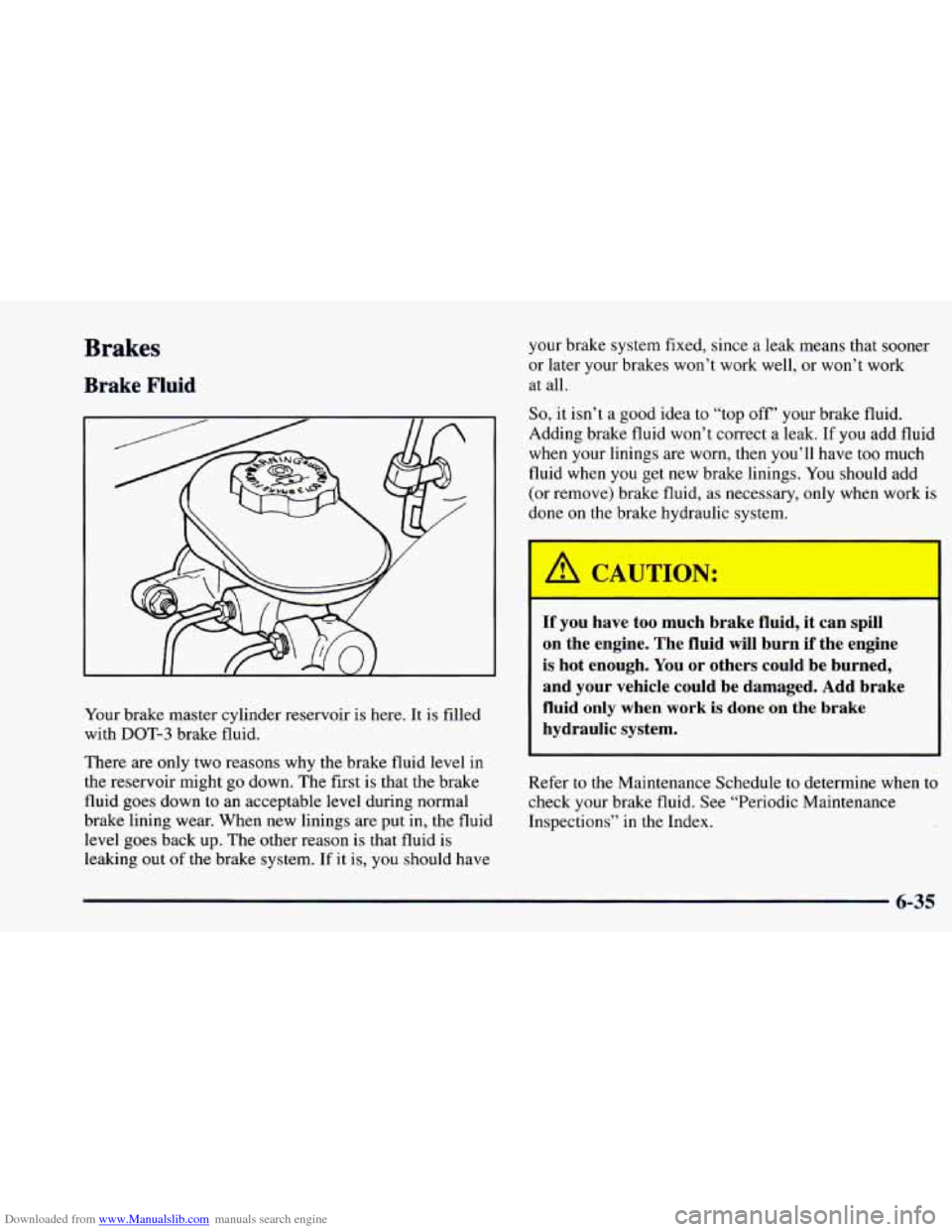
Your brake master cylinder reservoir is here. It is filled
with DOT-3 brake fluid.
There are only two reasons why the brake fluid level in
the reservoir might go down. The first
is that the brake
fluid goes down to an acceptable level during normal
brake lining wear. When new linings are put in, the fluid
level goes back up. The other reason is that fluid
is
leaking out of the brake system. If it is, you should have your
brake system fixed, since
a leak means that sooner
or later your brakes won’t work well, or won’t work
at all.
So, it isn’t a good idea to “top off’ your brake fluid.
Adding brake fluid won’t correct a leak.
If you add fluid
when your linings are worn, then you’ll have too much
fluid when
you get new brake linings. You should add
(or remove) brake fluid, as necessary, only when work
is
done on the brake hydraulic system.
A CA, TION:
If you have too much brake fluid, it can spill
on the engine. The fluid
will burn if the engine
is hot enough. You or others could be burned,
and your vehicle could be damaged. Add brake
fluid only when work
is done on the brake
hydraulic system.
Refer to the Maintenance Schedule to determine when to
check your brake fluid. See “Periodic Maintenance
In~pections’~ in the Index.
6-35
Page 282 of 404
Downloaded from www.Manualslib.com manuals search engine Checking Brake Fluid
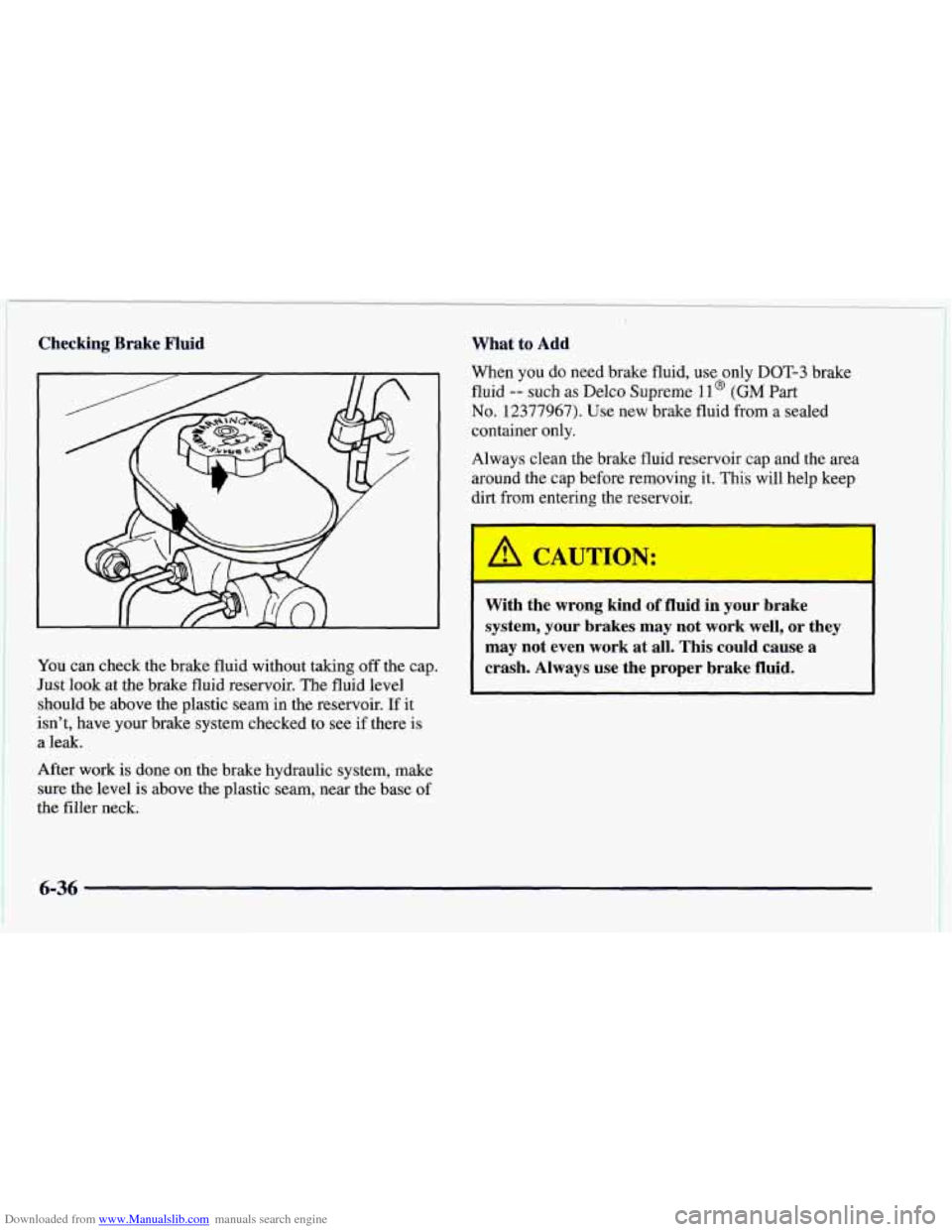
You can check the brake fluid without taking off the cap.
Just look at the brake fluid reservoir. The fluid level
should be above the plastic seam in the reservoir.
If it
isn’t, have your brake system checked to see if there is
a leak.
After work
is done on the brake hydraulic system, make
sure
the level is above the plastic seam, near the base of
the filler neck.
What to Add
When you do need brake fluid, use only DOT-3 brake
fluid
-- such as Delco Supreme 1 1 @ (GM Part
No. 12377967). Use new brake fluid from a sealed
container only.
Always clean the brake fluid reservoir cap and the area
around the cap before removing it. This will help keep
dirt from entering the reservoir.
With the wrong kind of fluid in your brake
system, your brakes may not work well,
or they
may not even work at all. This could cause a
crash. Always use the proper brake fluid.
1
6-36