check engine CHEVROLET CAMARO 1997 4.G Repair Manual
[x] Cancel search | Manufacturer: CHEVROLET, Model Year: 1997, Model line: CAMARO, Model: CHEVROLET CAMARO 1997 4.GPages: 404, PDF Size: 20.96 MB
Page 286 of 404
Downloaded from www.Manualslib.com manuals search engine Bulb Replacement
For the proper type of replacement bulb, see
“Replacement Bulbs”
in the Index.
Halogen Bulbs
Halogen bulbs have pressurized gas inside and
can burst if you drop or scratch the bulb. You or
others could be injured. Be sure to read and
follow the instructions on the bulb package.
Headlamp Aiming
Your vehicle has the 55 x 135 mini-quad headlamp
system. These headlamps have horizontal and vertical
aim indicators. The aim has been pre-set at the factory
and should need
no further adjustment.
If your vehicle is damaged in an accident and the
headlamp aim seems to be affected, see your
Chevrolet dealer. Headlamps on damaged vehicles may
require recalibration of the horizontal aim by your
Chevrolet dealer.
To check the aim, the vehicle should be properly
prepared as follows:
0
0
0
0
0
The vehicle must have all four tires on a perfectly
level surface.
The vehicle should not have any snow, ice or mud
attached to it.
There should not be any cargo or loading of the
vehicle, except it should have a full tank
of gas and
one person or
160 lbs. (75 kg) on the driver’s seat.
Tires should be properly inflated.
The horizontal indicator should read
“0.”
6-40
Page 287 of 404
Downloaded from www.Manualslib.com manuals search engine I NOTICE:
To make sure your headlamps are aimed
properly, read all the instructions before
beginning. Failure to follow these instructions
could cause damage
to headlamp parts.
State inspection stations will allow a vertical reading of
plus 0.76 degrees or minus 0.76 degrees from the center
of the bubble.
It
is recommended that the upper limit not exceed plus
0.4 degrees from the center of the bubble. Other drivers
may flash their high beams at
you if your adjustment is
much above plus
0.4 degrees.
If you find that the headlamp aiming needs adjustment,
follow these steps:
To adjust the aim of your headlamps:
1. Move your vehicle to a level surface. Use a spirit level
to be sure. Be sure to remove any items that
are not
part of your original equipment from the trunk and
passenger areas. No one should be seated in the vehicle
and
your fuel tank should be about half full. Check to
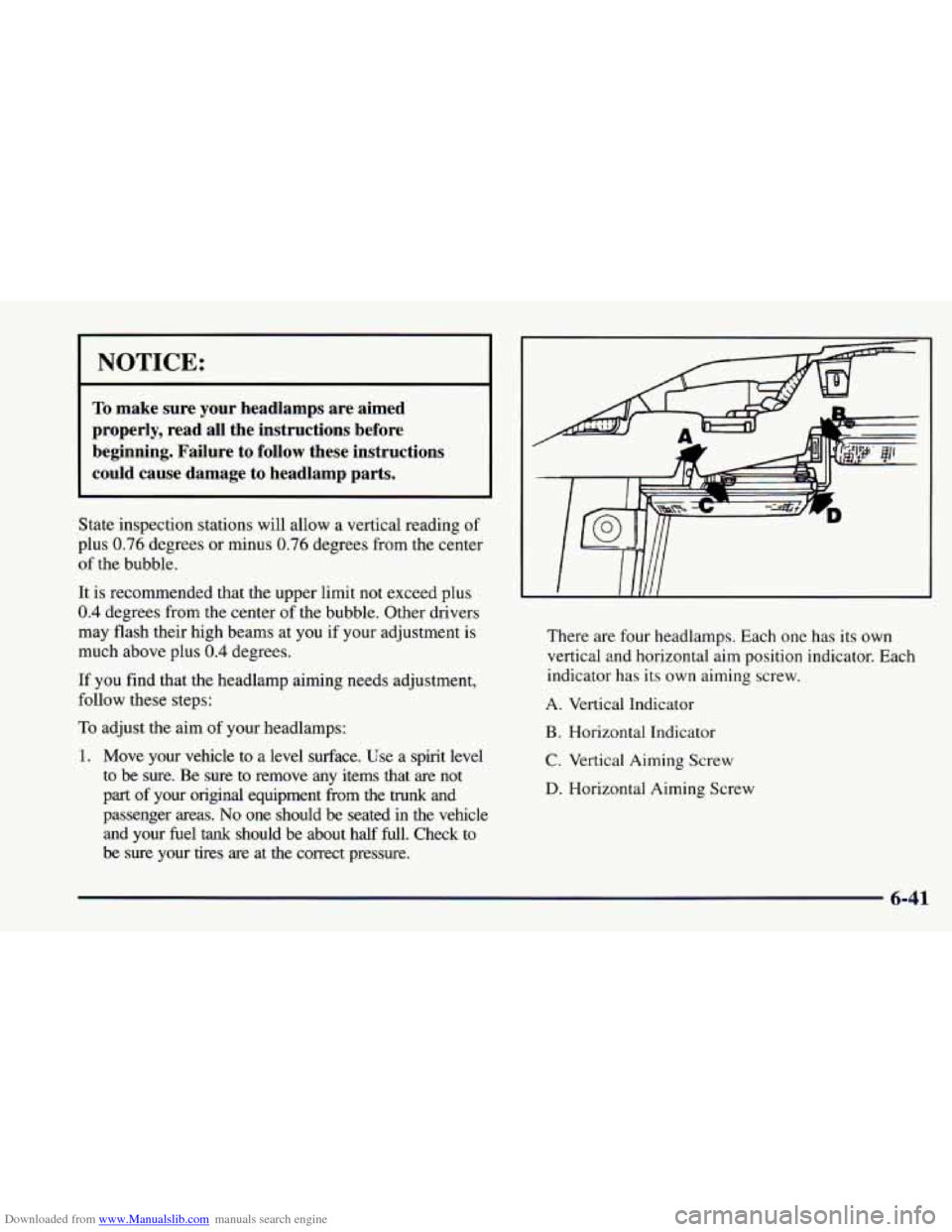
be sure your tires are at the correct pressure. There are four
headlamps. Each one has its own
vertical and horizontal aim position indicator. Each
indicator has its own aiming screw.
A. Vertical Indicator
B. Horizontal Indicator
C. Vertical Aiming Screw
D. Horizontal Aiming Screw
6-41
Page 288 of 404
Downloaded from www.Manualslib.com manuals search engine 2.
3.
4.
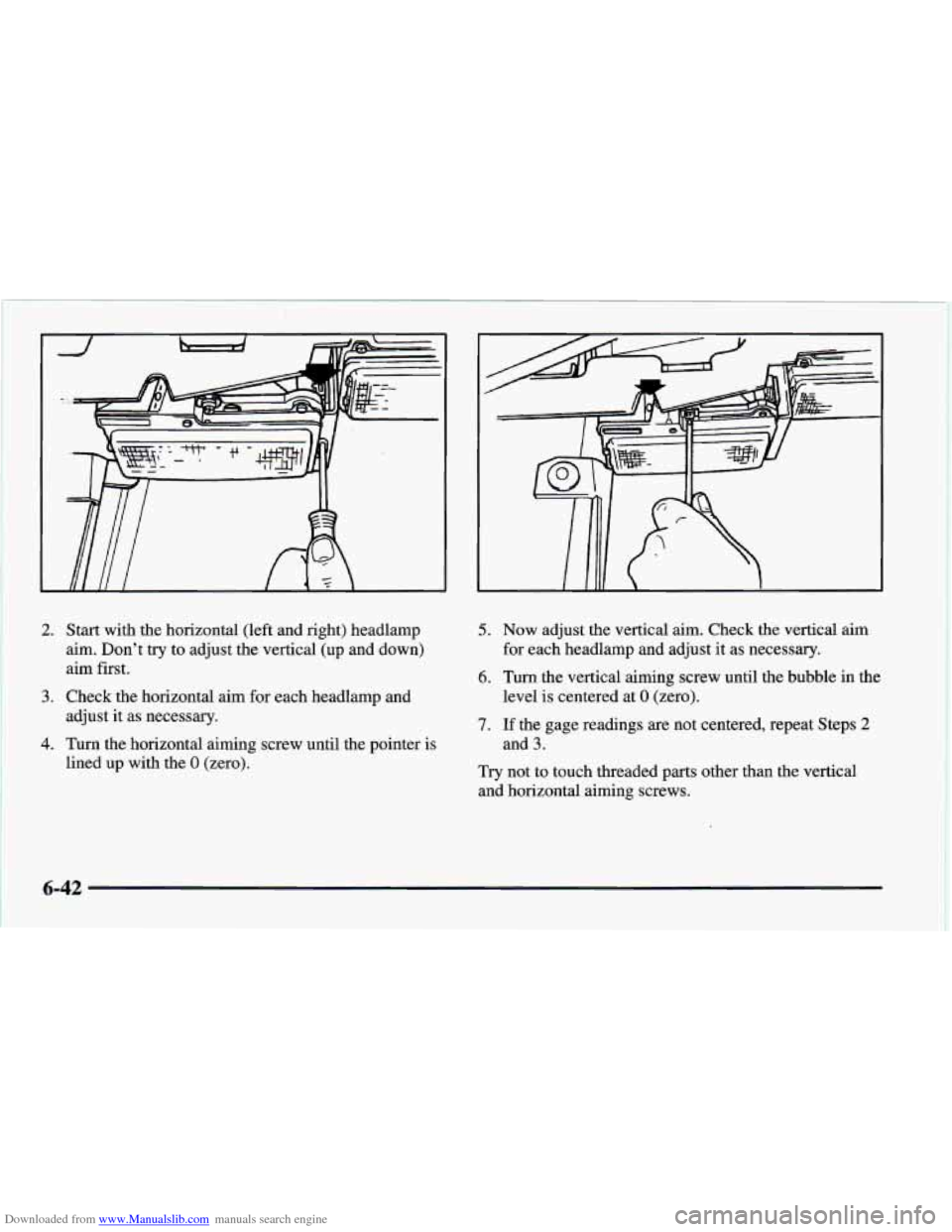
Start with the horizontal (left and right) headlamp
aim. Don’t try to adjust the vertical (up and down)
aim first.
Check the horizontal aim for each headlamp and
adjust it
as necessary.
Turn the horizontal aiming screw until the pointer is
lined
up with the 0 (zero).
5. Now adjust the vertical aim. Check the vertical aim
6. Turn the vertical aiming screw until the bubble in the
for each
headlamp and adjust it as necessary.
level is centered at
0 (zero).
7. If the gage readings are not centered, repeat Steps 2
and 3.
Try not to touch threaded parts other than the vertical
and horizontal aiming screws.
6-42
Page 289 of 404
Downloaded from www.Manualslib.com manuals search engine Headlamps
Before replacing a headlamp that does not light, check
to make sure that the wiring connector is securely
fastened to it.
See “Replacement Bulbs” in the Index to check the size
and type
of headlamp you need to use before you begin
to replace the headlamp. You must replace a headlamp
with
one that is exactly the same.
Be careful not to move the aiming screws when you
replace the headlamp.
If the headlamp being replaced
was properly aimed, the new one will be also if it
is
properly installed.
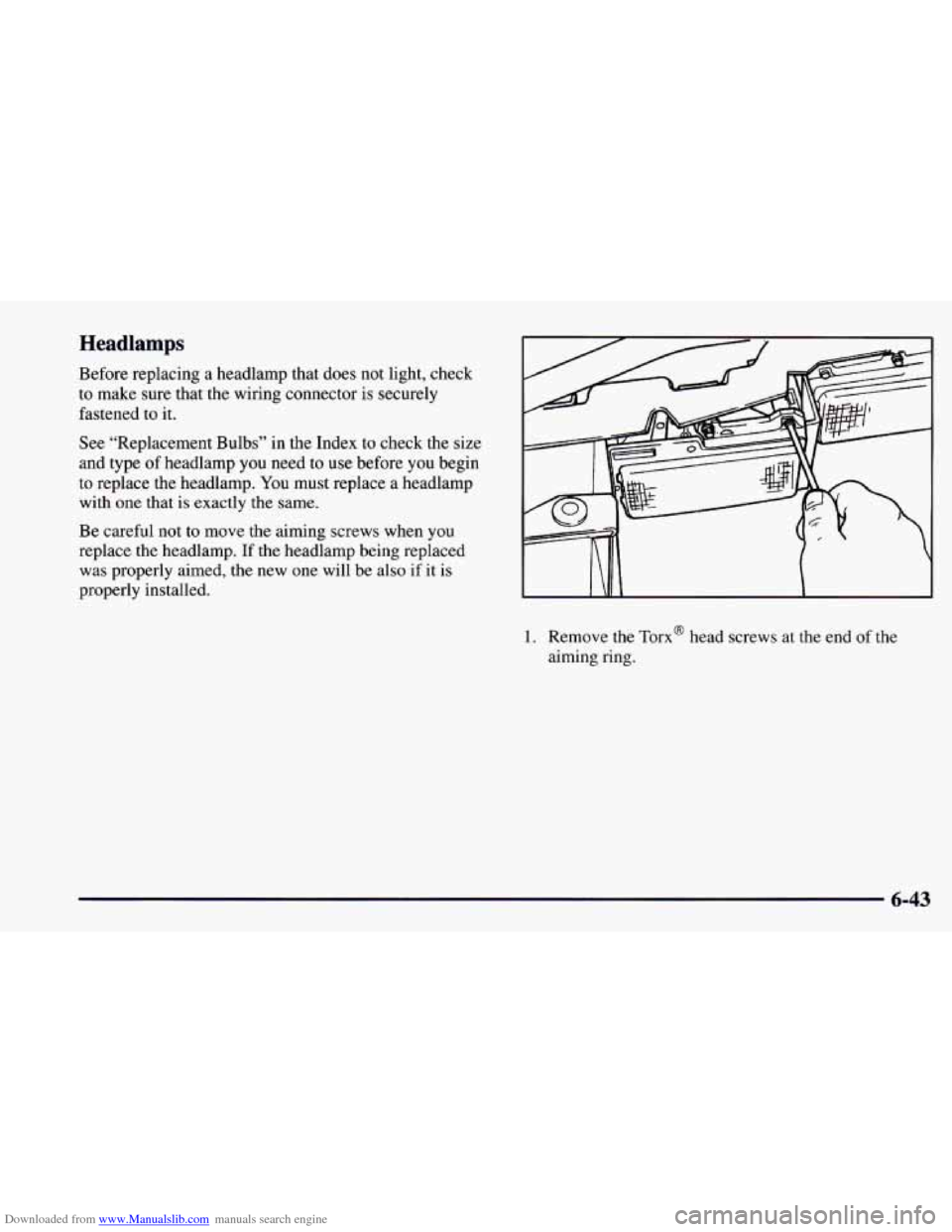
1. Remove the Tom@ head screws at the end of the
aiming ring.
6-43
Page 291 of 404
Downloaded from www.Manualslib.com manuals search engine 4. Check the new headlamp again. The number on the
lamp must match the number
of the headlamp being
replaced. The letter
U or L must also match.
5. Plug the wiring connector into the headlamp socket.
6. Place the new headlamp in the headlamp assembly.
Snap
the locking tabs onto the socket.
The socket must be pointing in the same direction
the socket
on the burned out bulb was.
7. Insert the tabs on the aiming ring into the tabs in the
8. Hold the aiming ring closed, insert the screws at the
end
of the ring. Tighten the screws until the aiming
ring touches the plastic nuts on both the top and
bottom.
Do not overtighten. Do not damage the
vertical aiming bubble.
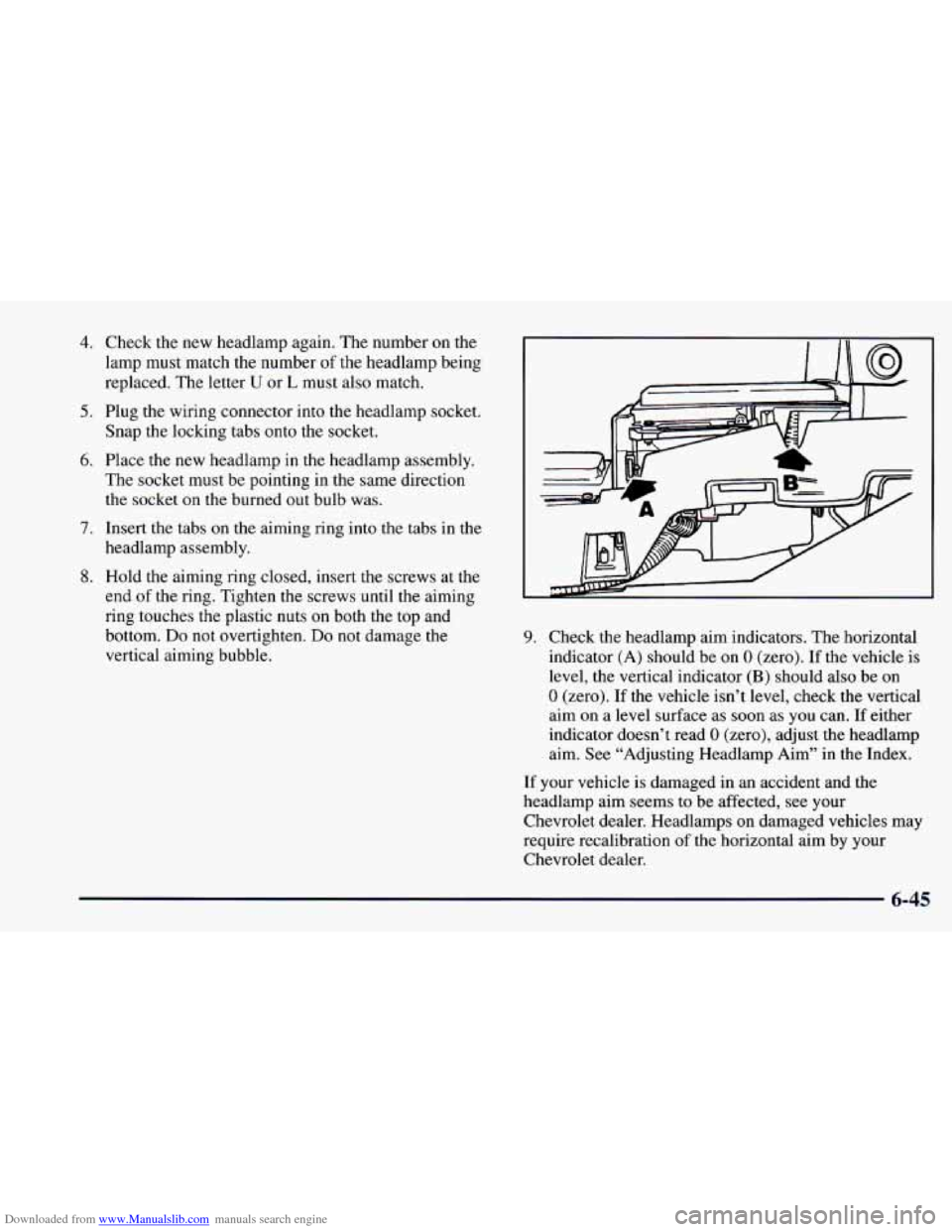
headlamp assembly. 9. Check the
headlamp aim indicators. The horizontal
indicator
(A) should be on 0 (zero). If the vehicle is
level, the vertical indicator
(B) should also be on
0 (zero). If the vehicle isn’t level, check the vertical
aim on a level surface as soon as you can.
If either
indicator doesn’t read
0 (zero), adjust the headlamp
aim. See “Adjusting Headlamp Aim’’ in the Index.
If your vehicle is damaged in an accident and the
headlamp aim seems to be affected, see your
Chevrolet dealer. Headlamps on damaged vehicles may
require recalibration of the horizontal aim by your
Chevrolet dealer.
6-45
Page 296 of 404
Downloaded from www.Manualslib.com manuals search engine ~ 3. At
the heel end of the wiper blade assembly, notched
end of blade element last, slide the blade element
into the blade claw sets. The plastic retainer caps
will be forced
off as the element is fully inserted.
Make sure that all the claw sets are properly engaged
in the slots of the blade element.
4. Install the wiper blade assembly on the wiper arm.
For information on wiper blade replacement length and
type, see “Capacities and Specifications” in the Index.
Tires
Your new Chevrolet comes with high-quality tires made
by a leading tire manufacturer. If you ever have
questions about your tire warranty and where to obtain
service, see your Chevrolet Warranty booklet for details.
Poorly maintained and improperly used tires
are dangerous.
CAUTION: (Continued)
Overloading your tires can cause
overheating as
a result of too much friction.
You could have an air-out and a serious
accident. See “Loading Your Vehicle” in
the Index.
0 Underinflated tires pose the same danger as
overloaded tires. The resulting accident
could cause serious injury. Check all tires
frequently to maintain the recommended
pressure. Tire pressure should be checked
when your tires are cold.
cut, punctured or broken
by a sudden
impact
-- such as when you hit a pothole.
Keep tires at the recommended pressure.
0 Worn, old tires can cause accidents. If your
tread
is badly worn, or if your tires have
been damaged, replace them.
See “Inflation
-- Tire Pressure’’ in this section
for inflation pressure adjustment for higher
speed driving.
Overinflated tires are more likely to be
6-50
Page 297 of 404
Downloaded from www.Manualslib.com manuals search engine Inflation -- Tire Pressure
The Tire-Loading Information label, which is on the
driver’s door shows the correct inflation pressures
for
your tires when they’re cold. “Cold” means your vehicle
has been sitting for
at least three hours or driven no
more than 1 mile
(1.6 km).
If you’ll be driving at speeds higher than 100 mph
(160 km/h) where it is legal, raise the cold inflation
pressure
of each tire to 35 psi (240 kPa). When you
end this very high-speed driving, reduce the cold
inflation pressures to those listed on the Tire-Loading
Information label.
NOTICE:
Don’t let anyone tell you that underinflation or
overinflation is all right.
It’s not. If your tires
don’t have enough air (underinflation), you can
get the following:
NOTICE: (Continued) NOTICE:
(Continued)
Too much flexing
Too much heat
Tire overloading
Bad wear
Bad handling
0 Bad fuel economy.
If your tires have too much air (overinflation),
you can get the following:
Unusual wear
0 Bad handling
Rough ride
Needless damage from road hazards.
When to Check
Check your tires once a month or more.
Don’t forget your compact spare tire. It should be at
60 psi (420 kPa).
6-51
Page 298 of 404
Downloaded from www.Manualslib.com manuals search engine How to Check
Use a good quality pocket-type gage to check tire
pressure. You can’t tell if your tires are properly inflated
simply by looking at them. Radial tires may look
properly inflated even when they’re underinflated.
Be sure to put
the valve caps back on the valve stems.
They help prevent leaks by keeping out dirt and moisture.
Tire Inspection and Rotation
Tires should be rotated every 6,000 to 8,000 miles
(10
000 to 13 000 km). Any time you notice unusual
wear, rotate your tires as soon as possible and check
wheel alignment.
Also check for damaged tires or
wheels. See “When It’s Time for New Tires” and
“Wheel Replacement” later in this section for
more information.
The purpose of regular rotation is
to achieve more
uniform wear for all tires on the vehicle. The first
rotation is the most important. See “Scheduled
Maintenance Services” in the Index for scheduled
rotation intervals.
c-
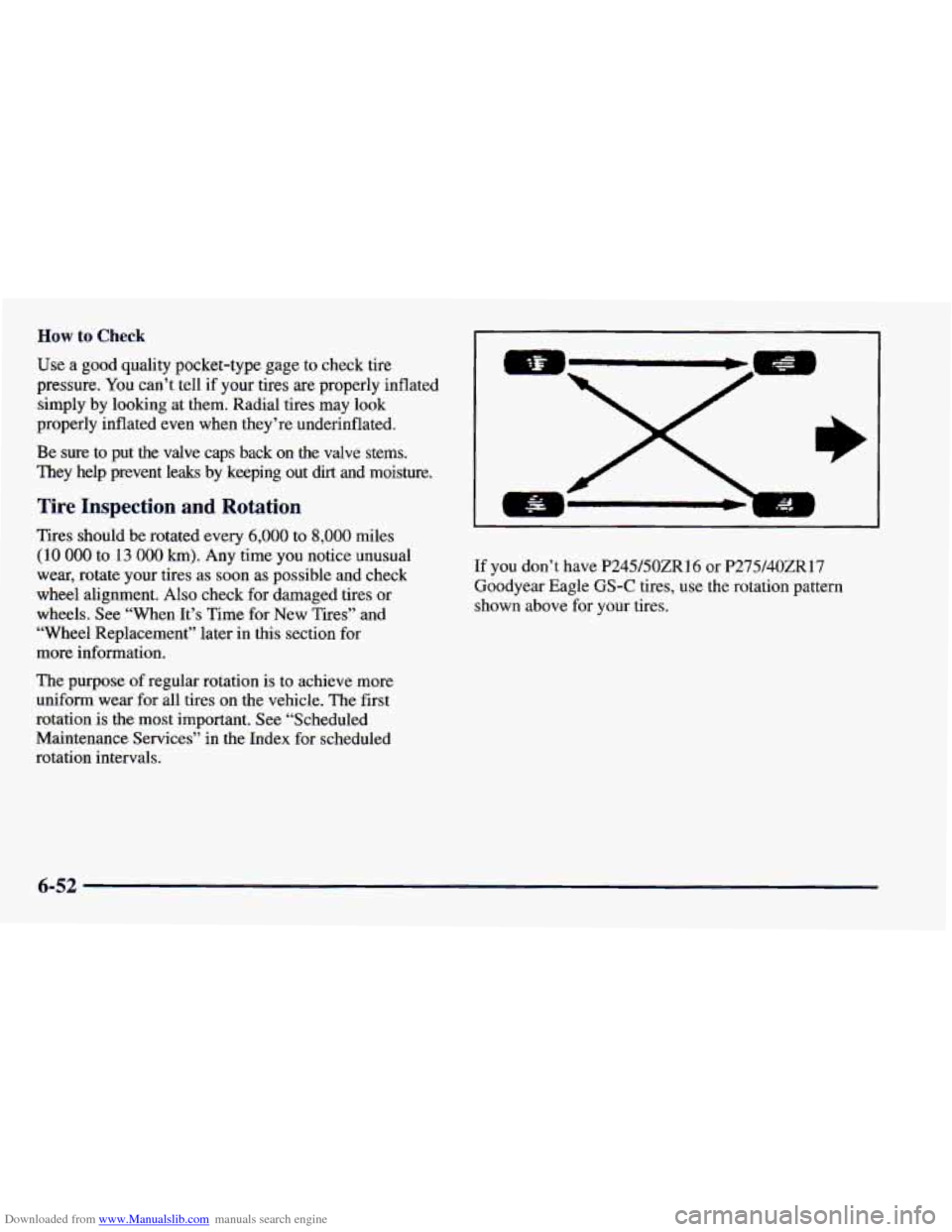
If you don’t have P245/5OZR16 or P275/40ZR17
Goodyear Eagle GS-C tires, use the rotation pattern
shown above for your tires.
6-52
Page 300 of 404
Downloaded from www.Manualslib.com manuals search engine When It’s Time for New Tires
L
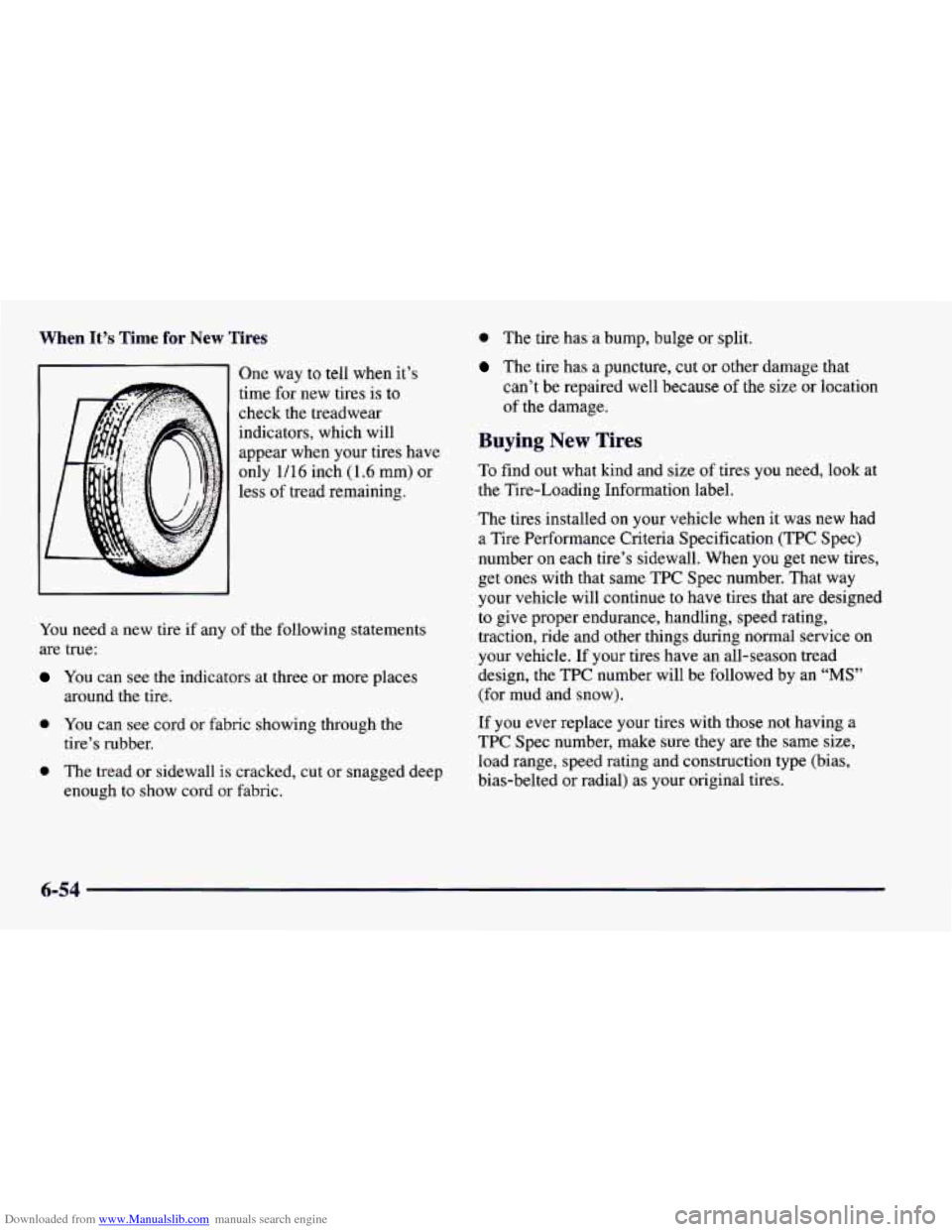
One way to tell when it’s
time
for new tires is to
check the treadwear
indicators, which will
appear when your tires have
only
1/16 inch (1.6 mm) or
less of tread remaining.
You need a new tire if any of the following statements
are true:
You can see the indicators at three or more places
around the tire.
0 You can see cord or fabric showing through the
tire’s rubber.
0 The tread or sidewall is cracked, cut or snagged deep
enough to show cord or fabric.
0 The tire has a bump, bulge or split.
The tire has a puncture, cut or other damage that
can’t be repaired well because
of the size or location
of the damage.
Buying New Tires
To find out what kind and size of tires you need, look at
the Tire-Loading Information label.
The tires installed on your vehicle when it was new had
a Tire Performance Criteria Specification (TPC Spec)
number
on each tire’s sidewall. When you get new tires,
get ones with that same TPC Spec number. That way
your vehicle will continue to have tires that are designed
to give proper endurance, handling, speed rating,
traction, ride and other things during normal service on
your vehicle. If your tires have an all-season tread
design, the TPC number will be followed by an
“MS”
(for mud and snow).
If you ever replace your tires with those not having a
TPC Spec number, make sure they
are the same size,
load range, speed rating and construction type (bias,
bias-belted or radial) as your original tires.
6-54
Page 308 of 404
Downloaded from www.Manualslib.com manuals search engine Cleaning the Top of the Instrument Panel
Use only mild soap and water to clean the top surfaces
of the instrument panel. Sprays containing silicones or
waxes may cause annoying reflections in the windshield
and even make it difficult to
see through the windshield
under certain conditions.
Care of Safety Belts
Keep belts clean and dry.
Do not bleach or dye safety belts. If you do, it
may severely weaken them.
In a crash, they
might not be able
to provide adequate protection.
Clean safety belts only with mild soap and
lukewarm water.
Glass
Glass should be cleaned often. GM Glass Cleaner (GM
Part No. 1050427) or a liquid household glass cleaner
will remove normal tobacco smoke and dust films on
interior glass. Don’t
use abrasive cleaners on glass, because they may
cause scratches. Avoid placing decals
on the inside rear
window, since they may have to be scraped off later. If
abrasive cleaners are used
on the inside of the rear
window, an electric defogger element may be damaged.
Any temporary license should not be attached across the
defogger grid.
Cleaning the Outside of the
Windshield and Wiper Blades
If the windshield is not clear after using the windshield
washer, or if the wiper blade chatters when running,
wax, sap or other material may be
on the blade
or windshield.
Clean the outside of the windshield with GM Windshield
Cleaner, Bon Ami@ Powder (non-scratching glass
cleaning powder),
GM Part No. 10500 1 1. The
windshield is clean if beads do not form when you
rinse it with water.
Grime from the windshield will stick to the wiper blades
and affect their performance. Clean the blade by wiping
vigorously with a cloth soaked in full-strength windshield
washer solvent. Then rinse the blade with water.
Check the wiper blades and clean them as necessary;
replace blades that look worn.
6-62