light CHEVROLET CAMARO 1997 4.G Owners Manual
[x] Cancel search | Manufacturer: CHEVROLET, Model Year: 1997, Model line: CAMARO, Model: CHEVROLET CAMARO 1997 4.GPages: 404, PDF Size: 20.96 MB
Page 10 of 404
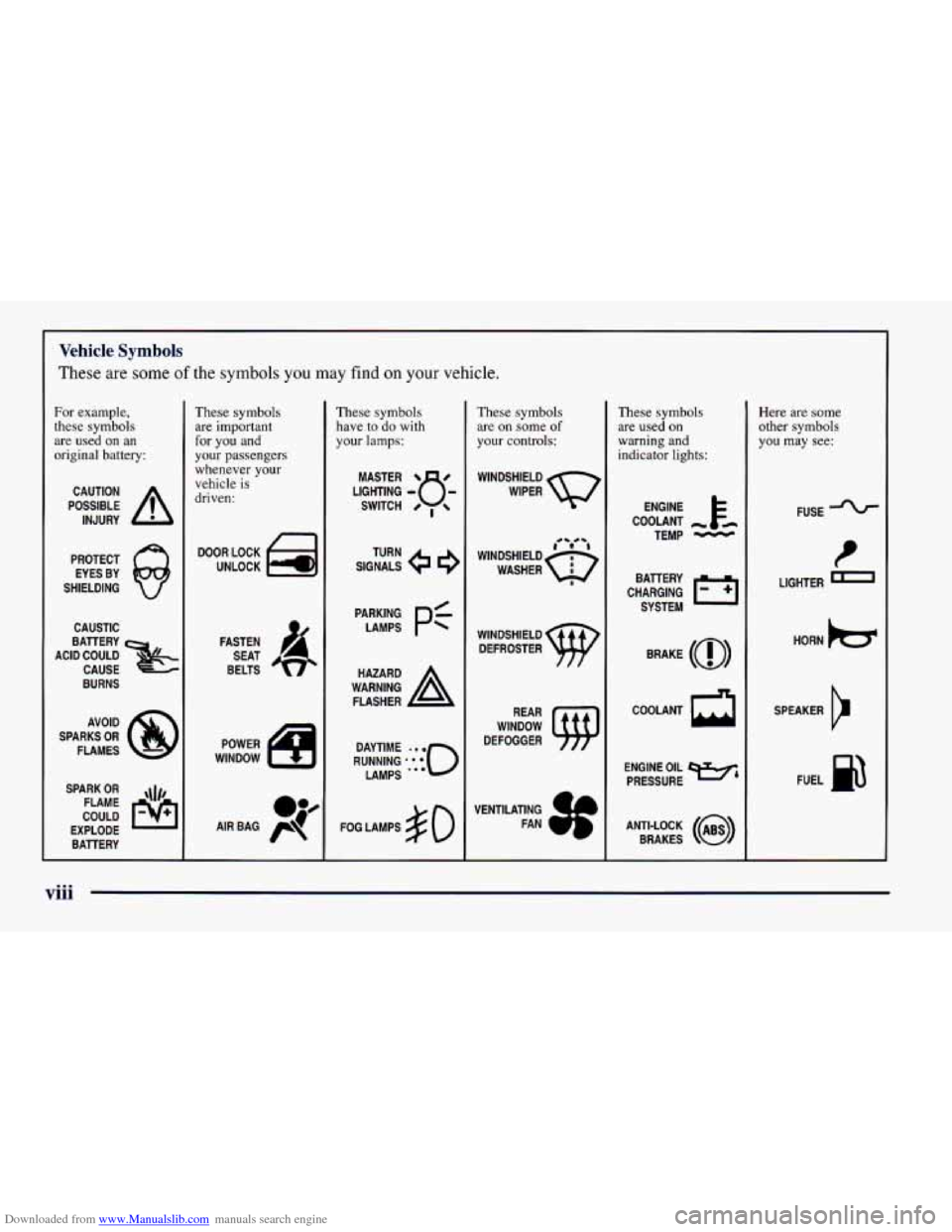
Downloaded from www.Manualslib.com manuals search engine Vehicle Symbols
These are some of the symbols you may find on your vehicle.
For example,
these symbols
are used on an
original battery:
POSSIBLE A
CAUTION
INJURY
PROTECT EYES BY
SHIELDING
CAUSTIC
BURNS AVOID
SPARKS
OR
FLAMES
SPARK
OR ,\I/,
COULD FLAME
EXPLODE BAllERY
These symbols
are important
for you and
your passengers
whenever your
vehicle
is
driven:
DOOR LOCK
UNLOCK
FASTEN SEAT
BELTS
These symbols have to
do with
your
lamps:
SIGNALS e a
TURN
FOG LAMPS
$0
These symbols
are
on some of
your controls:
WINDSHIELD
WIPER
WINDSHIELD DEFROSTER
WINDOW
DEFOGGER
These symbols
are used
on
warning and
indicator lights:
ENGINE t
COOLANT
TEMP
-
CHARGING 1-1
BAllERY
SYSTEM
BRAKE
(@)
COOLANT a
ENGINE OIL w,
PRESSURE
ANTI-LOCK
(a)
BRAKES
Here are some other symbols
you may
see:
FUSE
t
LIGHTER m
HORN k3
SPEAKER
Er
FUEL B
...
Page 17 of 404
Downloaded from www.Manualslib.com manuals search engine In most states and Canadian provinces, the law says to
wear safety belts. Here’s why:
They work.
It is extremely dangerous to ride in a cargo area,
inside or outside of a vehicle. In
a collision,
people riding in these areas are more likely to be
seriously injured or killed.
Do not allow people
to ride in any area of your vehicle that is not
equipped with seats and safety belts. Be sure
everyone in your vehicle is in a seat and using
a
safety belt properly.
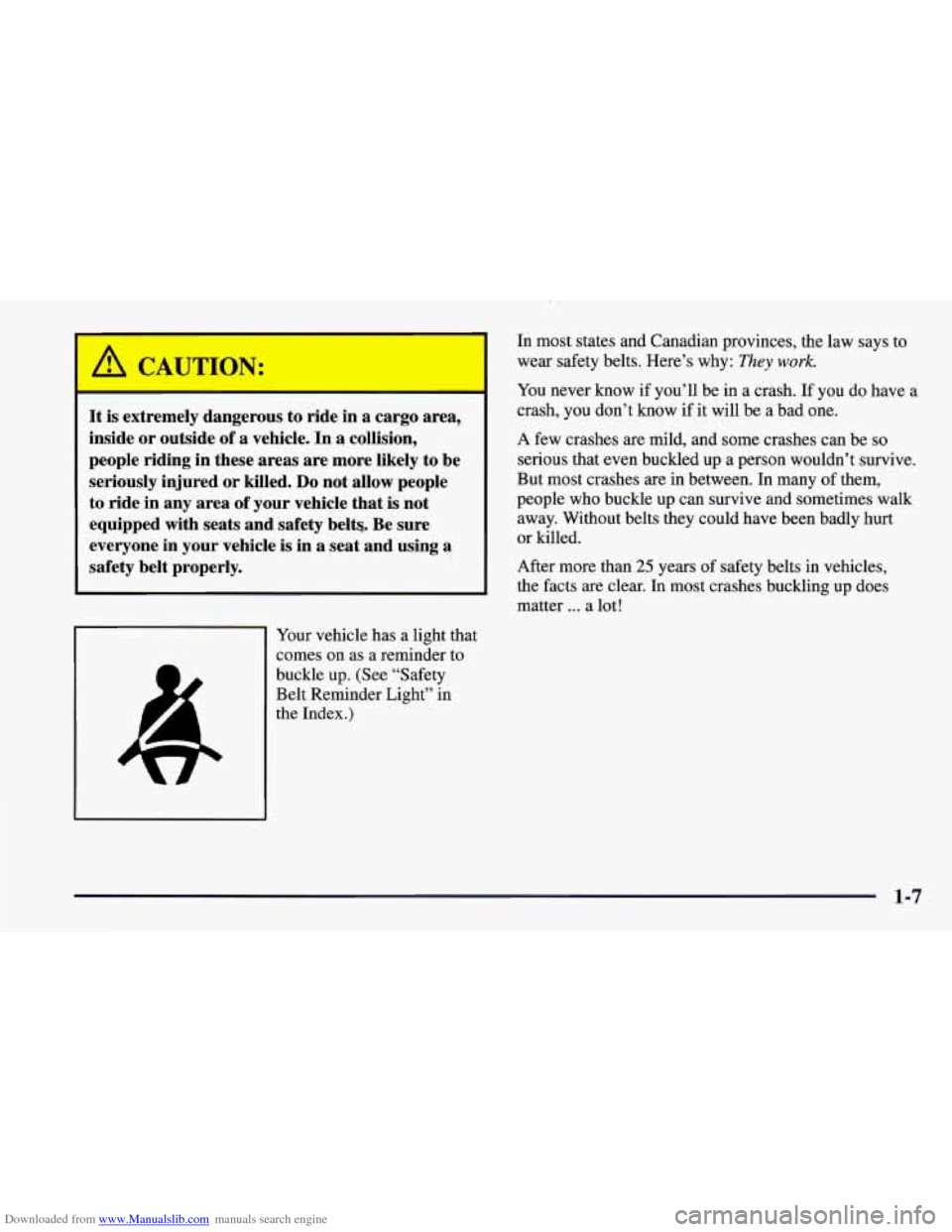
Your vehicle has a light that
comes on as a reminder to
buckle up. (See “Safety
Belt Reminder Light” in
the Index.) You
never know if you’ll be in a crash. If you do have a
crash, you don’t know if it will be a bad one.
A few crashes are mild, and some crashes can be so
serious that even buckled up a person wouldn’t survive.
But most crashes are in between. In many of them,
people who buckle up can survive and sometimes walk
away. Without belts they could have been badly hurt
or killed.
After more than
25 years of safety belts in vehicles,
the facts are clear. In most crashes buckling up does
matter
... a lot!
1-7
Page 23 of 404
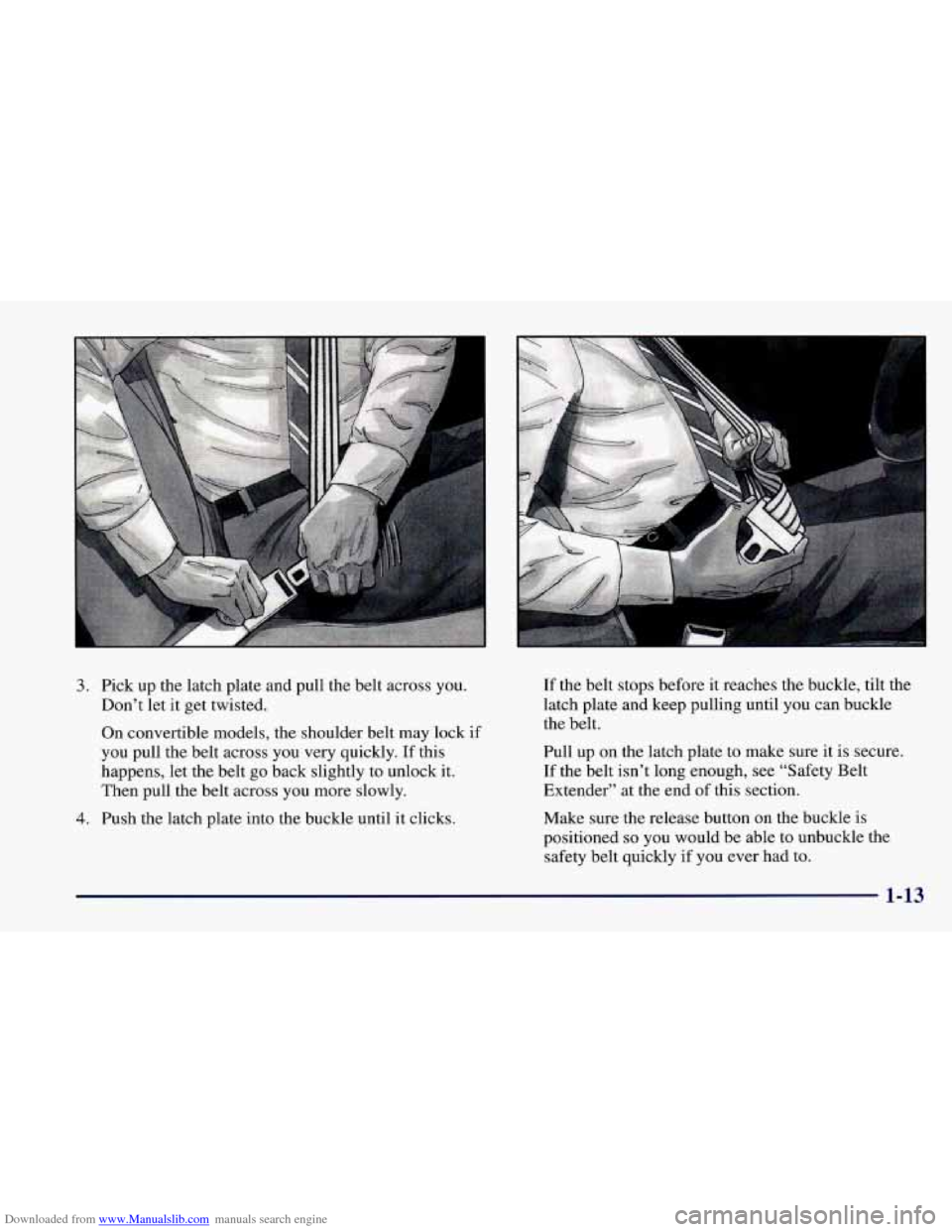
Downloaded from www.Manualslib.com manuals search engine 3. Pick up the latch plate and pull the belt across you.
Don’t let it get twisted.
On convertible models, the shoulder belt may lock if
you pull the belt across you very quickly. If this
happens, let the belt
go back slightly to unlock it.
Then pull the belt across you more slowly.
4. Push the latch plate into the buckle until it clicks. If
the belt stops before it reaches the buckle, tilt
the
latch plate and keep pulling until you can buckle
the belt.
Pull up on the latch plate to make sure it is secure.
If the belt isn’t
long enough, see “Safety Belt
Extender” at the end
of this section.
Make sure the release button on the buckle is
positioned
so you would be able to unbuckle the
safety belt quickly if you ever had to.
1-13
Page 31 of 404
Downloaded from www.Manualslib.com manuals search engine A CAUTION:
Air bags inflate with great force, faster than the
blink
of an eye. If you’re too close to an inflating
air bag, it could seriously injure you. Safety belts
help keep you in position before and during a
crash. Always wear your safety belt, even with air
bags. The driver should sit
as far back as possible
while still maintaining control of the vehicle.
A CAUTION:
An inflating air bag can seriously injure small
children. Always secure children properly in your
vehicle.
To read how, see the part of this manual
called “Children” and the caution label on the
right front passenger’s safety belt.
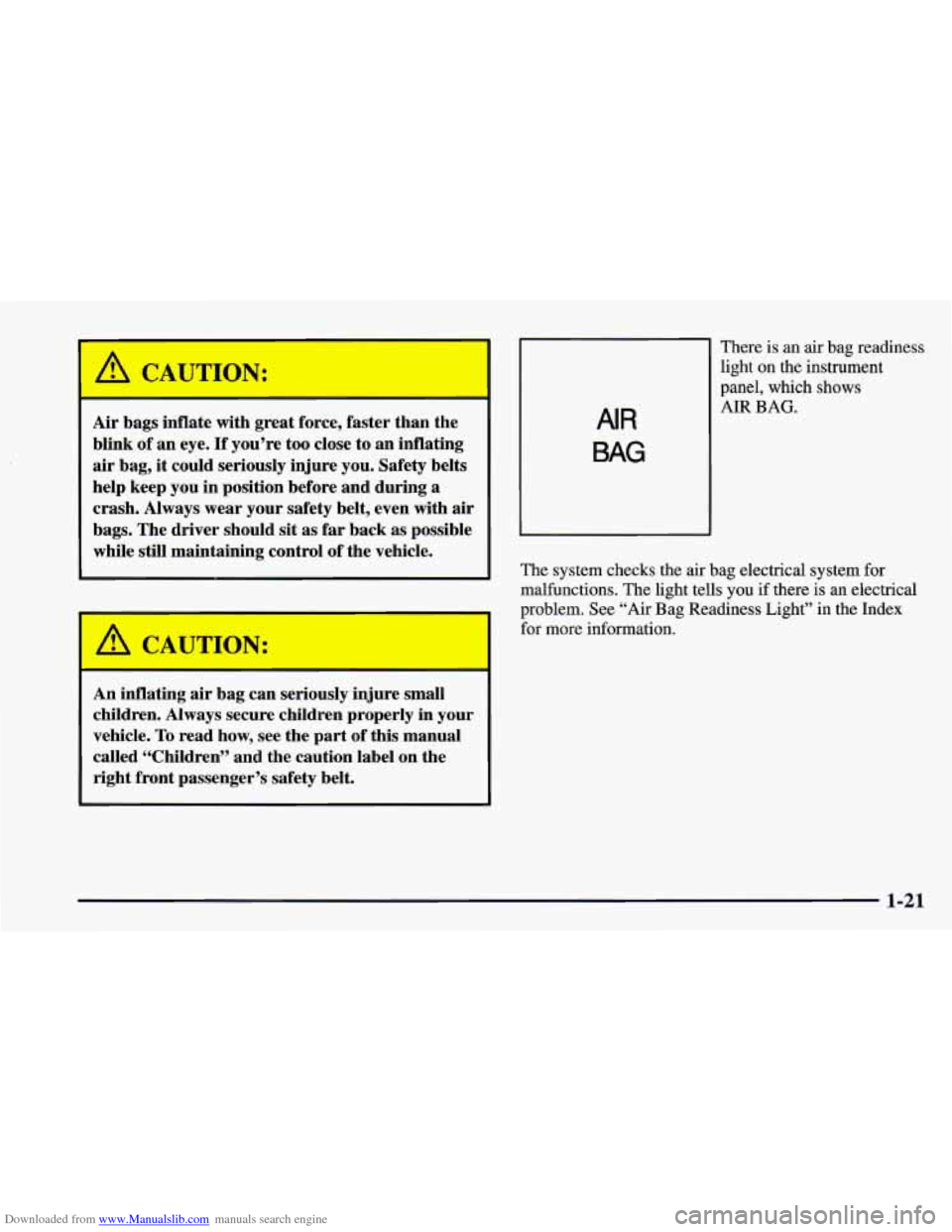
AIR
BAG
There is an air bag readiness
light on the instrument
panel, which shows
AIR BAG.
The system checks the air bag electrical system for
malfunctions. The light tells
you if there is an electrical
problem. See “Air Bag Readiness Light” in the Index
for more information.
1-21
Page 36 of 404
Downloaded from www.Manualslib.com manuals search engine Rear Seat Passengers
It’s very important for rear seat passengers to buckle up!
Accident statistics show that unbelted people in the rear
seat are hurt more often in crashes than those who are
wearing safety belts.
Rear passengers who aren’t safety belted can be thrown
out of the vehicle in a crash. And they can strike others
in the vehicle who are wearing safety belts.
I
Lap-Shoulder Belt
The rear seats have lap-shoulder belts. Here’s how to
wear one properly.
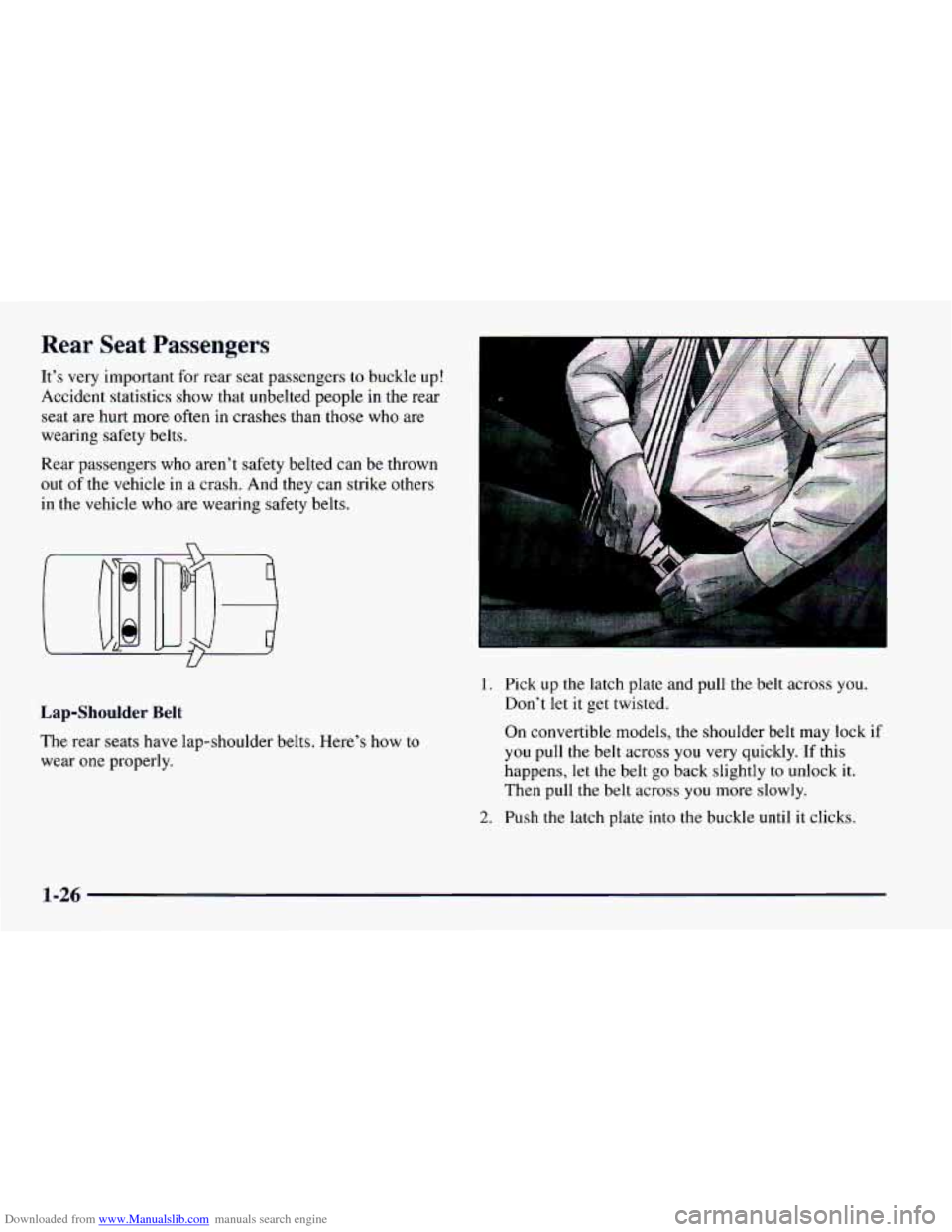
1. Pick up the latch plate and pull the belt across you.
Don’t let
it get twisted.
On convertible models, the shoulder belt may lock if
you pull
the belt across you very quickly. If this
happens, let the belt go back slightly to unlock it.
Then pull the belt across
you more slowly.
2. Push the latch plate into the buckle until it clicks.
1-26
Page 50 of 404
Downloaded from www.Manualslib.com manuals search engine Safety Belt Extender
If the vehicle’s safety belt will fasten around you, you
should
use it.
But if a safety belt isn’t long enough to fasten, your
dealer will order you an extender. It’s free. When you go
in to order it, take the heaviest coat you will wear,
so the
extender will be
long enough for you. The extender will
be just for you, and just
for the seat in your vehicle that
you choose. Don’t let someone else use it, and use it
only
for the seat it is made to fit. To wear it, just attach it
to the regular safety belt.
Checking Your Restraint Systems
Now and then, make sure the safety belt reminder light
and all your belts, buckles, latch plates, retractors and
anchorages are working properly. Look for any other
loose or damaged safety belt system parts.
If you see
anything that might keep a safety belt system from
doing its job, have it repaired.
Torn or frayed safety belts may not protect you in a
crash. They can rip apart under impact forces.
If a belt is
torn or frayed, get a new one right away.
Replacing Restraint System Parts
After a Crash
If you’ve had a crash, do you need new belts?
After a very minor collision, nothing may be necessary.
But if the belts were stretched, as they would be if worn
during a more severe crash, then you need new belts.
If belts are cut or damaged, replace them. Collision
damage also may mean
you will need to have safety belt
or seat parts repaired or replaced. New
parts and repairs
may be necessary even if the belt wasn’t being used at
the time of the collision.
If an air bag inflates, you’ll need to replace air bag
system parts. See the part on the air bag system earlier in
this section.
Also look for any opened or broken air bag covers, and
have them repaired or replaced. (The air bag system
does not need regular maintenance.)
Page 51 of 404
Downloaded from www.Manualslib.com manuals search engine a Section 2 Features and Controls
Here you can learn about the many standard and optional features on your Chevrolet, and information on starting,
shifting and braking. Also explained are the instrument panel and the warning systems that tell you
if everything is
working properly
-- and what to do if you have a problem.
2-2
2-4 2-7
2-1
1
2-13 2- 14
2-17
2-18
2-23
2- 24
2-26
2-27
2-29
2-32 Keys
Door Locks
Remote Keyless Entry
Hatch
Theft Vehicle and Content Theft-DeterrentIAlarm
System
PASS-Key@
I1
Feature Customization
New Vehicle “Break-In”
Ignition Positions
Starting Your Engine
Engine Coolant Heater
Automatic Transmission Operation
Manual Transmission
2-3 8
2-42
2-42
2-44
2-44
2-45
2-5 2
2-56
2-5
8
2-60
2-6
1
2-6 1
2-68
2-74
2-77 Parking Brake
Parking Over Things That Burn
Engine Exhaust
Windows
Tilt Steering Wheel
Turn Signalhlultifunction Lever
Lamps
Mirrors Storage Compartments
Ashtray and Lighter
Sun Visors
Accessory Plug
Convertible Top
Instrument Panel
Warning Lights, Gages and Indicators
2-1
Page 63 of 404
Downloaded from www.Manualslib.com manuals search engine When you park your Chevrolet and open the driver’s
key from the ignition and take it with you. Always do
NOTICE: door, you’ll hear a chime reminding you to remove your
If you put things in the hatchback area, be sure
they won’t break the glass when you close it.
Never
slam the hatch down. You could break the
glass or damage the defogger grid (if equipped).
this. Your steering wheel will be locked, and so will
your ignition. If you have an automatic transmission,
taking your
key out also locks your transmission. And
remember
to lock the doors.
I I Parking at Night
On vehicles with the Vehicle and Content
Theft-DeterrenUAlarm System: The hatch switch will
not work while the system
is armed. See “Vehicle and
Content Theft-DeterrendAlarm System” in the Index.
Theft
Vehicle theft is big business, especially in some cities.
Although your Chevrolet
has a number of theft-deterrent
features, we know that nothing we put
on it can make it
impossible
to steal. However, there are ways you can help.
Key in the Ignition
If you leave your vehicle with the keys inside, it’s an
easy target for
joy riders or professional thieves -- so
don’t do it. Park
in a lighted spot, close all windows and lock your
vehicle. Remember to keep your valuables
out of sight.
Put them in a storage area, or take them with
you.
Parking Lots
If you park in a lot where someone will be watching
your vehicle, it’s best to lock
it up and take your keys.
But what if you have to leave your ignition key? What
if
you have to leave something valuable in your vehicle?
0 Put your valuables in a storage area, like your trunk
or glove box.
0 Lock the glove box.
@ Lock all the doors except the driver’s.
Then take the
door key with you.
2-13
Page 65 of 404
Downloaded from www.Manualslib.com manuals search engine Arming the System Remote Keyless Entry Transmitter Locking
Passive arming is also available, if you would like the
system to arm all by itself after the doors have been
closed for a short time. When the system is armed, a red
light will flash briefly once every two seconds. (Note:
If
you return to your vehicle and the red light is flashing
two brief flashes every two seconds, the system is armed
and the shock sensor had triggered a two minute alarm.
If the red light is flashing three times every two seconds,
the system is armed and there was an intrusion that
sounded the alarm). Horn chirps and parking lamp
flashes can be set to your choice.
If all the doors are closed, locking the vehicle with
the transmitter will immediately arm the system. The
horn will chirp twice and the parking lamps will flash,
confirming that the system is armed.
If any door is open
when the transmitter
LOCK button is pressed, the
system goes into an armed wait mode, waiting for the
doors to close. Once they are closed, the system will
arm, chirp the horn twice and flash the parking lamps.
If the hatch is open or ajar at the time the system is
arming, the horn will only chirp once.
Power Door Lock Switch Locking
If any door is open when the power door lock switch
is pressed, the system goes into an armed wait mode,
waiting for the doors to close. Once they are closed, the
system will arm and flash the parking lamps.
If all of the
doors are closed when the lock switch is pressed, the
system assumes
you are inside the vehicle, so it will not
arm. Note: Locking the doors by using the manual door
locks will not arm the system.
2-15
Page 67 of 404
Downloaded from www.Manualslib.com manuals search engine PASS-Key@ I1
Your vehicle is equipped
with the PASS-Key I1
(Personalized Automotive
Security System)
theft-deterrent system.
PASS-Key
I1 is a passive
theft-deterrent system. It works when you insert
or remove the key from
the ignition.
PASS-Key 11 uses a resistor pellet in the ignition key
that matches a decoder in your vehicle.
When the PASS-Key I1 system senses that someone is
using the wrong key, it shuts down the vehicle’s starter
and fuel systems. For about three minutes, the starter
won’t work and fuel won’t
go to the engine. If someone
tries
to start your vehicle again or uses another key
during this time, the vehicle will not start. This
discourages someone from randomly trying different
keys with different resistor pellets in an attempt to make
a match. The
ignition key must be clean and dry before it’s
inserted in the ignition
or the engine may not start. If the
engine does not start and the SECURITY light stays on
when
you try to start the vehicle, the key may be dirty or
wet. Turn the ignition
off.
Clean and dry the key. Wait about three minutes and try
again. The SECURITY light may remain
on during this
time.
If the starter still won’t work, and the key appears
to be clean and dry, wait about three minutes and try
another ignition key. At this time,
you may also want to
check the fuses
(see “Fuses and Circuit Breakers” in the
Index). If the starter won’t work with the other key, your
vehicle needs service. If your vehicle does start, the first
ignition key may be faulty. See your Chevrolet dealer or
a locksmith who can service the PASS-Key 11.
If
you accidentally use a key that has a damaged or
missing resistor pellet, the starter won’t work, and
the
SECURITY light will flash. But you don’t have to wait
three minutes before trying another ignition key.
See your Chevrolet dealer or a locksmith who can
service the PASS-Key
I1 to have a new key made.
2-17