ignition CHEVROLET CAMARO 1998 4.G Owner's Manual
[x] Cancel search | Manufacturer: CHEVROLET, Model Year: 1998, Model line: CAMARO, Model: CHEVROLET CAMARO 1998 4.GPages: 402, PDF Size: 21.2 MB
Page 99 of 402
Downloaded from www.Manualslib.com manuals search engine Ensure the shift lever is fully in PARK (P) before starting
the engine. Your vehicle has a Brake-Transmission Shift
Interlock (BTSI). You have to fully apply your regular
brakes before you can shift from PARK (P) when the
ignition key
is in RUN. If you cannot shift out of
PARK (P), ease pressure on the shift lever--push the
shift lever all the way into PARK
(P) and also release the
shift lever button on floor shift console models as you
maintain brake application. Then move the shift lever
into the gear you wish. (Press the shift lever button before \
moving the
shift lever on floor shift console models.)
See “Shifting Out
of PARK (P)” in this section.
REVERSE (R): Use this gear to back up.
NOTICE:
Shifting to REVERSE (R) while your vehicle
is moving forward could damage your
transmission. Shift to REVERSE
(R) only
after your vehicle is stopped.
To rock your vehicle back and forth to get out of snow,
ice or sand without damaging your transmission, see
“Stuck: In Sand, Mud, Ice or Snow” in the Index.
NEUTRAL (N): In this position, your engine doesn’t
connect with the wheels.
To restart when you’re
already moving, use NEUTRAL
(N) only. Also, use
NEUTRAL
(N) when your vehicle is being towed.
Shifting out of PARK (P) or NEUTRAL (N) while
your engine
is “racing” (running at high speed) is
dangerous. Unless your foot
is firmly on the
brake pedal, your vehicle could move very
rapidly. You could lose control and hit people or
objects. Don’t shift out of PARK (P) or
NEUTRAL
(N) while your engine is racing.
NOTICE:
Damage to your transmission caused by shifting
out of PARK
(P) or NEUTRAL (N) with the
engine racing isn’t covered by your warranty.
2-31
Page 103 of 402
Downloaded from www.Manualslib.com manuals search engine 6-Speed
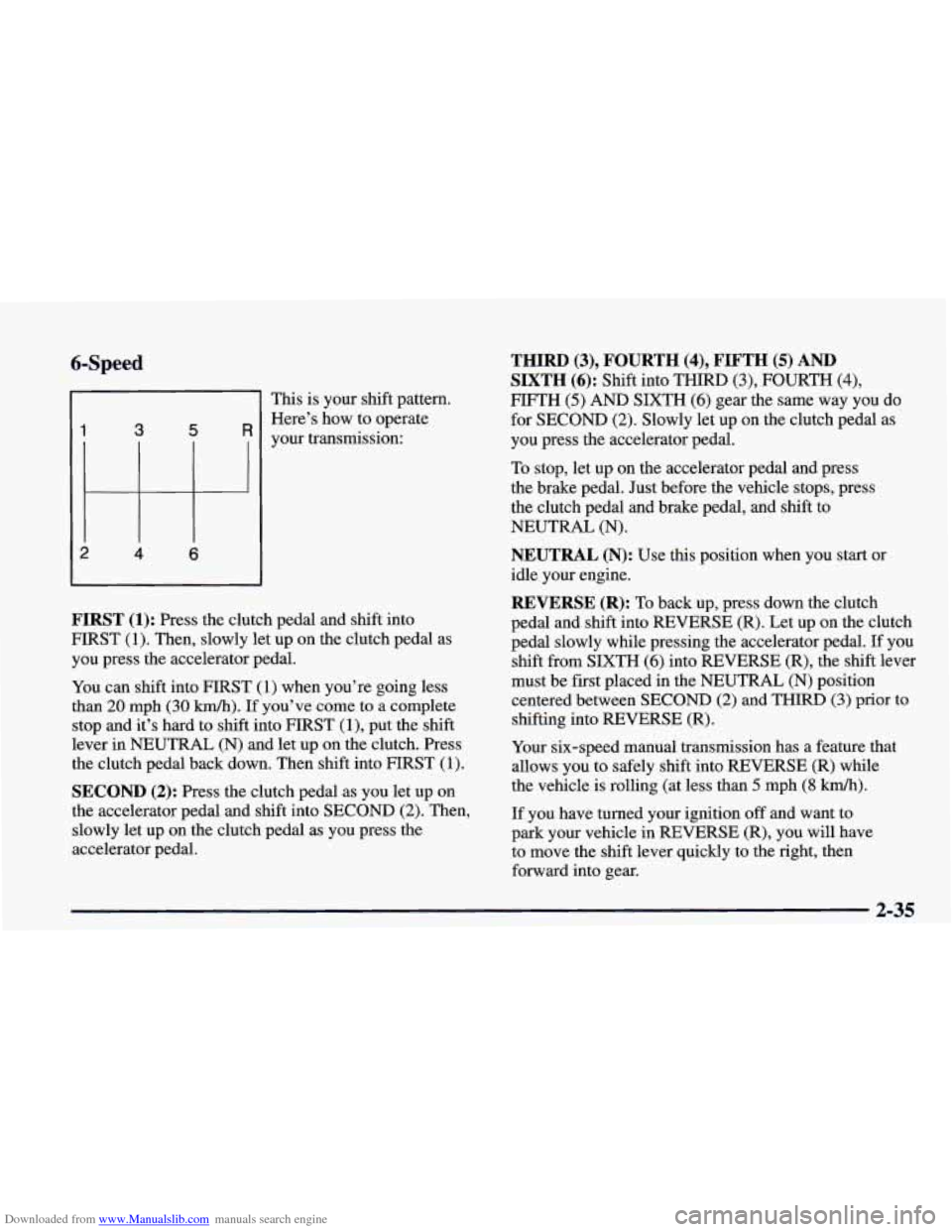
1 3 5 R
2 4 6
This is your shift pattern.
Here’s how to operate
your transmission:
FIRST (1): Press the clutch pedal and shift into
FIRST
(1). Then, slowly let up on the clutch pedal as
you press the accelerator pedal.
You can shift into FIRST
(1) when you’re going less
than
20 mph (30 km/h). If you’ve come to a complete
stop and it’s hard to shift into FIRST
(l), put the shift
lever in NEUTRAL (N) and let up on the clutch. Press
the clutch pedal back down. Then shift into FIRST
(1).
SECOND (2): Press the clutch pedal as you let up on
the accelerator pedal and shift into SECOND
(2). Then,
slowly
let up on the clutch pedal as you press the
accelerator pedal.
THIRD(3),FOURTH(4),FIFTH(5)AND
SIXTH (6): Shift into THIRD (3), FOURTH (4),
FIFTH (5) AND SIXTH (6) gear the same way you do
for SECOND
(2). Slowly let up on the clutch pedal as
you press the accelerator pedal.
To stop, let up on the accelerator pedal and press
the brake pedal. Just before the vehicle stops, press
the clutch pedal and brake pedal, and shift to
NEUTRAL (N).
NEUTRAL (N): Use this position when you start or
idle your engine.
REVERSE (R): To back up, press down the clutch
pedal and shift into REVERSE (R). Let up on the clutch
pedal slowly while pressing the accelerator pedal.
If you
shift from SIXTH
(6) into REVERSE (R), the shift levex
must be first placed in the NEUTRAL (N) position
centered between
SECOND (2) and THIRD (3) prior to
shifting into REVERSE (R).
Your six-speed manual transmission has a feature that
allows you to safely shift into REVERSE (R) while
the vehicle is rolling (at less than
5 mph (8 km/h).
If you have turned your ignition off and want to
park your vehicle
in REVERSE (R), you will have
to move the shift lever quickly to the right, then
forward into gear.
2-35
Page 105 of 402
Downloaded from www.Manualslib.com manuals search engine This light will come on under these conditions:
0 The engine coolant temperature is greater than
170°F (77"C),
You are going 15 to 20 mph (24 to 32 km/h) and
You are at 35 percent throttle or less.
When this light is on, the gearshift lever will let you
shift from FIRST (1) to FOURTH (4) only. Once you
are in FOURTH (4), you can press the clutch again
and shift into another gear.
Follow the shift speeds on this chart when the
SKIP
SHIFT light is on.
Computer Aided Manual Transmission Shift Speeds:
1st to 4th 15 mph (24 kdh)
4th to 5th 25 mph (40 km/h)*
5th to 6th 49 mph (64 km/h)**
Each time you come
to a stop, the engine's Powertrain
Control Module (PCM) determines when to activate the
SKIP SHIFT upshift system. Use SECOND (2) gear
only when you accelerate very quickly from a stop.
You can then follow the full gear shift pattern.
"30 mph (48 km/h) when accelerating to highway speeds.
""45 mph (72 kmk) when accelerating to highway speeds.
Parking Brake
To set the parking brake, hold the brake pedal down and
pull up
on the parking brake lever. If the ignition is on,
the brake system warning light will come on.
2-37
Page 107 of 402
Downloaded from www.Manualslib.com manuals search engine Shifting Into PARK (P)
(Automatic Transmission Only)
A CAUTION:
It can be dangerous to get out of your vehicle if
the shift lever is not fully in PARK (P) with the
parking brake firmly set. Your vehicle can roll.
If
you have left the engine running, the vehicle can
move suddenly. You or others could be injured.
To be sure your vehicle won’t move, even when
you’re on fairly level ground, use the steps that
follow.
If you’re pulling a trailer, see “Towing a
Trailer” in the Index.
., .,. ..
..
1.
2.
3.
4.
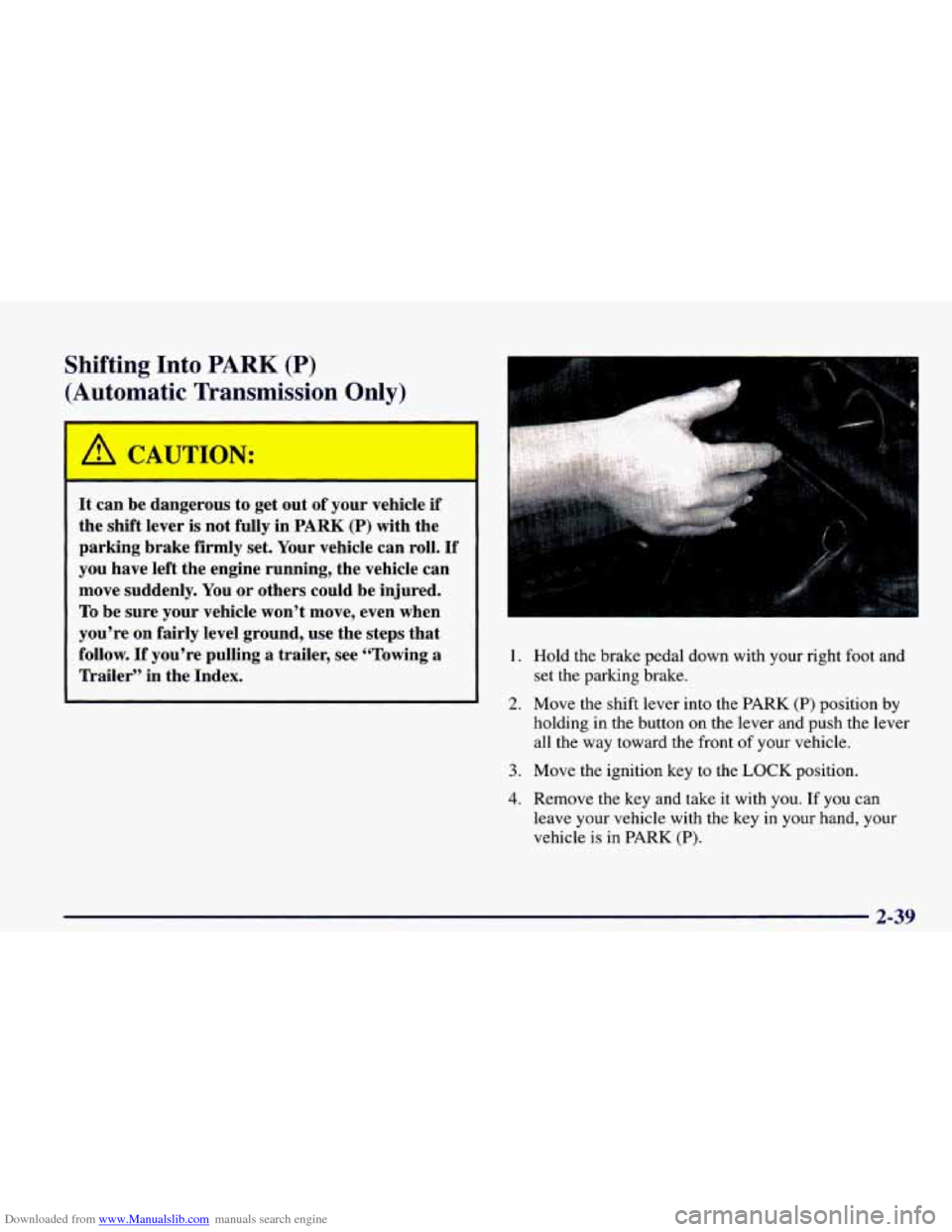
Hold the brake pedal down with your right foot and
set the parking brake.
Move the shift lever into the PARK
(P) position by
holding in the button on the lever and push the lever
all the way toward the front
of your vehicle.
Move the ignition key to the
LOCK position.
Remove the key and take it with you.
If you can
leave your vehicle with the key in your hand, your
vehicle
is in PARK (P).
2-39
Page 111 of 402
Downloaded from www.Manualslib.com manuals search engine Limited-Slip Rear Axle
If you have this feature, your limited-slip rear axle can
give you additional traction on snow, mud, ice, sand or
gravel. It works like a standard axle most of the time,
but when one of the rear wheels has no traction and the
other does, this feature will allow the wheel with
traction to move the vehicle.
Parking Your Vehicle (Manual
Transmission)
Before you get out of your vehicle, put your manual
transmission in REVERSE (R) and firmly apply the
parking brake.
If your vehicle is equipped to tow a trailer, see
“Towing a Trailer” in the Index.
Shifting Out of PARK (P)
(Automatic Transmission)
Your Chevrolet has a Brake-Transmission Shift
Interlock (BTSI). You have to fully apply your regular
brake before you can shift from PARK
(P) when the
ignition
is in the RUN position. See “Automatic
Transmission Operation’’ in the Index. If you cannot shift
out of PARK
(P), ease pressure on
the shift lever
-- push the shift lever all the way into
PARK
(P) and release the shift lever button as you
maintain brake application. Then press the shift lever
button and move the shift lever into the gear you wish.
If
you ever hold the brake pedal down but still can’t
shift out of PARK
(P), try this:
1. Turn the ignition key to OFF.
2. Apply and hold the brake.
3. Shift to NEUTRAL (N).
4. Start the engine and then shift to the drive gear you
want.
5. Have the vehicle fixed as soon as you can.
Windows
Manual Windows
Rotate the window crank handle to open and close each
door window.
2-43
Page 112 of 402
Downloaded from www.Manualslib.com manuals search engine Power Windows
Switches on the driver’s door control each window
when the ignition is on or when RAP is present. (See
“Retained Accessory Power” in the Index.)
You can open the passenger’s window any amount by
pressing the switch and releasing it when the window
has lowered to the position you want.
The driver’s window has an auto-down feature. This
switch is labeled AUTO. Tap the bottom
of the switch
and the driver’s window will open a small amount.
If the
lower part
of the switch is pressed all the way down and
released, the window will go all the way down.
To stop the window while it is lowering, press the top
of the switch. To raise the window, press and hold the
top of the switch.
Horn
To sound the horn, press either horn symbol on your
steering wheel.
If your
horn sounds two or three chirps when unlocking
your vehicle with the keyless entry transmitter (if
you
have that option), the alarm was triggered while you
were away. Check the vehicle before entering.
Tilt Steering Wheel
A tilt steering wheel allows you to adjust the steering
wheel before you drive.
You can also raise it to the highest level to give your
legs more room when
you exit and enter the vehicle.
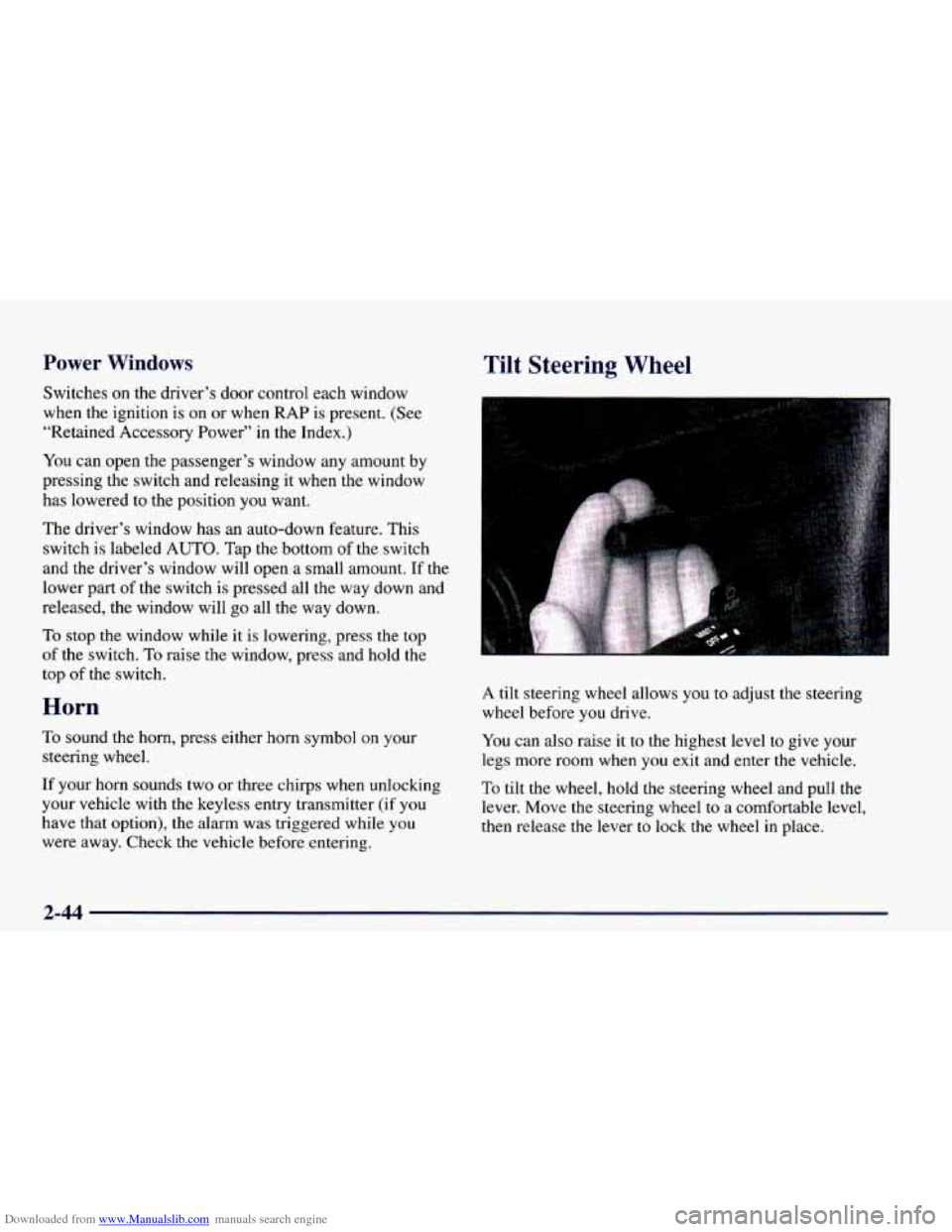
To tilt the wheel, hold the steering wheel and pull the
lever. Move the steering wheel to a comfortable level,
then release
the lever to lock the wheel in place.
2-44
Page 118 of 402
Downloaded from www.Manualslib.com manuals search engine Ending Out of Cruise Control
There are several ways to turn off the cruise control:
Step lightly on the brake pedal or push the clutch
pedal, if you have a manual transmission; or
Move the cruise switch to OFF.
Erasing Speed Memory
When you turn off the cruise control or the ignition,
your cruise control set speed memory is erased.
Exterior Lamps
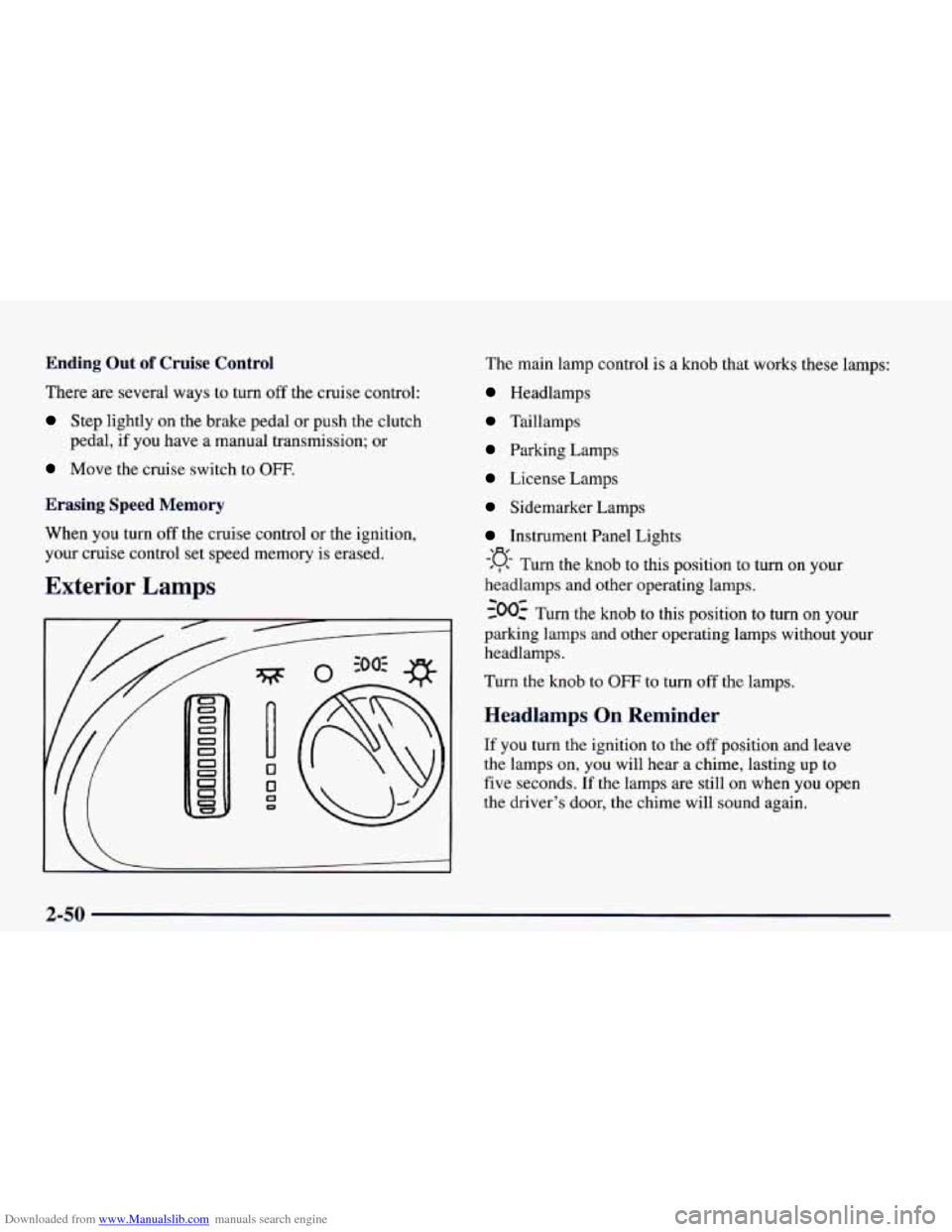
The main lamp control is a knob that works these lamps:
Headlamps
Taillamps
Parking Lamps
License Lamps
Sidemarker Lamps
Instrument Panel Lights
#, Turn the knob to this position to turn on your
headlamps and other operating lamps.
-300: Turn the knob to this position to turn on your
parking lamps and other operating lamps without
your
headlamps.
Turn the knob to OFF to turn
off the lamps.
-‘a-
Headlamps On Reminder
If you turn the ignition to the off position and leave
the lamps on, you will hear a chime, lasting up
to
five seconds. If the lamps are still on when you open
the driver’s door, the chime will sound again.
2-50
Page 119 of 402
Downloaded from www.Manualslib.com manuals search engine Daytime Running Lamps
Daytime Running Lamps (DRL) can make it easier
for others to see the front of your vehicle during the
day. DRL can be helpful
in many different driving
conditions, but they can be especially helpful in the
short periods after dawn and before sunset.
A light sensor on top of the instrument panel
automatically turns the headlamps
on, so be sure
it isn’t covered.
The
DRL system will make your front turn signal
lamps come on when:
The ignition is on,
0 The headlamp switch is off and
0 The parking brake is released.
When
the DRL are on, only your front turn signal lamps
will be on. The taillamps, sidemarker and other lamps
won’t be on. Your instrument panel won’t be lit up
either. When you
use your turn signals, the front turn
signal and the taillamp of the desired side will flash.
When it’s dark enough outside, your front turn signal
lamps will go out and your headlamps will come on.
The other lamps will also come on. When it’s
bright enough outside, the regular lamps will
go
off, and your front turn signal lamps will come on.
As with any vehicle, you should turn on the regular
headlamp system
when you need it.
Fog Lamps (If Equipped)
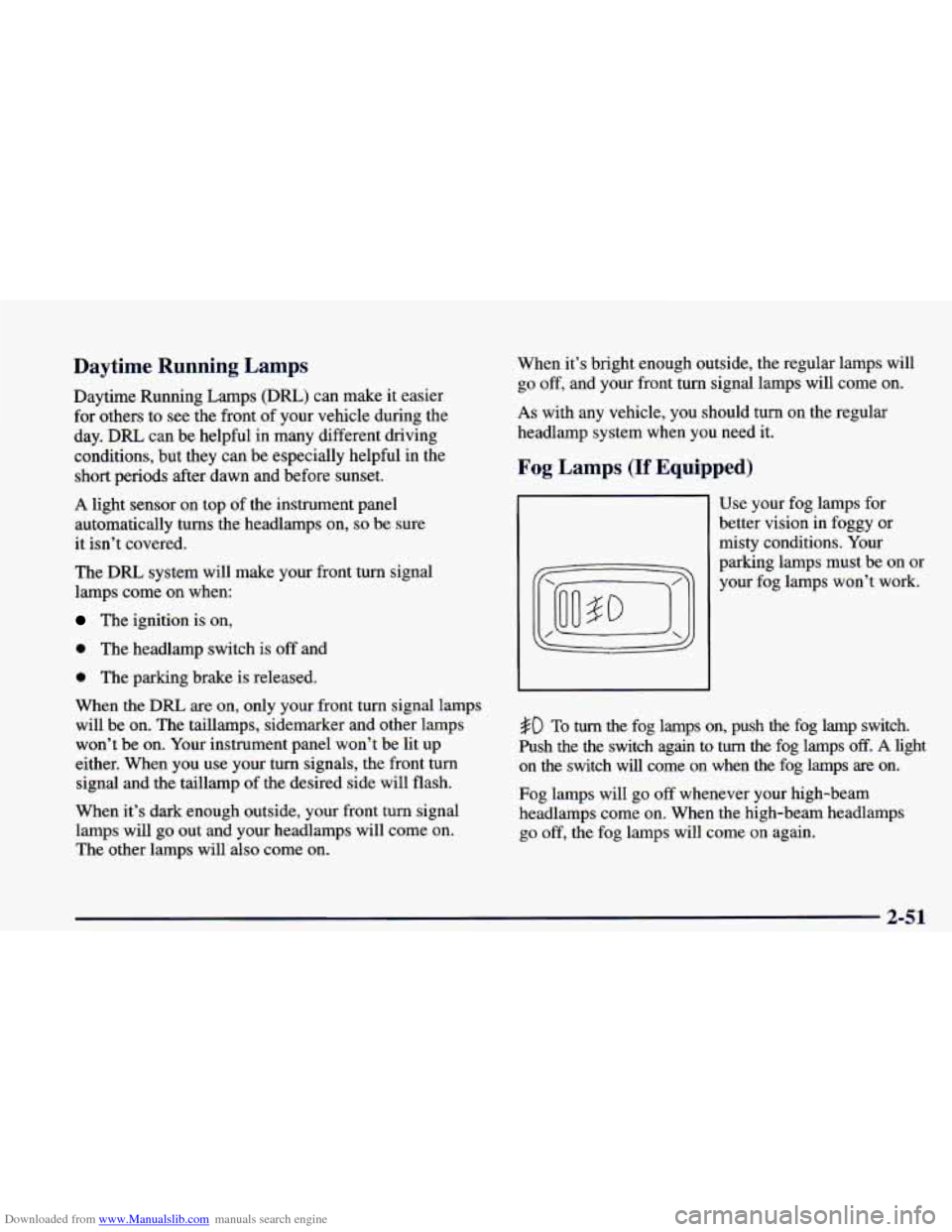
Use your fog lamps for
better vision in foggy or
misty conditions. Your
parking lamps must be on or
your fog lamps won’t work.
#D To turn the fog lamps on, push the fog lamp switch.
Push the the switch again to
turn the fog lamps off. A light
on the switch will come on when the fog lamps are on.
Fog lamps will go
off whenever your high-beam
headlamps come on. When the high-beam headlamps
go off, the fog lamps will come on again.
2-51
Page 120 of 402
Downloaded from www.Manualslib.com manuals search engine If your vehicle is equipped with the Vehicle and
Content Theft-DetenentlAlarm System and your fog
lamp switch
is on, the fog lamps may flash, along
with the parking lamps, to indicate operation
of the
Vehicle and Content Theft-DetemenVAlarm System.
See ‘Vehicle and Content Theft-DeterrendAlarm
System” in the Index.
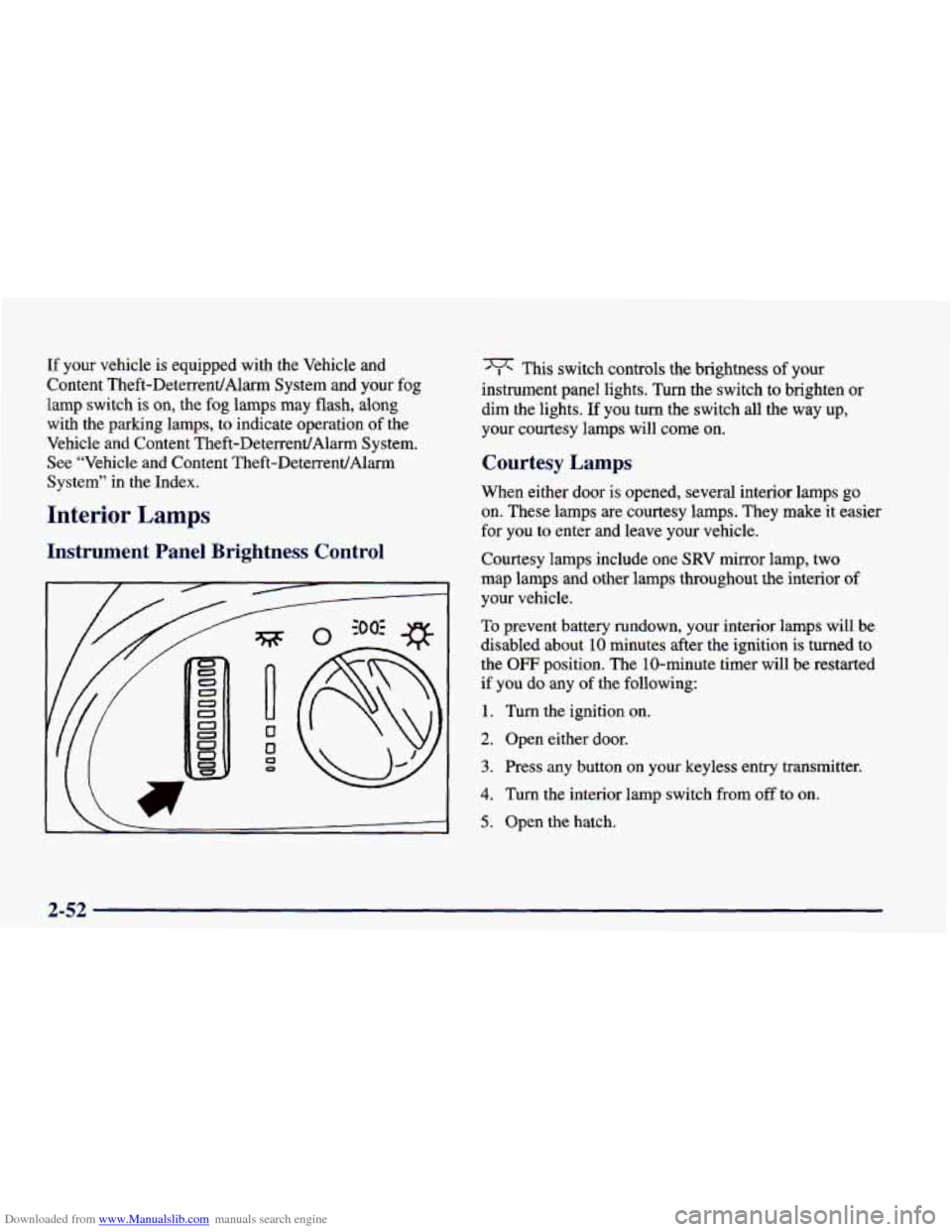
Interior Lamps
Instrument Panel Brightness Control
This switch controls the brightness of your
instrument panel lights. Turn the switch to brighten or
dim the lights.
If you turn the switch all the way up,
your courtesy lamps will come
on.
Courtesy Lamps
When either door is opened, several interior lamps go
on. These lamps are courtesy lamps. They make it easier
for you to enter and leave your vehicle.
Courtesy lamps include one
SRV mirror lamp, two
map lamps and other lamps throughout the interior of
your vehicle.
To prevent battery rundown, your interior lamps will be
disabled about
10 minutes after the ignition is turned to
the OFF position. The 10-minute timer will be restarted
if you do
any of the following:
1. Turn the ignition on.
2. Open either door.
3. Press any button on your keyless entry transmitter.
4. Turn the interior lamp switch from off to on.
5. Open the hatch.
2-52
Page 121 of 402
Downloaded from www.Manualslib.com manuals search engine Delayed Illumination
With delayed illumination, the courtesy lamps will come
on and stay on for
25 seconds after you close the doors
when entering the vehicle. They will also stay on for
five seconds after you close the doors when exiting the
vehicle. The times will be shortened if the ignition is
turned to
RUN or if the power locks are activated. To
turn this feature on or off, see “Feature Custornization”
in the Index.
Exit Lighting
With exit lighting, the interior lamps will come on when
you remove the key from the ignition to help you see
while exiting the vehicle.
To turn this feature on or off,
see “Feature Customization” in the Index.
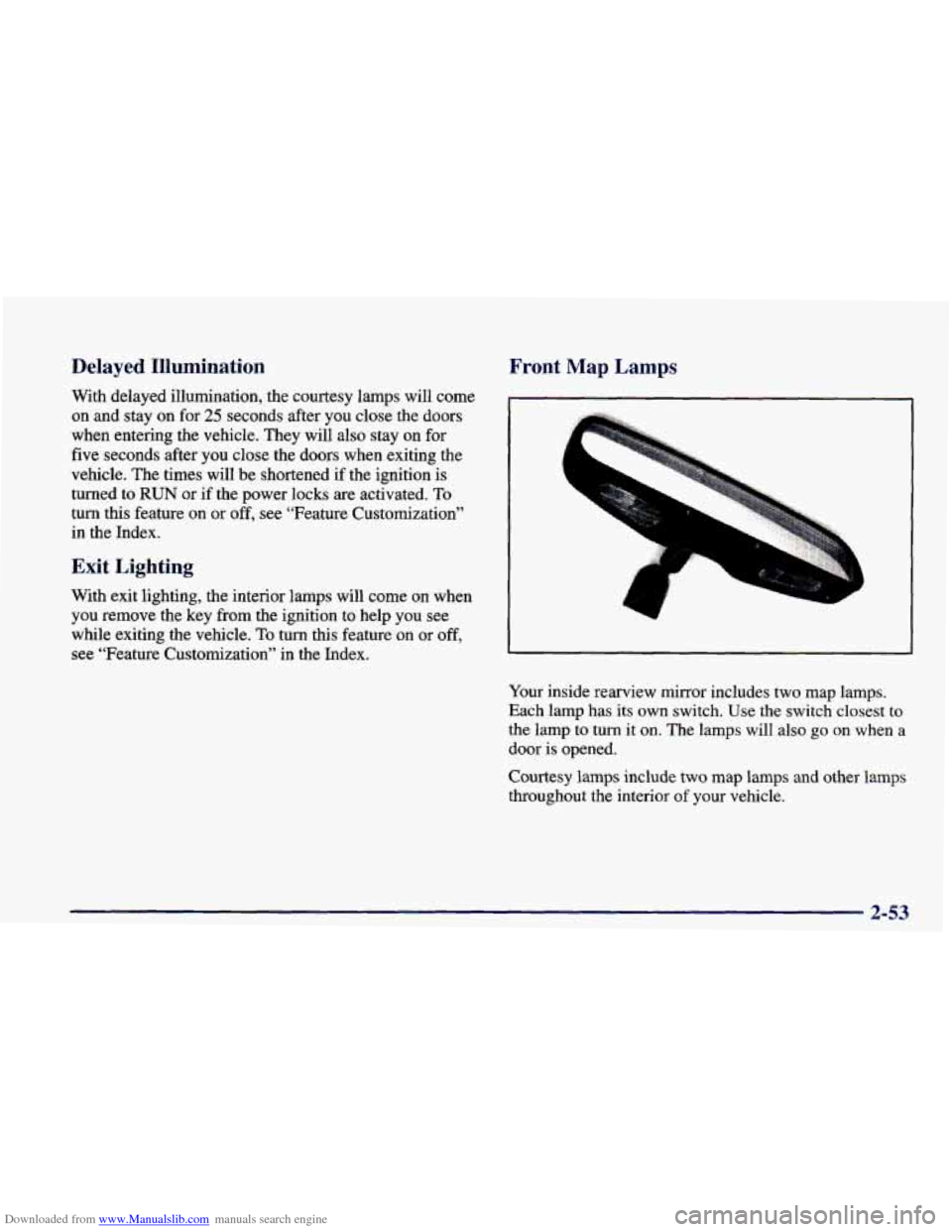
Front Map Lamps
Your inside rearview mirror includes two map lamps.
Each lamp has its own switch. Use the switch closest
to
the lamp to turn it on. The lamps will also go on when a
door is opened.
Courtesy lamps include two map lamps and other lamps
throughout the interior
of your vehicle.