ignition CHEVROLET CAMARO 1998 4.G User Guide
[x] Cancel search | Manufacturer: CHEVROLET, Model Year: 1998, Model line: CAMARO, Model: CHEVROLET CAMARO 1998 4.GPages: 402, PDF Size: 21.2 MB
Page 83 of 402
Downloaded from www.Manualslib.com manuals search engine Vehicle and Content Theft-DeterrenUAlarm System
(If Equipped)
If your vehicle has this option, it has a theft-deterrent
alarm system. Once armed, the system will sound the
horn and flash the parking lamps if the vehicle is
broken into.
Shock Sensor
Coupe Convertible
The shock sensor is what triggers the alarm when it
detects a blow
to your vehicle. It is located over the
right rear wheelhouse near the spare tire in the hatch
area. There are two levels
of alarms via the shock
sensor: Two horn blasts and parking lamp flashes for
non-threatening blows to the vehicle and
a full
two-minute alarm for harder blows to the vehicle.
Its sensitivity can be adjusted if more or less sensitivity
is desired. (Note:
If sensitivity is increased too much,
it may give false alarms caused by gusts
of wind or
other natural events that may shake the vehicle.)
To adjust, remove the label covering the adjustment
knob and adjust
as desired. Turn to the right
(clockwise) to increase sensitivity and turn to the left
(counterclockwise) to decrease sensitivity. The shock
sensor is ignored by
the alarm system when the ignition
is on, when the hatch is open, when the alarm is
disarmed, when customized
to be ignored and for
five seconds after the horn sounds an alarm or chirp.
The shock sensor is ignored after triggering three full
alarms until the system is rearmed.
2-15
Page 85 of 402
Downloaded from www.Manualslib.com manuals search engine Passive Arming
If the ignition was just turned off and a door was
opened, the system will arm six seconds after both doors are closed, whether or not you lock them. In all other
cases, the system will wait
30 seconds after both doors
are closed before arming, allowing you time to get into
the vehicle and put the key in the ignition. The parking
lamps will flash when the system arms. Passive arming
is not enabled from the factory.
Disarming the System
There are two ways to disarm the system:
1. Press the UNLOCK button on the keyless entry
transmitter. If the horn chirps two or three times
when you unlock the car, the alarm sounded in your
absence. Two chirps means that the shock sensor
was set off and three chirps means that a door or the
hatch was opened.
2. Turn the ignition to RUN with the proper key.
For more information on customizing the features
mentioned here, see “Feature Customization” in
the Index.
’Ibrning Off the Alarm
If you started the alarm by pressing the panic button on
the keyless entry transmitter, you must either push that button again
or turn the ignition switch to
RUN to stop
the alarm.
If the alarm is sounding due to the shock sensor
or a
door or hatch opening, it can be turned off by either
turning the ignition switch with
a proper key inserted or
by pressing any button on the keyless entry transmitter.
If you use your keyless entry transmitter to silence the
alarm, additional things will happen depending upon
which button you press.
0
0
0
0
Pressing the UNLOCK button will turn the alarm off, unlock the driver’s door and disarm the system.
Pressing the LOCK button will turn the alarm off,
keep the doors locked and keep the system armed. Pressing the trunk symbol button will turn the alarm
off and keep the system armed.
A second push of the
button (within five seconds) will unlock and disarm
the hatch only.
Pressing the panic button will turn the alarm off,
keep the doors locked and keep the system armed.
If the alarm is sounding because an incorrect ignition
key was used, press any button on the keyless entry
transmitter to turn the alarm off.
The alarm will stop by itself after two minutes.
2-17
Page 86 of 402

Downloaded from www.Manualslib.com manuals search engine PASS-Key@ I1
1
Your vehicle is equipped
with the PASS-Key I1
(Personalized Automotive
Security System)
theft-deterrent system.
PASS-Key
I1 is a passive
theft-deterrent system.
It works when you insert
or remove the key from
the ignition.
PASS-Key
I1 uses a resistor pellet in the ignition key
that matches a decoder in your vehicle.
When the PASS-Key
I1 system senses that someone is
using the wrong key, it shuts down the vehicle’s starter
and fuel systems. For about three minutes, the starter
won’t work and fuel won’t go to the engine. If someone
tries to start your vehicle again or uses another key
during this time, the vehicle will not start. This
discourages someone from randomly trying different
keys with different resistor pellets in an attempt
to
make a match. The ignition key must
be clean and dry before it’s
inserted in the ignition or the engine may not start. If
the engine does not start and the
SECURITY light stays
on when you
try to start the vehicle, the key may be
dirty or wet.
Turn the ignition off.
Clean and dry the key. Wait about three minutes and
try
again. The SECURITY light may remain on during this
time. If the starter still won’t work, and the key appears
to be clean and dry, wait about three minutes and try
another ignition key. At this time, you may also want
to
check the fuses (see “Fuses and Circuit Breakers” in the
Index).
If the starter won’t work with the other key, your
vehicle needs service. If your vehicle does start, the first
ignition key may be faulty. See your dealer or a
locksmith who can service the PASS-Key
11.
If you accidentally use a key that has a damaged or
missing resistor pellet, the starter won’t work. The
SECURITY light will flash. But you don’t have to wait
three minutes before trying another ignition key.
See your dealer or a locksmith who can service the
PASS-Key
I1 to have a new key made.
2-18
Page 87 of 402
Downloaded from www.Manualslib.com manuals search engine If you’re ever driving and the SECURITY light comes
on and stays
on, you will be able to restart your engine
if you turn it off. Your PASS-Key I1 system, however,
is not working properly and must be serviced by
your dealer. Your vehicle is not protected by the
PASS-Key I1 system.
If you lose or damage a PASS-Key I1 ignition key, see
your dealer or a locksmith who can service PASS-Key I1
to have a new key made. In an emergency, call the
Chevrolet Roadside Assistance Center at 1 -800-CHEV-USA
(1 -800-243-8872).
Feature Customization (If Equipped)
Your vehicle’s locks and lighting systems can be
programmed with several different features. The
features you can program depend upon the options that
came with your vehicle. The following list tells you the
features that can be programmed. Listed next to each
feature is the option you need to have on your vehicle in
order to be able to program that particular feature.
0 Exit Lighting (available for all)
0 Delayed Illumination (available for all)
Last Door Closed Locking (if equipped with power
door locks)
Lockout Prevention (if equipped with power
door locks)
Keyless Entry Verification (if equipped with Vehicle
and Content Theft-DeterrendAlarm System)
Theft-Deterrent Arming Method (if equipped with
Vehicle and Content Theft-DeterrenUAlarm System)
Theft-Deterrent Arming Verification (if equipped with
Vehicle and Content Theft-Deterrent/Alarm System)
Driver’s Door Alarm Delay (if equipped with
Shock Sensor Enable (if equipped with Vehicle and
Vehicle and Content Theft-DeterrenUAlann
System)
Content Theft-DeterrendAlarm System)
2-19
Page 88 of 402
Downloaded from www.Manualslib.com manuals search engine ‘To program features, your vehicle must be in the
programming mode. Follow these steps:
1.
2.
3.
4.
5.
Put your key in the ignition.
Turn the ignition to RUN to disarm the Vehicle
and Content Theft-DeterrentIAlarm System.
Turn
the ignition to OFF position.
Remove the RADIO
fuse. This fuse is in the
main fuse block, located on the left side
of your
instrument panel. When the main fuse block is
open, the RADIO fuse
is located in the lower
right corner side
of the fuse panel. See “Fuses and
Circuit Breakers” in the Index.
Turn the ignition to ACC.
You should hear a chime
to verify that the system
is in programming mode.
If the chime sounds once,
you will be able to program Exit Lighting, Delayed
Illumination, Last Door Closed Locking and Lockout
Prevention only. If the chime sounds twice and your
vehicle is equipped with the Vehicle and Content
Theft-Deterrent System, you will also be able to
set Keyless Entry Verification, Arming Method,
Arming Verification, Driver’s Door Delay and
Shock Sensor Enable.
Exit Lighting and Delayed Illumination
With Exit Lighting, your interior lamps will come on
for up to
25 seconds when the key is removed from
the ignition.
With Delayed Illumination, your interior lamps will come
on and stay
on for up to 25 seconds when entering the
vehicle and up
to 5 seconds when leaving your vehicle.
Your vehicle comes with both features enabled (Mode
4).
To change the factory setting, do the following:
1. Turn the courtesy lamps on by turning the instrument
panel brightness control knob all the way up.
2. Count the number of chimes you hear. The number of
chimes tells you which mode your vehicle is set for.
3. Turn the courtesy lamp switch to off.
4. Turn the courtesy lamp switch from on to off until
you hear the number
of chimes that corresponds to
the mode selection you want.
Mode 1: Both Off
Mode 2: Delayed Illumination Only
Mode 3: Exit Lighting Only
Mode 4: Both On
2-20
Page 89 of 402
Downloaded from www.Manualslib.com manuals search engine Last Door Closed Locking and
Lockout Prevention
Your vehicle comes with this feature set in Mode 2. This
means that your power door locks will
not lock when
the keys are in the ignition and a door is open. To
change the factory setting,
do the following:
1. Press the LOCK switch on the door.
2. Count the number of chimes you hear. The number of
chimes tells
you which mode your vehicle is set for.
3. Press the LOCK switch on the door until you hear
the number of chimes that correspond to the mode
selection you want.
Mode 1: Both Off (Doors will lockhnlock when you
press the power door lock switch).
Mode 2: Lockout Prevention Only (If you leave your
keys in the ignition and get out the driver’s door, you
won’t be able to lock the doors with the power door
lock switch).
Mode 3: Last Door Closed Locking Only (If the power
door lock switch is used to lock the vehicle while any
door is open, you will hear three chimes. The doors
will
not lock until after all doors are closed).
Mode 4: Both On (This combines Mode 2 and 3).
Keyless Entry Verification
Your vehicle comes with this feature set in Mode 5. This
means that when you use the keyless entry transmitter
to
1ocWunlock your vehicle, your parking lamps will flash
briefly upon the first press on
LOCK. Your horn will
sound briefly and your parking lamps will flash briefly
upon the second press on LOCK. Your parking lamps
will flash briefly upon any press on UNLOCK.
To
change the factory setting, do the following:
1. Press the UNLOCK button on the keyless
entry transmitter.
2. Count the number of chimes you hear. The number of
chimes tells you which mode your vehicle is set for.
3. Press the UNLOCK button on the keyless entry
transmitter until
you hear the number of chimes that
correspond to the mode selection you want.
Mode 1: All Off (The headlamps will not flash and the
horn will not sound to provide you feedback that a
1ocWunlock command has been received by the keyless
entry transmitter).
Mode 2: Horn and LampsLamps (Your horn will sound
briefly and your parking lamps will flash when you
press LOCK on the keyless entry transmitter. Only your
parking lamps will flash when you press UNLOCK).
2-21
Page 92 of 402
Downloaded from www.Manualslib.com manuals search engine Mode 1: Zero Delay and Shock Sensor Disabled (The
alarm will sound immediately if the driver’s
door is
opened with your key and the shock sensor will not be
available to measure sharp blows
to your vehicle).
Mode
2: Eight-Second Delay and Shock Sensor
Disabled (The alarm will sound eight seconds after the
driver’s door
is opened with your key and the shock
sensor will not be available to measure
sharp blows
to your vehicle).
Mode
3: Zero Delay and Shock Sensor Enabled (The
alarm will sound immediately after the driver’s door is
opened with your key and the shock sensor will be available to measure
sharp blows to your vehicle).
Mode
4: Eight-Second Delay and Shock Sensor
Enabled (The alarm will sound eight seconds after the
driver’s door is opened with your key and the shock
sensor will be available
to measure sharp blows to
your vehicle).
Leaving Programming Mode
When programming is done, turn the ignition switch to
OFF and replace the RADIO fuse.
New Vehicle “Break-In”
NOTICE:
Your vehicle doesn’t need an elaborate
“break-in.” But it will perform better in the long
run if
you follow these guidelines:
Keep your speed at 55 mph (88 kmh) or
less for the first
500 miles (805 km).
Don’t drive at any one speed -- fast or
slow -- for the first 500 miles (805 km).
Don’t make full-throttle starts.
200 miles (322 km) or so. During this time
your new brake linings aren’t yet broken
in. Hard stops with new linings can mean
premature wear and earlier replacement.
Follow this breaking-in guideline every
time
you get new brake linings.
See “Towing
a Trailer” in the Index for
more information.
Avoid making hard stops for the first
Don’t tow a trailer during break-in.
2-24
Page 93 of 402
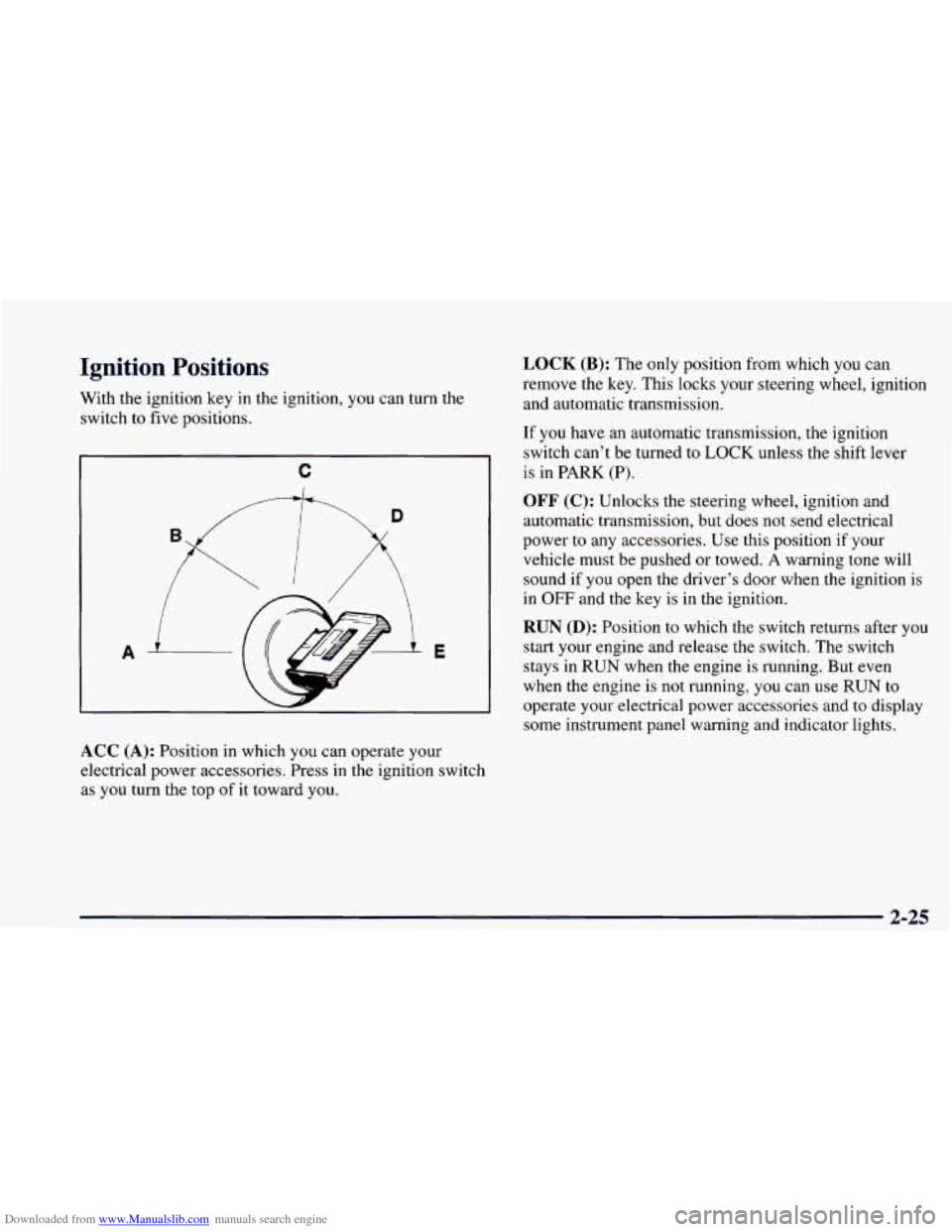
Downloaded from www.Manualslib.com manuals search engine Ignition Positions
With the ignition key in the ignition, you can turn the
switch to five positions.
C
A
/
E
ACC (A): Position in which you can operate your
electrical power accessories. Press
in the ignition switch
as you turn the top
of it toward you.
LOCK (B): The only position from which you can
remove the key. This locks your steering wheel, ignition
and automatic transmission.
If you have an automatic transmission, the ignition
switch can’t be turned to
LOCK unless the shift lever
is in
PARK (P).
OFF (C): Unlocks the steering wheel, ignition and
automatic transmission, but does not send electrical
power to any accessories. Use this position if your
vehicle must be pushed or towed.
A warning tone will
sound if you open the driver’s door when the ignition is
in
OFF and the key is in the ignition.
RUN (D): Position to which the switch returns after you
start your engine and release the switch. The switch
stays
in RUN when the engine is running. But even
when the engine is not running,
you can use RUN to
operate your electrical power accessories and to display
some instrument panel warning and indicator lights.
2-25
Page 94 of 402
Downloaded from www.Manualslib.com manuals search engine START (E): Starts the engine. When the engine starts,
release the key. The ignition will return
to RUN for
normal driving.
Note that even if the engine is not running,
ACC and
RUN allow you
to operate your electrical accessories,
such
as the radio and ventilation fan.
I a CAUTION: I
On manual transmission vehicles, turning the key
to
LOCK will lock the steering column and result
in a loss of ability to steer the vehicle. This could
cause
a collision. If you need to turn the engine
off while the vehicle
is moving, turn the key only
to
OFF.
NOTICE:
If your key seems stuck in LOCK and you can’t
turn it, be sure you are using the correct key; if
so, is it all the way in? If it is, then turn the
steering wheel left and right while you turn the
key hard. But turn the key only with your hand.
Using
a tool to force it could break the key or the
ignition switch.
If none of this works, then your
vehicle needs service.
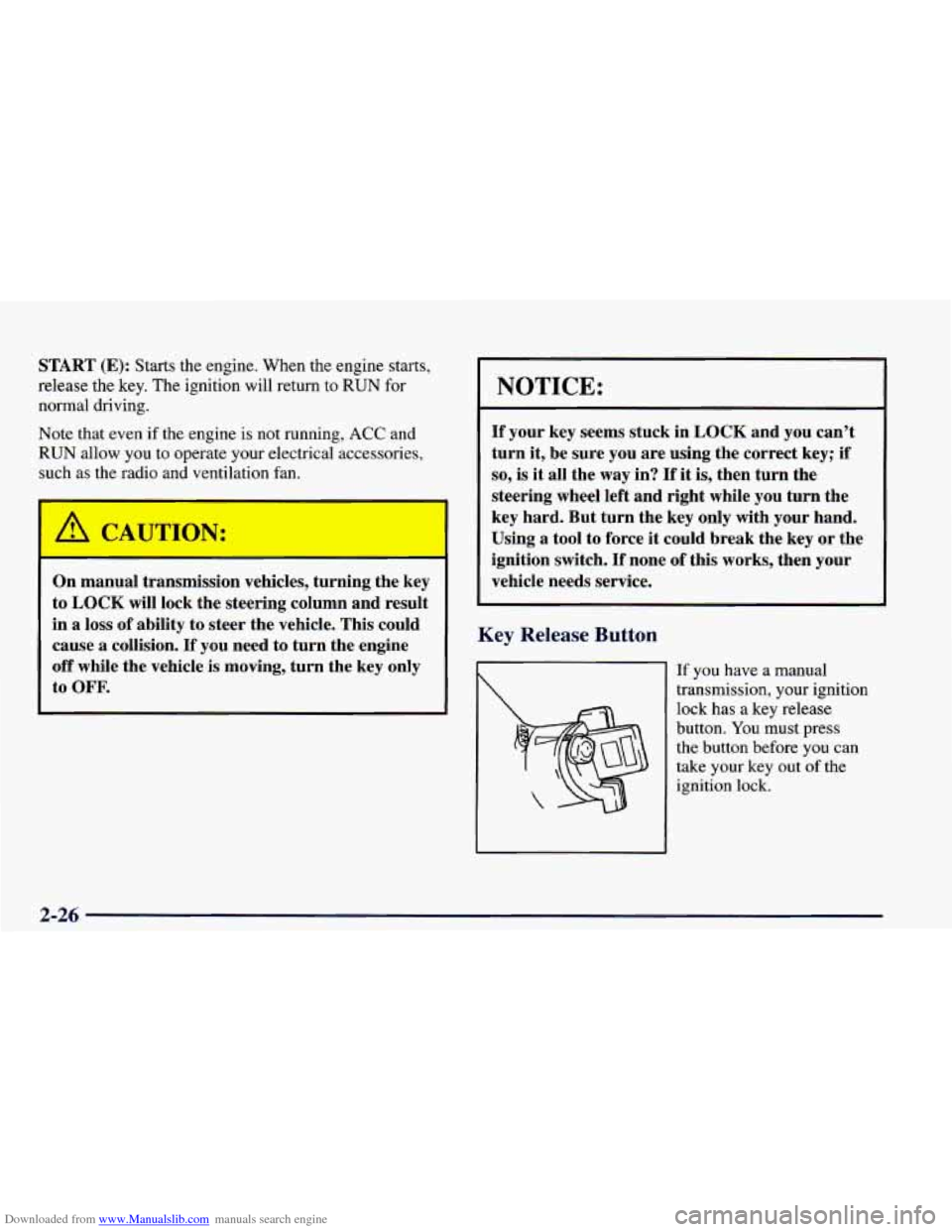
Key Release Button
If you have a manual
transmission, your ignition
lock has
a key release
button.
You must press
the button before you can
take your key out
of the
ignition lock.
2-26
Page 95 of 402
Downloaded from www.Manualslib.com manuals search engine Starting Your Engine
Automatic Transmission
Move your shift lever to PARK (P) or NEUTRAL (N).
Your engine won’t start in any other position
-- that’s a
safety feature. To restart when you’re already moving,
use NEUTRAL
(N) only.
I NOTICE:
Don’t try to shift to PARK (P) if your Chevrolet
is moving.
If you do, you could damage the
transmission. Shift to
PARK (P) only when your
vehicle is stopped.
Manual Transmission
The gear selector should be in NEUTRAL (N). Hold
the clutch pedal to the floor and start the engine. Your
vehicle won’t start if the clutch pedal is not all the way
down
-- that’s a safety feature.
1. Without pushing the accelerator pedal, turn your
ignition key to START. When the engine starts, let
go of the key. The idle speed will go down as your
engine gets warm.
NOTICE:
Holding your key in START for longer than
15 seconds at a time will cause your battery to be
drained much sooner. And the excessive heat can
damage your starter motor.
2. If it doesn’t start right away, hold your key in
START for about three to five seconds at a time until
your engine starts. Wait about
15 seconds between
each
try to help avoid draining your battery or
damaging your starter.
2-27