light CHEVROLET CAMARO 1998 4.G Repair Manual
[x] Cancel search | Manufacturer: CHEVROLET, Model Year: 1998, Model line: CAMARO, Model: CHEVROLET CAMARO 1998 4.GPages: 402, PDF Size: 21.2 MB
Page 208 of 402
Downloaded from www.Manualslib.com manuals search engine a CAUTION:
Snow can trap exhaust gases under your vehicle.
This can cause deadly
CO (carbon monoxide) gas
to get inside. CO could overcome you and kill
you.
You can’t see it or smell it, so you might not
know it is in your vehicle. Clear away snow from
around the base of your vehicle, especially any
that
is blocking your exhaust pipe. And check
around again from time
to time to be sure snow
doesn’t collect there.
Open
a window just a little on the side of the
vehicle that’s away from the wind. This will help
keep
CO out.
Run your engine only as long as you must. This saves
fuel. When you run the engine, make it go a little faster
than just idle. That is, push the accelerator slightly. This
uses less fuel for the heat that
you get and it keeps the
battery charged.
You will need a well-charged battery to
restart the vehicle, and possibly for signaling later on
with your headlamps. Let the heater run for a while. Then,
shut the engine
off and close the window almost
all the way to preserve the heat. Start the engine again
and repeat this
only when you feel really uncomfortable
from the cold. But do it as little as possible. Preserve the
fuel as long as you can.
To help keep warm, you can get
out of the vehicle and do some fairly vigorous exercises
every half hour or
so until help comes.
Loading Your Ve’ kle
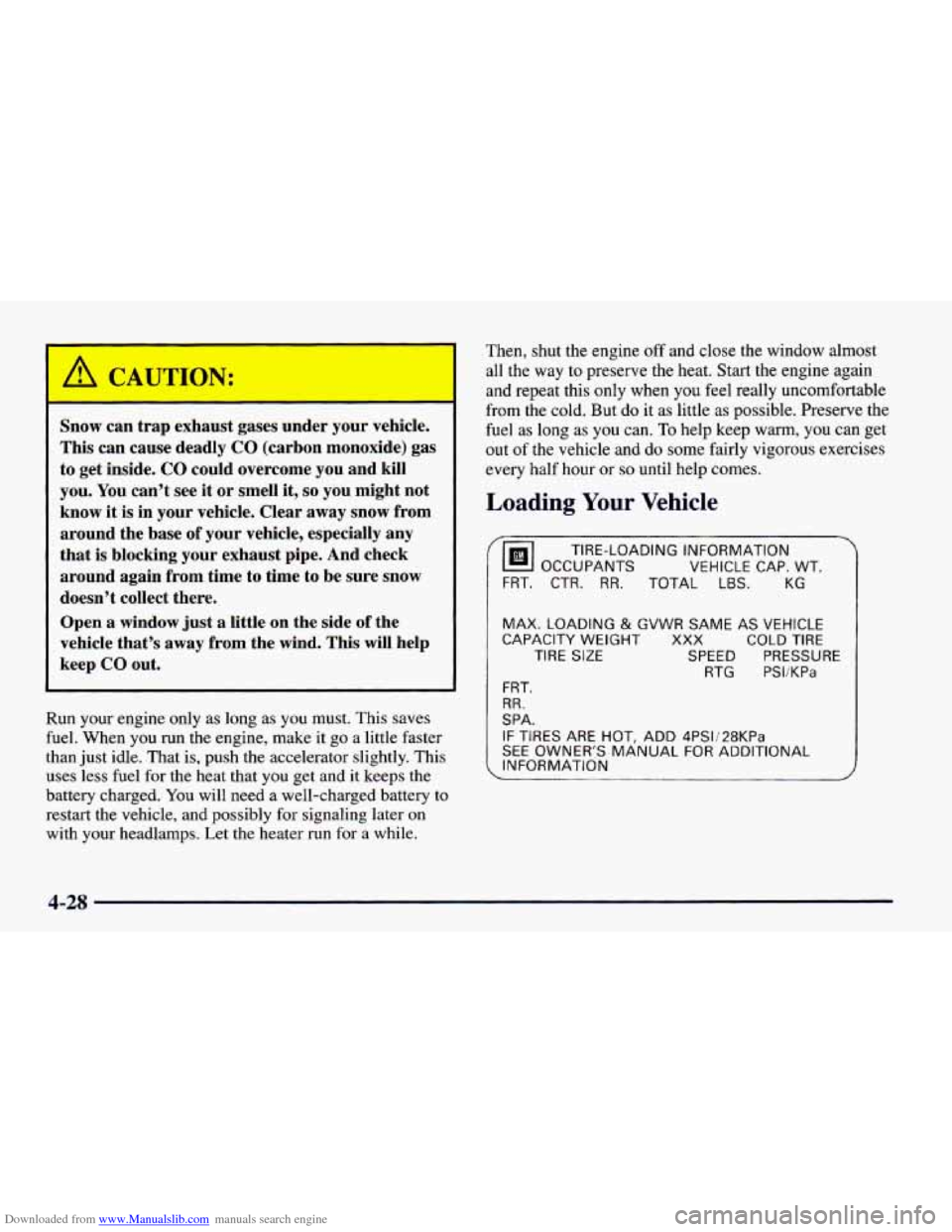
OCCUPANTS
VEHICLE CAP. WT.
.
TIRE-LOADING INFORMATION
FRT, CTR. RR. TOTAL LBS. KG
MAX. LOADING & GVWR SAME AS VEHICLE
CAPACITY WEIGHT XXX COLD TIRE
TIRE
SIZE SPEED PRESSURE
RTG PSPKPa
FRT.
RR.
SPA.
IF TIRES ARE HOT, ADD 4PSli28KPa
SEE OWNER’S MANUAL FOR ADDITIONAL
INFORMATION
4-28
Page 222 of 402
Downloaded from www.Manualslib.com manuals search engine 2. Get the vehicles close enough so the jumper cables
can reach, but be sure the vehicles aren’t touching
each other.
If they are, it could cause a ground
connection you don’t want. You wouldn’t be able to
start your Chevrolet, and the bad grounding could
damage the electrical systems.
3. Turn off the ignition on both vehicles. Turn off all
lights that aren’t needed, and radios.
This will avoid
sparks and help save both batteries. And it could
save your radio!
I I
NOTICE:
If you leave your radio on, it could be badly
damaged. The repairs wouldn’t be covered
by
your warranty.
4. Open the hoods and locate the batteries.
5. Find the positive (+) and negative (-) terminals on
each battery.
Using a match near a battery can cause battery
gas to explode. People have been hurt doing this,
and some have been blinded. Use a flashlight
if
you need more light.
Be sure the battery has enough water. You don’t
need to add water to the Delco Freedom@ battery
installed in every new
GM vehicle. But if a
battery has filler caps, be sure the right amount
of fluid is there.
If it is low, add water to take care
of that first.
If you don’t, explosive gas could
be present.
Battery fluid contains acid that can burn you.
Don’t get
it on you. If you accidentally get it in
your eyes or
on your skin, flush the place with
water and get medical help immediately.
5-4
Page 232 of 402
Downloaded from www.Manualslib.com manuals search engine Engine Overheating
You will find a coolant temperature gage on your
vehicle’s instrument panel. You may also find a low
coolant warning light on your vehicle’s instrument panel
(5.7L V8 Engine).
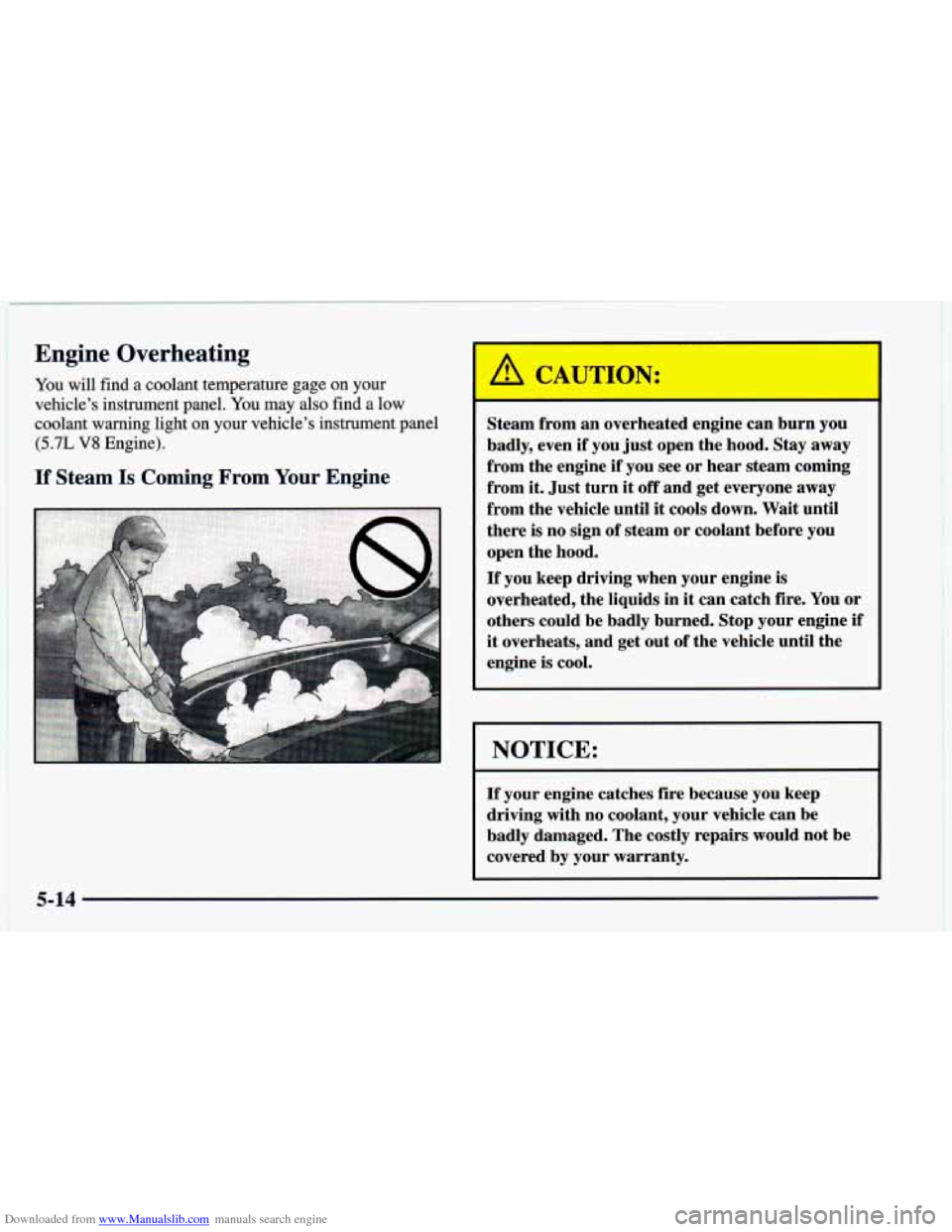
If Steam Is Coming From Your Engine
Steam from an overheated engine can burn you
badly, even if you just open the hood. Stay away
from the engine
if you see or hear steam coming
from it. Just turn
it off and get everyone away
from the vehicle until
it cools down. Wait until
there is no sign of steam or coolant before you
open the hood.
If you keep driving when your engine is
overheated, the liquids in
it can catch fire. You or
others could be badly burned. Stop your engine
if
it overheats, and get out of the vehicle until the
engine is cool.
NOTICE:
If your engine catches fire because you keep
driving
with no coolant, your vehicle can be
badly damaged. The costly repairs would not be
covered by your warranty.
5-14
Page 257 of 402

Downloaded from www.Manualslib.com manuals search engine If You’re Stuck: In Sand, Mud,
Ice or Snow
What you don’t want to do when your vehicle is stuck is
to spin your wheels too fast. The method known as
“rocking” can help you get out when you’re stuck, but
you must use caution.
I
I /i CAUTION:
If you let your tires spin at high speed, they can
explode, and you
or others could be injured. And,
the transmission or other parts
of the vehicle can
overheat. That could cause an engine
compartment fire
or other damage. When you’re
stuck, spin the wheels as little as possible. Don’t
spin the wheels above
35 mph (55 km/h) as shown
on the speedometer.
NOTICE:
Spinning your wheels can destroy parts of your
vehicle
as well as the tires. If you spin the wheels
too fast while shifting your transmission back
and forth, you can destroy your transmission.
For information about using tire chains on your vehicle,
see “Tire Chains” in the Index.
Rocking Your Vehicle To Get It Out
First, turn your steering wheel left and right. That will
clear the area around your front wheels. If
your vehicle has
ASR, you should
turn the system off. (See “ASR System”
in the Index.) Then shift back and forth between REVERSE
(R) and a forward gear (or with a manual
transmission, between
FIRST (1) or SECOND (2) and
REVERSE (R), spinning the wheels as little as possible.
Release the accelerator pedal while
you shift, and press
lightly on the accelerator pedal when
the transmission is in
gear. If that doesn’t get you out after a few tries, you may
need to be towed out.
If you do need to be towed out, see
“Towing Your Vehicle” in the Index.
5-39
Page 265 of 402
Downloaded from www.Manualslib.com manuals search engine To remove the cap, turn it slowly to the left
(counterclockwise). The cap has a spring in it;
if you let
go of the cap too soon, it will spring back to the right.
BN:
If you get gasoline on yourself and then
something ignites
it, you could be badly burned.
Gasoline can spray out on you if you open the
fuel filler cap too quickly. This spray can happen
if your
tank is nearly full, and is more likely in
hot weather. Open the fuel filler cap slowly and
wait for any “hiss” noise to stop. Then unscrew
the cap all the
way.
Be careful not to spill gasoline. Clean gasoline from
painted surfaces
as soon as possible. See “Cleaning the
Outside of Your Vehicle” in the Index. When you put
the cap
back on, turn it to the right
(clockwise) until you hear a clicking sound.
Make
sure you fully install the cap. The diagnostic system
can determine if the fuel cap has been left off
or
improperly installed. This would allow fuel to
evaporate into the atmosphere. See “Malfunction
Indicator Lamp” in the Index.
NOTICE:
If you need a new cap, be sure to get the right
type. Your dealer can get one for
you. If you get
the wrong type,
it may not fit properly. This may
cause your malfunction indicator lamp to light
and your fuel tank and emissions system may be
damaged. See “Malfunction Indicator Lamp” in
the Index.
6-7
Page 270 of 402
Downloaded from www.Manualslib.com manuals search engine Before closing the hood, be sure all the filler caps
are on.
Then just pull the hood down and close it firmly.
Engine Oil
LOW OIL
If the LOW OIL light on
the instrument panel comes
on, it means you need to
check your engine oil
level right
away. For more
information, see “Low Oil
Light”
in the Index.
You
should check your engine oil level regularly; this is
an added reminder.
It’s a good idea to check your engine oil every time you
get
fuel. In order to get an accurate reading, the oil must
be warm and the vehicle must be on level ground. The
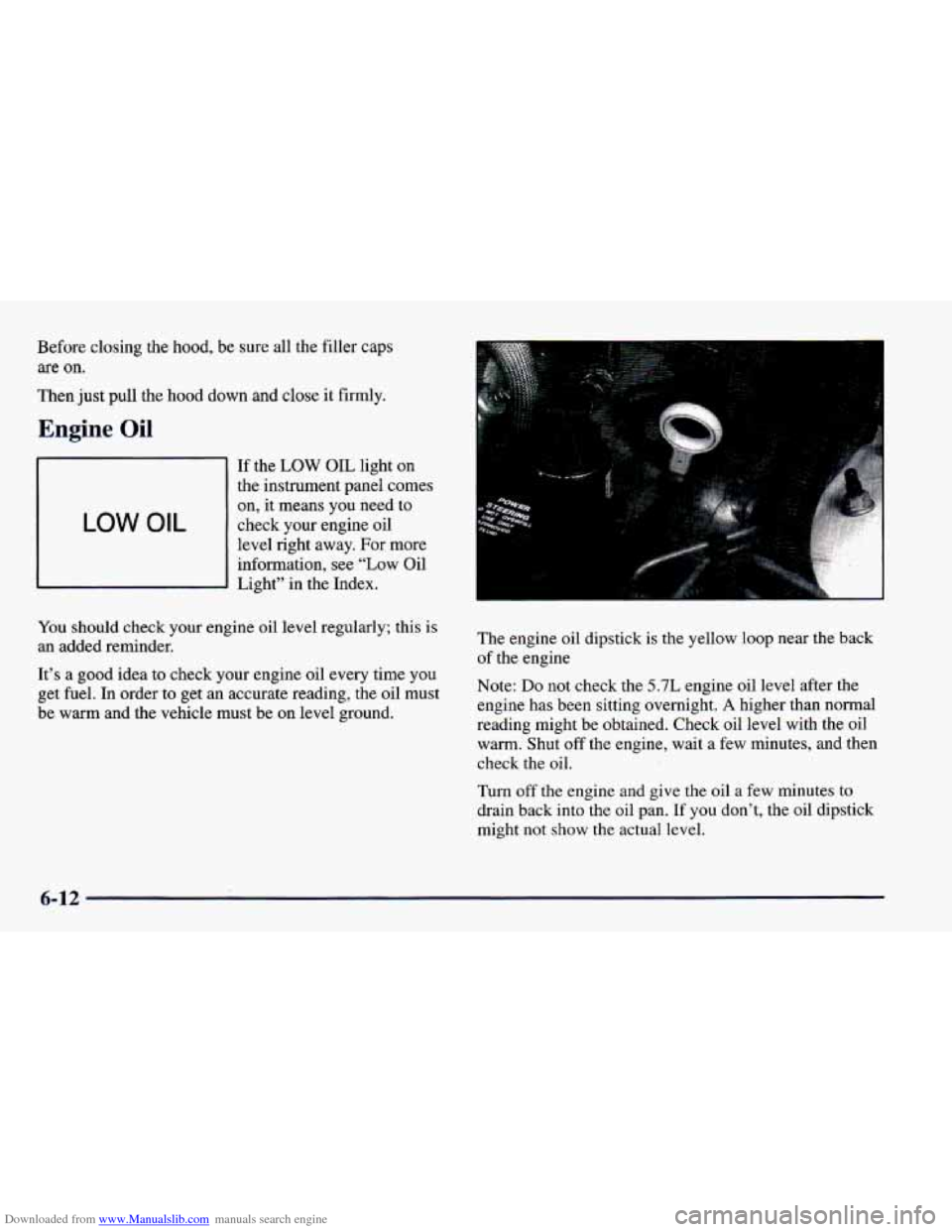
engine oil dipstick is the yellow loop near the back
of the engine
Note: Do not check the 5.7L engine oil level after the
engine has been sitting overnight,
A higher than normal
reading might be obtained. Check oil level with the oil
warm. Shut off the engine, wait a few minutes, and then
check the oil.
Turn off the engine and give the oil a few minutes to
drain back into the oil pan.
If you don’t, the oil dipstick
might not show the actual level.
6-12
Page 285 of 402
Downloaded from www.Manualslib.com manuals search engine A 50/50 mixture of water and DEX-COOL@ coolant will:
0 Give freezing protection down to -34°F (-37°C).
0 Give boiling protection up to 265°F (129°C).
0 Protect against rust and corrosion.
0 Help keep the proper engine temperature.
0 Let the warning lights and gages work as
they should.
NOTICE:
When adding coolant, it is important that you use
only
DEX-COOL@ (silicate-free) coolant.
If coolant other than DEX-COOL is added to
the system, premature engine, heater core
or
radiator corrosion may result. In addition, the
engine coolant
will require change sooner -- at
30,000 miles (50 000 km) or 24 months,
whichever occurs first. Damage caused
by the
use
of coolant other than DEX-COOL@ is not
covered by your new vehicle warranty.
What to Use
Use a mixture of one-half clean water (preferably
distilled)
and one-half DEX-COOL’ coolant which
won’t damage aluminum parts.
If you use this mixture,
you don’t need to add anything else.
Adding only plain water to your cooling system
can be dangerous. Plain water,
or some other
liquid like alcohol, can boil before the proper
coolant mixture will. Your vehicle’s coolant
warning system is set for the proper coolant
mixture. With plain water
or the wrong mixture,
your engine could get too hot but you wouldn’t
get the overheat warning. Your engine could
catch fire and you or others could be burned.
Use a
50/50 mixture of clean water and
DEX-COOL@ coolant.
6-27
Page 287 of 402
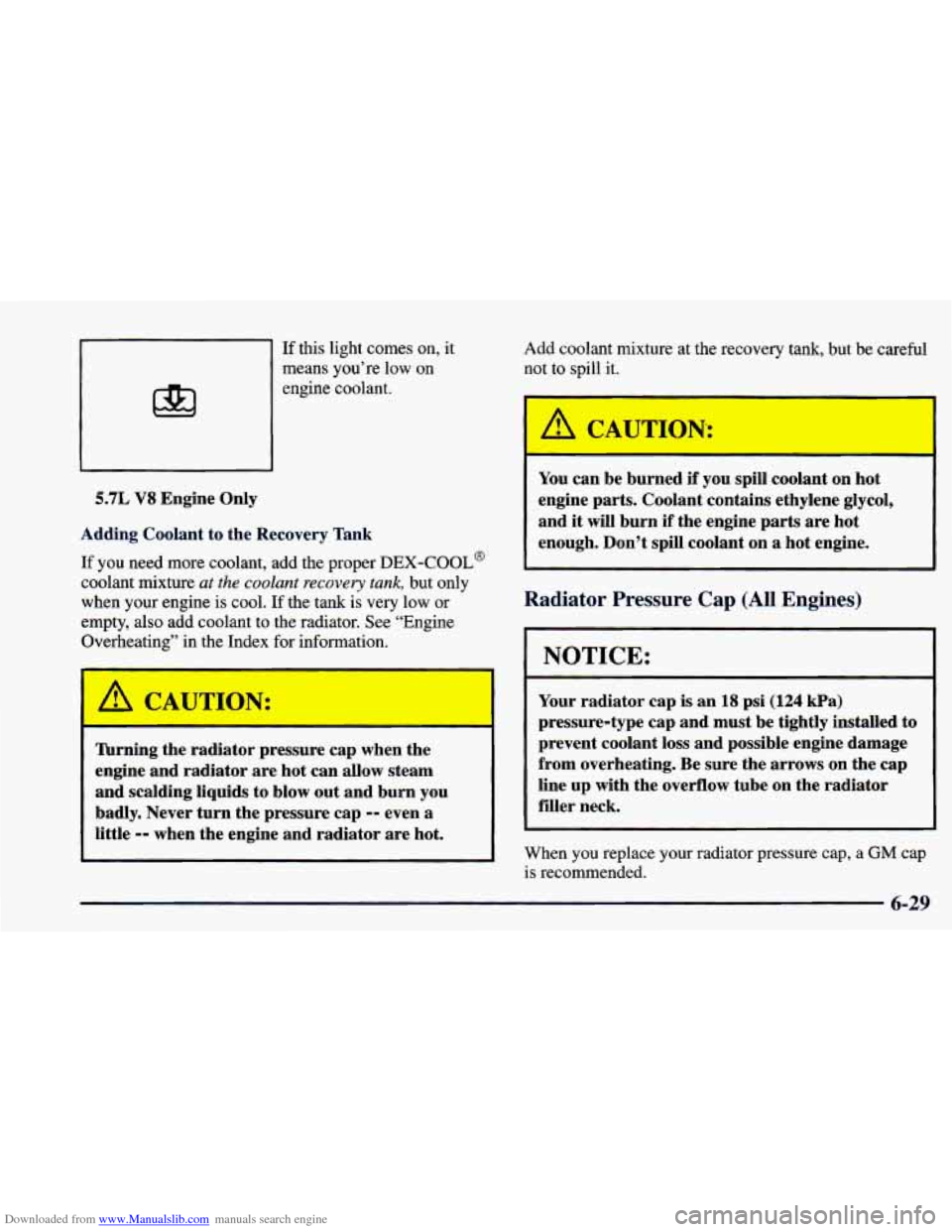
Downloaded from www.Manualslib.com manuals search engine If this light comes on, it
means you’re low
on
m
engine coolant.
5.7L V8 Engine Only
Adding Coolant to the Recovery Tank
If you need more coolant, add the proper DEX-COOL@
coolant mixture
ut the coolant recovery tank, but only
when your engine is cool.
If the tank is very low or
empty, also add coolant to the radiator. See “Engine
Overheating” in the Index for information. Add
coolant mixture at the recovery tank, but be careful
not
to spill it.
Turning the radiator pressure cap when the
engine and radiator are hot can allow steam
and scalding liquids to blow out and burn you
badly. Never turn the pressure cap
-- even a
little -- when the engine and radiator are hot. You
can be burned
if you spill coolant on hot
engine parts. Coolant contains ethylene glycol,
and it will burn
if the engine parts are hot
enough. Don’t spill coolant on
a hot engine.
Radiator Pressure Cap (All Engines)
~
NOTICE:
Your radiator cap is an 18 psi (124 kPa)
pressure-type cap and must be tightly installed to
prevent coolant loss and possible engine damage
from overheating. Be sure the arrows on the cap
line
up with the overflow tube on the radiator
filler neck.
When you replace your radiator pressure cap, a GM cap
is recommended.
6-29
Page 294 of 402
Downloaded from www.Manualslib.com manuals search engine Some driving conditions or climates may cause a brake
squeal when the brakes are first applied or lightly
applied. This does not mean something is wrong with
your brakes.
When you have the front brake pads replaced, have
the rear brakes inspected, too.
Brake linings should always be replaced as complete
axle sets.
See “Brake System Inspection” in Section
7 of
this manual under Part
C “Periodic Maintenance
Inspections.”
Brake Pedal Travel
See your dealer if the brake pedal does not return to
normal height, or if there is a rapid increase in pedal
travel. This could be a sign
of brake trouble.
Brake Adjustment
Every time you make a moderate brake stop, your
disc brakes adjust
for wear. If you rarely make a
moderate or heavier stop, then your brakes might not
adjust correctly. If you drive in that way, then
-- very
carefully
-- make a few moderate brake stops about
every
1,000 miles (1 600 km), so your brakes will
adjust properly. The
park brake system has separate brake linings that
do
not self adjust for wear. If the park brake lever pulls up
more than the normal eighteen clicks, the parking brakes
may need adjustment. See your dealer.
Replacing Brake System Parts
The braking system on a modern vehicle is complex.
Its many parts have to be of top quality and work well
together if the vehicle is to have really good braking.
Your vehicle was designed and tested with top-quality
GM brake parts. When you replace parts of your braking
system
-- for example, when your brake linings wear
down and you have to have new ones put
in -- be sure
you get new approved
GM replacement parts. If you
don’t, your brakes may no longer work properly. For
example, if someone puts
in brake linings that are wrong
for your vehicle, the balance between your front and
rear brakes can change
-- for the worse. The braking
performance you’ve come to expect can change in many
other ways if someone puts in the wrong replacement
brake parts.
6-36
Page 296 of 402
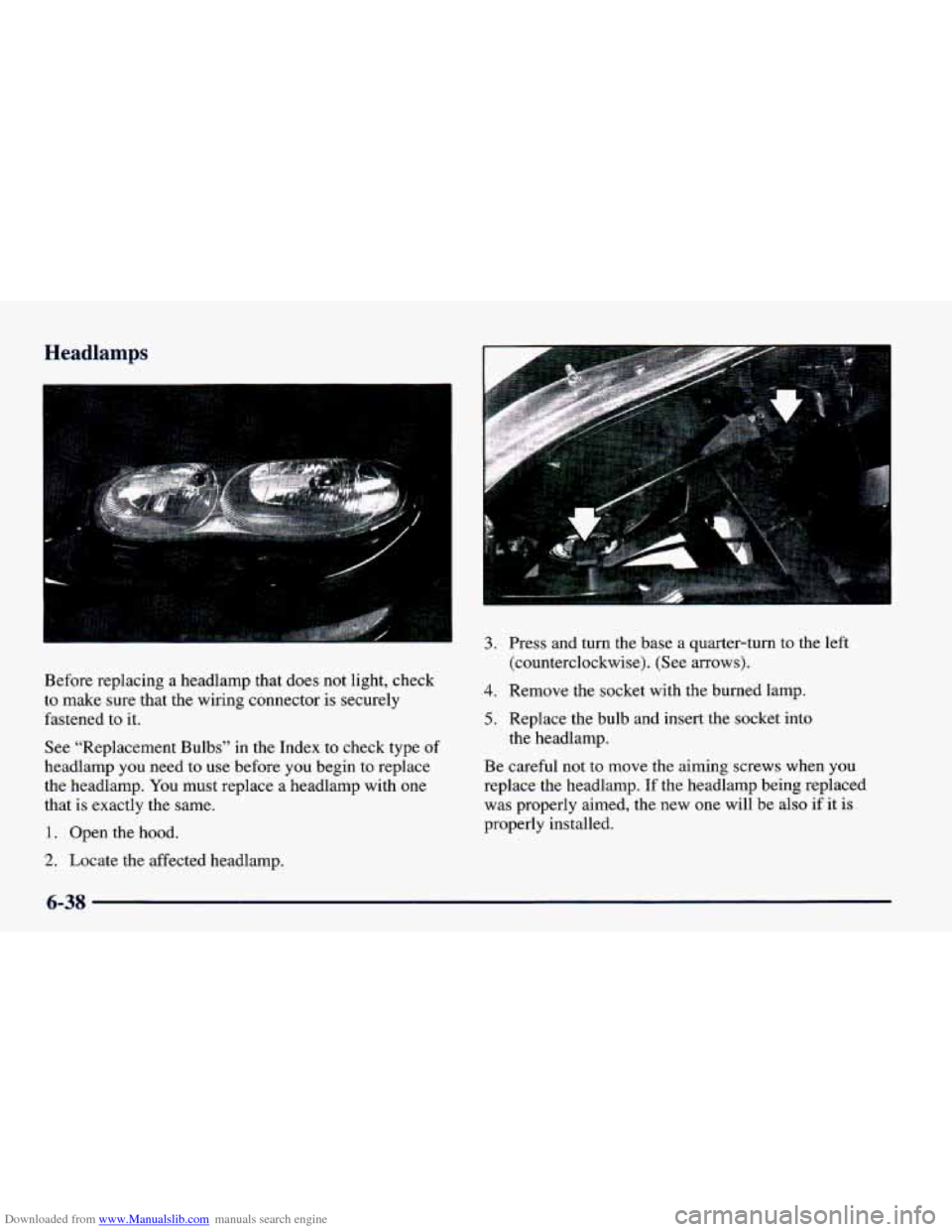
Downloaded from www.Manualslib.com manuals search engine Headlamns
3.
Before replacing a headlamp that does not light, check
to make sure that the wiring connector
is securely
fastened to
it.
See "Replacement Bulbs" in the Index to check type of
headlamp you need to use before you begin to replace
the headlamp.
You must replace a headlamp with one
that is exactly the same.
1. Open the hood.
2. Locate the affected headlamp.
4.
5.
Press and turn the base a quarter-turn to the left
(counterclockwise). (See arrows).
Remove the socket with
the burned lamp.
Replace the bulb and insert the socket into
the headlamp.
Be careful
not to move the aiming screws when you
replace the headlamp. If the headlamp being replaced
was properly aimed, the new one will be also
if it is
properly installed.
6-38