mirror CHEVROLET CAMARO 1998 4.G Owners Manual
[x] Cancel search | Manufacturer: CHEVROLET, Model Year: 1998, Model line: CAMARO, Model: CHEVROLET CAMARO 1998 4.GPages: 402, PDF Size: 21.2 MB
Page 69 of 402
Downloaded from www.Manualslib.com manuals search engine 0 Section 2 Features and Controls
Here you can learn about the many standard and optional features on your vehicle, and information on starting,
shifting and braking.
Also explained are the instrument panel and the warning systems that tell you if everything is
working properly -- and what to do if you have a problem.
2-2
2-4
2-7
2- 12
2- 13
2- 15
2-18
2-19
2-24
2-25
2-27
2-28
2-30 Keys
Door Locks
Keyless Entry
(If Equipped)
Hatch
Theft
Vehicle and Content Theft-DeterrenVAlarm
System (If Equipped)
PASS-Key@
I1
Feature Customization (if Equipped)
New Vehicle “Break-In”
Ignition Positions
Starting Your Engine
Engine Coolant Heater (Canada Only)
Automatic Transmission Operation 2-34
2-37
2-39 2-4 1
2-4
1
2-43
2-43
2-44
2-45
2-50
2-52
2-54
2-72
2-75
Manual Transmission Operation
Parking Brake Shifting Into PARK (P)
Parking Over Things That Bum
Engine Exhaust Shifting Out
of PARK (P)
Windows
Tilt Steering Wheel
Turn SignaVMultifunction Lever
Exterior Lamps
Interior Lamps
Mirrors
Instrument Panel
Warning Lights, Gages and Indicators
2-1
Page 120 of 402
Downloaded from www.Manualslib.com manuals search engine If your vehicle is equipped with the Vehicle and
Content Theft-DetenentlAlarm System and your fog
lamp switch
is on, the fog lamps may flash, along
with the parking lamps, to indicate operation
of the
Vehicle and Content Theft-DetemenVAlarm System.
See ‘Vehicle and Content Theft-DeterrendAlarm
System” in the Index.
Interior Lamps
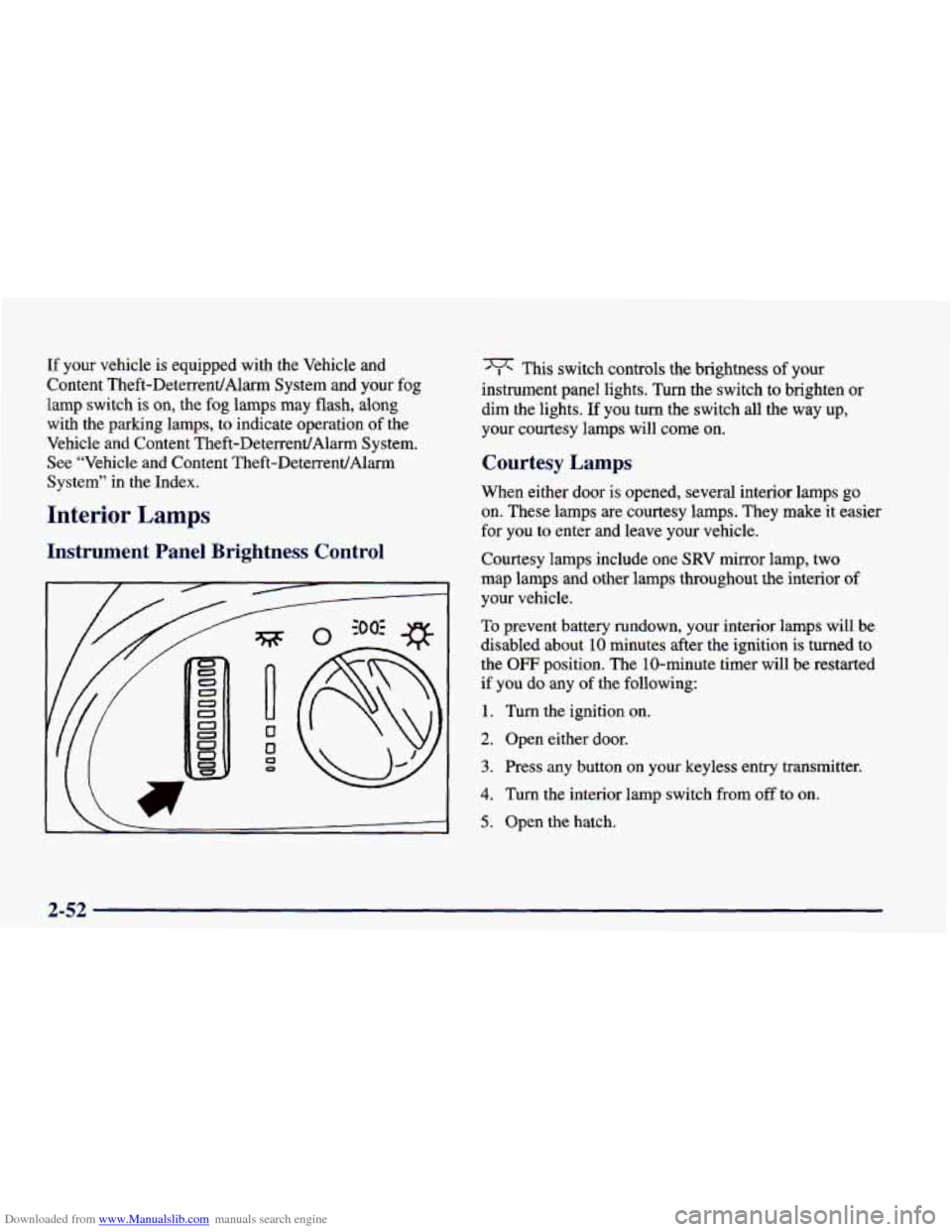
Instrument Panel Brightness Control
This switch controls the brightness of your
instrument panel lights. Turn the switch to brighten or
dim the lights.
If you turn the switch all the way up,
your courtesy lamps will come
on.
Courtesy Lamps
When either door is opened, several interior lamps go
on. These lamps are courtesy lamps. They make it easier
for you to enter and leave your vehicle.
Courtesy lamps include one
SRV mirror lamp, two
map lamps and other lamps throughout the interior of
your vehicle.
To prevent battery rundown, your interior lamps will be
disabled about
10 minutes after the ignition is turned to
the OFF position. The 10-minute timer will be restarted
if you do
any of the following:
1. Turn the ignition on.
2. Open either door.
3. Press any button on your keyless entry transmitter.
4. Turn the interior lamp switch from off to on.
5. Open the hatch.
2-52
Page 121 of 402
Downloaded from www.Manualslib.com manuals search engine Delayed Illumination
With delayed illumination, the courtesy lamps will come
on and stay on for
25 seconds after you close the doors
when entering the vehicle. They will also stay on for
five seconds after you close the doors when exiting the
vehicle. The times will be shortened if the ignition is
turned to
RUN or if the power locks are activated. To
turn this feature on or off, see “Feature Custornization”
in the Index.
Exit Lighting
With exit lighting, the interior lamps will come on when
you remove the key from the ignition to help you see
while exiting the vehicle.
To turn this feature on or off,
see “Feature Customization” in the Index.
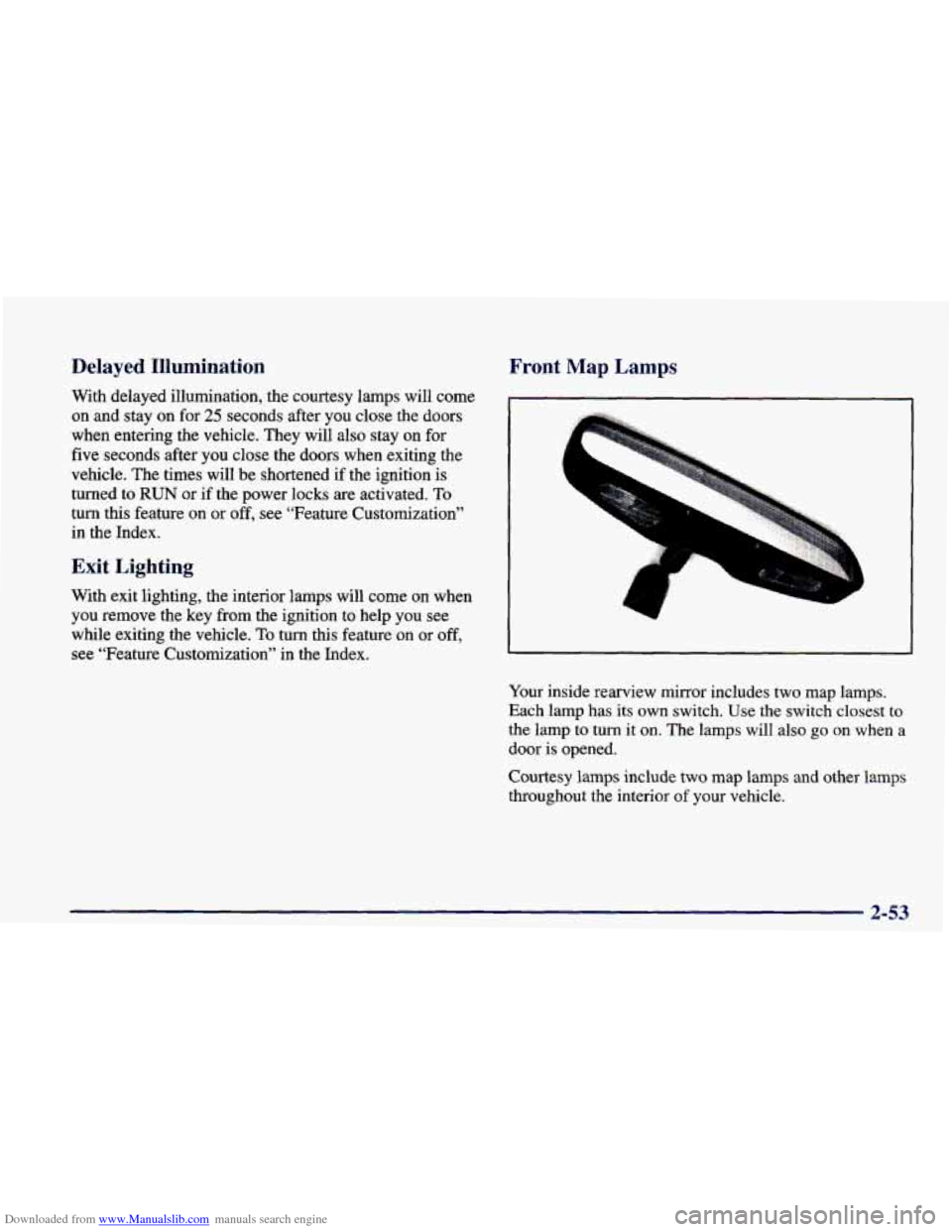
Front Map Lamps
Your inside rearview mirror includes two map lamps.
Each lamp has its own switch. Use the switch closest
to
the lamp to turn it on. The lamps will also go on when a
door is opened.
Courtesy lamps include two map lamps and other lamps
throughout the interior
of your vehicle.
Page 122 of 402
Downloaded from www.Manualslib.com manuals search engine Retained Accessory Power (RAP)
Your vehicle is equipped with a Retained Accessory
Power
(RAP) feature which will allow certain features
Mirrors
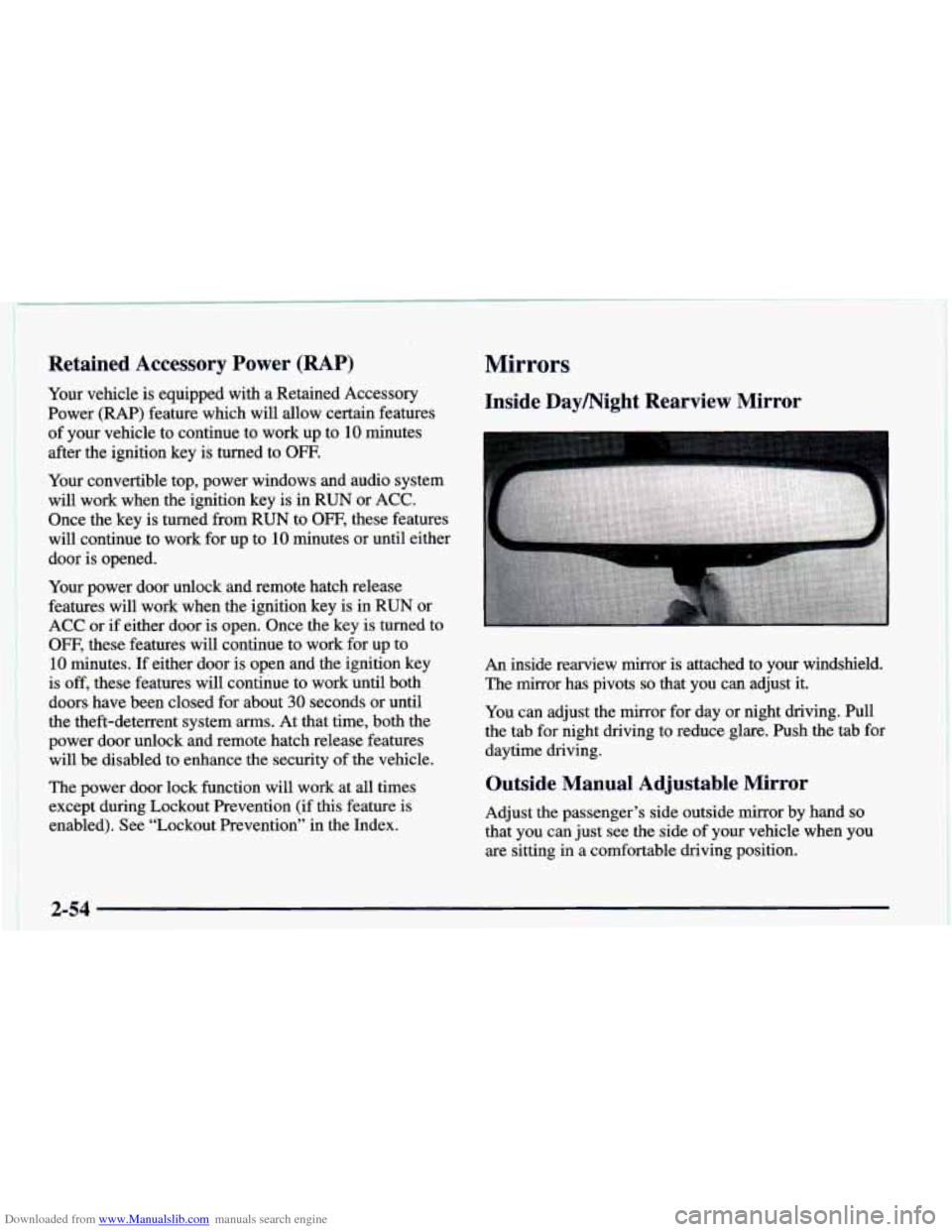
Inside Daymight Rearview Mirror
The power door lock function will work at all times
except during Lockout Prevention (if this feature is
enabled). See “Lockout Prevention” in the Index.
An inside rearview mirror is attached to your windshield.
The
mirror has pivots so that you can adjust it.
You can adjust the mirror for day or night driving. Pull
the tab for night driving to reduce glare. Push the tab for
daytime driving.
Outside Manual Adjustable Mirror
Adjust the passenger’s side outside mirror by hand so
that you can just see the side of your vehicle when you
are sitting in a comfortable driving position.
2-54
Page 123 of 402
Downloaded from www.Manualslib.com manuals search engine Manual Remote Control Mirror
Adjust the driver’s side outside mirror with the lever on
the door. Adjust the mirror so that you can just see the
side
of your vehicle when you are sitting in a
comfortable driving position.
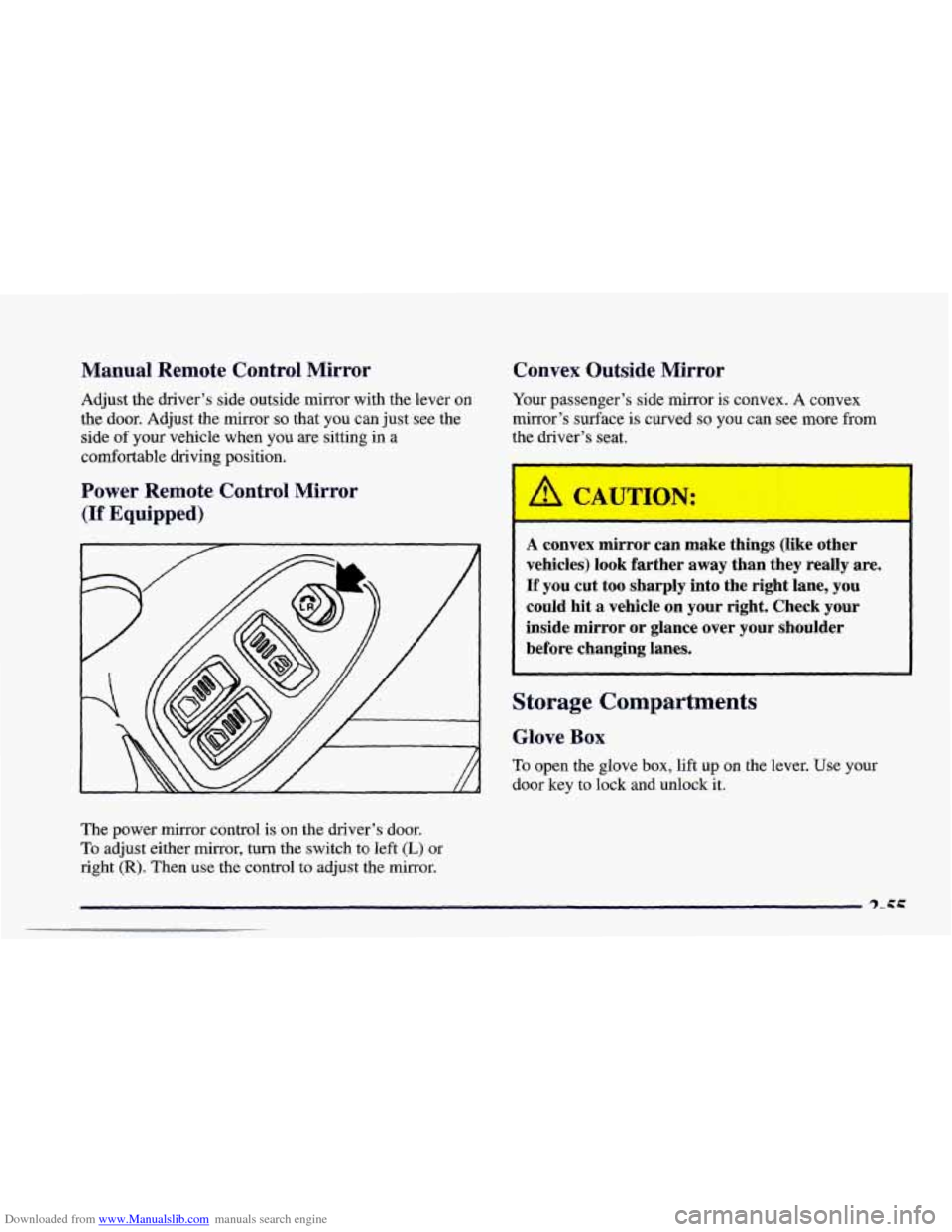
Power Remote Control Mirror (If Equipped)
The power mirror control is on the driver’s door.
To adjust either mirror, turn the switch to left (L) or
right
(R). Then use the control to adjust the mirror.
Convex Outside Mirror
Your passenger’s side mirror is convex. A convex
mirror’s surface is curved
so you can see more from
the driver’s seat.
A CAUTION:
A convex mirror can make things (like other
vehicles) look farther away than they really are.
If you cut
too sharply into the right lane, you
could hit a vehicle on your right. Check your
inside mirror or glance over your shoulder
before changing lanes.
Storage Compartments
Glove Box
To open the glove box, lift up on the lever. Use your
door key to lock and unlock it.
Page 126 of 402
Downloaded from www.Manualslib.com manuals search engine To use the lighter, push it in all the way and let go.
When it’s ready, it will pop back by itself.
~
NOTICE:
~~
I I 1 I
Don’t hold a cigarette lighter in with your hand
while
it is heating. If you do, it won’t be able to
back away from the heating element when it’s
ready. That can make it overheat, damaging the
lighter and the heating element.
If you plug accessories into your cigarette lighter, such
as heating devices or air compressors, these accessories
should have a rated current of less than 15 amps.
Exceeding
this limit will result in a blown fuse.
Sun Visors
To block out glare, you can swing down the visors. YQU
can also swing them to the side.
Visor Vanity Mirror
Pull down the sun visor and lift the cover to expose the
vanity mirror.
Accessory Plug
This plug is located inside the front section ahead of
the
shift lever in the console. The plug can be used to
connect electrical equipment such as a cellular phone or
CB radio. Be sure to follow the installation instructions
included with the equipment.
NOTICE:
When using the accessory plug:
0 The maximum load of any electrical
equipment should not exceed three amps.
Be sure to turn off any electrical equipment
when not in use. Leaving electrical
equipment
on for extended periods can
drain your battery.
We recommend that you see a qualified technician or
your dealer for the proper installation of your equipment.
2-58
Page 194 of 402
Downloaded from www.Manualslib.com manuals search engine 0 Check your mirrors, glance over your shoulder, and
start your left lane change signal before moving out
of the right lane to pass. When you are far enough
ahead
of the passed vehicle to see its front in your
inside mirror, activate your right lane change signal
and move back into the right lane. (Remember that
your right outside mirror is convex. The vehicle you
just passed may seem to be farther away from you
than
it really is.)
0 Try not to pass more than one vehicle at a time on
two-lane roads. Reconsider before passing the
next vehicle.
0 Don’t overtake a slowly moving vehicle too rapidly.
Even though the brake lamps
are not flashing, it may
be slowing down or starting to turn.
following driver to get ahead of you. Perhaps you
can ease a little to the right.
0 If you’re being passed, make it easy for the
Loss of Control
Let’s review what driving experts say about what
happens when the three control systems (brakes, steering
and acceleration)
don’t have enough friction where the
tires meet the road to do what the driver has asked.
Skidding
In a skid, a driver can lose control of the vehicle.
Defensive drivers avoid most skids by taking reasonable
care suited to existing conditions, and by not
“overdriving” those conditions. But skids
are
always possible.
The three types of
skids correspond to your vehicle’s
three control systems. In the braking skid, your wheels
aren’t rolling. In the steering or cornering skid, too
much speed or steering in a curve causes tires to
slip and
lose cornering force. And
in the acceleration skid, too
much throttle causes the driving wheels to spin.
A cornering skid is best handled by easing your foot off
the accelerator pedal.
If you have the ASR system, remember: It helps avoid
only the acceleration
skid.
If you do not have ASR, or if the system is off, then an
acceleration skid is also best handled by easing your
foot
off the accelerator pedal.
In any emergency, don’t give up. Keep trying to steer and
constantly seek an escape route or area
of less danger.
Page 195 of 402
Downloaded from www.Manualslib.com manuals search engine If your vehicle starts to slide, ease your foot off the
accelerator pedal and quickly steer the way you want the
vehicle to
go. If you start steering quickly enough, your
vehicle may straighten out. Always be ready for a
second skid if
it occurs.
Of course, traction is reduced when water, snow, ice,
gravel or other material is on the road. For safety, you’ll
want to slow down and adjust your driving to these
conditions. It is important to slow down on slippery
surfaces because stopping distance will be longer and
vehicle control more limited.
While driving on a surface with reduced traction,
try
your best to avoid sudden steering, acceleration or
braking (including engine braking by shifting to
a lower
gear). Any sudden changes could cause the tires to slide.
You may not realize the surface is slippery until your
vehicle
is skidding. Learn to recognize warning
clues
-- such as enough water, ice or packed snow on
the road to make a “mirrored surface”
-- and slow down
when you have any doubt.
Remember: Any anti-lock brake system (ABS) helps
avoid only the braking skid.
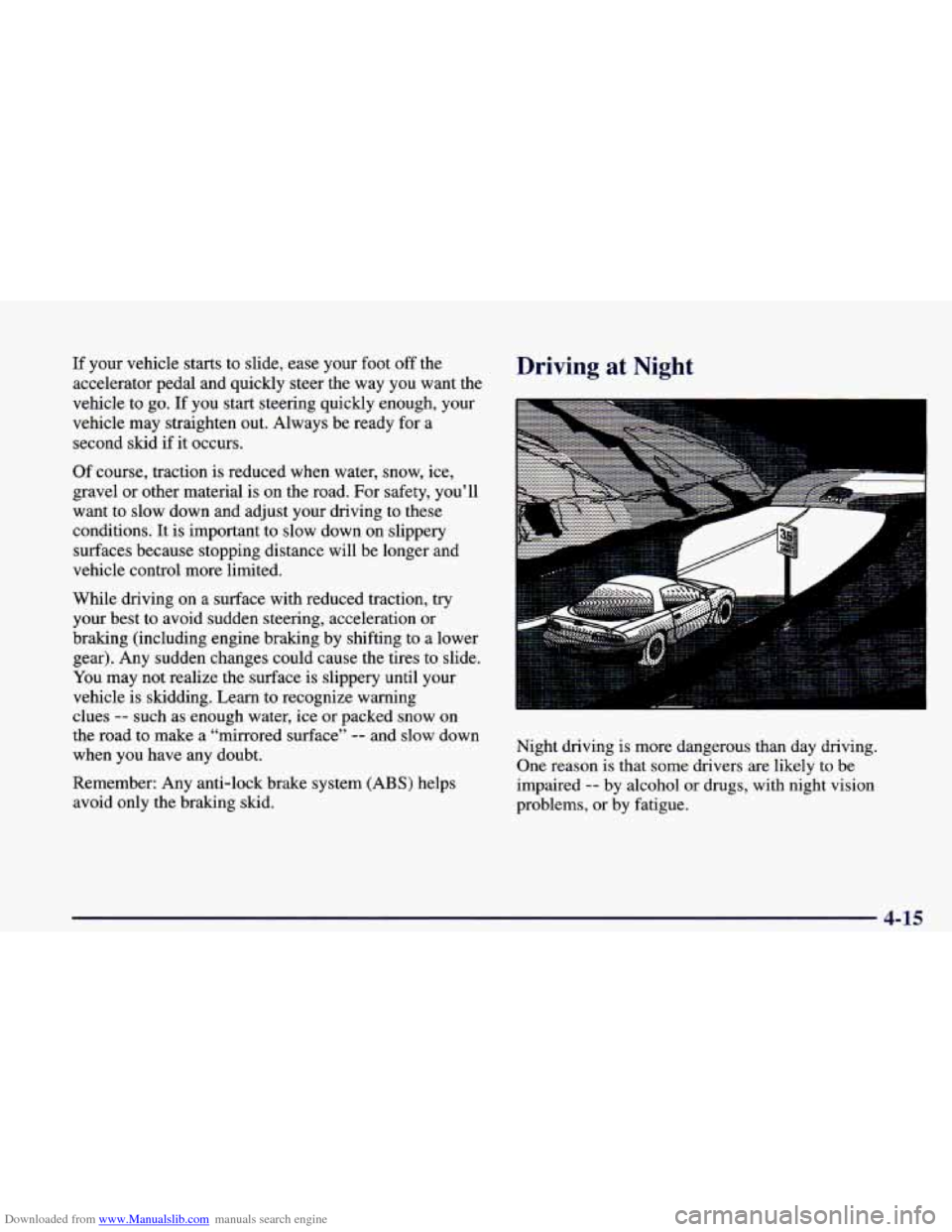
Driving at Night
Night driving is more dangerous than day driving.
One reason is that some drivers are likely to be
impaired
-- by alcohol or drugs, with night vision
problems, or
by fatigue.
4-15
Page 196 of 402
Downloaded from www.Manualslib.com manuals search engine Here are some tips on night driving.
0
0
0
0
0
0
0
Drive defensively.
Don’t drink and drive.
Adjust
your inside rearview mirror to reduce the
glare from headlamps behind you.
Since you can’t see as well, you may need to
slow down and keep more space between you and
other vehicles.
Slow down, especially on higher speed roads. Your
headlamps can light up only
so much road ahead.
In remote areas, watch for animals.
If you’re tired, pull off the road in a safe place
and rest.
Night Vision
No one can see as well at night as in the daytime. But as
we get older these differences increase. A 50-year-old
driver may require at least twice as much light to see the
same thing at night as a 20-year-old.
What you do in the daytime can also affect your night
vision. For example, if you spend the day in bright
sunshine you are wise to wear sunglasses. Your eyes will
have less trouble adjusting to night. But if you’re driving,
don’t wear sunglasses at night. They may cut
down on glare from headlamps, but they also make
a lot
of things invisible.
You can be temporarily blinded by approaching
headlamps. It can take
a second or two, or even several
seconds, for your eyes to readjust to the dark. When
you
are faced with severe glare (as from a driver who
doesn’t lower the high beams, or
a vehicle with
misaimed headlamps), slow
down a little. Avoid staring
directly into the approaching headlamps.
Keep your windshield and all the glass on your vehicle
clean
-- inside and out. Glare at night is made much
worse by dirt on the glass. Even the inside of the glass
can build up
a film caused by dust. Dirty glass makes
lights dazzle and flash more than clean glass would,
making the pupils of your eyes contract repeatedly.
Remember that your headlamps light up far less of
a
roadway when you are in a turn or curve. Keep your
eyes moving; that way, it’s easier to pick out dimly
lighted objects. Just as your headlamps should be
checked regularly for proper aim,
so should your eyes
be examined regularly. Some drivers suffer from night
blindness
-- the inability to see in dim light -- and aren’t
even aware
of it.
4-16
Page 201 of 402
Downloaded from www.Manualslib.com manuals search engine At the entrance, there is usually a ramp that leads to the
freeway.
If you have a clear view of the freeway as you
drive along the entrance ramp, you should begin to
check traffic. Try to determine where you expect to
blend with the flow.
Try to merge into the gap at close to
the prevailing speed. Switch on your turn signal, check
your mirrors and glance over your shoulder as often
as
necessary. Try to blend smoothly with the traffic flow.
Once you are on the freeway, adjust your speed to the
posted limit or to the prevailing rate if it’s slower. Stay
in the right lane unless you want to pass.
Before changing lanes, check your mirrors. Then use
your turn signal.
Just before you leave the lane, glance quickly over your
shoulder to make sure there isn’t another vehicle in your
“blind” spot.
Once you are moving on the freeway, make certain you
allow
a reasonable following distance. Expect to move
slightly slower at night.
When you want to leave the freeway, move
to the proper
lane well in advance.
If you miss your exit, do not,
under any circumstances, stop and back up. Drive
on to
the next exit. The exit
ramp can be curved, sometimes quite sharply.
The exit speed is usually posted.
Reduce your speed according to your speedometer, not
to your sense of motion. After driving for any distance
at higher speeds, you may tend to think you are going
slower than you actually are.
Before Leaving on a Long Trip
Make sure you’re ready. Try to be well rested. If you
must start when you’re not fresh
-- such as after a day’s
work
-- don’t plan to make too many miles that first part
of the journey. Wear comfortable clothing and shoes you
can easily drive in.
Is your vehicle ready for a long trip?
If you keep it
serviced and maintained, it’s ready to go. If it needs
service, have it done before starting out. Of course,
you’ll find experienced and able service
experts in
Chevrolet dealerships all across North America. They’ll
be ready and willing to help if you need it.
4-21