oil level CHEVROLET CAMARO 1998 4.G Owners Manual
[x] Cancel search | Manufacturer: CHEVROLET, Model Year: 1998, Model line: CAMARO, Model: CHEVROLET CAMARO 1998 4.GPages: 402, PDF Size: 21.2 MB
Page 152 of 402

Downloaded from www.Manualslib.com manuals search engine It may vary with engine speed, outside temperature and
oil viscosity, but readings above the red area show the
normal operating range. Readings in the red area tell
you that the engine is low on oil, or that you might have
some other oil problem. See “Engine Oil” in
the Index.
Don’t keep driving if the oil pressure is low. If
you do, your engine can become so hot that it
catches fire. You or others could be burned.
Check your oil as soon
as possible and have your
vehicle serviced.
NOTICE:
Damage to your engine from neglected oil
problems can be costly and
is not covered by
your warranty.
Low Oil Light
This warning light should
come on while you are
starting your engine.
If
the light doesn’t come on,
have
it repaired.
LOW OIL
I
If the light stays on after starting your engine, your
engine oil level may be too low. You may need to add
oil. See “Engine Oil’’ in the Index.
NOTICE:
The oil level monitoring system only checks the
oil level when you are starting your engine. It
does not keep monitoring the level once the
engine is running. Also, the oil level check only
works when the engine has been turned
off long
enough for the
oil to drain back into the oil pan.
2-84
Page 202 of 402
Downloaded from www.Manualslib.com manuals search engine Here are some things you can check before a trip:
a
a
a
e
a
Windshield Washer Fluid: Is the reservoir full? Are
all windows clean inside and outside?
Wiper Blades: Are they in good shape?
Fuel, Engine Oil, Other Fluids: Have you checked
all levels?
Lumps: Are they all working? Are the lenses clean?
Tires: They are vitally important to a safe,
trouble-free trip.
Is the tread good enough for
long-distance driving?
Are the tires all inflated to the
recommended pressure?
Weather Forecasts: What’s the weather outlook
along your route? Should you delay your trip a short
time to avoid a major storm system?
Maps: Do you have up-to-date maps?
Highway Hypnosis
Is there actually such a condition as “highway hypnosis”?
Or
is it just plain falling asleep at the wheel? Call it
highway hypnosis, lack of awareness, or whatever.
There is something about an easy stretch of road with
the same scenery, along with the hum of the tires on the
road, the drone of the engine, and the rush of the wind
against the vehicle that can make you sleepy. Don’t let it
happen to you! If it does, your vehicle can leave the
road in
less than a second, and you could crash and
be injured.
What can you
do about highway hypnosis? First, be
aware that it can happen.
Then here are some tips:
Make sure your vehicle is well ventilated, with a
comfortably cool interior.
Keep your eyes moving. Scan the road ahead and to
the sides. Check your rearview mirrors and your
instruments frequently.
If you get sleepy, pull off the road into a rest, service
or parking area and take a nap, get some exercise, or
both. For safety, treat drowsiness on the highway as
an emergency.
Page 259 of 402
Downloaded from www.Manualslib.com manuals search engine Section 6 Service and Appearance Care
Here you will find information about the care of your vehicle. This section begins with service and fuel information,
and then it shows how to check important fluid and lubricant levels. There is also technical information about your
vehicle, and
a part devoted to its appearance care.
6-2
6-3 6-5
6-6 6-8
6-8
6- 12
6-18
6-20
6-24
6-26
6-30
6-3
1
6-33
6-37 Service
Fuel
Fuels in Foreign Countries
Filling Your Tank
Filling
a Portable Fuel Container
Checking Things Under the Hood
Engine Oil
Air Cleaner
Automatic Transmission Fluid
Manual Transmission Fluid
Engine Coolant
Power Steering Fluid
Windshield Washer Fluid
Brakes
Battery 6-37
6-43
6-52
6-53
6-55
6-57 6-5 8
6-60
6-6
1
6-62
6-62
6-69
6-69 Bulb Replacement
Tires
Appearance Care Cleaning the Inside
of Your Vehicle
Care of Safety Belts
Cleaning the Outside of Your Vehicle
Cleaning Aluminum or Chrome Wheels
(If Equipped)
Underbody Maintenance
Appearance Care Materials
Chart
Vehicle Identification Number (VIN)
Electrical System Replacement Bulbs
Capacities and Specifications
6-1
Page 270 of 402
Downloaded from www.Manualslib.com manuals search engine Before closing the hood, be sure all the filler caps
are on.
Then just pull the hood down and close it firmly.
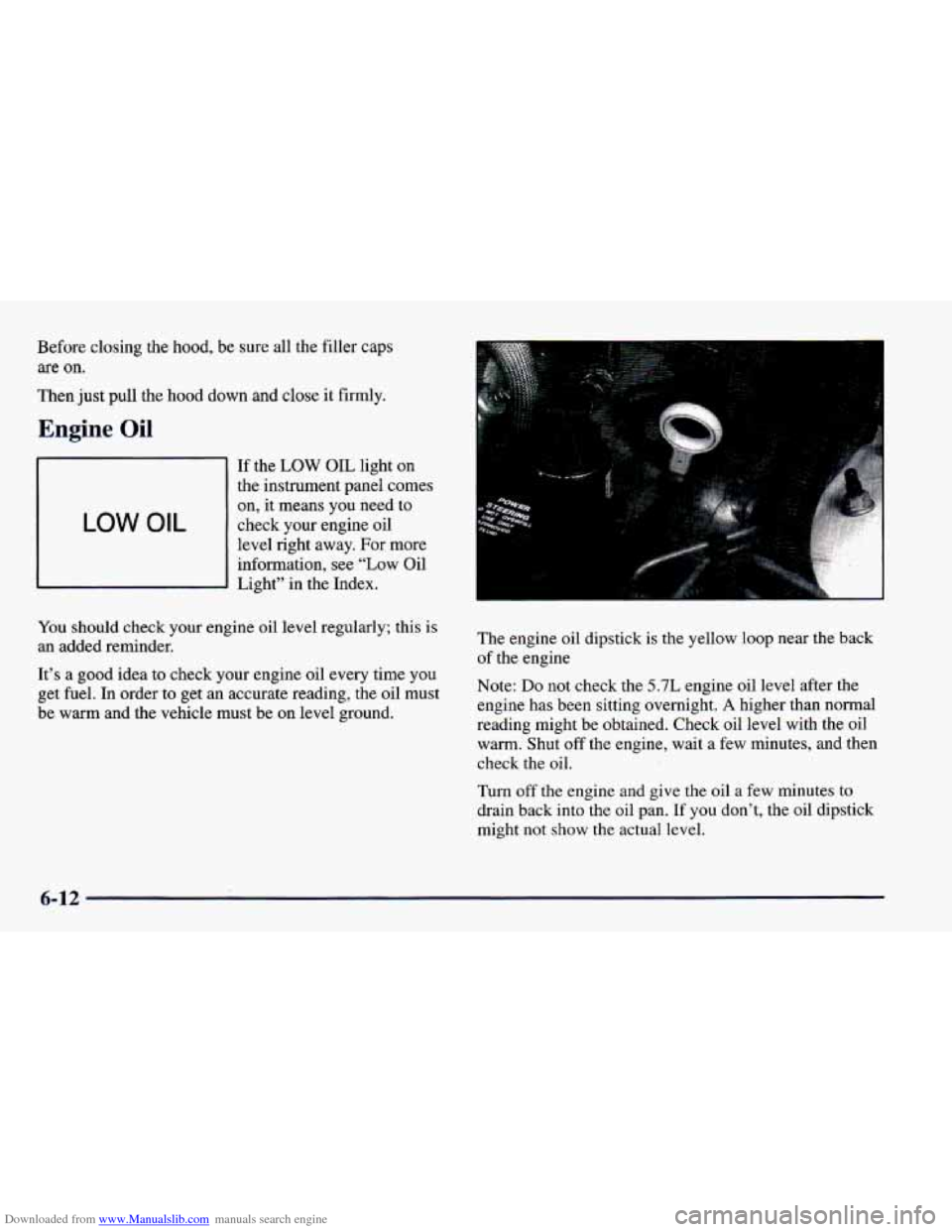
Engine Oil
LOW OIL
If the LOW OIL light on
the instrument panel comes
on, it means you need to
check your engine oil
level right
away. For more
information, see “Low Oil
Light”
in the Index.
You
should check your engine oil level regularly; this is
an added reminder.
It’s a good idea to check your engine oil every time you
get
fuel. In order to get an accurate reading, the oil must
be warm and the vehicle must be on level ground. The
engine oil dipstick is the yellow loop near the back
of the engine
Note: Do not check the 5.7L engine oil level after the
engine has been sitting overnight,
A higher than normal
reading might be obtained. Check oil level with the oil
warm. Shut off the engine, wait a few minutes, and then
check the oil.
Turn off the engine and give the oil a few minutes to
drain back into the oil pan.
If you don’t, the oil dipstick
might not show the actual level.
6-12
Page 272 of 402
Downloaded from www.Manualslib.com manuals search engine NOTICE:
Don’t add too much oil. If your engine has so
much oil that the oil level gets above the
cross-hatched area upper mark that shows the proper operating range, your engine
could be damaged.
The oil fill cap is located on the valve cover near the
oil dipstick.
Be sure to fill it enough to put the level somewhere in
the proper operating range. Push the dipstick all the way
back in when you’re through.
What Kind of Engine Oil to Use
Oils recommended for your vehicle can be identified by
looking
for the “Starburst” symbol. This symbol
indicates that the oil has been certified by the American
Petroleum Institute (API).
Do not use any oil which
does not carry this Starburst symbol.
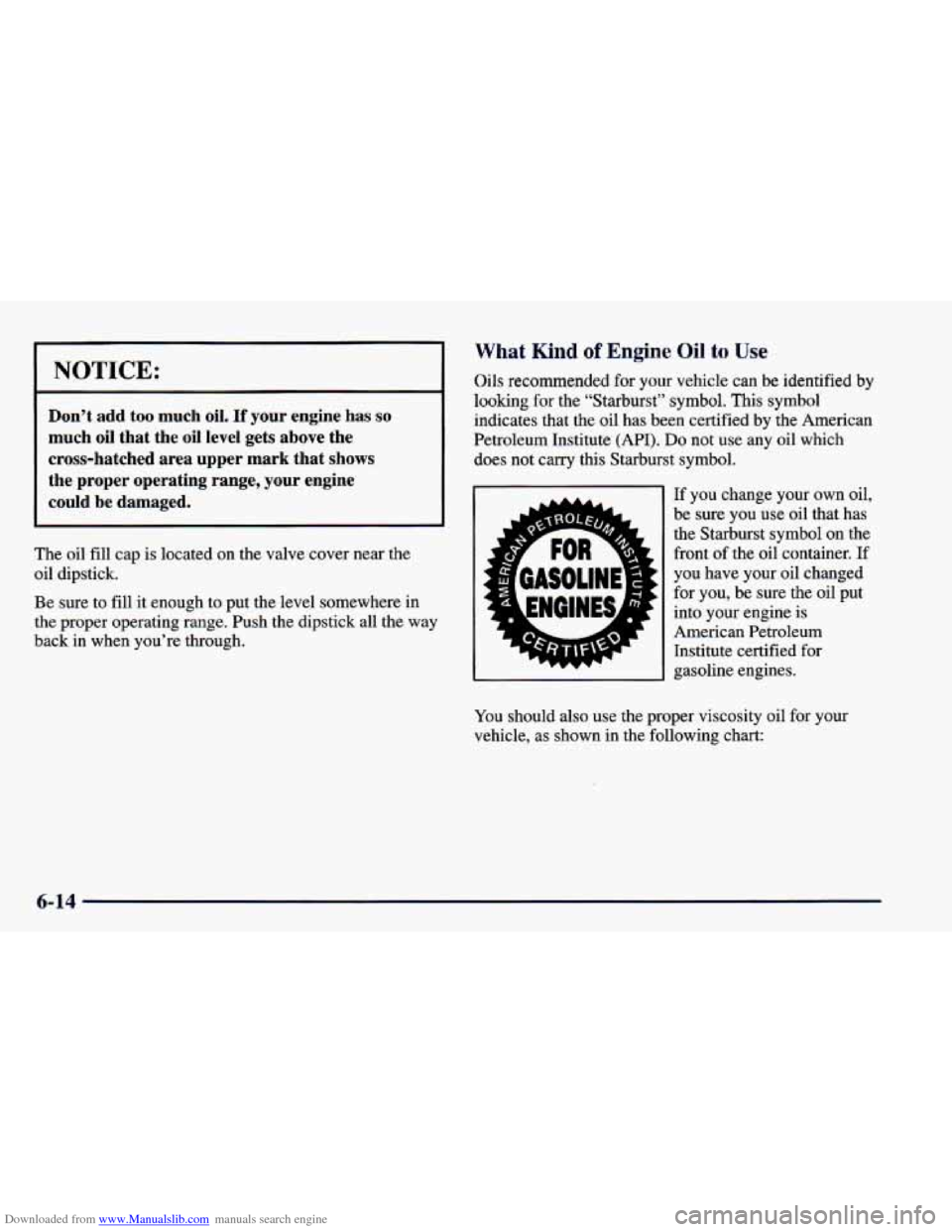
If you change your own oil,
be sure you use oil that has
the Starburst symbol on the
front
of the oil container. If
you have your oil changed
for you, be sure the oil put
into your engine is
American Petroleum
Institute certified for
gasoline engines.
You should also use the proper viscosity oil for your
vehicle,
as shown in the following chart:
6-14
Page 278 of 402
Downloaded from www.Manualslib.com manuals search engine Automatic Transmission Fluid
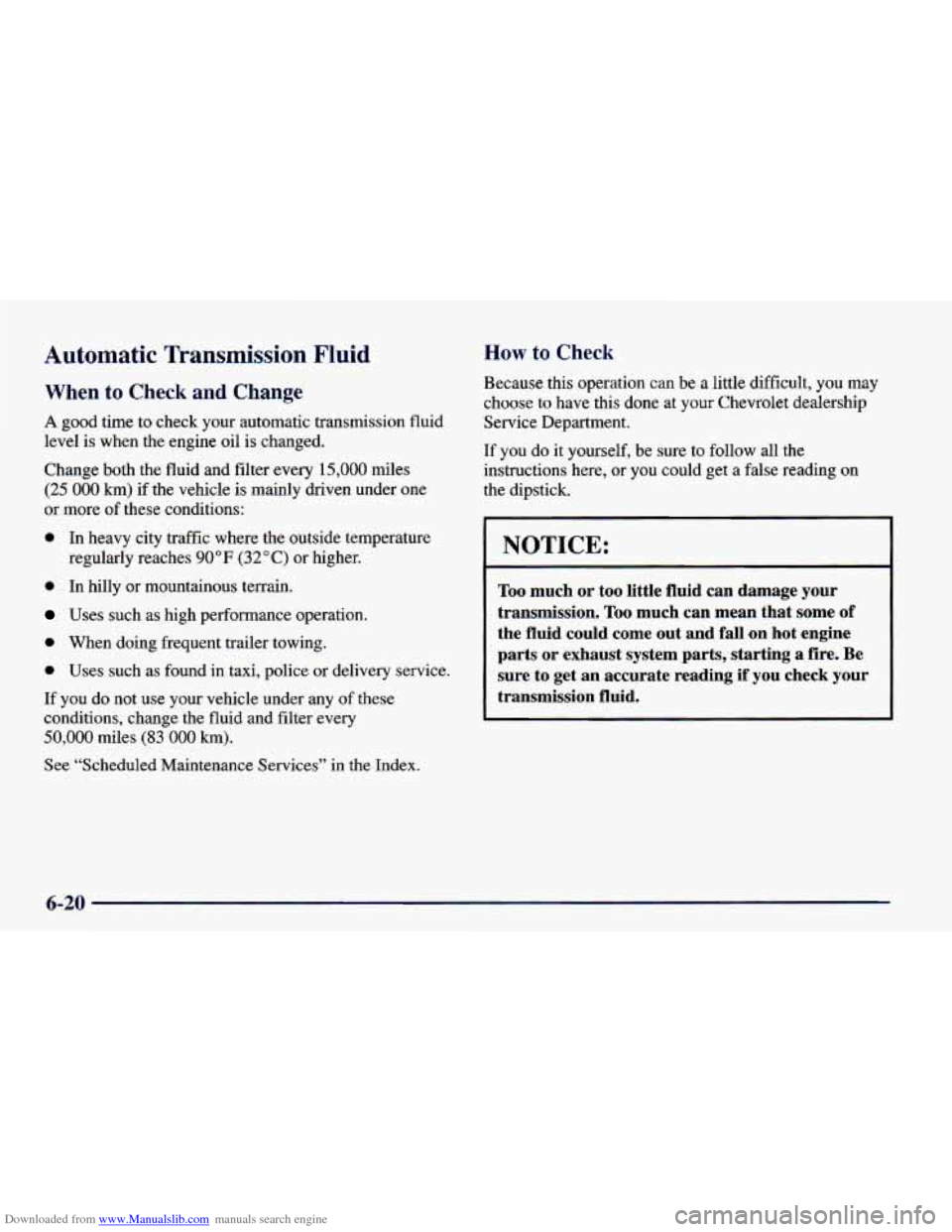
When to Check and Change
A good time to check your automatic transmission fluid
level is when the engine oil is changed.
Change both the fluid and filter every
15,000 miles
(25 000 km) if the vehicle is mainly driven under one
or more of these conditions:
0 In heavy city traffic where the outside temperature
0 In hilly or mountainous terrain.
Uses such as high performance operation.
regularly reaches
90°F (32°C) or
higher.
0 When doing frequent trailer towing.
0 Uses such as found in taxi, police or delivery service.
If you do not use your vehicle under any of these
conditions, change
the fluid and filter every
50,000 miles (83 000 km).
How to Check
Because this operation can be a little difficult, you may
choose to have this done at your Chevrolet dealership
Service Department.
If you do it yourself, be sure to follow all the
instructions here, or you could get a false reading on
the dipstick.
-- --
NOTICE:
Too much or too little fluid can damage your
transmission.
Too much can mean that some of
the fluid could come out and fall on hot engine
parts
or exhaust system parts, starting a fire. Be
sure to get an accurate reading if you check your transmission fluid.
See “Scheduled Maintenance Services’’ in the Index.
6-20
Page 282 of 402
Downloaded from www.Manualslib.com manuals search engine NOTICE:
We recommend you use only fluid labeled
DEXR0N’-III, because fluid with that label
is
made especially for your automatic transmission.
Damage caused
by fluid other than DEXRON-111
is not covered by your new vehicle warranty.
0 After adding fluid, recheck the fluid level as
0 When the correct fluid level is obtained, push the
described
under “How
to Check.”
dipstick back in
all the way.
Manual Transmission Fluid
When to Check
A good time to have it checked is when the engine
oil is changed. However, the fluid in your manual
transmission doesn’t require changing.
How to Check
Because this operation can be difficult, you may
choose to have this done at your Chevrolet dealership
Service Department.
If you do it yourself, be sure to follow all the
instructions here, or you could get a false reading.
NOTICE:
Too much or too little fluid can damage your
transmission.
Too much can mean that some of
the fluid could come out and fall on hot engine
parts or exhaust system parts, starting a fire.
Be
sure to get an accurate reading if you check your
transmission fluid.
Check the fluid level only when your engine is off, the
vehicle
is parked on a level place and the transmission
is cool enough for you to rest your fingers
on the
transmission case.
Then, follow these steps:
1. Remove the filler plug.
2. Check that the lubricant level is up to the bottom of
the filler plug hole.
3. If the fluid level is good, install the plug and be sure
it is fully seated. If the fluid level is
low, add more
fluid as described in the next steps.
6-24
Page 328 of 402
Downloaded from www.Manualslib.com manuals search engine Capacities (Approximate)
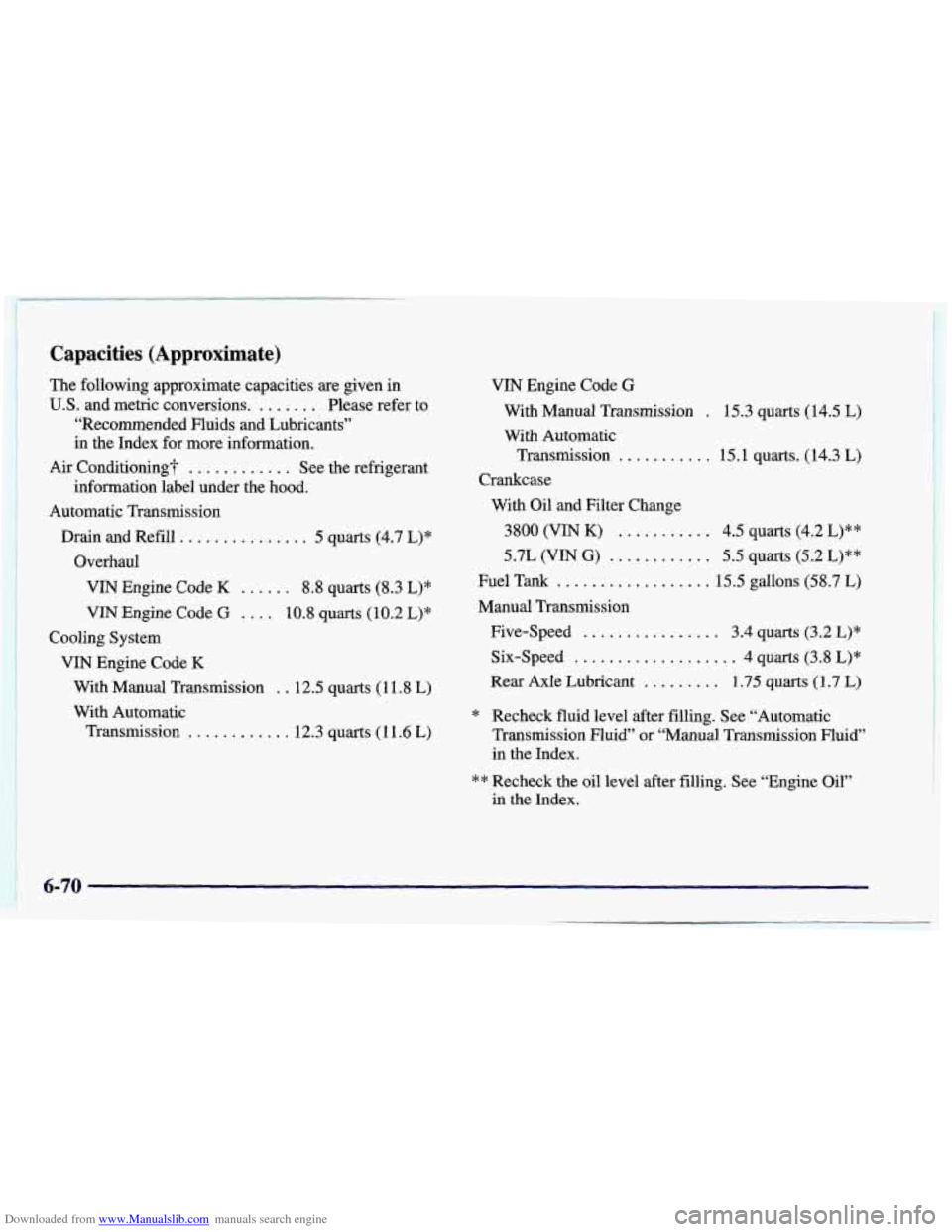
The following approximate capacities are given in
U.S. and metric conversions. ....... Please refer to
“Recommended Fluids and Lubricants”
in the Index for more information.
information label under the hood.
Air Conditioning? ............ See the refrigerant
Automatic Transmission Drain and Refill
............... 5 quarts (4.7 L)*
VIN Engine Code K ...... 8.8 quarts (8.3 L)*
Overhaul
VIN Engine Code
G .... 10.8 quarts (10.2 L)*
Cooling System VIN Engine Code
K
With Manual Transmission . . 12.5 quarts (11.8 L)
With Automatic
Transmission
............ 12.3 quarts (1 1.6 L)
VIN Engine Code G
With Manual Transmission . 15.3 quarts (14.5 L)
With Automatic Transmission
........... 15.1 quarts. (14.3 L)
Crankcase
With Oil and Filter Change
3800 (VIN K) ........... 4.5 quarts (4.2 L)**
5.7L (VIN G) ............ 5.5 quarts (5.2 L)**
Fuel Tank .................. 15.5 gallons (58.7 L)
Manual Transmission
Five-Speed
................ 3.4 quarts (3.2 L)*
Six-Speed ................... 4 quarts (3.8 L)*
Rear Axle Lubricant ......... 1.75 quarts (1.7 L)
* Recheck fluid level after filling. See “Automatic
Transmission Fluid” or “Manual Transmission Fluid”
in the Index.
** Recheck the oil level after filling. See “Engine Oil”
in the Index.
6-70
Page 332 of 402
Downloaded from www.Manualslib.com manuals search engine IMPORTANT:
KEEP ENGINE OIL
AT THE PROPER
LEVEL AND CHANGE AS
RECOMMENDED
I
HI protection
Plan
Have you purchased the GM Protection Plan ? The Plan
supplements your new vehicle warranties. See your
Warranty and Owner Assistance booklet, or your
Chevrolet dealer for details.
Introduction
Your Vehicle and the Environment
Proper vehicle maintenance not only helps to keep your
vehicle in good working condition, but also helps the
environment. All recommended maintenance procedures
are important. Improper vehicle maintenance can even
affect
the quality of the air we breathe. Improper fluid
levels or the wrong tire inflation can increase the level
of emissions from your vehicle.
To help protect our
environment, and to keep your vehicle in
good
condition, please maintain your vehicle properly.
7-2
Page 362 of 402
Downloaded from www.Manualslib.com manuals search engine Part B: Owner Checks and Services
Listed below are owner checks and services which
should be performed at the intervals specified to help
ensure the safety, dependability and emission control
performance of your vehicle.
Be sure any necessary repairs are completed at once.
Whenever
any fluids or lubricants are added to your
vehicle, make sure they are the proper ones, as shown
in
Part D.
At Each Fuel Fill
It is important for you or a service station attendant to
pegorm these underhood checks at eachfielfill.
Engine Oil Level Check
Check the engine oil level and add the proper oil if
necessary. See “Engine Oil” in
the Index for
further details.
Engine Coolant Level Check
Check the engine coolant level and add DEX-COOL@
coolant mixture if necessary. See “Engine Coolant” in
the Index for further details.
Windshield Washer Fluid Level Check
Check the windshield washer fluid level in the windshield
washer tank and add the proper fluid if necessary. See
“Windshield Washer Fluid”
in the Index for further details.
At Least Once a Month
Tire Inflation Check
Make sure tires are inflated to the correct pressures. See
“Tires” in the Index for further details.
Cassette Deck Service
Clean cassette deck. Cleaning should be done every
50 hours of tape play. See “Audio Systems” in the
Index for further details.
7-32