light CHEVROLET CAMARO 2010 5.G Owners Manual
[x] Cancel search | Manufacturer: CHEVROLET, Model Year: 2010, Model line: CAMARO, Model: CHEVROLET CAMARO 2010 5.GPages: 378, PDF Size: 5.75 MB
Page 294 of 378
Black plate (62,1)Chevrolet Camaro Owner Manual - 2010
9-62 Vehicle Care
.Operating electronic devices or
being near facilities using radio
wave frequencies similar to the
TPMS could cause the TPMS
sensors to malfunction.
If the TPMS is not functioning it
cannot detect or signal a low tire
condition. See your dealer for
service if the TPMS malfunction
light and DIC message comes on
and stays on.
TPMS Sensor Matching
Process
Each TPMS sensor has a unique
identification code. Any time you
replace one or more of the TPMS
sensors or rotate your vehicle's
tires, the identification codes need
to be matched to the new tire/wheel
position. The sensors are matched
to the tire/wheel positions in the
following order: driver side front tire,
passenger side front tire, passenger
side rear tire, and driver side rear
tire using a TPMS diagnostic tool.
See your dealer for service. The TPMS sensors can also be
matched to each tire/wheel position
by increasing or decreasing the
tire's air pressure. If increasing the
tire's air pressure, do not exceed
the maximum inflation pressure
indicated on the tire's sidewall.
To decrease the tire's air-pressure
use the pointed end of the valve
cap, a pencil-style air pressure
gauge, or a key.
You have two minutes to match
the first tire/wheel position, and
five minutes overall, to match all
four tire/wheel positions. If it takes
longer than two minutes, to match
the first tire and wheel, or more than
five minutes to match all four tire
and wheel positions, the matching
process stops and you need to
start over.
The TPMS matching process is
outlined below:
1. Set the parking brake.
2. Turn the ignition switch to
ON/RUN with the engine off. 3. Go to the TPM vehicle
information screen on the DIC.
See Driver Information Center
(DIC)
on page 4‑28. Press set
to relearn the sensors. The horn
sounds twice to signal the
receiver is in relearn mode and
Tire Learning Active message
displays on the DIC screen.
4. Start with the driver side front tire.
5. Remove the valve cap from the valve stem. Activate the
TPMS sensor by increasing or
decreasing the tire's air pressure
for 10 seconds, or until a horn
chirp sounds. The horn chirp,
which can take up to 30 seconds
to sound, confirms that the
TPMS sensor identification code
has been matched to this tire
position.
6. Proceed to the passenger side front tire, and repeat the
procedure in Step 5.
Page 300 of 378
Black plate (68,1)Chevrolet Camaro Owner Manual - 2010
9-68 Vehicle Care
The Uniform Tire Quality
Grading (UTQG) system
does not apply to deep
tread, winter-type snow tires,
space-saver, or temporary use
spare tires, tires with nominal
rim diameters of 10 to 12 inches
(25 to 30 cm), or to some
limited-production tires.
While the tires available on
General Motors passenger
cars and light trucks may vary
with respect to these grades,
they must also conform to
federal safety requirements and
additional General Motors Tire
Performance Criteria (TPC)
standards.
All Passenger Car Tires Must
Conform to Federal Safety
Requirements In Addition To
These Grades.Treadwear
The treadwear grade is a
comparative rating based
on the wear rate of the tire
when tested under controlled
conditions on a specified
government test course.
For example, a tire graded
150 would wear one and a
half (1½) times as well on the
government course as a tire
graded 100. The relative
performance of tires depends
upon the actual conditions of
their use, however, and may
depart significantly from the
norm due to variations in
driving habits, service practices
and differences in road
characteristics and climate.
Traction
–AA, A, B, C
The traction grades, from
highest to lowest, are AA, A, B,
and C. Those grades represent
the tire's ability to stop on wet
pavement as measured under
controlled conditions on
specified government test
surfaces of asphalt and
concrete. A tire marked C may
have poor traction performance.
Warning: The traction grade
assigned to this tire is based on
straight-ahead braking traction
tests, and does not include
acceleration, cornering,
hydroplaning, or peak
traction characteristics.
Page 307 of 378

Black plate (75,1)Chevrolet Camaro Owner Manual - 2010
Vehicle Care 9-75
Always do a safety check first.
SeeIf a Tire Goes Flaton
page 9‑71. Do not remove any
objects that have penetrated
the tire.
1. Remove the tire sealant and compressor kit from its storage
location. See Storing the Tire
Sealant and Compressor Kit
on
page 9‑79.
2. Unwrap the sealant/air hose (F) and the power plug (G).
3. Place the kit on the ground.
Make sure the tire valve stem is
positioned close to the ground
so the hose will reach it.
4. Remove the valve stem cap from the flat tire by turning it
counterclockwise. 5. Attach the sealant/air hose (F)
onto the tire valve stem. Turn it
clockwise until it is tight.
6. Plug the power plug (G) into the accessory power outlet in the
vehicle. Unplug all items from
other accessory power outlets.
See Power Outlets
on
page 4‑9.
If the vehicle has an accessory
power outlet, do not use the
cigarette lighter.
If the vehicle only has a cigarette
lighter, use the cigarette lighter.
Do not pinch the power plug
cord in the door or window.
7. Start the vehicle. The vehicle must be running while using the
air compressor. 8. Turn the selector switch (B)
clockwise to the Sealant + Air
position.
9. Press the on/off (A) button to turn the tire sealant and
compressor kit on.
The compressor will inject
sealant and air into the tire.
The pressure gauge (D) will
initially show a high pressure
while the compressor pushes the
sealant into the tire. Once the
sealant is completely dispersed
into the tire, the pressure will
quickly drop and start to rise
again as the tire inflates with
air only.
Page 310 of 378

Black plate (78,1)Chevrolet Camaro Owner Manual - 2010
9-78 Vehicle Care
2. Unwrap the air only hose (E)and the power plug (G).
3. Place the kit on the ground. Make sure the tire valve stem is
positioned close to the ground
so the hose will reach it.
4. Remove the tire valve stem cap from the flat tire by turning it
counterclockwise.
5. Attach the air only hose (E) onto the tire valve stem by turning it
clockwise until it is tight.
6. Plug the power plug (G) into the accessory power outlet in the
vehicle. Unplug all items from
other accessory power outlets.
See Power Outlets
on
page 4‑9.
If the vehicle has an accessory
power outlet, do not use the
cigarette lighter.
If the vehicle only has a cigarette
lighter, use the cigarette lighter.
Do not pinch the power plug
cord in the door or window. 7. Start the vehicle. The vehicle
must be running while using the
air compressor.
8. Turn the selector switch (B) counterclockwise to the Air Only
position.
9. Press the on/off (A) button to turn the compressor on.
The compressor will inflate the
tire with air only.
10. Inflate the tire to the recommended inflation
pressure using the pressure
gauge (D). The recommended
inflation pressure can be found
on the Tire and Loading
Information label. See Tire
Pressure on page 9‑56.
The pressure gauge (D) may
read higher than the actual tire
pressure while the compressor
is on. Turn the compressor off
to get an accurate reading.
The compressor may be turned
on/off until the correct pressure
is reached. 11. Press the on/off button (A)
to turn the tire sealant and
compressor kit off.
Be careful while handling the
tire sealant and compressor
kit as it could be warm after
usage.
12. Unplug the power plug (G) from the accessory power outlet in
the vehicle.
13. Disconnect the air only hose (E) from the tire
valve stem, by turning it
counterclockwise, and replace
the tire valve stem cap.
14. Replace the air only hose (E) and the power plug (G) and
cord back in its original
location.
15. Place the equipment in the original storage location in the
vehicle.
Page 319 of 378
Black plate (87,1)Chevrolet Camaro Owner Manual - 2010
Vehicle Care 9-87
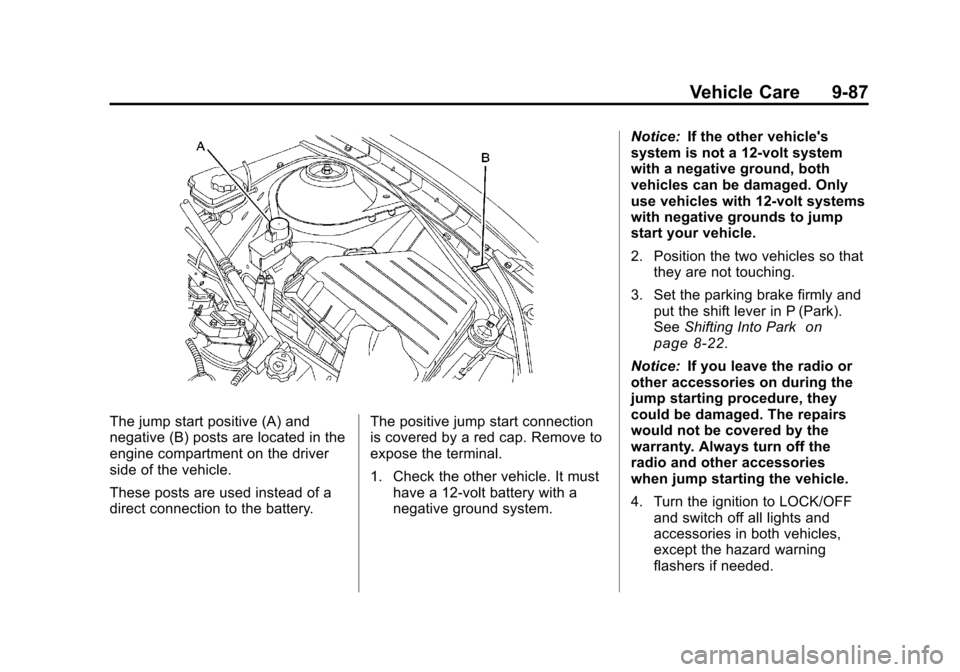
The jump start positive (A) and
negative (B) posts are located in the
engine compartment on the driver
side of the vehicle.
These posts are used instead of a
direct connection to the battery.The positive jump start connection
is covered by a red cap. Remove to
expose the terminal.
1. Check the other vehicle. It must
have a 12-volt battery with a
negative ground system. Notice:
If the other vehicle's
system is not a 12-volt system
with a negative ground, both
vehicles can be damaged. Only
use vehicles with 12-volt systems
with negative grounds to jump
start your vehicle.
2. Position the two vehicles so that they are not touching.
3. Set the parking brake firmly and put the shift lever in P (Park).
See Shifting Into Park
on
page 8‑22.
Notice: If you leave the radio or
other accessories on during the
jump starting procedure, they
could be damaged. The repairs
would not be covered by the
warranty. Always turn off the
radio and other accessories
when jump starting the vehicle.
4. Turn the ignition to LOCK/OFF and switch off all lights and
accessories in both vehicles,
except the hazard warning
flashers if needed.
Page 320 of 378
Black plate (88,1)Chevrolet Camaro Owner Manual - 2010
9-88 Vehicle Care
{WARNING
An electric fan can start up even
when the engine is not running
and can injure you. Keep hands,
clothing and tools away from any
underhood electric fan.
{WARNING
Using a match near a battery can
cause battery gas to explode.
People have been hurt doing this,
and some have been blinded.
Use a flashlight if you need more
light.
Be sure the battery has enough
water. You do not need to add
water to the battery installed in
your new vehicle. But if a battery
has filler caps, be sure the right(Continued)
WARNING (Continued)
amount of fluid is there. If it is low,
add water to take care of that
first. If you don't, explosive gas
could be present.
Battery fluid contains acid that
can burn you. Do not get it on
you. If you accidentally get it in
your eyes or on your skin, flush
the place with water and get
medical help immediately.
{WARNING
Fans or other moving engine
parts can injure you badly. Keep
your hands away from moving
parts once the engine is running.
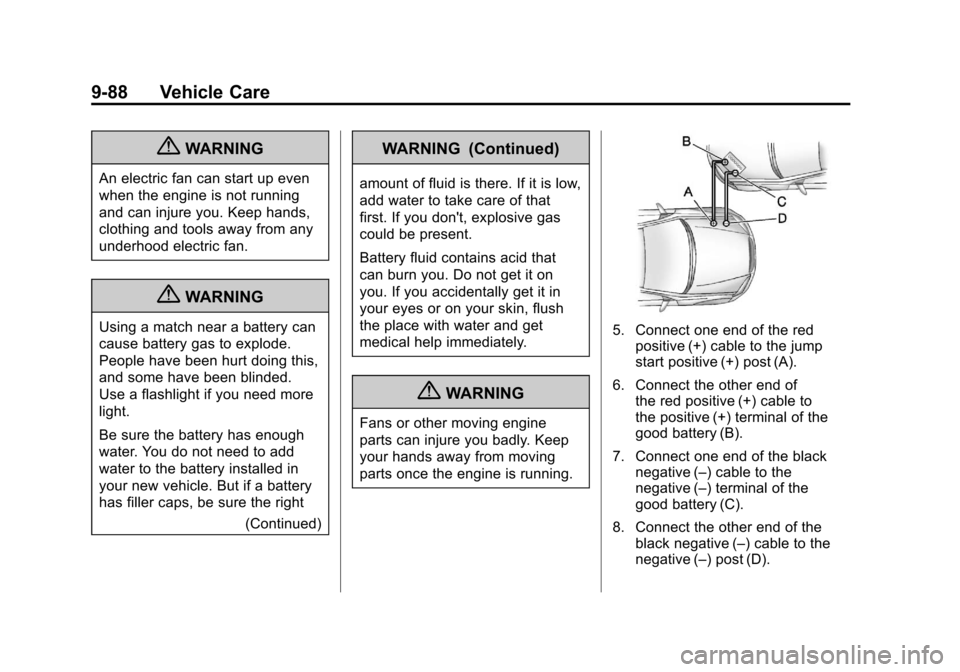
5. Connect one end of the redpositive (+) cable to the jump
start positive (+) post (A).
6. Connect the other end of the red positive (+) cable to
the positive (+) terminal of the
good battery (B).
7. Connect one end of the black negative (–) cable to the
negative (–) terminal of the
good battery (C).
8. Connect the other end of the black negative (–) cable to the
negative (–) post (D).
Page 323 of 378
Black plate (91,1)Chevrolet Camaro Owner Manual - 2010
Vehicle Care 9-91
If the vehicle has a basecoat/
clearcoat paint finish, the clearcoat
gives more depth and gloss to the
colored basecoat. Always use
waxes and polishes that are
non-abrasive and made for a
basecoat/clearcoat paint finish.
Notice:Machine compounding
or aggressive polishing on a
basecoat/clearcoat paint finish
may damage it. Use only
non-abrasive waxes and polishes
that are made for a basecoat/
clearcoat paint finish on the
vehicle.
Foreign materials such as calcium
chloride and other salts, ice melting
agents, road oil and tar, tree sap,
bird droppings, chemicals from
industrial chimneys, etc., can
damage the vehicle's finish if they
remain on painted surfaces. Wash
the vehicle as soon as possible.
If necessary, use non-abrasive
cleaners that are marked safe for
painted surfaces to remove foreign
matter. Exterior painted surfaces are
subject to aging, weather, and
chemical fallout that can take their
toll over a period of years. To keep
the paint finish looking new, keep
the vehicle garaged or covered
whenever possible.
Protecting Exterior Bright Metal
Parts
Bright metal parts should be
cleaned regularly to keep their
luster. Wash with water or use
chrome polish on chrome or
stainless steel trim, if necessary.
Use special care with aluminum
trim. To avoid damaging protective
trim, never use auto or chrome
polish, steam, or caustic soap
to clean aluminum. A coating
of wax, rubbed to high polish,
is recommended for all bright
metal parts.Washing the Vehicle
To preserve the vehicle's finish,
keep it clean by washing it often.
Do not wash the vehicle in
direct sunlight and use a car
washing soap.
Notice:
Certain cleaners contain
chemicals that can damage the
emblems or nameplates on the
vehicle. Check the cleaning
product label. If it states that it
should not be used on plastic
parts, do not use it on the vehicle
or damage may occur and it
would not be covered by the
warranty.
Do not use cleaning agents
that are petroleum based or
that contain acid or abrasives,
as they can damage the paint,
metal, or plastic on the vehicle.
Page 327 of 378
Black plate (95,1)Chevrolet Camaro Owner Manual - 2010
Vehicle Care 9-95
Interior Care
The vehicle's interior will continue
to look its best if it is cleaned often.
Dust and dirt can accumulate on
the upholstery and cause damage
to the carpet, fabric, leather, and
plastic surfaces. Stains should be
removed quickly as extreme heat
could cause them to set rapidly.
Lighter colored interiors may
require more frequent cleaning.
Newspapers and garments that can
transfer color to home furnishings
can also transfer color to the
vehicle's interior.
Remove dust from small buttons
and knobs with a small brush with
soft bristles.
Your dealer has products for
cleaning the vehicle's interior.
When cleaning the vehicle's interior,
only use cleaners specifically
designed for the surfaces that are
being cleaned. Permanent damagecan result from using cleaners on
surfaces for which they were not
intended. Apply the cleaner directly
to the cleaning cloth to prevent
over-spray. Remove any accidental
over-spray from other surfaces
immediately.
Notice:
Using abrasive cleaners
when cleaning glass surfaces on
the vehicle, could scratch the
glass and/or cause damage to
the rear window defogger. When
cleaning the glass on the vehicle,
use only a soft cloth and glass
cleaner.
Cleaners can contain solvents that
can become concentrated in the
vehicle's interior. Before using
cleaners, read and adhere to all
safety instructions on the label.
While cleaning the vehicle's interior,
maintain adequate ventilation by
opening the vehicle's doors and
windows. Do not clean the interior using the
following cleaners or techniques:.Never use a knife or any other
sharp object to remove a soil
from any interior surface.
.Never use a stiff brush. It can
cause damage to the vehicle's
interior surfaces.
.Never apply heavy pressure or
rub aggressively with a cleaning
cloth. Use of heavy pressure can
damage the interior and does
not improve the effectiveness of
soil removal.
.Use only mild, neutral-pH soaps.
Avoid laundry detergents or
dishwashing soaps with
degreasers. Using too much
soap will leave a residue that
leaves streaks and attracts dirt.
For liquid cleaners, about
20 drops per 3.78 L (1 gal) of
water is a good guide.
Page 367 of 378

Black plate (1,1)Chevrolet Camaro Owner Manual - 2010
INDEX i-1
A
Accessories andModifications . . . . . . . . . . . . . . . . . . 9-4
Accessory Power . . . . . . . . . . . . . . 8-19
Active Fuel Management™ . . . . 8-25
Add-On Electrical Equipment . . . . . . . . . . . . . . . . . . . 8-55
Adding Equipment to the Airbag-Equipped Vehicle . . . . . 2-34
Air Cleaner/Filter, Engine . . . . . . 9-15
Air Vents . . . . . . . . . . . . . . . . . . . . . . . 7-3
Airbag System Check . . . . . . . . . . . . . . . . . . . . . . . . 2-35
How Does an AirbagRestrain? . . . . . . . . . . . . . . . . . . . 2-27
Passenger Sensing
System . . . . . . . . . . . . . . . . . . . . . . 2-29
What Makes an Airbag Inflate? . . . . . . . . . . . . . . . . . . . . . . 2-27
What Will You See After
an Airbag Inflates? . . . . . . . . . . 2-28
When Should an Airbag Inflate? . . . . . . . . . . . . . . . . . . . . . . 2-25
Where Are the Airbags? . . . . . . 2-24 Airbags
Adding Equipment to the
Vehicle . . . . . . . . . . . . . . . . . . . . . . 2-34
Passenger Status Indicator . . . 4-19
Readiness Light . . . . . . . . . . . . . . 4-18
Servicing Airbag-Equipped Vehicles . . . . . . . . . . . . . . . . . . . . . 2-34
System Check . . . . . . . . . . . . . . . . 2-22
Alarm System Anti-Theft . . . . . . . . . . . . . . . . . . . . . . 1-9
AM-FM Radio . . . . . . . . . . . . . . . . . . . 6-7
Antenna
Satellite Radio . . . . . . . . . . . . . . . . 6-13
Anti-Theft Alarm System . . . . . . . . . . . . . . . . . 1-9
Alarm System Messages . . . . . 4-36
Antilock Brake System (ABS) . . . . . . . . . . . . . . . . 8-31
Warning Light . . . . . . . . . . . . . . . . . 4-24
Appearance Care Exterior . . . . . . . . . . . . . . . . . . . . . . . 9-90
Interior . . . . . . . . . . . . . . . . . . . . . . . . 9-95 Assistance Program,
Roadside . . . . . . . . . . . . . . . . . . . . . 12-6
Audio Players . . . . . . . . . . . . . . . . . 6-14 CD . . . . . . . . . . . . . . . . . . . . . . . . . . . 6-14
Audio System Backglass Antenna . . . . . . . . . . . 6-13
Radio Reception . . . . . . . . . . . . . . 6-12
Theft-Deterrent Feature . . . . . . . . 6-1
Automatic Dimming Mirrors . . . . . . . . . . . . . . 1-13
Headlamp System . . . . . . . . . . . . . 5-4
Automatic Transmission . . . . . . . 8-26 Fluid . . . . . . . . . . . . . . . . . . . . . . . . . . 9-14
Manual Mode . . . . . . . . . . . . . . . . . 8-29
Shiftlock Control SystemCheck . . . . . . . . . . . . . . . . . . . . . . . 9-31
Auxiliary Devices . . . . . . . . . . . . . . 6-16
Axle, Rear . . . . . . . . . . . . . . . . . . . . . 9-29
Page 368 of 378

Black plate (2,1)Chevrolet Camaro Owner Manual - 2010
i-2 INDEX
B
Battery . . . . . . . . . . . . . . . . . . . . . . . . 9-29Jump Starting . . . . . . . . . . . . . . . . . 9-86
Load Management . . . . . . . . . . . . . 5-6
Power Protection . . . . . . . . . . . . . . 5-7
Voltage and ChargingMessages . . . . . . . . . . . . . . . . . . . 4-31
Blade Replacement, Wiper . . . . 9-32
Bluetooth . . . . . . . . . . 6-21, 6-22, 6-25
Brakes . . . . . . . . . . . . . . . . . . . . . . . . . 9-27 Antilock . . . . . . . . . . . . . . . . . . . . . . . 8-31
Assist . . . . . . . . . . . . . . . . . . . . . . . . . 8-33
Fluid . . . . . . . . . . . . . . . . . . . . . . . . . . 9-28
Parking . . . . . . . . . . . . . . . . . . . . . . . 8-32
System Messages . . . . . . . . . . . . 4-32
Braking . . . . . . . . . . . . . . . . . . . . . . . . . 8-4
Break-In, New Vehicle . . . . . . . . . 8-17
Bulb Replacement . . . . . . . . . . . . . 9-41
Fog Lamps . . . . . . . . . . . . . . . . . . . 9-40
Halogen Bulbs . . . . . . . . . . . . . . . . 9-36
Headlamp Aiming . . . . . . . . . . . . . 9-33
Headlamps . . . . . . . . . . . . . . . . . . . 9-36
Headlamps, FrontTurn Signal and
Parking Lamps . . . . . . . . 9-37, 9-38 Bulb Replacement (cont.)
High Intensity Discharge
(HID) Lighting . . . . . . . . . . . . . . . 9-36
License Plate Lamps . . . . . . . . . 9-41
Taillamps, Turn Signal and
Stoplamps . . . . . . . . . . . . . . . . . . 9-40
Buying New Tires . . . . . . . . . . . . . . 9-65
C
Calibration . . . . . . . . . . . . . . . . . . . . . . 4-8
California Fuel Requirements . . . . . . . . . . . 8-45
Perchlorate MaterialsRequirements . . . . . . . . . . . . . . . . 9-3
Warning . . . . . . . . . . . . . . . . . . . . . . . 9-3
Canadian Vehicle Owners . . . . . . . . iii
Capacities and
Specifications . . . . . . . . . . . . . . . . 11-2
Carbon Monoxide Engine Exhaust . . . . . . . . . . . . . . . 8-25
Trunk . . . . . . . . . . . . . . . . . . . . . . . . . . 1-8
Winter Driving . . . . . . . . . . . . . . . . 8-10
Cautions, Danger, and Warnings . . . . . . . . . . . . . . . . . . . . . . . . iv
CD Player . . . . . . . . . . . . . . . . . . . . . 6-14
Center Console Storage . . . . . . . . 3-1 Chains, Tire . . . . . . . . . . . . . . . . . . . 9-71
Charging System Light . . . . . . . . 4-20
Check
Engine Light . . . . . . . . . . . . . . . . . . 4-20
Ignition Transmission Lock . . . 9-32
Child Restraints Infants and Young
Children . . . . . . . . . . . . . . . . . . . . . 2-39
Lower Anchors and Tethers for Children . . . . . . . . . 2-45
Older Children . . . . . . . . . . . . . . . . 2-36
Securing . . . . . . . . . . . . . . . . 2-50, 2-52
Systems . . . . . . . . . . . . . . . . . . . . . . 2-41
Where to Put the Restraint . . . 2-43
Circuit Breakers . . . . . . . . . . . . . . . 9-42
Cleaning Exterior Care . . . . . . . . . . . . . . . . . 9-90
Interior Care . . . . . . . . . . . . . . . . . . 9-95
Climate Control Systems . . . . . . . 7-1
Clock . . . . . . . . . . . . . . . . . . . . . . . . . . . 4-8
Cluster, IP . . . . . . . . . . . . . . . . . . . . . 4-11
Clutch, Hydraulic . . . . . . . . . . . . . . 9-15
Collision Damage Repair . . . . . 12-10
Compact Spare Tire . . . . . . . . . . . 9-85
Compass . . . . . . . . . . . . . . . . . . . . . . . 4-8
Compass Messages . . . . . . . . . . . 4-32