light CHEVROLET CAMARO 2010 5.G Manual Online
[x] Cancel search | Manufacturer: CHEVROLET, Model Year: 2010, Model line: CAMARO, Model: CHEVROLET CAMARO 2010 5.GPages: 378, PDF Size: 5.75 MB
Page 260 of 378
Black plate (28,1)Chevrolet Camaro Owner Manual - 2010
9-28 Vehicle Care
Brake Fluid
The brake/clutch master cylinder
reservoir is filled with DOT 3 brake
fluid as indicated on the reservoir
cap. SeeEngine Compartment
Overview
on page 9‑6for the
location of the reservoir.
There are only two reasons why
the fluid level in the reservoir might
go down:
.The fluid level goes down
because of normal brake lining
wear. When new linings are
installed, the fluid level goes
back up.
.A fluid leak in the brake/clutch
hydraulic system can also cause
a low fluid level. Have the brake/
clutch hydraulic system fixed,
since a leak means that sooner
or later the brakes and/or clutch
will not work well.
Do not top off the brake/clutch fluid.
Adding fluid does not correct a leak.
If fluid is added when the linings
are worn, there will be too much
fluid when new brake linings are
installed. Add or remove brake fluid,
as necessary, only when work is
done on the brake/clutch hydraulic
system.
{WARNING
If too much brake fluid is added, it
can spill on the engine and burn,
if the engine is hot enough. You
or others could be burned, and
the vehicle could be damaged.
Add brake fluid only when work
is done on the brake/clutch
hydraulic system. When the brake/clutch fluid falls to
a low level, the brake warning light
comes on. See
Brake System
Warning Light on page 4‑23.
What to Add
Use only new DOT 3 brake
fluid from a sealed container.
See Recommended Fluids and
Lubricants on page 10‑8.
Always clean the brake/clutch
fluid reservoir cap and the area
around the cap before removing it.
This helps keep dirt from entering
the reservoir.
{WARNING
With the wrong kind of fluid in the
brake/clutch hydraulic system,
the brakes might not work well.
This could cause a crash. Always
use the proper brake/clutch fluid.
Page 266 of 378
Black plate (34,1)Chevrolet Camaro Owner Manual - 2010
9-34 Vehicle Care
The vehicle should be properly
prepared as follows:
.The vehicle should be placed so
the headlamps are 7.6 m (25 ft)
from a light colored wall.
.The vehicle must have all four
tires on a level surface which is
level all the way to the wall.
.The vehicle should be placed so
it is perpendicular to the wall or
other flat surface.
.The vehicle should not have any
snow, ice, or mud on it.
.The vehicle should be fully
assembled and all other work
stopped while headlamp aiming
is being performed.
.The vehicle should be normally
loaded with a full tank of fuel and
one person or 75 kg (160 lbs)
sitting on the driver's seat.
.Tires should be properly inflated.Headlamp aiming is done with the
vehicle's low-beam headlamps.
The high-beam headlamps will be
correctly aimed if the low-beam
headlamps are aimed properly.
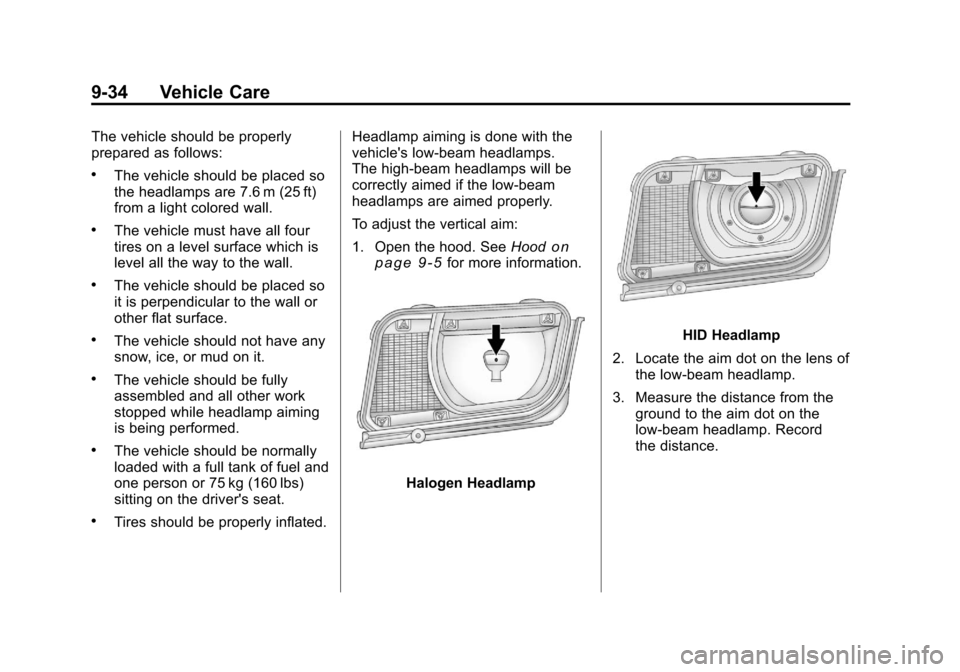
To adjust the vertical aim:
1. Open the hood. See
Hood
on
page 9‑5for more information.
Halogen Headlamp
HID Headlamp
2. Locate the aim dot on the lens of the low‐beam headlamp.
3. Measure the distance from the ground to the aim dot on the
low‐beam headlamp. Record
the distance.
Page 267 of 378
Black plate (35,1)Chevrolet Camaro Owner Manual - 2010
Vehicle Care 9-35
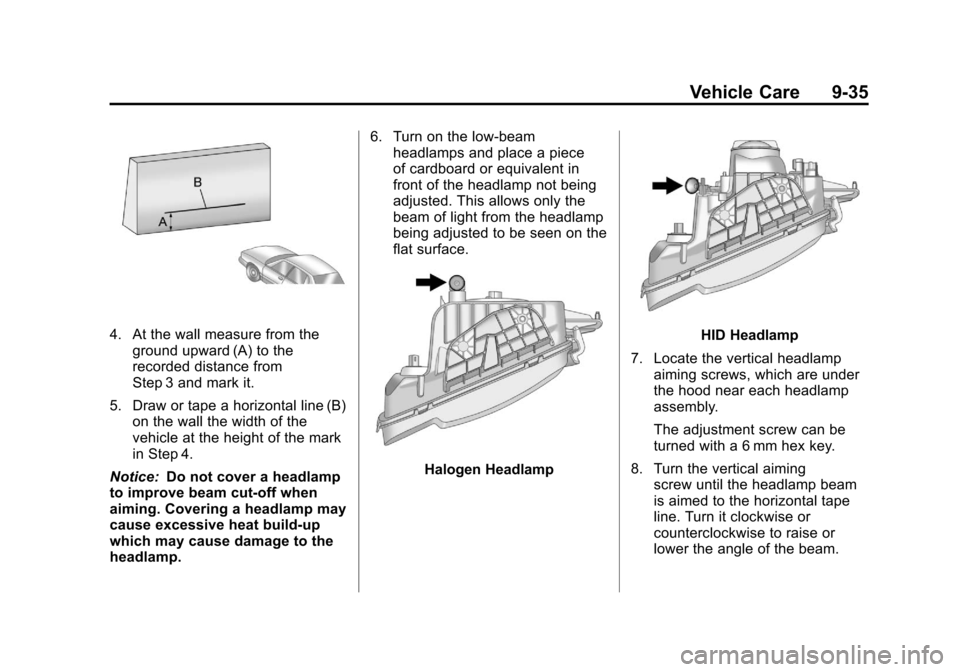
4. At the wall measure from theground upward (A) to the
recorded distance from
Step 3 and mark it.
5. Draw or tape a horizontal line (B) on the wall the width of the
vehicle at the height of the mark
in Step 4.
Notice: Do not cover a headlamp
to improve beam cut-off when
aiming. Covering a headlamp may
cause excessive heat build-up
which may cause damage to the
headlamp. 6. Turn on the low-beam
headlamps and place a piece
of cardboard or equivalent in
front of the headlamp not being
adjusted. This allows only the
beam of light from the headlamp
being adjusted to be seen on the
flat surface.
Halogen Headlamp
HID Headlamp
7. Locate the vertical headlamp aiming screws, which are under
the hood near each headlamp
assembly.
The adjustment screw can be
turned with a 6 mm hex key.
8. Turn the vertical aiming screw until the headlamp beam
is aimed to the horizontal tape
line. Turn it clockwise or
counterclockwise to raise or
lower the angle of the beam.
Page 268 of 378
Black plate (36,1)Chevrolet Camaro Owner Manual - 2010
9-36 Vehicle Care
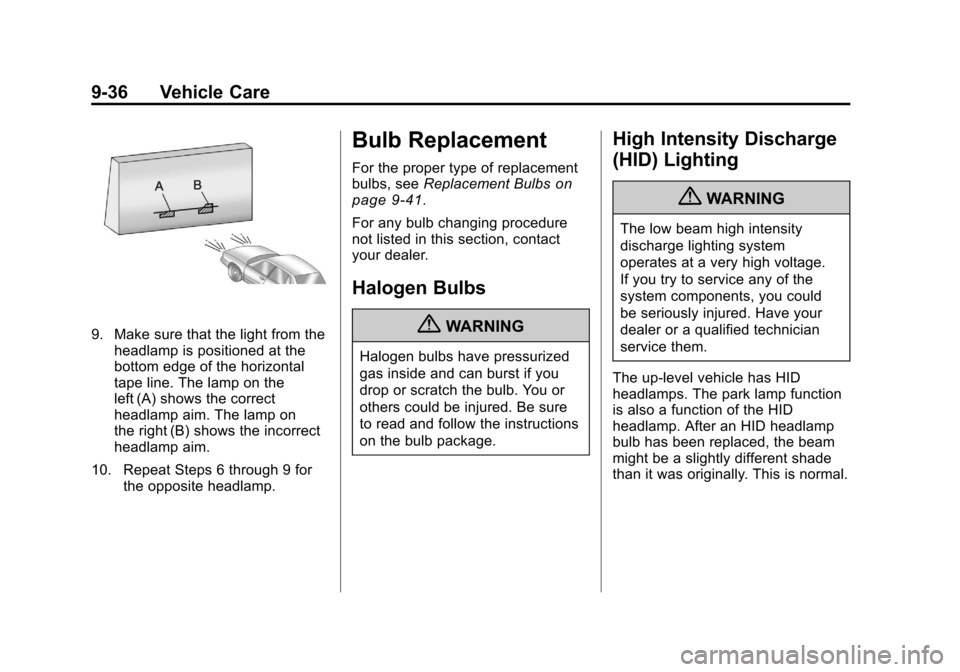
9. Make sure that the light from theheadlamp is positioned at the
bottom edge of the horizontal
tape line. The lamp on the
left (A) shows the correct
headlamp aim. The lamp on
the right (B) shows the incorrect
headlamp aim.
10. Repeat Steps 6 through 9 for the opposite headlamp.
Bulb Replacement
For the proper type of replacement
bulbs, see Replacement Bulbson
page 9‑41.
For any bulb changing procedure
not listed in this section, contact
your dealer.
Halogen Bulbs
{WARNING
Halogen bulbs have pressurized
gas inside and can burst if you
drop or scratch the bulb. You or
others could be injured. Be sure
to read and follow the instructions
on the bulb package.
High Intensity Discharge
(HID) Lighting
{WARNING
The low beam high intensity
discharge lighting system
operates at a very high voltage.
If you try to service any of the
system components, you could
be seriously injured. Have your
dealer or a qualified technician
service them.
The up‐level vehicle has HID
headlamps. The park lamp function
is also a function of the HID
headlamp. After an HID headlamp
bulb has been replaced, the beam
might be a slightly different shade
than it was originally. This is normal.
Page 270 of 378
Black plate (38,1)Chevrolet Camaro Owner Manual - 2010
9-38 Vehicle Care
5. Push the new bulb into thesocket and reinstall the socket
into the headlamp assembly by
turning it clockwise.
6. Reconnect the electrical connector.
7. Pull the duct back out of the air cleaner/filter housing until the
tabs snap the duct back into
position.
Headlamps, Front Turn
Signal and Parking
Lamps (Up-Level Vehicle)
The up–level model vehicle has a
HID headlamp and a turn signal
lamp on the headlamp assembly.
The park lamp is also the function
of the HID headlamp. See High
Intensity Discharge (HID) Lighting
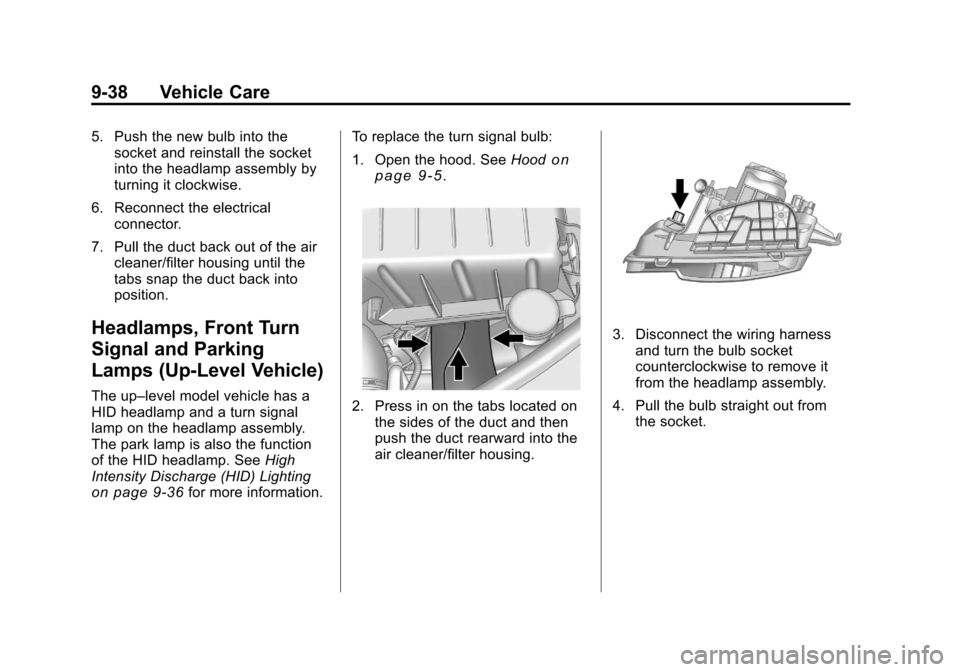
on page 9‑36for more information. To replace the turn signal bulb:
1. Open the hood. See
Hood
on
page 9‑5.
2. Press in on the tabs located on the sides of the duct and then
push the duct rearward into the
air cleaner/filter housing.
3. Disconnect the wiring harnessand turn the bulb socket
counterclockwise to remove it
from the headlamp assembly.
4. Pull the bulb straight out from the socket.
Page 278 of 378
Black plate (46,1)Chevrolet Camaro Owner Manual - 2010
9-46 Vehicle Care
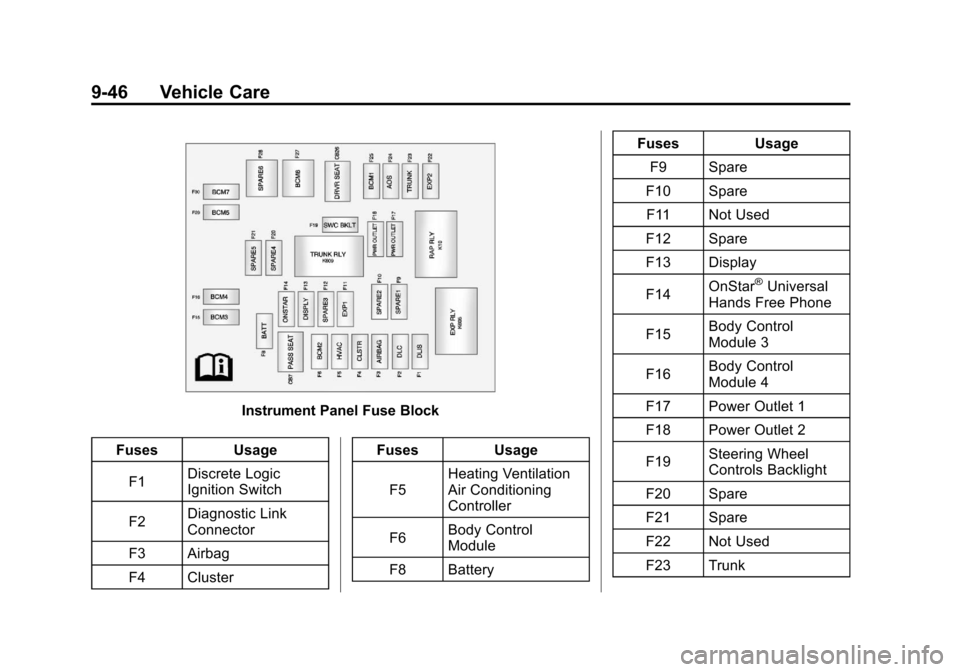
Instrument Panel Fuse Block
Fuses Usage
F1 Discrete Logic
Ignition Switch
F2 Diagnostic Link
Connector
F3 Airbag
F4 Cluster Fuses
Usage
F5 Heating Ventilation
Air Conditioning
Controller
F6 Body Control
Module
F8 Battery Fuses
Usage
F9 Spare
F10 Spare
F11 Not Used
F12 Spare
F13 Display
F14 OnStar
®Universal
Hands Free Phone
F15 Body Control
Module 3
F16 Body Control
Module 4
F17 Power Outlet 1
F18 Power Outlet 2
F19 Steering Wheel
Controls Backlight
F20 Spare
F21 Spare
F22 Not Used
F23 Trunk
Page 286 of 378

Black plate (54,1)Chevrolet Camaro Owner Manual - 2010
9-54 Vehicle Care
DOT Markings:A code
molded into the sidewall of a
tire signifying that the tire is
in compliance with the U.S.
Department of Transportation
(DOT) motor vehicle safety
standards. The DOT code
includes the Tire Identification
Number (TIN), an alphanumeric
designator which can also
identify the tire manufacturer,
production plant, brand, and
date of production.
GVWR
:Gross Vehicle Weight
Rating. See Vehicle Load Limits
on page 8‑12.
GAWR FRT
:Gross Axle
Weight Rating for the front axle.
See Vehicle Load Limits
on
page 8‑12
.
GAWR RR
:Gross Axle
Weight Rating for the rear axle.
See Vehicle Load Limits
on
page 8‑12
. Intended Outboard Sidewall
:
The side of an asymmetrical tire,
that must always face outward
when mounted on a vehicle.
Kilopascal (kPa)
:The metric
unit for air pressure.
Light Truck (LT‐Metric) Tire
:A
tire used on light duty trucks and
some multipurpose passenger
vehicles.
Load Index
:An assigned
number ranging from 1 to 279
that corresponds to the load
carrying capacity of a tire.
Maximum Inflation Pressure
:
The maximum air pressure to
which a cold tire can be inflated.
The maximum air pressure is
molded onto the sidewall.
Maximum Load Rating
:
The load rating for a tire at the
maximum permissible inflation
pressure for that tire. Maximum Loaded Vehicle
Weight
:The sum of curb
weight, accessory weight,
vehicle capacity weight, and
production options weight.
Normal Occupant Weight
:The
number of occupants a vehicle
is designed to seat multiplied by
68 kg (150 lbs). See Vehicle
Load Limits
on page 8‑12.
Occupant Distribution
:
Designated seating positions.
Outward Facing Sidewall
:The
side of an asymmetrical tire that
has a particular side that faces
outward when mounted on a
vehicle. The side of the tire
that contains a whitewall,
bears white lettering, or bears
manufacturer, brand, and/or
model name molding that is
higher or deeper than the same
moldings on the other sidewall
of the tire.
Page 287 of 378

Black plate (55,1)Chevrolet Camaro Owner Manual - 2010
Vehicle Care 9-55
Passenger (P-Metric) Tire:
A tire used on passenger cars
and some light duty trucks and
multipurpose vehicles.
Recommended Inflation
Pressure
:Vehicle
manufacturer's recommended
tire inflation pressure as shown
on the tire placard. See Tire
Pressure
on page 9‑56and
Vehicle Load Limits
on
page 8‑12
.
Radial Ply Tire
:A pneumatic
tire in which the ply cords that
extend to the beads are laid at
90 degrees to the centerline of
the tread. Rim
:A metal support for a tire
and upon which the tire beads
are seated.
Sidewall
:The portion of a tire
between the tread and the bead.
Speed Rating
:An
alphanumeric code assigned to
a tire indicating the maximum
speed at which a tire can
operate.
Traction
:The friction between
the tire and the road surface.
The amount of grip provided.
Tread
:The portion of a tire
that comes into contact with
the road. Treadwear Indicators
:Narrow
bands, sometimes called wear
bars, that show across the
tread of a tire when only 1.6 mm
(1/16 inch) of tread remains.
See When It Is Time for New
Tires
on page 9‑64.
UTQGS (Uniform Tire
Quality Grading Standards)
:
A tire information system
that provides consumers with
ratings for a tire's traction,
temperature, and treadwear.
Ratings are determined by
tire manufacturers using
government testing procedures.
The ratings are molded into the
sidewall of the tire. See Uniform
Tire Quality Grading
on
page 9‑67
.
Page 292 of 378
Black plate (60,1)Chevrolet Camaro Owner Manual - 2010
9-60 Vehicle Care
Tire Pressure Monitor
Operation
This vehicle may have a Tire
Pressure Monitor System (TPMS).
The TPMS is designed to warn
the driver when a low tire pressure
condition exists. TPMS sensors are
mounted onto each tire and wheel
assembly, excluding the spare tire
and wheel assembly, if the vehicle
has one. The TPMS sensors
monitor the air pressure in the
vehicle's tires and transmits the
tire pressure readings to a receiver
located in the vehicle.
Using the Driver Information Center
(DIC), the driver can also check
tire pressure levels using the DIC.
For additional information and
details about the DIC operation and
displays seeTire Messages
on
page 4‑36.
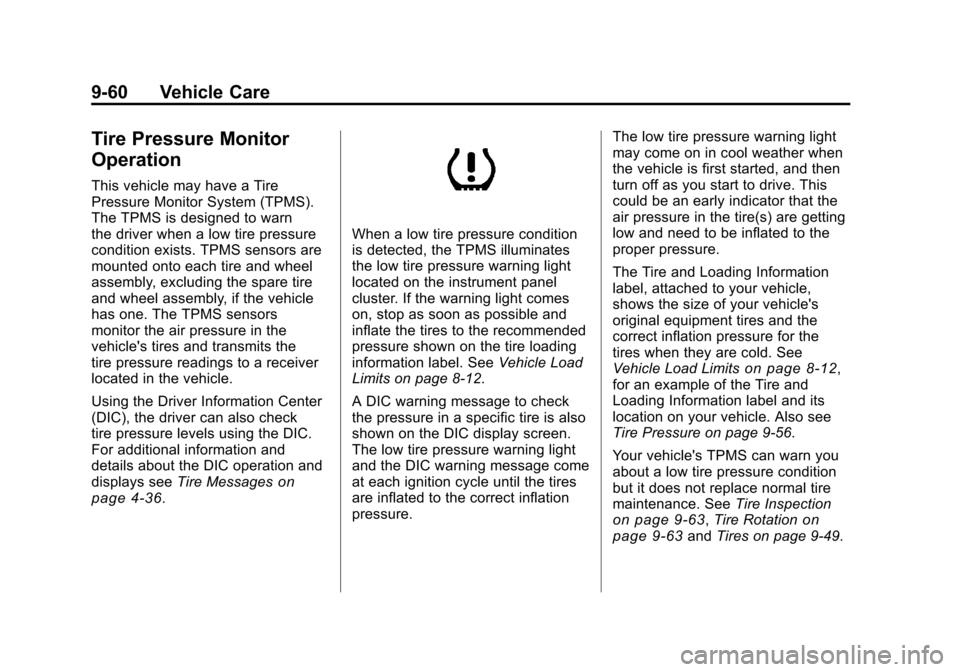
When a low tire pressure condition
is detected, the TPMS illuminates
the low tire pressure warning light
located on the instrument panel
cluster. If the warning light comes
on, stop as soon as possible and
inflate the tires to the recommended
pressure shown on the tire loading
information label. See Vehicle Load
Limits on page 8‑12.
A DIC warning message to check
the pressure in a specific tire is also
shown on the DIC display screen.
The low tire pressure warning light
and the DIC warning message come
at each ignition cycle until the tires
are inflated to the correct inflation
pressure. The low tire pressure warning light
may come on in cool weather when
the vehicle is first started, and then
turn off as you start to drive. This
could be an early indicator that the
air pressure in the tire(s) are getting
low and need to be inflated to the
proper pressure.
The Tire and Loading Information
label, attached to your vehicle,
shows the size of your vehicle's
original equipment tires and the
correct inflation pressure for the
tires when they are cold. See
Vehicle Load Limits
on page 8‑12,
for an example of the Tire and
Loading Information label and its
location on your vehicle. Also see
Tire Pressure on page 9‑56.
Your vehicle's TPMS can warn you
about a low tire pressure condition
but it does not replace normal tire
maintenance. See Tire Inspection
on page 9‑63,Tire Rotationon
page 9‑63and Tires on page 9‑49.
Page 293 of 378
Black plate (61,1)Chevrolet Camaro Owner Manual - 2010
Vehicle Care 9-61
Notice:Using non‐approved tire
sealants could damage the Tire
Pressure Monitor System (TPMS)
sensors. TPMS sensor damage
caused by using an incorrect tire
sealant is not covered by the
vehicle warranty. Always use
the GM approved tire sealant
available through your dealer.
Factory-installed Tire Inflator Kits
use a GM approved liquid tire
sealant. Using non-approved tire
sealants could damage the TPMS
sensors. See Tire Sealant and
Compressor Kit
on page 9‑73for
information regarding the inflator kit
materials and instructions.
TPMS Malfunction Light and
Message
The TPMS will not function properly
if one or more of the TPMS sensors
are missing or inoperable. When the
system detects a malfunction, the
low tire warning light flashes for
about one minute and then stays
on for the remainder of the ignition
cycle. A DIC warning message is
also displayed. The low tire warning
light and DIC warning message
come on at each ignition cycle until
the problem is corrected. Some of
the conditions that can cause the
malfunction light and DIC message
to come on are:
.One of the road tires has been
replaced with the spare tire,
if the vehicle has one. The spare
tire does not have a TPMS
sensor. The DIC message
should go off once you re‐install
the road tire containing the
TPMS sensor.
.The TPMS sensor matching
process was not done or not
completed successfully after
rotating the vehicle's tires.
The DIC message should go
off after successfully completing
the sensor matching process.
See “TPMS Sensor Matching
Process” later in this section.
.One or more TPMS sensors are
missing or damaged. The DIC
message and the TPMS
malfunction light should go
off when the TPMS sensors
are installed and the sensor
matching process is performed
successfully. See your dealer
for service.
.Replacement tires or wheels do
not match your vehicle's original
equipment tires or wheels. Tires
and wheels other than those
recommended for your vehicle
could prevent the TPMS from
functioning properly. See Buying
New Tires on page 9‑65.