lock CHEVROLET CAMARO 2010 5.G Owners Manual
[x] Cancel search | Manufacturer: CHEVROLET, Model Year: 2010, Model line: CAMARO, Model: CHEVROLET CAMARO 2010 5.GPages: 378, PDF Size: 5.75 MB
Page 310 of 378

Black plate (78,1)Chevrolet Camaro Owner Manual - 2010
9-78 Vehicle Care
2. Unwrap the air only hose (E)and the power plug (G).
3. Place the kit on the ground. Make sure the tire valve stem is
positioned close to the ground
so the hose will reach it.
4. Remove the tire valve stem cap from the flat tire by turning it
counterclockwise.
5. Attach the air only hose (E) onto the tire valve stem by turning it
clockwise until it is tight.
6. Plug the power plug (G) into the accessory power outlet in the
vehicle. Unplug all items from
other accessory power outlets.
See Power Outlets
on
page 4‑9.
If the vehicle has an accessory
power outlet, do not use the
cigarette lighter.
If the vehicle only has a cigarette
lighter, use the cigarette lighter.
Do not pinch the power plug
cord in the door or window. 7. Start the vehicle. The vehicle
must be running while using the
air compressor.
8. Turn the selector switch (B) counterclockwise to the Air Only
position.
9. Press the on/off (A) button to turn the compressor on.
The compressor will inflate the
tire with air only.
10. Inflate the tire to the recommended inflation
pressure using the pressure
gauge (D). The recommended
inflation pressure can be found
on the Tire and Loading
Information label. See Tire
Pressure on page 9‑56.
The pressure gauge (D) may
read higher than the actual tire
pressure while the compressor
is on. Turn the compressor off
to get an accurate reading.
The compressor may be turned
on/off until the correct pressure
is reached. 11. Press the on/off button (A)
to turn the tire sealant and
compressor kit off.
Be careful while handling the
tire sealant and compressor
kit as it could be warm after
usage.
12. Unplug the power plug (G) from the accessory power outlet in
the vehicle.
13. Disconnect the air only hose (E) from the tire
valve stem, by turning it
counterclockwise, and replace
the tire valve stem cap.
14. Replace the air only hose (E) and the power plug (G) and
cord back in its original
location.
15. Place the equipment in the original storage location in the
vehicle.
Page 311 of 378
Black plate (79,1)Chevrolet Camaro Owner Manual - 2010
Vehicle Care 9-79
Removal and Installation of the
Sealant Canister
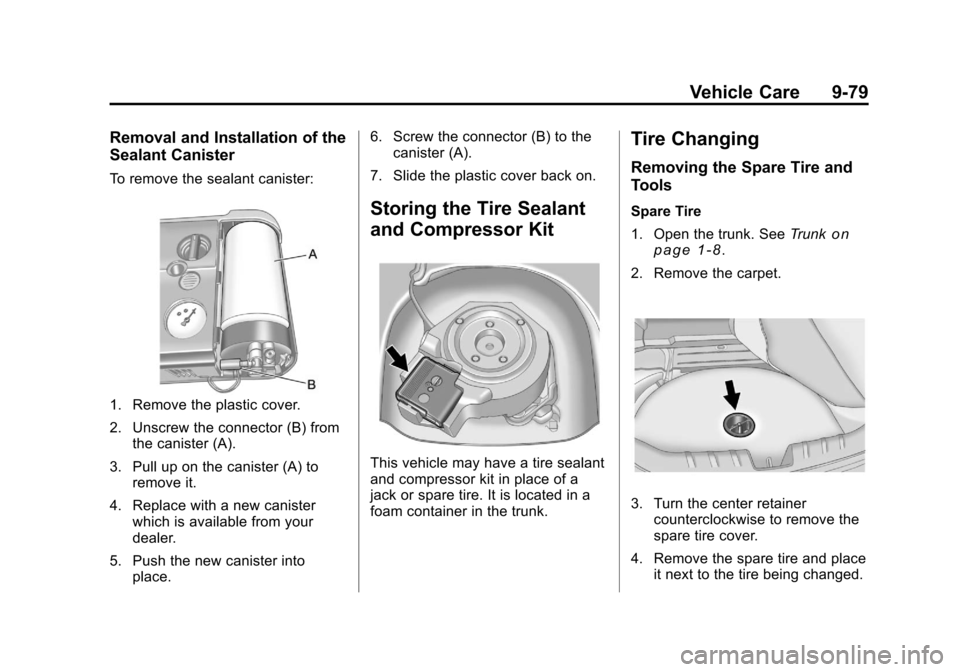
To remove the sealant canister:
1. Remove the plastic cover.
2. Unscrew the connector (B) fromthe canister (A).
3. Pull up on the canister (A) to remove it.
4. Replace with a new canister which is available from your
dealer.
5. Push the new canister into place. 6. Screw the connector (B) to the
canister (A).
7. Slide the plastic cover back on.
Storing the Tire Sealant
and Compressor Kit
This vehicle may have a tire sealant
and compressor kit in place of a
jack or spare tire. It is located in a
foam container in the trunk.
Tire Changing
Removing the Spare Tire and
Tools
Spare Tire
1. Open the trunk. See Trunk
on
page 1‑8.
2. Remove the carpet.
3. Turn the center retainer counterclockwise to remove the
spare tire cover.
4. Remove the spare tire and place it next to the tire being changed.
Page 312 of 378
Black plate (80,1)Chevrolet Camaro Owner Manual - 2010
9-80 Vehicle Care
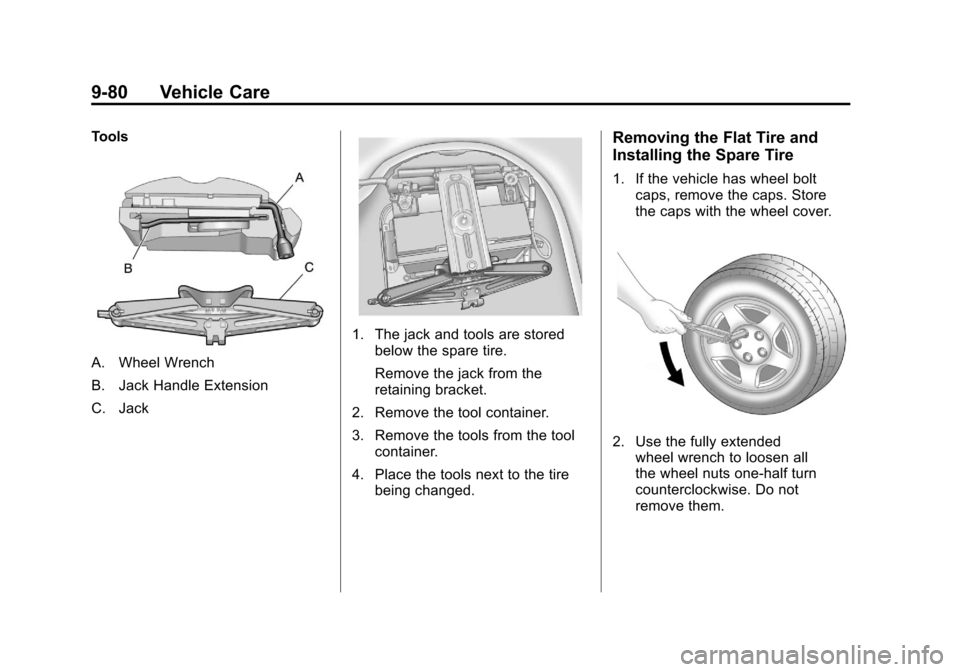
Tools
A. Wheel Wrench
B. Jack Handle Extension
C. Jack
1. The jack and tools are storedbelow the spare tire.
Remove the jack from the
retaining bracket.
2. Remove the tool container.
3. Remove the tools from the tool container.
4. Place the tools next to the tire being changed.
Removing the Flat Tire and
Installing the Spare Tire
1. If the vehicle has wheel boltcaps, remove the caps. Store
the caps with the wheel cover.
2. Use the fully extendedwheel wrench to loosen all
the wheel nuts one-half turn
counterclockwise. Do not
remove them.
Page 314 of 378
Black plate (82,1)Chevrolet Camaro Owner Manual - 2010
9-82 Vehicle Care
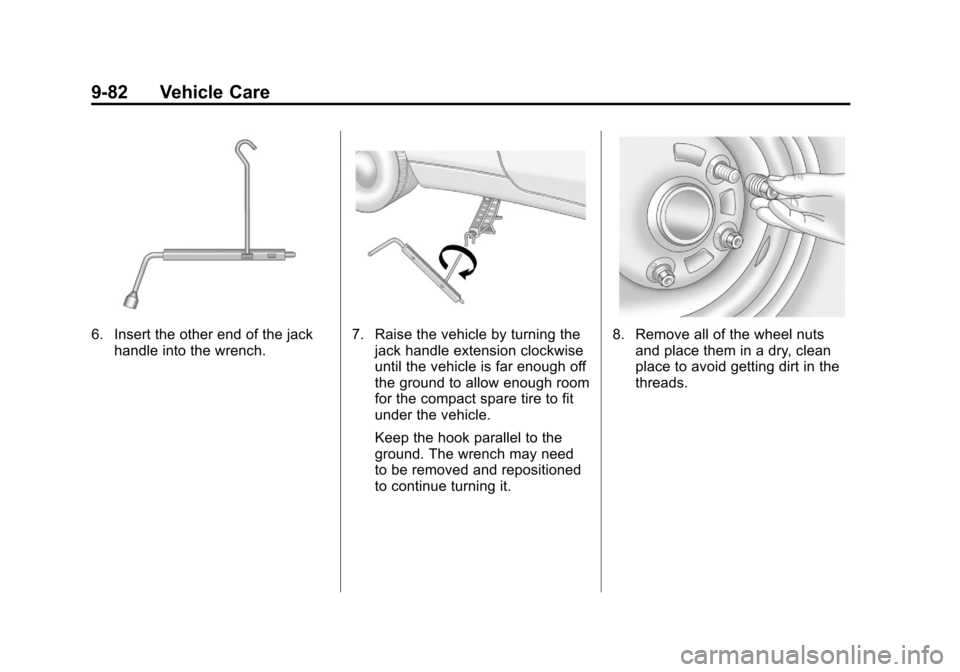
6. Insert the other end of the jackhandle into the wrench.7. Raise the vehicle by turning thejack handle extension clockwise
until the vehicle is far enough off
the ground to allow enough room
for the compact spare tire to fit
under the vehicle.
Keep the hook parallel to the
ground. The wrench may need
to be removed and repositioned
to continue turning it.8. Remove all of the wheel nutsand place them in a dry, clean
place to avoid getting dirt in the
threads.
Page 315 of 378
Black plate (83,1)Chevrolet Camaro Owner Manual - 2010
Vehicle Care 9-83
{WARNING
Rust or dirt on a wheel, or on the
parts to which it is fastened, can
make wheel nuts become loose
after time. The wheel could come
off and cause an accident. When
changing a wheel, remove any
rust or dirt from places where
the wheel attaches to the vehicle.
In an emergency, use a cloth or a
paper towel to do this; but be sure
to use a scraper or wire brush
later, if needed, to get all the rust
or dirt off. SeeIf a Tire Goes Flat
on page 9‑71.
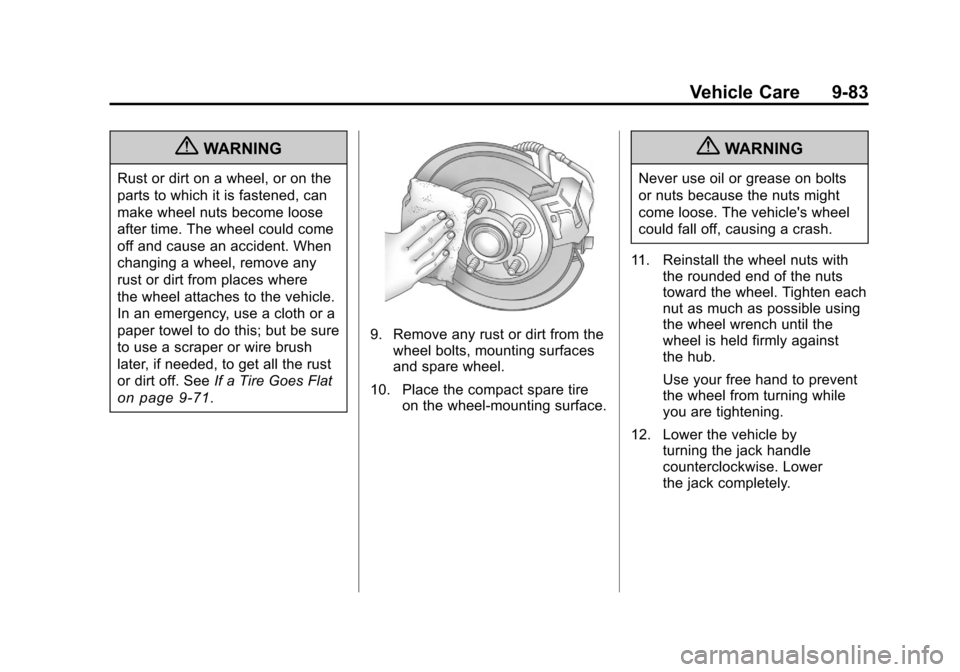
9. Remove any rust or dirt from the
wheel bolts, mounting surfaces
and spare wheel.
10. Place the compact spare tire on the wheel-mounting surface.
{WARNING
Never use oil or grease on bolts
or nuts because the nuts might
come loose. The vehicle's wheel
could fall off, causing a crash.
11. Reinstall the wheel nuts with the rounded end of the nuts
toward the wheel. Tighten each
nut as much as possible using
the wheel wrench until the
wheel is held firmly against
the hub.
Use your free hand to prevent
the wheel from turning while
you are tightening.
12. Lower the vehicle by turning the jack handle
counterclockwise. Lower
the jack completely.
Page 316 of 378
Black plate (84,1)Chevrolet Camaro Owner Manual - 2010
9-84 Vehicle Care
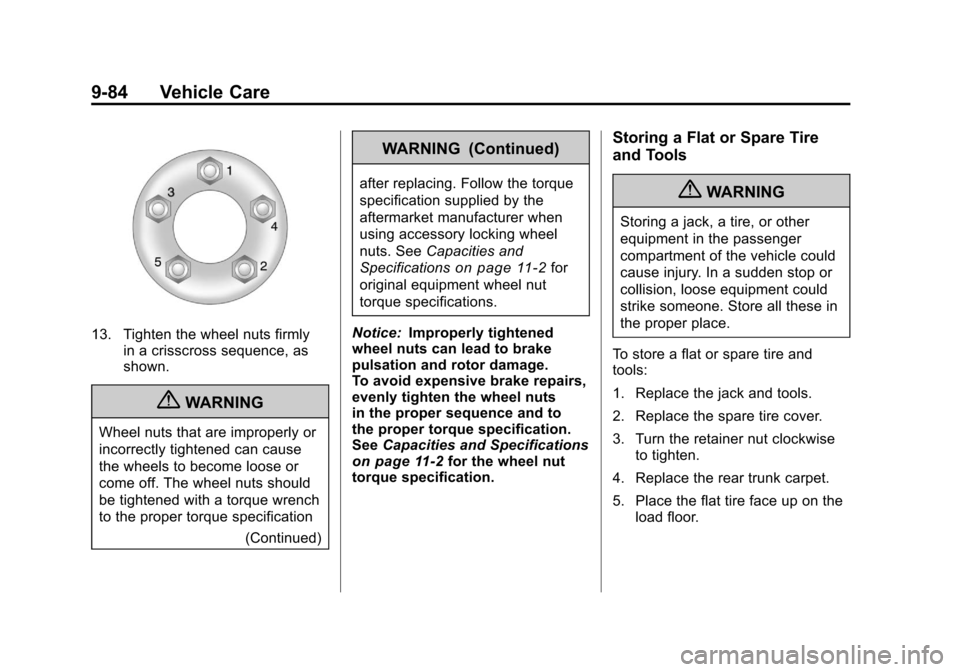
13. Tighten the wheel nuts firmlyin a crisscross sequence, as
shown.
{WARNING
Wheel nuts that are improperly or
incorrectly tightened can cause
the wheels to become loose or
come off. The wheel nuts should
be tightened with a torque wrench
to the proper torque specification
(Continued)
WARNING (Continued)
after replacing. Follow the torque
specification supplied by the
aftermarket manufacturer when
using accessory locking wheel
nuts. SeeCapacities and
Specifications
on page 11‑2for
original equipment wheel nut
torque specifications.
Notice: Improperly tightened
wheel nuts can lead to brake
pulsation and rotor damage.
To avoid expensive brake repairs,
evenly tighten the wheel nuts
in the proper sequence and to
the proper torque specification.
See Capacities and Specifications
on page 11‑2for the wheel nut
torque specification.
Storing a Flat or Spare Tire
and Tools
{WARNING
Storing a jack, a tire, or other
equipment in the passenger
compartment of the vehicle could
cause injury. In a sudden stop or
collision, loose equipment could
strike someone. Store all these in
the proper place.
To store a flat or spare tire and
tools:
1. Replace the jack and tools.
2. Replace the spare tire cover.
3. Turn the retainer nut clockwise to tighten.
4. Replace the rear trunk carpet.
5. Place the flat tire face up on the load floor.
Page 319 of 378
Black plate (87,1)Chevrolet Camaro Owner Manual - 2010
Vehicle Care 9-87
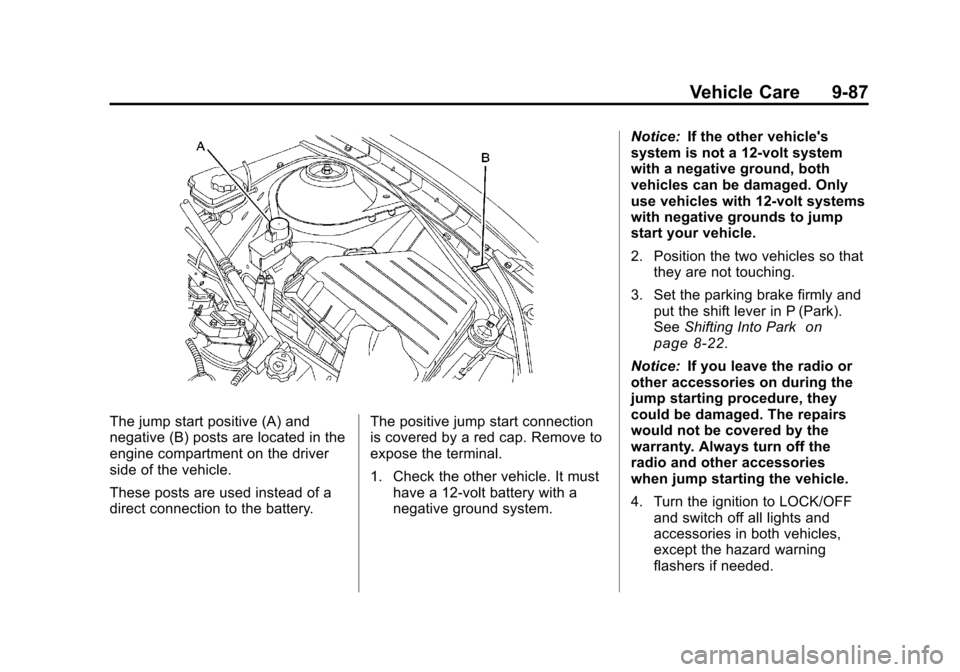
The jump start positive (A) and
negative (B) posts are located in the
engine compartment on the driver
side of the vehicle.
These posts are used instead of a
direct connection to the battery.The positive jump start connection
is covered by a red cap. Remove to
expose the terminal.
1. Check the other vehicle. It must
have a 12-volt battery with a
negative ground system. Notice:
If the other vehicle's
system is not a 12-volt system
with a negative ground, both
vehicles can be damaged. Only
use vehicles with 12-volt systems
with negative grounds to jump
start your vehicle.
2. Position the two vehicles so that they are not touching.
3. Set the parking brake firmly and put the shift lever in P (Park).
See Shifting Into Park
on
page 8‑22.
Notice: If you leave the radio or
other accessories on during the
jump starting procedure, they
could be damaged. The repairs
would not be covered by the
warranty. Always turn off the
radio and other accessories
when jump starting the vehicle.
4. Turn the ignition to LOCK/OFF and switch off all lights and
accessories in both vehicles,
except the hazard warning
flashers if needed.
Page 322 of 378
Black plate (90,1)Chevrolet Camaro Owner Manual - 2010
9-90 Vehicle Care
Towing
Towing the Vehicle
To avoid damage, the disabled
vehicle should be towed with all
four wheels off the ground. Consult
your dealer or a professional towing
service if the disabled vehicle
needs to be towed. SeeRoadside
Assistance Program on page 12‑6.
If the vehicle has lost battery power,
the shift lever needs to be manually
released to neutral for towing. See
“Shift Lock Manual Release” under
Shifting Out of Park on page 8‑23.
To tow the vehicle behind
another vehicle for recreational
purposes —such as behind a
motorhome, see Recreational
Vehicle Towing following.
Recreational Vehicle
Towing
Notice: Dolly towing or dinghy
towing the vehicle may cause
damage because of reduced
ground clearance. Always put
the vehicle on a flatbed truck or
trailer.
The vehicle was neither designed
nor intended to be towed with any
of its wheels on the ground. If the
vehicle must be towed, see “Towing
the Vehicle” earlier in this section.
Appearance Care
Exterior Care
Cleaning Exterior
Lamps/Lenses
Use only lukewarm or cold water, a
soft cloth, and a car washing soap
to clean exterior lamps and lenses.
Follow instructions under “Washing
the Vehicle” later in this section.
Finish Care
Occasional waxing or mild polishing
of the vehicle by hand may be
necessary to remove residue from
the paint finish. Approved cleaning
products can be obtained from your
dealer.
Page 334 of 378
Black plate (4,1)Chevrolet Camaro Owner Manual - 2010
10-4 Service and Maintenance
.Windshield wiper blade
inspection for wear, cracking,
or contamination and windshield
and wiper blade cleaning,
if contaminated. SeeExterior
Care
on page 9‑90. Worn
or damaged wiper blade
replacement. See Wiper Blade
Replacement on page 9‑32.
.Body hinges and latches,
key lock cylinders, folding
seat hardware, and sunroof
(if equipped) lubrication.
See Recommended Fluids and
Lubricants
on page 10‑8.
More frequent lubrication may
be required when vehicle is
exposed to a corrosive
environment. Applying silicone
grease on weatherstrips with
a clean cloth makes them last
longer, seal better, and not stick
or squeak.
.Restraint system component
check. See Safety System
Check on page 2‑21.
.Automatic transmission fluid
level check and adding fluid,
if needed. See Automatic
Transmission Fluid
on
page 9‑14.
.Rear axle fluid level check and
adding fluid, if needed. See Rear
Axle on page 9‑29.
.Engine air cleaner filter
inspection. See Engine Air
Cleaner/Filter on page 9‑15.
.Passenger compartment air
filter replacement (or every
12 months, whichever occurs
first). More frequent replacement
may be required if vehicle is
driven regularly under dusty
conditions.
Additional Required Services
At Each Fuel Stop
.Engine oil level check.
See Engine Oil on page 9‑10.
.Engine coolant level check.
SeeEngine Coolanton
page 9‑18.
.Windshield washer fluid level
check. See Washer Fluidon
page 9‑26.
Once a Month
.Tire inflation check. See Tire
Pressure on page 9‑56.
.Tire wear inspection. See Tire
Inspection on page 9‑63.
Once a Year
.See Starter Switch Checkon
page 9‑31.
.See Automatic Transmission
Shift Lock Control System
Check on page 9‑31.
.See Ignition Transmission Lock
Check on page 9‑32.
.See Park Brake and P (Park)
Mechanism Checkon
page 9‑32.
.Engine cooling system and
pressure cap pressure check.
Radiator and air conditioning
condenser outside cleaning.
See Cooling System
on
page 9‑17.
Page 340 of 378
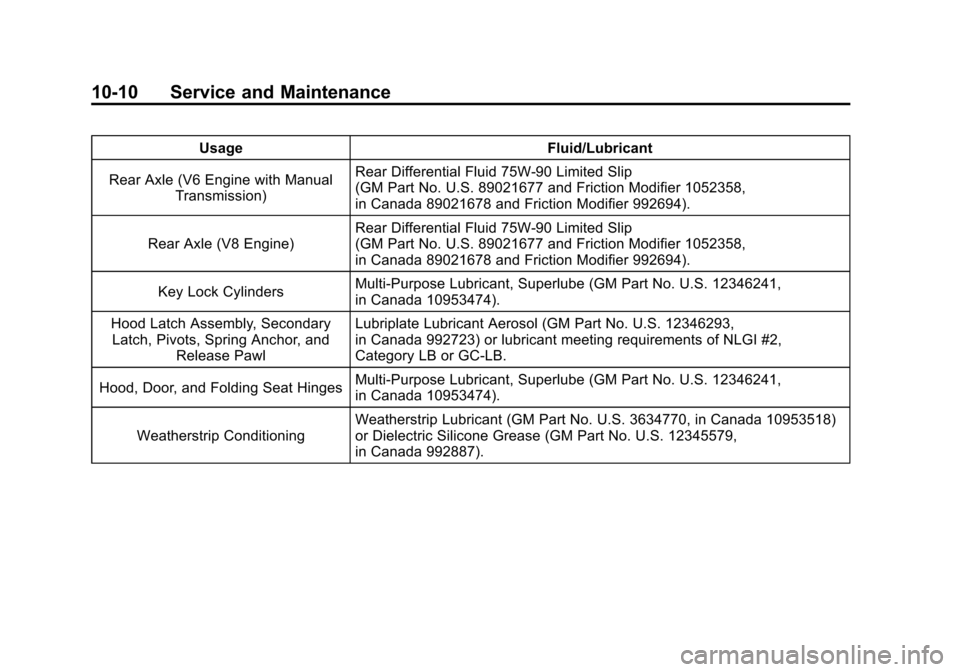
Black plate (10,1)Chevrolet Camaro Owner Manual - 2010
10-10 Service and Maintenance
UsageFluid/Lubricant
Rear Axle (V6 Engine with Manual Transmission) Rear Differential Fluid 75W-90 Limited Slip
(GM Part No. U.S. 89021677 and Friction Modifier 1052358,
in Canada 89021678 and Friction Modifier 992694).
Rear Axle (V8 Engine) Rear Differential Fluid 75W-90 Limited Slip
(GM Part No. U.S. 89021677 and Friction Modifier 1052358,
in Canada 89021678 and Friction Modifier 992694).
Key Lock Cylinders Multi-Purpose Lubricant, Superlube (GM Part No. U.S. 12346241,
in Canada 10953474).
Hood Latch Assembly, Secondary Latch, Pivots, Spring Anchor, and Release Pawl Lubriplate Lubricant Aerosol (GM Part No. U.S. 12346293,
in Canada 992723) or lubricant meeting requirements of NLGI #2,
Category LB or GC-LB.
Hood, Door, and Folding Seat Hinges Multi-Purpose Lubricant, Superlube (GM Part No. U.S. 12346241,
in Canada 10953474).
Weatherstrip Conditioning Weatherstrip Lubricant (GM Part No. U.S. 3634770, in Canada 10953518)
or Dielectric Silicone Grease (GM Part No. U.S. 12345579,
in Canada 992887).