roof CHEVROLET CAMARO 2022 User Guide
[x] Cancel search | Manufacturer: CHEVROLET, Model Year: 2022, Model line: CAMARO, Model: CHEVROLET CAMARO 2022Pages: 357, PDF Size: 7.99 MB
Page 80 of 357
Chevrolet Camaro Owner Manual (GMNA-Localizing-U.S./Canada/Mexico-
14583589) - 2021 - CRC - 3/26/20
Instruments and Controls 79
INT :Move the lever up to INT for
intermittent wipes, then turn the
xINT
band up for more frequent wipes or down
for less frequent wipes.
OFF : Use to turn the wipers off.
1X : For a single wipe, briefly move the
wiper lever down. For several wipes, hold
the wiper lever down.
n L: Pull the windshield wiper lever
toward you to spray windshield washer fluid
and activate the wipers. The wipers will
continue until the lever is released or the
maximum wash time is reached. When the
windshield wiper lever is released, additional
wipes may occur depending on how long
the windshield washer had been activated.
See Washer Fluid 0258 for information on
filling the windshield washer fluid reservoir.
Clear snow and ice from the wiper blades
and windshield before using them. If frozen
to the windshield, carefully loosen or thaw
them. Damaged blades should be replaced.
See Wiper Blade Replacement 0262.
Heavy snow or ice can overload the wiper
motor.
{Warning
In freezing weather, do not use the
washer until the windshield is warmed.
Otherwise the washer fluid can form ice
on the windshield, blocking your vision.
{Warning
Before driving the vehicle, always clear
snow and ice from the hood, windshield,
roof, and rear of the vehicle, including all
lamps and windows. Reduced visibility
from snow and ice buildup could lead to
a crash.
Wiper Parking
If the ignition is turned off while the wipers
are on LO, HI, or INT, they will
immediately stop.
If the windshield wiper lever is then moved
to OFF before the driver door is opened or
within 10 minutes, the wipers will restart
and move to the base of the windshield.
If the ignition is turned off while the wipers
are performing wipes due to windshield
washing, the wipers continue to run until
they reach the base of the windshield.
Compass
The vehicle has a compass display in the
Driver Information Center (DIC). The compass
receives its heading and other information
from the Global Positioning System (GPS)
antenna, StabiliTrak/Electronic Stability
Control (ESC), and vehicle speed information.
Avoid covering the GPS antenna, located on
the roof, for long periods of time with
objects that may interfere with the
antenna's ability to receive a satellite signal.
The compass system is designed to operate
for a certain number of miles or degrees of
turn before needing a signal from the GPS
satellites. When the compass display shows
CAL, drive the vehicle for a short distance in
an open area where it can receive a GPS
signal. The compass system will
automatically determine when the GPS
signal is restored and provide a heading
again.
Clock
Set the time and date using the
infotainment system. See "Time / Date"
under Settings 0158.
Page 127 of 357
Chevrolet Camaro Owner Manual (GMNA-Localizing-U.S./Canada/Mexico-
14583589) - 2021 - CRC - 3/24/20
126 Infotainment System
SiriusXM Satellite Radio Service
If equipped, SiriusXM Satellite Radio Service
provides digital radio reception. Tall
buildings or hills can interfere with satellite
radio signals, causing the sound to fade in
and out. In addition, traveling or standing
under heavy foliage, bridges, garages,
or tunnels may cause loss of the SiriusXM
signal for a period of time. Some cellular
services may interfere with SXM reception
causing loss of signal.
Mobile Device Usage
Mobile device usage, such as making or
receiving calls, charging, or just having the
mobile device on may cause static
interference in the radio. Unplug the mobile
device or turn it off if this happens.
Multi-Band Antenna
The roof antenna is for AM, FM, SiriusXM
Satellite Radio, OnStar, and GPS (Global
Positioning System). Keep clear of
obstructions for clear reception. If the
vehicle has a sunroof, and it is open,
reception can also be affected.
Audio Players
Avoiding Untrusted Media Devices
When using media devices such as SD cards,
USB devices, and mobile devices, consider
the source. Untrusted media devices could
contain files that affect system operation or
performance. Avoid use if the content or
origin cannot be trusted.
USB Port
Audio stored on a USB device may be
listened to.
The vehicle may be equipped with two USB
ports in the center console. These ports are
for data and charging.
Caution
To avoid vehicle damage, unplug all
accessories and disconnect all accessory
cables from the vehicle when not in use.
Accessory cables left plugged into the
vehicle, unconnected to a device, could be
damaged or cause an electrical short if
the unconnected end comes in contact
with liquids or another power source such
as the accessory power outlet.
Playing from a USB
A USB mass storage device can be connected
to the USB port.
Audio extensions supported by the USB may
include:
.MP3
.AAC
.OGG
.3GP
Gracenote
When plugging in a USB device, Gracenote
service builds voice tags for music. Voice
tags allow artists, albums with hard to
pronounce names, and nicknames to be used
to play music through voice recognition,
if equipped.
While indexing, infotainment features may
be available.
My Media Library
MyMedia is only available when more than
one indexed device is connected. It allows
access to content from all indexed media
sources. MyMedia will show as an available
source in the Source page.
Page 142 of 357
Chevrolet Camaro Owner Manual (GMNA-Localizing-U.S./Canada/Mexico-
14583589) - 2021 - CRC - 3/24/20
Infotainment System 141
When available, the system will show the
best lane(s) to be in for the next maneuver.
Cancel a Route
If a route is in progress using either the
vehicle navigation system or the
Turn-by-Turn route, and a new route is
requested, the current route in progress will
be canceled.
Global Positioning System (GPS)
If equipped, the position of the vehicle is
determined by using satellite signals, various
vehicle signals, and map data.
At times, other interference such as the
satellite condition, road configuration,
condition of the vehicle, and/or other
circumstances can affect the navigation
system's ability to determine the accurate
position of the vehicle.
The GPS shows the current position of the
vehicle using signals sent by GPS satellites.
When the vehicle is not receiving signals
from the satellites, a symbol appears in the
status bar.
This system might not be available or
interference can occur if any of the
following are true:
.Signals are obstructed by tall buildings,
trees, large trucks, or a tunnel.
.Satellites are being repaired or improved.
For more information if the GPS is not
functioning properly, see Problems with
Route Guidance 0141 and
If the System Needs Service 0142.
Vehicle Positioning
At times, the position of the vehicle on the
map could be inaccurate due to one or more
of the following reasons:
.The road system has changed.
.The vehicle is driving on slippery road
surfaces such as sand, gravel, or snow.
.The vehicle is traveling on winding roads
or long, straight roads.
.The vehicle is approaching a tall building
or a large vehicle.
.The surface streets run parallel to a
freeway.
.The vehicle has been transferred by a
vehicle carrier or a ferry.
.The current position calibration is set
incorrectly.
.The vehicle is traveling at high speed.
.The vehicle changes directions more than
once, or the vehicle is turning on a turn
table in a parking lot.
.The vehicle is entering and/or exiting a
parking lot, garage, or a lot with a roof.
.The GPS signal is not received.
.A roof carrier is installed on the vehicle.
.Tire chains are installed on the vehicle.
.The tires are replaced or worn.
.The tire pressure for the tires is incorrect.
.This is the first navigation use after the
map data is updated.
.The 12-volt battery has been disconnected
for several days.
.The vehicle is driving in heavy traffic
where driving is at low speeds, and the
vehicle is stopped and started repeatedly.
Problems with Route Guidance
Inappropriate route guidance can occur
under one or more of the following
conditions:
.The turn was not made on the road
indicated.
.Route guidance might not be available
when using automatic rerouting for the
next right or left turn.
Page 207 of 357
Chevrolet Camaro Owner Manual (GMNA-Localizing-U.S./Canada/Mexico-
14583589) - 2021 - CRC - 3/24/20
206 Driving and Operating
If equipped, the engine heater can help in
cold weather conditions at or below−18 °C
(0 °F) for easier starting and better fuel
economy during engine warm-up. Plug in
the coolant heater at least four hours before
starting the vehicle. An internal thermostat
in the plug end of the cord will prevent
engine heater operation at temperatures
above −18 °C (0 °F).
Using the Engine Heater
1. Turn off the engine.
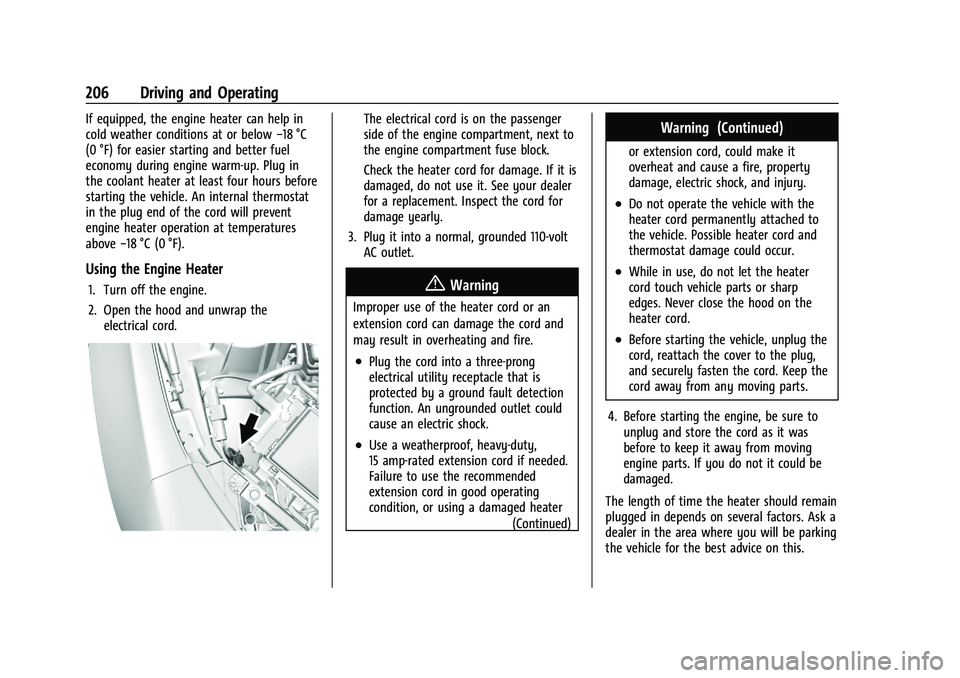
2. Open the hood and unwrap the
electrical cord.
The electrical cord is on the passenger
side of the engine compartment, next to
the engine compartment fuse block.
Check the heater cord for damage. If it is
damaged, do not use it. See your dealer
for a replacement. Inspect the cord for
damage yearly.
3. Plug it into a normal, grounded 110-volt AC outlet.
{Warning
Improper use of the heater cord or an
extension cord can damage the cord and
may result in overheating and fire.
.Plug the cord into a three-prong
electrical utility receptacle that is
protected by a ground fault detection
function. An ungrounded outlet could
cause an electric shock.
.Use a weatherproof, heavy-duty,
15 amp-rated extension cord if needed.
Failure to use the recommended
extension cord in good operating
condition, or using a damaged heater
(Continued)
Warning (Continued)
or extension cord, could make it
overheat and cause a fire, property
damage, electric shock, and injury.
.Do not operate the vehicle with the
heater cord permanently attached to
the vehicle. Possible heater cord and
thermostat damage could occur.
.While in use, do not let the heater
cord touch vehicle parts or sharp
edges. Never close the hood on the
heater cord.
.Before starting the vehicle, unplug the
cord, reattach the cover to the plug,
and securely fasten the cord. Keep the
cord away from any moving parts.
4. Before starting the engine, be sure to unplug and store the cord as it was
before to keep it away from moving
engine parts. If you do not it could be
damaged.
The length of time the heater should remain
plugged in depends on several factors. Ask a
dealer in the area where you will be parking
the vehicle for the best advice on this.
Page 208 of 357
Chevrolet Camaro Owner Manual (GMNA-Localizing-U.S./Canada/Mexico-
14583589) - 2021 - CRC - 3/24/20
Driving and Operating 207
Retained Accessory Power (RAP)
When the ignition is turned from on to off,
the following features (if equipped) will
continue to function for up to 10 minutes,
or until the driver door is opened. These
features will also work when the ignition is
in RUN or ACC/ACCESSORY:
.Infotainment System
.Power Windows (during RAP this
functionality will be lost when any door
is opened)
.Sunroof (during RAP this functionality will
be lost when any door is opened)
.Auxiliary Power Outlet
.Audio System
.OnStar System
Shifting Into Park
To shift into P (Park):1. Hold the brake pedal down and set the parking brake.
See Electric Parking Brake 0216.
2. Move the shift lever into P (Park) by holding in the button on the shift lever
and pushing the shift lever all the way
toward the front of the vehicle.
3. Turn the ignition off.
Leaving the Vehicle with the Engine
Running
{Warning
It can be dangerous to leave the vehicle
with the engine running. It could
overheat and catch fire.
It is dangerous to get out of the vehicle
if the shift lever is not fully in P (Park)
with the parking brake firmly set. The
vehicle can roll.
Do not leave the vehicle when the engine
is running. If you have left the engine
running, the vehicle can move suddenly.
You or others could be injured. To be
sure the vehicle will not move, even
when you are on fairly level ground,
always set the parking brake and move
the shift lever to P (Park). See Shifting
Into Park 0207.
If you have to leave the vehicle with the
engine running, be sure the vehicle is in
P (Park) and the parking brake is set before
you leave it. After you have moved the shift
lever into P (Park), hold the brake pedal down. Then, see if you can move the shift
lever away from P (Park) without first
pressing the button on the shift lever.
Release the button and check that the shift
lever cannot be moved out of P (Park).
Torque Lock
Torque lock is when the weight of the
vehicle puts too much force on the parking
pawl in the transmission. This happens when
parking on a hill and shifting the
transmission into P (Park) is not done
properly and then it is difficult to shift out
of P (Park). To prevent torque lock, set the
parking brake and then shift into P (Park). To
find out how, see
“Shifting Into Park”
previously in this section.
If torque lock does occur, the vehicle may
need to be pushed uphill by another vehicle
to relieve the parking pawl pressure, so you
can shift out of P (Park).
Shifting out of Park
This vehicle is equipped with an electronic
shift lock release system. The shift lock
release is designed to prevent movement of
the shift lever out of P (Park), unless the
ignition is on and the brake pedal is applied.
Page 269 of 357
Chevrolet Camaro Owner Manual (GMNA-Localizing-U.S./Canada/Mexico-
14583589) - 2021 - CRC - 3/24/20
268 Vehicle Care
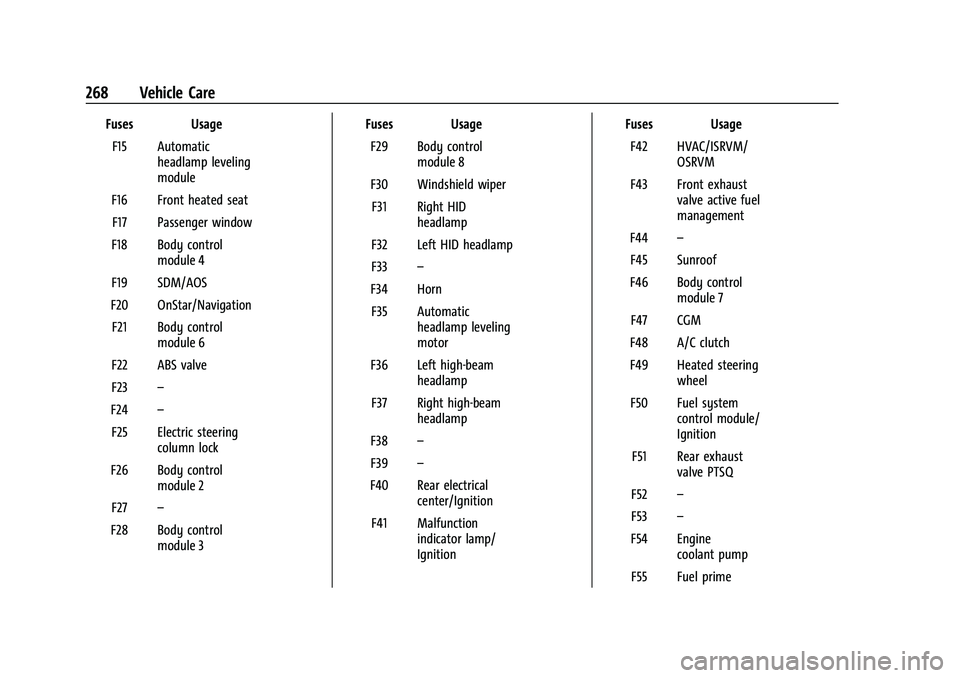
Fuses UsageF15 Automatic headlamp leveling
module
F16 Front heated seat F17 Passenger window
F18 Body control module 4
F19 SDM/AOS
F20 OnStar/Navigation F21 Body control module 6
F22 ABS valve
F23 –
F24 –
F25 Electric steering column lock
F26 Body control module 2
F27 –
F28 Body control module 3 Fuses Usage
F29 Body control module 8
F30 Windshield wiper F31 Right HID headlamp
F32 Left HID headlamp
F33 –
F34 Horn F35 Automatic headlamp leveling
motor
F36 Left high-beam headlamp
F37 Right high-beam headlamp
F38 –
F39 –
F40 Rear electrical center/Ignition
F41 Malfunction indicator lamp/
Ignition Fuses Usage
F42 HVAC/ISRVM/ OSRVM
F43 Front exhaust valve active fuel
management
F44 –
F45 Sunroof
F46 Body control module 7
F47 CGM
F48 A/C clutch
F49 Heated steering wheel
F50 Fuel system control module/
Ignition
F51 Rear exhaust valve PTSQ
F52 –
F53 –
F54 Engine coolant pump
F55 Fuel prime
Page 313 of 357
Chevrolet Camaro Owner Manual (GMNA-Localizing-U.S./Canada/Mexico-
14583589) - 2021 - CRC - 3/24/20
312 Service and Maintenance
.Check restraint system components. See
Safety System Check047.
.Visually inspect fuel system for damage
or leaks.
.Visually inspect exhaust system and
nearby heat shields for loose or damaged
parts.
.Lubricate body components. See Exterior
Care 0300.
.Check automatic transmission shift lock
control function. See Automatic
Transmission Shift Lock Control Function
Check 0261.
.Check parking brake and automatic
transmission park mechanism. See Park
Brake and P (Park) Mechanism Check
0 261.
.Check accelerator pedal for damage, high
effort, or binding. Replace if needed.
.Visually inspect gas strut for signs of
wear, cracks, or other damage. Check the
hold open ability of the strut. If the hold
open is low, service the gas strut. See Gas
Strut(s) 0263.
.Check tire sealant expiration date,
if equipped. See Tire Sealant and
Compressor Kit 0291.
.Inspect sunroof track and seal,
if equipped. See Sunroof029.
Page 353 of 357
Chevrolet Camaro Owner Manual (GMNA-Localizing-U.S./Canada/Mexico-
14583589) - 2021 - CRC - 3/24/20
352 Index
R
RadioHD Radio Technology . . . . . . . . . . . . . . . . . . 124
Radio Data System (RDS) . . . . . . . . . . . . . . . . . 125
Radio Frequency Statement . . . . . . . . . . . . . . 334
Radio Reception . . . . . . . . . . . . . . . . . . . . . . . . . . 125
Radios AM-FM Radio . . . . . . . . . . . . . . . . . . . . . . . . . . 122
Satellite . . . . . . . . . . . . . . . . . . . . . . . . . . . . . . . . 125
Reading Lamps . . . . . . . . . . . . . . . . . . . . . . . . . . . 113
Rear Axle . . . . . . . . . . . . . . . . . . . . . . . . . . . . . . . . 261
Limited-Slip . . . . . . . . . . . . . . . . . . . . . . . . . . . . 224
Rear Camera Mirror . . . . . . . . . . . . . . . . . . . . . . . 24
Rear Seats . . . . . . . . . . . . . . . . . . . . . . . . . . . . . . . . .41
Rear Storage . . . . . . . . . . . . . . . . . . . . . . . . . . . . . . .75
Rear Vision Camera (RVC) . . . . . . . . . . . . . . . . 228
Rearview Mirrors . . . . . . . . . . . . . . . . . . . . . . . . . 24 Automatic Dimming . . . . . . . . . . . . . . . . . . . . 24
Reclining Seatbacks . . . . . . . . . . . . . . . . . . . . . . . .37
Recognition
Voice . . . . . . . . . . . . . . . . . . . . . . . . . . . . . . . . . . 143
Recommended Fuel . . . . . . . . . . . . . . . . . . . . . . . . . . . . . . . . . . . . 234
Recommended Fluids and Lubricants . . . . . .318
Records
Maintenance . . . . . . . . . . . . . . . . . . . . . . . . . . . 321
Recreational Vehicle Towing . . . . . . . . . . . . . 300 Reimbursement Program, GM
Mobility . . . . . . . . . . . . . . . . . . . . . . . . . . . . . . . 329
Remote Keyless Entry (RKE) System . . . . . . . .7
Remote Vehicle Start . . . . . . . . . . . . . . . . . . . . . .14
Replacement Parts Airbags . . . . . . . . . . . . . . . . . . . . . . . . . . . . . . . . . 59
Maintenance . . . . . . . . . . . . . . . . . . . . . . . . . . . 320
Replacing Airbag System . . . . . . . . . . . . . . . . . . 59
Replacing LATCH System Parts after a Crash . . . . . . . . . . . . . . . . . . . . . . . . . . . . . . . . . . . 70
Replacing Seat Belt System Parts after
a Crash . . . . . . . . . . . . . . . . . . . . . . . . . . . . . . . . . 48
Reporting Safety Defects Canadian Government . . . . . . . . . . . . . . . . . 334
General Motors . . . . . . . . . . . . . . . . . . . . . . . . 335
U.S. Government . . . . . . . . . . . . . . . . . . . . . . . 334
Restraints Where to Put . . . . . . . . . . . . . . . . . . . . . . . . . . . 64
Retained Accessory Power (RAP) . . . . . . . . . 207
Reverse Tilt Mirrors . . . . . . . . . . . . . . . . . . . . . . . 24
Ride Control Systems Limited Slip Rear Axle . . . . . . . . . . . . . . . . . 224
Roads Driving, Wet . . . . . . . . . . . . . . . . . . . . . . . . . . . 196
Roadside Assistance Program . . . . . . . . . . . . 329
Roof
Sunroof . . . . . . . . . . . . . . . . . . . . . . . . . . . . . . . . . 29
Rotation, Tires . . . . . . . . . . . . . . . . . . . . . . . . . . . 284 Routing, Engine Drive Belt . . . . . . . . . . . . . . . 325
Run-Flat Tires . . . . . . . . . . . . . . . . . . . . . . . . . . . . 273
Running the Vehicle While Parked . . . . . . . 209
S
Safety Defects Reporting
Canadian Government . . . . . . . . . . . . . . . . . 334
General Motors . . . . . . . . . . . . . . . . . . . . . . . . 335
U.S. Government . . . . . . . . . . . . . . . . . . . . . . . 334
Safety System Check . . . . . . . . . . . . . . . . . . . . . 47
Satellite Radio . . . . . . . . . . . . . . . . . . . . . . . . . . . . 125
Scheduling Appointments . . . . . . . . . . . . . . . . 330
Sealant Kit, Tire . . . . . . . . . . . . . . . . . . . . . . . . . . 291
Seat Belts . . . . . . . . . . . . . . . . . . . . . . . . . . . . . . . . . 42 Care . . . . . . . . . . . . . . . . . . . . . . . . . . . . . . . . . . . . 47
Extender . . . . . . . . . . . . . . . . . . . . . . . . . . . . . . . . 47
How to Wear Seat Belts Properly . . . . . . . 43
Lap-Shoulder Belt . . . . . . . . . . . . . . . . . . . . . . . 45
Reminders . . . . . . . . . . . . . . . . . . . . . . . . . . . . . . 90
Replacing after a Crash . . . . . . . . . . . . . . . . . 48
Use During Pregnancy . . . . . . . . . . . . . . . . . . 47
Seatback Latches . . . . . . . . . . . . . . . . . . . . . . . . . . 40
Seats Adjustment, Front . . . . . . . . . . . . . . . . . . . . . . 36
Head Restraints . . . . . . . . . . . . . . . . . . . . . . . . . 35
Heated and Ventilated Front . . . . . . . . . . . . 40
Memory . . . . . . . . . . . . . . . . . . . . . . . . . . . . . . . . 37
Power Adjustment, Front . . . . . . . . . . . . . . . 36
Page 354 of 357
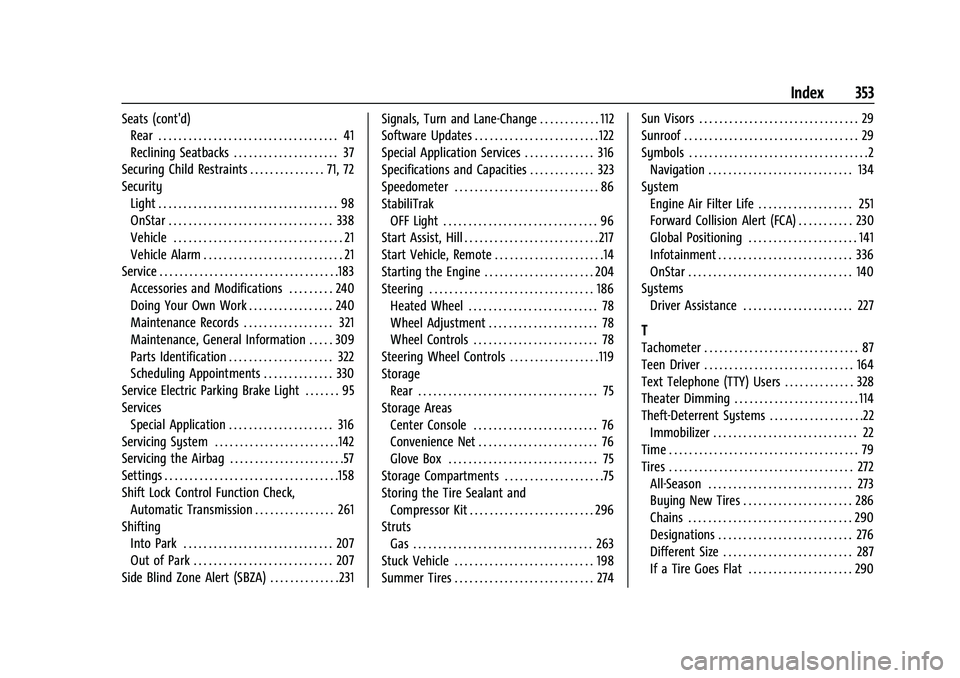
Chevrolet Camaro Owner Manual (GMNA-Localizing-U.S./Canada/Mexico-
14583589) - 2021 - CRC - 3/24/20
Index 353
Seats (cont'd)Rear . . . . . . . . . . . . . . . . . . . . . . . . . . . . . . . . . . . . 41
Reclining Seatbacks . . . . . . . . . . . . . . . . . . . . . 37
Securing Child Restraints . . . . . . . . . . . . . . . 71, 72
Security Light . . . . . . . . . . . . . . . . . . . . . . . . . . . . . . . . . . . . 98
OnStar . . . . . . . . . . . . . . . . . . . . . . . . . . . . . . . . . 338
Vehicle . . . . . . . . . . . . . . . . . . . . . . . . . . . . . . . . . . 21
Vehicle Alarm . . . . . . . . . . . . . . . . . . . . . . . . . . . . 21
Service . . . . . . . . . . . . . . . . . . . . . . . . . . . . . . . . . . . .183 Accessories and Modifications . . . . . . . . . 240
Doing Your Own Work . . . . . . . . . . . . . . . . . 240
Maintenance Records . . . . . . . . . . . . . . . . . . 321
Maintenance, General Information . . . . . 309
Parts Identification . . . . . . . . . . . . . . . . . . . . . 322
Scheduling Appointments . . . . . . . . . . . . . . 330
Service Electric Parking Brake Light . . . . . . . 95
Services Special Application . . . . . . . . . . . . . . . . . . . . . 316
Servicing System . . . . . . . . . . . . . . . . . . . . . . . . .142
Servicing the Airbag . . . . . . . . . . . . . . . . . . . . . . .57
Settings . . . . . . . . . . . . . . . . . . . . . . . . . . . . . . . . . . .158
Shift Lock Control Function Check, Automatic Transmission . . . . . . . . . . . . . . . . 261
Shifting Into Park . . . . . . . . . . . . . . . . . . . . . . . . . . . . . . 207
Out of Park . . . . . . . . . . . . . . . . . . . . . . . . . . . . 207
Side Blind Zone Alert (SBZA) . . . . . . . . . . . . . . 231 Signals, Turn and Lane-Change . . . . . . . . . . . . 112
Software Updates . . . . . . . . . . . . . . . . . . . . . . . . . 122
Special Application Services . . . . . . . . . . . . . . 316
Specifications and Capacities . . . . . . . . . . . . . 323
Speedometer . . . . . . . . . . . . . . . . . . . . . . . . . . . . . 86
StabiliTrak
OFF Light . . . . . . . . . . . . . . . . . . . . . . . . . . . . . . . 96
Start Assist, Hill . . . . . . . . . . . . . . . . . . . . . . . . . . . 217
Start Vehicle, Remote . . . . . . . . . . . . . . . . . . . . . .14
Starting the Engine . . . . . . . . . . . . . . . . . . . . . . 204
Steering . . . . . . . . . . . . . . . . . . . . . . . . . . . . . . . . . 186 Heated Wheel . . . . . . . . . . . . . . . . . . . . . . . . . . 78
Wheel Adjustment . . . . . . . . . . . . . . . . . . . . . . 78
Wheel Controls . . . . . . . . . . . . . . . . . . . . . . . . . 78
Steering Wheel Controls . . . . . . . . . . . . . . . . . . 119
Storage Rear . . . . . . . . . . . . . . . . . . . . . . . . . . . . . . . . . . . . 75
Storage Areas Center Console . . . . . . . . . . . . . . . . . . . . . . . . . 76
Convenience Net . . . . . . . . . . . . . . . . . . . . . . . . 76
Glove Box . . . . . . . . . . . . . . . . . . . . . . . . . . . . . . 75
Storage Compartments . . . . . . . . . . . . . . . . . . . .75
Storing the Tire Sealant and Compressor Kit . . . . . . . . . . . . . . . . . . . . . . . . . 296
Struts
Gas . . . . . . . . . . . . . . . . . . . . . . . . . . . . . . . . . . . . 263
Stuck Vehicle . . . . . . . . . . . . . . . . . . . . . . . . . . . . 198
Summer Tires . . . . . . . . . . . . . . . . . . . . . . . . . . . . 274 Sun Visors . . . . . . . . . . . . . . . . . . . . . . . . . . . . . . . . 29
Sunroof . . . . . . . . . . . . . . . . . . . . . . . . . . . . . . . . . . . 29
Symbols . . . . . . . . . . . . . . . . . . . . . . . . . . . . . . . . . . . .2
Navigation . . . . . . . . . . . . . . . . . . . . . . . . . . . . . 134
System Engine Air Filter Life . . . . . . . . . . . . . . . . . . . 251
Forward Collision Alert (FCA) . . . . . . . . . . . 230
Global Positioning . . . . . . . . . . . . . . . . . . . . . . 141
Infotainment . . . . . . . . . . . . . . . . . . . . . . . . . . . 336
OnStar . . . . . . . . . . . . . . . . . . . . . . . . . . . . . . . . . 140
Systems
Driver Assistance . . . . . . . . . . . . . . . . . . . . . . 227
T
Tachometer . . . . . . . . . . . . . . . . . . . . . . . . . . . . . . . 87
Teen Driver . . . . . . . . . . . . . . . . . . . . . . . . . . . . . . 164
Text Telephone (TTY) Users . . . . . . . . . . . . . . 328
Theater Dimming . . . . . . . . . . . . . . . . . . . . . . . . . 114
Theft-Deterrent Systems . . . . . . . . . . . . . . . . . . .22Immobilizer . . . . . . . . . . . . . . . . . . . . . . . . . . . . . 22
Time . . . . . . . . . . . . . . . . . . . . . . . . . . . . . . . . . . . . . . 79
Tires . . . . . . . . . . . . . . . . . . . . . . . . . . . . . . . . . . . . . 272
All-Season . . . . . . . . . . . . . . . . . . . . . . . . . . . . . 273
Buying New Tires . . . . . . . . . . . . . . . . . . . . . . 286
Chains . . . . . . . . . . . . . . . . . . . . . . . . . . . . . . . . . 290
Designations . . . . . . . . . . . . . . . . . . . . . . . . . . . 276
Different Size . . . . . . . . . . . . . . . . . . . . . . . . . . 287
If a Tire Goes Flat . . . . . . . . . . . . . . . . . . . . . 290