key battery CHEVROLET CAMARO SS 2010 User Guide
[x] Cancel search | Manufacturer: CHEVROLET, Model Year: 2010, Model line: CAMARO SS, Model: CHEVROLET CAMARO SS 2010Pages: 372, PDF Size: 1.91 MB
Page 196 of 372
To prevent gear damage, this
system also prevents cranking if
the engine is already running.
Engine cranking can be stopped
by turning the ignition switch
to ACC/ACCESSORY or
LOCK/OFF.
Notice:Cranking the engine for
long periods of time, by returning
the key to the START position
immediately after cranking has
ended, can overheat and damage
the cranking motor, and drain the
battery. Wait at least 15 seconds
between each try, to let the
cranking motor cool down.
2. If the engine does not start
after 5-10 seconds, especially in
very cold weather (below 0°F or
−18°C), it could be flooded with
too much gasoline. Push the
accelerator pedal all the way to
the floor and holding it there as
you hold the key in START for a
maximum of 15 seconds. Wait atleast 15 seconds between each
try, to allow the cranking motor to
cool. When the engine starts, let
go of the key and accelerator.
If the vehicle starts briefly but
then stops again, repeat the
procedure. This clears the extra
gasoline from the engine. Do not
race the engine immediately after
starting it. Operate the engine and
transmission gently until the oil
warms up and lubricates all
moving parts.
Notice:The engine is designed
to work with the electronics in the
vehicle. If you add electrical parts
or accessories, you could change
the way the engine operates.
Before adding electrical
equipment, check with your
dealer/retailer. If you do not,
the engine might not perform
properly. Any resulting damage
would not be covered by the
vehicle warranty.Engine Heater
The engine coolant heater, if
available, can help in cold weather
conditions at or below 0°F (−18°C)
for easier starting and better fuel
economy during engine warm-up.
Plug in the coolant heater at least
four hours before starting the vehicle.
An internal thermostat in the
plug-end of the cord will prevent
engine coolant heater operation at
temperatures above 0°F (−18°C).
8-20 Driving and Operating
Page 198 of 372
3. Turn the ignition to LOCK/OFF.
4. Remove the key.
Leaving the Vehicle With the
Engine Running
{WARNING
It can be dangerous to leave the
vehicle with the engine running.
The vehicle could move suddenly
if the shift lever is not fully in
P (Park) with the parking brake
firmly set. And, if you leave the
vehicle with the engine running,
it could overheat and even catch
fire. You or others could be injured.
Do not leave the vehicle with the
engine running.
If you have to leave the vehicle
with the engine running, the vehicle
must be in P (Park) and the parking
brake set.
Release the button and check that
the shift lever cannot be moved
out of P (Park).
Torque Lock
Torque lock is when the weight of
the vehicle puts too much force on
the parking pawl in the transmission.
This happens when parking on a hill
and shifting the transmission into
P (Park) is not done properly and
then it is difficult to shift out of
P (Park). To prevent torque lock,
set the parking brake and then
shift into P (Park). To find out how,
see “Shifting Into P (Park)” listed
previously.
If torque lock does occur, the
vehicle may need to be pushed
uphill by another vehicle to relieve
the parking pawl pressure, so
you can shift out of P (Park).
Shifting Out of Park
This vehicle is equipped with an
electronic shift lock release system.
The shift lock release is designed to:
•Prevent ignition key removal
unless the shift lever is in P (Park)
with the shift lever button fully
released.
•Prevent movement of the shift
lever out of P (Park), unless the
ignition is in ON/RUN or ACC/
ACCESSORY and the brake
pedal is applied.
The shift lock release is always
functional except in the case of
an uncharged or low voltage
(less than 9 volt) battery.
8-22 Driving and Operating
Page 199 of 372
If the vehicle has an uncharged
battery or a battery with low voltage,
try charging or jump starting the
battery. SeeJump Starting on
page 9-84
To shift out of P (Park):
1. Apply the brake pedal.
2. Press the shift lever button.
3. Move the shift lever to the
desired position.
If still unable to shift out of P (Park):
1. Fully release the shift lever
button.
2. Hold the brake pedal down and
press the shift lever button again.
3. Move the shift lever to the
desired position.
If the shift lever still cannot be
moved from P (Park), see Shift
Lock Manual Release.Shift Lock Manual Release
The transmission has an electric
park lock called a shift lock manual
release. The key must be in the
ON/RUN position, and the brake
pedal pressed so the transmission
gear selector can be moved from the
P (Park) position. If the battery has
lost power, the selector cannot be
moved from P (Park) unless the shift
lock manual release is disengaged
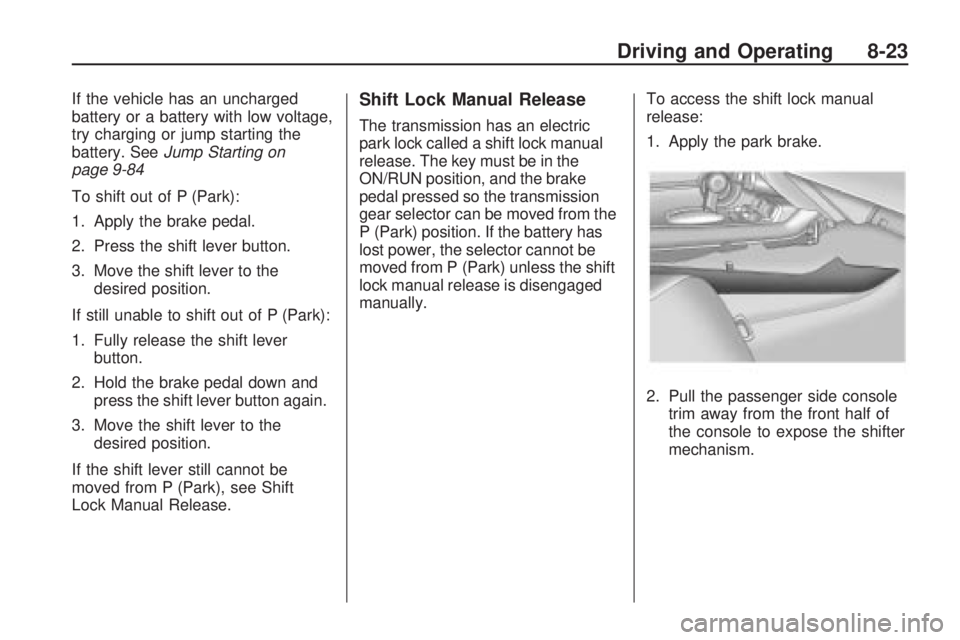
manually.To access the shift lock manual
release:
1. Apply the park brake.
2. Pull the passenger side console
trim away from the front half of
the console to expose the shifter
mechanism.
Driving and Operating 8-23
Page 366 of 372
L
Labeling, Tire Sidewall..........9-49
Lamp Messages..................4-33
Lamps
Daytime
Running (DRL).......5-3, 9-39
Dome ............................... 5-6
Exterior Controls................ 5-1
Front Fog.......................... 5-5
Headlamps, Front Turn
Signal and Parking
Lamps .................9-37, 9-38
License Plate...................9-40
Malfunction Indicator.........4-19
Lap-Shoulder Belt................2-16
Latch, Lower Anchors and
Tethers for Children...........2-43
LATCH System
Replacing Parts After a
Crash..........................2-48
Latches, Seatback................. 2-5
Lighting
Entry................................ 5-6
Theater Dimming................ 5-6
Lights
Airbag Readiness.............4-17Lights (cont.)
Antilock Brake System
(ABS) Warning..............4-23
Charging System..............4-19
Cruise Control..................4-26
Engine Oil Pressure..........4-25
Flash-to-Pass..................... 5-3
Fog Lamps ......................4-26
High/Low Beam Changer..... 5-2
Immobilizer......................4-26
Safety Belt Reminders.......4-16
Taillamp Indicator..............4-26
Tire Pressure...................4-24
Traction Control OFF/
StabiliTrak OFF.............4-24
Traction Control System
(TCS)/StabiliTrak
®..........4-24
Traction Off......................4-23
Limited-Slip Rear Axle...........8-38
Locks
Door ................................. 1-6
Lockout Protection.............. 1-8
Power Door ....................... 1-7
Loss of Control..................... 8-6
Lower Anchors and Tethers
for Children (LATCH
SYSTEM)........................2-43
M
Maintenance
Records.........................10-10
Maintenance Schedule
Recommended Fluids and
Lubricants....................10-7
Scheduled Maintenance.....10-2
Malfunction Indicator Lamp....4-19
Manual Mode......................8-29
Manual Transmission............8-30
Fluid...............................9-15
Messages
Airbag System..................4-35
Anti-Theft Alarm System....4-35
Battery Voltage and
Charging......................4-30
Brake System..................4-31
Compass.........................4-31
Door Ajar.........................4-31
Engine Cooling System.....4-32
Engine Oil.......................4-32
Engine Power..................4-33
Fuel System....................4-33
Key and Lock..................4-33
Lamp ..............................4-33
Object Detection System....4-34
i-6 INDEX
Page 368 of 372
Passenger Sensing System . . . 2-28
Perchlorate Materials
Requirements, California...... 9-3
Phone
Bluetooth.........6-22, 6-23, 6-26
Power
Door Locks........................ 1-7
Mirrors............................1-12
Protection, Battery.............. 5-7
Retained
Accessory (RAP)...........8-19
Seat Adjustment................. 2-4
Steering Fluid...................9-25
Windows.........................1-14
Pregnancy, Using
Safety Belts.....................2-19
Privacy
Radio Frequency
Identification (RFID).....12-15
Program
Courtesy Transportation.....12-8
Proposition 65 Warning,
California.......................... 9-2R
Radio Frequency
Identification (RFID).........12-15
Statement......................12-15
Radios
AM-FM Radio.................... 6-8
Reception........................6-13
Satellite...........................6-10
Rear Axle...........................9-30
Limited-Slip......................8-38
Rear Seats........................... 2-6
Rearview Mirrors..................1-13
Automatic Dimming...........1-13
Reclining Seatbacks............... 2-4
Recommended Fluids and
Lubricants........................10-7
Recommended Fuel.............8-44
Records
Maintenance...................10-10
Recreational Vehicle Towing . . . 9-87
Reimbursement Program,
GM Mobility.....................12-5
Remote Keyless Entry (RKE)
System............................. 1-3Remote Vehicle Start............. 1-5
Replacement Bulbs..............9-41
Replacement Parts
Airbags...........................2-34
Maintenance....................10-9
Replacing Airbag System......2-34
Replacing LATCH System
Parts After a Crash...........2-48
Replacing Safety Belt System
Parts After a Crash............2-21
Reporting Safety Defects
Canadian Government.....12-13
General Motors...............12-13
U.S. Government............12-13
Retained Accessory Power
(RAP) .............................8-19
Ride Control Systems
Limited Slip Rear Axle.......8-38
Messages........................4-34
Roadside Assistance
Program..........................12-6
Roof
Sunroof...........................1-16
Rotation, Tires.....................9-61
Routing, Engine Drive Belt....11-4
Running the Vehicle While
Parked............................8-26
i-8 INDEX