automatic transmission CHEVROLET CAMARO SS 2010 Owner's Manual
[x] Cancel search | Manufacturer: CHEVROLET, Model Year: 2010, Model line: CAMARO SS, Model: CHEVROLET CAMARO SS 2010Pages: 372, PDF Size: 1.91 MB
Page 233 of 372
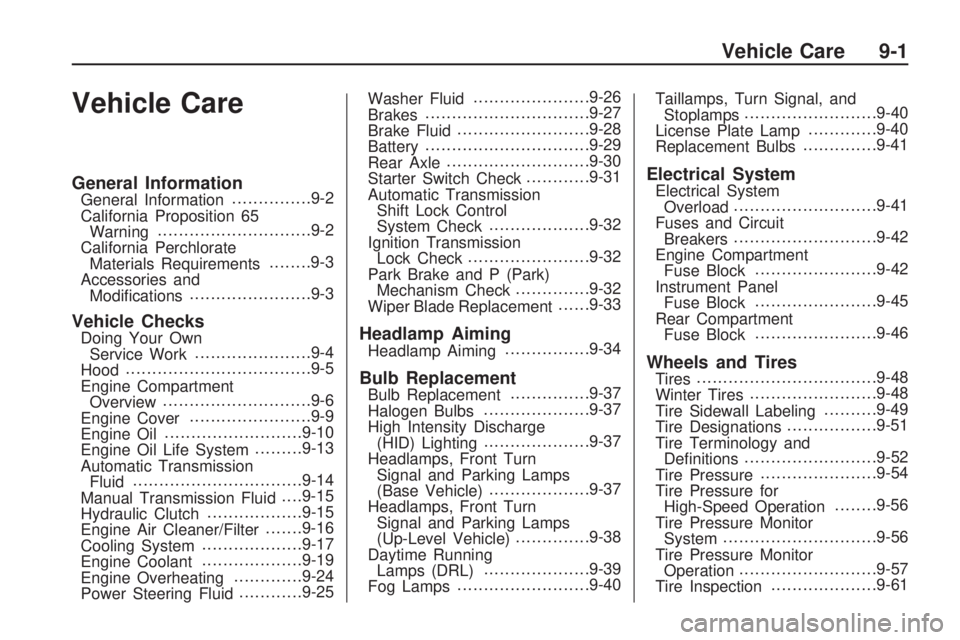
Vehicle Care
General InformationGeneral Information...............9-2
California Proposition 65
Warning.............................9-2
California Perchlorate
Materials Requirements........9-3
Accessories and
Modifications.......................9-3
Vehicle ChecksDoing Your Own
Service Work......................9-4
Hood...................................9-5
Engine Compartment
Overview............................9-6
Engine Cover.......................9-9
Engine Oil..........................9-10
Engine Oil Life System.........9-13
Automatic Transmission
Fluid................................9-14
Manual Transmission Fluid. . . .9-15
Hydraulic Clutch..................9-15
Engine Air Cleaner/Filter.......9-16
Cooling System...................9-17
Engine Coolant...................9-19
Engine Overheating.............9-24
Power Steering Fluid............9-25Washer Fluid......................9-26
Brakes...............................9-27
Brake Fluid.........................9-28
Battery...............................9-29
Rear Axle...........................9-30
Starter Switch Check............9-31
Automatic Transmission
Shift Lock Control
System Check...................9-32
Ignition Transmission
Lock Check.......................9-32
Park Brake and P (Park)
Mechanism Check..............9-32
Wiper Blade Replacement......9-33Headlamp AimingHeadlamp Aiming................9-34
Bulb ReplacementBulb Replacement...............9-37
Halogen Bulbs....................9-37
High Intensity Discharge
(HID) Lighting....................9-37
Headlamps, Front Turn
Signal and Parking Lamps
(Base Vehicle)...................9-37
Headlamps, Front Turn
Signal and Parking Lamps
(Up-Level Vehicle)..............9-38
Daytime Running
Lamps (DRL)....................9-39
Fog Lamps.........................9-40Taillamps, Turn Signal, and
Stoplamps.........................9-40
License Plate Lamp.............9-40
Replacement Bulbs..............9-41
Electrical SystemElectrical System
Overload...........................9-41
Fuses and Circuit
Breakers...........................9-42
Engine Compartment
Fuse Block.......................9-42
Instrument Panel
Fuse Block.......................9-45
Rear Compartment
Fuse Block.......................9-46
Wheels and TiresTires..................................9-48
Winter Tires........................9-48
Tire Sidewall Labeling..........9-49
Tire Designations.................9-51
Tire Terminology and
Definitions.........................9-52
Tire Pressure......................9-54
Tire Pressure for
High-Speed Operation........9-56
Tire Pressure Monitor
System.............................9-56
Tire Pressure Monitor
Operation..........................9-57
Tire Inspection....................9-61
Vehicle Care 9-1
Page 246 of 372
What to Do with Used Oil
Used engine oil contains certain
elements that can be unhealthy for
your skin and could even cause
cancer. Do not let used oil stay on
your skin for very long. Clean your
skin and nails with soap and water,
or a good hand cleaner. Wash or
properly dispose of clothing or rags
containing used engine oil. See the
manufacturer’s warnings about the
use and disposal of oil products.
Used oil can be a threat to the
environment. If you change your own
oil, be sure to drain all the oil from the
filter before disposal. Never dispose
of oil by putting it in the trash, pouring
it on the ground, into sewers, or into
streams or bodies of water. Recycle
it by taking it to a place that collects
used oil.
Automatic Transmission
Fluid
How to Check Automatic
Transmission Fluid
It is not necessary to check
the transmission fluid level.
A transmission fluid leak is the
only reason for fluid loss. If a leak
occurs, take the vehicle to your
dealer/retailer service department
and have it repaired as soon as
possible.
There is a special procedure
for checking and changing the
transmission fluid. Because this
procedure is difficult, you should
have this done at your dealer/
retailer service department.Contact your dealer/retailer for
additional information or the
procedure can be found in the
service manual. To purchase a
service manual, seeService
Publications Ordering Information
on page 12-12.
Change the fluid and filter at the
intervals listed inScheduled
Maintenance on page 10-2, and
be sure to use the fluid listed
inRecommended Fluids and
Lubricants on page 10-7.
9-14 Vehicle Care
Page 262 of 372
Vehicle Storage
{WARNING
Batteries have acid that can burn
you and gas that can explode.
You can be badly hurt if you are
not careful. SeeJump Starting
on page 9-84for tips on working
around a battery without
getting hurt.
Infrequent Usage: If the vehicle
is driven infrequently, remove
the black, negative (−) cable
from the battery. This helps keep
the battery from running down.Extended Storage: For extended
storage of the vehicle, remove the
black, negative (−) cable from the
battery or use a battery trickle
charger. This helps maintain the
charge of the battery over an
extended period of time.
Rear Axle
When to Check Lubricant
It is not necessary to regularly
check rear axle fluid unless you
suspect there is a leak or you hear
an unusual noise. A fluid loss could
indicate a problem. Have it inspected
and repaired.
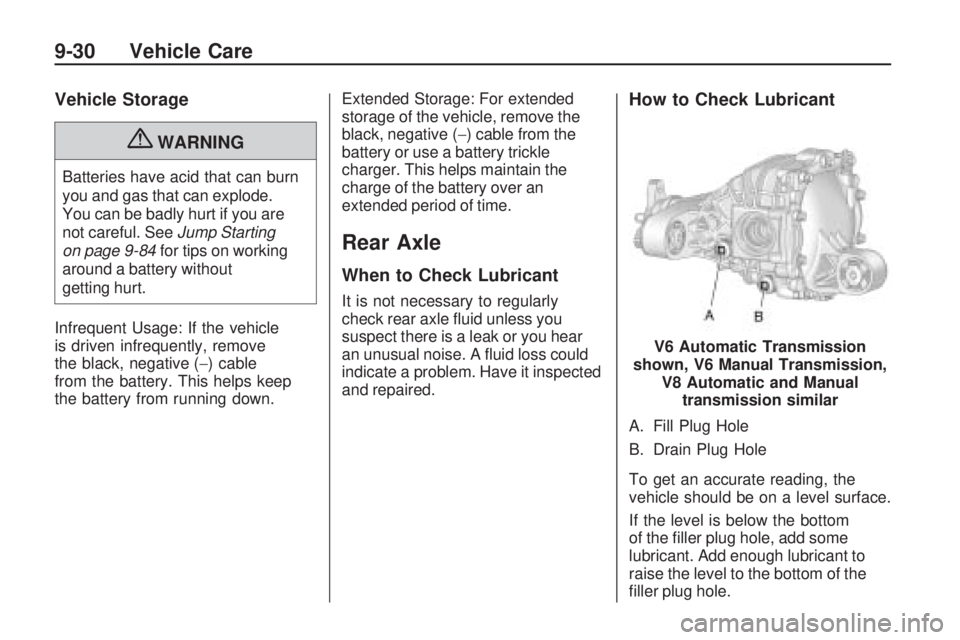
How to Check Lubricant
A. Fill Plug Hole
B. Drain Plug Hole
To get an accurate reading, the
vehicle should be on a level surface.
If the level is below the bottom
of the filler plug hole, add some
lubricant. Add enough lubricant to
raise the level to the bottom of the
filler plug hole.V6 Automatic Transmission
shown, V6 Manual Transmission,
V8 Automatic and Manual
transmission similar
9-30 Vehicle Care
Page 263 of 372

What to Use
For 218 mm rear drive module
(RDM) V6 manual, V8 automatic
and V8 manual:
To add lubricant when the level
is low, use 75W-90 LS gear oil
(GM Part No. US 89021677
and 1052358, in Canada
Part No. 89021678 and 992694)
meeting GM Specification 9986226.
To completely refill after draining,
seeRecommended Fluids and
Lubricants on page 10-7. Then fill
to the bottom of the filler plug hole
with the Synthetic Gear Lubricant.
For 195 mm RDM V6 automatic:
To add lubricant when the level
is low, use 75W-90 gear Oil
(GM Part No. US 89021677,
in Canada Part No. 89021678)
meeting GM Specification 9986115.
To completely refill after draining,
seeRecommended Fluids and
Lubricants on page 10-7. Then fill
to the bottom of the filler plug hole
with the Synthetic Gear Lubricant.
Starter Switch Check
{WARNING
When you are doing this
inspection, the vehicle could move
suddenly. If the vehicle moves,
you or others could be injured.
1. Before starting this check,
be sure there is enough
room around the vehicle.
2. Firmly apply both the parking
brake and the regular brake.
SeeParking Brake on page 8-32.
Do not use the accelerator
pedal, and be ready to turn off
the engine immediately if it starts.3. For automatic transmission
vehicles, try to start the engine
in each gear. The vehicle
should start only in P (Park) or
N (Neutral). If the vehicle starts
in any other position, contact your
dealer/retailer for service.
For manual transmission
vehicles, put the shift lever in
Neutral, push the clutch pedal
down halfway, and try to start the
engine. The vehicle should start
only when the clutch pedal is
pushed down all the way to the
floor. If the vehicle starts when
the clutch pedal is not pushed
all the way down, contact your
dealer/retailer for service.
Vehicle Care 9-31
Page 264 of 372
Automatic Transmission
Shift Lock Control
System Check
{WARNING
When you are doing this
inspection, the vehicle could move
suddenly. If the vehicle moves,
you or others could be injured.
1. Before starting this check, be
sure there is enough room
around the vehicle. It should
be parked on a level surface.
2. Firmly apply the parking brake.
SeeParking Brake on page 8-32.
Be ready to apply the regular
brake immediately if the vehicle
begins to move.3. With the engine off, turn the
ignition to ON/RUN, but do
not start the engine. Without
applying the regular brake,
try to move the shift lever out
of P (Park) with normal effort.
If the shift lever moves out
of P (Park), contact your
dealer/retailer for service.
Ignition Transmission
Lock Check
While parked, and with the parking
brake set, try to turn the ignition
to LOCK/OFF in each shift lever
position.
•The ignition should turn to
LOCK/OFF only when the
shift lever is in P (Park).
•The ignition key should come out
only in LOCK/OFF.
Contact your dealer/retailer if
service is required.
Park Brake and P (Park)
Mechanism Check
{WARNING
When you are doing this check,
the vehicle could begin to move.
You or others could be injured
and property could be damaged.
Make sure there is room in front
of the vehicle in case it begins to
roll. Be ready to apply the regular
brake at once should the vehicle
begin to move.
9-32 Vehicle Care
Page 284 of 372
Tire Terminology and
Denitions
Air Pressure:The amount
of air inside the tire pressing
outward on each square inch
of the tire. Air pressure is
expressed in pounds per square
inch (psi) or kilopascal (kPa).
Accessory Weight
:This means
the combined weight of optional
accessories. Some examples
of optional accessories are,
automatic transmission, power
steering, power brakes, power
windows, power seats, and air
conditioning.
Aspect Ratio
:The relationship
of a tire’s height to its width.
Belt
:A rubber coated layer of
cords that is located between the
plies and the tread. Cords may
be made from steel or other
reinforcing materials.Bead
:The tire bead contains
steel wires wrapped by steel
cords that hold the tire onto
the rim.
Bias Ply Tire
:A pneumatic
tire in which the plies are laid
at alternate angles less than
90 degrees to the centerline
of the tread.
Cold Tire Pressure
:The
amount of air pressure in a tire,
measured in pounds per square
inch (psi) or kilopascals (kPa)
before a tire has built up heat
from driving. SeeTire Pressure
on page 9-54.
Curb Weight
:The weight of
a motor vehicle with standard
and optional equipment including
the maximum capacity of fuel,
oil, and coolant, but without
passengers and cargo.DOT Markings
:A code
molded into the sidewall of
a tire signifying that the tire
is in compliance with the U.S.
Department of Transportation
(DOT) motor vehicle safety
standards. The DOT code
includes the Tire Identification
Number (TIN), an alphanumeric
designator which can also
identify the tire manufacturer,
production plant, brand, and
date of production.
GVWR
:Gross Vehicle Weight
Rating. SeeVehicle Load
Limits on page 8-12.
GAWR FRT
:Gross Axle
Weight Rating for the front axle.
SeeVehicle Load Limits on
page 8-12.
GAWR RR
:Gross Axle
Weight Rating for the rear axle.
SeeVehicle Load Limits on
page 8-12.
9-52 Vehicle Care
Page 302 of 372
Turn on the hazard warning flashers.
SeeHazard Warning Flashers on
page 5-4.
{WARNING
Changing a tire can be dangerous.
The vehicle can slip off the jack
and roll over or fall on you or other
people. You and they could be
badly injured or even killed. Find
a level place to change your tire.
To help prevent the vehicle from
moving:
1. Set the parking brake firmly.
2. Put an automatic
transmission shift lever in
P (Park), or shift a manual
transmission to 1 (First) or
R (Reverse).
(Continued)
WARNING (Continued)
3. Turn off the engine and do
not restart while the vehicle
is raised.
4. Do not allow passengers to
remain in the vehicle.
To be certain the vehicle will not
move, put blocks at the front and
rear of the tire farthest away from
the one being changed. That
would be the tire on the other side,
at the opposite end of the vehicle.
This vehicle may come with a jack
and spare tire or a tire sealant
and compressor kit. To use the jack
and spare tire, follow the instructions
below. To use the tire sealant and
compressor kit, seeTire Sealant and
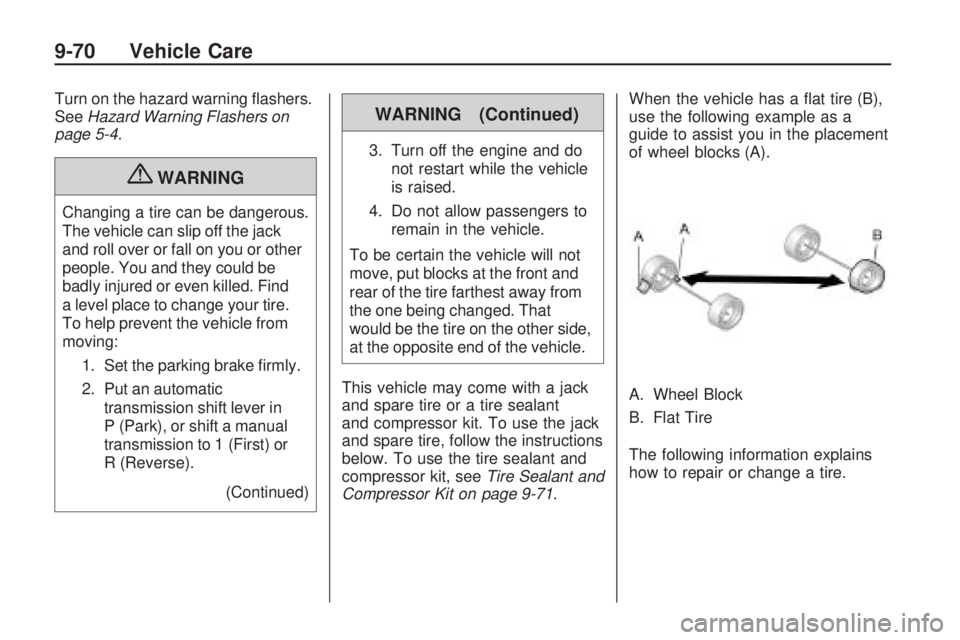
Compressor Kit on page 9-71.When the vehicle has a flat tire (B),
use the following example as a
guide to assist you in the placement
of wheel blocks (A).
A. Wheel Block
B. Flat Tire
The following information explains
how to repair or change a tire.
9-70 Vehicle Care
Page 332 of 372
•Restraint system component
check. SeeSafety System Check
on page 2-20.
•Automatic transmission fluid level
check and adding fluid, if needed.
SeeAutomatic Transmission
Fluid on page 9-14.
•Rear axle fluid level check and
adding fluid, if needed. SeeRear
Axle on page 9-30.
•Engine air cleaner filter
inspection. SeeEngine Air
Cleaner/Filter on page 9-16.
•Passenger compartment air filter
replacement (or every 12 months,
whichever occurs first). More
frequent replacement may be
required if vehicle is driven
regularly under dusty conditions.
Additional Required Services
At Each Fuel Stop
•Engine oil level check.
SeeEngine Oil on page 9-10.
•Engine coolant level check.
SeeEngine Coolant on
page 9-19.
•Windshield washer fluid level
check. SeeWasher Fluid on
page 9-26.
Once a Month
•Tire inflation check. SeeTire
Pressure on page 9-54.
•Tire wear inspection. SeeTire
Inspection on page 9-61.Once a Year
•SeeStarter Switch Check on
page 9-31.
•SeeAutomatic Transmission
Shift Lock Control System
Check on page 9-32.
•SeeIgnition Transmission Lock
Check on page 9-32.
•SeePark Brake and P (Park)
Mechanism Check on page 9-32.
•Engine cooling system and
pressure cap pressure check.
Radiator and air conditioning
condenser outside cleaning.
SeeCooling System on
page 9-17.
•If the vehicle has a Tire Sealant
and Compressor Kit, check the
sealant expiration date printed
on the instruction label of the
kit. SeeTire Sealant and
Compressor Kit on page 9-71.
10-4 Service and Maintenance
Page 333 of 372
First Engine Oil Change After
Every 40 000 km/25,000 Miles
•Fuel system inspection for
damage or leaks.
•Exhaust system inspection for
loose or damaged components.
First Engine Oil Change After
Every 80 000 km/50,000 Miles
•Engine air cleaner filter
replacement. SeeEngine Air
Cleaner/Filter on page 9-16.
•Automatic transmission fluid
change (severe service) for
vehicles mainly driven in heavy
city traffic in hot weather, in hilly
or mountainous terrain, when
frequently towing a trailer, or used
for taxi, police, or delivery service.
SeeAutomatic Transmission
Fluid on page 9-14.
•Rear axle fluid change (severe
service) for vehicles mainly driven
in hilly or mountainous terrain,
when frequently towing a
trailer, used for high speed or
competitive driving, or used for
taxi, police, or delivery service.
SeeRear Axle on page 9-30.
First Engine Oil Change After
Every 160 000 km/100,000 Miles
•Automatic transmission fluid
change (normal service).
SeeAutomatic Transmission
Fluid on page 9-14.
•Rear axle fluid change (normal
service). SeeRear Axle on
page 9-30.
•Spark plug replacement.
An Emission Control Service.First Engine Oil Change After
Every 240 000 km/150,000 Miles
•Engine cooling system drain,
flush, and refill, cooling system
and cap pressure check,
and cleaning of outside of
radiator and air conditioning
condenser (or every 5 years,
whichever occurs first). See
Cooling System on page 9-17.
An Emission Control Service.
•Engine accessory drive belt
inspection for fraying, excessive
cracks, or obvious damage
and replacement, if needed.
An Emission Control Service.
Service and Maintenance 10-5
Page 334 of 372
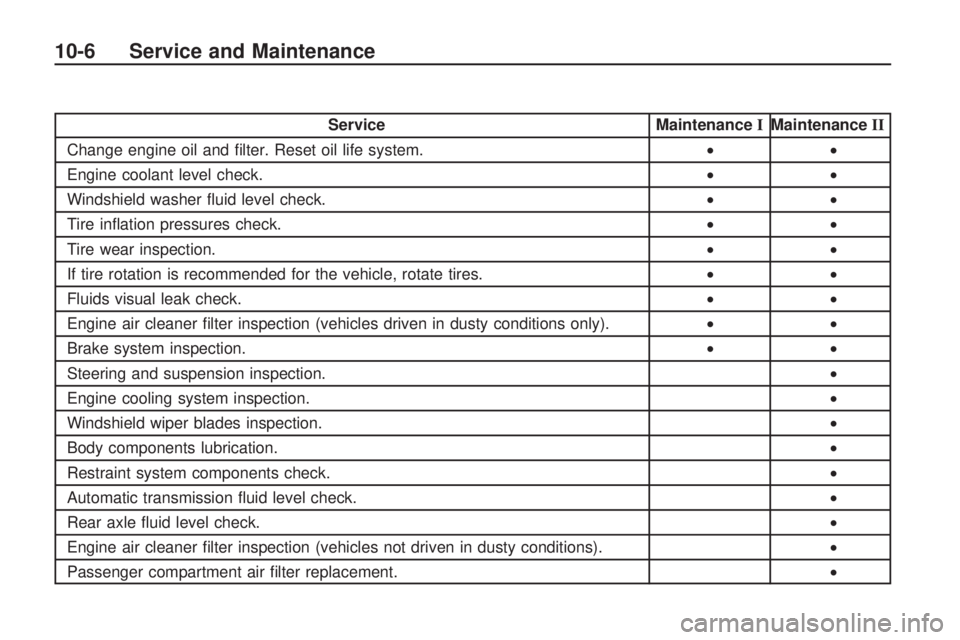
ServiceMaintenanceIMaintenance II
Change engine oil and filter. Reset oil life system. ••
Engine coolant level check. ••
Windshield washer fluid level check. ••
Tire inflation pressures check. ••
Tire wear inspection. ••
If tire rotation is recommended for the vehicle, rotate tires. ••
Fluids visual leak check. ••
Engine air cleaner filter inspection (vehicles driven in dusty conditions only). ••
Brake system inspection. ••
Steering and suspension inspection. •
Engine cooling system inspection. •
Windshield wiper blades inspection. •
Body components lubrication. •
Restraint system components check. •
Automatic transmission fluid level check. •
Rear axle fluid level check. •
Engine air cleaner filter inspection (vehicles not driven in dusty conditions). •
Passenger compartment air filter replacement. •
10-6 Service and Maintenance