clock CHEVROLET CAMARO SS 2010 Owner's Manual
[x] Cancel search | Manufacturer: CHEVROLET, Model Year: 2010, Model line: CAMARO SS, Model: CHEVROLET CAMARO SS 2010Pages: 372, PDF Size: 1.91 MB
Page 309 of 372
Removal and Installation of
the Sealant Canister
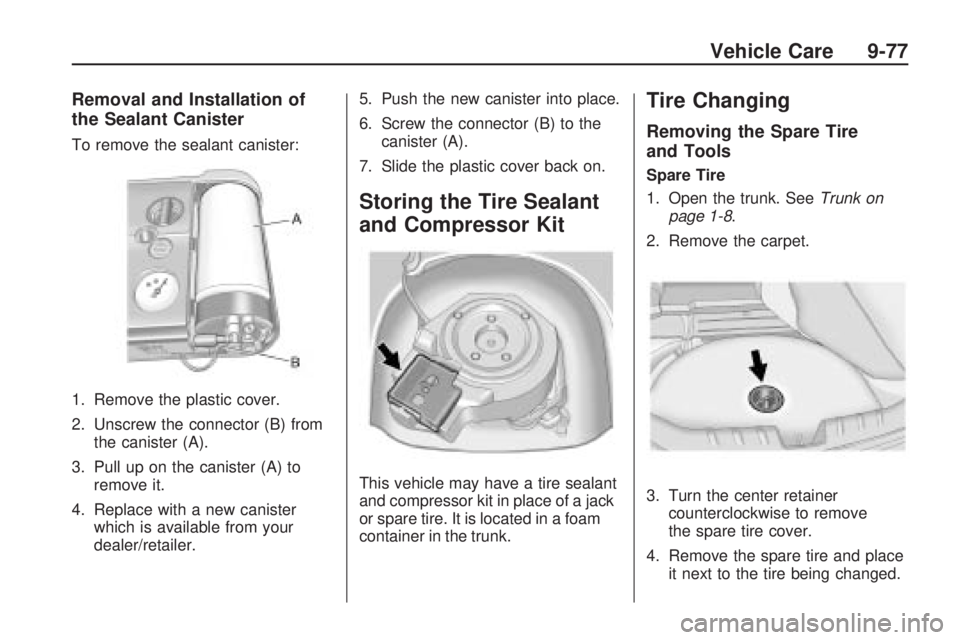
To remove the sealant canister:
1. Remove the plastic cover.
2. Unscrew the connector (B) from
the canister (A).
3. Pull up on the canister (A) to
remove it.
4. Replace with a new canister
which is available from your
dealer/retailer.5. Push the new canister into place.
6. Screw the connector (B) to the
canister (A).
7. Slide the plastic cover back on.
Storing the Tire Sealant
and Compressor Kit
This vehicle may have a tire sealant
and compressor kit in place of a jack
or spare tire. It is located in a foam
container in the trunk.
Tire Changing
Removing the Spare Tire
and Tools
Spare Tire
1. Open the trunk. SeeTrunk on
page 1-8.
2. Remove the carpet.
3. Turn the center retainer
counterclockwise to remove
the spare tire cover.
4. Remove the spare tire and place
it next to the tire being changed.
Vehicle Care 9-77
Page 310 of 372
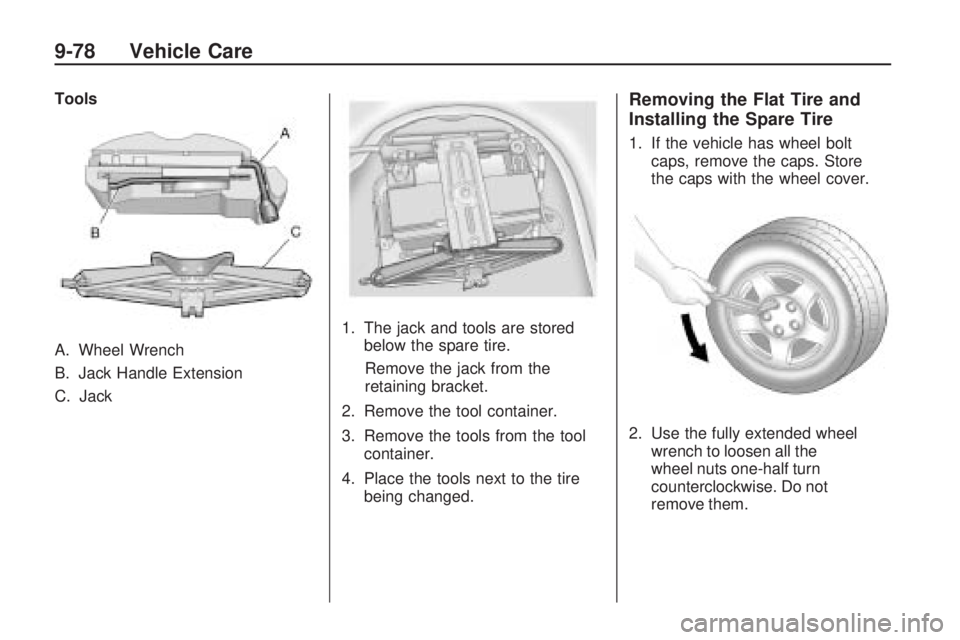
Tools
A. Wheel Wrench
B. Jack Handle Extension
C. Jack1. The jack and tools are stored
below the spare tire.
Remove the jack from the
retaining bracket.
2. Remove the tool container.
3. Remove the tools from the tool
container.
4. Place the tools next to the tire
being changed.Removing the Flat Tire and
Installing the Spare Tire
1. If the vehicle has wheel bolt
caps, remove the caps. Store
the caps with the wheel cover.
2. Use the fully extended wheel
wrench to loosen all the
wheel nuts one-half turn
counterclockwise. Do not
remove them.
9-78 Vehicle Care
Page 312 of 372
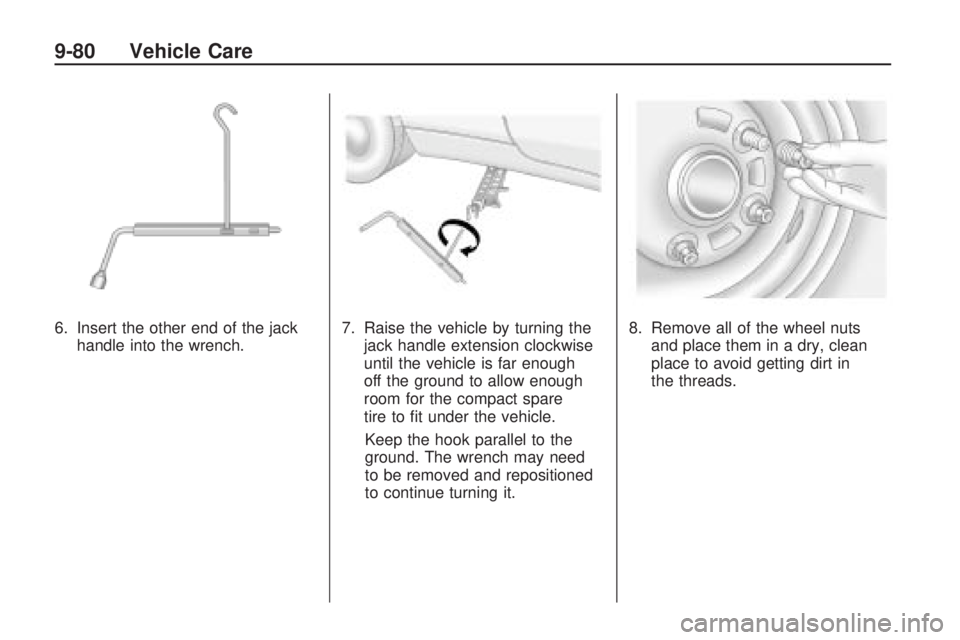
6. Insert the other end of the jack
handle into the wrench.7. Raise the vehicle by turning the
jack handle extension clockwise
until the vehicle is far enough
off the ground to allow enough
room for the compact spare
tire to fit under the vehicle.
Keep the hook parallel to the
ground. The wrench may need
to be removed and repositioned
to continue turning it.8. Remove all of the wheel nuts
and place them in a dry, clean
place to avoid getting dirt in
the threads.
9-80 Vehicle Care
Page 314 of 372
12. Lower the vehicle by turning the
jack handle counterclockwise.
Lower the jack completely.
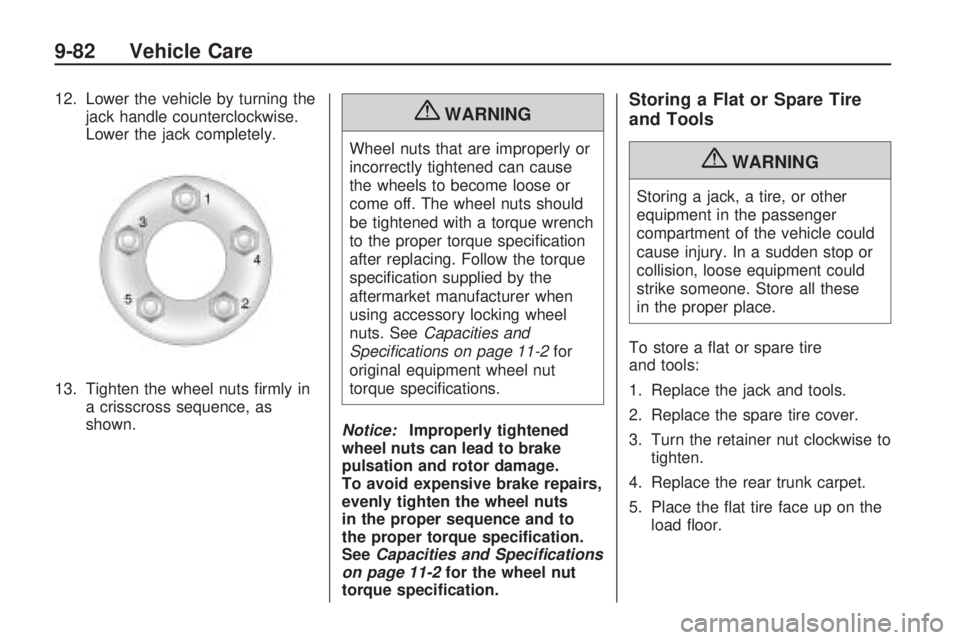
13. Tighten the wheel nuts firmly in
a crisscross sequence, as
shown.{WARNING
Wheel nuts that are improperly or
incorrectly tightened can cause
the wheels to become loose or
come off. The wheel nuts should
be tightened with a torque wrench
to the proper torque specification
after replacing. Follow the torque
specification supplied by the
aftermarket manufacturer when
using accessory locking wheel
nuts. SeeCapacities and
Specications on page 11-2for
original equipment wheel nut
torque specifications.
Notice:Improperly tightened
wheel nuts can lead to brake
pulsation and rotor damage.
To avoid expensive brake repairs,
evenly tighten the wheel nuts
in the proper sequence and to
the proper torque specication.
SeeCapacities and Specifications
on page 11-2for the wheel nut
torque specication.
Storing a Flat or Spare Tire
and Tools
{WARNING
Storing a jack, a tire, or other
equipment in the passenger
compartment of the vehicle could
cause injury. In a sudden stop or
collision, loose equipment could
strike someone. Store all these
in the proper place.
To store a flat or spare tire
and tools:
1. Replace the jack and tools.
2. Replace the spare tire cover.
3. Turn the retainer nut clockwise to
tighten.
4. Replace the rear trunk carpet.
5. Place the flat tire face up on the
load floor.
9-82 Vehicle Care
Page 362 of 372
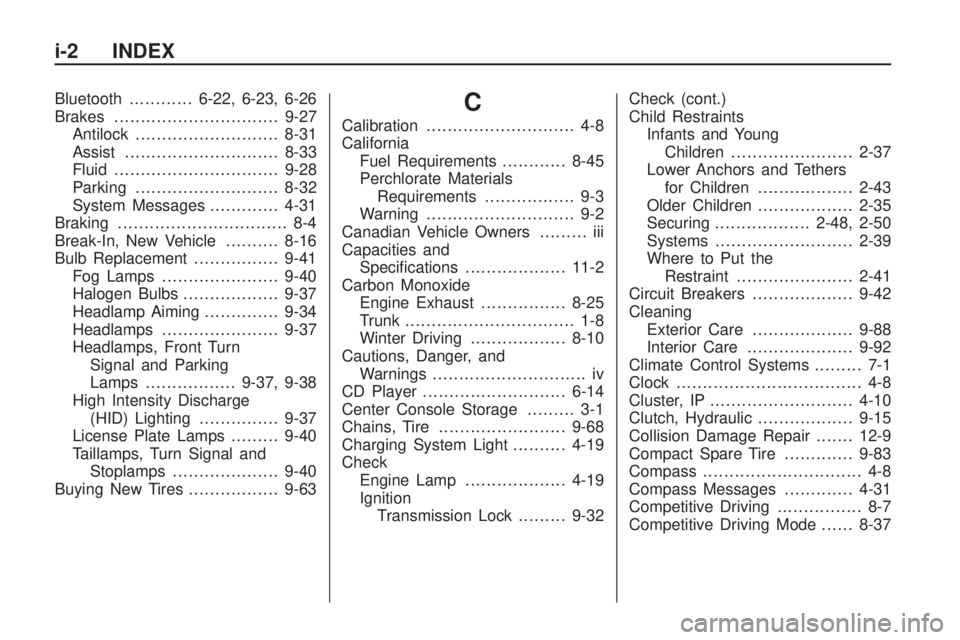
Bluetooth............6-22, 6-23, 6-26
Brakes...............................9-27
Antilock...........................8-31
Assist.............................8-33
Fluid...............................9-28
Parking...........................8-32
System Messages.............4-31
Braking................................ 8-4
Break-In, New Vehicle..........8-16
Bulb Replacement................9-41
Fog Lamps ......................9-40
Halogen Bulbs..................9-37
Headlamp Aiming..............9-34
Headlamps......................9-37
Headlamps, Front Turn
Signal and Parking
Lamps .................9-37, 9-38
High Intensity Discharge
(HID) Lighting...............9-37
License Plate Lamps.........9-40
Taillamps, Turn Signal and
Stoplamps....................9-40
Buying New Tires.................9-63C
Calibration............................ 4-8
California
Fuel Requirements............8-45
Perchlorate Materials
Requirements................. 9-3
Warning............................ 9-2
Canadian Vehicle Owners......... iii
Capacities and
Specifications...................11-2
Carbon Monoxide
Engine Exhaust................8-25
Trunk................................ 1-8
Winter Driving..................8-10
Cautions, Danger, and
Warnings............................. iv
CD Player...........................6-14
Center Console Storage......... 3-1
Chains, Tire........................9-68
Charging System Light..........4-19
Check
Engine Lamp...................4-19
Ignition
Transmission Lock.........9-32Check (cont.)
Child Restraints
Infants and Young
Children.......................2-37
Lower Anchors and Tethers
for Children..................2-43
Older Children..................2-35
Securing..................2-48, 2-50
Systems..........................2-39
Where to Put the
Restraint......................2-41
Circuit Breakers...................9-42
Cleaning
Exterior Care...................9-88
Interior Care....................9-92
Climate Control Systems......... 7-1
Clock................................... 4-8
Cluster, IP...........................4-10
Clutch, Hydraulic..................9-15
Collision Damage Repair.......12-9
Compact Spare Tire.............9-83
Compass.............................. 4-8
Compass Messages.............
4-31
Competitive Driving................ 8-7
Competitive Driving Mode......8-37
i-2 INDEX