clock CHEVROLET CAMARO SS 2010 User Guide
[x] Cancel search | Manufacturer: CHEVROLET, Model Year: 2010, Model line: CAMARO SS, Model: CHEVROLET CAMARO SS 2010Pages: 372, PDF Size: 1.91 MB
Page 255 of 372
6.2 L V8 Engine Fill Procedure
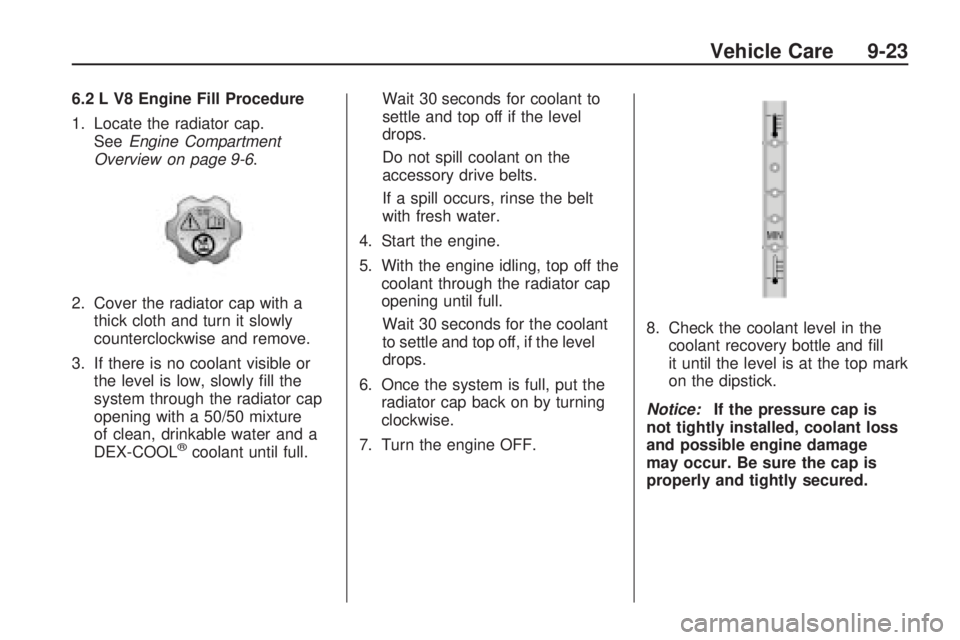
1. Locate the radiator cap.
SeeEngine Compartment
Overview on page 9-6.
2. Cover the radiator cap with a
thick cloth and turn it slowly
counterclockwise and remove.
3. If there is no coolant visible or
the level is low, slowly fill the
system through the radiator cap
opening with a 50/50 mixture
of clean, drinkable water and a
DEX-COOL
®coolant until full.Wait 30 seconds for coolant to
settle and top off if the level
drops.
Do not spill coolant on the
accessory drive belts.
If a spill occurs, rinse the belt
with fresh water.
4. Start the engine.
5. With the engine idling, top off the
coolant through the radiator cap
opening until full.
Wait 30 seconds for the coolant
to settle and top off, if the level
drops.
6. Once the system is full, put the
radiator cap back on by turning
clockwise.
7. Turn the engine OFF.8. Check the coolant level in the
coolant recovery bottle and fill
it until the level is at the top mark
on the dipstick.
Notice:If the pressure cap is
not tightly installed, coolant loss
and possible engine damage
may occur. Be sure the cap is
properly and tightly secured.
Vehicle Care 9-23
Page 258 of 372
How to Check Power Steering
Fluid
Check the level after the vehicle
has been driven for at least
twenty minutes so the fluid
is warm.
To check the power steering fluid:
1. Turn the ignition key to
LOCK/OFF and let the engine
compartment cool down.
2. Remove the engine cover. Refer
toEngine Cover on page 9-9.
3. Wipe the cap and the top of the
reservoir clean.
4. Turn the cap counterclockwise
and pull it straight up.
5. Wipe the dipstick with a
clean rag.6. Replace the cap and completely
tighten it.
7. Remove the cap again and look
at the fluid level on the dipstick.
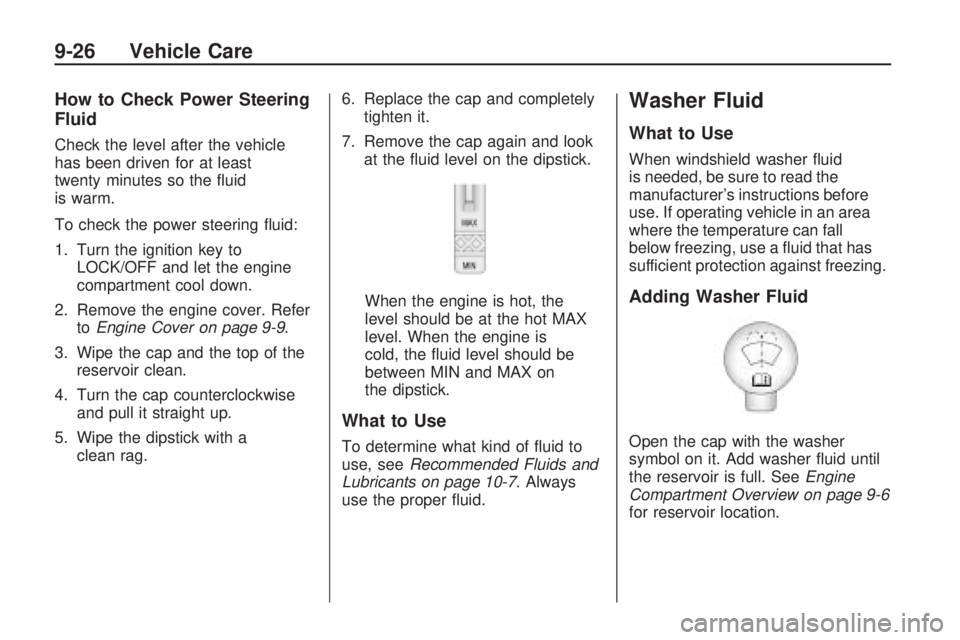
When the engine is hot, the
level should be at the hot MAX
level. When the engine is
cold, the fluid level should be
between MIN and MAX on
the dipstick.
What to Use
To determine what kind of fluid to
use, seeRecommended Fluids and
Lubricants on page 10-7. Always
use the proper fluid.
Washer Fluid
What to Use
When windshield washer fluid
is needed, be sure to read the
manufacturer’s instructions before
use. If operating vehicle in an area
where the temperature can fall
below freezing, use a fluid that has
sufficient protection against freezing.
Adding Washer Fluid
Open the cap with the washer
symbol on it. Add washer fluid until
the reservoir is full. SeeEngine
Compartment Overview on page 9-6
for reservoir location.
9-26 Vehicle Care
Page 268 of 372
Notice:Do not cover a headlamp
to improve beam cut-off when
aiming. Covering a headlamp may
cause excessive heat build-up
which may cause damage to
the headlamp.
6. Turn on the low-beam
headlamps and place a piece of
cardboard or equivalent in front of
the headlamp not being adjusted.
This allows only the beam of light
from the headlamp being adjusted
to be seen on the flat surface.
7. Locate the vertical headlamp
aiming screws, which are
under the hood near each
headlamp assembly.
The adjustment screw can be
turned with a 6 mm hex key.
8. Turn the vertical aiming screw
until the headlamp beam is aimed
to the horizontal tape line. Turn it
clockwise or counterclockwise
to raise or lower the angle of
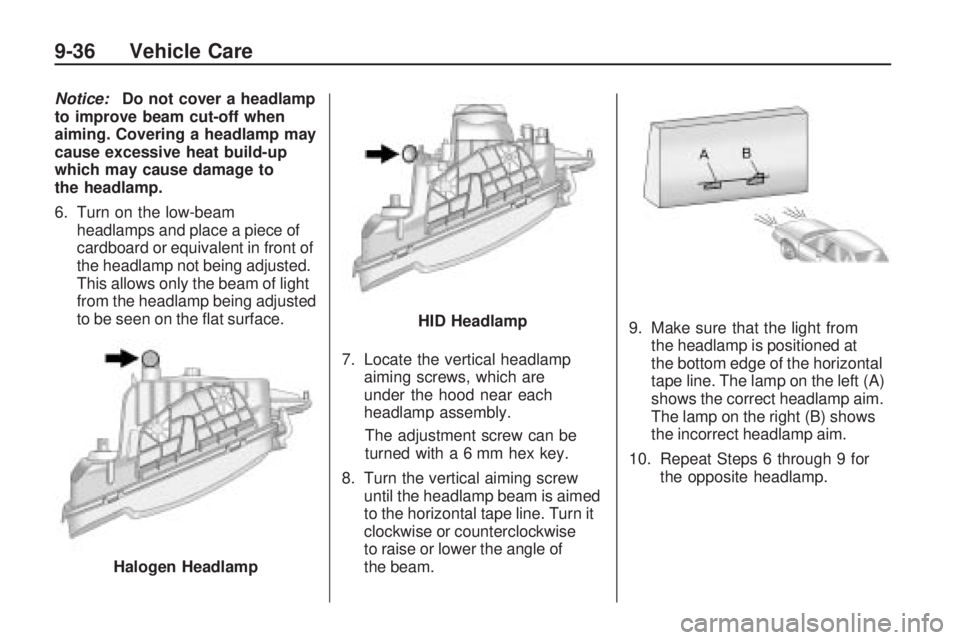
the beam.9. Make sure that the light from
the headlamp is positioned at
the bottom edge of the horizontal
tape line. The lamp on the left (A)
shows the correct headlamp aim.
The lamp on the right (B) shows
the incorrect headlamp aim.
10. Repeat Steps 6 through 9 for
the opposite headlamp.
Halogen Headlamp
HID Headlamp
9-36 Vehicle Care
Page 270 of 372
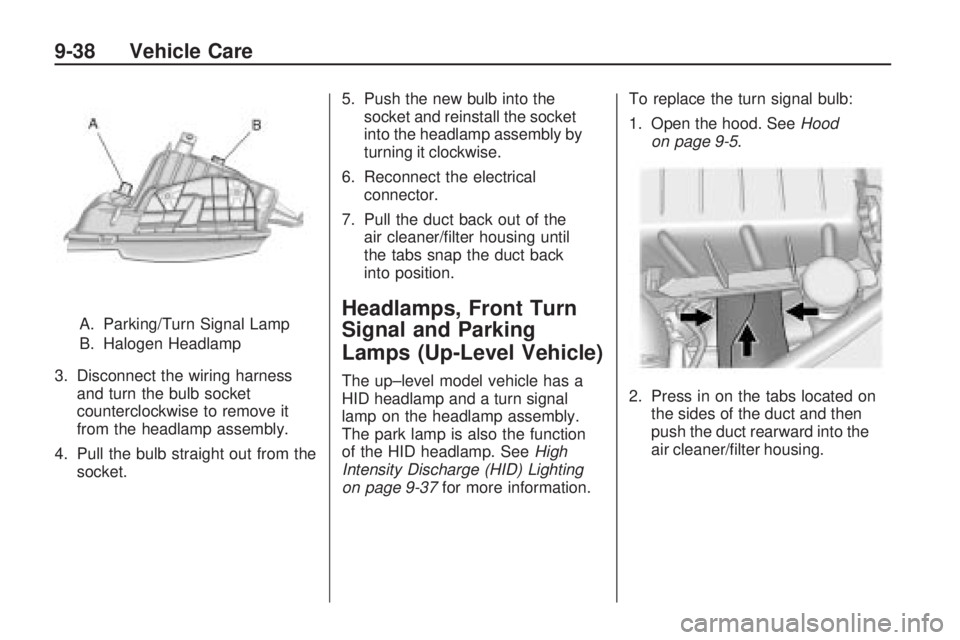
A. Parking/Turn Signal Lamp
B. Halogen Headlamp
3. Disconnect the wiring harness
and turn the bulb socket
counterclockwise to remove it
from the headlamp assembly.
4. Pull the bulb straight out from the
socket.5. Push the new bulb into the
socket and reinstall the socket
into the headlamp assembly by
turning it clockwise.
6. Reconnect the electrical
connector.
7. Pull the duct back out of the
air cleaner/filter housing until
the tabs snap the duct back
into position.Headlamps, Front Turn
Signal and Parking
Lamps (Up-Level Vehicle)
The up–level model vehicle has a
HID headlamp and a turn signal
lamp on the headlamp assembly.
The park lamp is also the function
of the HID headlamp. SeeHigh
Intensity Discharge (HID) Lighting
on page 9-37for more information.To replace the turn signal bulb:
1. Open the hood. SeeHood
on page 9-5.
2. Press in on the tabs located on
the sides of the duct and then
push the duct rearward into the
air cleaner/filter housing.
9-38 Vehicle Care
Page 271 of 372
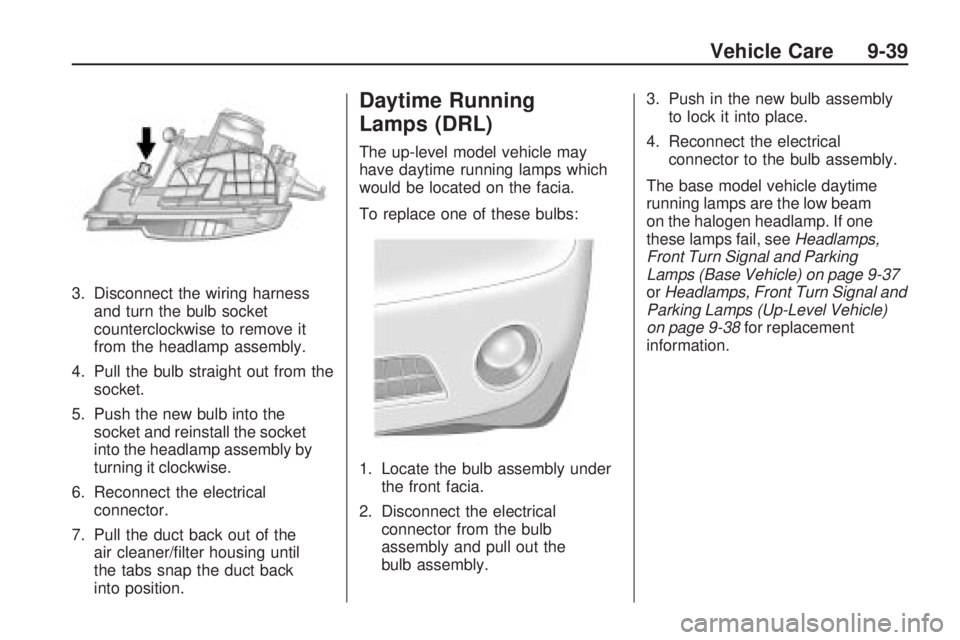
3. Disconnect the wiring harness
and turn the bulb socket
counterclockwise to remove it
from the headlamp assembly.
4. Pull the bulb straight out from the
socket.
5. Push the new bulb into the
socket and reinstall the socket
into the headlamp assembly by
turning it clockwise.
6. Reconnect the electrical
connector.
7. Pull the duct back out of the
air cleaner/filter housing until
the tabs snap the duct back
into position.
Daytime Running
Lamps (DRL)
The up-level model vehicle may
have daytime running lamps which
would be located on the facia.
To replace one of these bulbs:
1. Locate the bulb assembly under
the front facia.
2. Disconnect the electrical
connector from the bulb
assembly and pull out the
bulb assembly.3. Push in the new bulb assembly
to lock it into place.
4. Reconnect the electrical
connector to the bulb assembly.
The base model vehicle daytime
running lamps are the low beam
on the halogen headlamp. If one
these lamps fail, seeHeadlamps,
Front Turn Signal and Parking
Lamps (Base Vehicle) on page 9-37
orHeadlamps, Front Turn Signal and
Parking Lamps (Up-Level Vehicle)
on page 9-38for replacement
information.
Vehicle Care 9-39
Page 272 of 372
Fog Lamps
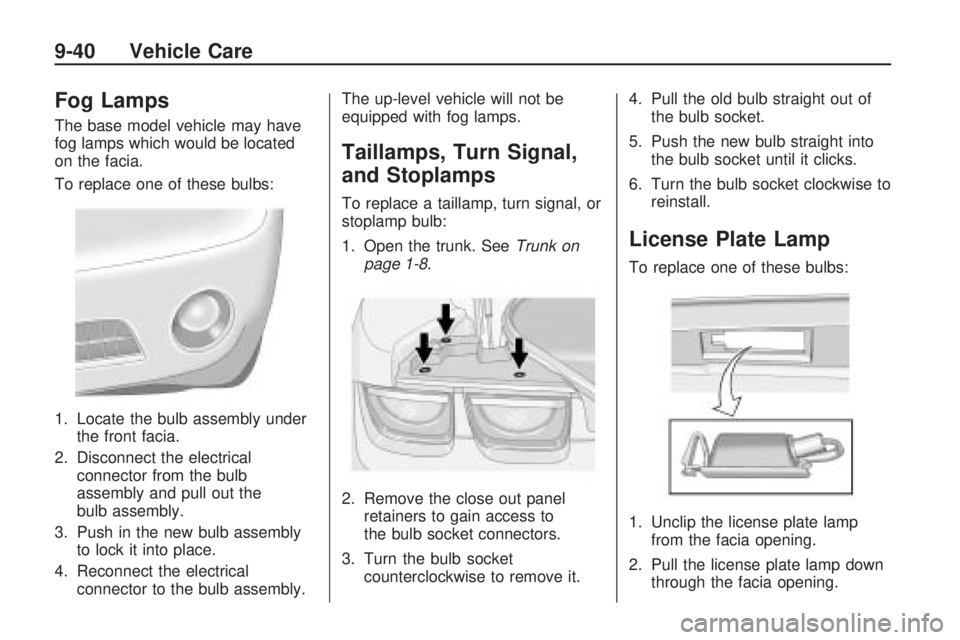
The base model vehicle may have
fog lamps which would be located
on the facia.
To replace one of these bulbs:
1. Locate the bulb assembly under
the front facia.
2. Disconnect the electrical
connector from the bulb
assembly and pull out the
bulb assembly.
3. Push in the new bulb assembly
to lock it into place.
4. Reconnect the electrical
connector to the bulb assembly.The up-level vehicle will not be
equipped with fog lamps.
Taillamps, Turn Signal,
and Stoplamps
To replace a taillamp, turn signal, or
stoplamp bulb:
1. Open the trunk. SeeTrunk on
page 1-8.
2. Remove the close out panel
retainers to gain access to
the bulb socket connectors.
3. Turn the bulb socket
counterclockwise to remove it.4. Pull the old bulb straight out of
the bulb socket.
5. Push the new bulb straight into
the bulb socket until it clicks.
6. Turn the bulb socket clockwise to
reinstall.
License Plate Lamp
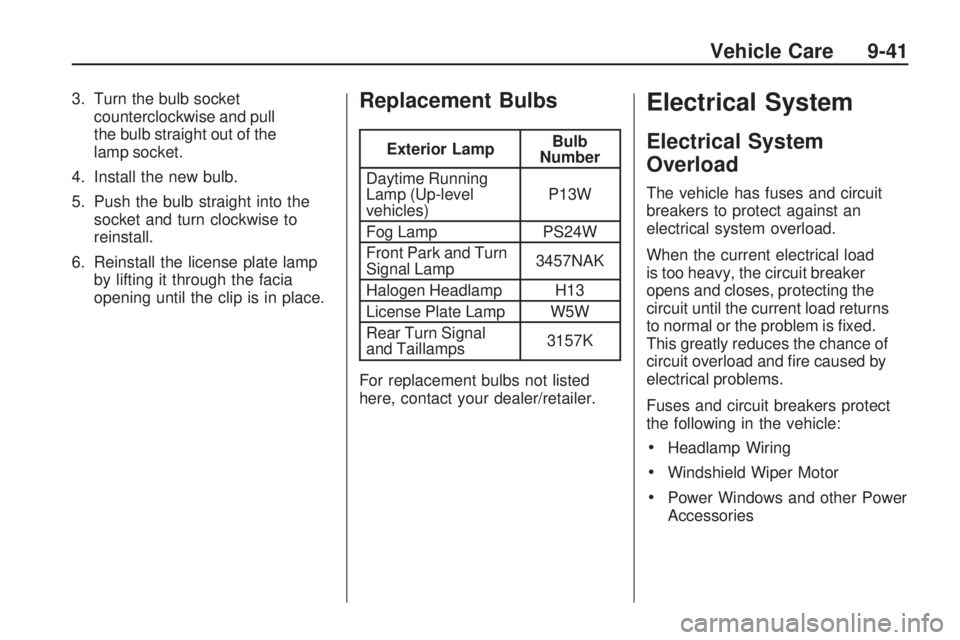
To replace one of these bulbs:
1. Unclip the license plate lamp
from the facia opening.
2. Pull the license plate lamp down
through the facia opening.
9-40 Vehicle Care
Page 273 of 372
3. Turn the bulb socket
counterclockwise and pull
the bulb straight out of the
lamp socket.
4. Install the new bulb.
5. Push the bulb straight into the
socket and turn clockwise to
reinstall.
6. Reinstall the license plate lamp
by lifting it through the facia
opening until the clip is in place.Replacement Bulbs
Exterior LampBulb
Number
Daytime Running
Lamp (Up-level
vehicles)P13W
Fog Lamp PS24W
Front Park and Turn
Signal Lamp3457NAK
Halogen Headlamp H13
License Plate Lamp W5W
Rear Turn Signal
and Taillamps3157K
For replacement bulbs not listed
here, contact your dealer/retailer.
Electrical System
Electrical System
Overload
The vehicle has fuses and circuit
breakers to protect against an
electrical system overload.
When the current electrical load
is too heavy, the circuit breaker
opens and closes, protecting the
circuit until the current load returns
to normal or the problem is fixed.
This greatly reduces the chance of
circuit overload and fire caused by
electrical problems.
Fuses and circuit breakers protect
the following in the vehicle:
•Headlamp Wiring
•Windshield Wiper Motor
•Power Windows and other Power
Accessories
Vehicle Care 9-41
Page 305 of 372
Always do a safety check first.
SeeIf a Tire Goes Flat on
page 9-69. Do not remove any
objects that have penetrated
the tire.
1. Remove the tire sealant and
compressor kit from its storage
location. SeeStoring the Tire
Sealant and Compressor Kit
on page 9-77.
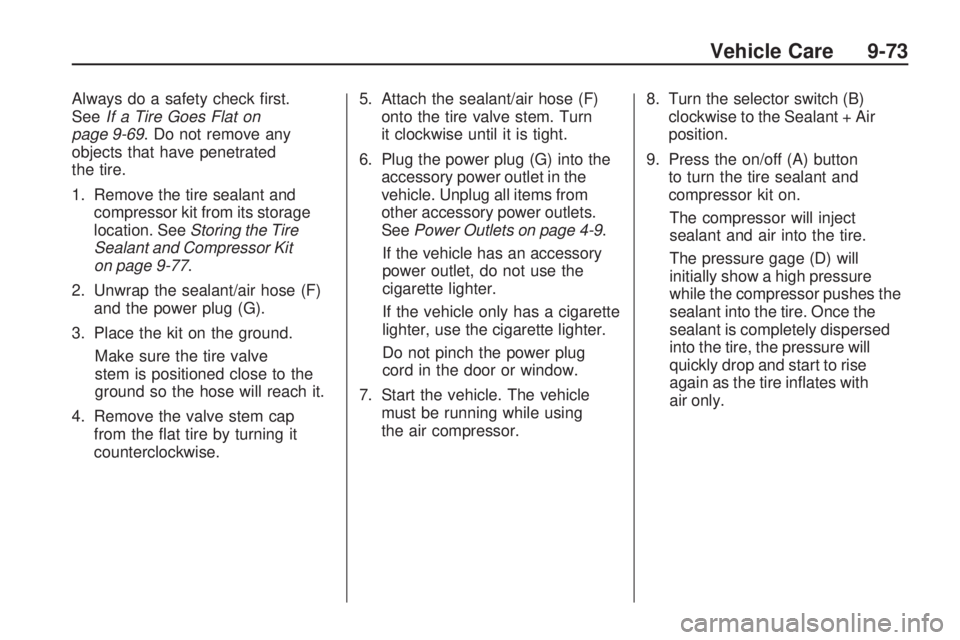
2. Unwrap the sealant/air hose (F)
and the power plug (G).
3. Place the kit on the ground.
Make sure the tire valve
stem is positioned close to the
ground so the hose will reach it.
4. Remove the valve stem cap
from the flat tire by turning it
counterclockwise.5. Attach the sealant/air hose (F)
onto the tire valve stem. Turn
it clockwise until it is tight.
6. Plug the power plug (G) into the
accessory power outlet in the
vehicle. Unplug all items from
other accessory power outlets.
SeePower Outlets on page 4-9.
If the vehicle has an accessory
power outlet, do not use the
cigarette lighter.
If the vehicle only has a cigarette
lighter, use the cigarette lighter.
Do not pinch the power plug
cord in the door or window.
7. Start the vehicle. The vehicle
must be running while using
the air compressor.8. Turn the selector switch (B)
clockwise to the Sealant + Air
position.
9. Press the on/off (A) button
to turn the tire sealant and
compressor kit on.
The compressor will inject
sealant and air into the tire.
The pressure gage (D) will
initially show a high pressure
while the compressor pushes the
sealant into the tire. Once the
sealant is completely dispersed
into the tire, the pressure will
quickly drop and start to rise
again as the tire inflates with
air only.
Vehicle Care 9-73
Page 306 of 372
10. Inflate the tire to the
recommended inflation pressure
using the pressure gage (D).
The recommended inflation
pressure can be found on the
Tire and Loading Information
label. SeeTire Pressure on
page 9-54.
The pressure gage (D) may
read higher than the actual tire
pressure while the compressor
is on. Turn the compressor off
to get an accurate pressure
reading. The compressor may
be turned on/off until the correct
pressure is reached.
Notice:If the recommended
pressure cannot be reached after
approximately 25 minutes, the
vehicle should not be driven
farther. The tire is too severely
damaged and the tire sealant and
compressor kit cannot inate the
tire. Remove the power plug from
the accessory power outlet and
unscrew the inating hose from
the tire valve. SeeRoadside
Assistance Program on page 12-6.11. Press the on/off button (A)
to turn the tire sealant and
compressor kit off.
The tire is not sealed and will
continue to leak air until the
vehicle is driven and the sealant
is distributed in the tire,
therefore, Steps 12 through 18
must be done immediately after
Step 11.
Be careful while handling the
tire sealant and compressor
kit as it could be warm
after usage.
12. Unplug the power plug (G) from
the accessory power outlet in
the vehicle.
13. Turn the sealant/air hose (F)
counterclockwise to remove it
from the tire valve stem.
14. Replace the tire valve
stem cap.
15. Replace the sealant/air
hose (F), and the power plug (G)
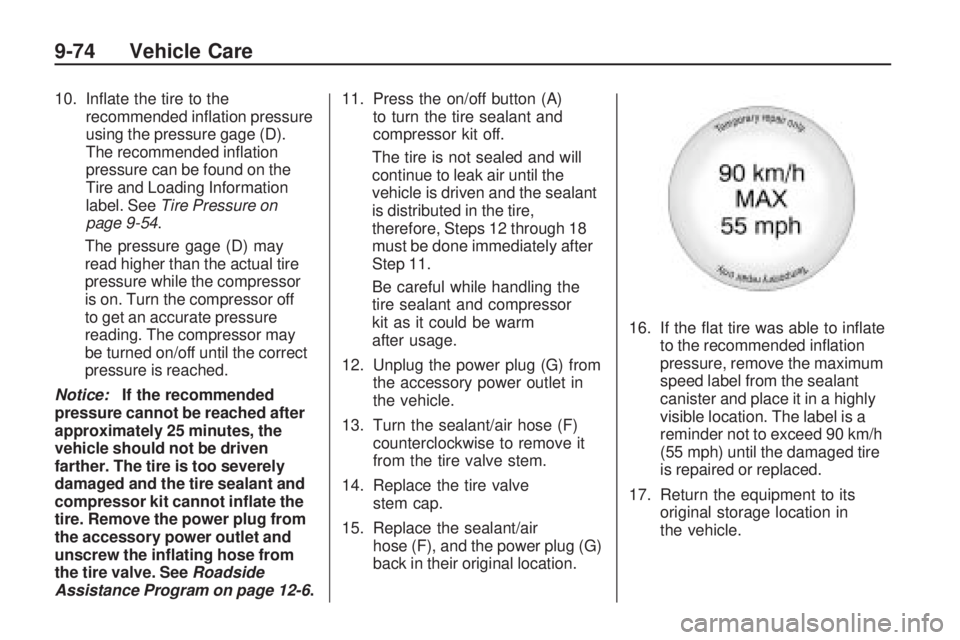
back in their original location.16. If the flat tire was able to inflate
to the recommended inflation
pressure, remove the maximum
speed label from the sealant
canister and place it in a highly
visible location. The label is a
reminder not to exceed 90 km/h
(55 mph) until the damaged tire
is repaired or replaced.
17. Return the equipment to its
original storage location in
the vehicle.
9-74 Vehicle Care
Page 308 of 372
3. Place the kit on the ground.
Make sure the tire valve
stem is positioned close to the
ground so the hose will reach it.
4. Remove the tire valve stem cap
from the flat tire by turning it
counterclockwise.
5. Attach the air only hose (E) onto
the tire valve stem by turning it
clockwise until it is tight.
6. Plug the power plug (G) into the
accessory power outlet in the
vehicle. Unplug all items from
other accessory power outlets.
SeePower Outlets on page 4-9.
If the vehicle has an accessory
power outlet, do not use the
cigarette lighter.
If the vehicle only has a cigarette
lighter, use the cigarette lighter.
Do not pinch the power plug
cord in the door or window.7. Start the vehicle. The vehicle
must be running while using
the air compressor.
8. Turn the selector switch (B)
counterclockwise to the Air
Only position.
9. Press the on/off (A) button to
turn the compressor on.
The compressor will inflate the
tire with air only.
10. Inflate the tire to the
recommended inflation pressure
using the pressure gage (D).
The recommended inflation
pressure can be found on the
Tire and Loading Information
label. SeeTire Pressure on
page 9-54.
The pressure gage (D) may
read higher than the actual tire
pressure while the compressor
is on. Turn the compressor off
to get an accurate reading.
The compressor may be turned
on/off until the correct pressure
is reached.11. Press the on/off button (A)
to turn the tire sealant and
compressor kit off.
Be careful while handling the
tire sealant and compressor kit
as it could be warm after usage.
12. Unplug the power plug (G) from
the accessory power outlet in
the vehicle.
13. Disconnect the air only hose (E)
from the tire valve stem, by
turning it counterclockwise, and
replace the tire valve stem cap.
14. Replace the air only hose (E)
and the power plug (G) and
cord back in its original location.
15. Place the equipment in
the original storage location
in the vehicle.
9-76 Vehicle Care