maintenance CHEVROLET CAMARO SS 2010 Owner's Manual
[x] Cancel search | Manufacturer: CHEVROLET, Model Year: 2010, Model line: CAMARO SS, Model: CHEVROLET CAMARO SS 2010Pages: 372, PDF Size: 1.91 MB
Page 293 of 372
10. Set all four tires to the
recommended air pressure
level as indicated on the tire
and loading information label.
11. Put the valve caps back on the
valve stems.
The tires air pressure will not
appear on the screen until you start
driving the vehicle.
Tire Inspection
We recommend that you
regularly inspect your vehicle’s
tires, including the spare tire, if
the vehicle has one, for signs of
wear or damage. SeeWhen It Is
Time for New Tires on page 9-62
for more information.
Tire Rotation
Tire rotation is not
recommended if the vehicle
has different size tires on the
front and rear wheels.
Different tire sizes should not be
rotated front to rear. Each tire
and wheel should only be used in
its original front or rear position.
Tire rotation is recommended if
the vehicle has the same size
tires on all four wheel positions.
These tires should be rotated
every 5,000 to 8,000 miles
(8 000 to 13 000 km). See
Scheduled Maintenance on
page 10-2.
The purpose of a regular tire
rotation is to achieve a uniform
wear for all tires on the vehicle.
This will ensure that your vehicle
continues to perform most like it
did when the tires were new.Any time you notice unusual
wear, rotate the tires as soon
as possible and check wheel
alignment. Also check for
damaged tires or wheels.
SeeWhen It Is Time for
New Tires on page 9-62
andWheel Replacement
on page 9-67.
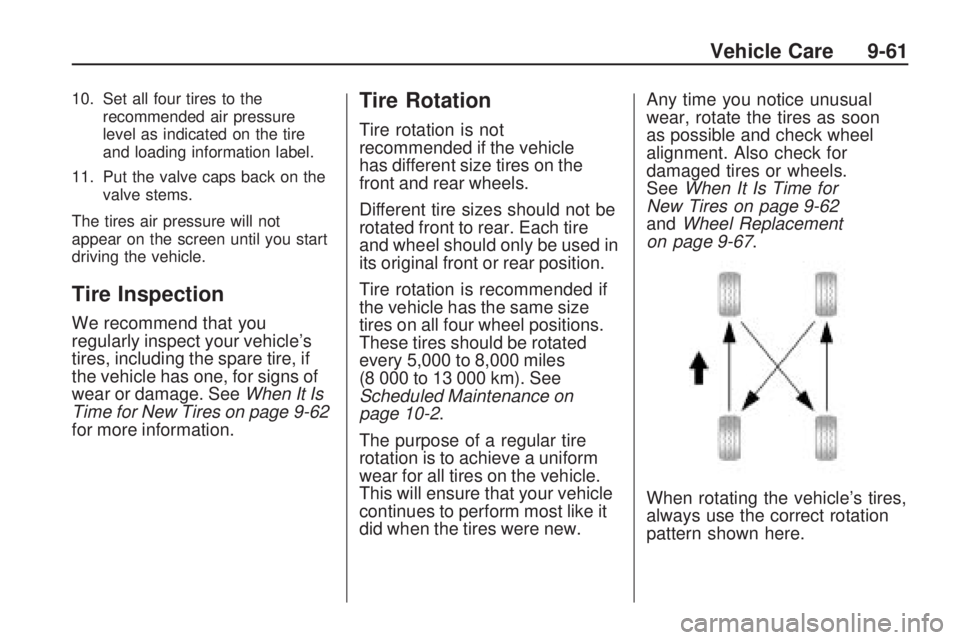
When rotating the vehicle’s tires,
always use the correct rotation
pattern shown here.
Vehicle Care 9-61
Page 294 of 372
The compact spare tire, if the
vehicle has one, is not included
in the tire rotation.
After the tires have been rotated,
adjust the front and rear inflation
pressures as shown on the Tire
and Loading Information label.
SeeTire Pressure on page 9-54
andVehicle Load Limits on
page 8-12.
Reset the Tire Pressure Monitor
System. SeeTire Pressure
Monitor Operation on page 9-57.
Make certain that all wheel
nuts are properly tightened.
See “Wheel Nut Torque” under
Capacities and Specications on
page 11-2.{WARNING
Rust or dirt on a wheel, or on the
parts to which it is fastened, can
make wheel nuts become loose
after time. The wheel could come
off and cause an accident. When
changing a wheel, remove any
rust or dirt from places where the
wheel attaches to the vehicle.
In an emergency, use a cloth or
a paper towel to do this; but be
sure to use a scraper or wire
brush later, if needed, to get all
the rust or dirt off. SeeIf a Tire
Goes Flat on page 9-69.
When It Is Time for
New Tires
Various factors, such as
maintenance, temperatures,
driving speeds, vehicle loading,
and road conditions influence
when you need new tires.
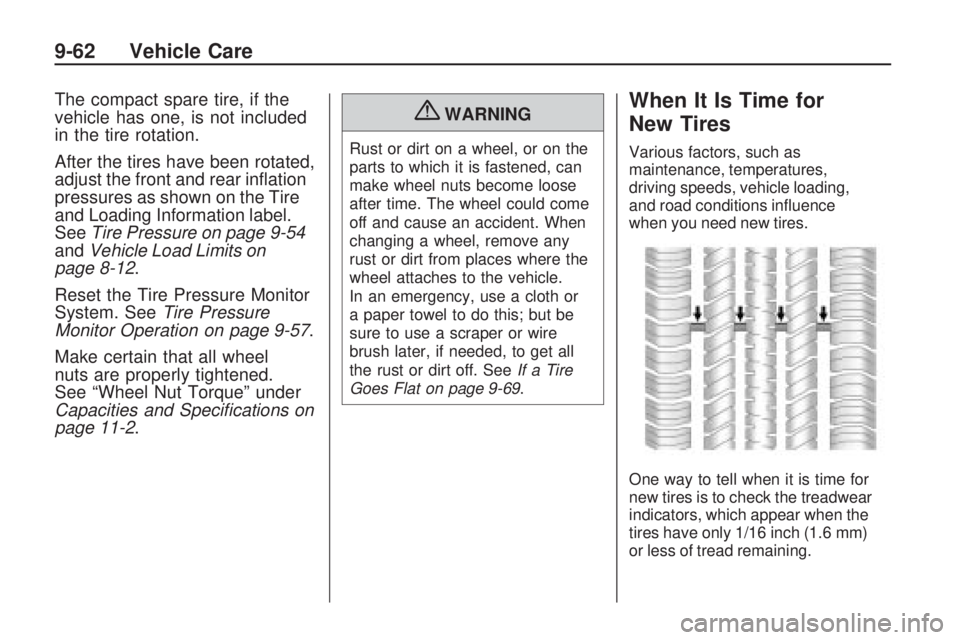
One way to tell when it is time for
new tires is to check the treadwear
indicators, which appear when the
tires have only 1/16 inch (1.6 mm)
or less of tread remaining.
9-62 Vehicle Care
Page 295 of 372
The vehicle needs new tires if any
of the following statements are true:
•You can see the indicators at
three or more places around
the tire.
•You can see cord or fabric
showing through the tire’s rubber.
•The tread or sidewall is cracked,
cut, or snagged deep enough to
show cord or fabric.
•The tire has a bump, bulge,
or split.
•The tire has a puncture, cut, or
other damage that cannot be
repaired well because of the size
or location of the damage.
The rubber in tires degrades over
time, even if they are not being used.
This is also true for the spare tire,
if the vehicle has one. Multiple
conditions affect how fast this aging
takes place, including temperatures,
loading conditions, and inflationpressure maintenance. With proper
care and maintenance tires typically
wear out before they degrade due to
age. If you are unsure about the
need to replace the tires as they get
older, consult the tire manufacturer
for more information.
Buying New Tires
GM has developed and matched
specific tires for your vehicle. The
original equipment tires installed
on your vehicle, when it was new,
were designed to meet General
Motors Tire Performance Criteria
Specification (TPC Spec) system
rating. If you need replacement
tires, GM strongly recommends
that you get tires with the same
TPC Spec rating. This way, your
vehicle will continue to have tires
that are designed to give the
same performance and vehicle
safety, during normal use, as the
original tires.GM’s exclusive TPC Spec
system considers over a dozen
critical specifications that impact
the overall performance of your
vehicle, including brake system
performance, ride and handling,
traction control, and tire pressure
monitoring performance. GM’s
TPC Spec number is molded
onto the tire’s sidewall near the
tire size. If the tires have an
all-season tread design, the TPC
Spec number will be followed
by an MS for mud and snow.
SeeTire Sidewall Labeling
on page 9-49for additional
information.
GM recommends replacing tires
in sets of four. This is because
uniform tread depth on all tires
will help keep your vehicle
performing most like it did
when the tires were new.
Vehicle Care 9-63
Page 301 of 372
WARNING (Continued)
To help avoid damage to the
vehicle, drive slowly, re-adjust
or remove the device if it is
contacting the vehicle, and do not
spin the wheels. If you do find
traction devices that will fit, install
them on the rear tires.
If a Tire Goes Flat
It is unusual for a tire to blowout
while you are driving, especially if
you maintain your vehicle’s tires
properly. If air goes out of a tire, it is
much more likely to leak out slowly.But if you should ever have a
blowout, here are a few tips about
what to expect and what to do:
If a front tire fails, the flat tire
creates a drag that pulls the vehicle
toward that side. Take your foot off
the accelerator pedal and grip the
steering wheel firmly. Steer to
maintain lane position, and then
gently brake to a stop well out of
the traffic lane.
A rear blowout, particularly on a
curve, acts much like a skid and may
require the same correction you
would use in a skid. In any rear
blowout remove your foot from the
accelerator pedal. Get the vehicle
under control by steering the way
you want the vehicle to go. It may be
very bumpy and noisy, but you can
still steer. Gently brake to a stop,
well off the road if possible.
{WARNING
Lifting a vehicle and getting under
it to do maintenance or repairs is
dangerous without the appropriate
safety equipment and training. If a
jack is provided with the vehicle, it
is designed only for changing a
flat tire. If it is used for anything
else, you or others could be badly
injured or killed if the vehicle slips
off the jack. If a jack is provided
with the vehicle, only use it for
changing a flat tire.
If a tire goes flat, avoid further
tire and wheel damage by
driving slowly to a level place.
Vehicle Care 9-69
Page 321 of 372
Washing the Vehicle
To preserve the vehicle’s finish,
keep it clean by washing it often.
Do not wash the vehicle in
direct sunlight and use a car
washing soap.
Notice:Certain cleaners contain
chemicals that can damage the
emblems or nameplates on the
vehicle. Check the cleaning
product label. If it states that it
should not be used on plastic
parts, do not use it on the vehicle
or damage may occur and it would
not be covered by the warranty.
Do not use cleaning agents that are
petroleum based or that contain acid
or abrasives, as they can damage
the paint, metal or plastic on the
vehicle. Approved cleaning products
can be obtained from your dealer/
retailer. Follow all manufacturerdirections regarding correct product
usage, necessary safety precautions
and appropriate disposal of any
vehicle care product.
Rinse the vehicle well, before
washing and after to remove all
cleaning agents completely. If they
are allowed to dry on the surface,
they could stain.
Dry the finish with a soft, clean
chamois or an all-cotton towel to
avoid surface scratches and
water spotting.
High pressure car washes could
cause water to enter the vehicle.
Avoid using high pressure washes
closer than 30 cm (12 inches) to
the surface of the vehicle. Use of
power washers exceeding 8,274 kPa
(1,200 psi) can result in damage or
removal of paint and decals.Notice:Conveyor systems on
some automatic car washes could
damage the vehicle. There may
not be enough clearance for the
undercarriage. Check with the car
wash manager before using the
automatic car wash.
Weatherstrips
Silicone grease on weatherstrips will
make them last longer, seal better,
and not stick or squeak. Apply
silicone grease with a clean cloth.
During very cold, damp weather
frequent application may be required.
See “Fluids and Lubricants” in the
Index of the “Maintenance and
Warranty and Owner assistance
Information” manual.
Vehicle Care 9-89
Page 323 of 372
Windshield and Wiper Blades
Clean the outside of the windshield
with glass cleaner.
Clean the rubber blades using a lint
free cloth or paper towel soaked with
windshield washer fluid or a mild
detergent. Wash the windshield
thoroughly when cleaning the blades.
Bugs, road grime, sap, and a buildup
of vehicle wash/wax treatments may
cause wiper streaking. Replace the
wiper blades if they are worn or
damaged.
Wipers can be damaged by:
•Extreme dusty conditions
•Sand and salt
•Heat and sun
•Snow and ice, without proper
removal
Tires
Use a stiff brush with tire cleaner to
clean the tires.
Notice:Using petroleum-based
tire dressing products on the
vehicle may damage the paint
nish and/or tires. When applying
a tire dressing, always wipe off
any overspray from all painted
surfaces on the vehicle.
Sheet Metal Damage
If the vehicle is damaged and
requires sheet metal repair or
replacement, make sure the body
repair shop applies anti-corrosion
material to parts repaired or
replaced to restore corrosion
protection.
Original manufacturer replacement
parts will provide the corrosion
protection while maintaining
the vehicle warranty.
Finish Damage
Any stone chips, fractures or deep
scratches in the finish should be
repaired right away. Bare metal will
corrode quickly and may develop into
major repair expense.
Minor chips and scratches can be
repaired with touch-up materials
available from your dealer/retailer.
Larger areas of finish damage can be
corrected in your dealer’s/retailer’s
body and paint shop.
Underbody Maintenance
Chemicals used for ice and snow
removal and dust control can collect
on the underbody. If these are not
removed, corrosion and rust can
develop on the underbody parts such
as fuel lines, frame, floor pan, and
exhaust system even though they
have corrosion protection.
Vehicle Care 9-91
Page 329 of 372

Service and
Maintenance
General InformationGeneral Information.............10-1
Scheduled MaintenanceScheduled Maintenance........10-2
Recommended Fluids,
Lubricants, and Parts
Recommended Fluids and
Lubricants.........................10-7
Maintenance Replacement
Parts................................10-9
Maintenance RecordsMaintenance Records.........10-10
General Information
Notice:Maintenance
intervals, checks, inspections,
recommended uids, and
lubricants are necessary to
keep this vehicle in good
working condition. Damage
caused by failure to follow
scheduled maintenance might
not be covered by the vehicle
warranty.
Proper vehicle maintenance helps to
keep the vehicle in good working
condition, improves fuel economy,
and reduces vehicle emissions
for better air quality.
Because of all the different ways
people use vehicles, maintenance
needs vary. The vehicle might need
more frequent checks and services.
Please read the information under
Scheduled Maintenance. To keep
the vehicle in good condition, see
your dealer/retailer.The maintenance schedule is for
vehicles that:•carry passengers and cargo
within recommended limits on
the Tire and Loading Information
label. SeeVehicle Load Limits
on page 8-12.
•are driven on reasonable road
surfaces within legal driving
limits.
•use the recommended fuel.
SeeRecommended Fuel
on page 8-44.
{WARNING
Performing maintenance work can
be dangerous. Some jobs can
cause serious injury. Perform
maintenance work only if you
have the required know-how and
the proper tools and equipment.
If in doubt, see your dealer/retailer
to have a qualified technician do
the work. SeeDoing Your Own
Service Work on page 9-4.
Service and Maintenance 10-1
Page 330 of 372
At your General Motors dealer/
retailer, you can be certain that
you will receive the highest level
of service available. Your dealer
/retailer has specially trained service
technicians, uses genuine GM
replacement parts, as well as, up to
date tools and equipment to ensure
fast and accurate diagnostics.
The proper replacement parts,
fluids, and lubricants to use are
listed inRecommended Fluids
and Lubricants on page 10-7and
Maintenance Replacement Parts on
page 10-9. We recommend the use
of genuine parts from your dealer/
retailer.
Rotation of New Tires
Tire rotation is not recommended if
the vehicle has different size tires
on the front and rear wheels. If tire
rotation is recommended for the
vehicle, to maintain ride, handling,
and performance of the vehicle,
it is important that the first rotation
service for new tires be performed
when they have 8 000 to 13 000 km
(5,000 to 8,000 miles). SeeTire
Rotation on page 9-61.Scheduled
Maintenance
When the Change Engine Oil
Soon Message Displays
Change engine oil and filter.
SeeEngine Oil on page 9-10.
An Emission Control Service.
When the Change Engine Oil
Soon message displays, service is
required for the vehicle as soon as
possible, within the next 1 000 km/
600 miles. If driving under the best
conditions, the engine oil life system
might not indicate the need for
vehicle service for more than a year.
The engine oil and filter must be
changed at least once a year and the
oil life system must be reset. Your
dealer/retailer has trained service
technicians who will perform this
work and reset the system.If the engine oil life system is reset
accidentally, service the vehicle
within 5 000 km/3,000 miles since
the last service. Reset the oil life
system whenever the oil is changed.
SeeEngine Oil Life System on
page 9-13.
When the Change Engine Oil
Soon message displays, certain
services, checks, and inspections
are required. The services described
for MaintenanceIshould be
performed at every engine oil
change. The services described
for MaintenanceIIshould be
performed when:
•MaintenanceIwas performed
the last time the engine oil was
changed.
•It has been 10 months or more
since the Change Engine Oil
Soon message has displayed
or since the last service.
10-2 Service and Maintenance
Page 331 of 372
MaintenanceI
•
Change engine oil and filter.
SeeEngine Oil on page 9-10.
An Emission Control Service.
•Engine coolant level check. See
Engine Coolant on page 9-19.
•Windshield washer fluid level
check. SeeWasher Fluid on
page 9-26.
•Tire inflation check. SeeTire
Pressure on page 9-54.
•Tire wear inspection. SeeTire
Inspection on page 9-61.
•If tire rotation is recommended
for the vehicle, rotate tires.
SeeTire Rotation on page 9-61.
•Fluids visual leak check (or every
12 months, whichever occurs
first). A leak in any system must
be repaired and the fluid level
checked.
•Engine air cleaner filter
inspection (vehicles driven
in dusty conditions only).
SeeEngine Air Cleaner/Filter
on page 9-16.
•Brake system inspection (or
every 12 months, whichever
occurs first).
MaintenanceII
•
Perform all services described in
MaintenanceI.
•Steering and suspension
inspection. Visual inspection
for damaged, loose, or missing
parts or signs of wear.
•Engine cooling system
inspection. Visual inspection of
hoses, pipes, fittings, and clamps
and replacement, if needed.
•Windshield wiper blade
inspection for wear, cracking, or
contamination and windshield
and wiper blade cleaning,
if contaminated. SeeExterior
Care on page 9-88. Worn
or damaged wiper blade
replacement. SeeWiper Blade
Replacement on page 9-33.
•Body hinges and latches,
key lock cylinders, folding
seat hardware, and sunroof
(if equipped) lubrication.
SeeRecommended Fluids
and Lubricants on page 10-7.
More frequent lubrication may be
required when vehicle is exposed
to a corrosive environment.
Applying silicone grease on
weatherstrips with a clean cloth
makes them last longer, seal
better, and not stick or squeak.
Service and Maintenance 10-3
Page 332 of 372
•Restraint system component
check. SeeSafety System Check
on page 2-20.
•Automatic transmission fluid level
check and adding fluid, if needed.
SeeAutomatic Transmission
Fluid on page 9-14.
•Rear axle fluid level check and
adding fluid, if needed. SeeRear
Axle on page 9-30.
•Engine air cleaner filter
inspection. SeeEngine Air
Cleaner/Filter on page 9-16.
•Passenger compartment air filter
replacement (or every 12 months,
whichever occurs first). More
frequent replacement may be
required if vehicle is driven
regularly under dusty conditions.
Additional Required Services
At Each Fuel Stop
•Engine oil level check.
SeeEngine Oil on page 9-10.
•Engine coolant level check.
SeeEngine Coolant on
page 9-19.
•Windshield washer fluid level
check. SeeWasher Fluid on
page 9-26.
Once a Month
•Tire inflation check. SeeTire
Pressure on page 9-54.
•Tire wear inspection. SeeTire
Inspection on page 9-61.Once a Year
•SeeStarter Switch Check on
page 9-31.
•SeeAutomatic Transmission
Shift Lock Control System
Check on page 9-32.
•SeeIgnition Transmission Lock
Check on page 9-32.
•SeePark Brake and P (Park)
Mechanism Check on page 9-32.
•Engine cooling system and
pressure cap pressure check.
Radiator and air conditioning
condenser outside cleaning.
SeeCooling System on
page 9-17.
•If the vehicle has a Tire Sealant
and Compressor Kit, check the
sealant expiration date printed
on the instruction label of the
kit. SeeTire Sealant and
Compressor Kit on page 9-71.
10-4 Service and Maintenance