maintenance CHEVROLET CAMARO SS 2010 User Guide
[x] Cancel search | Manufacturer: CHEVROLET, Model Year: 2010, Model line: CAMARO SS, Model: CHEVROLET CAMARO SS 2010Pages: 372, PDF Size: 1.91 MB
Page 219 of 372

When the System Does Not
Seem to Work Properly
If the URPA system does not
activate due to a temporary
condition, the message PARK
ASSIST OFF displays on the DIC
and a red light comes on the rear
URPA display when the shift lever is
moved into R (Reverse). This can
occur under the following conditions:
•The ultrasonic sensors are not
clean. Keep the vehicle’s rear
bumper free of mud, dirt, snow,
ice and slush. For cleaning
instructions, seeExterior Care
on page 9-88.
•A trailer was attached to the
vehicle, or an object was hanging
out of the trunk during the last
drive cycle, making the red light
come on in the rear display.
Once the attached object is
removed, URPA will return
to normal operation.
•A tow bar is attached to the
vehicle.
•The vehicle’s bumper is
damaged. Take the vehicle to
your dealer/retailer to repair the
system.
•Other conditions may affect
system performance, such as
vibrations from a jackhammer or
the compression of air brakes on
a very large truck that is near the
vehicle.
If the system is still disabled, after
driving forward at least 25 km/h
(15 mph), take the vehicle to your
dealer/retailer.
Fuel
Use of the recommended fuel
is an important part of the proper
maintenance of this vehicle. To help
keep the engine clean and maintain
optimum vehicle performance, we
recommend the use of gasoline
advertised as TOP TIER Detergent
Gasoline.
Look for the TOP TIER label on the
fuel pump to ensure gasoline meets
enhanced detergency standards
developed by auto companies. A list
of marketers providing TOP TIER
Detergent Gasoline can be found
at www.toptiergas.com.
Driving and Operating 8-43
Page 229 of 372

Maintenance When Trailer
Towing
The vehicle needs service more
often when pulling a trailer. See this
manual’s Maintenance Schedule or
Index for more information. Things
that are especially important in trailer
operation are automatic transmission
fluid, engine oil, axle lubricant, belts,
cooling system and brake system.
It is a good idea to inspect these
before and during the trip.
Check periodically to see that all
hitch nuts and bolts are tight.
Engine Cooling When Trailer
Towing
The cooling system may temporarily
overheat during severe operating
conditions. SeeEngine Overheating
on page 9-24.
Trailer Towing
Before pulling a trailer, there are
three important considerations that
have to do with weight:
•The weight of the trailer.
•The weight of the trailer tongue.
•The total weight on your
vehicle’s tires.
Weight of the Trailer
How heavy can a trailer safely be?
It should never weigh more than
1,000 lbs (454 kg). But even
that can be too heavy.
It depends on how the rig is used.
For example, speed, altitude, road
grades, outside temperature and
how much the vehicle is used to pull
a trailer are all important. It candepend on any special equipment
on the vehicle, and the amount of
tongue weight the vehicle can carry.
See “Weight of the Trailer Tongue”
later in this section for more
information.
Maximum trailer weight is calculated
assuming only the driver is in the tow
vehicle and it has all the required
trailering equipment. The weight
of additional optional equipment,
passengers and cargo in the tow
vehicle must be subtracted from
the maximum trailer weight.
Ask your dealer/retailer for our
trailering information or advice, or
you can write us at our Customer
Assistance Offices. SeeCustomer
Assistance Offices on page 12-3
for more information.
Driving and Operating 8-53
Page 236 of 372

Vehicle Checks
Doing Your Own
Service Work
{WARNING
You can be injured and the
vehicle could be damaged if you
try to do service work on a vehicle
without knowing enough about it.
•Be sure you have sufficient
knowledge, experience, the
proper replacement parts, and
tools before attempting any
vehicle maintenance task.
(Continued)
WARNING (Continued)
•Be sure to use the proper
nuts, bolts, and other
fasteners. English and metric
fasteners can be easily
confused. If the wrong
fasteners are used, parts
can later break or fall off.
You could be hurt.
If doing some of your own service
work, use the proper service
manual. It tells you much more
about how to service the vehicle
than this manual can. To order
the proper service manual,
seeService Publications Ordering
Information on page 12-12.This vehicle has an airbag system.
Before attempting to do your
own service work, seeAirbag
System Check on page 2-34.
Keep a record with all parts receipts
and list the mileage and the date
of any service work performed.
SeeMaintenance Records on
page 10-10.
9-4 Vehicle Care
Page 246 of 372
What to Do with Used Oil
Used engine oil contains certain
elements that can be unhealthy for
your skin and could even cause
cancer. Do not let used oil stay on
your skin for very long. Clean your
skin and nails with soap and water,
or a good hand cleaner. Wash or
properly dispose of clothing or rags
containing used engine oil. See the
manufacturer’s warnings about the
use and disposal of oil products.
Used oil can be a threat to the
environment. If you change your own
oil, be sure to drain all the oil from the
filter before disposal. Never dispose
of oil by putting it in the trash, pouring
it on the ground, into sewers, or into
streams or bodies of water. Recycle
it by taking it to a place that collects
used oil.
Automatic Transmission
Fluid
How to Check Automatic
Transmission Fluid
It is not necessary to check
the transmission fluid level.
A transmission fluid leak is the
only reason for fluid loss. If a leak
occurs, take the vehicle to your
dealer/retailer service department
and have it repaired as soon as
possible.
There is a special procedure
for checking and changing the
transmission fluid. Because this
procedure is difficult, you should
have this done at your dealer/
retailer service department.Contact your dealer/retailer for
additional information or the
procedure can be found in the
service manual. To purchase a
service manual, seeService
Publications Ordering Information
on page 12-12.
Change the fluid and filter at the
intervals listed inScheduled
Maintenance on page 10-2, and
be sure to use the fluid listed
inRecommended Fluids and
Lubricants on page 10-7.
9-14 Vehicle Care
Page 248 of 372

Engine Air Cleaner/Filter
SeeEngine Compartment
Overview on page 9-6for the
location of the engine air
cleaner/filter.
When to Inspect the Engine
Air Cleaner/Filter
Inspect the air cleaner/filter at the
MaintenanceIIintervals and replace
it at the first oil change after each
50,000 mile (80 000 km) interval.
See “Schedule Maintenance” in
Service and Maintenance for more
information. If driving in dusty/dirty
conditions, inspect the filter at each
engine oil change.
How to Inspect the Engine Air
Cleaner/Filter
To inspect the air cleaner/filter,
remove the filter from the vehicle
and lightly shake the filter to release
loose dust and dirt. If the filter
remains caked with dirt, a new
filter is required.
To inspect or replace the engine air
cleaner/filter:
1. Open the hood. SeeHood on
page 9-5.
2. Locate the air filter housing
on the front of the driver
side of the engine compartment.
SeeEngine Compartment
Overview on page 9-6.
3.6 L V6 Engine Air Cleaner/
Filter Housing shown
(6.2 L V8 Engines similar)
9-16 Vehicle Care
Page 249 of 372
3. Loosen the clamp at the duct of
the air cleaner/filter housing.
4. Unlatch the retaining clips on the
air cleaner/filter housing.
5. Lift cover at retaining clip
location high enough to
clear retaining clips and pull
cover outward to remove cover
from the air cleaner/filter housing
hinges.
6. Pull straight up on cover, while
holding the cover remove the
air filter.
7. Inspect or replace the air filter.
SeeMaintenance Replacement
Parts on page 10-9.
8. Reverse steps 6 to 1 to install
cover.{WARNING
Operating the engine with the air
cleaner/filter off can cause you
or others to be burned. The air
cleaner not only cleans the air; it
helps to stop flames if the engine
backfires. If it is not there and the
engine backfires, you could be
burned. Do not drive with it off, and
be careful working on the engine
with the air cleaner/filter off.
Notice:If the air cleaner/lter
is off, a backre can cause a
damaging engine re. And, dirt
can easily get into the engine,
which will damage it. Always have
the air cleaner/lter in place when
you are driving.
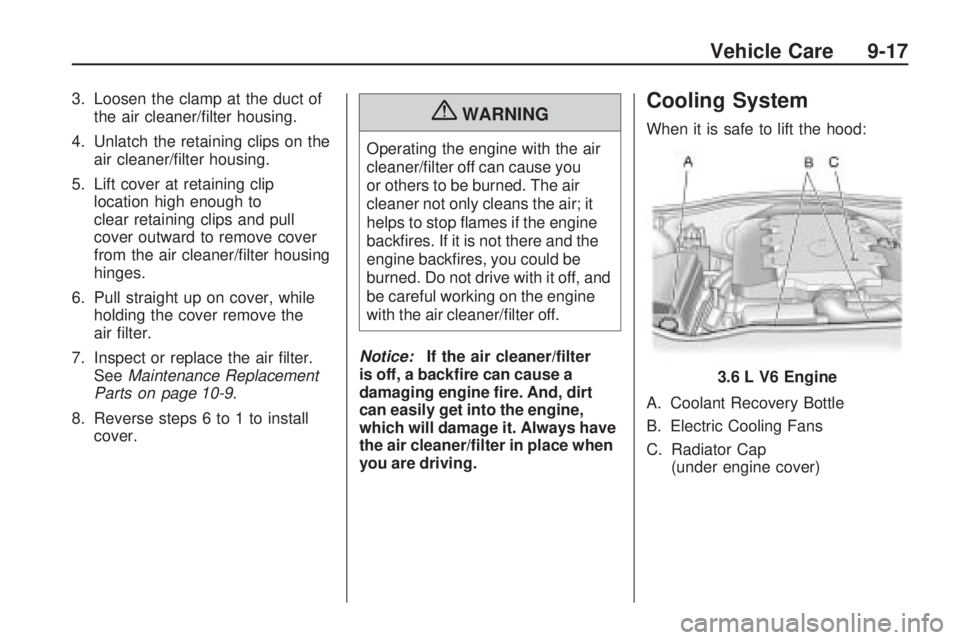
Cooling System
When it is safe to lift the hood:
A. Coolant Recovery Bottle
B. Electric Cooling Fans
C. Radiator Cap
(under engine cover)3.6 L V6 Engine
Vehicle Care 9-17
Page 261 of 372
What to Add
Use only new DOT 3 brake
fluid from a sealed container.
SeeRecommended Fluids and
Lubricants on page 10-7.
Always clean the brake/clutch
fluid reservoir cap and the area
around the cap before removing it.
This helps keep dirt from entering
the reservoir.
{WARNING
With the wrong kind of fluid in the
brake/clutch hydraulic system,
the brakes might not work well.
This could cause a crash. Always
use the proper brake/clutch fluid.Notice:
Using the wrong uid can
badly damage brake/clutch
hydraulic system parts.
For example, just a few drops
of mineral-based oil, such
as engine oil, in the brake
hydraulic system can damage
brake hydraulic system parts so
badly that they will have to be
replaced. Do not let someone
put in the wrong kind of uid.
If brake uid is spilled on the
vehicle’s painted surfaces, the
paint nish can be damaged.
Be careful not to spill brake
uid on the vehicle. If you do,
wash it off immediately.
Battery
This vehicle has a maintenance
free battery. When it is time for a
new battery, see your dealer/retailer
for one that has the replacement
number shown on the original
battery’s label. SeeEngine
Compartment Overview on
page 9-6for battery location.
{WARNING
Battery posts, terminals, and
related accessories contain lead
and lead compounds, chemicals
known to the State of California
to cause cancer and reproductive
harm. Wash hands after handling.
Vehicle Care 9-29
Page 265 of 372
Park on a fairly steep hill, with the
vehicle facing downhill. Keeping
your foot on the regular brake,
set the parking brake.
•To check the parking brake’s
holding ability: With the engine
running and the transmission
in N (Neutral), slowly remove
foot pressure from the regular
brake pedal. Do this until
the vehicle is held by the
parking brake only.
•To check the P (Park)
mechanism’s holding ability:
With the engine running, shift
to P (Park). Then release the
parking brake followed by the
regular brake.
Contact your dealer/retailer if
service is required.
Wiper Blade
Replacement
Windshield wiper blades should be
inspected for wear and cracking.
SeeScheduled Maintenance on
page 10-2for more information.
Replacement blades come in
different types and are removed
in different ways. For proper type
and length, seeMaintenance
Replacement Parts on page 10-9.To replace the windshield wiper
blade:
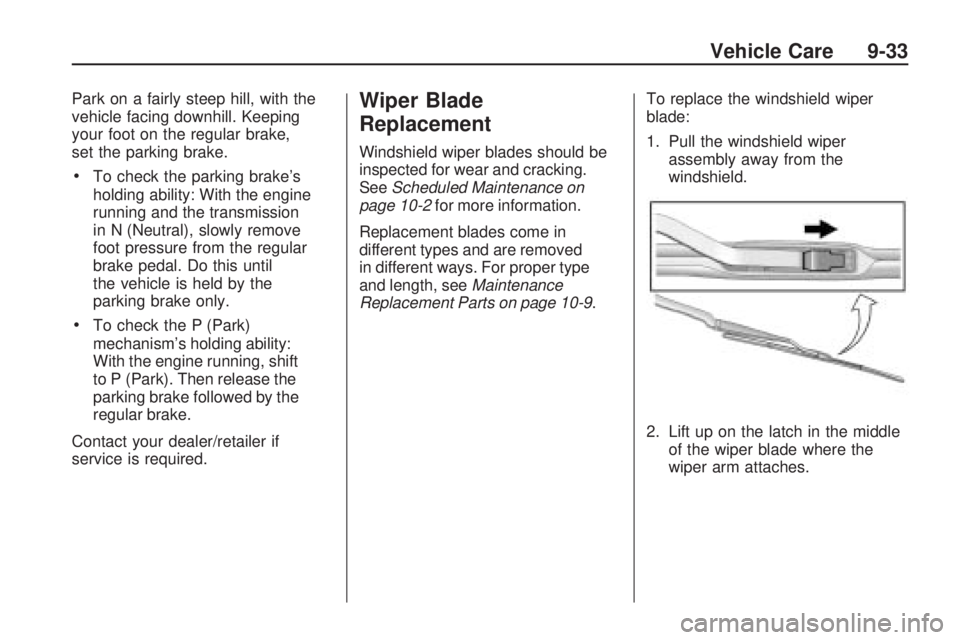
1. Pull the windshield wiper
assembly away from the
windshield.
2. Lift up on the latch in the middle
of the wiper blade where the
wiper arm attaches.
Vehicle Care 9-33
Page 289 of 372
Please note that the TPMS
is not a substitute for proper tire
maintenance, and it is the driver’s
responsibility to maintain correct tire
pressure, even if under-inflation
has not reached the level to trigger
illumination of the TPMS low tire
pressure telltale.
Your vehicle has also been
equipped with a TPMS malfunction
indicator to indicate when the system
is not operating properly. The TPMS
malfunction indicator is combined
with the low tire pressure telltale.
When the system detects a
malfunction, the telltale will flash
for approximately one minute and
then remain continuously illuminated.
This sequence will continue upon
subsequent vehicle start-ups as
long as the malfunction exists.
When the malfunction indicator is
illuminated, the system may not
be able to detect or signal low
tire pressure as intended. TPMS
malfunctions may occur for a varietyof reasons, including the installation
of replacement or alternate tires or
wheels on the vehicle that prevent
the TPMS from functioning properly.
Always check the TPMS malfunction
telltale after replacing one or more
tires or wheels on your vehicle to
ensure that the replacement or
alternate tires and wheels allow
the TPMS to continue to function
properly.
SeeTire Pressure Monitor
Operation on page 9-57for
additional information.
Federal Communications
Commission (FCC) and
Industry and Science Canada
SeeRadio Frequency Statement
(US, Can) on page 12-15for
information regarding Part 15
of the Federal Communications
Commission (FCC) Rules and
RSS-210/211 of Industry and
Science Canada.
Tire Pressure Monitor
Operation
This vehicle may have a Tire
Pressure Monitor System (TPMS).
The TPMS is designed to warn the
driver when a low tire pressure
condition exists. TPMS sensors are
mounted onto each tire and wheel
assembly, excluding the spare tire
and wheel assembly, if the vehicle
has one. The TPMS sensors monitor
the air pressure in the vehicle’s tires
and transmits the tire pressure
readings to a receiver located in
the vehicle.
Using the Driver Information
Center (DIC), the driver can also
check tire pressure levels using the
DIC. For additional information and
details about the DIC operation and
displays seeTire Messages on
page 4-36.
Vehicle Care 9-57
Page 290 of 372
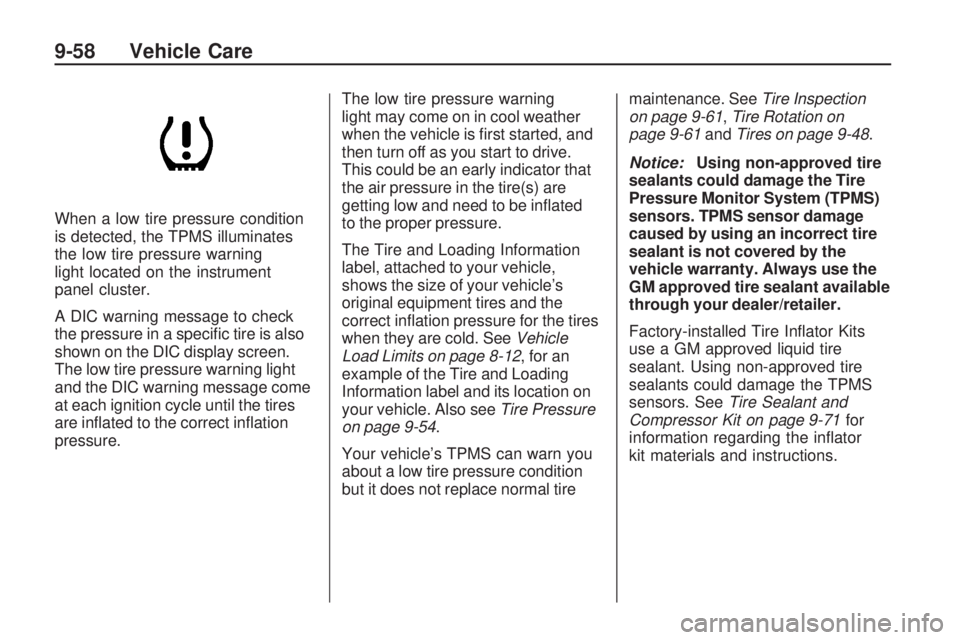
When a low tire pressure condition
is detected, the TPMS illuminates
the low tire pressure warning
light located on the instrument
panel cluster.
A DIC warning message to check
the pressure in a specific tire is also
shown on the DIC display screen.
The low tire pressure warning light
and the DIC warning message come
at each ignition cycle until the tires
are inflated to the correct inflation
pressure.The low tire pressure warning
light may come on in cool weather
when the vehicle is first started, and
then turn off as you start to drive.
This could be an early indicator that
the air pressure in the tire(s) are
getting low and need to be inflated
to the proper pressure.
The Tire and Loading Information
label, attached to your vehicle,
shows the size of your vehicle’s
original equipment tires and the
correct inflation pressure for the tires
when they are cold. SeeVehicle
Load Limits on page 8-12, for an
example of the Tire and Loading
Information label and its location on
your vehicle. Also seeTire Pressure
on page 9-54.
Your vehicle’s TPMS can warn you
about a low tire pressure condition
but it does not replace normal tiremaintenance. SeeTire Inspection
on page 9-61,Tire Rotation on
page 9-61andTires on page 9-48.
Notice:Using non-approved tire
sealants could damage the Tire
Pressure Monitor System (TPMS)
sensors. TPMS sensor damage
caused by using an incorrect tire
sealant is not covered by the
vehicle warranty. Always use the
GM approved tire sealant available
through your dealer/retailer.
Factory-installed Tire Inflator Kits
use a GM approved liquid tire
sealant. Using non-approved tire
sealants could damage the TPMS
sensors. SeeTire Sealant and
Compressor Kit on page 9-71for
information regarding the inflator
kit materials and instructions.
9-58 Vehicle Care