manual transmission CHEVROLET CAMARO SS 2010 Owner's Manual
[x] Cancel search | Manufacturer: CHEVROLET, Model Year: 2010, Model line: CAMARO SS, Model: CHEVROLET CAMARO SS 2010Pages: 372, PDF Size: 1.91 MB
Page 241 of 372
A. Underhood Electrical Center.
SeeEngine Compartment
Fuse Block on page 9-42.
B. Engine Coolant Recovery Bottle
and Cap. SeeEngine Coolant
on page 9-19.
C. Engine Oil Dipstick. SeeEngine
Oil on page 9-10.
D. Engine Oil Fill Cap (Out of
View). SeeEngine Oil on
page 9-10.
E.Engine Cover on page 9-9.
F. Engine Cooling Fans (Out of
View). SeeCooling System
on page 9-17.
G. Power Steering Reservoir and
Cap (Under Engine Cover).
SeePower Steering Fluid
on page 9-25.H. Brake Master Cylinder and
Hydraulic Clutch (if equipped
with manual transmission)
Reservoir. SeeBrakes on
page 9-27orHydraulic Clutch
on page 9-15.
I. Remote Positive (+) Terminal.
SeeBattery on page 9-29.
J.Engine Air Cleaner/Filter on
page 9-16.
K. Windshield Washer Fluid
Reservoir. SeeWasher Fluid
on page 9-26.
L. Radiator Fill Cap. SeeEngine
Coolant on page 9-19.Engine Cover
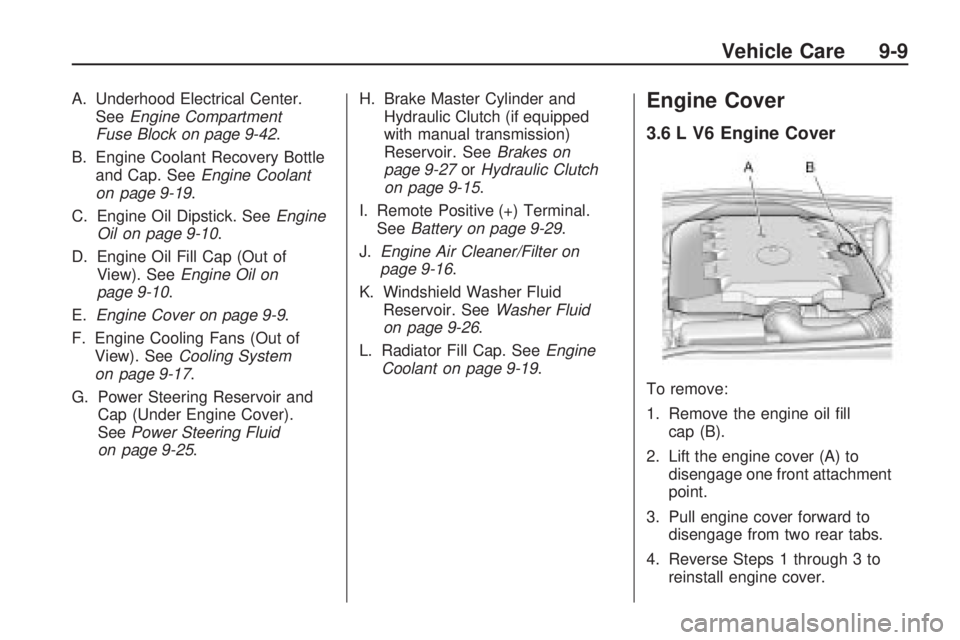
3.6 L V6 Engine Cover
To remove:
1. Remove the engine oil fill
cap (B).
2. Lift the engine cover (A) to
disengage one front attachment
point.
3. Pull engine cover forward to
disengage from two rear tabs.
4. Reverse Steps 1 through 3 to
reinstall engine cover.
Vehicle Care 9-9
Page 246 of 372
What to Do with Used Oil
Used engine oil contains certain
elements that can be unhealthy for
your skin and could even cause
cancer. Do not let used oil stay on
your skin for very long. Clean your
skin and nails with soap and water,
or a good hand cleaner. Wash or
properly dispose of clothing or rags
containing used engine oil. See the
manufacturer’s warnings about the
use and disposal of oil products.
Used oil can be a threat to the
environment. If you change your own
oil, be sure to drain all the oil from the
filter before disposal. Never dispose
of oil by putting it in the trash, pouring
it on the ground, into sewers, or into
streams or bodies of water. Recycle
it by taking it to a place that collects
used oil.
Automatic Transmission
Fluid
How to Check Automatic
Transmission Fluid
It is not necessary to check
the transmission fluid level.
A transmission fluid leak is the
only reason for fluid loss. If a leak
occurs, take the vehicle to your
dealer/retailer service department
and have it repaired as soon as
possible.
There is a special procedure
for checking and changing the
transmission fluid. Because this
procedure is difficult, you should
have this done at your dealer/
retailer service department.Contact your dealer/retailer for
additional information or the
procedure can be found in the
service manual. To purchase a
service manual, seeService
Publications Ordering Information
on page 12-12.
Change the fluid and filter at the
intervals listed inScheduled
Maintenance on page 10-2, and
be sure to use the fluid listed
inRecommended Fluids and
Lubricants on page 10-7.
9-14 Vehicle Care
Page 247 of 372
Manual Transmission
Fluid
It is not necessary to check the
manual transmission fluid level.
A transmission fluid leak is the only
reason for fluid loss. If a leak occurs,
take the vehicle to your dealer/
retailer service department and
have it repaired as soon as possible.
SeeRecommended Fluids and
Lubricants on page 10-7for the
proper fluid to use.
Hydraulic Clutch
It is not necessary to regularly
check brake/clutch fluid unless
you suspect there is a leak in the
system. Adding fluid will not correct
a leak. A fluid loss in this system
could indicate a problem. Have the
system inspected and repaired.
When to Check and What
to Use
The brake/hydraulic clutch fluid
reservoir cap has this symbol
on it. The common hydraulic clutch
and brake master cylinder fluid
reservoir is filled with DOT 3 brake
fluid as indicated on the reservoir
cap. SeeEngine Compartment
Overview on page 9-6for reservoir
location.
How to Check and Add Fluid
Visually check the brake/clutch
fluid reservoir to make sure the
fluid level is at the MIN (minimum)
line on the side of the reservoir.
The brake/hydraulic clutch fluid
system should be closed and
sealed.
Do not remove the cap to check
the fluid level or to top-off the fluid
level. Remove the cap only when
necessary to add the proper fluid
until the level reaches the MIN line.
Vehicle Care 9-15
Page 262 of 372
Vehicle Storage
{WARNING
Batteries have acid that can burn
you and gas that can explode.
You can be badly hurt if you are
not careful. SeeJump Starting
on page 9-84for tips on working
around a battery without
getting hurt.
Infrequent Usage: If the vehicle
is driven infrequently, remove
the black, negative (−) cable
from the battery. This helps keep
the battery from running down.Extended Storage: For extended
storage of the vehicle, remove the
black, negative (−) cable from the
battery or use a battery trickle
charger. This helps maintain the
charge of the battery over an
extended period of time.
Rear Axle
When to Check Lubricant
It is not necessary to regularly
check rear axle fluid unless you
suspect there is a leak or you hear
an unusual noise. A fluid loss could
indicate a problem. Have it inspected
and repaired.
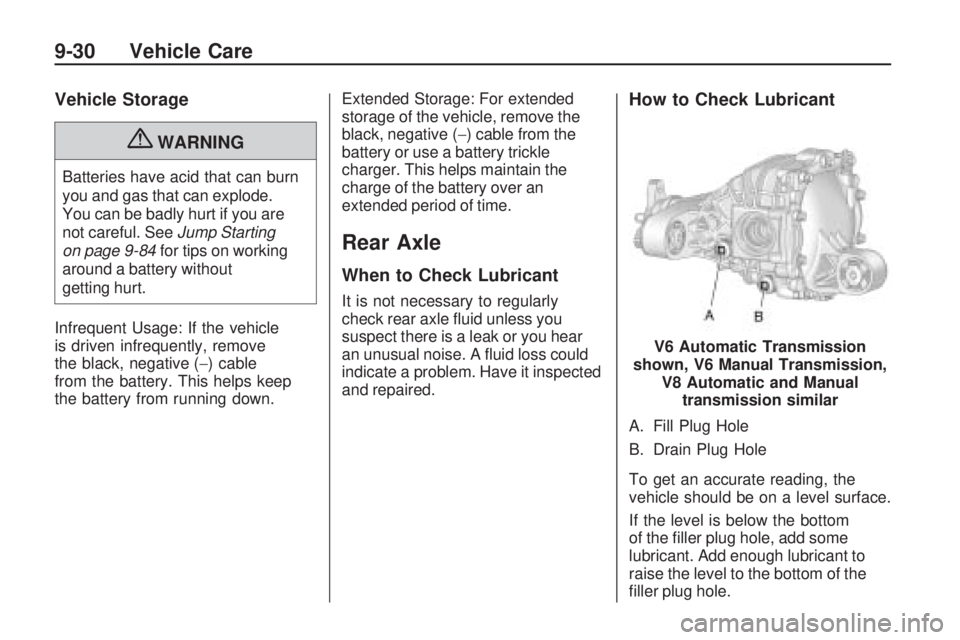
How to Check Lubricant
A. Fill Plug Hole
B. Drain Plug Hole
To get an accurate reading, the
vehicle should be on a level surface.
If the level is below the bottom
of the filler plug hole, add some
lubricant. Add enough lubricant to
raise the level to the bottom of the
filler plug hole.V6 Automatic Transmission
shown, V6 Manual Transmission,
V8 Automatic and Manual
transmission similar
9-30 Vehicle Care
Page 263 of 372

What to Use
For 218 mm rear drive module
(RDM) V6 manual, V8 automatic
and V8 manual:
To add lubricant when the level
is low, use 75W-90 LS gear oil
(GM Part No. US 89021677
and 1052358, in Canada
Part No. 89021678 and 992694)
meeting GM Specification 9986226.
To completely refill after draining,
seeRecommended Fluids and
Lubricants on page 10-7. Then fill
to the bottom of the filler plug hole
with the Synthetic Gear Lubricant.
For 195 mm RDM V6 automatic:
To add lubricant when the level
is low, use 75W-90 gear Oil
(GM Part No. US 89021677,
in Canada Part No. 89021678)
meeting GM Specification 9986115.
To completely refill after draining,
seeRecommended Fluids and
Lubricants on page 10-7. Then fill
to the bottom of the filler plug hole
with the Synthetic Gear Lubricant.
Starter Switch Check
{WARNING
When you are doing this
inspection, the vehicle could move
suddenly. If the vehicle moves,
you or others could be injured.
1. Before starting this check,
be sure there is enough
room around the vehicle.
2. Firmly apply both the parking
brake and the regular brake.
SeeParking Brake on page 8-32.
Do not use the accelerator
pedal, and be ready to turn off
the engine immediately if it starts.3. For automatic transmission
vehicles, try to start the engine
in each gear. The vehicle
should start only in P (Park) or
N (Neutral). If the vehicle starts
in any other position, contact your
dealer/retailer for service.
For manual transmission
vehicles, put the shift lever in
Neutral, push the clutch pedal
down halfway, and try to start the
engine. The vehicle should start
only when the clutch pedal is
pushed down all the way to the
floor. If the vehicle starts when
the clutch pedal is not pushed
all the way down, contact your
dealer/retailer for service.
Vehicle Care 9-31
Page 302 of 372
Turn on the hazard warning flashers.
SeeHazard Warning Flashers on
page 5-4.
{WARNING
Changing a tire can be dangerous.
The vehicle can slip off the jack
and roll over or fall on you or other
people. You and they could be
badly injured or even killed. Find
a level place to change your tire.
To help prevent the vehicle from
moving:
1. Set the parking brake firmly.
2. Put an automatic
transmission shift lever in
P (Park), or shift a manual
transmission to 1 (First) or
R (Reverse).
(Continued)
WARNING (Continued)
3. Turn off the engine and do
not restart while the vehicle
is raised.
4. Do not allow passengers to
remain in the vehicle.
To be certain the vehicle will not
move, put blocks at the front and
rear of the tire farthest away from
the one being changed. That
would be the tire on the other side,
at the opposite end of the vehicle.
This vehicle may come with a jack
and spare tire or a tire sealant
and compressor kit. To use the jack
and spare tire, follow the instructions
below. To use the tire sealant and
compressor kit, seeTire Sealant and
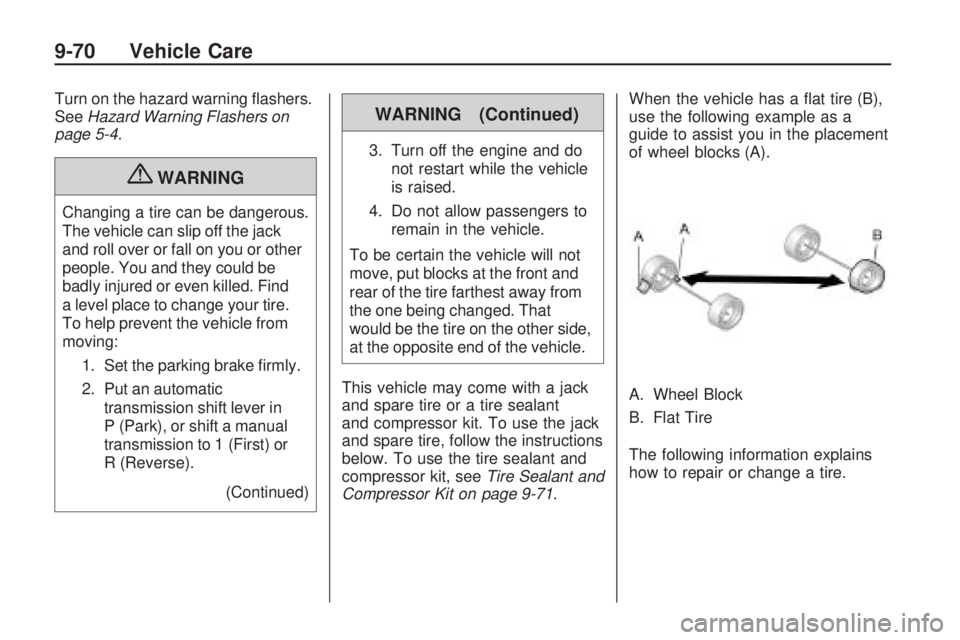
Compressor Kit on page 9-71.When the vehicle has a flat tire (B),
use the following example as a
guide to assist you in the placement
of wheel blocks (A).
A. Wheel Block
B. Flat Tire
The following information explains
how to repair or change a tire.
9-70 Vehicle Care
Page 335 of 372

Recommended Fluids, Lubricants, and Parts
Recommended Fluids and Lubricants
UsageFluid/Lubricant
Engine Oil (V6 Engine) Engine oil which meets GM Standard GM6094M and displays the
American Petroleum Institute Certified for Gasoline Engines starburst
symbol. To determine the proper viscosity for the vehicle’s engine, see
Engine Oil on page 9-10
.
Engine Oil (V8 Engines) The engine requires a special engine oil meeting GM Standard GM4718M.
Oils meeting this standard can be identified with the American Petroleum
Institute (API) Certified for Gasoline Engines starburst symbol. However,
not all synthetic API oils with the starburst symbol will meet this GM
standard. Look for and use only an oil that meets GM Standard GM4718M.
For the proper viscosity, see
Engine Oil on page 9-10.
Engine Coolant 50/50 mixture of clean, drinkable water and use only DEX-COOL
®
Coolant. See
Engine Coolant on page 9-19 .
Hydraulic Brake System Hydraulic Brake Fluid (GM Part No. U.S. 88862806, in Canada 88862807).
Hydraulic Clutch System Hydraulic Brake Fluid (GM Part No. U.S. 88862806, in Canada 88862807). Windshield Washer Optikleen
®Washer Solvent.
Hydraulic Power Steering System DEXRON®-VI Automatic Transmission Fluid.
Parking Brake Cable Guides Chassis Lubricant (GM Part No. 12377985, in Canada 88901242) or
lubricant meeting requirements of NLGI #2, Category LB or GC-LB.
Automatic Transmission DEXRON
®-VI Automatic Transmission Fluid.
Manual Transmission (V6 Engine) SAE 75W-90 GL5 Gear Oil (GM Part No. U.S. 88862475,
in Canada 88862476).
Service and Maintenance 10-7
Page 336 of 372
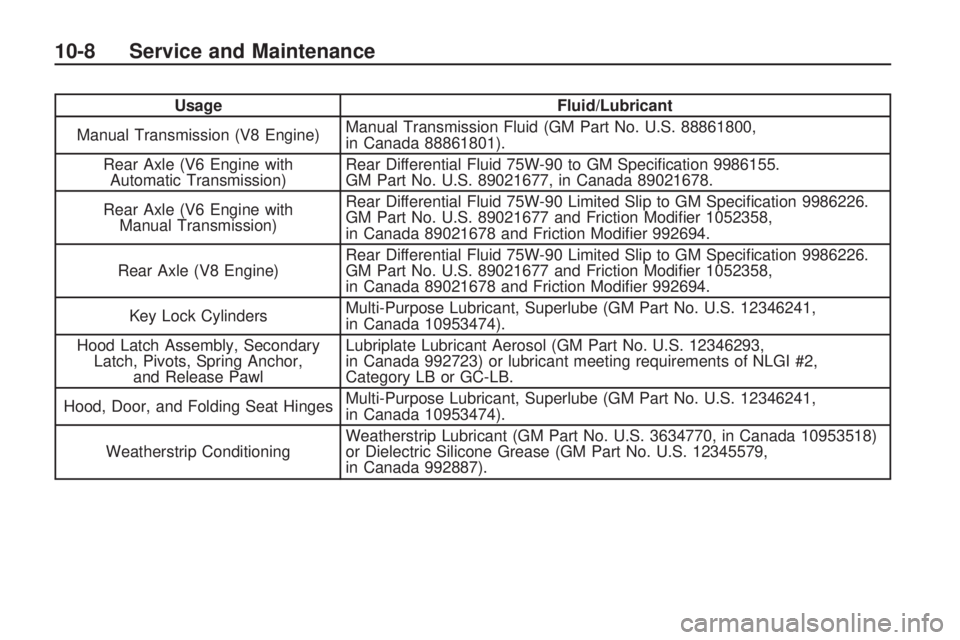
UsageFluid/Lubricant
Manual Transmission (V8 Engine) Manual Transmission Fluid (GM Part No. U.S. 88861800,
in Canada 88861801).
Rear Axle (V6 Engine with Automatic Transmission) Rear Differential Fluid 75W-90 to GM Specification 9986155.
GM Part No. U.S. 89021677, in Canada 89021678.
Rear Axle (V6 Engine with Manual Transmission) Rear Differential Fluid 75W-90 Limited Slip to GM Specification 9986226.
GM Part No. U.S. 89021677 and Friction Modifier 1052358,
in Canada 89021678 and Friction Modifier 992694.
Rear Axle (V8 Engine) Rear Differential Fluid 75W-90 Limited Slip to GM Specification 9986226.
GM Part No. U.S. 89021677 and Friction Modifier 1052358,
in Canada 89021678 and Friction Modifier 992694.
Key Lock Cylinders Multi-Purpose Lubricant, Superlube (GM Part No. U.S. 12346241,
in Canada 10953474).
Hood Latch Assembly, Secondary Latch, Pivots, Spring Anchor, and Release Pawl Lubriplate Lubricant Aerosol (GM Part No. U.S. 12346293,
in Canada 992723) or lubricant meeting requirements of NLGI #2,
Category LB or GC-LB.
Hood, Door, and Folding Seat Hinges Multi-Purpose Lubricant, Superlube (GM Part No. U.S. 12346241,
in Canada 10953474).
Weatherstrip Conditioning Weatherstrip Lubricant (GM Part No. U.S. 3634770, in Canada 10953518)
or Dielectric Silicone Grease (GM Part No. U.S. 12345579,
in Canada 992887).
10-8 Service and Maintenance
Page 342 of 372

Vehicle Data
Capacities and Specications
ApplicationCapacities
Metric English
Air Conditioning Refrigerant R134a For the air conditioning system refrigerant charge
amount, see the refrigerant caution label located
under the hood. See your dealer/retailer for more information.
Engine Cooling System 3.6L V6 Engine Automatic Transmission 10.2 L10.8 qt
3.6L V6 Engine Manual Transmission 10.6 L11.2 qt
6.2L V8 Engine (L99) Automatic Transmission 10.8 L11.4 qt
6.2L V8 Engine (LS3) Manual Transmission 11.2 L11.8 qt
Engine Oil with Filter 3.6L V6 Engine 5.7 L6.0 qt
6.2L V8 Engine (L99) 7.6 L8.0 qt
6.2L V8 Engine (LS3) 7.6 L8.0 qt
Fuel Tank 71.0 L18.8 gal
Rear Axle Fluid V6 Engine 6-Speed Automatic 0.9 L1.0 qt
V6 Engine 6-Speed Manual* 0.9 L1.0 qt
V8 Engine* 0.9 L1.0 qt
11-2 Technical Data
Page 343 of 372

ApplicationCapacities
Metric English
Transmission Fluid (Pan Removal and Filter Replacement) V6 Engine 6-Speed Automatic** 6.3 L6.7 qt
V8 Engine 6-Speed Automatic** 6.3 L6.7 qt
V6 Engine 6-Speed Manual 1.8 L1.9 qt
V8 Engine 6-Speed Manual 3.9 L4.2 qt
Wheel Nut Torque 190Y 140 ft lb
*Add 2.5 oz. (75 mL) of friction modifier to the specified quantity of axle lubricant.
**See Automatic Transmission Fluid on page 9-14 for information on checking fluid level.
All capacities are approximate. When adding, be sure to fill to the approximate level, as recommended in this
manual. Recheck fluid level after filling.
Engine Specications
Engine VIN CodeTransmission Spark Plug Gap
3.6L V6 (LLT) VAutomatic
Manual 1.1 mm (0.043 in)
6.2L V8 (L99) JAutomatic 1.0 mm (0.040 in)
6.2L V8 (LS3) WManual 1.0 mm (0.040 in)
Technical Data 11-3