brake CHEVROLET CAMARO SS 2010 Repair Manual
[x] Cancel search | Manufacturer: CHEVROLET, Model Year: 2010, Model line: CAMARO SS, Model: CHEVROLET CAMARO SS 2010Pages: 372, PDF Size: 1.91 MB
Page 302 of 372
Turn on the hazard warning flashers.
SeeHazard Warning Flashers on
page 5-4.
{WARNING
Changing a tire can be dangerous.
The vehicle can slip off the jack
and roll over or fall on you or other
people. You and they could be
badly injured or even killed. Find
a level place to change your tire.
To help prevent the vehicle from
moving:
1. Set the parking brake firmly.
2. Put an automatic
transmission shift lever in
P (Park), or shift a manual
transmission to 1 (First) or
R (Reverse).
(Continued)
WARNING (Continued)
3. Turn off the engine and do
not restart while the vehicle
is raised.
4. Do not allow passengers to
remain in the vehicle.
To be certain the vehicle will not
move, put blocks at the front and
rear of the tire farthest away from
the one being changed. That
would be the tire on the other side,
at the opposite end of the vehicle.
This vehicle may come with a jack
and spare tire or a tire sealant
and compressor kit. To use the jack
and spare tire, follow the instructions
below. To use the tire sealant and
compressor kit, seeTire Sealant and
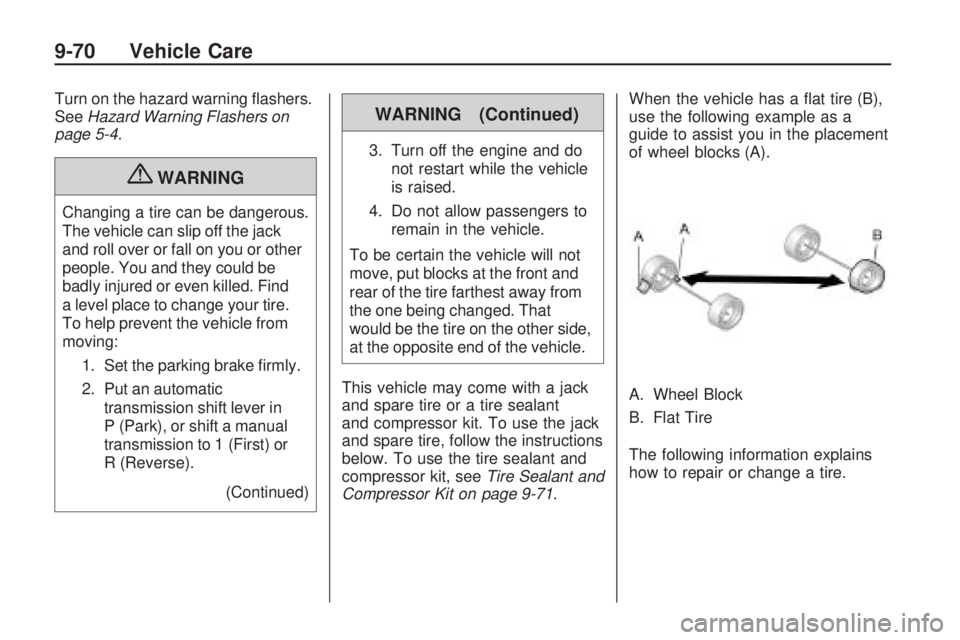
Compressor Kit on page 9-71.When the vehicle has a flat tire (B),
use the following example as a
guide to assist you in the placement
of wheel blocks (A).
A. Wheel Block
B. Flat Tire
The following information explains
how to repair or change a tire.
9-70 Vehicle Care
Page 314 of 372
12. Lower the vehicle by turning the
jack handle counterclockwise.
Lower the jack completely.
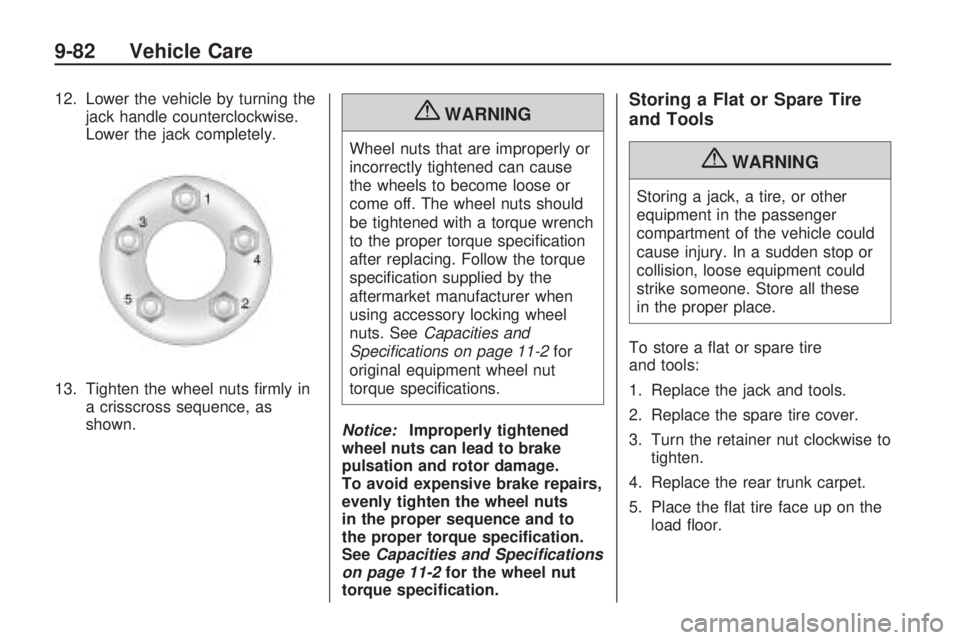
13. Tighten the wheel nuts firmly in
a crisscross sequence, as
shown.{WARNING
Wheel nuts that are improperly or
incorrectly tightened can cause
the wheels to become loose or
come off. The wheel nuts should
be tightened with a torque wrench
to the proper torque specification
after replacing. Follow the torque
specification supplied by the
aftermarket manufacturer when
using accessory locking wheel
nuts. SeeCapacities and
Specications on page 11-2for
original equipment wheel nut
torque specifications.
Notice:Improperly tightened
wheel nuts can lead to brake
pulsation and rotor damage.
To avoid expensive brake repairs,
evenly tighten the wheel nuts
in the proper sequence and to
the proper torque specication.
SeeCapacities and Specifications
on page 11-2for the wheel nut
torque specication.
Storing a Flat or Spare Tire
and Tools
{WARNING
Storing a jack, a tire, or other
equipment in the passenger
compartment of the vehicle could
cause injury. In a sudden stop or
collision, loose equipment could
strike someone. Store all these
in the proper place.
To store a flat or spare tire
and tools:
1. Replace the jack and tools.
2. Replace the spare tire cover.
3. Turn the retainer nut clockwise to
tighten.
4. Replace the rear trunk carpet.
5. Place the flat tire face up on the
load floor.
9-82 Vehicle Care
Page 317 of 372
The positive jump start connection
is covered by a red cap. Remove to
expose the terminal.
1. Check the other vehicle. It must
have a 12-volt battery with a
negative ground system.
Notice:If the other vehicle’s
system is not a 12-volt system
with a negative ground, both
vehicles can be damaged. Only
use vehicles with 12-volt systems
with negative grounds to jump
start your vehicle.
2. Position the two vehicles so that
they are not touching.
3. Set the parking brake firmly and
put the shift lever in P (Park).
SeeShifting Into Park on
page 8-21.Notice:If you leave the radio or
other accessories on during the
jump starting procedure, they
could be damaged. The repairs
would not be covered by the
warranty. Always turn off the
radio and other accessories
when jump starting the vehicle.
4. Turn the ignition to LOCK/OFF
and switch off all lights and
accessories in both vehicles,
except the hazard warning
flashers if needed.
{WARNING
An electric fan can start up even
when the engine is not running
and can injure you. Keep hands,
clothing and tools away from any
underhood electric fan.
{WARNING
Using a match near a battery can
cause battery gas to explode.
People have been hurt doing this,
and some have been blinded. Use
a flashlight if you need more light.
Be sure the battery has enough
water. You do not need to add
water to the battery installed in
your new vehicle. But if a battery
has filler caps, be sure the right
amount of fluid is there. If it is
low, add water to take care of
that first. If you don’t, explosive
gas could be present.
Battery fluid contains acid that
can burn you. Do not get it on
you. If you accidentally get it in
your eyes or on your skin, flush
the place with water and get
medical help immediately.
Vehicle Care 9-85
Page 331 of 372
MaintenanceI
•
Change engine oil and filter.
SeeEngine Oil on page 9-10.
An Emission Control Service.
•Engine coolant level check. See
Engine Coolant on page 9-19.
•Windshield washer fluid level
check. SeeWasher Fluid on
page 9-26.
•Tire inflation check. SeeTire
Pressure on page 9-54.
•Tire wear inspection. SeeTire
Inspection on page 9-61.
•If tire rotation is recommended
for the vehicle, rotate tires.
SeeTire Rotation on page 9-61.
•Fluids visual leak check (or every
12 months, whichever occurs
first). A leak in any system must
be repaired and the fluid level
checked.
•Engine air cleaner filter
inspection (vehicles driven
in dusty conditions only).
SeeEngine Air Cleaner/Filter
on page 9-16.
•Brake system inspection (or
every 12 months, whichever
occurs first).
MaintenanceII
•
Perform all services described in
MaintenanceI.
•Steering and suspension
inspection. Visual inspection
for damaged, loose, or missing
parts or signs of wear.
•Engine cooling system
inspection. Visual inspection of
hoses, pipes, fittings, and clamps
and replacement, if needed.
•Windshield wiper blade
inspection for wear, cracking, or
contamination and windshield
and wiper blade cleaning,
if contaminated. SeeExterior
Care on page 9-88. Worn
or damaged wiper blade
replacement. SeeWiper Blade
Replacement on page 9-33.
•Body hinges and latches,
key lock cylinders, folding
seat hardware, and sunroof
(if equipped) lubrication.
SeeRecommended Fluids
and Lubricants on page 10-7.
More frequent lubrication may be
required when vehicle is exposed
to a corrosive environment.
Applying silicone grease on
weatherstrips with a clean cloth
makes them last longer, seal
better, and not stick or squeak.
Service and Maintenance 10-3
Page 332 of 372
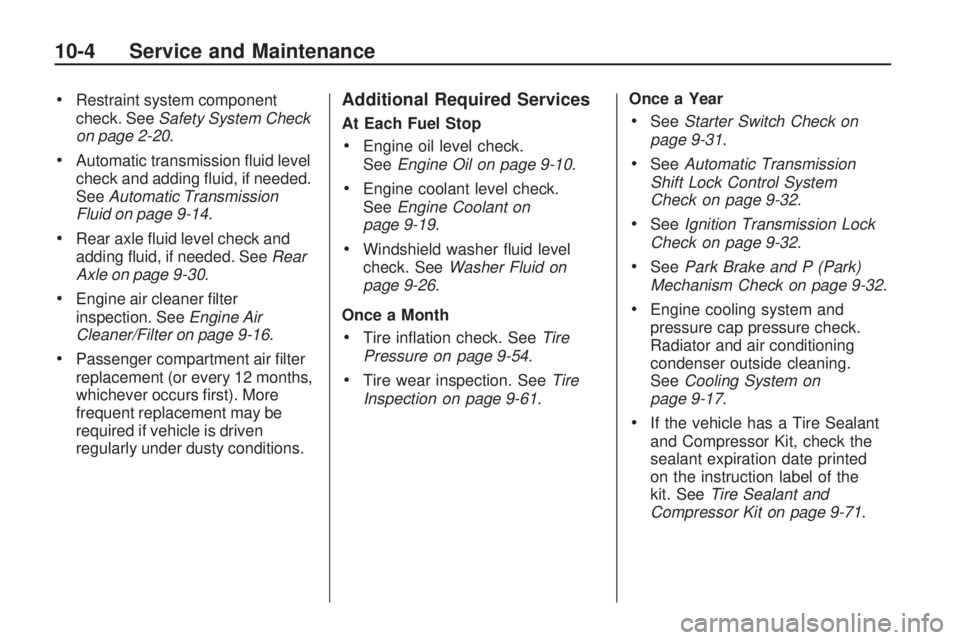
•Restraint system component
check. SeeSafety System Check
on page 2-20.
•Automatic transmission fluid level
check and adding fluid, if needed.
SeeAutomatic Transmission
Fluid on page 9-14.
•Rear axle fluid level check and
adding fluid, if needed. SeeRear
Axle on page 9-30.
•Engine air cleaner filter
inspection. SeeEngine Air
Cleaner/Filter on page 9-16.
•Passenger compartment air filter
replacement (or every 12 months,
whichever occurs first). More
frequent replacement may be
required if vehicle is driven
regularly under dusty conditions.
Additional Required Services
At Each Fuel Stop
•Engine oil level check.
SeeEngine Oil on page 9-10.
•Engine coolant level check.
SeeEngine Coolant on
page 9-19.
•Windshield washer fluid level
check. SeeWasher Fluid on
page 9-26.
Once a Month
•Tire inflation check. SeeTire
Pressure on page 9-54.
•Tire wear inspection. SeeTire
Inspection on page 9-61.Once a Year
•SeeStarter Switch Check on
page 9-31.
•SeeAutomatic Transmission
Shift Lock Control System
Check on page 9-32.
•SeeIgnition Transmission Lock
Check on page 9-32.
•SeePark Brake and P (Park)
Mechanism Check on page 9-32.
•Engine cooling system and
pressure cap pressure check.
Radiator and air conditioning
condenser outside cleaning.
SeeCooling System on
page 9-17.
•If the vehicle has a Tire Sealant
and Compressor Kit, check the
sealant expiration date printed
on the instruction label of the
kit. SeeTire Sealant and
Compressor Kit on page 9-71.
10-4 Service and Maintenance
Page 334 of 372
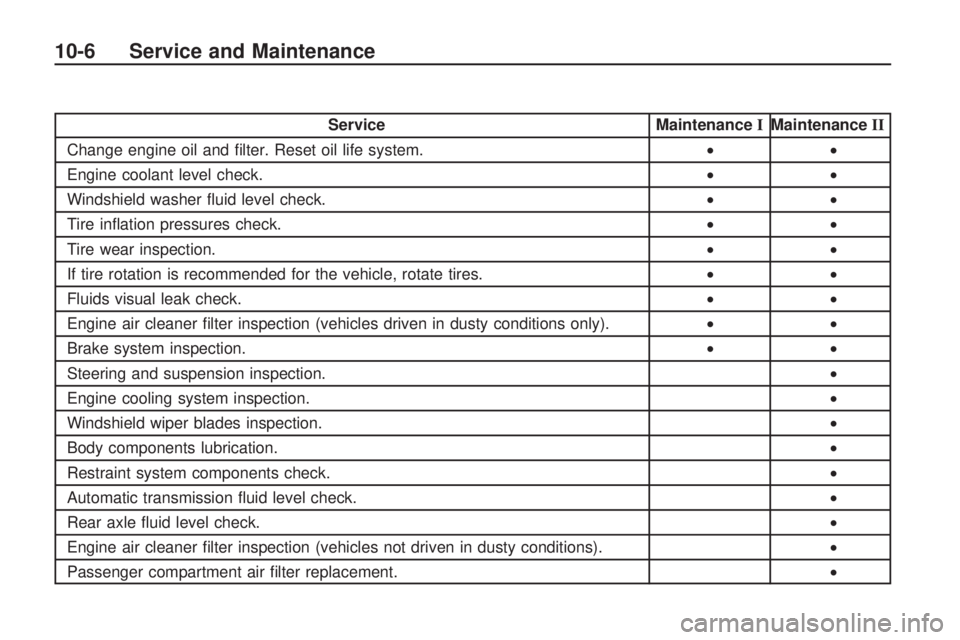
ServiceMaintenanceIMaintenance II
Change engine oil and filter. Reset oil life system. ••
Engine coolant level check. ••
Windshield washer fluid level check. ••
Tire inflation pressures check. ••
Tire wear inspection. ••
If tire rotation is recommended for the vehicle, rotate tires. ••
Fluids visual leak check. ••
Engine air cleaner filter inspection (vehicles driven in dusty conditions only). ••
Brake system inspection. ••
Steering and suspension inspection. •
Engine cooling system inspection. •
Windshield wiper blades inspection. •
Body components lubrication. •
Restraint system components check. •
Automatic transmission fluid level check. •
Rear axle fluid level check. •
Engine air cleaner filter inspection (vehicles not driven in dusty conditions). •
Passenger compartment air filter replacement. •
10-6 Service and Maintenance
Page 335 of 372

Recommended Fluids, Lubricants, and Parts
Recommended Fluids and Lubricants
UsageFluid/Lubricant
Engine Oil (V6 Engine) Engine oil which meets GM Standard GM6094M and displays the
American Petroleum Institute Certified for Gasoline Engines starburst
symbol. To determine the proper viscosity for the vehicle’s engine, see
Engine Oil on page 9-10
.
Engine Oil (V8 Engines) The engine requires a special engine oil meeting GM Standard GM4718M.
Oils meeting this standard can be identified with the American Petroleum
Institute (API) Certified for Gasoline Engines starburst symbol. However,
not all synthetic API oils with the starburst symbol will meet this GM
standard. Look for and use only an oil that meets GM Standard GM4718M.
For the proper viscosity, see
Engine Oil on page 9-10.
Engine Coolant 50/50 mixture of clean, drinkable water and use only DEX-COOL
®
Coolant. See
Engine Coolant on page 9-19 .
Hydraulic Brake System Hydraulic Brake Fluid (GM Part No. U.S. 88862806, in Canada 88862807).
Hydraulic Clutch System Hydraulic Brake Fluid (GM Part No. U.S. 88862806, in Canada 88862807). Windshield Washer Optikleen
®Washer Solvent.
Hydraulic Power Steering System DEXRON®-VI Automatic Transmission Fluid.
Parking Brake Cable Guides Chassis Lubricant (GM Part No. 12377985, in Canada 88901242) or
lubricant meeting requirements of NLGI #2, Category LB or GC-LB.
Automatic Transmission DEXRON
®-VI Automatic Transmission Fluid.
Manual Transmission (V6 Engine) SAE 75W-90 GL5 Gear Oil (GM Part No. U.S. 88862475,
in Canada 88862476).
Service and Maintenance 10-7
Page 356 of 372
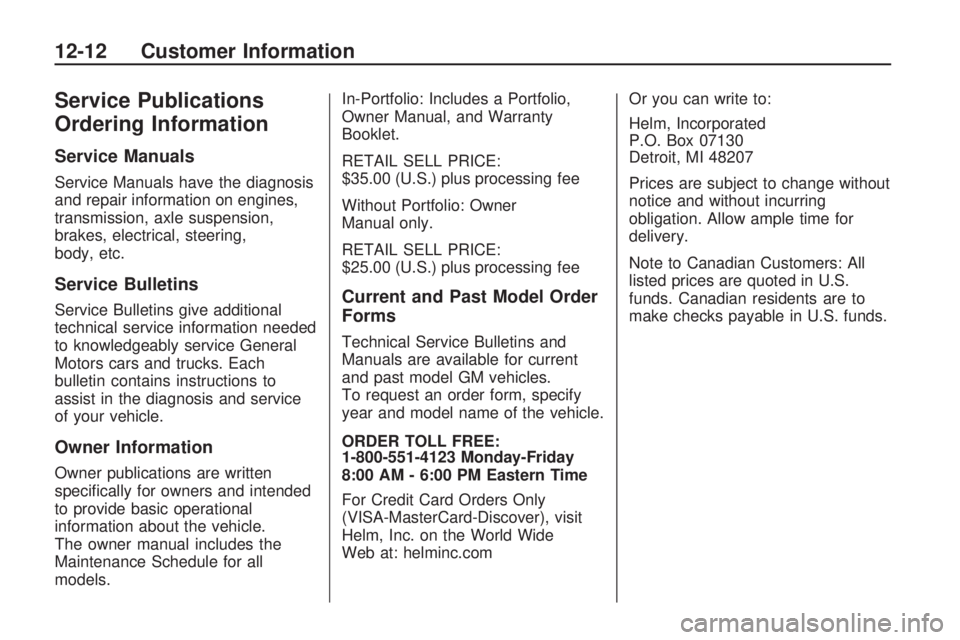
Service Publications
Ordering Information
Service Manuals
Service Manuals have the diagnosis
and repair information on engines,
transmission, axle suspension,
brakes, electrical, steering,
body, etc.
Service Bulletins
Service Bulletins give additional
technical service information needed
to knowledgeably service General
Motors cars and trucks. Each
bulletin contains instructions to
assist in the diagnosis and service
of your vehicle.
Owner Information
Owner publications are written
specifically for owners and intended
to provide basic operational
information about the vehicle.
The owner manual includes the
Maintenance Schedule for all
models.In-Portfolio: Includes a Portfolio,
Owner Manual, and Warranty
Booklet.
RETAIL SELL PRICE:
$35.00 (U.S.) plus processing fee
Without Portfolio: Owner
Manual only.
RETAIL SELL PRICE:
$25.00 (U.S.) plus processing fee
Current and Past Model Order
Forms
Technical Service Bulletins and
Manuals are available for current
and past model GM vehicles.
To request an order form, specify
year and model name of the vehicle.
ORDER TOLL FREE:
1-800-551-4123 Monday-Friday
8:00 AM - 6:00 PM Eastern Time
For Credit Card Orders Only
(VISA-MasterCard-Discover), visit
Helm, Inc. on the World Wide
Web at: helminc.comOr you can write to:
Helm, Incorporated
P.O. Box 07130
Detroit, MI 48207
Prices are subject to change without
notice and without incurring
obligation. Allow ample time for
delivery.
Note to Canadian Customers: All
listed prices are quoted in U.S.
funds. Canadian residents are to
make checks payable in U.S. funds.
12-12 Customer Information
Page 358 of 372
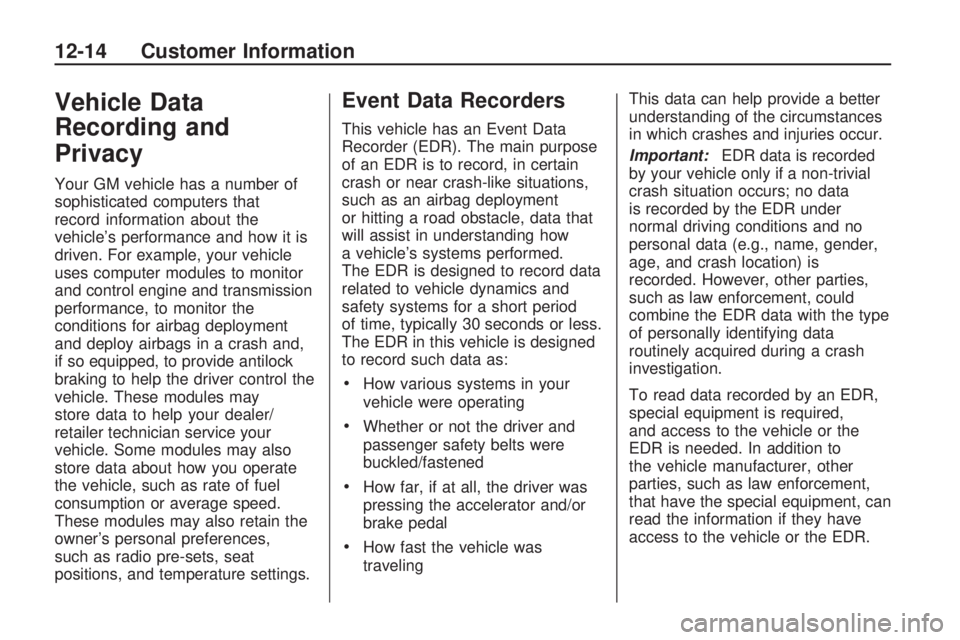
Vehicle Data
Recording and
Privacy
Your GM vehicle has a number of
sophisticated computers that
record information about the
vehicle’s performance and how it is
driven. For example, your vehicle
uses computer modules to monitor
and control engine and transmission
performance, to monitor the
conditions for airbag deployment
and deploy airbags in a crash and,
if so equipped, to provide antilock
braking to help the driver control the
vehicle. These modules may
store data to help your dealer/
retailer technician service your
vehicle. Some modules may also
store data about how you operate
the vehicle, such as rate of fuel
consumption or average speed.
These modules may also retain the
owner’s personal preferences,
such as radio pre-sets, seat
positions, and temperature settings.
Event Data Recorders
This vehicle has an Event Data
Recorder (EDR). The main purpose
of an EDR is to record, in certain
crash or near crash-like situations,
such as an airbag deployment
or hitting a road obstacle, data that
will assist in understanding how
a vehicle’s systems performed.
The EDR is designed to record data
related to vehicle dynamics and
safety systems for a short period
of time, typically 30 seconds or less.
The EDR in this vehicle is designed
to record such data as:
•How various systems in your
vehicle were operating
•Whether or not the driver and
passenger safety belts were
buckled/fastened
•How far, if at all, the driver was
pressing the accelerator and/or
brake pedal
•How fast the vehicle was
travelingThis data can help provide a better
understanding of the circumstances
in which crashes and injuries occur.
Important:EDR data is recorded
by your vehicle only if a non-trivial
crash situation occurs; no data
is recorded by the EDR under
normal driving conditions and no
personal data (e.g., name, gender,
age, and crash location) is
recorded. However, other parties,
such as law enforcement, could
combine the EDR data with the type
of personally identifying data
routinely acquired during a crash
investigation.
To read data recorded by an EDR,
special equipment is required,
and access to the vehicle or the
EDR is needed. In addition to
the vehicle manufacturer, other
parties, such as law enforcement,
that have the special equipment, can
read the information if they have
access to the vehicle or the EDR.
12-14 Customer Information
Page 361 of 372
A
Accessories and
Modifications...................... 9-3
Accessory Power.................8-19
Active Fuel Management™....8-25
Adding Equipment to the
Airbag-Equipped Vehicle....2-33
Add-On Electrical
Equipment.......................8-55
Air Cleaner/Filter, Engine.......9-16
Air Vents.............................. 7-3
Airbag System
Check.............................2-34
How Does an Airbag
Restrain?.....................2-27
Passenger Sensing
System........................2-28
What Makes an Airbag
Inflate?........................2-26
What Will You See After
an Airbag Inflates?........2-27
When Should an Airbag
Inflate?........................2-25
Where Are the Airbags?.....2-23Airbag System (cont.)
Airbags
Adding Equipment to the
Vehicle........................2-33
Passenger Status
Indicator.......................4-18
Readiness Light................4-17
Servicing Airbag-Equipped
Vehicles.......................2-32
System Check..................2-21
Alarm System
Anti-Theft........................1-10
AM-FM Radio........................ 6-8
Antenna
Satellite Radio..................6-14
Antilock Brake
System (ABS)..................8-31
Warning Light...................4-23
Anti-Theft
Alarm System..................1-10
Alarm System Messages....4-35
Appearance Care
Exterior...........................9-88
Interior............................9-92
Assistance Program,
Roadside.........................12-6Audio Players......................6-14
CD .................................6-14
Audio System
Backglass Antenna............6-13
Radio Reception...............6-13
Theft-Deterrent Feature....... 6-2
Automatic
Dimming Mirrors...............1-12
Headlamp System.............. 5-3
Automatic Transmission.........8-26
Fluid...............................9-14
Manual Mode...................8-29
Shiftlock Control System
Check..........................9-32
Auxiliary Devices..................6-16
Axle, Rear..........................9-30
B
Battery...............................9-29
Jump Starting...................9-84
Load Management.............. 5-6
Power Protection................ 5-7
Voltage and Charging
Messages....................4-30
Blade Replacement, Wiper....9-33
INDEX i-1