fog light CHEVROLET CAMARO SS 2010 Owners Manual
[x] Cancel search | Manufacturer: CHEVROLET, Model Year: 2010, Model line: CAMARO SS, Model: CHEVROLET CAMARO SS 2010Pages: 372, PDF Size: 1.91 MB
Page 5 of 372

Vehicle Symbol Chart
Here are some additional symbols
that may be found on the vehicle
and what they mean. For more
information on the symbol, refer to
the index.
9:Airbag Readiness Light
#:Air Conditioning
!:Antilock Brake System (ABS)
g:Audio Steering Wheel
Controls or OnStar®
$:Brake System Warning Light
":Charging System
I:Cruise Control
B:Engine Coolant Temperature
O:Exterior Lamps
#:Fog Lamps
.:Fuel Gage
+:Fuses
i:Headlamp High/Low-Beam
Changer
j:LATCH System Child Restraints
*:Malfunction Indicator Lamp
::Oil Pressure
}:Power
/:Remote Vehicle Start
>:Safety Belt Reminders
7:Tire Pressure Monitor
F:Traction Control
M:Windshield Washer Fluid
Introduction v
Page 81 of 372
Instruments and
Controls
Instrument Panel OverviewInstrument Panel Overview......4-4
ControlsSteering Wheel Adjustment.....4-6
Steering Wheel Controls.........4-6
Horn....................................4-7
Windshield Wiper/Washer.......4-7
Compass.............................4-8
Clock...................................4-8
Power Outlets.......................4-9
Warning Lights, Gages,
and Indicators
Warning Lights, Gages,
and Indicators.....................4-9
Instrument Cluster...............4-10
Speedometer......................4-11
Odometer...........................4-11
Trip Odometer.....................4-11
Tachometer........................4-11
Fuel Gage..........................4-11
Engine Oil Pressure Gage......4-12Engine Oil
Temperature Gage.............4-13
Engine Coolant
Temperature Gage.............4-14
Transmission
Temperature Gage.............4-14
Voltmeter Gage...................4-15
Safety Belt Reminders..........4-16
Airbag Readiness Light.........4-17
Passenger Airbag Status
Indicator...........................4-18
Charging System Light.........4-19
Malfunction
Indicator Lamp..................4-19
Brake System Warning
Light................................4-22
Antilock Brake System
(ABS) Warning Light...........4-23
Traction Off Light.................4-23
Traction Control System
(TCS)/StabiliTrak
®Light.......4-24
Traction Control System
(TCS) OFF/StabiliTrak
®OFF
Light................................4-24
Tire Pressure Light..............4-24
Engine Oil Pressure Light.....4-25
Immobilizer Light.................4-26
Fog Lamp Light...................4-26
Taillamp Indicator Light.........4-26
Cruise Control Light.............4-26
Information DisplaysDriver Information
Center (DIC).....................4-27
Vehicle MessagesBattery Voltage and
Charging Messages............4-30
Brake System Messages......4-31
Compass Messages.............4-31
Cruise Control Messages......4-31
Door Ajar Messages............4-31
Engine Cooling System
Messages.........................4-32
Engine Oil Messages...........4-32
Engine Power Messages......4-33
Fuel System Messages........4-33
Key and Lock Messages......4-33
Lamp Messages..................4-33
Object Detection System
Messages.........................4-34
Ride Control System
Messages.........................4-34
Airbag System Messages......4-35
Safety Belt Messages...........4-35
Anti-Theft Alarm System
Messages.........................4-35
Service Vehicle Messages.....4-35
Tire Messages....................4-36
Transmission Messages........4-36
Vehicle Reminder
Messages.........................4-37
Instruments and Controls 4-1
Page 106 of 372

Immobilizer Light
The immobilizer light should come
on briefly as the engine is started.
If it does not come on have the
vehicle serviced by your dealer/
retailer. If the system is working
normally the indicator light will go off.
This light comes on when the
ignition is turned from OFF to ON
and stays on if the vehicle is
immobilized. This happens when an
incorrect key or an unprogrammed
key is used to start the vehicle.
If the light stays on and the engine
does not start, there could be a
problem with the theft-deterrent
system. SeeImmobilizer Operation
on page 1-11for more information.
Fog Lamp Light
The fog lamp light comes on when
the fog lamps are in use.
The light goes out when the fog
lamps are turned off. SeeFront
Fog Lamps on page 5-5for more
information.
Taillamp Indicator Light
This light comes on when the
taillamps are on.
Cruise Control Light
This light is white when the cruise
control is set and will be green when
the system is active.
The light goes out when the cruise
control is turned off. SeeCruise
Control on page 8-38for more
information.
4-26 Instruments and Controls
Page 131 of 372
Lighting
Exterior LightingExterior Lamp Controls...........5-1
Headlamp High/Low-Beam
Changer.............................5-2
Flash-to-Pass........................5-3
Daytime Running
Lamps (DRL)......................5-3
Automatic Headlamp
System..............................5-3
Hazard Warning Flashers.......5-4
Turn and Lane-Change
Signals...............................5-4
Front Fog Lamps..................5-5
Interior LightingInstrument Panel
Illumination Control..............5-5
Dome Lamps........................5-6
Lighting FeaturesEntry Lighting.......................5-6
Theater Dimming...................5-6
Battery Load Management......5-6
Battery Power Protection........5-7
Exterior Lighting
Exterior Lamp Controls
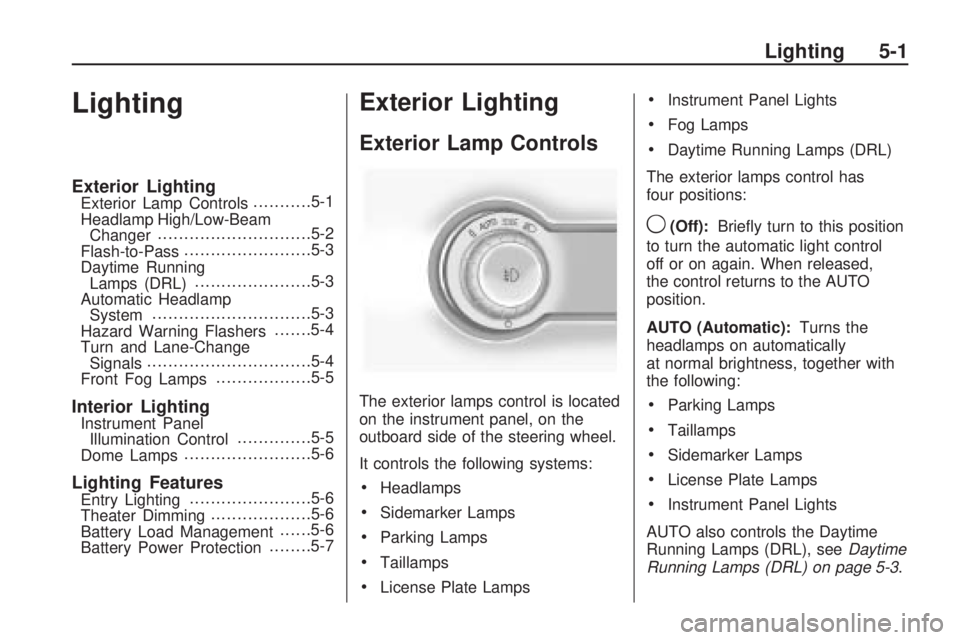
The exterior lamps control is located
on the instrument panel, on the
outboard side of the steering wheel.
It controls the following systems:
•Headlamps
•Sidemarker Lamps
•Parking Lamps
•Taillamps
•License Plate Lamps
•Instrument Panel Lights
•Fog Lamps
•Daytime Running Lamps (DRL)
The exterior lamps control has
four positions:
9(Off):Briefly turn to this position
to turn the automatic light control
off or on again. When released,
the control returns to the AUTO
position.
AUTO (Automatic):Turns the
headlamps on automatically
at normal brightness, together with
the following:
•Parking Lamps
•Taillamps
•Sidemarker Lamps
•License Plate Lamps
•Instrument Panel Lights
AUTO also controls the Daytime
Running Lamps (DRL), seeDaytime
Running Lamps (DRL) on page 5-3.
Lighting 5-1
Page 132 of 372

;(Parking Lamps):Turns the
parking lamps on together with the
following:
•Taillamps
•Sidemarker Lamps
•License Plate Lamps
•Instrument Panel Lights
A warning chime sounds if the
driver’s door is opened when the
ignition switch is off and the parking
lamps are on.
2(Headlamps):Turns the
headlamps on together with the
following lamps listed below.
•Parking Lamps
•Taillamps
•Sidemarker Lamps
•License Plate Lamps
•Instrument Panel LightsA warning chime sounds if the
driver’s door is opened when the
ignition switch is off and the
headlamps are on.
#(Front Fog Lamps):Push the
fog lamps button in to turn the
fog lamps on or off. The fog lamps
come on together with the
following:
•Parking Lamps
•Taillamps
•Sidemarker Lamps
•License Plate Lamps
•Instrument Panel Lights
SeeFront Fog Lamps on page 5-5.
Headlamp High/
Low-Beam Changer
23
Headlamp High/Low Beam
Changer:Push the turn and
lane change lever away from
you to turn the high beams on.
Pull the lever towards you to return
to low beams.
This indicator light turns on in the
instrument panel cluster when
the high beam headlamps are on.
5-2 Lighting
Page 135 of 372

The lever returns to its starting
position whenever it is released.
If after signaling a turn or lane
change the arrow flashes rapidly or
does not come on, a signal bulb
might be burned out.
Have the bulbs replaced. If the bulb
is not burned out, check the fuse.
SeeElectrical System Overload
on page 9-41.
Front Fog Lamps
For vehicles with front fog lamps,
the button is located on the exterior
lamp control, on the outboard
side of the steering wheel.
The ignition must be turned to
ON/RUN to turn on the fog lamps.
#:Press to turn the fog lamps
on or off. An indicator light on
the instrument panel cluster comes
on when the fog lamps are on.
The fog lamps come on together
with the parking and sidemarker
lamps.
If the high-beam headlamps are
turned on, the fog lamps will turn off.
If the high-beam headlamps are
turned off, the fog lamps will
turn back on again. For vehicles
with High Intensity Discharge (HID)
headlamps, the Daytime Running
Lamps (DRL) replace the fog lamps.
Some localities have laws that
require the headlamps to be
on along with the fog lamps.Interior Lighting
Instrument Panel
Illumination Control
This feature controls the brightness
of the instrument panel lights.
The thumbwheel is located next to
the exterior lamp control.
D(Instrument Panel Brightness):
Turn the thumbwheel up or down
to brighten or dim the instrument
panel lights.
Lighting 5-5
Page 137 of 372

A high electrical load occurs when
several of the following are on, such
as: headlamps, high beams, fog
lamps, rear window defogger,
climate control fan at high speed,
heated seats, engine cooling fans,
trailer loads, and loads plugged into
accessory power outlets.
EPM works to prevent excessive
discharge of the battery. It does
this by balancing the generator’s
output and the vehicle’s electrical
needs. It can increase engine
idle speed to generate more power,
whenever needed. It can temporarily
reduce the power demands of
some accessories.
Normally, these actions occur in
steps or levels, without being
noticeable. In rare cases at thehighest levels of corrective action,
this action may be noticeable to the
driver. If so, a Driver Information
Center (DIC) message might be
displayed, such as BATTERY
SAVER ACTIVE, BATTERY
VOLTAGE LOW, or LOW BATTERY.
If one of these messages display, it
is recommended that the driver
reduce the electrical loads as much
as possible. SeeDriver Information
Center (DIC) on page 4-27.
Battery Power Protection
This feature shuts off the dome
lamps if they are left on for more than
10 minutes when the ignition is in
LOCK/OFF. This helps to prevent the
battery from running down.
Lighting 5-7
Page 152 of 372
If a cellular telephone antenna
needs to be attached to the glass,
make sure that the grid lines for
the AM-FM antenna are not
damaged. There is enough space
between the grid lines to attach
a cellular telephone antenna without
interfering with radio reception.
Notice:Using a razor blade or
sharp object to clear the inside
rear window can damage the rear
window antenna and/or the rear
window defogger. Repairs would
not be covered by the vehicle
warranty. Do not clear the inside
rear window with sharp objects.Notice:Do not apply aftermarket
glass tinting with metallic lm.
The metallic lm in some tinting
materials will interfere with or
distort the incoming radio
reception. Any damage caused to
your backglass antenna due to
metallic tinting materials will
not be covered by the vehicle
warranty.
Satellite Radio Antenna
For vehicles with XM™ Satellite
Radio Service, the antenna is
located on the decklid of the vehicle.
Keep the antenna clear of
obstructions for clear radio
reception.
Audio Players
CD Player
The CD player can play audio CDs
and MP3 CDs.
The CD player will not play
8 cm (3 inches) CDs.
Care of CDs
Sound quality can be reduced due to
disc quality, recording method,
quality of the music recorded, and
how the disc has been handled.
Handle discs carefully and store
them in their original cases or other
protective cases away from direct
sunlight and dust. If the bottom
surface of a disc is damaged, the
disc may not play properly or at all.
Do not touch the bottom surface of a
disc while handling it; this could
damage the surface. Pick up discs by
grasping the outer edges or the edge
of the hole and the outer edge.
6-14 Infotainment System
Page 174 of 372

Air Delivery Mode Control:
To change the current mode, select
one of the following:
F(Vent):Air is directed to the
instrument panel outlets.
*(Bi-Level):Air is directed to the
instrument panel outlets and the
floor outlets.
7(Floor):Air is directed to the
floor outlets.
W(Defog):Clears the windows of
fog or moisture. Air is directed to
the windshield and floor outlets.
0(Defrost):Clears the windshield
of fog or frost more quickly. Air is
directed to the windshield and side
window outlets.
For best results, clear all snow and
ice from the windshield before
defrosting.
Do not drive the vehicle until all the
windows are clear.
Air Conditioning
#(Air Conditioning):Press to
turn the air conditioning on or off.
An indicator light turns on. If the
fan is turned off or the outside
temperature falls below freezing,
the air conditioning will not work.
The air conditioning might
automatically come on when
0is
selected.
)(Recirculation):Press to turn on
the recirculation. An indicator light
comes on. Air is recirculated inside
the vehicle. It helps to quickly cool
the air inside the vehicle or prevent
outside air and odors from entering.
Operation in the recirculation mode
while the air conditioner is off
increases humidity and may
cause the windows to fog.
Recirculation is not available in the
defrost or defog modes.
Rear Window Defogger
<(Rear Defogger):Press to turn
the rear window defogger on or off.
The rear window defogger turns off
automatically after about 12 minutes.
It can also be turned off by turning
the ignition to ACC/ACCESSORY or
LOCK/OFF. If turned on again it runs
for about 6 minutes before turning
off. At higher vehicle speeds, the rear
defogger can stay on continuously.
Do not drive the vehicle until all the
windows are clear.
Notice:Do not use a razor blade
or sharp object to clear the inside
rear window. Do not adhere
anything to the defogger grid lines
in the rear glass. These actions
may damage the rear defogger.
Repairs would not be covered by
your warranty.
L/M(Heated Seats):Press to
turn on or off. SeeHeated Front
Seats on page 2-6.
7-2 Climate Controls
Page 233 of 372
Vehicle Care
General InformationGeneral Information...............9-2
California Proposition 65
Warning.............................9-2
California Perchlorate
Materials Requirements........9-3
Accessories and
Modifications.......................9-3
Vehicle ChecksDoing Your Own
Service Work......................9-4
Hood...................................9-5
Engine Compartment
Overview............................9-6
Engine Cover.......................9-9
Engine Oil..........................9-10
Engine Oil Life System.........9-13
Automatic Transmission
Fluid................................9-14
Manual Transmission Fluid. . . .9-15
Hydraulic Clutch..................9-15
Engine Air Cleaner/Filter.......9-16
Cooling System...................9-17
Engine Coolant...................9-19
Engine Overheating.............9-24
Power Steering Fluid............9-25Washer Fluid......................9-26
Brakes...............................9-27
Brake Fluid.........................9-28
Battery...............................9-29
Rear Axle...........................9-30
Starter Switch Check............9-31
Automatic Transmission
Shift Lock Control
System Check...................9-32
Ignition Transmission
Lock Check.......................9-32
Park Brake and P (Park)
Mechanism Check..............9-32
Wiper Blade Replacement......9-33Headlamp AimingHeadlamp Aiming................9-34
Bulb ReplacementBulb Replacement...............9-37
Halogen Bulbs....................9-37
High Intensity Discharge
(HID) Lighting....................9-37
Headlamps, Front Turn
Signal and Parking Lamps
(Base Vehicle)...................9-37
Headlamps, Front Turn
Signal and Parking Lamps
(Up-Level Vehicle)..............9-38
Daytime Running
Lamps (DRL)....................9-39
Fog Lamps.........................9-40Taillamps, Turn Signal, and
Stoplamps.........................9-40
License Plate Lamp.............9-40
Replacement Bulbs..............9-41
Electrical SystemElectrical System
Overload...........................9-41
Fuses and Circuit
Breakers...........................9-42
Engine Compartment
Fuse Block.......................9-42
Instrument Panel
Fuse Block.......................9-45
Rear Compartment
Fuse Block.......................9-46
Wheels and TiresTires..................................9-48
Winter Tires........................9-48
Tire Sidewall Labeling..........9-49
Tire Designations.................9-51
Tire Terminology and
Definitions.........................9-52
Tire Pressure......................9-54
Tire Pressure for
High-Speed Operation........9-56
Tire Pressure Monitor
System.............................9-56
Tire Pressure Monitor
Operation..........................9-57
Tire Inspection....................9-61
Vehicle Care 9-1