oil temperature CHEVROLET CAMARO SS 2010 Owners Manual
[x] Cancel search | Manufacturer: CHEVROLET, Model Year: 2010, Model line: CAMARO SS, Model: CHEVROLET CAMARO SS 2010Pages: 372, PDF Size: 1.91 MB
Page 5 of 372

Vehicle Symbol Chart
Here are some additional symbols
that may be found on the vehicle
and what they mean. For more
information on the symbol, refer to
the index.
9:Airbag Readiness Light
#:Air Conditioning
!:Antilock Brake System (ABS)
g:Audio Steering Wheel
Controls or OnStar®
$:Brake System Warning Light
":Charging System
I:Cruise Control
B:Engine Coolant Temperature
O:Exterior Lamps
#:Fog Lamps
.:Fuel Gage
+:Fuses
i:Headlamp High/Low-Beam
Changer
j:LATCH System Child Restraints
*:Malfunction Indicator Lamp
::Oil Pressure
}:Power
/:Remote Vehicle Start
>:Safety Belt Reminders
7:Tire Pressure Monitor
F:Traction Control
M:Windshield Washer Fluid
Introduction v
Page 12 of 372
The vehicle’s ignition switch must
be turned to ON/RUN and then back
to LOCK/OFF using the key
before the remote start procedure
can be used again.
Shutting the Engine Off After a
Remote Start
To shut off the engine:
•Press/until the parking lamps
turn off.
•Turn on the hazard warning
flashers.
•Insert the key and turn it to
ON/RUN and then back to
LOCK/OFF.Conditions in Which Remote Start
Will Not Work
The remote start will not operate if:
•The key is in the ignition.
•The hood is not closed.
•The hazard warning flashers
are on.
•There is an emission control
system malfunction.
•The engine coolant temperature is
too high.
•The oil pressure is low.
•Two remote vehicle starts have
already been used.
•The vehicle is not in P (Park).
Door Locks
{WARNING
Unlocked doors can be
dangerous.
•Passengers, especially
children, can easily open the
doors and fall out of a moving
vehicle. The chance of being
thrown out of the vehicle in
a crash is increased if the
doors are not locked. So, all
passengers should wear
safety belts properly and
the doors should be locked
whenever the vehicle is
driven.
(Continued)
1-6 Keys, Doors and Windows
Page 81 of 372
Instruments and
Controls
Instrument Panel OverviewInstrument Panel Overview......4-4
ControlsSteering Wheel Adjustment.....4-6
Steering Wheel Controls.........4-6
Horn....................................4-7
Windshield Wiper/Washer.......4-7
Compass.............................4-8
Clock...................................4-8
Power Outlets.......................4-9
Warning Lights, Gages,
and Indicators
Warning Lights, Gages,
and Indicators.....................4-9
Instrument Cluster...............4-10
Speedometer......................4-11
Odometer...........................4-11
Trip Odometer.....................4-11
Tachometer........................4-11
Fuel Gage..........................4-11
Engine Oil Pressure Gage......4-12Engine Oil
Temperature Gage.............4-13
Engine Coolant
Temperature Gage.............4-14
Transmission
Temperature Gage.............4-14
Voltmeter Gage...................4-15
Safety Belt Reminders..........4-16
Airbag Readiness Light.........4-17
Passenger Airbag Status
Indicator...........................4-18
Charging System Light.........4-19
Malfunction
Indicator Lamp..................4-19
Brake System Warning
Light................................4-22
Antilock Brake System
(ABS) Warning Light...........4-23
Traction Off Light.................4-23
Traction Control System
(TCS)/StabiliTrak
®Light.......4-24
Traction Control System
(TCS) OFF/StabiliTrak
®OFF
Light................................4-24
Tire Pressure Light..............4-24
Engine Oil Pressure Light.....4-25
Immobilizer Light.................4-26
Fog Lamp Light...................4-26
Taillamp Indicator Light.........4-26
Cruise Control Light.............4-26
Information DisplaysDriver Information
Center (DIC).....................4-27
Vehicle MessagesBattery Voltage and
Charging Messages............4-30
Brake System Messages......4-31
Compass Messages.............4-31
Cruise Control Messages......4-31
Door Ajar Messages............4-31
Engine Cooling System
Messages.........................4-32
Engine Oil Messages...........4-32
Engine Power Messages......4-33
Fuel System Messages........4-33
Key and Lock Messages......4-33
Lamp Messages..................4-33
Object Detection System
Messages.........................4-34
Ride Control System
Messages.........................4-34
Airbag System Messages......4-35
Safety Belt Messages...........4-35
Anti-Theft Alarm System
Messages.........................4-35
Service Vehicle Messages.....4-35
Tire Messages....................4-36
Transmission Messages........4-36
Vehicle Reminder
Messages.........................4-37
Instruments and Controls 4-1
Page 85 of 372
A.Air Vents on page 7-3.
B. Driver Shift Controls
(If Equipped). SeeAutomatic
Transmission on page 8-26.
C.Instrument Cluster on page 4-10.
D.Windshield Wiper/Washer on
page 4-7.
E.AM-FM Radio on page 6-8.
F.Turn and Lane-Change Signals
on page 5-4.Headlamp
High/Low-Beam Changer on
page 5-2.Flash-to-Pass
on page 5-3.Driver Information
Center (DIC) on page 4-27
(If Equipped).G.Cruise Control on page 8-38.
H.Exterior Lamp Controls on
page 5-1.Front Fog Lamps
on page 5-5(If Equipped).
Instrument Panel Illumination
Control on page 5-5.
I.Steering Wheel Adjustment on
page 4-6.
J.Horn on page 4-7.
K.Steering Wheel Controls on
page 4-6.
L.Climate Control Systems on
page 7-1.M.Transmission Temperature
Gage on page 4-14.Voltmeter
Gage on page 4-15.Engine
Oil Temperature Gage on
page 4-13.Engine Oil Pressure
Gage on page 4-12.
N. Shift Lever. SeeShifting Into
Park on page 8-21.
O.Power Outlets on page 4-9.
P.Hazard Warning Flashers on
page 5-4.Power Door Locks
on page 1-7.
Q.Glove Box on page 3-1.
Instruments and Controls 4-5
Page 92 of 372
When the fuel tank is low on fuel,
a Fuel Level Low message will
appear on the Driver Information
Center (DIC). For more information
seeFuel System Messages on
page 4-33.
Here are some situations that can
occur with the fuel gage. None of
these indicate a problem with
the fuel gage.
•At the gas station, the fuel pump
shuts off before the gage
reads full.
•It takes a little more or less fuel to
fill up than the fuel gage indicated.
For example, the gage may have
indicated the tank was half full,
but it actually took a little more or
less than half the tank’s capacity
to fill the tank.
•The pointer on the fuel gage is on
empty when the ignition is off.
Engine Oil
Pressure Gage
The oil pressure gage, located in
front of the shifter, shows the engine
oil pressure in psi (pounds per
square inch) when the engine is
running. Canadian vehicles indicate
pressure in kPa (kilopascals).
Oil pressure may vary with engine
speed, outside temperature and oil
viscosity, but readings above the low
pressure zone indicate the normal
operating range. When the oil
pressure reaches the low pressure
zone, a message appears in the
Driver Information Center (DIC). United States
Canada
4-12 Instruments and Controls
Page 93 of 372
SeeEngine Oil Messages on
page 4-32andEngine Oil on
page 9-10for more information.
{WARNING
Do not keep driving if the oil
pressure is low. The engine can
become so hot that it catches fire.
Someone could be burned.
Check the oil as soon as possible
and have the vehicle serviced.
Notice:Lack of proper engine oil
maintenance can damage the
engine. The repairs would not be
covered by the vehicle warranty.
Always follow the maintenance
schedule in this manual for
changing engine oil.
A reading in the low pressure zone
can be caused by a dangerously
low oil level or some other problem
causing low oil pressure. Check
the oil as soon as possible.
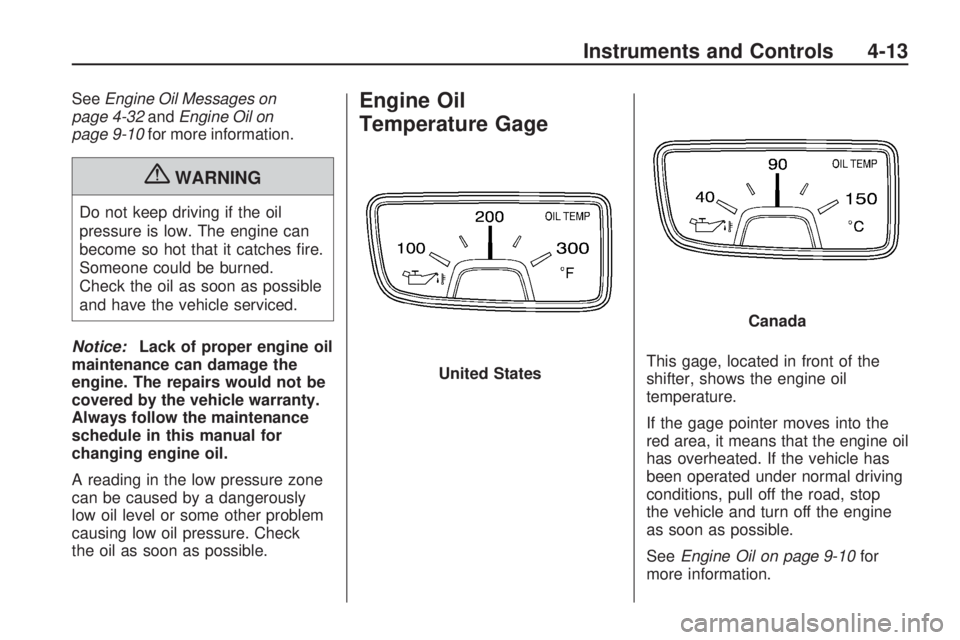
Engine Oil
Temperature Gage
This gage, located in front of the
shifter, shows the engine oil
temperature.
If the gage pointer moves into the
red area, it means that the engine oil
has overheated. If the vehicle has
been operated under normal driving
conditions, pull off the road, stop
the vehicle and turn off the engine
as soon as possible.
SeeEngine Oil on page 9-10for
more information. United States
Canada
Instruments and Controls 4-13
Page 95 of 372

This gage, located in front of the
shifter, shows the transmission
oil temperature when the ignition is
on. If the gage is reading in the
red area and/or a message appears
in the DIC, the vehicle must be
stopped and the cause checked.
One possible cause is a low level in
the transmission.For information on the DIC
messages seeTransmission
Messages on page 4-36.
Notice:If the vehicle is driven
with the transmission temperature
gage above the normal operating
range, the transmission can be
damaged. This could lead to
costly repairs that would not be
covered by the vehicle warranty.
Do not drive the vehicle while the
transmission temperature gage
reading is above normal. See your
dealer/retailer for service.
Voltmeter Gage
This gage, located in front of the
shifter, shows the battery’s state of
charge in DC volts.
When the engine is running, but the
ignition is on, this gage shows
the condition of the charging system.
The vehicle’s charging system
regulates voltage based on the state
of charge of the battery. It is normal
for the voltmeter to fluctuate. Canada
United States Version Shown,
Canada Similar
Instruments and Controls 4-15
Page 112 of 372
Engine Cooling System
Messages
A/C Off Due to High
Engine Temp
This message displays when the
engine coolant becomes hotter than
the normal operating temperature.
To avoid added strain on a hot
engine, the air conditioning
compressor automatically turns off.
When the coolant temperature
returns to normal, the air conditioning
compressor turns back on. You can
continue to drive your vehicle.
If this message continues to appear,
have the system repaired by your
dealer/retailer as soon as possible
to avoid damage to the engine.
Coolant Level Low Add
Coolant
This message will display if the
coolant is low, seeEngine Coolant
on page 9-19.
Engine Overheated — Idle
Engine
This message displays when the
engine coolant temperature is
too hot. Stop and allow the vehicle
to idle until it cools down.
Engine Overheated — Stop
Engine
This message displays and a
continuous chime sounds if the
engine cooling system reaches
unsafe temperatures for operation.
Stop and turn off the vehicle as
soon as it is safe to do so to avoid
severe damage. This message
clears when the engine has cooled
to a safe operating temperature.
High Coolant Temperature
This message displays if the coolant
temperature is hot, seeEngine
Overheating on page 9-24.
Engine Oil Messages
Change Engine Oil Soon
This message displays when the
engine oil needs to be changed.
When you change the engine oil,
be sure to reset the CHANGE
ENGINE OIL SOON message.
SeeEngine Oil Life System
on page 9-13andDriver Information
Center (DIC) on page 4-27for
information on how to reset
the message. SeeEngine Oil
on page 9-10andScheduled
Maintenance on page 10-2for
more information.
Engine Oil Hot, Idle Engine
This message displays when
the engine oil temperature is too
hot. Stop and allow the vehicle
to idle until it cools down.
Engine Oil Low – Add Oil
This message displays when
the engine oil level is too low.
Check the oil level. SeeEngine Oil
on page 9-10.
4-32 Instruments and Controls
Page 183 of 372
Of course, traction is reduced when
water, snow, ice, gravel, or other
material is on the road. For safety,
slow down and adjust your driving
to these conditions. It is important
to slow down on slippery surfaces
because stopping distance is longer
and vehicle control more limited.
While driving on a surface with
reduced traction, try your best to
avoid sudden steering, acceleration,
or braking, including reducing vehicle
speed by shifting to a lower gear.
Any sudden changes could cause
the tires to slide. You might not
realize the surface is slippery until
the vehicle is skidding. Learn to
recognize warning clues — such as
enough water, ice, or packed snow
on the road to make a mirrored
surface — and slow down when
you have any doubt.
Remember: Any Antilock Brake
System (ABS) helps avoid only
the braking skid.Competitive Driving
Competitive driving may affect the
vehicle warranty. See the warranty
book before using the vehicle for
racing or other competitive driving.
The new vehicle break-in must be
performed before the vehicle is used
for competitive driving. SeeNew
Vehicle Break-In on page 8-16.
Notice:If you use your vehicle
for competitive driving, the engine
may use more oil than it would
with normal use. Low oil levels
can damage the engine. Be sure
to check the oil level often during
competitive driving and keep the
level at or near the upper mark
that shows the proper operating
range on the engine oil dipstick.
For information on how to add oil,
seeEngine Oil on page 9-10.For competitive driving, it is
recommended that the brake fluid be
replaced with a high performance
brake fluid that has a dry boiling point
greater than 279°C (534°F). After
conversion to the high performance
brake fluid, follow the brake fluid
service recommendations outlined
by the fluid manufacturer. Do not
use silicone or DOT-5 brake fluids.
If the vehicle is used for racing,
competitive driving, sustained high
speed, or events that generate
excessive wheel slip, the rear axle
fluid temperatures will be higher
than would occur in normal driving.
We recommend that the rear axle
fluid be drained and refilled with
new fluid after every six hours of
racing or competitive driving.
SeeRecommended Fluids and
Lubricants on page 10-7for what
fluid to use.
Driving and Operating 8-7
Page 196 of 372
To prevent gear damage, this
system also prevents cranking if
the engine is already running.
Engine cranking can be stopped
by turning the ignition switch
to ACC/ACCESSORY or
LOCK/OFF.
Notice:Cranking the engine for
long periods of time, by returning
the key to the START position
immediately after cranking has
ended, can overheat and damage
the cranking motor, and drain the
battery. Wait at least 15 seconds
between each try, to let the
cranking motor cool down.
2. If the engine does not start
after 5-10 seconds, especially in
very cold weather (below 0°F or
−18°C), it could be flooded with
too much gasoline. Push the
accelerator pedal all the way to
the floor and holding it there as
you hold the key in START for a
maximum of 15 seconds. Wait atleast 15 seconds between each
try, to allow the cranking motor to
cool. When the engine starts, let
go of the key and accelerator.
If the vehicle starts briefly but
then stops again, repeat the
procedure. This clears the extra
gasoline from the engine. Do not
race the engine immediately after
starting it. Operate the engine and
transmission gently until the oil
warms up and lubricates all
moving parts.
Notice:The engine is designed
to work with the electronics in the
vehicle. If you add electrical parts
or accessories, you could change
the way the engine operates.
Before adding electrical
equipment, check with your
dealer/retailer. If you do not,
the engine might not perform
properly. Any resulting damage
would not be covered by the
vehicle warranty.Engine Heater
The engine coolant heater, if
available, can help in cold weather
conditions at or below 0°F (−18°C)
for easier starting and better fuel
economy during engine warm-up.
Plug in the coolant heater at least
four hours before starting the vehicle.
An internal thermostat in the
plug-end of the cord will prevent
engine coolant heater operation at
temperatures above 0°F (−18°C).
8-20 Driving and Operating