engine CHEVROLET CAPTIVA SPORT 2013 Workshop Manual
[x] Cancel search | Manufacturer: CHEVROLET, Model Year: 2013, Model line: CAPTIVA SPORT, Model: CHEVROLET CAPTIVA SPORT 2013Pages: 374, PDF Size: 6.66 MB
Page 209 of 374
Black plate (21,1)Chevrolet Captiva Sport Owner Manual - 2013 - crc - 11/12/12
Driving and Operating 9-21
{ WARNINGIt is dangerous to get out of the
vehicle if the shift lever is not fully
in P (Park) with the parking brake
firmly set. The vehicle can roll.
Do not leave the vehicle when the
engine is running. If you have left
the engine running, the vehicle
can move suddenly. You or others
could be injured. To be sure the
vehicle will not move, even when
you are on fairly level ground,
always set the parking brake and
move the shift lever to P (Park).
See Shifting Into Park on
page 9 ‑ 17 and Driving
Characteristics and Towing Tips
on page 9 ‑ 39 .
Make sure the shift lever is fully in
P (Park) before starting the engine.
The vehicle has an automatic
transmission shift lock control system. You have to fully apply the
regular brakes first and then press
the shift lever button before you can
shift from P (Park) when the ignition
key is in ON/RUN. If you cannot
shift out of P (Park), ease pressure
on the shift lever and push the shift
lever all the way into P (Park) as
you maintain brake application.
Then press the shift lever button
and move the shift lever into
another gear. See Shifting out of
Park on page 9 ‑ 18 .
R (Reverse): Use this gear to
back up.
Notice: Shifting to R (Reverse)
while the vehicle is moving
forward could damage the
transmission. The repairs would
not be covered by the vehicle
warranty. Shift to R (Reverse) only
after the vehicle is stopped.
To rock the vehicle back and forth to
get out of snow, ice, or sand without
damaging the transmission, see If
the Vehicle Is Stuck on page 9 ‑ 9 . N (Neutral): In this position, the
engine does not connect with the
wheels. To restart the engine when
the vehicle is already moving, use
N (Neutral) only. Also, use
N (Neutral) when the vehicle is
being towed.
{ WARNINGShifting into a drive gear while the
engine is running at high speed is
dangerous. Unless your foot is
firmly on the brake pedal, the
vehicle could move very rapidly.
You could lose control and hit
people or objects. Do not shift
into a drive gear while the engine
is running at high speed.
Notice: Shifting out of P (Park) or
N (Neutral) with the engine
running at high speed may
damage the transmission. The
repairs would not be covered by
the vehicle warranty. Be sure the
engine is not running at high
speed when shifting the vehicle.
Page 211 of 374
Black plate (23,1)Chevrolet Captiva Sport Owner Manual - 2013 - crc - 11/12/12
Driving and Operating 9-23the DIC is the highest gear that the
transmission will be allowed to
operate in. This means that all
gears below that number are
available. For example, when
4 (Fourth) is shown, 1 (First) through
4 (Fourth) gears are automatically
shifted by the vehicle. The
transmission will not shift into
5 (Fifth) until the + (Plus) button is
used or you shift back into D (Drive).
While in M (Manual), the
transmission will prevent shifting to
a lower gear range if the engine
speed is too high. You have a brief
period of time to slow the vehicle.
If vehicle speed is not reduced
within the time allowed, the lower
gear range shift will not be
completed. You must further slow
the vehicle, then press the − (Minus)
button to the desired lower gear
range.
Automatic Engine Grade Braking is
not available when the ERS is
active. It is available in D (Drive).
While using the ERS, cruise control
can be used. Fuel Economy Mode The vehicle may have a fuel
economy mode. When engaged,
fuel economy mode can improve the
vehicle's fuel economy.
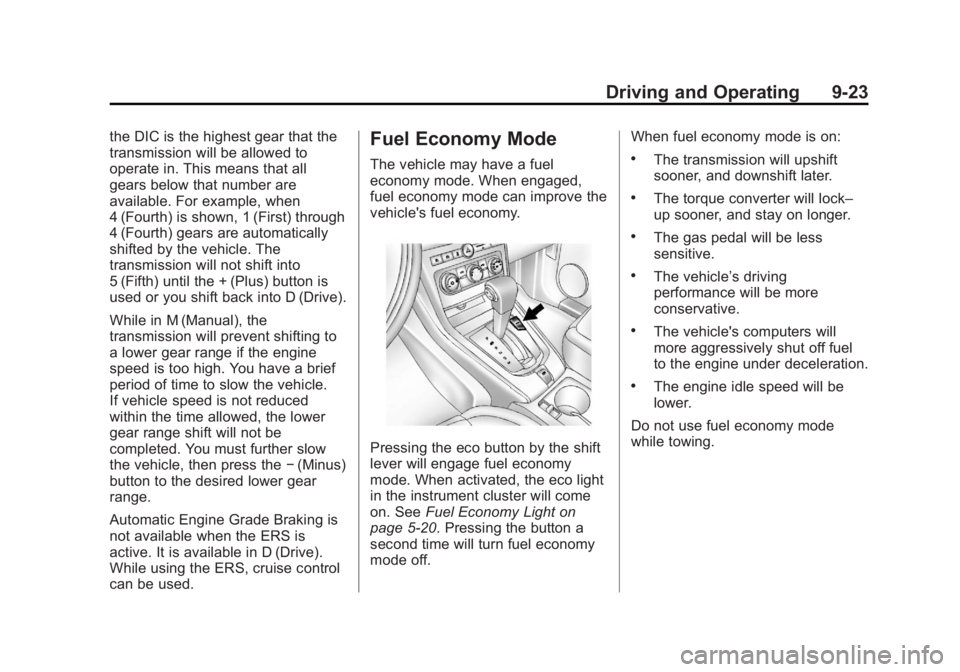
Pressing the eco button by the shift
lever will engage fuel economy
mode. When activated, the eco light
in the instrument cluster will come
on. See Fuel Economy Light on
page 5 ‑ 20 . Pressing the button a
second time will turn fuel economy
mode off. When fuel economy mode is on: .
The transmission will upshift
sooner, and downshift later. .
The torque converter will lock –
up sooner, and stay on longer. .
The gas pedal will be less
sensitive. .
The vehicle ’ s driving
performance will be more
conservative. .
The vehicle's computers will
more aggressively shut off fuel
to the engine under deceleration. .
The engine idle speed will be
lower.
Do not use fuel economy mode
while towing.
Page 212 of 374
Black plate (24,1)Chevrolet Captiva Sport Owner Manual - 2013 - crc - 11/12/12
9-24 Driving and Operating
Drive Systems All-Wheel Drive Vehicles with this feature always
send engine power to all four
wheels. It is fully automatic, and
adjusts itself as needed for road
conditions.
When using a compact spare tire on
an AWD vehicle, the system
automatically detects the compact
spare and disables AWD. To restore
AWD operation and prevent
excessive wear on the system,
replace the compact spare with a
full-size tire as soon as possible.
See Compact Spare Tire on
page 10 ‑ 64 . Brakes Antilock Brake
System (ABS) This vehicle has the Antilock Brake
System (ABS), an advanced
electronic braking system that helps
prevent a braking skid.
When the vehicle begins to drive
away, ABS checks itself.
A momentary motor or clicking noise
might be heard while this test is
going on, and it might even be
noticed that the brake pedal moves
a little. This is normal.
If there is a problem with ABS, this
warning light stays on. See Antilock
Brake System (ABS) Warning Light
on page 5 ‑ 18 . If driving safely on a wet road and it
becomes necessary to slam on the
brakes and continue braking to
avoid a sudden obstacle, a
computer senses that the wheels
are slowing down. If one of the
wheels is about to stop rolling, the
computer will separately work the
brakes at each wheel.
ABS can change the brake pressure
to each wheel, as required, faster
than any driver could. This can help
you steer around the obstacle while
braking hard.
As the brakes are applied, the
computer keeps receiving updates
on wheel speed and controls
braking pressure accordingly.
Page 213 of 374
Black plate (25,1)Chevrolet Captiva Sport Owner Manual - 2013 - crc - 11/12/12
Driving and Operating 9-25Remember: ABS does not change
the time needed to get a foot up to
the brake pedal or always decrease
stopping distance. If you get too
close to the vehicle in front of you,
there will not be enough time to
apply the brakes if that vehicle
suddenly slows or stops. Always
leave enough room up ahead to
stop, even with ABS.
Using ABS Do not pump the brakes. Just hold
the brake pedal down firmly and let
ABS work. You might hear the ABS
pump or motor operating and feel
the brake pedal pulsate, but this is
normal.
Braking in Emergencies
ABS allows you to steer and brake
at the same time. In many
emergencies, steering can help
more than even the very best
braking. Parking Brake
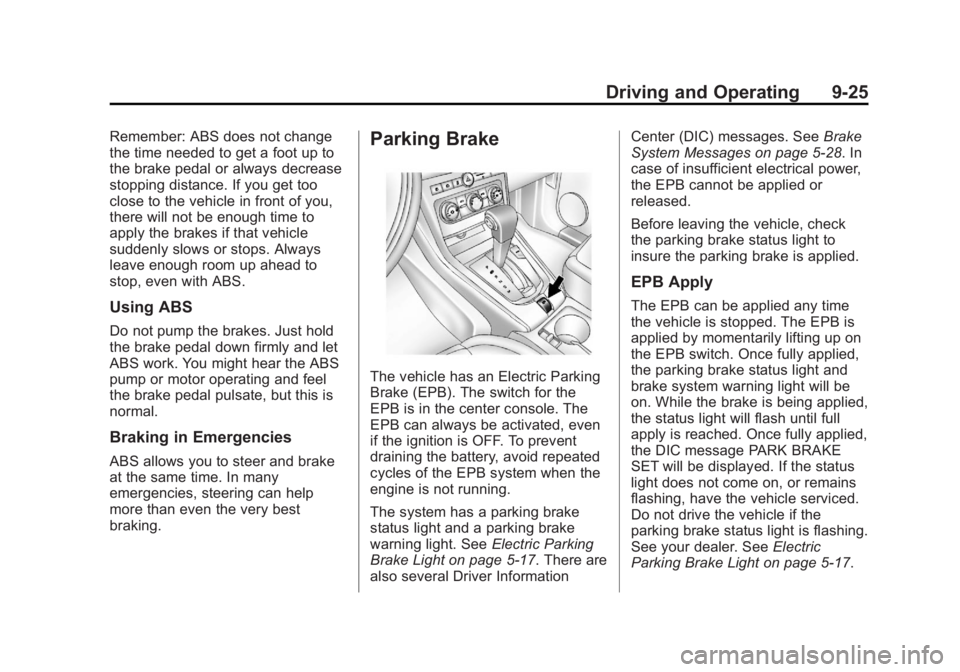
The vehicle has an Electric Parking
Brake (EPB). The switch for the
EPB is in the center console. The
EPB can always be activated, even
if the ignition is OFF. To prevent
draining the battery, avoid repeated
cycles of the EPB system when the
engine is not running.
The system has a parking brake
status light and a parking brake
warning light. See Electric Parking
Brake Light on page 5 ‑ 17 . There are
also several Driver Information Center (DIC) messages. See Brake
System Messages on page 5 ‑ 28 . In
case of insufficient electrical power,
the EPB cannot be applied or
released.
Before leaving the vehicle, check
the parking brake status light to
insure the parking brake is applied.
EPB Apply The EPB can be applied any time
the vehicle is stopped. The EPB is
applied by momentarily lifting up on
the EPB switch. Once fully applied,
the parking brake status light and
brake system warning light will be
on. While the brake is being applied,
the status light will flash until full
apply is reached. Once fully applied,
the DIC message PARK BRAKE
SET will be displayed. If the status
light does not come on, or remains
flashing, have the vehicle serviced.
Do not drive the vehicle if the
parking brake status light is flashing.
See your dealer. See Electric
Parking Brake Light on page 5 ‑ 17 .
Page 215 of 374
Black plate (27,1)Chevrolet Captiva Sport Owner Manual - 2013 - crc - 11/12/12
Driving and Operating 9-27Automatic EPB Release The EPB will automatically release if
the vehicle is running, placed into
gear and an attempt is made to
drive away. Avoid rapid acceleration
when the EPB is applied, to
preserve parking brake lining life.
For maximum EPB force when
towing a trailer or parking on a hill,
pull the EPB switch twice. If you are
towing a trailer and parking on a hill,
see Driving Characteristics and
Towing Tips on page 9 ‑ 39 .Ride Control Systems Traction Control
System (TCS) The vehicle has a Traction Control
System (TCS) that limits wheel spin.
This is useful in slippery road
conditions. The system operates
only if it senses that any of the drive
wheels are spinning or beginning to
lose traction. When this happens,
TCS applies the brakes to limit
wheel spin and also reduces engine
power. The system may be heard or
felt while it is working, but this is
normal.
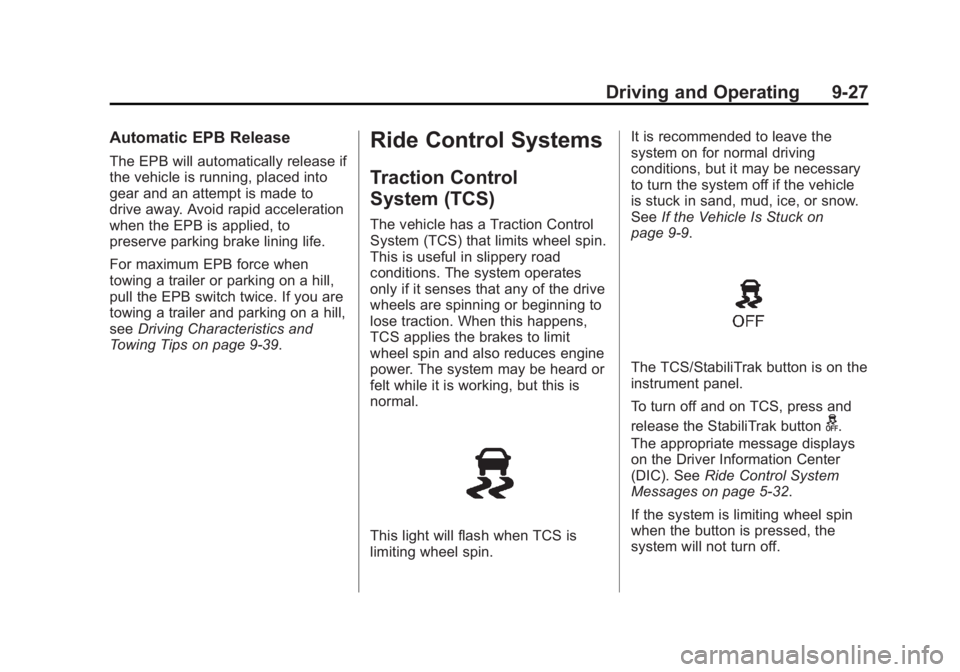
This light will flash when TCS is
limiting wheel spin. It is recommended to leave the
system on for normal driving
conditions, but it may be necessary
to turn the system off if the vehicle
is stuck in sand, mud, ice, or snow.
See If the Vehicle Is Stuck on
page 9 ‑ 9 .
The TCS/StabiliTrak button is on the
instrument panel.
To turn off and on TCS, press and
release the StabiliTrak button
g .
The appropriate message displays
on the Driver Information Center
(DIC). See Ride Control System
Messages on page 5 ‑ 32 .
If the system is limiting wheel spin
when the button is pressed, the
system will not turn off.
Page 216 of 374
Black plate (28,1)Chevrolet Captiva Sport Owner Manual - 2013 - crc - 11/12/12
9-28 Driving and Operating Adding non-dealer accessories can
affect the vehicle's performance.
See Accessories and Modifications
on page 10 ‑ 2 .
Brake Pedal Override This vehicle has this feature that
limits engine torque when the brake
pedal is applied. If there is one foot
on the brake pedal and the other
foot on the accelerator, the engine
rpm will only climb to slightly more
than idle speed.
This feature is enabled at vehicle
start. Press and release the TCS/
StabiliTrak button
g to disable or
enable this feature and TCS. The
appropriate message will display on
the DIC. See Ride Control System
Messages on page 5 ‑ 32 .
StabiliTrak ®
SystemThe vehicle has a stability control
system called StabiliTrak which
combines antilock brake, traction,
and stability control systems and helps the driver maintain directional
control of the vehicle in most driving
conditions.
StabiliTrak activates when the
computer senses a difference
between the intended path and the
direction the vehicle is actually
traveling. StabiliTrak selectively
applies braking pressure at any one
of the vehicle's brakes to assist the
driver with keeping the vehicle on
the intended path.
When the vehicle is started and
begins to move, the system
performs several diagnostic checks
to ensure that there are no
problems. The system may be
heard or felt while it is working. This
is normal and does not mean there
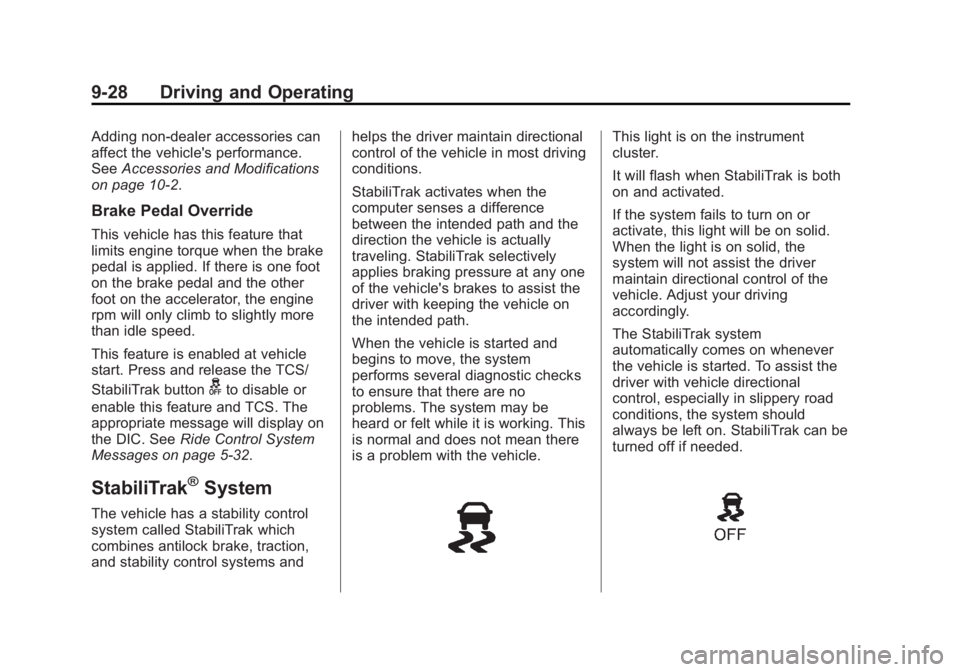
is a problem with the vehicle. This light is on the instrument
cluster.
It will flash when StabiliTrak is both
on and activated.
If the system fails to turn on or
activate, this light will be on solid.
When the light is on solid, the
system will not assist the driver
maintain directional control of the
vehicle. Adjust your driving
accordingly.
The StabiliTrak system
automatically comes on whenever
the vehicle is started. To assist the
driver with vehicle directional
control, especially in slippery road
conditions, the system should
always be left on. StabiliTrak can be
turned off if needed.
Page 223 of 374
Black plate (35,1)Chevrolet Captiva Sport Owner Manual - 2013 - crc - 11/12/12
Driving and Operating 9-35
Fuel Use of the recommended fuel is an
important part of the proper
maintenance of this vehicle. To help
keep the engine clean and maintain
optimum vehicle performance, we
recommend using TOP TIER
Detergent Gasolines. See
www.toptiergas.com for a list of TOP
TIER Detergent Gasolines.
If the vehicle has a yellow fuel cap,
E85 or flex fuel can be used in the
vehicle. See Fuel E85 (85%
Ethanol) on page 9 ‑ 36 . Recommended Fuel Use regular unleaded gasoline with
a posted octane rating of 87 or
higher. If the octane rating is less
than 87, an audible knocking noise,
commonly referred to as spark
knock, might be heard when driving.
If this occurs, use a gasoline rated
at 87 octane or higher as soon as
possible. If heavy knocking is heard
when using gasoline rated at
87 octane or higher, the engine
needs service.
Prohibited Fuels
Gasolines containing oxygenates,
such as ethers and ethanol, as well
as reformulated gasolines are
available in some cities. If these
gasolines comply with the
previously described specification,
then they are acceptable to use.
However, E85 (85% ethanol) and
other fuels containing more than
15% ethanol must be used only in
flex fuel vehicles. { CAUTIONDo not use fuel containing
methanol. It can corrode metal
parts in the fuel system and also
damage plastic and rubber parts.
That damage would not be
covered under the vehicle
warranty.
Some gasolines that are not
reformulated for low emissions can
contain an octane-enhancing
additive called
methylcyclopentadienyl manganese
tricarbonyl (MMT). Do not use
gasolines with MMT as they can
reduce spark plug life and affect
emission control system
performance. The malfunction
indicator lamp may turn on. If this
occurs, see your dealer for service.
Gasoline Specifications Some gasolines contain an
octane-enhancing additive called
methylcyclopentadienyl manganese
Page 224 of 374
Black plate (36,1)Chevrolet Captiva Sport Owner Manual - 2013 - crc - 11/12/12
9-36 Driving and Operating tricarbonyl (MMT). We recommend
against the use of gasolines
containing MMT. See Fuel Additives
on page 9 ‑ 36 for additional
information.
Fuels in Foreign
Countries If planning to drive in countries
outside the U.S. or Canada, the
proper fuel might be hard to find.
Check regional auto club or fuel
retail brand websites for availability
in the country where driving. Never
use leaded gasoline, fuel containing
methanol, or any other fuel not
recommended. Costly repairs
caused by use of improper fuel
would not be covered by the vehicle
warranty.
Fuel Additives Gasoline should contain detergent
additives that help prevent engine
and fuel system deposits from
forming. Clean fuel injectors and
intake valves will allow the emission control system to work properly.
Some gasoline does not contain
sufficient quantities of additive to
keep fuel injectors and intake valves
clean. To make up for this lack of
detergency, it is recommended that
GM Fuel System Treatment PLUS,
part number 88861013 be added to
the fuel tank at every engine oil
change or every 15 000 km,
whichever occurs first.
Fuel E85 (85% Ethanol) Vehicles that are ethanol fuel
capable can use either unleaded
gasoline or ethanol fuel containing
up to 85% ethanol (E85). For all
other vehicles, use only the
unleaded gasoline described under
Recommended Fuel on page 9 ‑ 35 .
We encourage the use of E85 in
vehicles that are designed to use it.
The ethanol in E85 is a “ renewable ”
fuel, meaning it is made from
renewable sources such as corn
and other crops. Many service stations will not have
an 85% ethanol fuel (E85) pump
available. Those stations that do
have E85 should have a label
indicating ethanol content. Do not
use the fuel if the ethanol content is
greater than 85%.
At a minimum, E85 should meet
specifications. By definition, this
means that fuel labeled E85 will
have an ethanol content between
70% and 85%. Filling the fuel tank
with fuel mixtures that do not meet
specifications can affect driveability
and could cause the malfunction
indicator lamp to come on.
It is best not to alternate repeatedly
between gasoline and E85. If you
do switch fuels, it is recommended
that you add as much fuel as
possible — do not add less than 11 L
(3 gal) when refueling. You should
drive the vehicle immediately after
refueling for at least 11 km (7 mi) to
allow the vehicle to adapt to the
change in ethanol concentration.
Page 225 of 374
Black plate (37,1)Chevrolet Captiva Sport Owner Manual - 2013 - crc - 11/12/12
Driving and Operating 9-37E85 has less energy per liter
(gallon) than gasoline, so you will
need to refill the fuel tank more
often when using E85 than when
you are using gasoline. See Filling
the Tank on page 9 ‑ 37 .
Notice: Some additives are not
compatible with E85 fuel and can
harm the vehicle's fuel system.
Do not add anything to E85.
Damage caused by additives
would not be covered by the
vehicle warranty.
Notice: This vehicle was not
designed for fuel that contains
methanol. Do not use fuel
containing methanol. It can
corrode metal parts in the fuel
system and also damage plastic
and rubber parts. That damage
would not be covered under the
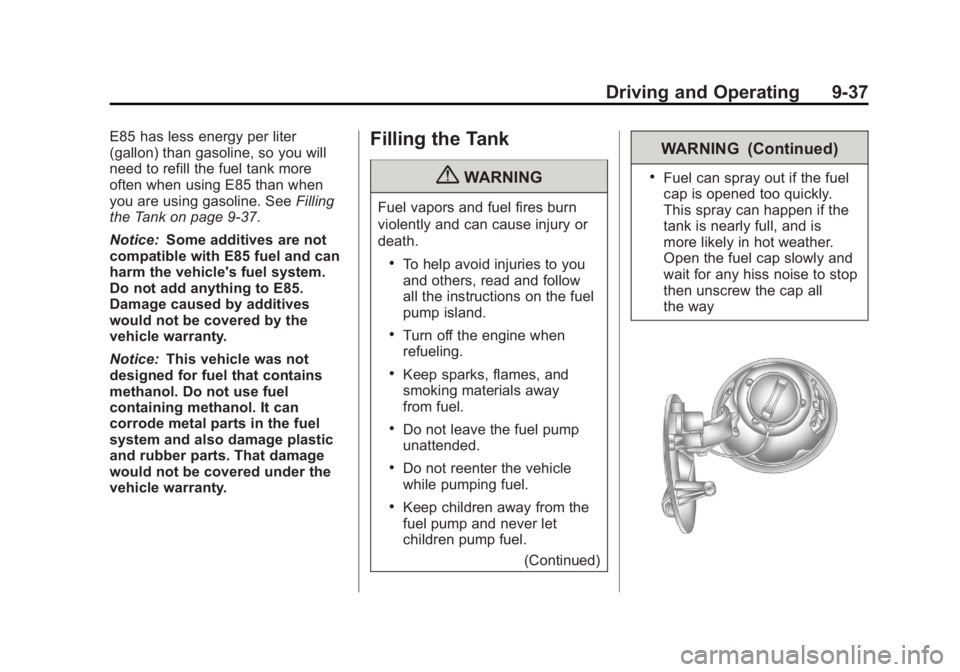
vehicle warranty. Filling the Tank
{ WARNINGFuel vapors and fuel fires burn
violently and can cause injury or
death. .
To help avoid injuries to you
and others, read and follow
all the instructions on the fuel
pump island. .
Turn off the engine when
refueling. .
Keep sparks, flames, and
smoking materials away
from fuel. .
Do not leave the fuel pump
unattended. .
Do not reenter the vehicle
while pumping fuel. .
Keep children away from the
fuel pump and never let
children pump fuel.
(Continued) WARNING (Continued) .
Fuel can spray out if the fuel
cap is opened too quickly.
This spray can happen if the
tank is nearly full, and is
more likely in hot weather.
Open the fuel cap slowly and
wait for any hiss noise to stop
then unscrew the cap all
the way
Page 227 of 374
Black plate (39,1)Chevrolet Captiva Sport Owner Manual - 2013 - crc - 11/12/12
Driving and Operating 9-39WARNING (Continued) .
Place the nozzle inside the fill
opening of the container
before dispensing fuel, and
keep it in contact with the fill
opening until filling is
complete. .
Fill the container no more
than 95% full to allow for
expansion. .
Do not smoke, light matches,
or use lighters while
pumping fuel. .
Avoid using cell phones or
other electronic devices. Towing General Towing
Information Only use towing equipment that has
been designed for the vehicle.
Contact your dealer or trailering
dealer for assistance with preparing
the vehicle for towing a trailer. Read
the entire section before towing a
trailer.
For towing a disabled vehicle, see
Towing the Vehicle on page 10 ‑ 69 .
For towing the vehicle behind
another vehicle such as a motor
home, see Recreational Vehicle
Towing on page 10 ‑ 69 .
Driving Characteristics
and Towing Tips Driving with a Trailer
When towing a trailer: .
Become familiar with the state
and local laws that apply
specifically to trailer towing. .
Do not tow a trailer during the
first 800 km (500 mi), to prevent
damage to the engine, axle or
other parts. .
Then, during the first 800 km
(500 mi) trailer towing, do not
drive over 80 km/h (50 mph) and
do not make starts at full throttle. .
The vehicle can tow in D (Drive)
but M (Manual Mode) is
recommended. See Manual
Mode on page 9 ‑ 22 . Use a lower
gear if the transmission shifts
too often.
{ WARNING
When towing a trailer, exhaust
gases may collect at the rear of
the vehicle and enter if the
liftgate, trunk/hatch, or rear-most
window is open.
When towing a trailer:
(Continued)