checking oil CHEVROLET CAPTIVA SPORT 2013 Owners Manual
[x] Cancel search | Manufacturer: CHEVROLET, Model Year: 2013, Model line: CAPTIVA SPORT, Model: CHEVROLET CAPTIVA SPORT 2013Pages: 374, PDF Size: 6.66 MB
Page 239 of 374
Black plate (5,1)Chevrolet Captiva Sport Owner Manual - 2013 - crc - 11/12/12
Vehicle Care 10-51. Engine Air Cleaner/Filter on
page 10 ‑ 11 .
2. Power Steering Fluid Reservoir.
See Power Steering Fluid on
page 10 ‑ 19 .
3. Engine Cooling Fan (Out of
View). See Cooling System on
page 10 ‑ 13 .
4. Engine Oil Dipstick (Out of
View). See “ Checking Engine
Oil ” under Engine Oil on
page 10 ‑ 8 .
5. Engine Oil Fill Cap. See “ When
to Add Engine Oil ” under Engine
Oil on page 10 ‑ 8 .
6. Windshield Washer Fluid
Reservoir. See “ Adding Washer
Fluid ” under Washer Fluid on
page 10 ‑ 20 . 7. Brake Fluid Reservoir. See
Brakes on page 10 ‑ 20 .
8. Remote Positive (+) Terminal.
See Jump Starting on
page 10 ‑ 65 .
9. Battery on page 10 ‑ 23 .
10. Engine Coolant Surge Tank
and Pressure Cap. See
“ Checking Coolant ” under
Engine Coolant on page 10 ‑ 14 .
11. Remote Negative (-) Terminal.
See Jump Starting on
page 10 ‑ 65 .
12. Engine Compartment Fuse
Block on page 10 ‑ 30 .
Page 241 of 374
Black plate (7,1)Chevrolet Captiva Sport Owner Manual - 2013 - crc - 11/12/12
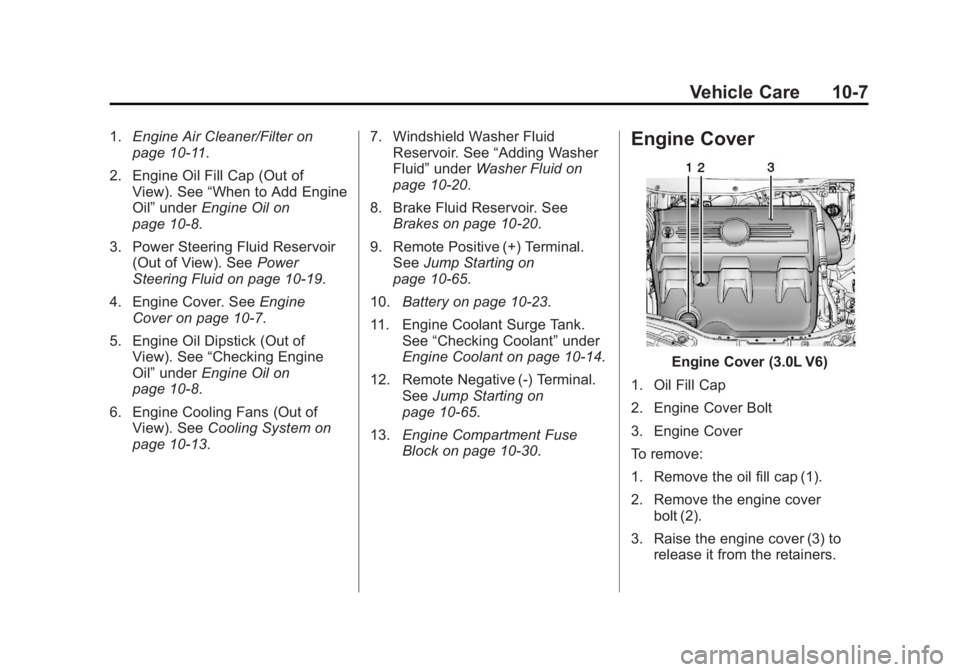
Vehicle Care 10-71. Engine Air Cleaner/Filter on
page 10 ‑ 11 .
2. Engine Oil Fill Cap (Out of
View). See “ When to Add Engine
Oil ” under Engine Oil on
page 10 ‑ 8 .
3. Power Steering Fluid Reservoir
(Out of View). See Power
Steering Fluid on page 10 ‑ 19 .
4. Engine Cover. See Engine
Cover on page 10 ‑ 7 .
5. Engine Oil Dipstick (Out of
View). See “ Checking Engine
Oil ” under Engine Oil on
page 10 ‑ 8 .
6. Engine Cooling Fans (Out of
View). See Cooling System on
page 10 ‑ 13 . 7. Windshield Washer Fluid
Reservoir. See “ Adding Washer
Fluid ” under Washer Fluid on
page 10 ‑ 20 .
8. Brake Fluid Reservoir. See
Brakes on page 10 ‑ 20 .
9. Remote Positive (+) Terminal.
See Jump Starting on
page 10 ‑ 65 .
10. Battery on page 10 ‑ 23 .
11. Engine Coolant Surge Tank.
See “ Checking Coolant ” under
Engine Coolant on page 10 ‑ 14 .
12. Remote Negative (-) Terminal.
See Jump Starting on
page 10 ‑ 65 .
13. Engine Compartment Fuse
Block on page 10 ‑ 30 .Engine Cover
Engine Cover (3.0L V6)
1. Oil Fill Cap
2. Engine Cover Bolt
3. Engine Cover
To remove:
1. Remove the oil fill cap (1).
2. Remove the engine cover
bolt (2).
3. Raise the engine cover (3) to
release it from the retainers.
Page 242 of 374
Black plate (8,1)Chevrolet Captiva Sport Owner Manual - 2013 - crc - 11/12/12
10-8 Vehicle Care 4. Lift and remove the engine
cover.
5. Reverse Steps 1 – 4 to reinstall
the engine cover.
Engine Oil To ensure proper engine
performance and long life, careful
attention must be paid to engine oil.
Following these simple, but
important steps will help protect
your investment: .
Always use engine oil approved
to the proper specification and of
the proper viscosity grade. See
“ Selecting the Right Engine Oil ”
in this section. .
Check the engine oil level
regularly and maintain the
proper oil level. See “ Checking
Engine Oil ” and “ When to Add
Engine Oil ” in this section..
Change the engine oil at the
appropriate time. See Engine Oil
Life System on page 10 ‑ 10 . .
Always dispose of engine oil
properly. See “ What to Do with
Used Oil ” in this section.
Checking Engine Oil It is a good idea to check the engine
oil level at each fuel fill. In order to
get an accurate reading, the vehicle
must be on level ground. The
engine oil dipstick handle is a loop.
See Engine Compartment Overview
on page 10 ‑ 4 for the location of the
engine oil dipstick.
Obtaining an accurate oil level
reading is essential:
1. If the engine has been running
recently, turn off the engine and
allow several minutesfor the oil
to drain back into the oil pan.
Checking the oil level too soon
after engine shutoff will not
provide an accurate oil level
reading. { WARNINGThe engine oil dipstick handle
may be hot; it could burn you.
Use a towel or glove to touch the
dipstick handle.
2. Pull out the dipstick and clean it
with a paper towel or cloth, then
push it back in all the way.
Remove it again, keeping the tip
down, and check the level.
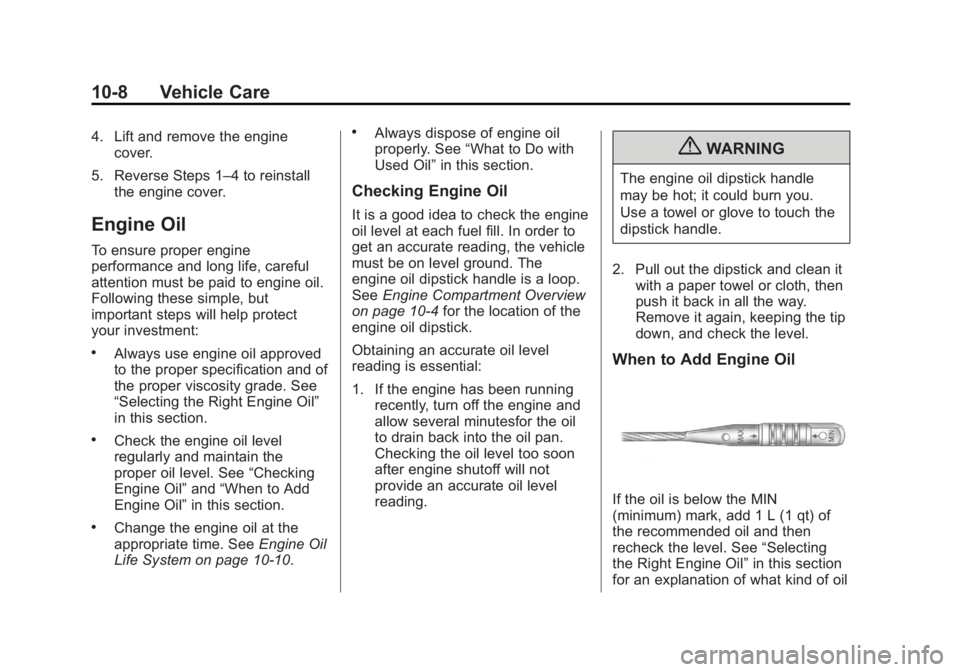
When to Add Engine Oil
If the oil is below the MIN
(minimum) mark, add 1 L (1 qt) of
the recommended oil and then
recheck the level. See “ Selecting
the Right Engine Oil ” in this section
for an explanation of what kind of oil
Page 249 of 374
Black plate (15,1)Chevrolet Captiva Sport Owner Manual - 2013 - crc - 11/12/12
Vehicle Care 10-15sooner than DEX-COOL. Any
repairs would not be covered by
the vehicle warranty. Always use
DEX-COOL (silicate-free) coolant
in the vehicle.
What to Use Use a mixture of one-half clean,
drinkable water and one-half
DEX-COOL coolant which will not
damage aluminum parts. If you use
this coolant mixture, you do not
need to add anything else.
{ WARNINGAdding only plain water or some
other liquid to the cooling system
can be dangerous. Plain water
and other liquids, can boil before
the proper coolant mixture will.
The coolant warning system is set
for the proper coolant mixture.
(Continued) WARNING (Continued) With plain water or the wrong
mixture, the engine could get too
hot but you would not get the
overheat warning. The engine
could catch fire and you or
others could be burned. Use a
50/50 mixture of clean, drinkable
water and DEX-COOL coolant.
Notice: If an improper coolant
mixture is used, the engine could
overheat and be badly damaged.
The repair cost would not be
covered by the vehicle warranty.
Too much water in the mixture
can freeze and crack the engine,
radiator, heater core, and other
parts.
If coolant has to be added more
than four times a year, have the
dealer check the vehicle cooling
system. Notice: If extra inhibitors and/or
additives are used in the vehicle's
cooling system, the vehicle could
be damaged. Use only the proper
mixture of the engine coolant
listed in this manual for the
cooling system. See
Recommended Fluids and
Lubricants on page 11 ‑ 12 for
more information.
Never dispose of engine coolant by
putting it in the trash, pouring it on
the ground, or into sewers, streams,
or bodies of water. Have the coolant
changed by an authorized service
center, familiar with legal
requirements regarding used
coolant disposal. This will help
protect the environment and your
health.
Checking Coolant
The coolant surge tank is located on
the driver side of the engine
compartment. See Engine
Compartment Overview on
page 10 ‑ 4 for more information on
location.