belt CHEVROLET CAVALIER 1984 1.G Owners Manual
[x] Cancel search | Manufacturer: CHEVROLET, Model Year: 1984, Model line: CAVALIER, Model: CHEVROLET CAVALIER 1984 1.GPages: 105, PDF Size: 24.23 MB
Page 6 of 105
Downloaded from www.Manualslib.com manuals search engine SECTION 1
BEFORE DRIVING YOUR CAVALIER
TRANSAXLE
While reading this manual, you will nole many references 10 Ihe "transaxle." The transaxle is a transmission and differential (axle) combined in a singl ,e unit.
To avoid confusion, the word
"transaxle" will be used throughout this manual 10 refer to bolh Ihe transmission and differenlial funclions.
DRIVER DAILY CHECKUST
Be sure you know how to use your vehicle and its equipment before operating it
Before Entering the Vehicle
1. See that windows, mirrors and lights are clean and unobstructed.
2. If any lire does not look normal, check it with a pressure gage.
3. Look for fluid leaks .
4. Be sure everything is properly stowed.
5. Check the area behind the vehicle if you are about to back up.
__ Before Driving Off
1. Lock all doors.
2. Adjust the seat and any movable head restraint
3. Adjust inside and outside mirrors.
4. DO NOT allow anyone to ride where there is no seat belt ; and ALWAYS properly fasten the seat belt.
5. Check that all the warning lights work as the key is turned to "Run" or "Start"
6. Check all gages (including the fuel gage).
7 . Release the parking brake (and make sure the
"BRAKE " light turns .off).
See related topics in this manual
or the Maintenance Schedule folder H problems are found.
STOWING THINGS IN (OR ON) THE VEHICLE
CAUTION: Put luggage or cargo In the trunk, or rea' area if postible. Cargo weight,
whether In the trunk or rear area, should be located as far forward as possible. Cargo weight on the roof Shoukt be positioned .s evenly as possible. Secure all i1ems in place to help keep them -from being thrown about and injuring people during a cot"-ion or sudden maneuver. Do not pile luggage or cargo higher than the seetbaCks. Do not place anything on the filler panel, or any cargo cover between the rear seat~.ck and window.
GUARD AGAINST THEFT
Your new Cava~er has many features to help prevent then of the vehicle, its
equipment, and contents. But these anti-then features
depend upon you to work.
t -1
Page 8 of 105
Downloaded from www.Manualslib.com manuals search engine DOOR LOCKS
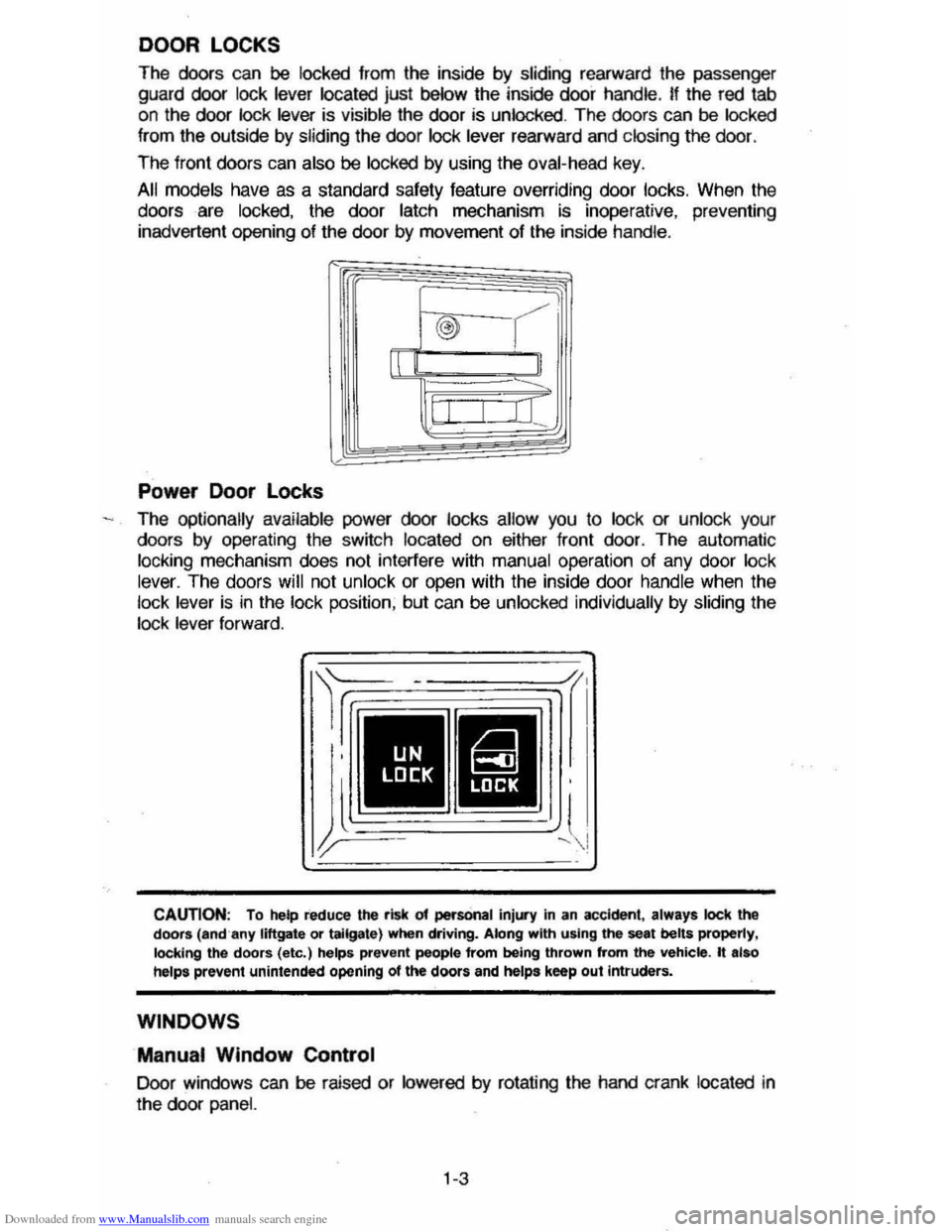
The doors can be locked from the inside by sliding rearward the passenger
guard
door lock lever located just below the inside door handle . If the red tab on the door lock lever is visible the door is unlocked . The doors can be locked
from the outside by sliding the door lock lever rearward and closing the door.
The front doors can
also be locked by using the oval-head key.
All inodels have as a standard safety feature overriding door locks. When the doors ·are locked, the door latch mechanism is inoperative, preventing
inadvertent opening 01 the door by movement of the inside handle.
@ r------
II II
lJI
[ Sf J ,tr=I ___ ,
Power Door Locks
The optionally available power door locks allow you to lock or unlock your
dears by operating the switch located on either front door. The automatic
locking mechanism does not interfere with manual operation of any door lock
lever. The doors will not unlock or open with the inside door handle when the lock lever is in the lock position, but can be unlocked individually by sliding the
lock lever forward.
r
CAUTION: To help reduce the risk of persOnal inj .... y in an accident. always lock the doors (and"any liftgate or tailgate) when driving. Along with using the seat belts properly.
locking the doors (etc.) helps prevent people from being thrown from the vehicle. It also helps prevent unintended opening of the doors and helps keep out intruders.
WINDOWS
Manual Window Control
Door windews can be raised or lowered by rotating the hand crank located in
the dear
panel.
1-3
Page 11 of 105
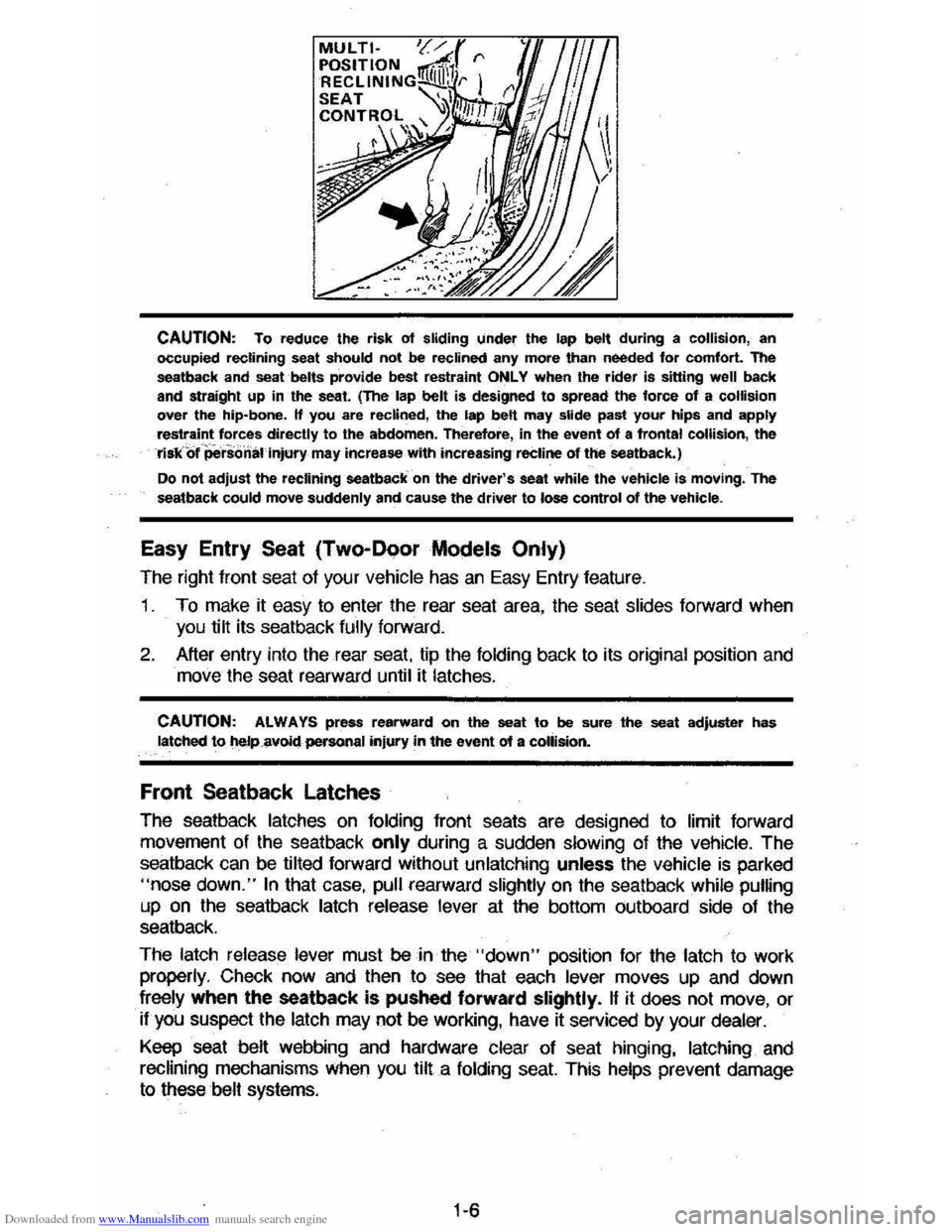
Downloaded from www.Manualslib.com manuals search engine CAUTION: To reduce the risk of sliding under the lap belt during a collision, an
occupied reclining seat should not be reclined any more than needed for comfort. The
seatback and seat belts provide best restraint ONLY when the rider is siuing well back
and straight up in the seat. (The lap belt is designed to spread the force of a collision over the hip-bone. If you are reclined, the lap belt may slide past your hips and apply restraint forces directly to the abdomen. Therefore, in the event of a frontal collision, the riskof 'personal Injury may increase with increasing reCline of theseatback.)
Do not adjust the reclining seatback on the driver's seat while the vehicle is moving. The
seatback could move suddenly and cause the driver to lose control of the vehicle.
Easy Entry Seat (Two-Door Models Only)
The right front seat of your vehicle has an Easy Entry feature.
1 . To make it easy to enter the rear seat area, the seat slides forward when
you tilt its seatback
fully forward.
2. After entry into the rear seat. tip the folding back to its original position and
move the seat rearward until it latches.
CAUTION: ALWAYS press rearward on the seat to be sure the seat adjuster has latched to t\eJp.8voidpersonal injury in the event of a collision.
Front Seatback Latches
The seatback latches on folding front seats are designed to limit forward
movement of the seatback
only during a sudden slowing of the vehicle. The
seatback can be tilted forward without unlatching unless the vehicle
is parked "nose down." In that case, pull rearward slightly on the seatback while pumng
up on the seatback latch release lever at the bottom outboard side of the
seatback.
The latch release lever must
be in the "down" position for the latch to work
properly. Check now and then to see that each lever moves up and down
freely when the seatback
is pushed forward slightly. If it does not move, or
if you suspect the latch may not be working, have it serviced by your dealer.
Keep seat belt webbing and hardware clear of seat hinging, latching and
recHning mechanisms When you tilt a folding seat. This helps prevent damage
to these belt systems.
1·6
Page 12 of 105
Downloaded from www.Manualslib.com manuals search engine Power Operated Front Seats (Optional)
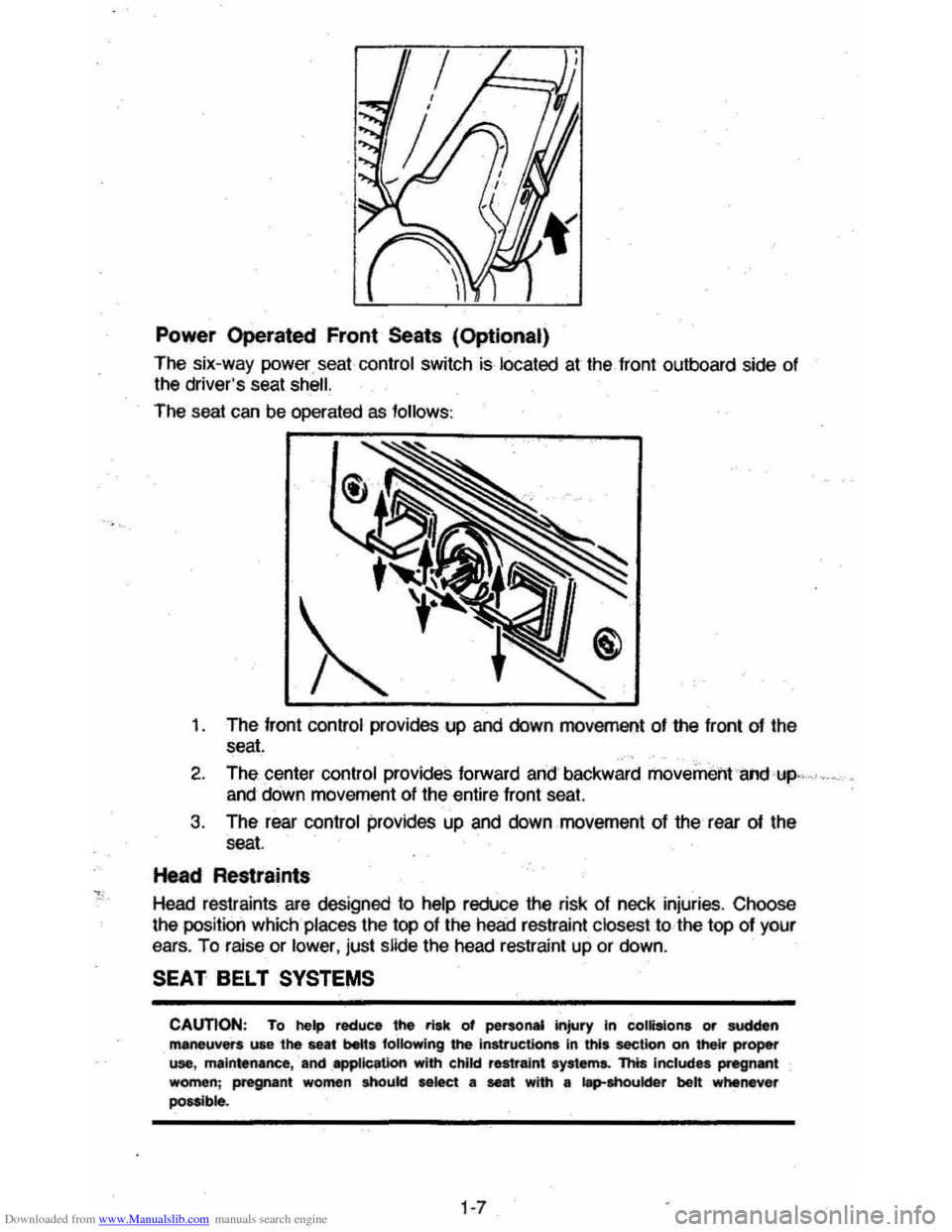
The six-way power seat. control switch is located at the. front outboard side of the driver's seat shell.
The seat can be operated as follows :
t . The front control provides up and down movement of the front of the
seat.
2. The center control provides forward and' backward movement ·i,"d·~p" ..
and down movement of the entire front seat.
3 . The rear
control provides up and down movement of the rear of the
seat.
Head Restraints
Head restraints are designed to help reduce the risk of neck injuries . Choose
the position which
places the top of the head restraint closest to the top of your ears. To raise or lower, just slide the head restraint up or down.
SEAT BEL.T SYSTEMS
CAUTION: To help reduce the risk 01 personal injury In collisions or sudden maneuvers use the selt belts fOllowing the instructions in this section on their proper use, mlintenance. -and IPPUCaUon with child res1riUnt system.. This includes pregnant women ; pregnant women shoukl Mk!ct a seat wrth a tep-shoukler bett whenever OOsoible.
1 .. 7
Page 13 of 105
Downloaded from www.Manualslib.com manuals search engine NEVER:
• Wear a shoulder belt under your arm nearest the door.
• Use a belt for more than one person at a time.
• Wear the belts twisted.
• Let the belt system become damaged by a door or seat.
• Put anything into the opening where the seat belt passes through the trim panel. (This may jam the retractor or damage the belt.)
Front Seat Lap-Shoulder Belt
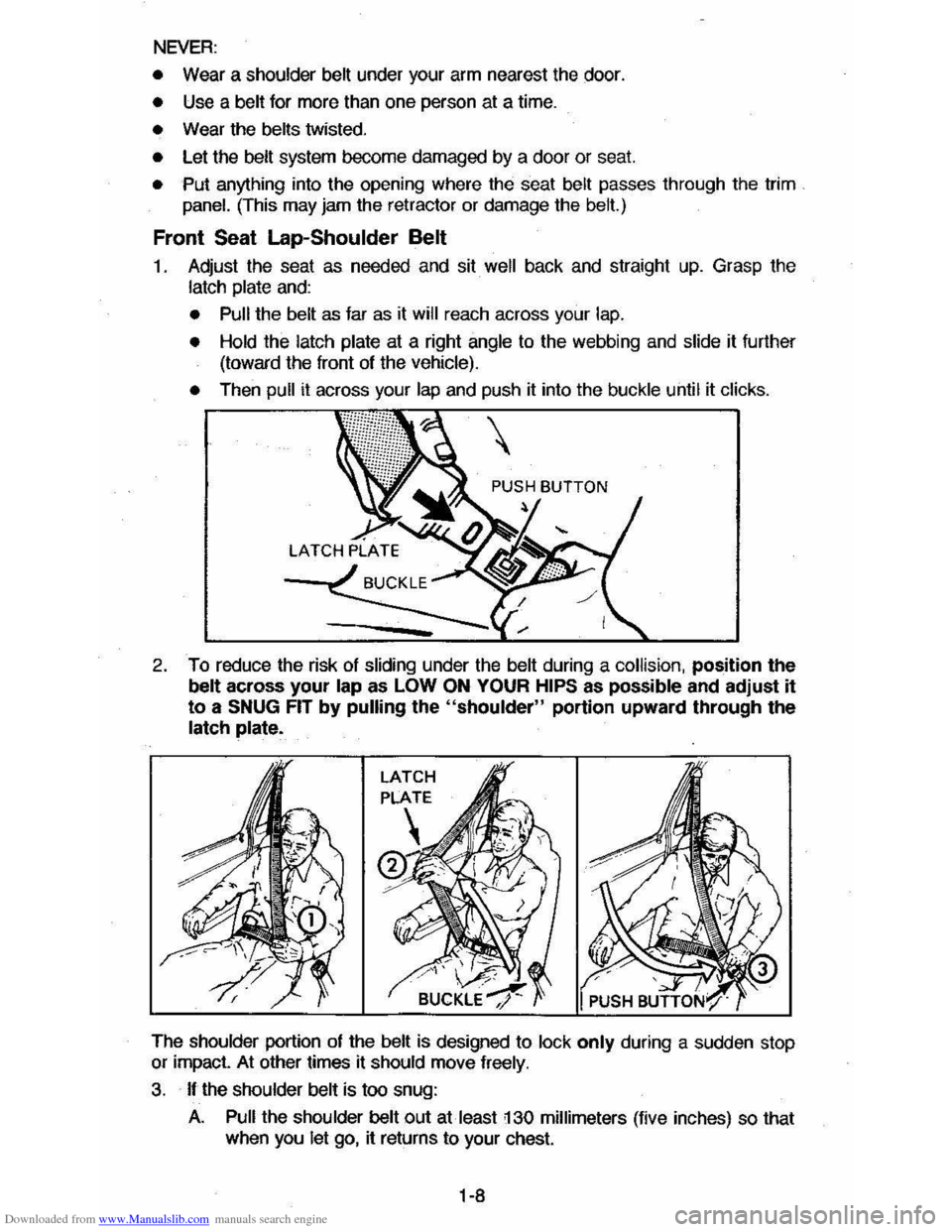
1. Adjust the seat as needed and sit well back and straight up. Grasp the
latch plate and:
• Pull the belt as far as it will reach across your lap.
• Hold the latch plate at a right angle to the webbing and slide it further
(toward the front of the vehicle).
•
Then pull it across your lap and push it into the buckle until it clicks.
2. To reduce the risk of sliding under the belt during a collision, position the belt across your lap as LOW ON YOUR HIPS as pOSSible and adjust it
to a SNUG FIT by pulling the "shoulder" portion upward through the latch plate.
The shoulder portion of the belt is designed to lock only during a sudden stop or impact. At other times it should move freely.
3. If the shoulder belt is too snug:
A. Pull the shoulder belt out at least 130 millimeters (five inches) so that
when you let go, it returns to your chest.
1·8
Page 14 of 105
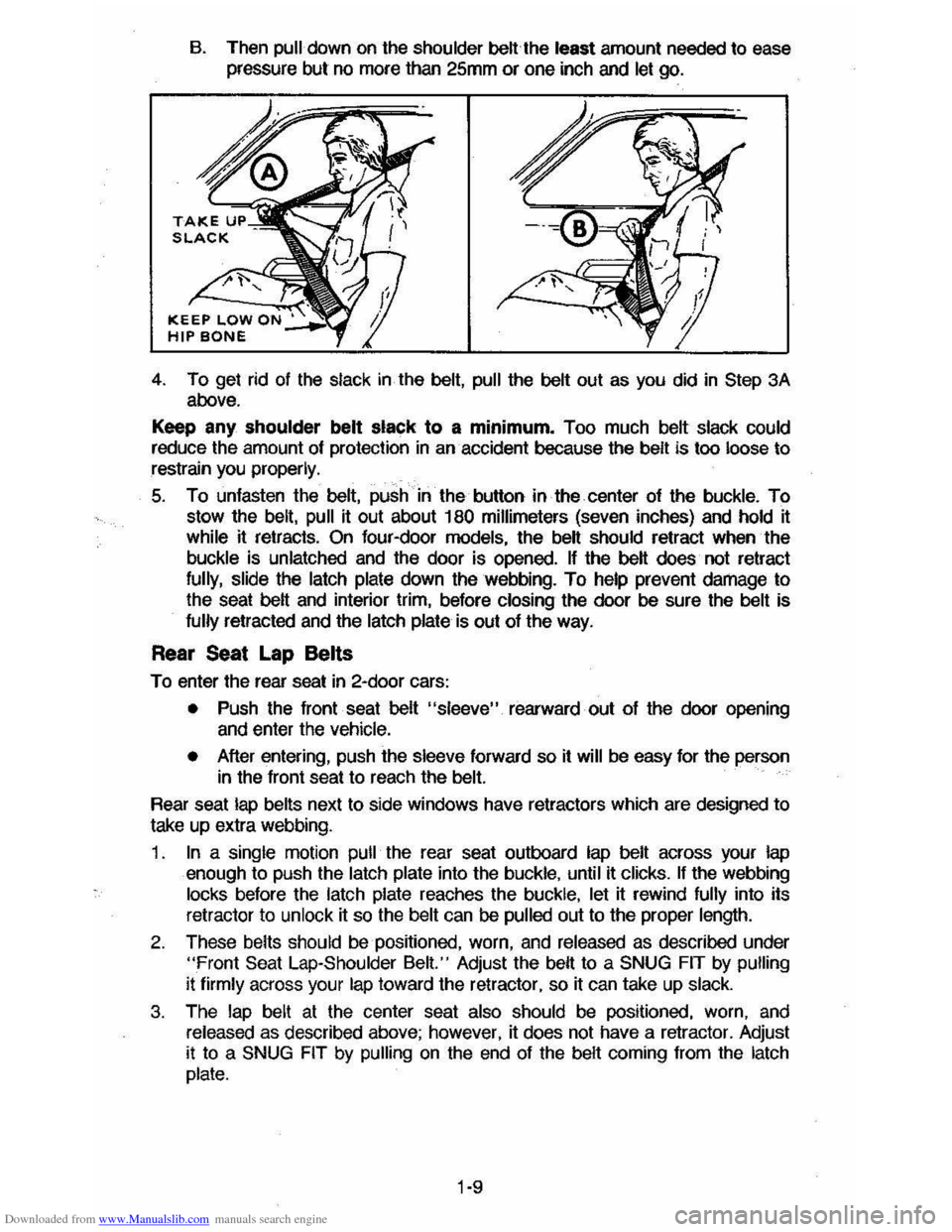
Downloaded from www.Manualslib.com manuals search engine B. Then pull down on the shoulder beUthe teast amount needed to ease
pressure but no more than 25mm or one inch and let go.
4. To get rid of the slack in the belt, pull the belt out as you did in Step 3A above.
Keep any
shoulder belt stack to a minimum. Too much belt slack could reduce the amount of protection in an· accident because the belt is too loose to restrain you properly.
5. To unfasten the belt, push in the button in the center of the buckle. To
stow the
belt, pull it out about 180 millimeters (seven inches) and hold it
while it retracts. On four-door models, the beH should retract when the
buckle is unlatched and the door is opened. If the beH does not retract
fully,
slide the latch plate down the webbing. To help prevent damage to
the seat beH and interior trim, before closing the door be sure the belt is
fully retracted
and the latch plate is out of the way.
Rear Seat Lap Belts
To enter the rear seat in 2-door cars:
• Push the front seat belt "sleeve" rearward out of the door opening and enter the vehicle.
•
After entering, push the sleeve forward so it will be easy for the person in the front seat to reach the belt.
Rear seat lap belts next to side windows have retractors which are designed to
take up extra webbing.
1 .
In a single motion pull the rear seat outboard lap belt across your lap enough to push the latch plate into the buckle, until it clicks. If the webbing
locks before the latch plate reaches the buckle, let it rewind fully into its
retractor to
unlock it so the belt can be pulled out to the proper length.
2. These belts should be positioned, worn, and released as described under
"Front Seat Lap-Shoulder Belt." Adjust the beH to a SNUG FIT by pulling
it firmly across your lap toward the retractor, so it can take up slack.
3. The lap belt at the center seat also should be positioned, worn, and
released as described above; however, it does not have a retractor. Adjust it to a SNUG FIT by pulling on the end of the beH coming from the latch
plate.
1·9
Page 15 of 105
Downloaded from www.Manualslib.com manuals search engine 4. To lengthen the center seat lap belt, place the latch plate at a right angle
to the belt webbing and pull on the latch plate; the belt should then slide
easily.
Rear Seat Shoulder Belts (Dealer-Installed Accessory)
Except Convertible
When properly worn with a lap bell, a shoulder belt (available for rear outboard
seats) can give riders added protection. It can prevent or reduce impact with the inside of the vehicle by restraining the upper body in a collision, especially
in a frontal impact.
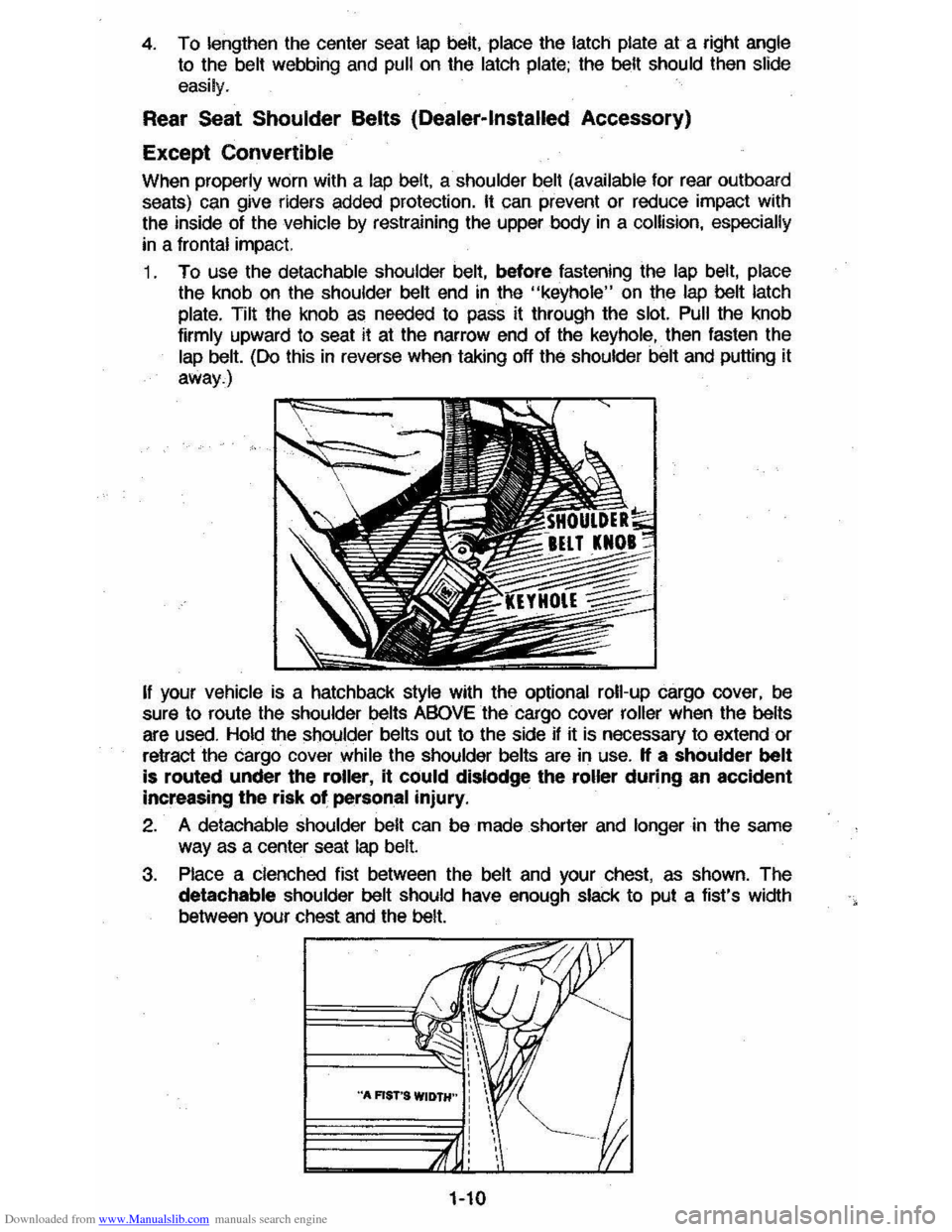
1 . To use the detachable
shoulder belt, before fastening the lap belt, place the knob on the shoulder belt end in the "keyhole" on the lap bell latch
plate. Tilt
the knob as needed to pass it through the slot. Pull the knob
firmly upward to seat it at the narrow end of the keyhole, then fasten the lap belt. (Do this in reverse when taking off the shoulder belt and putting it
away.)
If your vehicle is a hatchback style with the optional roll-up cargo cover, be
sure to route the shoulder belts ABOVE the cargo cover roller when the belts are used. Hold the Shoulder belts out to the side if it is necessary to extend or
retract the cargo cover
while the shoulder belts are in use. If a shoulder belt
is routed under the roller, it eQuid dislodge the roller during an accident
increasing
the risk of personal injury.
2. A detachable shoulder belt can be made shorter and longer in the same way as a center seat lap belt.
3. Place a clenched fist between the belt and your chest, as shown. The
detachable shoulder belt should have enough slack to put a fist's width
between your chest
and the belt.
1-10
Page 16 of 105
Downloaded from www.Manualslib.com manuals search engine Keep any shoulder belt slack to a minimum. Too much belt slack could
reduce the amount of protection in an accident because the belt is too loose to restrain you properly_
Seat Belt Inspection
Now and Ihen check that belts. buckles, latch plates, retractors, reminder
systems and guide
loops work properly; look for loose parts or damage that
could keep the restraint system from doing its job. Replace a
belt if the
webbing has been cut or otherwise damaged. Replace belts in use during all
but a minor collision; if there is any question, replace the belt.
SEAT BELT LIGHT/BUZZER REMINDER
When the key is turned to "Run" or "Start," a light will come on for four to
eight seconds to remind people to fasten their· seat belts. Unless the driver's
seat
belt is buckled, a buzzer will sound at the same time.
If the seat belt or reminder system does not work as described, see your dealer
for service.
CHILD RESTRAINT
All vehicle occupants and especially children should be restrained
whenever riding
in vehicles. Holding a child in your arms is NOT a substitute for a child restraint system. In an accident, a child held in a person's arms can
be struck or crushed by any unrestrained- rider. An unrestrained child could
also be injured by striking the interior, or by being ejected from the vehicle
during a sudden maneuver or impact. A child restraint system can help
protect a child in a vehicle.
In convertibles, a top-strap-equipped child restraint can only be used in
the Iront seat because there is no appropriate place to aUach a top strap
anchor bracket behind the rear seat in this vehicle. Installing a top strap
anchor bracket behind the rear seat may expose the child to hazards if the top
is raised or lowered with the child restraint occupied,
and, the bracket itself
may damage the convertible top.
In using any child restraint system, be sure to read and follow all instructions on installation and use that come with the system.
Riding Without A Child Restraint
For the best protection in an accident or sudden maneuver, children
small enough lor child restraint systems should be restrained that way.
However, the
following may provide some degree of protection for such children if a child restraint is not used.
• Place an infant who cannot sit up in a baby carrier, preferably covered and
padded. Put it crossways on the vehicle seat and securely restrain it with the vehicle's seat belts. Or, if that is not possible, place it crossways on the floor behind the driver's seat.
• Children who can sit up by themselves should be restrained with a lap belt
when riding in a rear seat. In the front seat a child should wear both lap
and shoulder belt. If the shoulder belt irritates the neck or face move the
child
closer to the center of the vehicle or to the rear seat. Never let a child stand or kneel on any seat. If unusual conditions prevent the use of
restraints, the
child should stand on the floor behind the driver's seat.
1-11
Page 19 of 105
Downloaded from www.Manualslib.com manuals search engine Now and then, check that all trailer hitch bolts and nuts are tight. Also see the
Maintenance
Schedule folder, and thelndax in this manual , for important facts
on
belts , cooling system care and brake ~tment.
Break-In Schedule
See the new vehicle break-in information in this manual. Also, we recommend
you drive your new vehicle for 500 miles (800 kilometers) before trailer towing.
At the end of this 500 mile (800 kilometer) break-in period, avoid speeds over
50 mph (80 km/h) and full throttle starts during the first 500 miles (800 kilometers) of trailer towing .
CAUTION:
BRAKES-To help avoid personal injury due to poor braking action :
•
Trailer brakes of adequate size are required on trailers more than 450
kilograms (1,000 pounds) loaded weight.
• If you use trailer brakes with this vehicle, follow the instailation and balance instructions of the trailer brake manufacturer.
• Do not tap into the vehicle's brake system iUhe trailer brake system uses
more than 0.3 cubic centimeter (0.02 cubic inches) 01 fluid from the
vehicle 's
mast.". cyllnd<1r .. , In this case, the vehicle's brake fluid capacity will not be enough to operate both thevehicte and trailer brakes under all kinds
of use.
• All brake fluid parts must be able to stand 20 650 kPa (3,000 psi) . The
brake fluid tap must be made at the upper rear master cylinder port.
Copper tubing is subject to fatigue failure and must not be used.
HITCHES-To help avoid personal injury due to sway caused by such things as
crosswinds, large trucks passing or road roughness , or due to separation of
the trailer :
• A properly installed and adjusted (1) frame mounted, weight-dstribut ing hitch and (2) sway control witheoough capacity are required for trailers
more than 900 kilograms (2,000 pounds) loaded weight.
• Keep the trailer tongue load at 10 percent of the loaded trailer weight for
dead-weight hitches and 12 percent for weight-distributing hitches. Tongue
loads can be adjusted by proper distribution of the load in the trailer. This
can
be checked by weighing separately the loaded trailer and then the
tongue .
• Do not use axle-mounted Mches. They can damage the axle housing , wheel bearings , wheels or tires.
• Do not allow steel hitch parts to be in direct contact with aluminum bumper
parts, if so equipped. When steel and aluminum are in contact, a galvanic
reaction (a form of corrosion) can occur which will progressively lessen the
strength of the contacting metals to the point
of failure. An organic
compound or paint should
be used as a barrier on the contacting surfaces
and on the attaching fasteners.
• When you remove a trailer hitch, be sure to seal any mounting holes in the body. This will help prevent entry 01 exhaust fumes,
"Starting and Operating ," Section 2 ollhis manual.)
2-3
Page 39 of 105
Downloaded from www.Manualslib.com manuals search engine '" ,
t:l
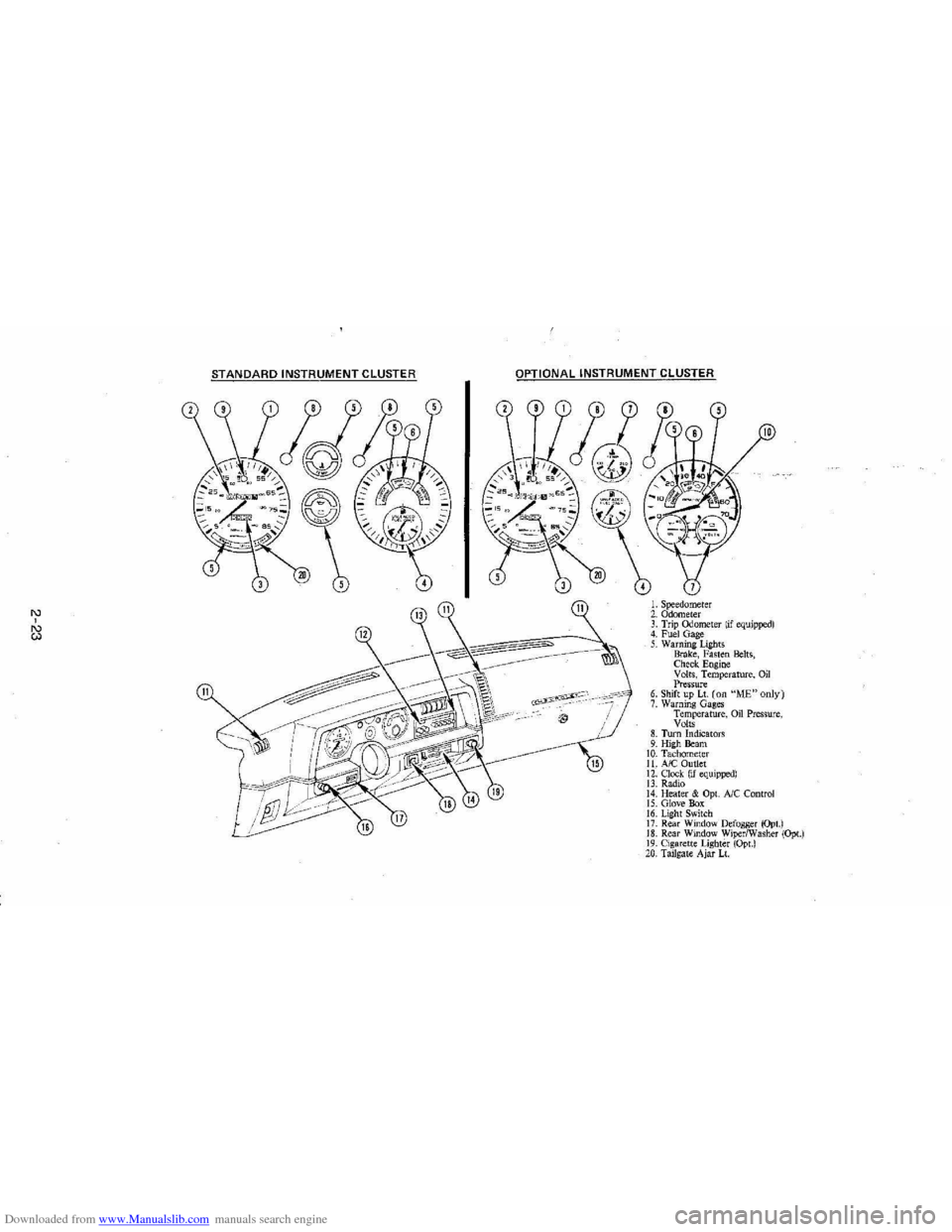
STANDARD INSTRUMENT CLUSTER
IJ
12
OPTIONAL INSTRUMENT CLUSTER
~~~~-:'----,~~:
l'l
1l
10
L Speedometer 2. Odometer 3. Trip ()jometer lif equipped) 4. Fuel Gage 5. Warning Lights Brake, Fasten Belts, Check. Engine Volts, Temperature, Oil Pressure 6. Shift up Lt. (on "ME"only) 7. Warning Gages Temperature, on Pressure, Volts 8. Turn Indicators 9. High Beam 10. Tachomet er 11. A/C Outlet 12. Clock. (if equipped) 13. Radio 14. Heater & Opt. Ale Control 15. Glove Box 16. Lig ht Switch 17. Rear Window Defogger (Opt.) 18. Rear Window WiperlWasher (Opt.) 19. Cigare tt e Lighter (Opt.) 20, Tailgat e Ajar Lt.