ESP CHEVROLET CAVALIER 1993 1.G User Guide
[x] Cancel search | Manufacturer: CHEVROLET, Model Year: 1993, Model line: CAVALIER, Model: CHEVROLET CAVALIER 1993 1.GPages: 308, PDF Size: 15.62 MB
Page 149 of 308
Downloaded from www.Manualslib.com manuals search engine Hydroplaning
Hydroplaning is dangerous. So much
water can build up under your tires that
they can actually ride on the water. This
can happen if the road is wet enough
and you’re going fast enough. When
your vehicle
is hydroplaning, it has little
or
no contact with the road.
You might
not be aware of hydroplaning.
You could drive along for some time
without realizing your tires aren’t
in
constant contact with the road. You
could find out the hard way: when you
have to slow, turn, move out to pass-or
if you get hit by a gust of wind. You could
suddenly find yourself
out of control. Hydroplaning doesn’t happen often. But
it
can
if your tires haven’t much tread or
if the pressure in one or more is low. It
can happen if a lot of water is standing
on the road. If
you can see reflections
from trees, telephone poles, or other
vehicles, and raindrops “dimple’’ the
water’s surface, there could be
hydroplaning.
Hydroplaning usually happens at higher
speeds. There just isn’t
a hard and fast
rule about hydroplaning. The best
advice is to slow down when
it is
raining, and be careful.
Some Other Rainy Weather Tips
Turn on your headlights-not just your
parking lights-to help make you
more
visible to others.
Look for hard-to-see vehicles coming
from behind. You may want
to use
your headlights even
in daytime if it’s
raining hard.
Besides slowing down, allow some
extra following distance. And be
especially careful when you pass
another vehicle. Allow yourself more
clear room ahead, and be prepared to
have your view restricted by road
spray. If
the road spray is so heavy you
are actually blinded, drop back. Don’t
pass until conditions improve. Going
more slowly is better than having an
accident.
Use your defogger if it helps.
Have good tires with proper tread
depth. (See
the Index under fires.)
I47
Page 150 of 308
Downloaded from www.Manualslib.com manuals search engine Your Driving and the Road
Driving in Fog, Mist and Haze
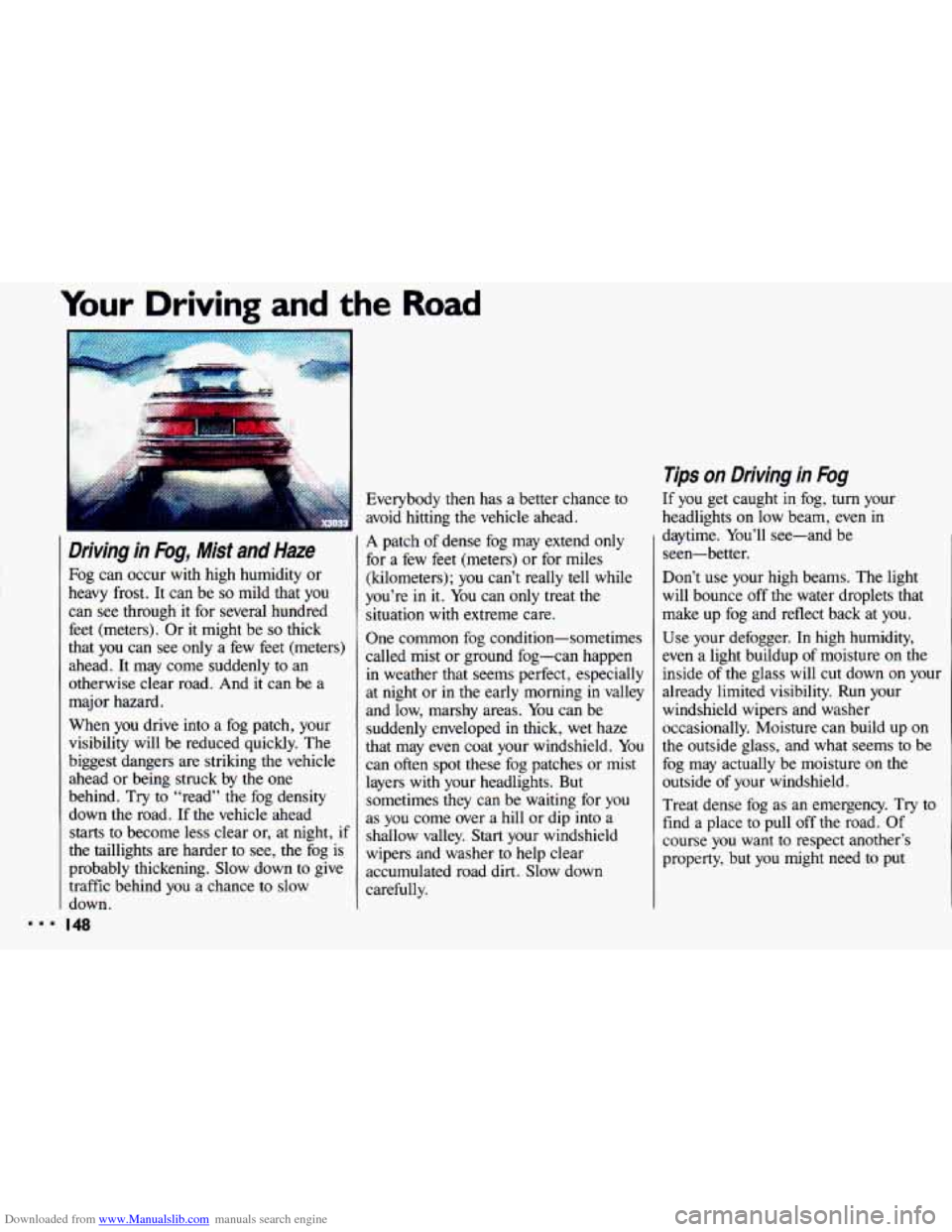
Fog can occur with high humidity or
heavy frost. It can be
so mild that you
can see through it for several hundred
feet (meters). Or it might be
so thick
that you can see only a few
feet (meters)
ahead. It may come suddenly to an
otherwise clear road. And it can be a
major hazard.
When
you drive into a fog patch, your
visibility will be reduced quickly. The
biggest dangers are striking the vehicle
ahead or being struck by the one
behind. Try to “read” the fog density
down the road.
If the vehicle ahead
starts to become less clear or, at night, if
the taillights are harder to see, the fog is
probably thickening. Slow down to give traffic behind you a chance to slow
down.
I48
Everybody then has a better chance to
avoid hitting the vehicle ahead.
A patch of dense fog may extend only
for a
few feet (meters) or for miles
(kilometers); you can’t really tell while
you’re
in it. You can only treat the
situation with extreme care.
One common fog condition-sometimes
called mist or ground fog-can happen
in weather that seems perfect, especially
at night or in the early morning
in valley
and low, marshy areas.
You can be
suddenly enveloped
in thick, wet haze
that may even coat your windshield.
You
can often spot these fog patches or mist
layers with your headlights. But
sometimes they can be waiting for
you
as you come over a hill or dip into a
shallow valley. Start your windshield
wipers and washer to help clear
accumulated road dirt. Slow down
carefully.
Tips on Driving in Fog
If you get caught in fog, turn your
headlights on low beam, even in
daytime. You’ll see-and be
seen-better.
Don’t use your high beams. The light
will bounce
off the water droplets that
make up fog and reflect back at you.
Use your defogger. In high humidity,
even a light buildup of moisture
on the
inside
of the glass will cut down on your
already limited visibility. Run your
windshield wipers and washer
occasionally. Moisture can build up
on
the outside glass, and what seems to be
fog may actually be moisture on the
outside of your windshield.
Treat dense fog as an emergency. Try to
find a place
to pull off the road. Of
course you want to respect another’s
property, but you might need to put
Page 151 of 308
Downloaded from www.Manualslib.com manuals search engine something between you and moving
vehicles-space, trees, telephone poles,
a private driveway, anything that
removes you from other traffic.
zf visibility is near zero and you must
stop but are unsure whether you are
away from the road, turn your lights on,
start your hazard warning flashers, and
sound your horn at intervals or when
you hear approaching traffic.
Pass other vehicles in fog only if you
can see far enough ahead to pass safely.
Even then, be prepared to delay your
pass if you suspect the
fog is worse up
ahead. If other vehicles try to pass
you,
make it easy for them.
City Driving
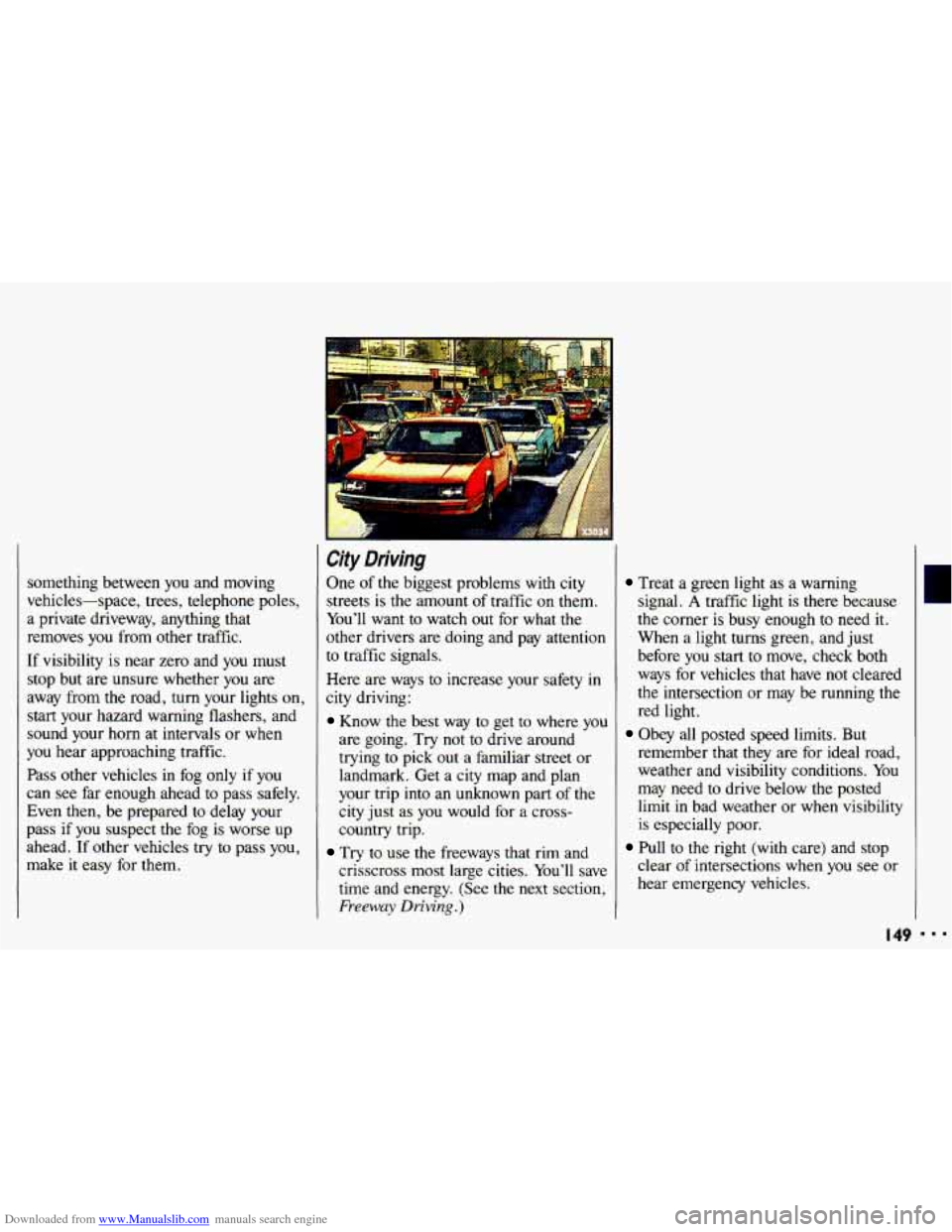
One of the biggest problems with city
streets is the amount
of traffic on them.
You’ll want to watch out for what the
other drivers are doing and pay attention
to traffic signals.
Here are ways to increase your safety in
city driving:
Know the best way to get to where you
are going. Try not to drive around
trying to pick out a familiar street or
landmark. Get a city map and plan
your trip into an unknown part
of the
city just as
you would for a cross-
country trip.
Try to use the freeways that rim and
crisscross most large cities. You’ll save
time and energy. (See the next section,
Freeway Driving.)
Treat a green light as a warning
signal.
A traffic light is there because
the corner is busy enough to need it.
When
a light turns green, and just
before you
start to move, check both
ways for vehicles that have not cleared
the intersection or may be running the
red light.
remember that
they are for ideal road,
weather and visibility conditions. You
may need to drive below the posted
limit
in bad weather or when visibility
is especially poor.
clear
of intersections when you see or
hear emergency vehicles.
Obey all posted speed limits. But
Pull to the right (with care) and stop
I49 BIB
Page 161 of 308
Downloaded from www.Manualslib.com manuals search engine If You’re Caught in a Blizzard
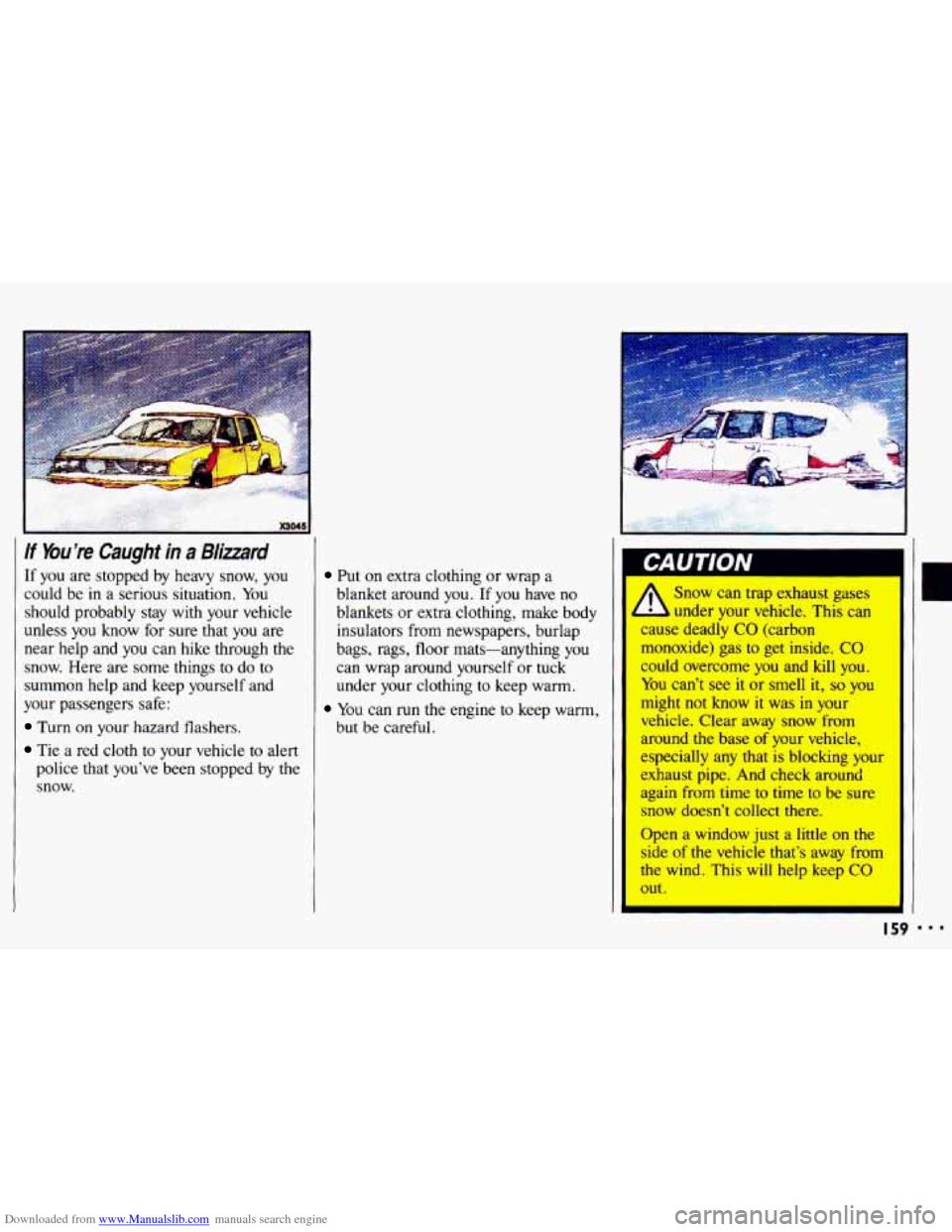
If you are stopped by heavy snow, you
could be
in a serious situation. You
should probably
stay with your vehicle
unless you know for sure that
you are
near help and you can
hike through the
snow. Here are some things to do to
summon help and keep yourself and
your passengers safe:
Turn on your hazard flashers.
Tie a red cloth to your vehicle to alert
police that you’ve been stopped by
the
snow.
Put on extra clothing or wrap a
blanket around you. If you have
no
blankets or extra clothing, make body
insulators from newspapers, burlap
bags, rags, floor mats-anything
you
can wrap around yourself or tuck
under your clothing to keep warm.
You can run the engine to keep warm,
but be careful.
I
A a
-C L Snow can trap exhaust gases
L under your vehicle. This can
cause deadly
CO (carbon
monoxide) gas to get inside.
CO
could overcome you and kill you.
You can’t see
it or smell it, so you
might not know
it was in your
vehicle. Clear away snow from
around the base of your vehicle,
especially any that is bloclng your
exhaust pipe. And check around
again from time to time to be sure
snow doesn’t collect there.
Open a window just a
little on the
side of the vehicle that’s away from
the wind. This
will help keep CO
out.
Page 186 of 308
Downloaded from www.Manualslib.com manuals search engine Problems on the Road
Zf a Tire Goes Flat
It’s unusual for a tire to “blow out”
while you’re driving, especially if you
maintain your tires properly.
If air goes
out of a tire, it’s much more likely
to
leak out slowly. But if you should ever
have a “blowout,” here are a few tips
about what to expect and what to do:
If a front tire fails, the flat tire will
create a drag that pulls the vehicle
toward that side. Take your foot off the accelerator pedal and grip the steering
wheel firmly. Steer to maintain lane
position, then gently brake
to a stop well
out of
the traffic lane.
I 84
A rear blowout, particularly on a curve,
acts much like a skid and may require
the same correction you’d use in a skid.
In any rear blowout, remove your foot
from the accelerator pedal. Get the
vehicle under control by steering the
way
you want the vehicle to go. It may
be very bumpy and noisy, but you can
still steer. Gently brake
to a stop, well
off the road
if possible.
If your tire goes flat, the next section
shows how
to use your jacking
equipment to change
a flat tire safely.
Changing a Flat Tire
If a tire goes flat, avoid further tire and
wheel damage by driving slowly to a
level place.
Turn on your hazard
warning flashers.
Page 200 of 308
Downloaded from www.Manualslib.com manuals search engine Service & Appearance Care
Fuel (CONTI
What about gasoline with blending
materials that contain oxygen, such
as
MTBE or alcohol?
MTBE is “methyl tertiary-butyl
ether?
Fuel that is no more than 15 %
MTBE is fine for your vehicle.
Ethanol is ethyl or grain alcohol.
Properly-blended fuel that is
no more
than
10% ethanol is fine for your
vehicle.
Methanol is methyl or wood alcohol.
I98
Fuel that is more than 5 %
methanol is bad for your vehicle.
Don’t use it.
It can corrode metal
parts in your fuel system and also
damage plastic and rubber
parts.
That damage wouldn’t be covered
under
your warranty. And even at
5 % or less, there must be
“cosolvents” and corrosion
preventers in th he1 to :lp avoid
these problems.
- -
Gasolines for Cleaner Air
Your use of gasoline with detergent
additives will help prevent deposits from
forming
in your engine and fuel system.
That helps keep your engine
in tune and
your emission control system working
properly. It’s good for your vehicle, and
you’ll be doing your part for cleaner air.
Many gasolines are now blended
with
materials called oxygenates. General
Motors recommends that you use
gasolines with these blending materials,
such as MTBE and ethanol. By doing
so, you can help clean the air, especially
in those parts of the country that have
high carbon monoxide levels.
Page 201 of 308
Downloaded from www.Manualslib.com manuals search engine In addition, some gasoline suppliers are
now producing reformulated gasolines.
These gasolines are specially designed
to reduce vehicle emissions. General
Motors recommends that you use
reformulated gasoline. By doing
so, you
can help clean the air, especially in
those parts of the country that have high
ozone levels.
You should ask your service station
operators if their gasolines contain
detergents and oxygenates, and if they
have been reformulated to reduce
vehicle emissions.
X
Fuels in Foreign Countries
If you plan on driving in another
country outside the
U.S. or Canada,
unleaded fuel may be hard to find.
Do not use leaded gasoline. If you use
even one tankful, your emission controls
won’t work well or at all. With
continuous use, spark plugs can get
fouled, the exhaust system can corrode,
and your engine oil can deteriorate
quickly. Your vehicle’s oxygen sensor
will be damaged. All of that means
costly repairs that wouldn’t be covered
by your warranty.
To check on fuel availability, ask an auto
club, or contact a major
oil company
that does business in the country where
you’ll be driving.
You can also write us at the following
address for advice. Just tell us where
you’re going and give your Vehicle Identification Number (VIN).
General Motors of Canada Ltd.
International Export
- Sales
P.O. Box 828
Oshawa, Ontario LEX 7Ni, Canada
I99
Page 213 of 308
Downloaded from www.Manualslib.com manuals search engine Automaric Transaxle Fluid
When to Check and Change:
A good time to check your automatic
transaxle fluid level is when the engine
oil is changed. Refer to the Maintenance
Schedule to determine when to change
your fluid. See the
Index under
Scheduled Maintenance Services.
How to Check:
Because this operation can be a little
difficult, you may choose to have this
done at a Chevrolet dealership Service
Department.
If you do it yourself, be sure to follow
all the instructions here, or you could
get a false reading on the dipstick.
Too much or too little fluid can
damage
your transaxle. Too much
can mean that some of the fluid
could come out and fall
on hot
engine parts, starting a fire. Be
sure to get an accurate reading
if
you check your transaxle fluid. Wait
at least 30 minutes before checking
the transaxle fluid level if you have been
driving:
When outside temperatures are above
At high speed for quite a while.
In heavy traffic-especially in hot
To get the right reading, the fluid should
be at normal operating temperature,
which is 180°F to 200°F (82°C to
93" C).
Get the vehicle warmed up by driving
about 15 miles (24
km) when outside
temperatures are above
50°F (10OC). If
it's colder than 50" F (10" C), you may
have to drive longer.
90°F (32°C).
weather.
21 I
Page 215 of 308
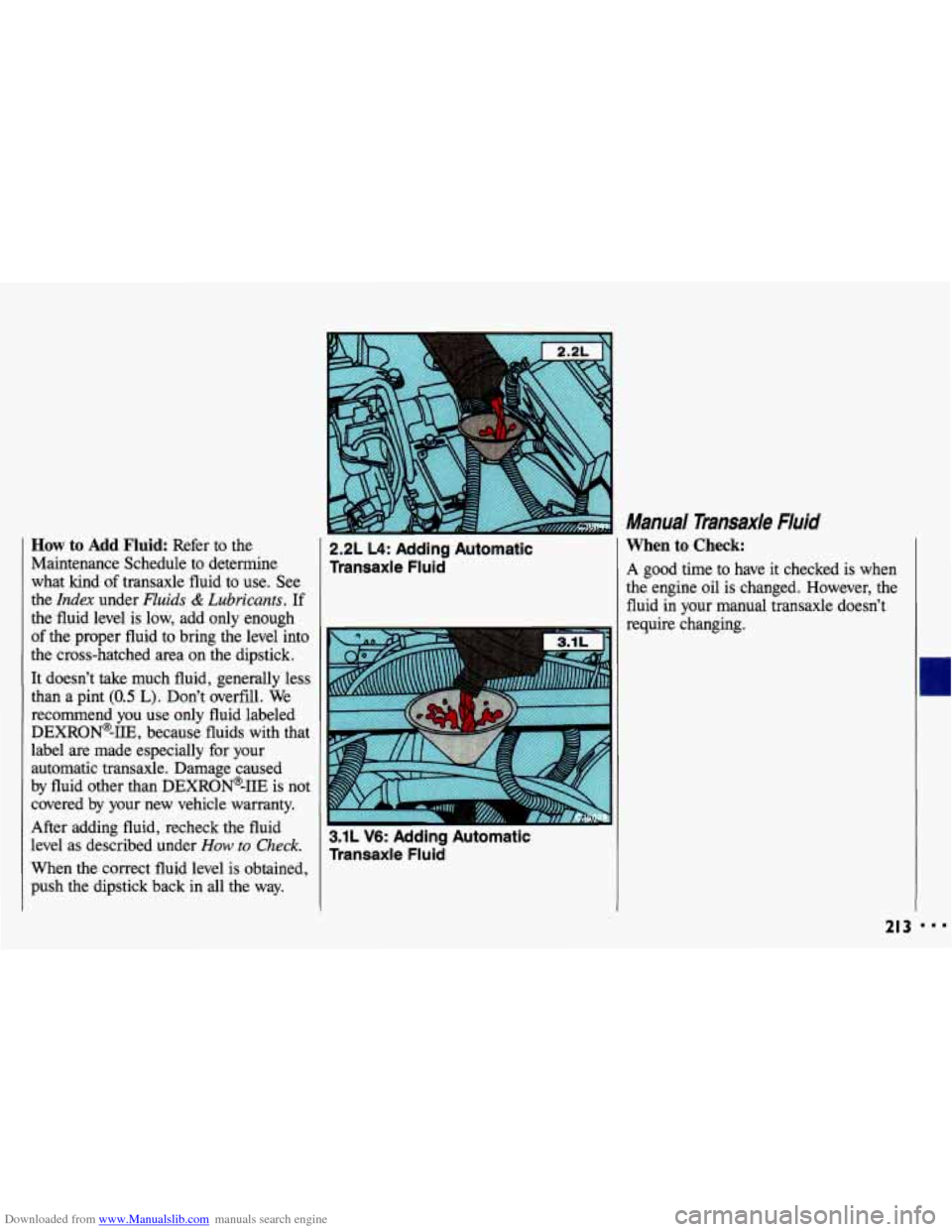
Downloaded from www.Manualslib.com manuals search engine How to Add Fluid: Refer to the
Maintenance Schedule to determine
what kind of transaxle fluid to use. See
the
Index under Fluids & Lubricants. If
the fluid level is low, add only enough
of the proper fluid to bring the level into
the cross-hatched area on the dipstick.
It doesn't take much fluid, generally less
than a pint
(0.5 L). Don't overfill. We
recommend you use only fluid labeled
DEXRON@-IIE, because fluids with that
label are made especially for your
automatic transaxle. Damage caused
by fluid other than DEXRON@-IIE is not
covered by your new vehicle warranty.
After adding fluid, recheck the fluid
level as described under
How to Check.
When the correct fluid level is obtained,
push the dipstick back in all the way.
2.2L L4: Adding Automatic
Transaxle Fluid
3.1L V6: Adding Automatic
Transaxle Fluid
Manual Transaxle Fluid
When to Check:
A good time to have it checked is when
the engine oil is changed. However, the
fluid in your manual transaxle doesn't
require changing.
213
Page 232 of 308
Downloaded from www.Manualslib.com manuals search engine Service & Appearance Care
lnflation-lire Pressure
The Tire-Loading Information label
which is
on the rear edge of the driver’s
door shows the correct inflation
pressures for your tires, when they’re
cold. “Cold” means your vehicle has
been sitting for at least three hours or
driven no more than a mile. Don’t
let anyone tell you that
underinflation
or overinflation is
all right. It’s
not. If your tires don’t
have enough
you can get:
Too much flexing
Too much heat
Tire overloading
Bad weLA
Bad handling
Bad fuel economy. ition)
If your tires have too much air
(overinflation), you can get:
Unusual wear
Bad handling
Rough ride
Needless damage from road
hazards.
When to Check:
Check your tires once a month or more.
Don’t forget your compact spare tire. It
should be at
60 psi (420 kpa).
How to Check:
Use a good quality pocket-type gage to
check tire pressure. Simply looking at
the tires will not tell you the pressure,
especially if
you have radial tires-
which may look properly inflated even if
they’re underinflated.
If your tires have valve caps, be sure to
put them back on. They help prevent
leaks by keeping out dirt and moisture.
230