tires CHEVROLET CAVALIER 1993 1.G User Guide
[x] Cancel search | Manufacturer: CHEVROLET, Model Year: 1993, Model line: CAVALIER, Model: CHEVROLET CAVALIER 1993 1.GPages: 308, PDF Size: 15.62 MB
Page 157 of 308
Downloaded from www.Manualslib.com manuals search engine As you go over the top of a hill, be
alert. There could be something in
your lane, like a stalled car or an
accident.
You may see highway signs on
mountains that warn of special
problems. Examples are long grades,
passing or no passing zones, a falling
rocks area, or winding roads. Be alert
to these and take appropriate action.
problems. See the
Index under Winter
Driving.
Winter driving can present special
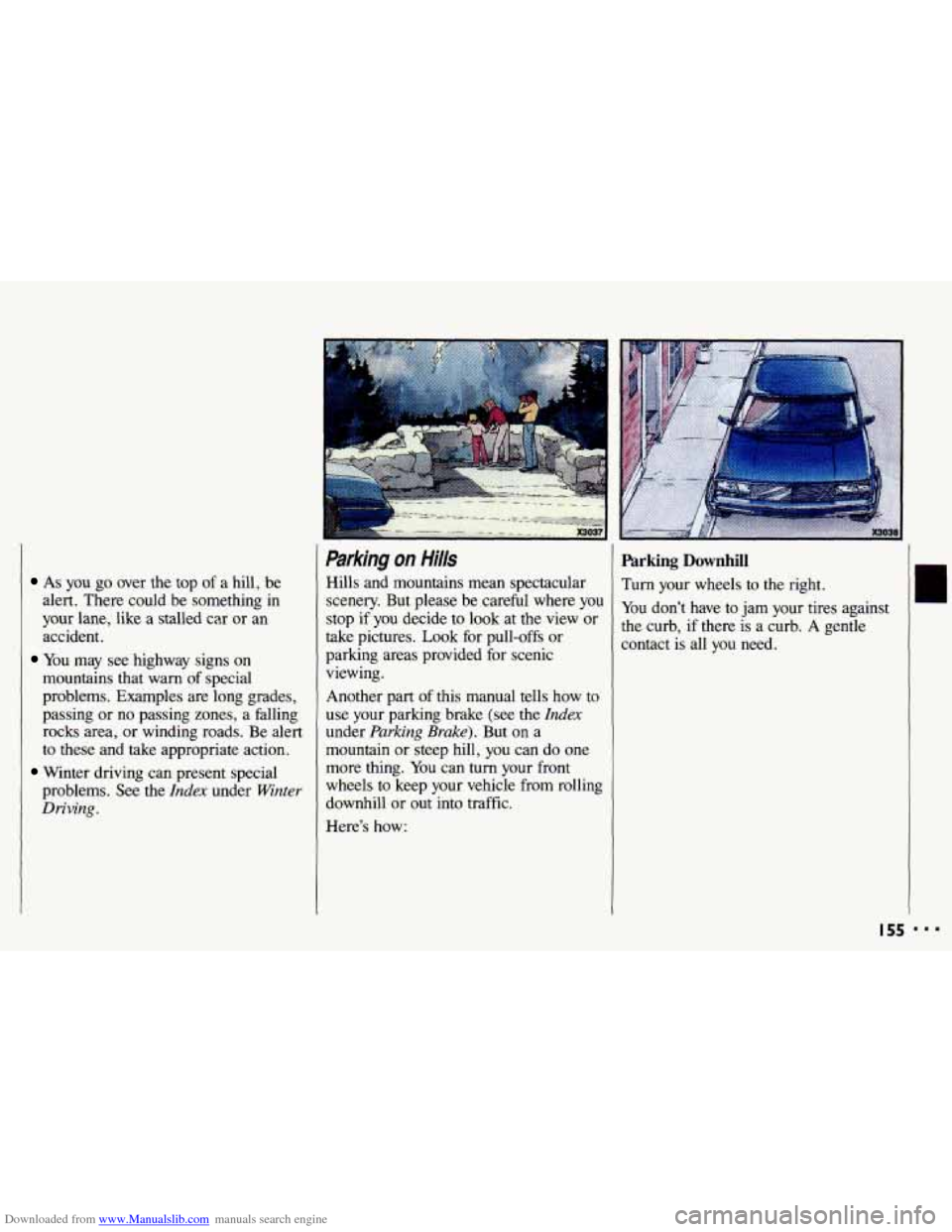
Parking on Hills
Hills and mountains mean spectacular
scenery. But please be careful where you
stop if you decide to look at the view or
take pictures. Look for pull-offs or
parking areas provided for scenic
viewing.
Another part
of this manual tells how to
use your parking brake (see the
Index
under Parking Brake). But on a
mountain or steep hill,
you can do one
more thing. You can turn your front
wheels
to keep your vehicle from rolling
downhill or out into traffic.
Here’s how
:
Parking Downhill
Turn your wheels to the right.
You don’t have to jam your tires against
the curb, if there
is a curb. A gentle
contact is all you need.
I55
Page 159 of 308
Downloaded from www.Manualslib.com manuals search engine Torque Lock
(AUTOMATIC TRANSAXLE)
If you are parking on a hill and you
don’t shift
your transaxle into P (Park)
properly, the weight of the vehicle may
put too much force on the parking pawl
in the transaxle. You may find it difficult
to pull the
shift lever out of P (Park).
This
is called “torque lock.” To prevent
torque lock, always be sure to shift into
P (Park) properly before you leave the
driver’s seat.
To find out how, see the
Index under Shiftirtg Into P (Park),
When you are ready to drive, move the
shift lever out
of P (Park) before you
release the parking brake.
If torque lock does occur, you may need
to have another vehicle push yours a
little uphill to take some
of the pressure
from the transaxle,
so you can pull the
shift lever out
of P (Park).
Winter Driving
Here are some tips for winter driving:
Have your Chevrolet in good shape for
winter. Be sure your engine coolant
mix is correct.
Snow tires can help in loose snow, but
they may give you less traction on ice
than regular tires.
If you do not expect
to be driving in deep snow, but may
have to travel over ice,
you may not
want to switch to snow tires at all.
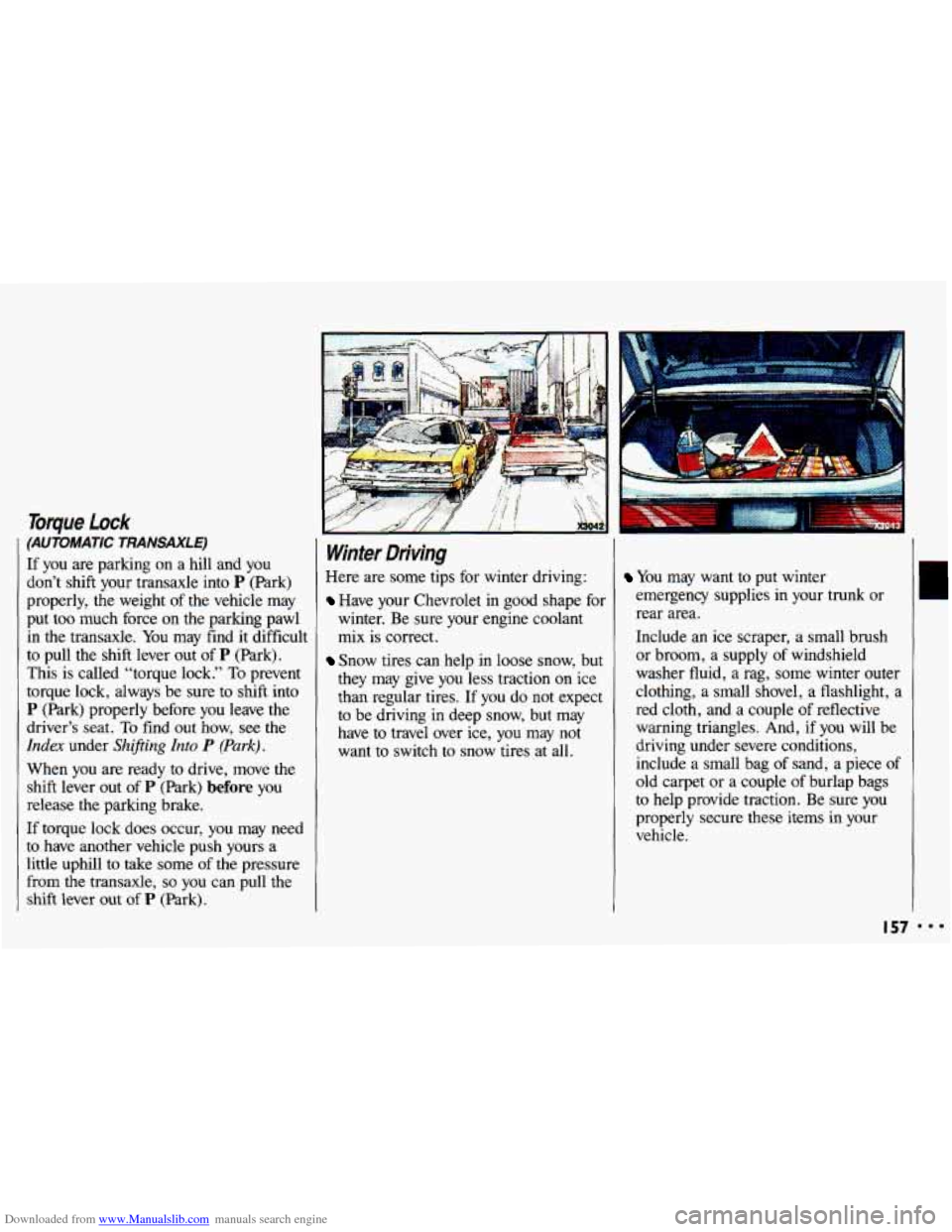
You may want to put winter
emergency supplies in your trunk or
rear area.
Include an ice scraper, a small brush
or broom, a supply of windshield
washer fluid, a rag, some winter outer
clothing, a small shovel, a flashlight,
a
red cloth, and a couple of reflective
warning triangles. And, if you will be
driving under severe conditions,
include a small bag
of sand, a piece of
old carpet or a couple
of burlap bags
to help provide traction. Be sure you
properly secure these items
in your
vehicle.
I57
Page 160 of 308
Downloaded from www.Manualslib.com manuals search engine ...
Your Driving and the Road
Driving on Snow or /ce
Most of the time, those places where
your tires meet the road probably have
good traction.
However,
if there is snow or ice
between your tires and the road, you can
have a very slippery situation. You’ll
have a lot less traction or “grip” and
will need to be very careful.
What’s the worst time for this? “Wet ice.”
Very cold snow or ice can be slick
and hard to drive on. But wet ice can be
even more trouble because
it may offer
the least traction
of all. You can get
“wet ice” when it’s about freezing
(32°F; OOC) and freezing rain begins to
fall. Try to avoid driving on
wet ice
until salt and sand crews can get there.
I58
Whatever the condition-smooth ice,
packed, blowing or loose snow-drive
with caution. Accelerate gently. Try not
to break the fragile traction.
If you
accelerate too fast, the drive wheels
will
spin and polish the surface under the
tires even more.
Your anti-lock brakes inlprove your
ability
to make a hard stop on a slippery
road. Even though you have the anti-
lock braking system, you’ll want to
begin stopping sooner than you would
on dry pavement. See the
Index under
Anti-Lock Bruke System.
Allow greater following distance on
any slippery road.
9 Watch for slippery spots. The road
might be fine
until you hit a spot that’s
covered with
ice. On an otherwise
clear road, ice patches may appear
in
shaded areas where the sun can’t
reach: around clumps of trees, behind
buildings, or under bridges.
Sometimes the surface of a curve or
an overpass may remain
icy when the
surrounding roads are clear. If you see
a patch of ice ahead of
you, brake
before
you are on it. Try not to brake
while you’re actually on the ice, and
avoid sudden steering maneuvers.
Page 171 of 308
Downloaded from www.Manualslib.com manuals search engine 12. Remove the cables in reverse order
to prevent electrical shorting. Take
care that they don't touch each other
or any other metal.
I
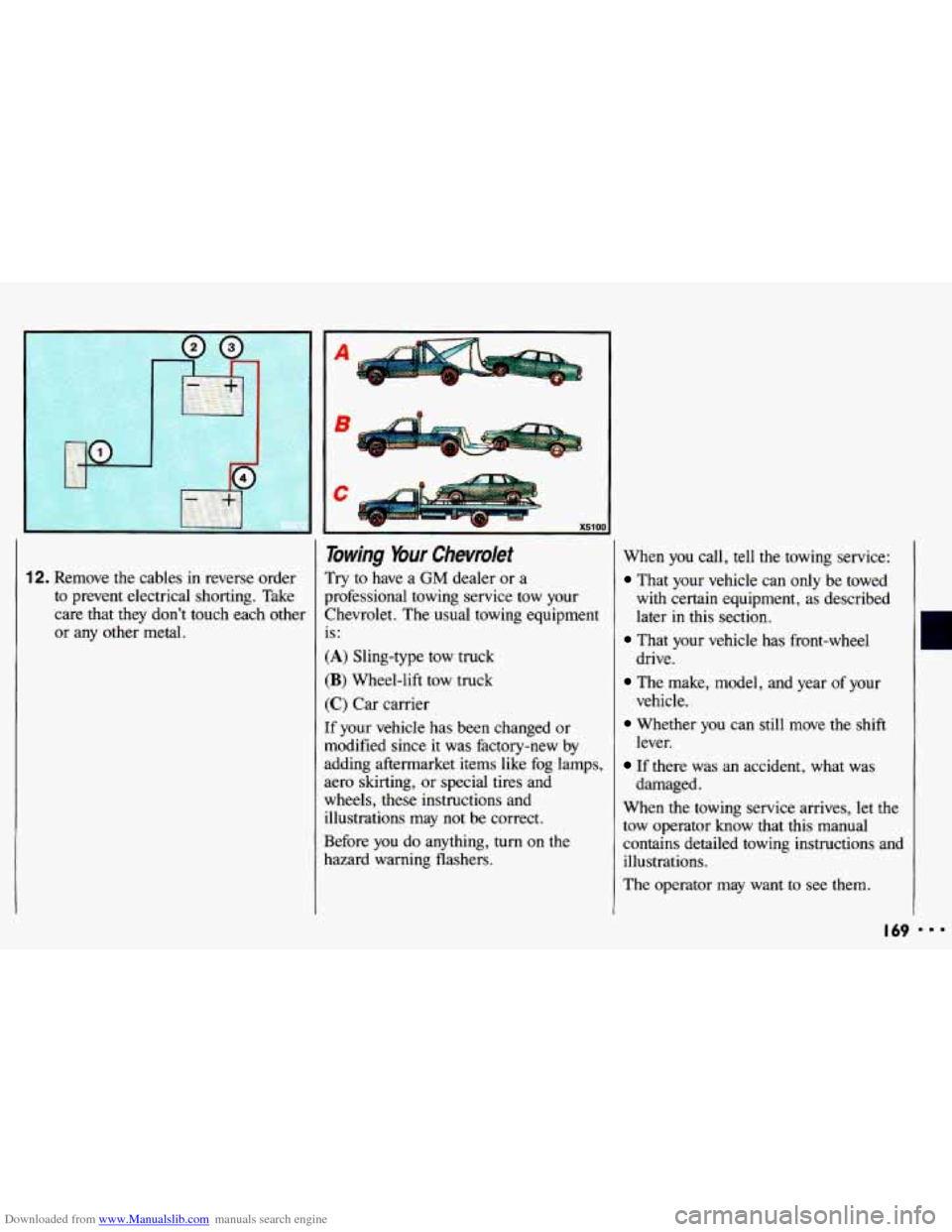
Towing Your Chevrolet
Try to have a GM dealer or a
professional towing service tow your
Chevrolet. The usual towing equipment
is:
(A) Sling-type tow truck
(B) Wheel-lift tow truck
(C) Car carrier
If your vehicle has been changed or
modified since it was factory-new by
adding aftermarket items like fog lamps,
aero skirting, or special tires and
wheels, these instructions and illustrations may not be correct.
Before you do anything, turn on the
hazard warning flashers. When
you call, tell the towing service:
That your vehicle can only be towed
with certain equipment,
as described
later
in this section.
drive.
vehicle. lever.
damaged.
That your vehicle has front-wheel
The make, model, and year of your
Whether you can still move the shift
If there was an accident, what was
When the towing service arrives, let the
tow operator know that this manual
contains detailed towing instructions and
illustrations.
The operator may want to see them.
I69
Page 186 of 308
Downloaded from www.Manualslib.com manuals search engine Problems on the Road
Zf a Tire Goes Flat
It’s unusual for a tire to “blow out”
while you’re driving, especially if you
maintain your tires properly.
If air goes
out of a tire, it’s much more likely
to
leak out slowly. But if you should ever
have a “blowout,” here are a few tips
about what to expect and what to do:
If a front tire fails, the flat tire will
create a drag that pulls the vehicle
toward that side. Take your foot off the accelerator pedal and grip the steering
wheel firmly. Steer to maintain lane
position, then gently brake
to a stop well
out of
the traffic lane.
I 84
A rear blowout, particularly on a curve,
acts much like a skid and may require
the same correction you’d use in a skid.
In any rear blowout, remove your foot
from the accelerator pedal. Get the
vehicle under control by steering the
way
you want the vehicle to go. It may
be very bumpy and noisy, but you can
still steer. Gently brake
to a stop, well
off the road
if possible.
If your tire goes flat, the next section
shows how
to use your jacking
equipment to change
a flat tire safely.
Changing a Flat Tire
If a tire goes flat, avoid further tire and
wheel damage by driving slowly to a
level place.
Turn on your hazard
warning flashers.
Page 194 of 308
Downloaded from www.Manualslib.com manuals search engine Problems on the Road
Compact Spare Tire (CONT.)
Don't use your compact spare on some
other vehicle.
And don't
mix your compact spare or
wheel with other wheels or tires. They
won't fit. Keep your spare and its wheel
together.
I92
Tire spare. chains Using won't them=! fit your compact ;$
your vehicle and destroy the chains""'"
too. Don't use tire chains on your
compact spare.
lf You're Stuck: In Sand, Mud,
lce or Snow
What you don't want to do when your
vehicle is stuck is to spin your wheels.
The method known as "rocking" can
help 'you get out when you're stuck, but
you must use caution.
Page 195 of 308
Downloaded from www.Manualslib.com manuals search engine If you let your tires spin at
- high speed, they can explode
and you or others could be injured.
And, the transaxle or other parts of
the vehicle can overheat. That could
cause an engine compartment fire
or other damage. When you’re
stuck, spin
the wheels as little as
possible. Don’t spin the wheels
above
35 mph (56 h/h) as shown
on
the speedometer. Spinning
your wheels can destroy
parts
of your vehicle as well as the
tires.
If you spin the wheels too
fast while shifting your transa:
back and forth, you can destroy
your transaxle.
-
Rocking Your Vehicle to Get it Out:
First, turn your steering wheel left and
right. That will clear the area around
your front wheels. Then shift back and
forth between
R (Reverse) and a
forward gear, or with a manual
transaxle, between
1 (First) or 2 (Second)
gear and
R (Reverse), spinning the
wheels as little as possible. Release
the
accelerator pedal while you shift, and
press lightly on the accelerator pedal
when the transaxle is in gear. If that
doesn’t get you out after a few tries,
you
may need to be towed out.
If
you do need to be towed out, see the
Index under Towing Your Chevrolet.
I93
Page 197 of 308
Downloaded from www.Manualslib.com manuals search engine i
.....
.................................. ...................
........ ... . &5
..... ..... .... .. --
' . I .. ~
Here you wit1 find information
about the care
of your Chevrolet .
This part begins with service and
fuel information. and then
it shows
how to check important fluid and
lubricant levels
. There is also
technical information about your
vehicle. and
a section devoted to its
appearance care
.
Part 6
Service & Appearance Care
Service ......................................................... 196
Fuel ........................................................... 197
HoodRelease
.................................................... 201
EngineOil
...................................................... 205
Aircleaner
..................................................... 209
Transaxle Fluid
................................................... 211
Engine Coolant
................................................... 216
Power Steering Fluid
.............................................. 219
Windshield Washer Fluid
........................................... 220
Brakes
......................................................... 221
Battery
......................................................... 223
BulbReplacement
................................................ 224
Windshield Wiper Blade Replacement
................................. 227
Loading
Your Vehicle ............................................. 227
Vehicle Identification Number (VIN)
................................. 246
Add-on Electrical Equipment
....................................... 247
Fuses
& Circuit Breakers ........................................... 247
Capacities & Specifications ......................................... 250
Fluids & Lubricants ............................................... 252
Replacement Bulbs
............................................... 253
Engine Specifications
............................................. 255
Normal Maintenance Replacement
Parts ............................... 256
Tires .......................................................... 229
Appearancecare
................................................. 236
I95
Page 229 of 308
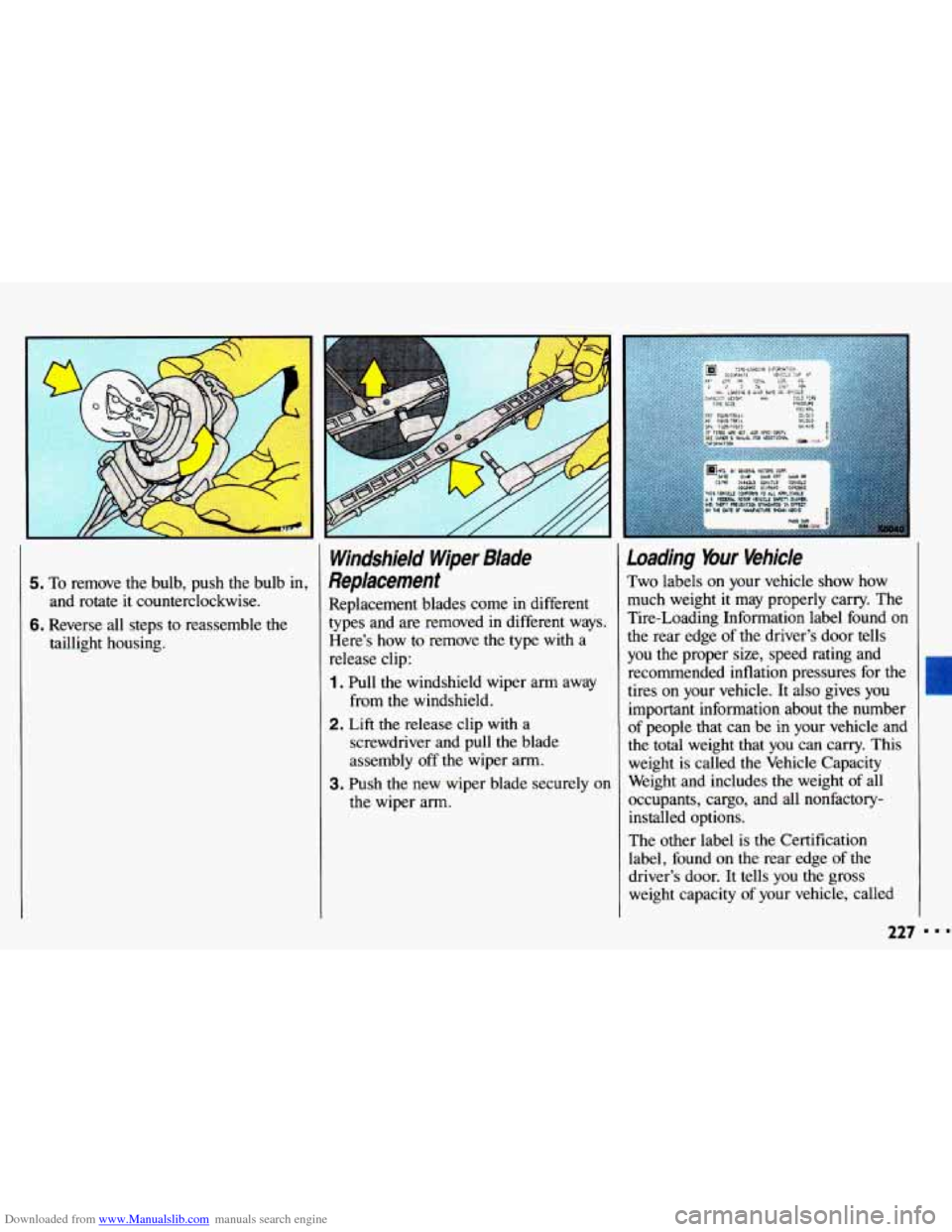
Downloaded from www.Manualslib.com manuals search engine 5. To remove the bulb, push the bulb in,
and rotate it counterclockwise.
6. Reverse all steps to reassemble the
taillight housing.
Windshield Wiper Blade
Replacement
Replacement blades come in different
types and are removed in different ways.
Here’s how
to remove the type with a
release clip:
1. Pull the windshield wiper arm away
2. Lift the release clip with a
from the windshield.
screwdriver and pull the blade
assembly
off the wiper arm.
the wiper arm.
3. Push the new wiper blade securely on
Loading %ur Vehicle
Two labels on your vehicle show how
much weight it may properly carry. The
Tire-Loading Information label found
on
the rear edge of the driver’s door tells
you the proper size, speed rating and
recommended inflation pressures for the
tires on your vehicle. It also gives
you
important information about the number
of people
that can be in your vehicle and
the total weight that you can carry. This
weight
is called the Vehicle Capacity
Weight and includes the weight
of all
occupants, cargo, and all nonfactory- installed options.
The other label
is the Certification
label, found on the rear edge of the
driver’s door. It tells you the gross
weight capacity
of your vehicle, called
I
227
Page 231 of 308
Downloaded from www.Manualslib.com manuals search engine 1--
-
Things you=
strike and injure
people in
a sudden stop or turn, or
in
a crash.
Put things in the trunk or rear
area
of your vehicle. In a trunk,
put them as hr forward as you
can.
Try to spread the weight
evenly.
If you have fold-down
rear seats, you’ll find four
anchors on the back wall
of your
trunk.
You can use these anchors
to tie down lighter loads. They’re
not strong enough for
heavy
things, however, so put them as
fbr forward
as you can in the
trunk or rear area.
Never stack heavier things, like
suitcases, inside the vehicle
so
that some of them are above the
tops
of the seats.
e When you carry something
inside the vehicle, secure it
whenever you can.
unless you need to.
0 Don’t leave a seat folded down
I
Tires
We don’t make tires. Your new vehicle comes with high quality tires made by a
leading tire manufacturer. These tires are warranted by the tire manufacturers and
their warranties are delivered with every
new Chevrolet. If your spare tire is a
different brand than your road tires,
you will have a tire warranty folder from each
of these manufacturers.
I I
CAUTION
Poorly maintained and improperly used tires are dangerous. 1
’ - Overloading your tires can cause overheating as a result of too much
friction. You could have
an air-out and a serious accident. See the Index
under hading Your Vehicle.
Underinflated tires pose the same danger as overloaded tires. The resulting
accident could cause serious injury. Check all tires frequently to maintain
the recommended pressure. Tire pressure should be checked
when your
tires
are cold.
sudden impact:
such as when you hit a pothole. Keep tires at the
recommended pressure.
I Overinflated tires are more likely to be cut, punctured, or broken by a
Worn, old tires can cause accidents. If your tread is badly worn, or if your
I tires have been damaged, replace them. I
229
I
I..