tow CHEVROLET CAVALIER 1993 1.G User Guide
[x] Cancel search | Manufacturer: CHEVROLET, Model Year: 1993, Model line: CAVALIER, Model: CHEVROLET CAVALIER 1993 1.GPages: 308, PDF Size: 15.62 MB
Page 111 of 308
Downloaded from www.Manualslib.com manuals search engine i; . ... ..- -. . ,' $,
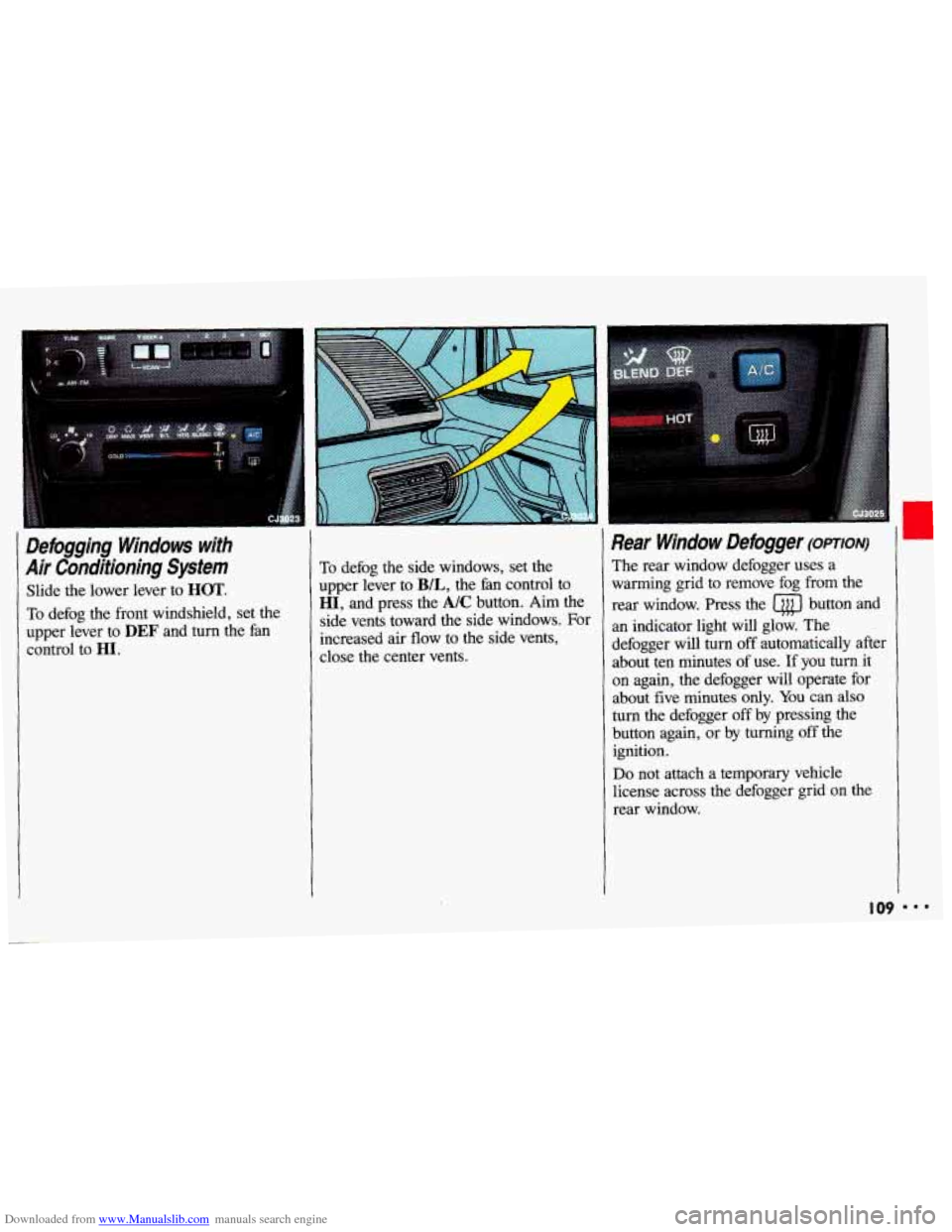
Defogging Windows with
Air Conditioning System
Slide the lower lever to HOT.
To defog the front windshield, set the
upper lever to
DEF and turn the fan
control to HI.
To defog the side windows, set the
upper lever to
B/L, the fan control to
HI, and press the A/C button. Aim the
side vents toward the side windows. For
increased air flow to the side vents,
close the center vents.
Rear Window Defogger (omoN)
The rear window defogger uses a
warming grid to remove fog from the
rear window. Press the
a button and
an indicator light will glow. The
defogger will turn
off automatically after
about ten minutes of use. If you
turn it
on again, the defogger will operate for
about five minutes
only. You can also
turn the defogger off by pressing the
button again, or by turning off the
ignition.
Do not attach a temporary vehicle
license across the defogger grid on
the
rear window.
I09 I..
Page 125 of 308
Downloaded from www.Manualslib.com manuals search engine Part 4
Here you’ll find information about
driving on different kinds of roads
and in varying weather conditions
.
We’ve also included many other
useful tips on driving
.
Your Driving and the Road
Roadsigns ...................................................... 124
Defensive Driving ................................................ 128
Drunken Driving ................................................. 129
Control of a Vehicle ............................................... 131
Braking ....................................................... 132
Anti-Lock Brakes ............................................... 134
Steering Tips ................................................... 138
Steering in Emergencies .......................................... 139
Passing ....................................................... 140
DrivingatNight
.................................................. 143
Driving in the Rain ............................................... 145
Driving in Fog, Mist and Haze ...................................... 148
CityDriving ...................................................... 149
Freeway Driving ................................................. 150
Driving a Long Distance ........................................... 152
HillandMountainRoads ........................................... 154
ParkingonHills .................................................. 155
Winter Driving ................................................... 157
TowingaTrailer .................................................. 161
I23
Page 130 of 308
Downloaded from www.Manualslib.com manuals search engine Your Driving and the Road
Defensive Driving
The best advice anyone can give about
driving is: Drive defensively.
Please
start with a very important safety
device in your Chevrolet: Buckle up. (See the
Index under Safety Belts.)
Defensive driving really means “be
ready for anything.” On city streets, rural roads, or freeways, it means
“always expect the unexpected.”
Assume that pedestrians or other drivers
are going to be careless and make
mistakes. Anticipate what they might do. Be ready for their mistakes.
Expect children to dash out from behind
parked cars, often followed by other
children. Expect occupants in parked
cars to open doors into traffic. Watch for movement in parked cars-someone
may be about to open a door.
213
Expect other drivers to run stop signs
when you are on a through street. Be
ready to brake if necessary as you go
through intersections. You may not have
to use the brake, but if you do, you will
be ready.
If you’re driving through a shopping
center parking lot where there are well-
marked lanes, directional arrows, and
designated parking areas, expect some
drivers to ignore
all these markings and
dash straight toward one part of the lot.
Pedestrians can be careless. Watch for
them.
In general, you must give way to
pedestrians even if you know you have
the right of way.
Rear-end collisions are about the most
preventable of accidents. Yet they are
common. Allow enough following distance. It’s the best defensive driving
maneuver, in both city and
rural
driving.
You never know when the
vehicle in front of you is going
to brake
or turn suddenly.
Here’s a final bit
of information about
defensive driving. The most dangerous
time for driving in the
U.S. is very early
on Sunday morning.
In fact, GM
Research studies show that the most and
the least dangerous times for driving,
every week, fall on the same day. That
day is Sunday. The most dangerous time
is Sunday from
3 a.m. to 4 a.m. The
safest time is Sunday from
10 a.m. to
11 a.m. Driving the same distance on a
Sunday at
3 a.m. isn’t just a little more
dangerous than it is at
10 a.m. It’s about
134 times more dangerous!
That leads to the next section.
Page 153 of 308
Downloaded from www.Manualslib.com manuals search engine If you are moving from an outside to a
center lane on a freeway having more
than two lanes, make sure another vehicle isn’t about to move into the same
spot. Look at the vehicles two lanes
over and watch for telltale signs: turn
signals flashing, an increase in speed, or
moving toward the edge of the lane. Be
prepared
to delay your move.
Once you are moving on the freeway,
make certain you allow a reasonable
following distance. Expect to move
slightly slower at night.
Leaving the Freeway
When you want to leave the freeway,
move to the proper lane well in advance.
Dashing across lanes at the last minute
is dangerous. If you
miss your exit do
not, under any circumstances, stop and
back up. Drive on to the next exit.
At each exit point is
a deceleration lane.
Ideally it should be long enough for you
to enter it at freeway speed (after
signaling, of course) and then do your
braking before moving onto the exit
ramp. Unfortunately, not all deceleration
lanes
are long enough-some are too
short for all the braking. Decide when
to start braking. If you must brake on
the through lane, and if there is traffic
close behind you, you can allow a little extra
time and flash your brake lights (in
addition to your turn signal) as extra
warning that you are about to slow
down and exit.
The exit ramp can be curved, sometimes
quite sharply. The exit speed is usually
posted. Reduce your speed according to
your speedometer, not to your sense
of
motion. After driving for any distance at
higher speeds, you may tend to think
you are going slower than you actually
are. For example,
40 mph (65 km/h)
might seem like only
20 mph (30 km/h).
Obviously, this could lead to serious
trouble on a ramp designed for
20 mph
(30 km/h)!
I51
Page 156 of 308
Downloaded from www.Manualslib.com manuals search engine Your Driving and the Road
mmm ‘I
”- .
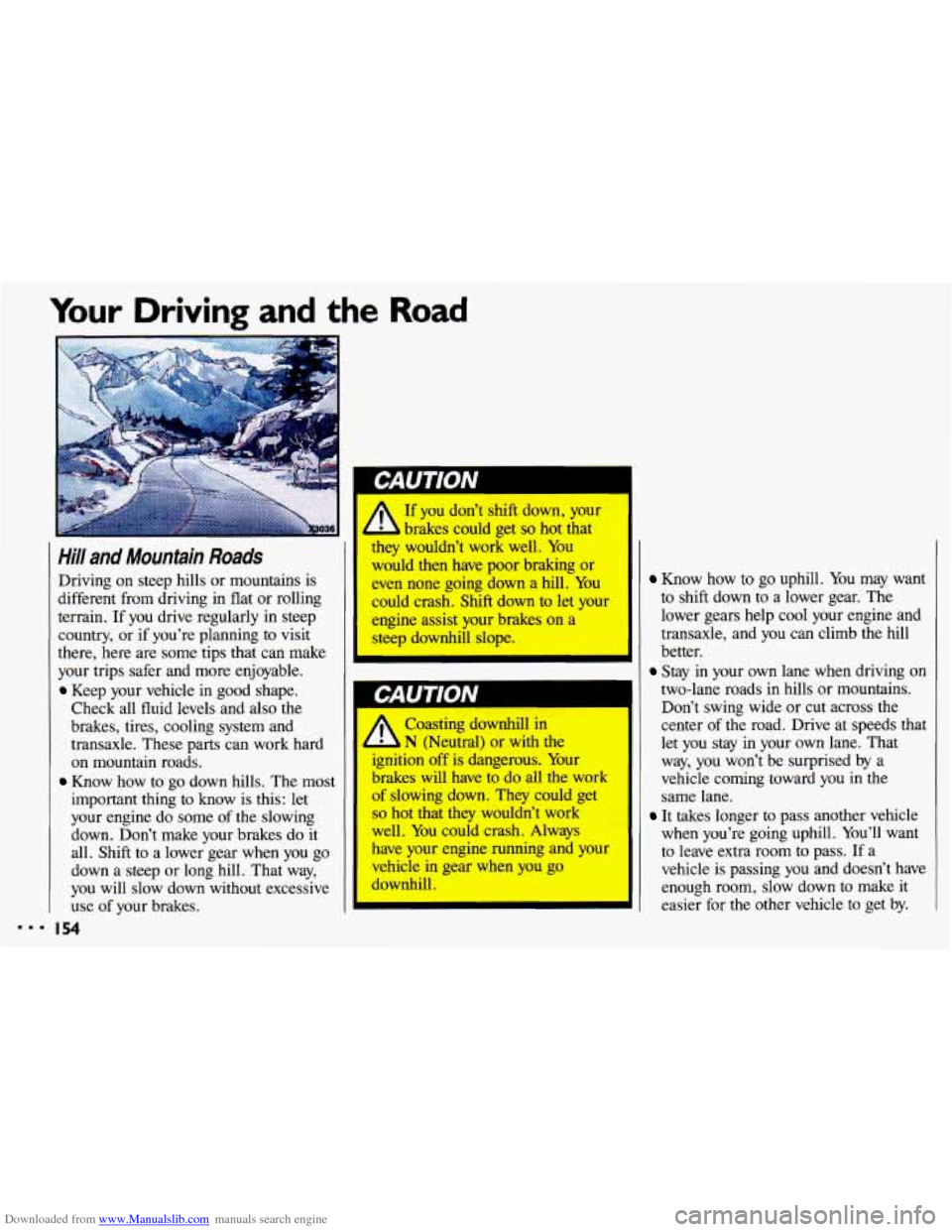
Hill and Mountain Roads
Driving on steep hills or mountains is
different from driving in flat or rolling
terrain. If you drive regularly in steep
country, or if you’re planning to visit
there, here are some tips that can make
your trips safer and more enjoyable.
Keep your vehicle in good shape.
Check all fluid levels and
also the
brakes, tires, cooling system and
transaxle. These parts can work hard
on mountain roads.
Know how to go down hills. The most
important thing to know is this: let
your engine do some
of the slowing
down. Don’t make your brakes do it
all. Shift to a lower gear when you go
down a steep or long hill. That way,
you will slow down without excessive use of your brakes.
I 54
r If you don’t shift down, your
brakes could get
so hot that
they wouldn’t work well. You
would then have poor braking or
even none going down a hill. You
could crash. Shift down to let your
engine assist your brakes on a
steep downhill slope.
Coasting downhill in
N (Neutral) or with the
ignition
off is dangerous. Your
brakes will have
to do all the work
of slowing down. They could get
so hot that they wouldn’t work
well.
You could crash. Always
have
your engine running and your
vehicle in gear when you go
downhill.
Know how to go uphill. You may want
to shift down to a lower gear. The
lower gears help cool your engine and
transaxle, and
you can climb the hill
better.
Stay in your own lane when driving on
two-lane roads in hills or mountains.
Don’t swing wide or cut across the
center of the road. Drive at speeds that
let you stay in your own lane. That
way, you won’t be surprised by a
vehicle coming toward you in the
same lane.
It takes longer to pass another vehicle
when you’re going uphill. You’ll want
to leave extra room to pass.
If a
vehicle is passing you and doesn’t have
enough room, slow down to make it
~ easier for the other vehicle to get by.
Page 163 of 308
Downloaded from www.Manualslib.com manuals search engine Towing a nailer
Your Cavalier is neither designed nor
intended to tow a trailer.
Page 165 of 308
Downloaded from www.Manualslib.com manuals search engine Part 5
Problems on the Road
Hazard Warning Flashers .......................................... .164
Towing Your Chevrolet ........................................... .169
Engine Overheating
.............................................. ,174
If a Tire Goes Flat ............................................... .184
ComDact Spare Tire
.............................................. .191
Jumpstarting
....................................................164
ChangingaFlatTire .............................................. 184
If You’re
Stuck: In Sand, Mud, Ice or Snow ................... ...... .192
Here you’ll find what to do about
some problems that can occur on
the road.
I63
Page 171 of 308
Downloaded from www.Manualslib.com manuals search engine 12. Remove the cables in reverse order
to prevent electrical shorting. Take
care that they don't touch each other
or any other metal.
I
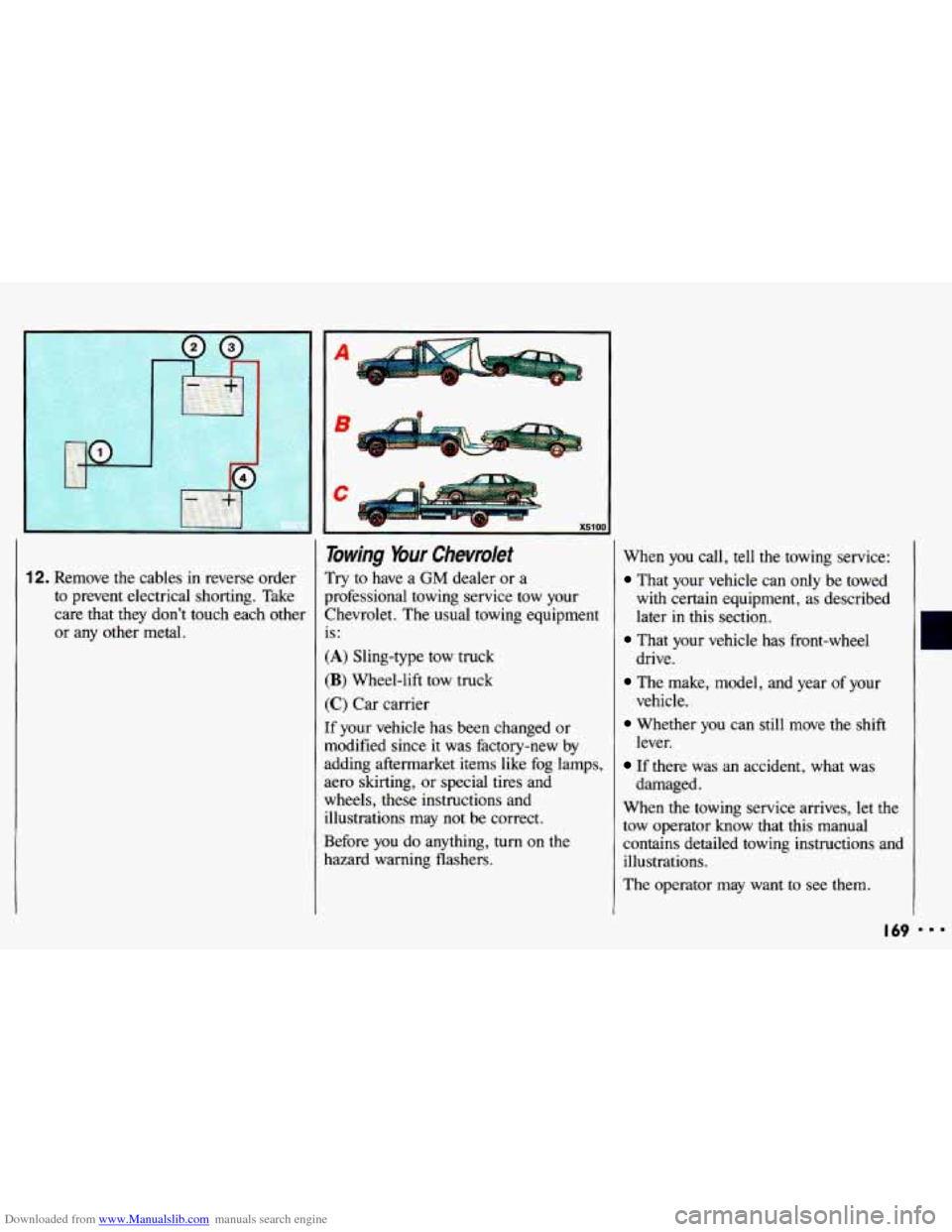
Towing Your Chevrolet
Try to have a GM dealer or a
professional towing service tow your
Chevrolet. The usual towing equipment
is:
(A) Sling-type tow truck
(B) Wheel-lift tow truck
(C) Car carrier
If your vehicle has been changed or
modified since it was factory-new by
adding aftermarket items like fog lamps,
aero skirting, or special tires and
wheels, these instructions and illustrations may not be correct.
Before you do anything, turn on the
hazard warning flashers. When
you call, tell the towing service:
That your vehicle can only be towed
with certain equipment,
as described
later
in this section.
drive.
vehicle. lever.
damaged.
That your vehicle has front-wheel
The make, model, and year of your
Whether you can still move the shift
If there was an accident, what was
When the towing service arrives, let the
tow operator know that this manual
contains detailed towing instructions and
illustrations.
The operator may want to see them.
I69
Page 172 of 308
Downloaded from www.Manualslib.com manuals search engine Problems on the Road
bwing Your Chevrolet (CONI)
To help avoid injury to you or
lers:
a Never let passengers ride in a
vehicle that is being towed.
a Never tow faster than safe or
posted speeds.
* Never tow with damaged parts
not fully secured.
* Never get under your vehicle after
it
has been lifted by the tow truck.
* Always use separate safety
chains on each side when towing
a vehicle.
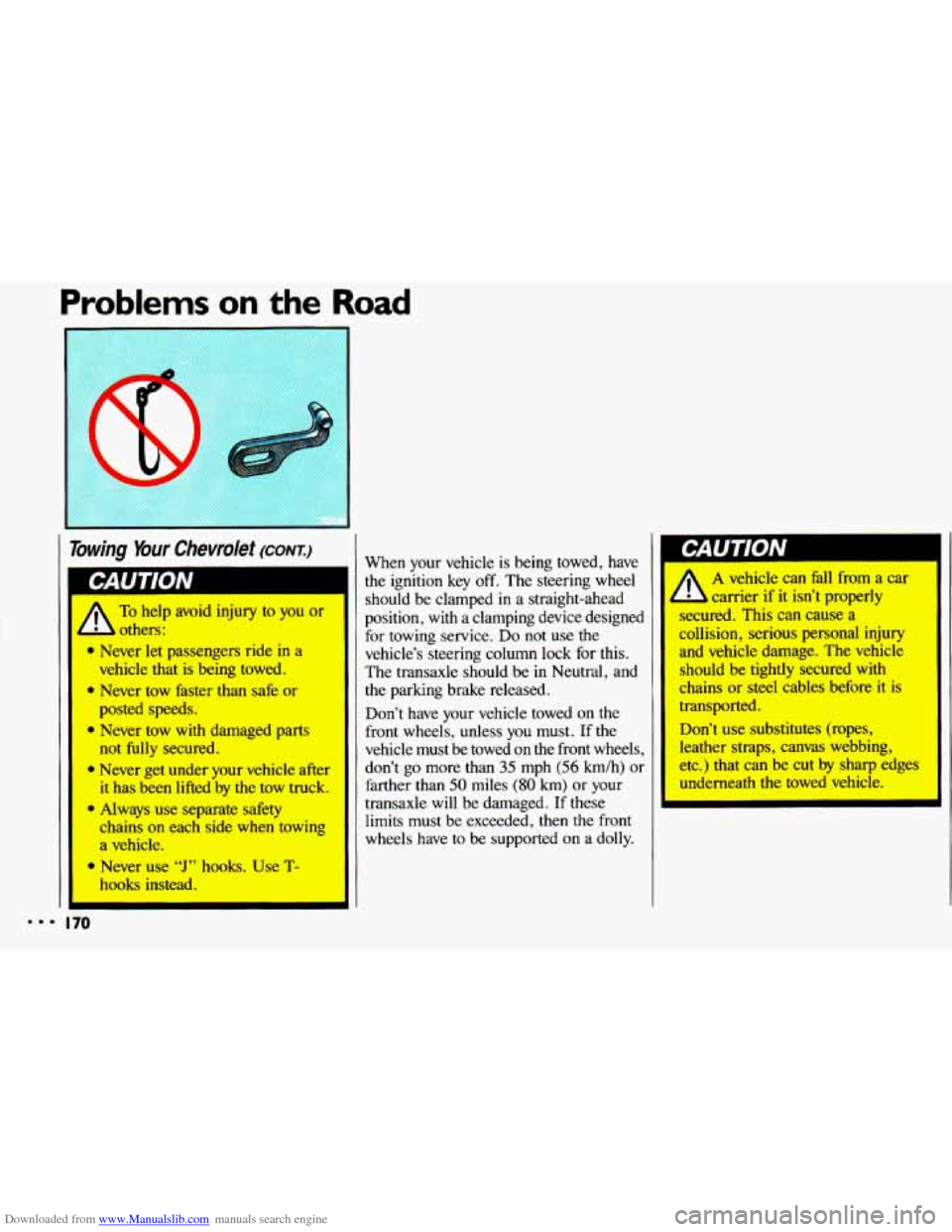
Never use
“J” hooks. Use T-
hooks instead.
the ignition key off. The steering wheel
should be clamped
in a straight-ahead
position,
with a clamping device designed
for towing service. Do not use the
vehicle’s steering column lock for this.
The transaxle should be
in Neutral, and
the parking brake released.
Don’t have your vehicle towed on the
front wheels, unless
you must. If the
vehicle must be towed on the front wheels,
don’t go more than
35 mph (56 km/h) or
farther than
50 miles (80 km) or your
transaxle will be damaged. If these
limits must be exceeded, then
the front
wheels have to be supported on a dolly.
p-AU I IUN I
A vehicle can fall from a car
carrier if it isn’t properly
secured. This can cause a
collision, serious personal injury
and vehicle damage. The vehicle
should be tightly secured with
chains or steel cables before it is
transported.
Don’t use substitutes (ropes,
leather straps, canvas webbing,
etc.) that can be cut
by sharp edges
underneath
the towed vehicle.
A
mmm 170
Page 173 of 308
Downloaded from www.Manualslib.com manuals search engine Towing from the Front-
Vehicle
Hook-Up
Before hooking up to a tow truck, be
sure to read all the information
in
Towing Your Chevrolet earlier in this
section.
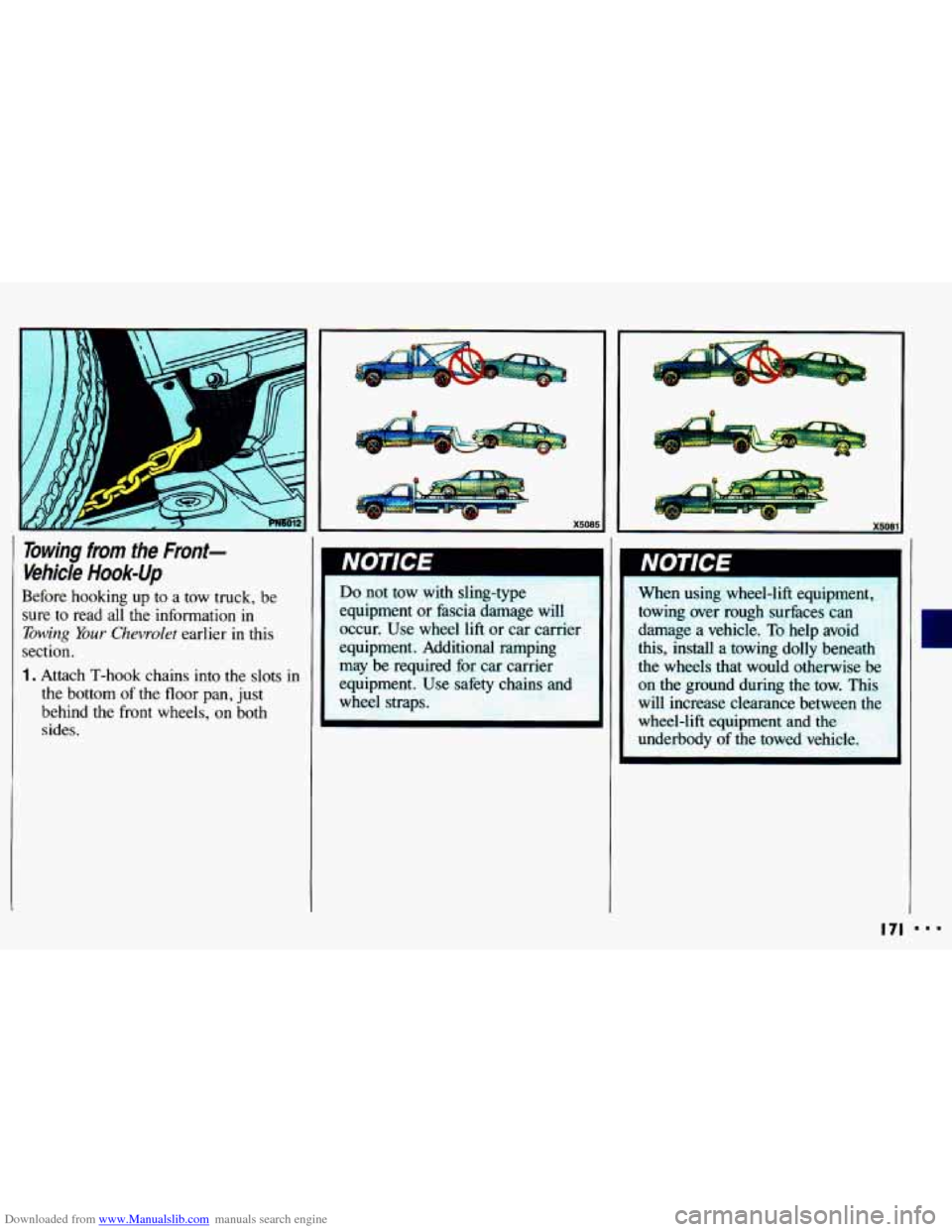
1. Attach T-hook chains into the slots in
the bottom of the floor pan, just
behind the front wheels, on both
sides.
Do not tow with sling-type
equipment or fascia damage will
occur. Use wheel lift
or car carrier
equipment. Additional ramping
may be required for car carrier
equipment. Use safety chains and
wheel straps.
I D m
I
When using wheel-lift equipmen1
towing over rough surfaces can
damage a vehicle.
To help avoid
this, install a towing dolly beneath
the wheels that would otherwise be
on the ground during the tow. This
will increase clearance between the wheel-lift equipment and
the
underbody of the towed vehicle.
I