tow CHEVROLET CAVALIER 1993 1.G Owner's Manual
[x] Cancel search | Manufacturer: CHEVROLET, Model Year: 1993, Model line: CAVALIER, Model: CHEVROLET CAVALIER 1993 1.GPages: 308, PDF Size: 15.62 MB
Page 174 of 308
Downloaded from www.Manualslib.com manuals search engine Problems on the Road
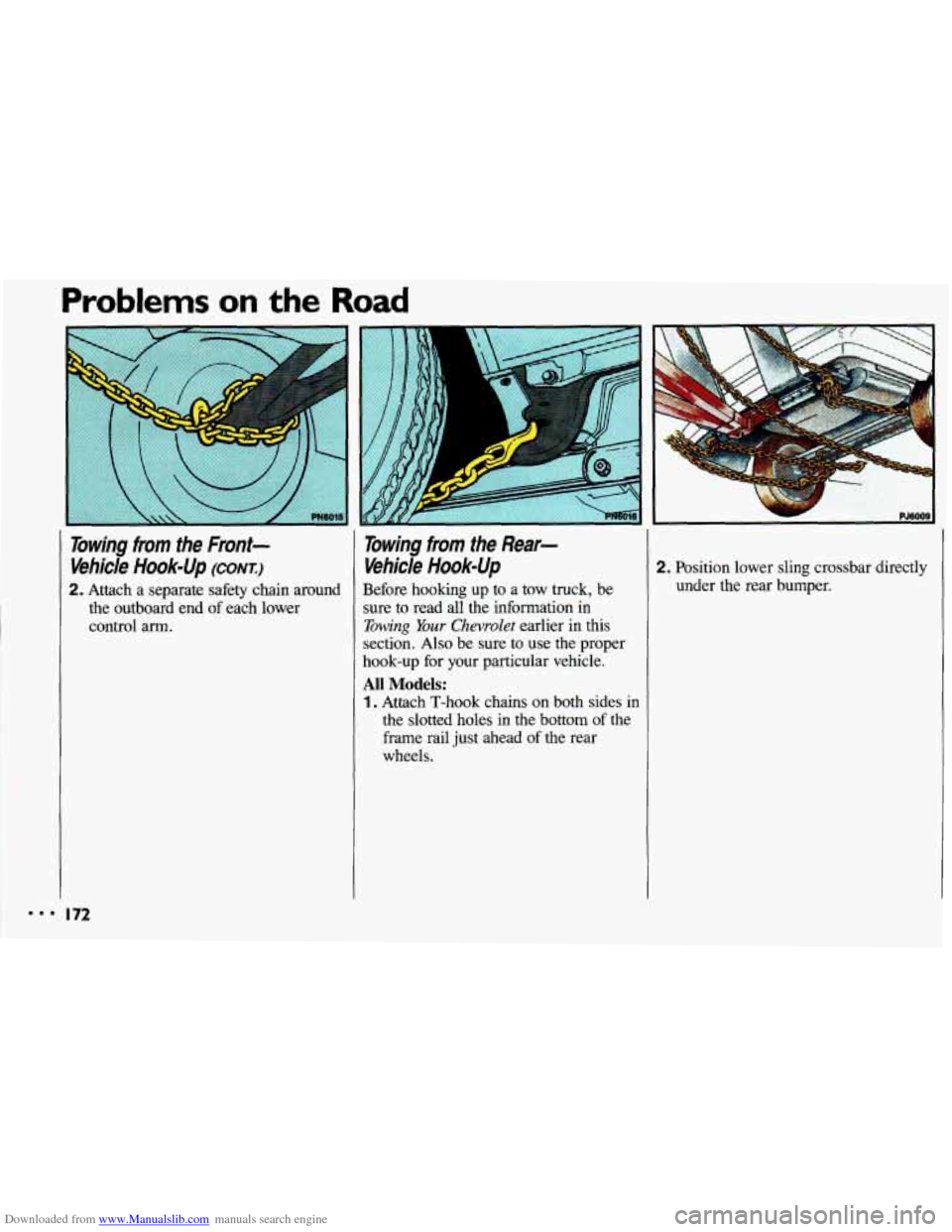
Towing from the Front- Vehicle
Hook-Up (CONT.)
2. Attach a separate safety chain around
the outboard end of each lower
control arm.
I 72
Towing from the Rear-
Vehicle
Hook-Up
Before hooking up to a tow truck, be
sure to read all the information in
Towing Your Chevrolet earlier in this
section. Also be sure to use the proper
hook-up for your particular vehicle.
All Models:
1. Attach T-hook chains on both sides in
the slotted holes in the bottom of the
frame rail just ahead of the rear
wheels.
2. Position lower sling crossbar directly
under the rear bumper.
Page 175 of 308
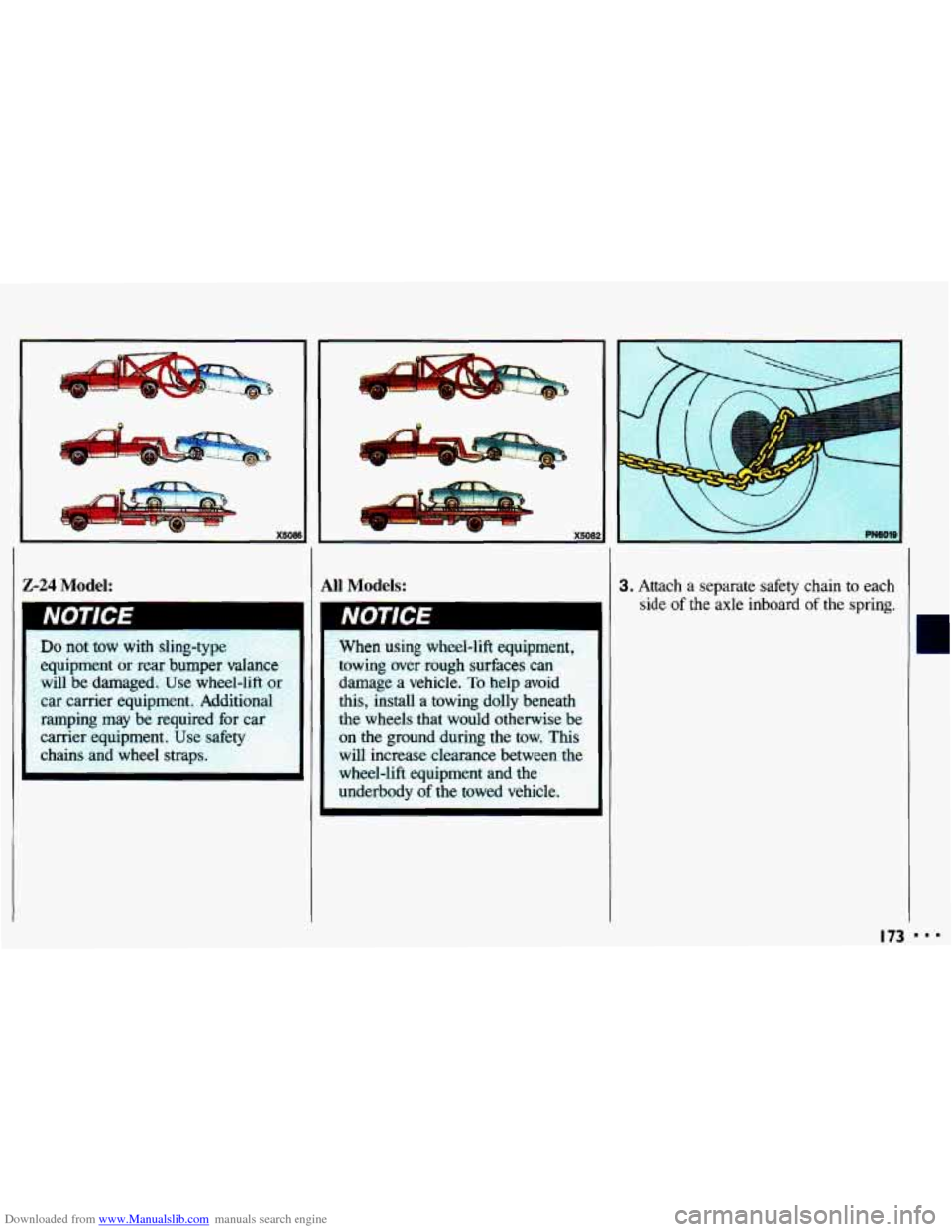
Downloaded from www.Manualslib.com manuals search engine 2-24 Model: All Models:
NOTICE I
men using.w~&l-lift equipment,
towing
over rough surfices can
damage a vehicle. To help avoid
this, install a towing dolly beneath
the wheels that would otherwise be
on the ground during the tow. This
will increase clearance between the wheel-lift equipment and the
underbody
of the towed vehicle. I
3. Attach a separate safety chain to each
side
of the axle inboard of the spring.
Page 178 of 308
Downloaded from www.Manualslib.com manuals search engine Problems on the Road
Engine Overheating (CONT.)
The coolant level should be at or above
FULL COLD. If it isn't, you may have
a leak
in the radiator hoses, heater
hoses, radiator, water pump
or
somewhere else in the cooling system.
II Heater and radiator hoses, and
L other engine parts, can be
very hot. Don't touch them. If you
do, you can be burned.
Don't run the engine if there is a
leak. If you run the engine, it
could
lose all coolant. That could
cause
an engine fire, and you could
be burned. Get any leak fixed
before you drive the vehicle.
Engine damage from running
your
engine without coolant isn't
covered by your warranty.
I
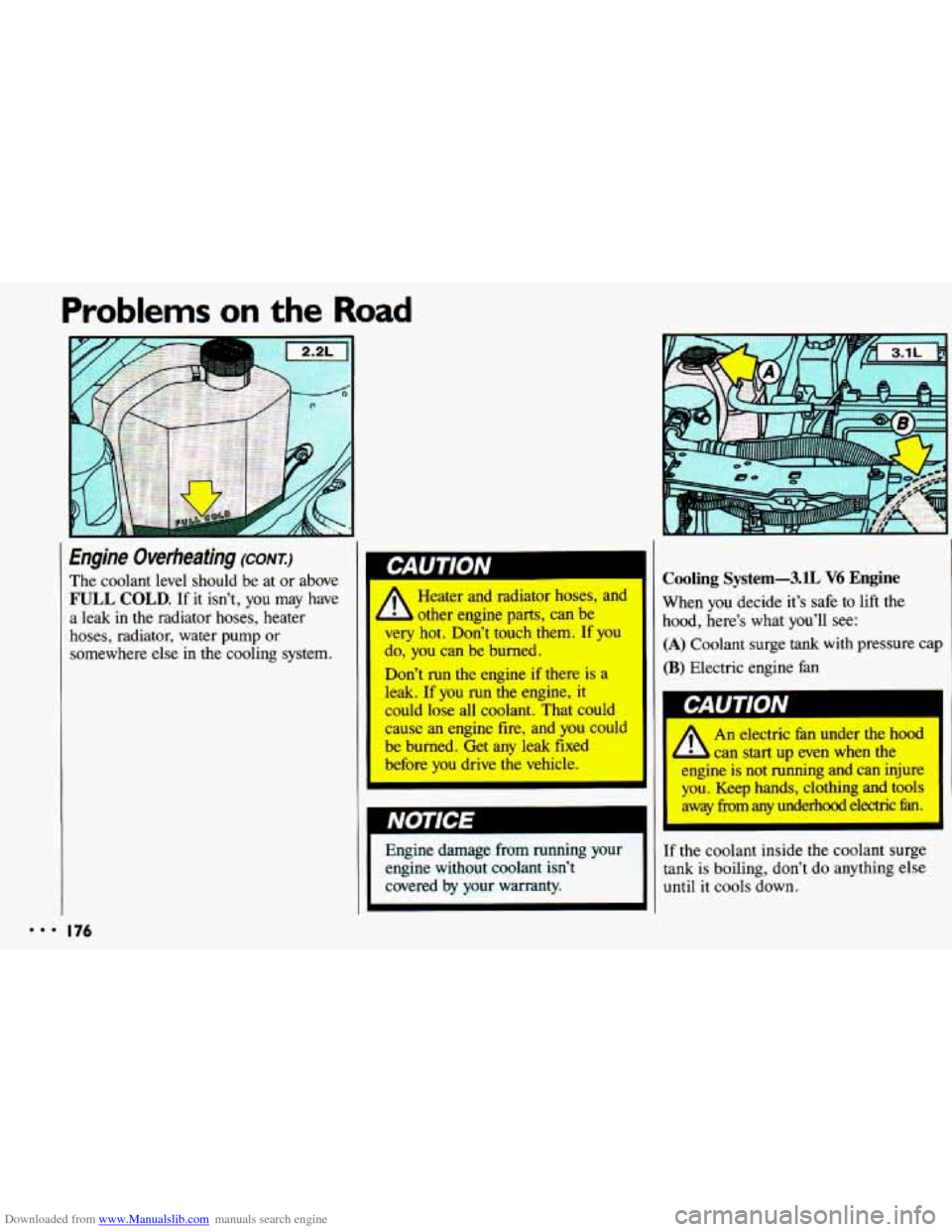
Cooling System-3.1L V6 Engine
When you decide it's safe to lift the
hood, here's what you'll see:
(A) Coolant surge tank with pressure cap
(B) Electric engine fan
An electric fan under the hood
L can start up even when the
engine
is not running and can injl
you. Keep hands, clothing and tows
away hm any underhood electric f8n. I
If the coolant inside the coolant surge
tank is boiling, don't do anything else
until it cools down.
I.. I76
Page 186 of 308
Downloaded from www.Manualslib.com manuals search engine Problems on the Road
Zf a Tire Goes Flat
It’s unusual for a tire to “blow out”
while you’re driving, especially if you
maintain your tires properly.
If air goes
out of a tire, it’s much more likely
to
leak out slowly. But if you should ever
have a “blowout,” here are a few tips
about what to expect and what to do:
If a front tire fails, the flat tire will
create a drag that pulls the vehicle
toward that side. Take your foot off the accelerator pedal and grip the steering
wheel firmly. Steer to maintain lane
position, then gently brake
to a stop well
out of
the traffic lane.
I 84
A rear blowout, particularly on a curve,
acts much like a skid and may require
the same correction you’d use in a skid.
In any rear blowout, remove your foot
from the accelerator pedal. Get the
vehicle under control by steering the
way
you want the vehicle to go. It may
be very bumpy and noisy, but you can
still steer. Gently brake
to a stop, well
off the road
if possible.
If your tire goes flat, the next section
shows how
to use your jacking
equipment to change
a flat tire safely.
Changing a Flat Tire
If a tire goes flat, avoid further tire and
wheel damage by driving slowly to a
level place.
Turn on your hazard
warning flashers.
Page 191 of 308
Downloaded from www.Manualslib.com manuals search engine Ll X5076
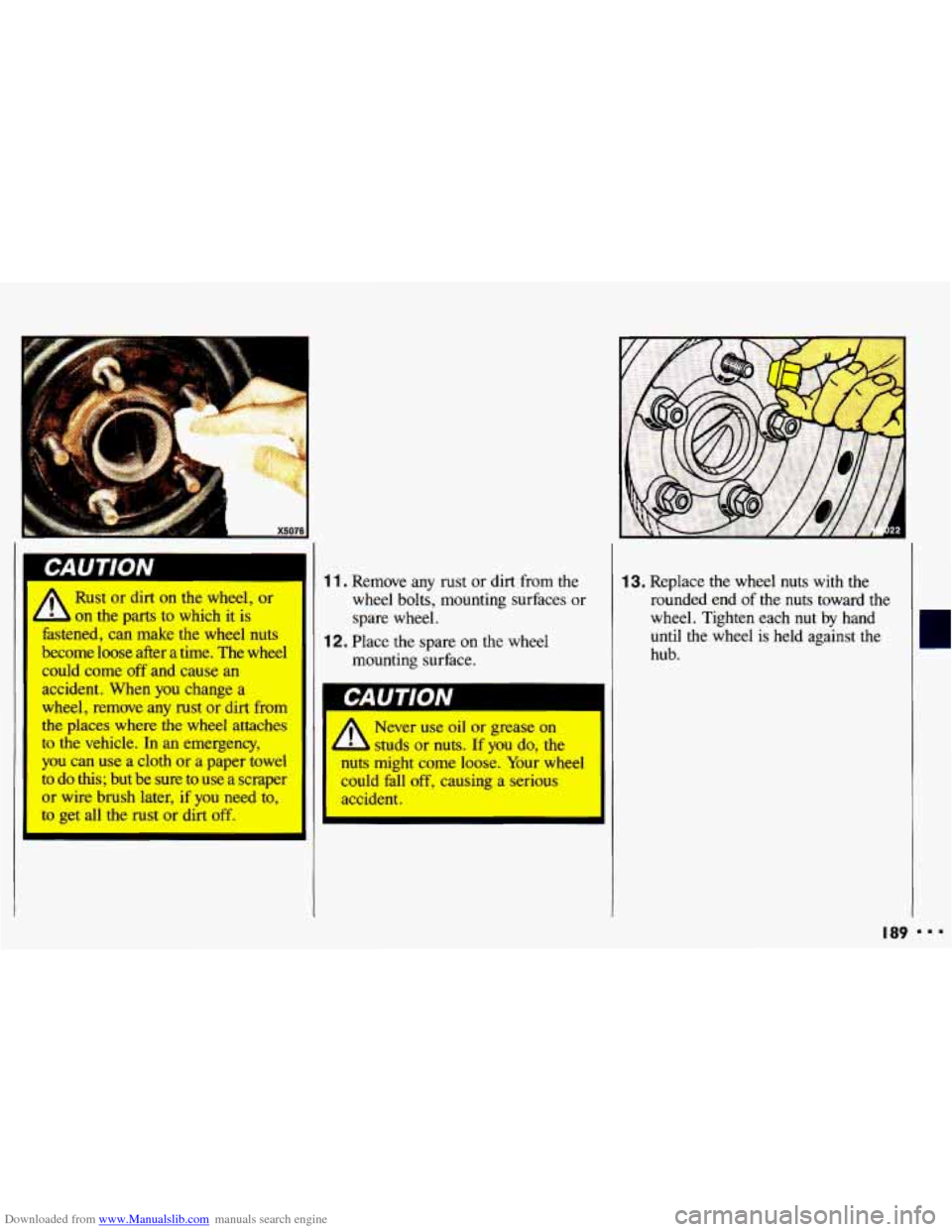
Rust or dirt on the wheel, or
on the parts to which it is
fastened, can make the wheel nuts
become loose after a time. The wheel
could come off and cause an
accident. When
you change a
wheel, remove any rust
or dirt from
the places where the wheel attaches
to the vehicle. In an emergency,
you can use a cloth
or a paper towel
to do this; but be sure to use a scraper
or wire brush later, if you need to,
to get all the rust or dirt off.
1 1. Remove any rust or dirt from the
wheel bolts, mounting surfaces or
spare wheel.
mounting surface.
1 2. Place the spare on the wheel
~ CAUTION
13. Replace the wheel nuts with the
rounded end of the nuts toward the
wheel. Tighten each nut by hand
until
the wheel is held against the
hub.
A
Never use oil or grease on
studs or nuts. If
you do, the
nuts might come loose. Your wheel
could fall off, causing a serious
accident.
I89
Page 195 of 308
Downloaded from www.Manualslib.com manuals search engine If you let your tires spin at
- high speed, they can explode
and you or others could be injured.
And, the transaxle or other parts of
the vehicle can overheat. That could
cause an engine compartment fire
or other damage. When you’re
stuck, spin
the wheels as little as
possible. Don’t spin the wheels
above
35 mph (56 h/h) as shown
on
the speedometer. Spinning
your wheels can destroy
parts
of your vehicle as well as the
tires.
If you spin the wheels too
fast while shifting your transa:
back and forth, you can destroy
your transaxle.
-
Rocking Your Vehicle to Get it Out:
First, turn your steering wheel left and
right. That will clear the area around
your front wheels. Then shift back and
forth between
R (Reverse) and a
forward gear, or with a manual
transaxle, between
1 (First) or 2 (Second)
gear and
R (Reverse), spinning the
wheels as little as possible. Release
the
accelerator pedal while you shift, and
press lightly on the accelerator pedal
when the transaxle is in gear. If that
doesn’t get you out after a few tries,
you
may need to be towed out.
If
you do need to be towed out, see the
Index under Towing Your Chevrolet.
I93
Page 207 of 308
Downloaded from www.Manualslib.com manuals search engine Engine Oil
It’s a good idea to check your engine oil
level every time
you get fuel. In order to
get an accurate reading, the
oil must be
warm and the vehicle must be on level
ground.
Turn off the engine and give the oil a
few minutes to drain back into the oil
pan. If you don’t, the oil dipstick might
not show
the actual level.
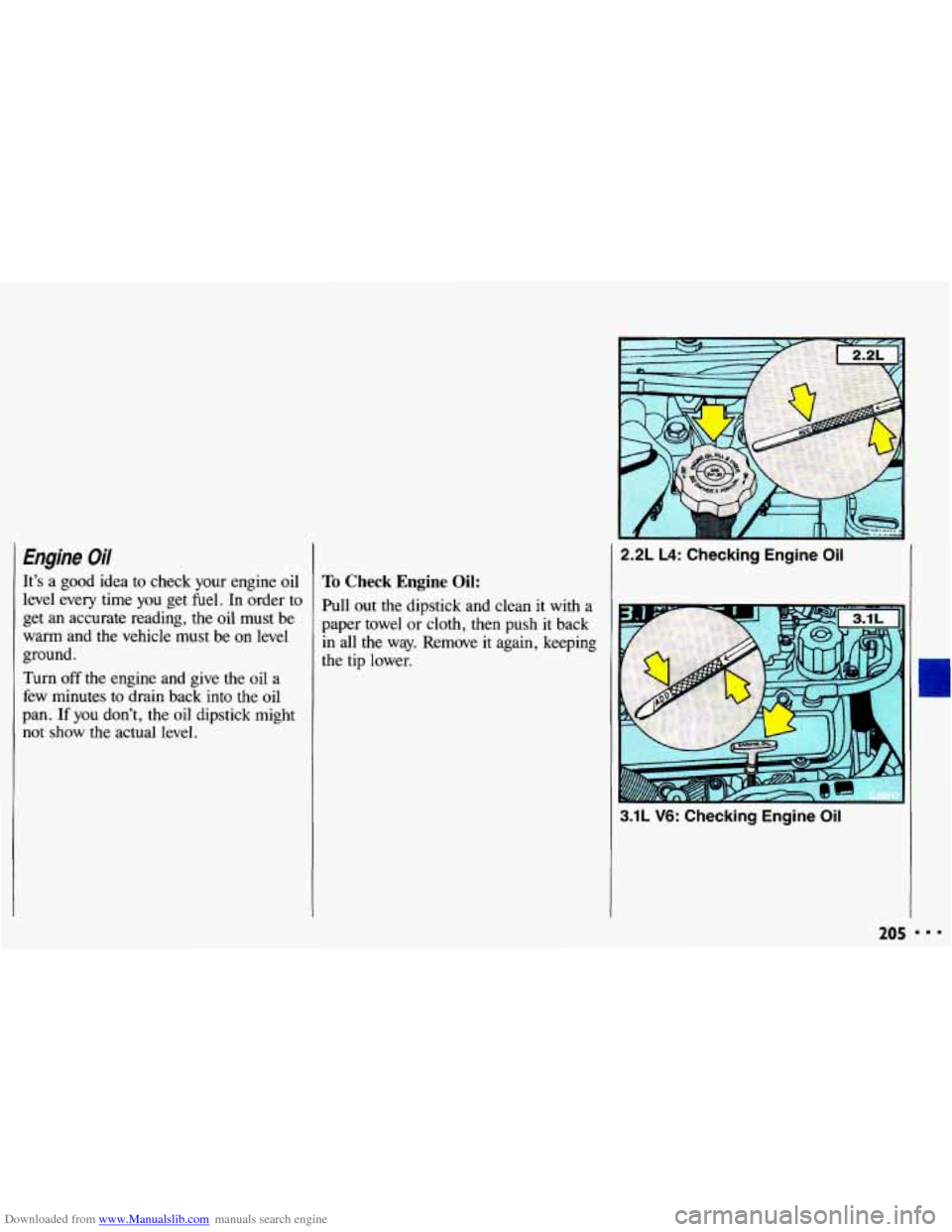
To Check Engine Oil:
Pull out the dipstick and clean it with a
paper towel or cloth, then push
it back
in all the way. Remove
it again, keeping
the tip lower.
2.2L L4: Checking Engine Oil
3.1L V6: Checking Engine Oil
205 I..
Page 214 of 308
Downloaded from www.Manualslib.com manuals search engine Service & Appearance Care
Automatic Transaxle Fluid (CONT.)
To Check the Fluid Level:
Park your vehicle on a level place.
Place the shift lever in P (Park) with
With your foot on the brake pedal,
the
parking brake applied.
move the shift lever through each gear
range, pausing for about three seconds
in each range. Then, position the shift
lever in
P (Park).
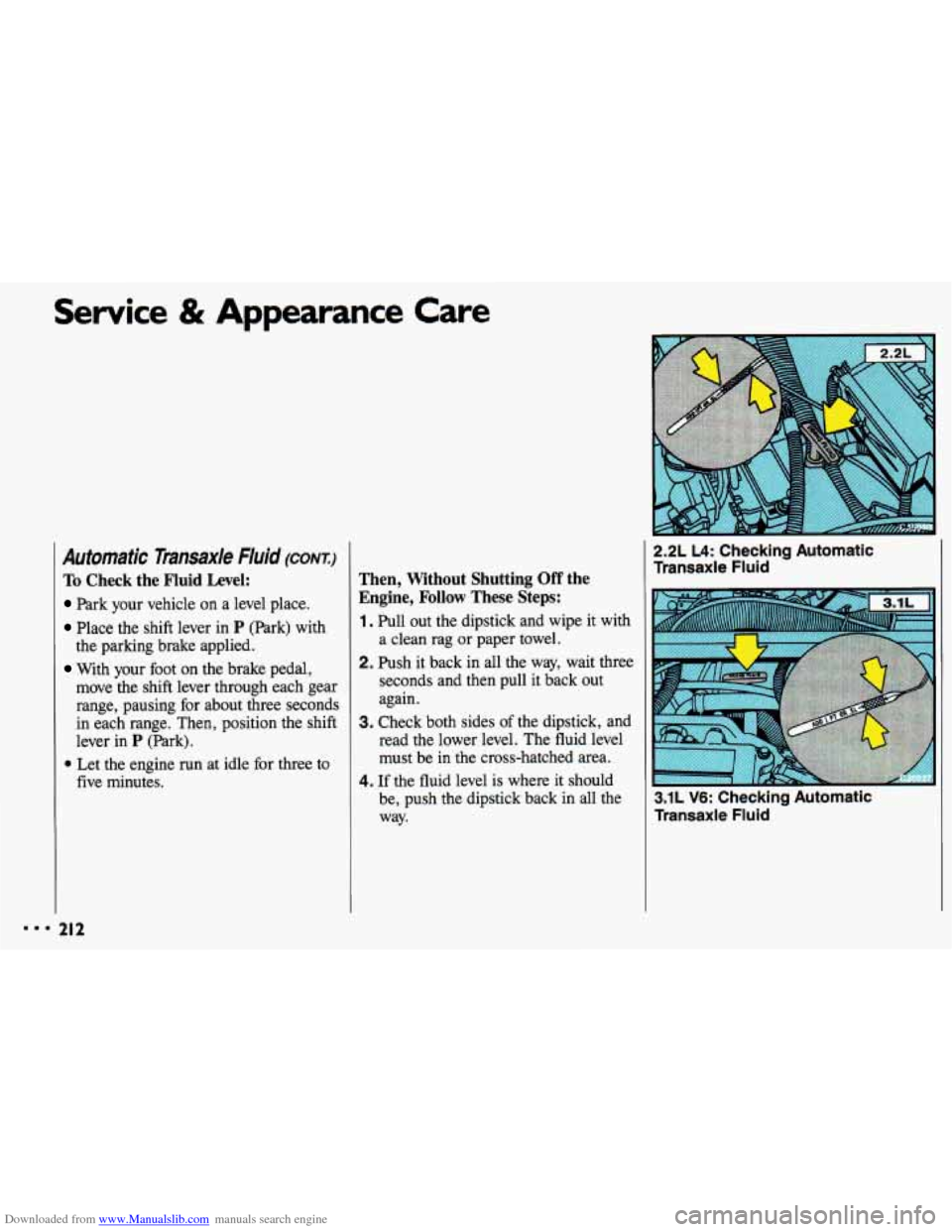
Then, Without Shutting Off the
Engine,
Follow These Steps:
1. Pull out the dipstick and wipe it with
a clean rag or paper towel.
2. Push it back in all the way, wait three
seconds and then pull it back out
again.
3. Check both sides of the dipstick, and
read the lower level. The fluid level
must be in the cross-hatched area.
4. If the fluid level is where it should
be, push the dipstick back in all the
way.
2.2L L4: Checking Automatic
Transaxle Fluid
3.1L V6: Checking Automatic
Transaxle Fluid
Page 216 of 308
Downloaded from www.Manualslib.com manuals search engine Service & Appearance Care
Manual Transax/e Fluid (CONT.)
How to Check: Because this operation
can be a little difficult, you may choose
to have this done at a Chevrolet
dealership Service Department.
If you do it yourself, be sure to follow
all the instructions here, or you could
get a false reading on the dipstick.
Too much or too little fluid can
damage your transaxle.
Too much
can mean that some
of the fluid
could come out and fall on hot
engine parts, starting a fire. Be
sure to get an accurate reading if
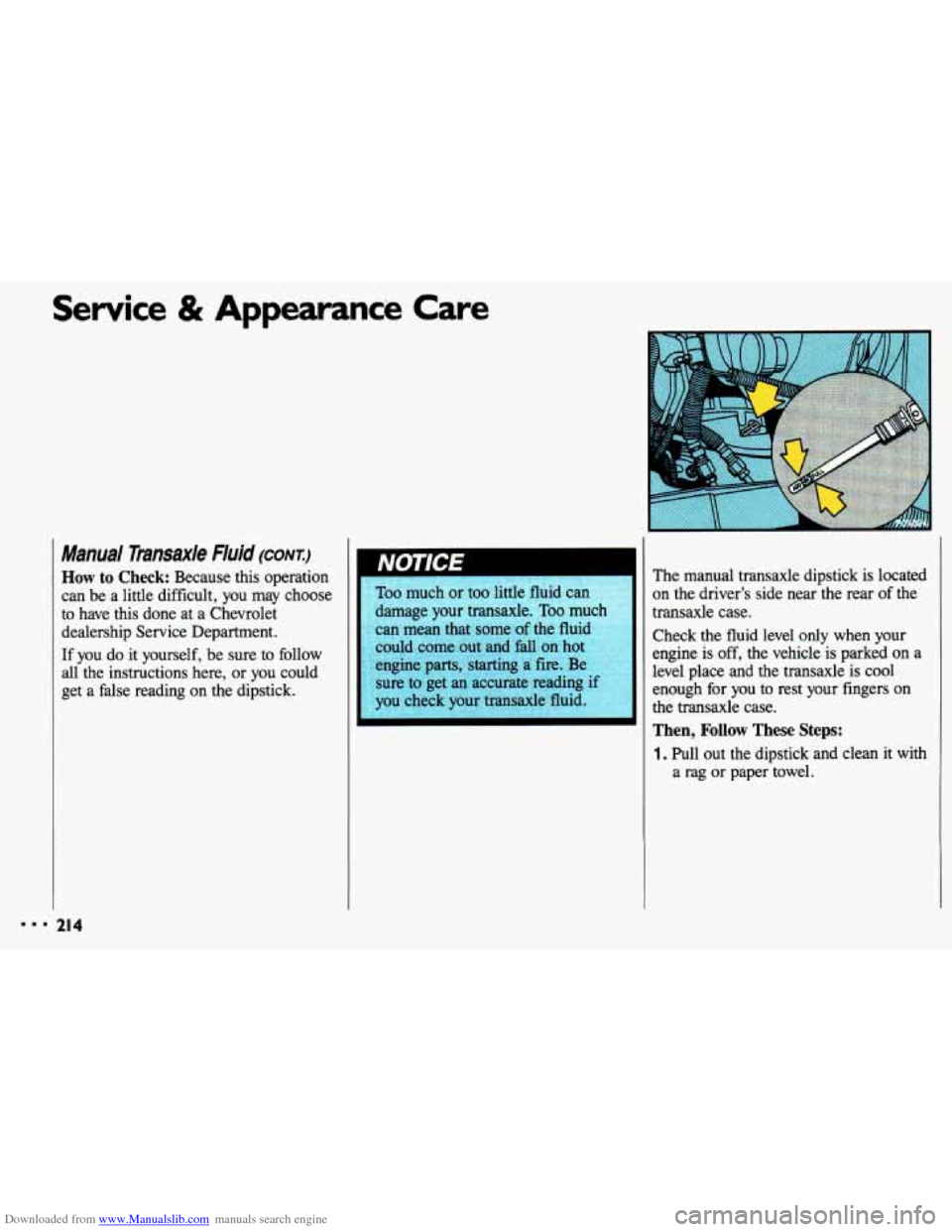
you check your transaxle fluid. The manual transaxle dipstick is located
on the driver’s side near the
rear
of the
transaxle case.
Check the fluid level only
when your
engine is off, the vehicle is parked on a
level place and the transaxle is cool
enough for you to rest your fingers
on
the transaxle case.
Then, Follow These Steps:
1. Pull out the dipstick and clean it with
a rag or paper towel.
Page 233 of 308
Downloaded from www.Manualslib.com manuals search engine Tire hspection and Rotation I
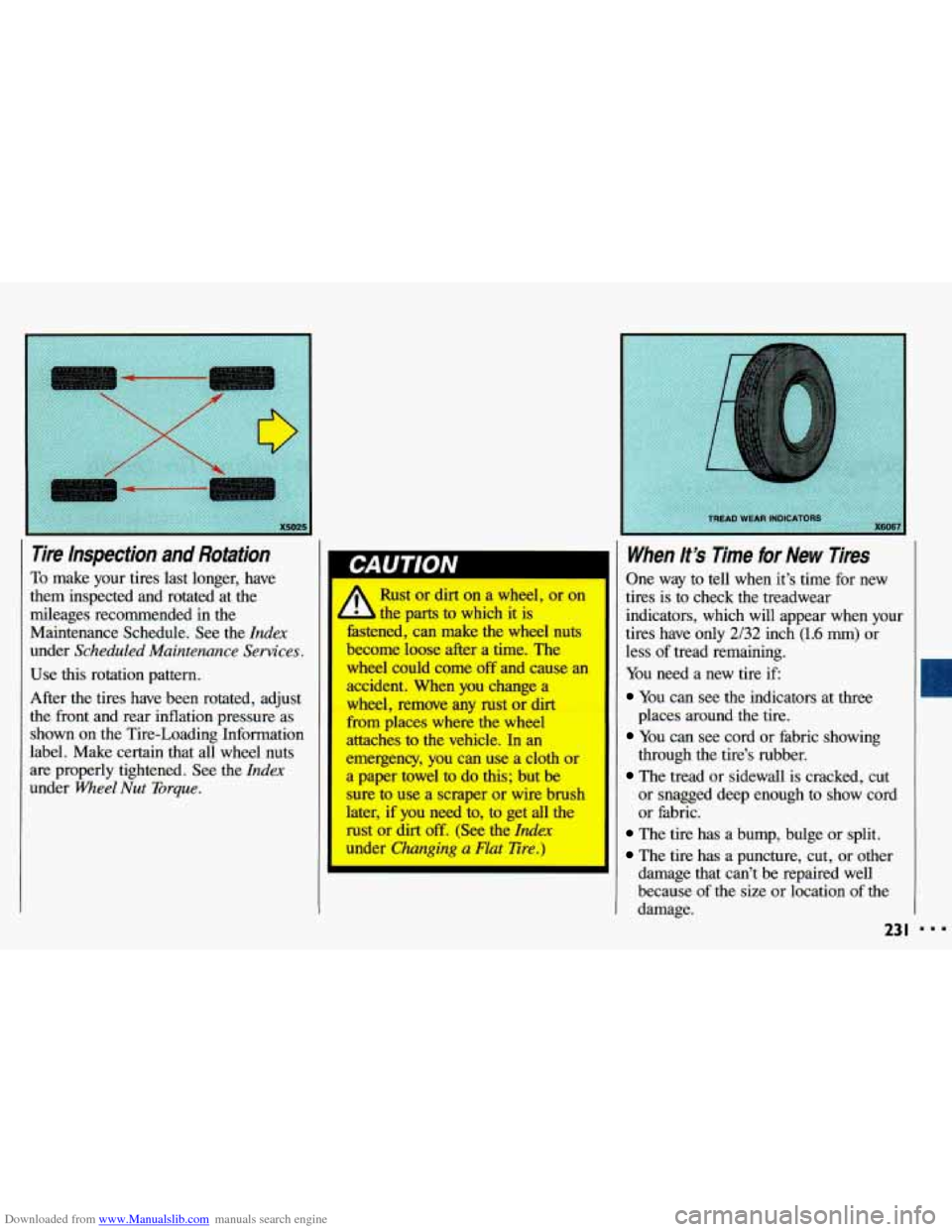
Use this rotation pattern.
After the tires have been rotated, adjust
the front and rear inflation pressure as
shown on the Tire-Loading Information
label. Make certain that all wheel nuts
are properly tightened. See the Index
under Wheel Nut Torque.
To make your tires last longer, have
them inspected and rotated at the
mileages recommended in the
Maintenance Schedule. See the
Index
under Scheduled Maintenance Services.
u I I’ -
Rust or dirt on a wheel, or on
; parts to which it is
fastened, can make the wheel nuts
become loose after a time. The
wheel could come off and cause an
accident. When you change a
wheel, remove any rust or dirt
from
places where the wheel
attaches to the vehicle. In an
emergency, you can use a cloth or
a paper towel to do this; but be
sure to use a scraper or wire brush
later, if you need to, to get all the
rust or dirt
off. (See the Index
under Changing a Flat Tire.)
When lt’s Time for New Tires
One way to tell when it’s time for new
tires
is to check the treadwear
indicators, which will appear when your
tires have
only 2/32 inch (1.6 mm) or
less of tread remaining.
You need a new tire if
You can see the indicators at three
You can see cord or fabric showing
The tread or sidewall is cracked, cut
places around the tire.
through the tire’s rubber.
or
snagged deep enough to show cord
or fabric.
The tire has a bump, bulge or split.
The tire has a puncture, cut, or other
damage that can’t be repaired well
because
of the size or location of the
damage.
23 I