light CHEVROLET CAVALIER 1993 1.G Repair Manual
[x] Cancel search | Manufacturer: CHEVROLET, Model Year: 1993, Model line: CAVALIER, Model: CHEVROLET CAVALIER 1993 1.GPages: 308, PDF Size: 15.62 MB
Page 193 of 308
Downloaded from www.Manualslib.com manuals search engine Don’t try to put a wheel cover on your
compact spare tire.
It won’t fit. Store the
wheel cover and plastic cap nuts in the
trunk or rear area until you have the flat
tire repaired or replaced.
16. Store the flat tire in the compact
spare tire compartment, and secure
with the wing bolt and extension.
Store the jack and wheel wrench in
their compartment, also.
MU I IVN 1
Storing a jack, a tire, or other
:quipment in the passenger
compartment
of the vehicle could
cause injury. In a sudden stop
or
collision, loose equipment could
strike someone. Store all these in
the proper place.
The compact spare is for temporary use
only. Replace the compact spare tire
with a full-size tire as soon as you can.
See
Compact Spare Tire next in this
section.
Compact Spare Tire
Although the compact spare was fully
inflated when your vehicle was new, it
can lose air after a time. Check the
inflation pressure regularly.
It should be
60 psi (420 Wa). The compact spare is
made to go up to
3,000 miles (5 000 km),
so you can finish your trip and have
your full-size tire repaired or replaced
where you want.
Of course, it’s best to
replace
your spare with a full-size tire as
soon as you can. Your spare will last
longer and be in good shape in case you
need it again.
Your anti-lock brake system warning
light may come on when you are driving
with a compact spare. See the
Index
under Anti-Lock Brake System Warning
Light.
191
Page 195 of 308
Downloaded from www.Manualslib.com manuals search engine If you let your tires spin at
- high speed, they can explode
and you or others could be injured.
And, the transaxle or other parts of
the vehicle can overheat. That could
cause an engine compartment fire
or other damage. When you’re
stuck, spin
the wheels as little as
possible. Don’t spin the wheels
above
35 mph (56 h/h) as shown
on
the speedometer. Spinning
your wheels can destroy
parts
of your vehicle as well as the
tires.
If you spin the wheels too
fast while shifting your transa:
back and forth, you can destroy
your transaxle.
-
Rocking Your Vehicle to Get it Out:
First, turn your steering wheel left and
right. That will clear the area around
your front wheels. Then shift back and
forth between
R (Reverse) and a
forward gear, or with a manual
transaxle, between
1 (First) or 2 (Second)
gear and
R (Reverse), spinning the
wheels as little as possible. Release
the
accelerator pedal while you shift, and
press lightly on the accelerator pedal
when the transaxle is in gear. If that
doesn’t get you out after a few tries,
you
may need to be towed out.
If
you do need to be towed out, see the
Index under Towing Your Chevrolet.
I93
Page 218 of 308
Downloaded from www.Manualslib.com manuals search engine 888
Service rance Care
Hydraulic Clutch (CONTJ
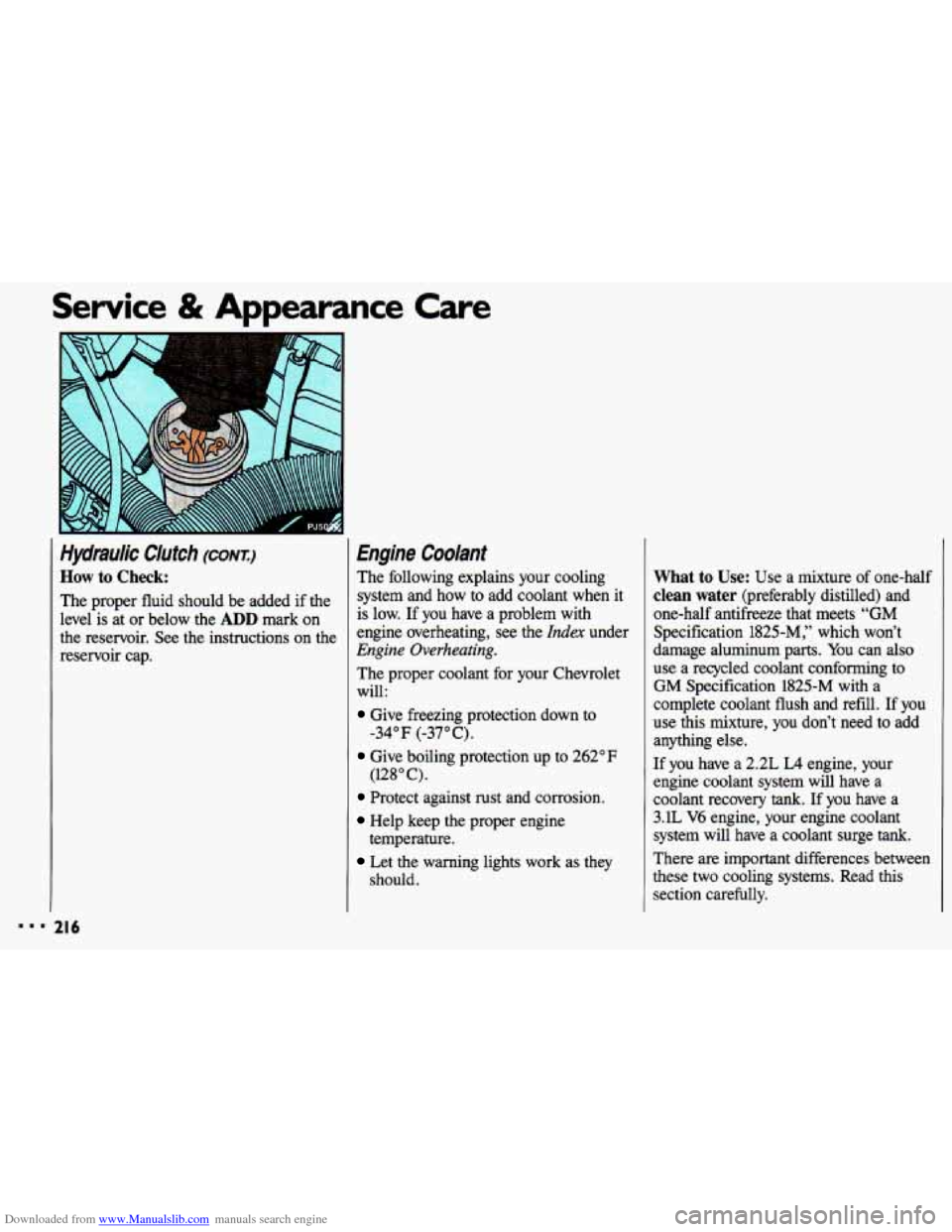
How to Check:
The proper fluid should be added if the
level is at or below the
ADD mark on
the reservoir.
See the instructions on the
reservoir cap.
216
Engine Coolant
The following explains your cooling
system and how to add coolant when it
is low. If you have a problem with
engine overheating,
see the Index under
Engine Overheating.
The proper coolant for your Chevrolet
will:
Give freezing protection down to
Give boiling protection up to 262°F
Protect against rust and corrosion.
Help keep the proper engine
Let the warning lights work as they
-34" F (-37" C).
(128" C).
temperature.
should.
What to Use: Use a mixture of one-half
clean water (preferably distilled) and
one-half antifreeze that meets "GM
Specification 1825-M," which won't
damage aluminum parts.
You can also
use a recycled coolant conforming to
GM Specification 1825-M with a
complete coolant flush and refill.
If you
use this mixture, you don't need to add
anything else.
If you have a 2.2L LA engine, your
engine coolant system will have a
coolant recovery
tank. If you have a
3.1L V6 engine, your engine coolant
system will have a coolant surge
tank.
There are important differences between
these two cooling systems. Read this section carefully.
Page 224 of 308
Downloaded from www.Manualslib.com manuals search engine Service & Appearance Care
I’ A
Brake Master Cylinder (CONT.)
When your brake fluid falls to a low
level, your brake warning light will
come
on. See the Index under Brake
System Warning Light.
What to Add: When you do need brake
fluid, use only DOT-3 brake fluid-such
as Delco Supreme
ll@ (GM Part No.
1052535). Use new brake fluid from a
sealed container only.
122
DOT-5 silicone brake fluid can
damage your vehicle. Don’t use it.
Don’t let someone put in the
wrong kind
of fluid. For
example, just a few drops
of
mineral-based oil, such as engine
oil, in your brake system can
damage brake system parts
so
badly that they’ll have to be
replaced.
Brake fluid can damage ‘.nt, so
be careful not to spill brae fluid
on your vehicle.
Replacing Brake System parfs
The braking system on a modern vehicle
is complex.
Its many parts have to be of
top quality and work well together
if the
vehicle
is to have really good braking.
Vehicles we design and test have top-
quality
GM brake parts in them, as your
Chevrolet does when it
is new. When
you replace parts of your braking
system-for example, when your brake
linings wear down and
you have to have
new ones put in-be sure you get new
Page 226 of 308
Downloaded from www.Manualslib.com manuals search engine Service & Appearance Care
1 Halogen Bulbs Headlight Bulb Replacement
~1 For the type of bulb, see the Index under
Replacement Bulbs.
Halogen bulbs have
bLl3t if you drop or scratch the
bulb.
You or others could be
injured. Take special care when
handling and disposing
of halogen
bulbs.
L: pressurized gas inside and can
3
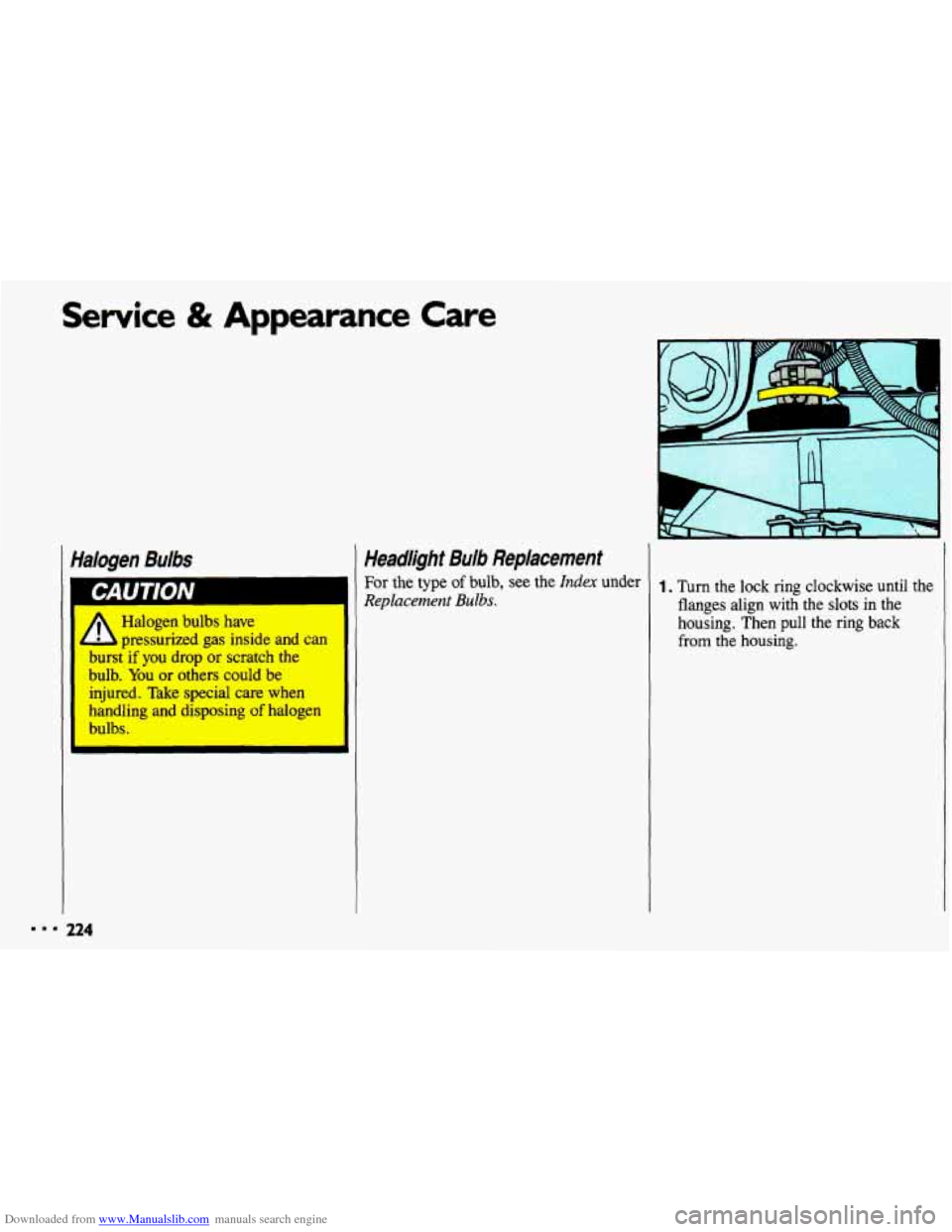
1. Turn the lock ring clockwise until the
flanges align with the slots in the
housing. Then pull the ring back
from the housing.
from the housing.
224
Page 227 of 308
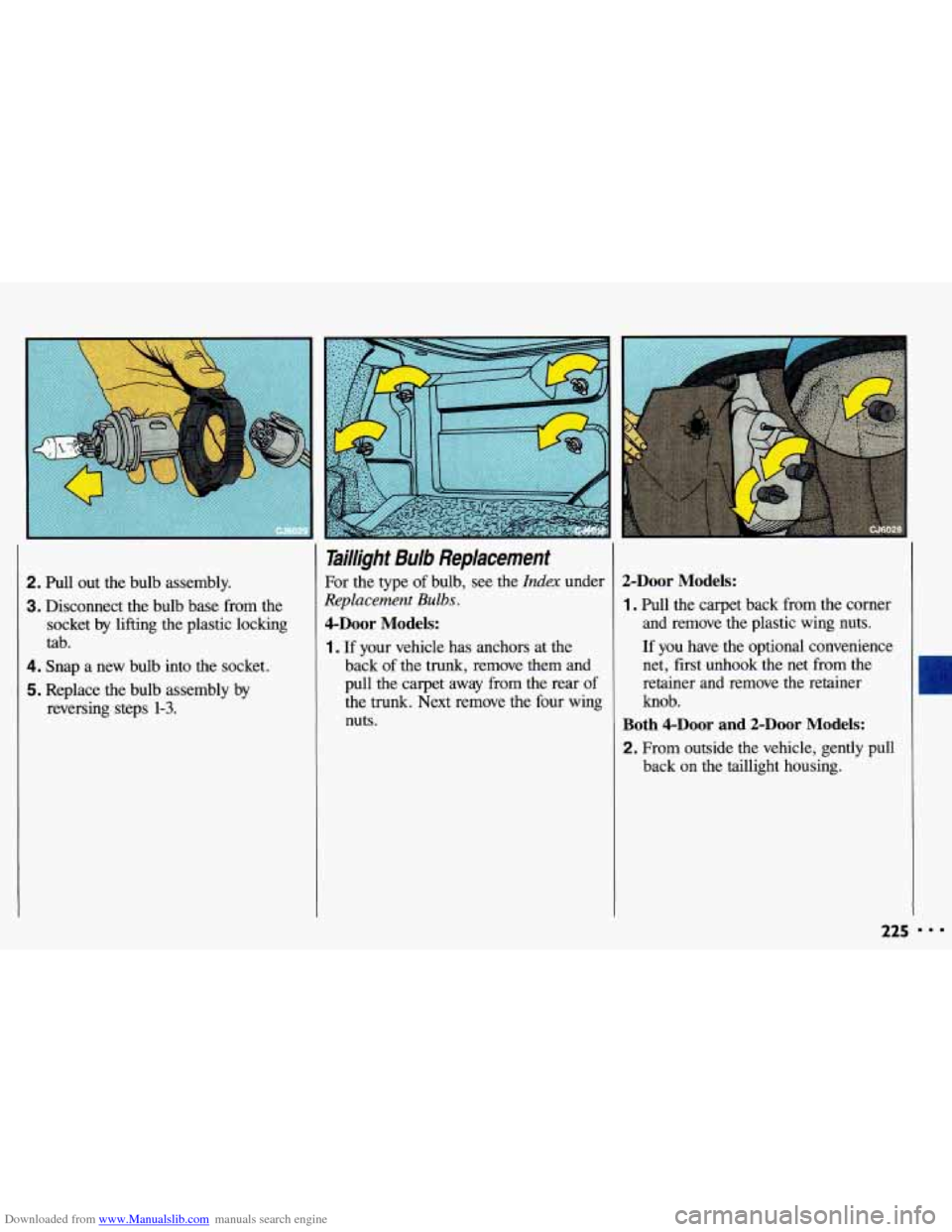
Downloaded from www.Manualslib.com manuals search engine 2. Pull out the bulb assembly.
3. Disconnect the bulb base from the
socket
by lifting the plastic locking
tab.
4. Snap a new bulb into the socket.
5. Replace the bulb assembly by
reversing steps
1-3.
Taillight Bulb Replacement
For the type of bulb, see the Idex under
Replacement Bulbs.
4-Door Models:
1 . If your vehicle has anchors at the
back
of the trunk, remove them and
pull the carpet away from the rear of
the trunk. Next remove the four wing
nuts.
2-Door Models:
1. Pull the carpet back from the comer
and remove the plastic wing nuts.
If you have the optional convenience
net, first unhook the net from the
retainer and remove the retainer
knob.
Both 4-Door and 2-Door Models:
2. From outside the vehicle, gently pull back
on the taillight housing.
Page 228 of 308
Downloaded from www.Manualslib.com manuals search engine DDD
Service & Appearance Care
Tai//ight Bulb Replacement
(CONr)
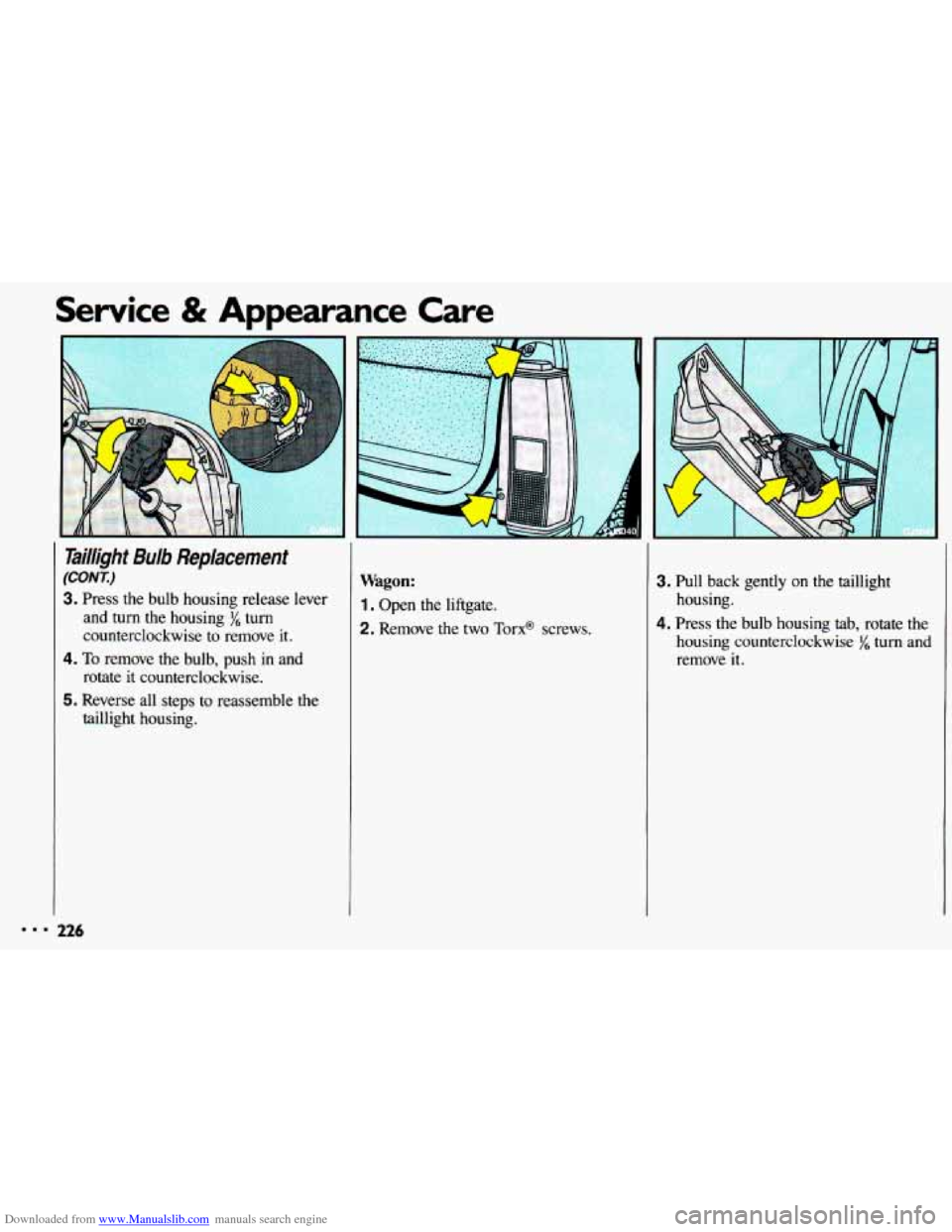
3. Press the bulb housing release lever
and turn the housing turn
counterclockwise to remove it.
4. To remove the bulb, push in and
rotate
it counterclockwise.
5. Reverse all steps to reassemble the
taillight housing.
226
Wagon:
1. Open the liftgate.
2. Remove the two Torx@ screws.
3. Pull back gently on the taillight
housing.
4. Press the bulb housing tab, rotate the housing counterclockwise
f/6 turn and
remove it.
Page 229 of 308
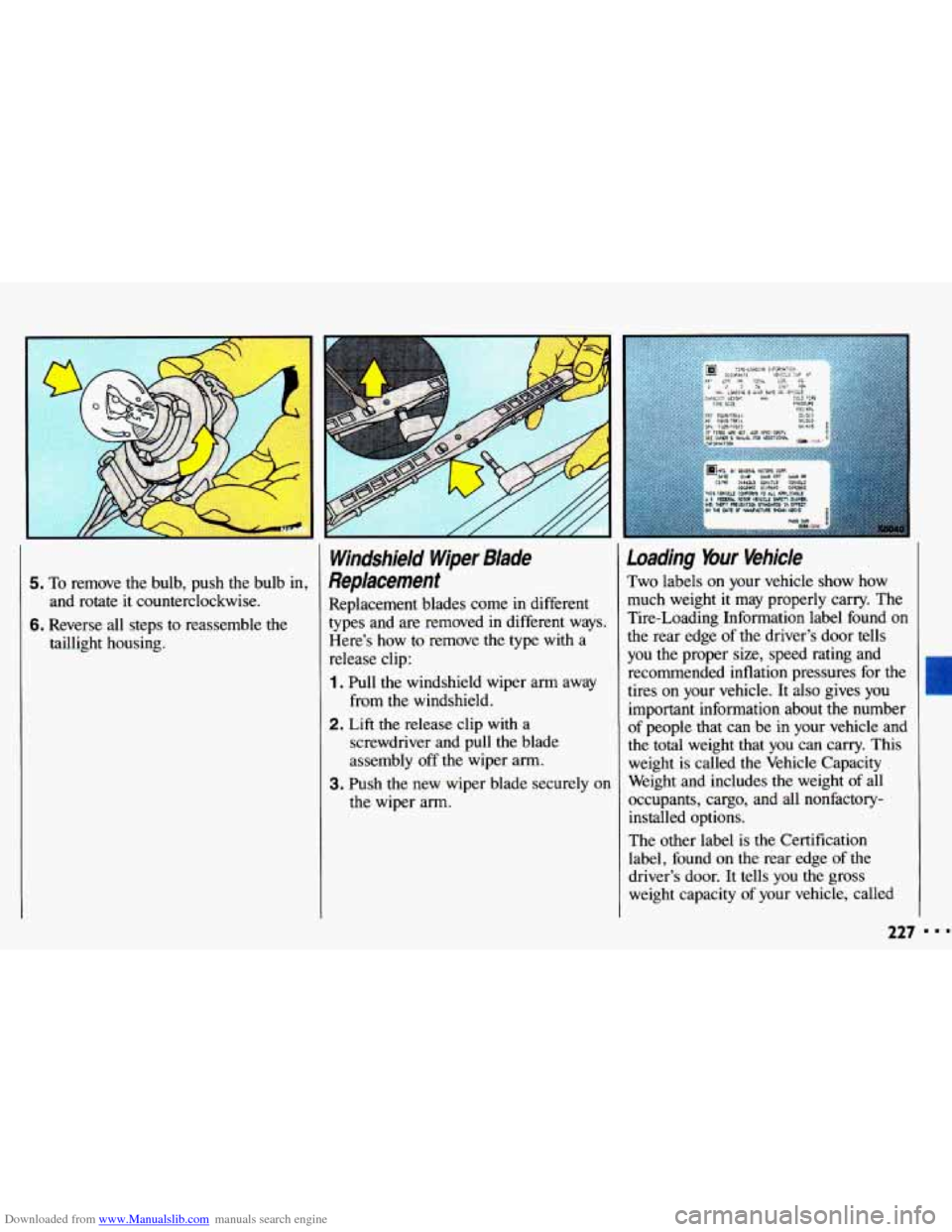
Downloaded from www.Manualslib.com manuals search engine 5. To remove the bulb, push the bulb in,
and rotate it counterclockwise.
6. Reverse all steps to reassemble the
taillight housing.
Windshield Wiper Blade
Replacement
Replacement blades come in different
types and are removed in different ways.
Here’s how
to remove the type with a
release clip:
1. Pull the windshield wiper arm away
2. Lift the release clip with a
from the windshield.
screwdriver and pull the blade
assembly
off the wiper arm.
the wiper arm.
3. Push the new wiper blade securely on
Loading %ur Vehicle
Two labels on your vehicle show how
much weight it may properly carry. The
Tire-Loading Information label found
on
the rear edge of the driver’s door tells
you the proper size, speed rating and
recommended inflation pressures for the
tires on your vehicle. It also gives
you
important information about the number
of people
that can be in your vehicle and
the total weight that you can carry. This
weight
is called the Vehicle Capacity
Weight and includes the weight
of all
occupants, cargo, and all nonfactory- installed options.
The other label
is the Certification
label, found on the rear edge of the
driver’s door. It tells you the gross
weight capacity
of your vehicle, called
I
227
Page 231 of 308
Downloaded from www.Manualslib.com manuals search engine 1--
-
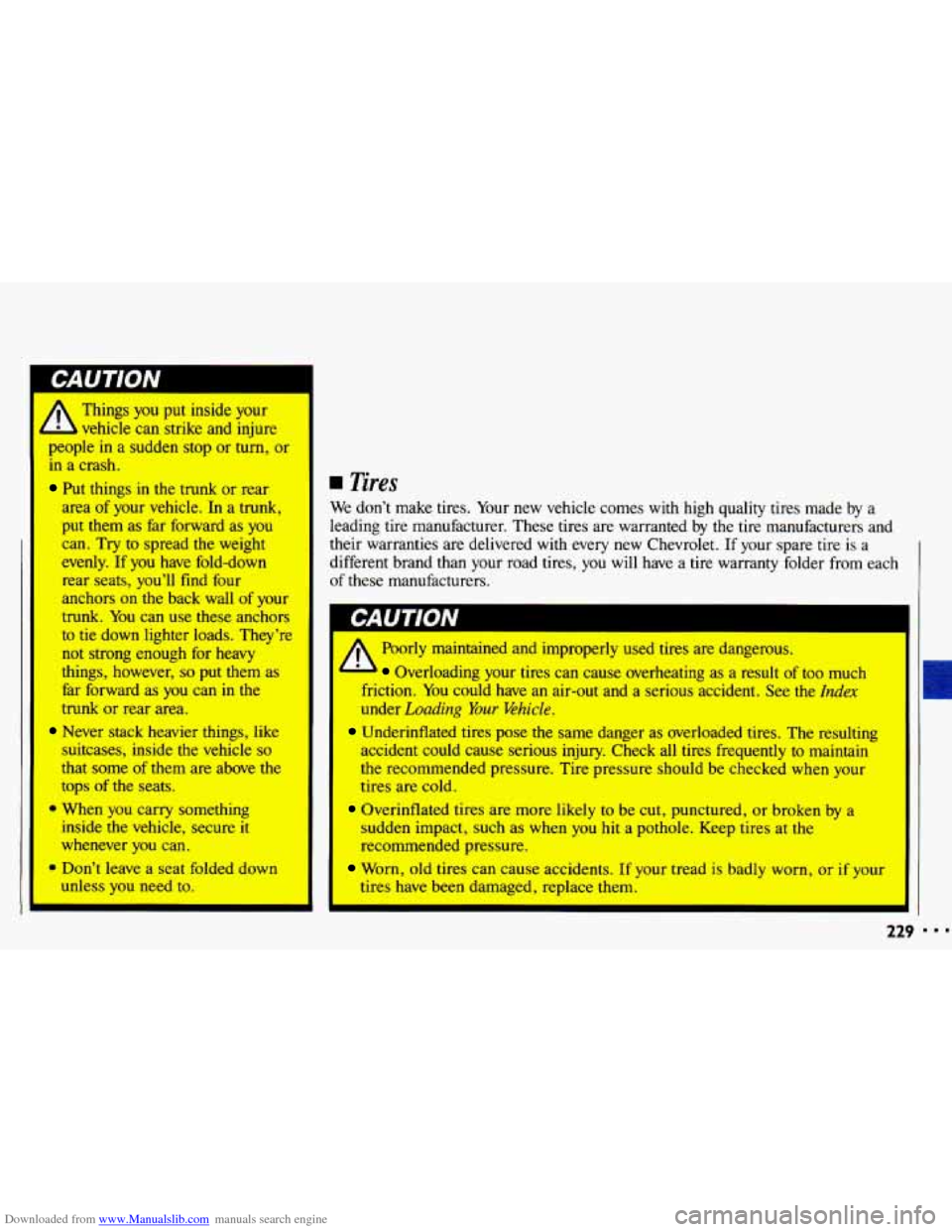
Things you=
strike and injure
people in
a sudden stop or turn, or
in
a crash.
Put things in the trunk or rear
area
of your vehicle. In a trunk,
put them as hr forward as you
can.
Try to spread the weight
evenly.
If you have fold-down
rear seats, you’ll find four
anchors on the back wall
of your
trunk.
You can use these anchors
to tie down lighter loads. They’re
not strong enough for
heavy
things, however, so put them as
fbr forward
as you can in the
trunk or rear area.
Never stack heavier things, like
suitcases, inside the vehicle
so
that some of them are above the
tops
of the seats.
e When you carry something
inside the vehicle, secure it
whenever you can.
unless you need to.
0 Don’t leave a seat folded down
I
Tires
We don’t make tires. Your new vehicle comes with high quality tires made by a
leading tire manufacturer. These tires are warranted by the tire manufacturers and
their warranties are delivered with every
new Chevrolet. If your spare tire is a
different brand than your road tires,
you will have a tire warranty folder from each
of these manufacturers.
I I
CAUTION
Poorly maintained and improperly used tires are dangerous. 1
’ - Overloading your tires can cause overheating as a result of too much
friction. You could have
an air-out and a serious accident. See the Index
under hading Your Vehicle.
Underinflated tires pose the same danger as overloaded tires. The resulting
accident could cause serious injury. Check all tires frequently to maintain
the recommended pressure. Tire pressure should be checked
when your
tires
are cold.
sudden impact:
such as when you hit a pothole. Keep tires at the
recommended pressure.
I Overinflated tires are more likely to be cut, punctured, or broken by a
Worn, old tires can cause accidents. If your tread is badly worn, or if your
I tires have been damaged, replace them. I
229
I
I..
Page 237 of 308
Downloaded from www.Manualslib.com manuals search engine A
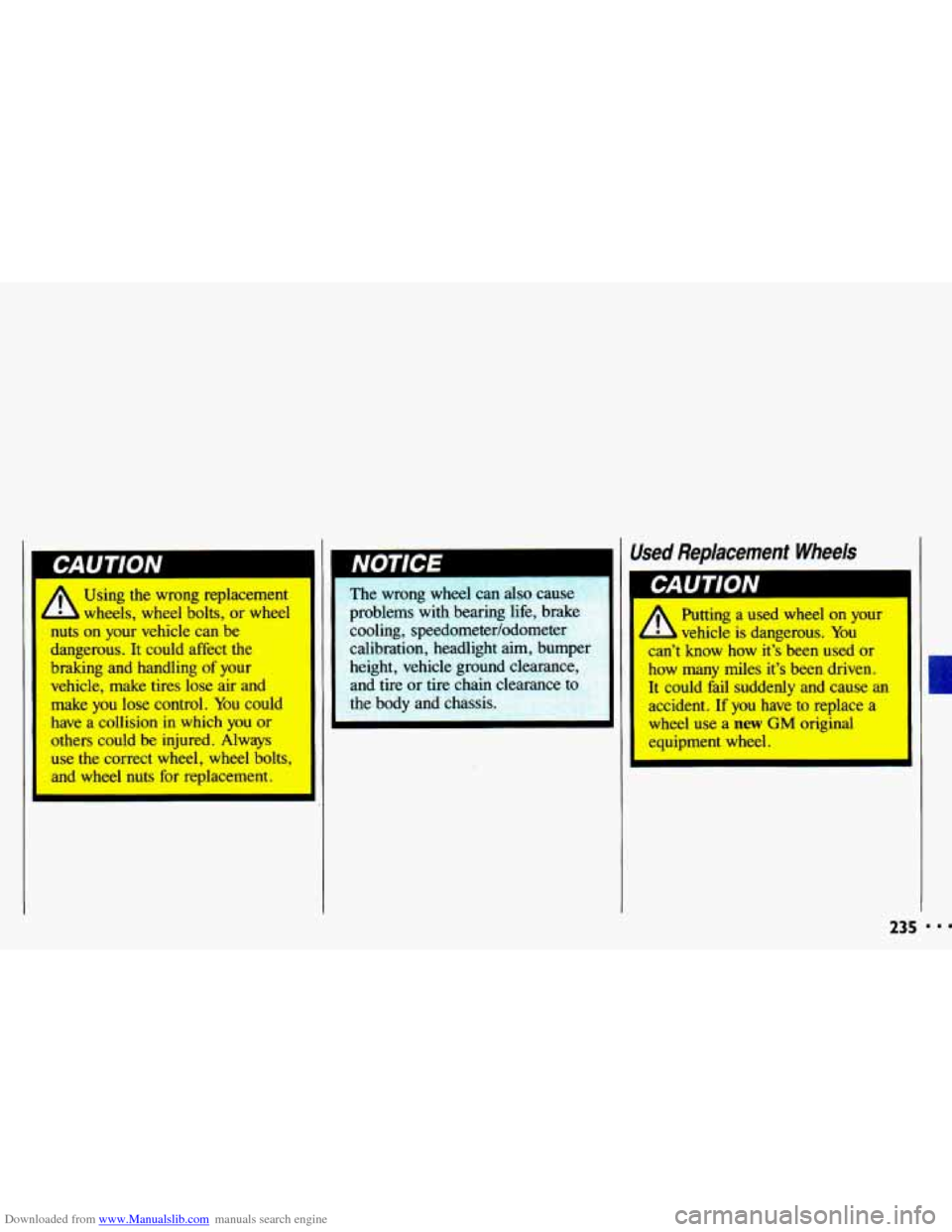
Using the wrong replacement
wheels, wheel
bolts, or wheel
nuts on your vehicle can be
dangerous. It could affect the braking
and handling of your
vehicle, make tires lose air and
make you lose control. You could
have a collision
in which you or
others .could be injured. Always
use the correct wheel, wheel bolts,
and wheel
nuts for replacement.
z -.
. ::?T?W wrong wheel can also cause
problems with bearing life, bra‘
cooling, speedometedodometer
calibration, headlight aim,
bumper
height, vehicle ground clearance,
.. and tire or tire chain clearance +*
the body adchassis.
Used Replacement Wheels
Putting a used wheel on your
4 vehicle is dangerous. You
can’t know how it’s been
used or
how many miles it’s been driven.
It could fail suddenly and cause an
accident. If you have to replace a
wheel use a new GM original
equipment wheel.
235
c