light CHEVROLET CAVALIER 1993 1.G Manual PDF
[x] Cancel search | Manufacturer: CHEVROLET, Model Year: 1993, Model line: CAVALIER, Model: CHEVROLET CAVALIER 1993 1.GPages: 308, PDF Size: 15.62 MB
Page 240 of 308
Downloaded from www.Manualslib.com manuals search engine Service & Appearance Care
Using &am-Type Cleaner on
Fabric
Vacuum and brush the area to remove
any loose dirt.
Always clean a whole trim panel or
section. Mask surrounding trim along
stitch or welt lines.
Mix Multi-Purpose Powdered Cleaner
following the directions on the
container label.
Use suds only and apply with a clean
Don’t saturate the material.
Don’t rub it roughly.
As soon as you’ve cleaned the section,
sponge.
use a sponge to remove the suds.
Rinse the section with a clean, wet
sponge.
Wipe off what’s left with a slightly
damp paper towel or cloth.
Then dry it immediately with an air
hose,
a hair dryer or a heat lamp.
I
Be careful with a hair dryer or heat
lamp. You
could scorch the fabric. I
Wipe with a clean cloth.
Using Solvent-Type Cleaner on
Fabric
First, see if you have to use solvent-type
cleaner at all. Some spots and stains will
clean
off better with just water and mild
soap.
If you need to use it, then:
Gently scrape excess soil from the
trim material with a clean, dull knife
or scraper. Use very little cleaner,
light pressure and clean cloths (preferably cheesecloth). Cleaning
should start at the outside of the stain,
“feathering” toward the center. Keep
changing to a clean section
of the
cloth.
When you clean a stain from fabric,
immediately dry the area with an air
hose, hair dryer, or heat lamp to help
prevent a cleaning ring. (See the
previous
NOTICE.)
Page 241 of 308
Downloaded from www.Manualslib.com manuals search engine Fabric Protection
Your Chevrolet has upholstery that has
been treated with ScotchgardTM Fabric Protector, a 3M product. Scotchgard”
protects fabrics by repelling
oil and
water, which are the carriers of most
stains. Even with this protection,
you
still need to clean your upholstery often
to keep it looking new.
Further information
on cleaning is
available by calling 1-800-433-3296 (in
Minnesota,
1-800-642-6167).
Special Cleaning Problems
Greasy or Oily Stains: Like grease, oil,
butter, margarine, shoe polish, coffee
with cream, chewing gum, cosmetic
creams, vegetable oils, wax crayon, tar
and asphalt.
Carefully scrape off excess stain.
Then follow the solvent-type
Shoe polish, wax crayon, tar and
instructions earlier
in this section.
asphalt will stain if
left on a vehicle
seat fabric. They should be removed
as soon as possible. Be careful,
because the cleaner will dissolve them
and may cause them
to bleed.
Non-Greasy Stains: Like catsup, coffee
(black), egg, fruit, fruit juice, milk,
soft
drinks, wine, vomit, urine and blood.
Carefully scrape off excess stain, then
sponge the soiled area with cool water.
If a stain remains, follow the foam-
type instructions earlier in this
section.
If an odor lingers after cleaning vomit
or urine, treat the area with a water/
baking soda solution:
1 teaspoon
(5 ml) of baking soda to 1 cup
(250 ml) of lukewarm water.
solvent-type cleaner.
Finally, if needed, clean lightly with
Combination Stains: Like candy, ice
cream, mayonnaise, chili sauce and
unknown stains.
Carefully scrape off excess stain, then
clean with cool water and allow to
dry.
If a stain remains, clean it with
solvent-type cleaner.
239
Page 250 of 308
Downloaded from www.Manualslib.com manuals search engine Service & Appearance Care
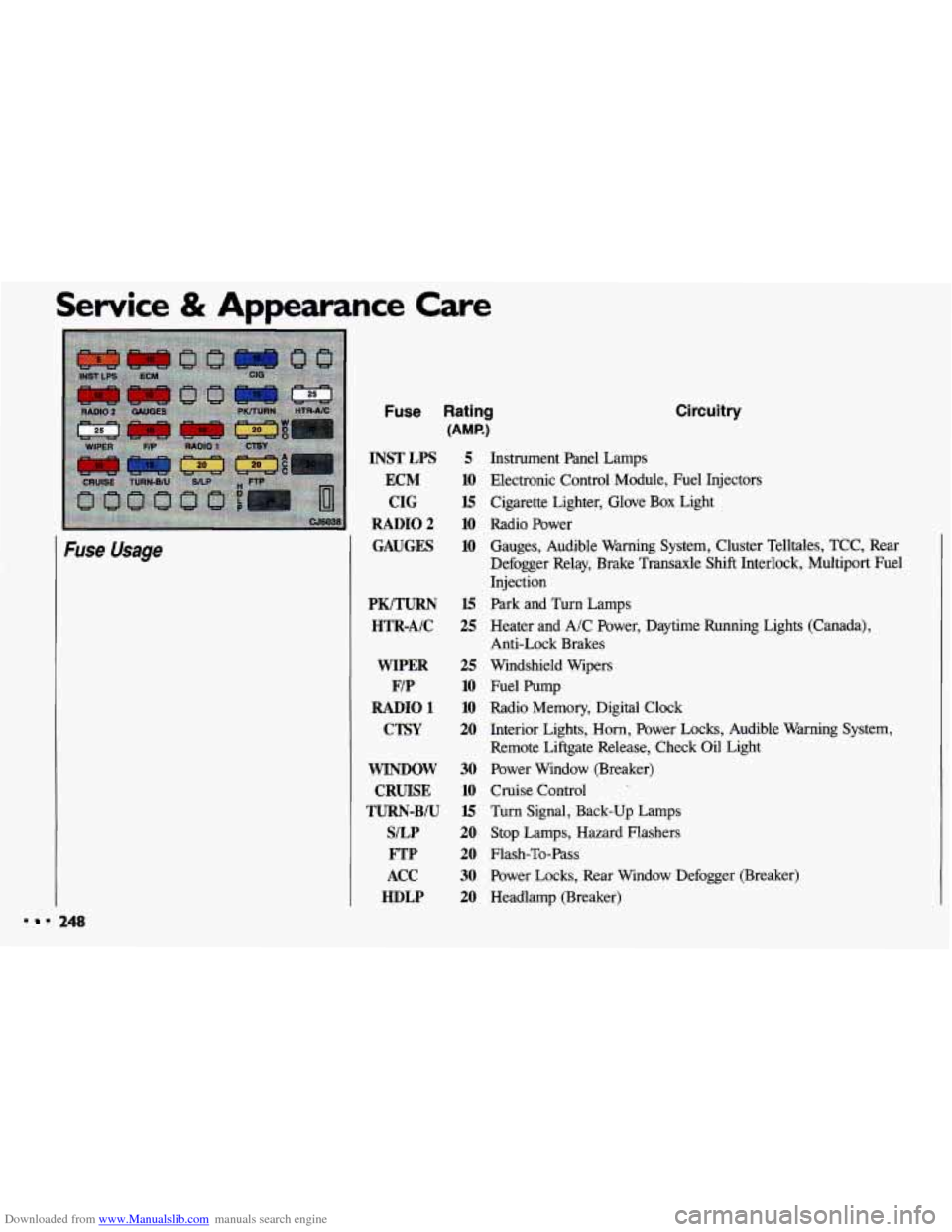
Fuse Usage
Fuse Rating
(AMP.)
INSTLPS 5
ECM 10
CIG 15
RADIO2 10
GAUGES 10
PK/TURN HTR-AIC
WIPER
F/P
RADIO 1
CTSY
WINDOW CRUISE
TURN-BIU
S/LP FTP
ACC
HDLP
15
25
25
10
10
20
30
10
15
20
20
30
20
Circuitry
Instrument Panel Lamps
Electronic Control Module, Fuel Injectors Cigarette Lighter, Glove
Box Light
Radio Power Gauges, Audible Warning System, Cluster Telltales, TCC, Rear
Defogger Relay, Brake Transaxle Shift Interlock, Multiport Fuel
Injection
Park and Turn Lamps
Heater and A/C Power, Daytime Running Lights (Canada),
Anti-Lock Brakes
Windshield Wipers
Fuel Pump
Radio Memory, Digital Clock
Interior Lights, Horn, Power Locks, Audible Warning System,
Remote Liftgate Release, Check Oil Light
Power Window (Breaker)
Cruise Control
Turn Signal, Back-up Lamps Stop Lamps, Hazard Flashers
Flash-To-Pass
Power Locks, Rear Window Defogger (Breaker)
Headlamp (Breaker)
248
Page 251 of 308
Downloaded from www.Manualslib.com manuals search engine Headlight Wiring
The headlight wiring is protected by a
circuit breaker in the fuseblock. An
electrical overload will cause the lights
to go on and
off, or in some cases to
remain
off. If this happens, have your
headlight system checked right away.
To access the headlight circuit breaker,
squeeze the plastic clip together and
remove.
Windsheld Wipers
The windshield wiper motor is protected
by a circuit breaker and a fuse.
If the
motor overheats due to heavy snow, etc.,
the wiper will stop until the motor
cools.
If the overload is caused by some
electrical problem, have it fixed.
Power Windows and Other
Power Options
Circuit breakers in the fuse panel protect
the power windows and other power
accessories. When the current load is
too heavy, the circuit breaker opens and
closes, protecting the circuit until the
problem is fixed.
249
Page 255 of 308
Downloaded from www.Manualslib.com manuals search engine Replacement Bulbs
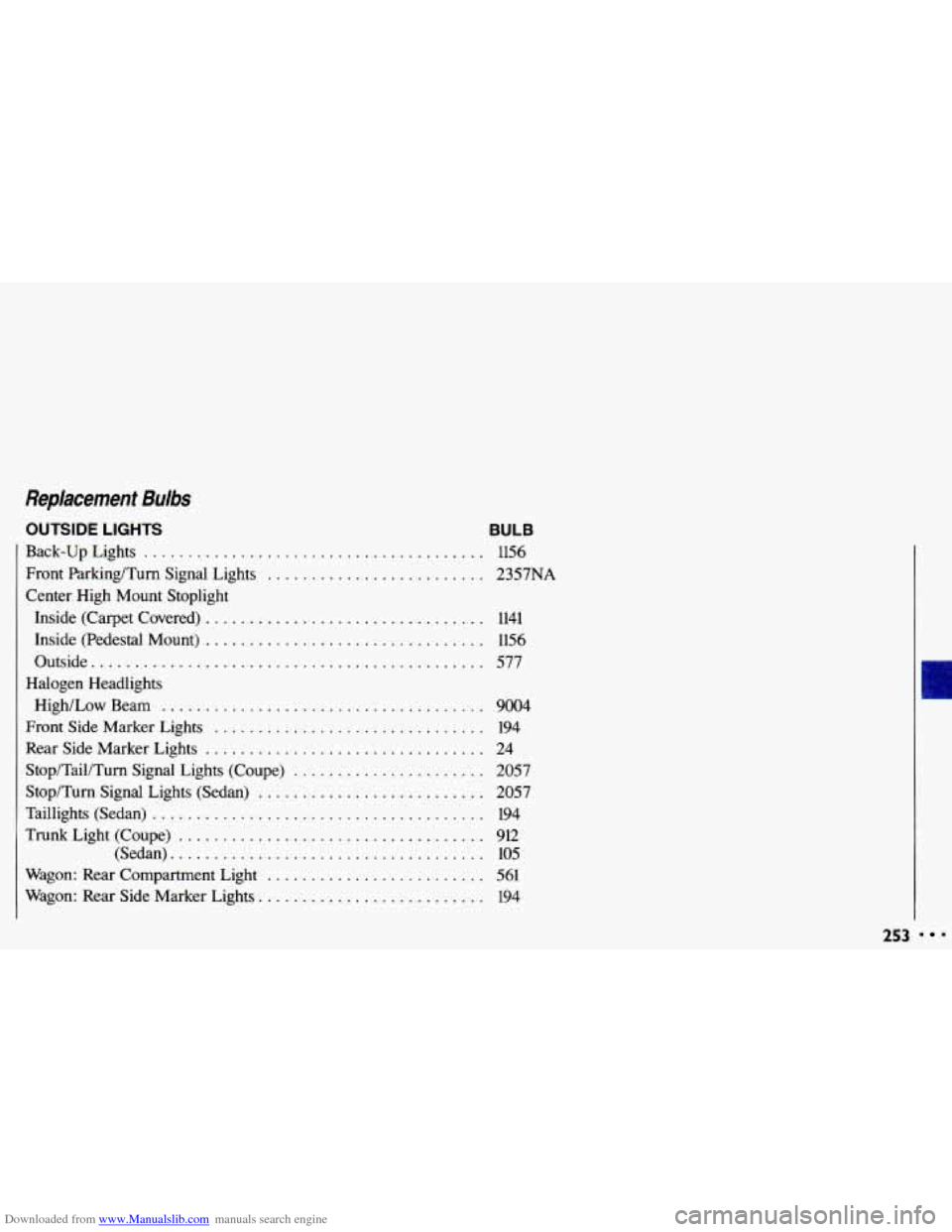
OUTSIDE LIGHTS
Back-UpLights .......................................
Front Parking/Turn Signal Lights .........................
Center High Mount Stoplight
Inside (Carpet Covered)
................................
Inside (Pedestal Mount) ................................
Outside .............................................
Halogen Headlights
High/LowBeam
.....................................
Front Side Marker Lights ...............................
Rear Side Marker Lights ................................
Stop/Tail/Turn Signal Lights (Coupe) ......................
Stop/Turn Signal Lights (Sedan) ..........................
Taillights (Sedan) ......................................
Trunk Light (Coupe) ...................................
(Sedan) ....................................
Wagon: Rear Compartment Light .........................
Wagon: Rear Side Marker Lights ..........................
BULB
1156
2357NA
1141
1156
577
9004 194
24
2057
2057
194
912
105
561 194
253 a
Page 256 of 308
Downloaded from www.Manualslib.com manuals search engine Service & Appearance Care
Replacement Bulbs (CONT.)
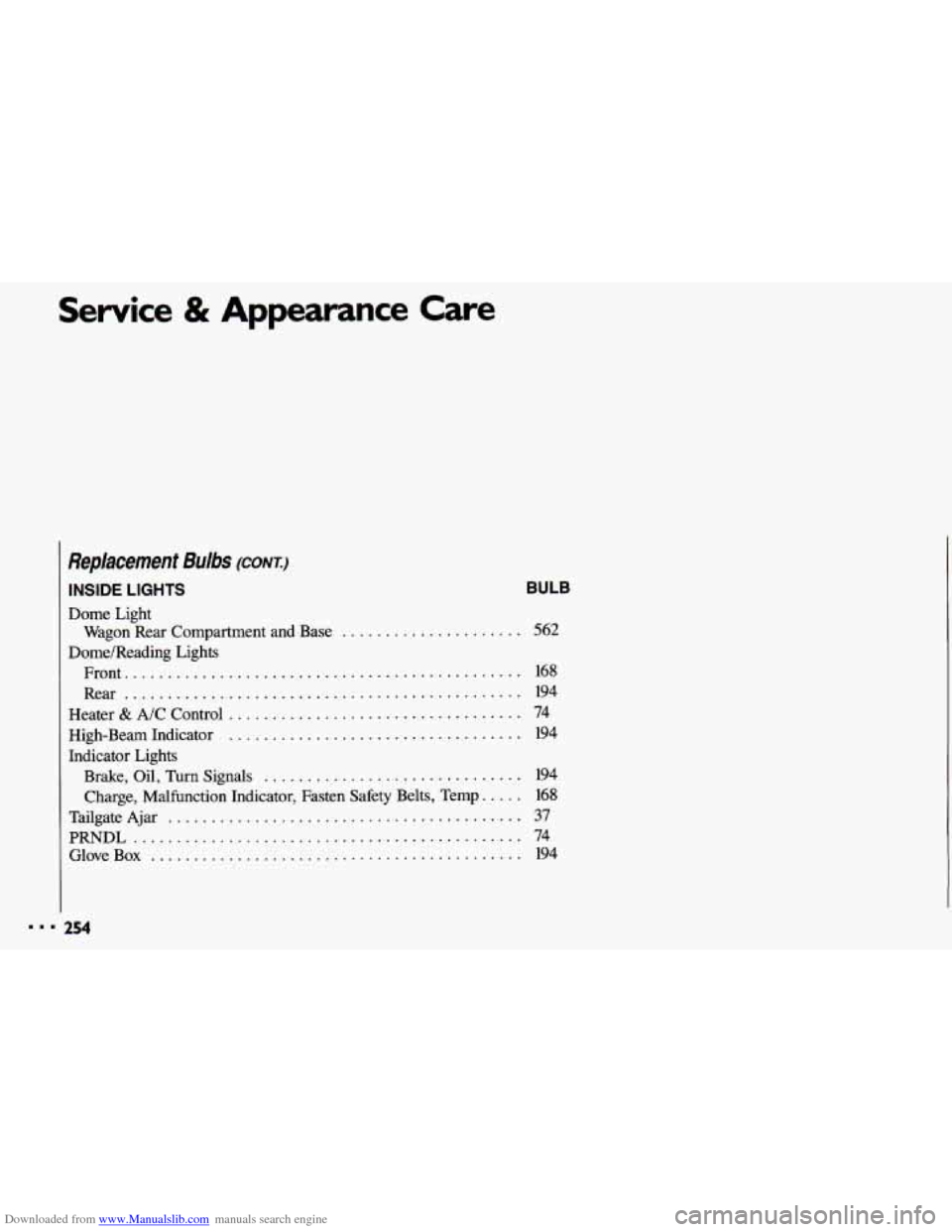
INSIDE LIGHTS
Dome Light
Dome/Reading Lights Wagon Rear
Compartment and Base
.....................
Front ..............................................
Rear ..............................................
Heater & A/C Control ..................................
Indicator Lights High-Beam Indicator
..................................
Brake. Oil. Turn Signals ..............................
Tailgate Ajar .........................................
Charge. Malfunction Indicator. Fasten Safety Belts. Temp .....
PRNDL .............................................
GloveBox ...........................................
I’ A 254
BULB
562
168
194
74
194
194
168
37
74
194
Page 274 of 308
Downloaded from www.Manualslib.com manuals search engine Maintenance Schedule
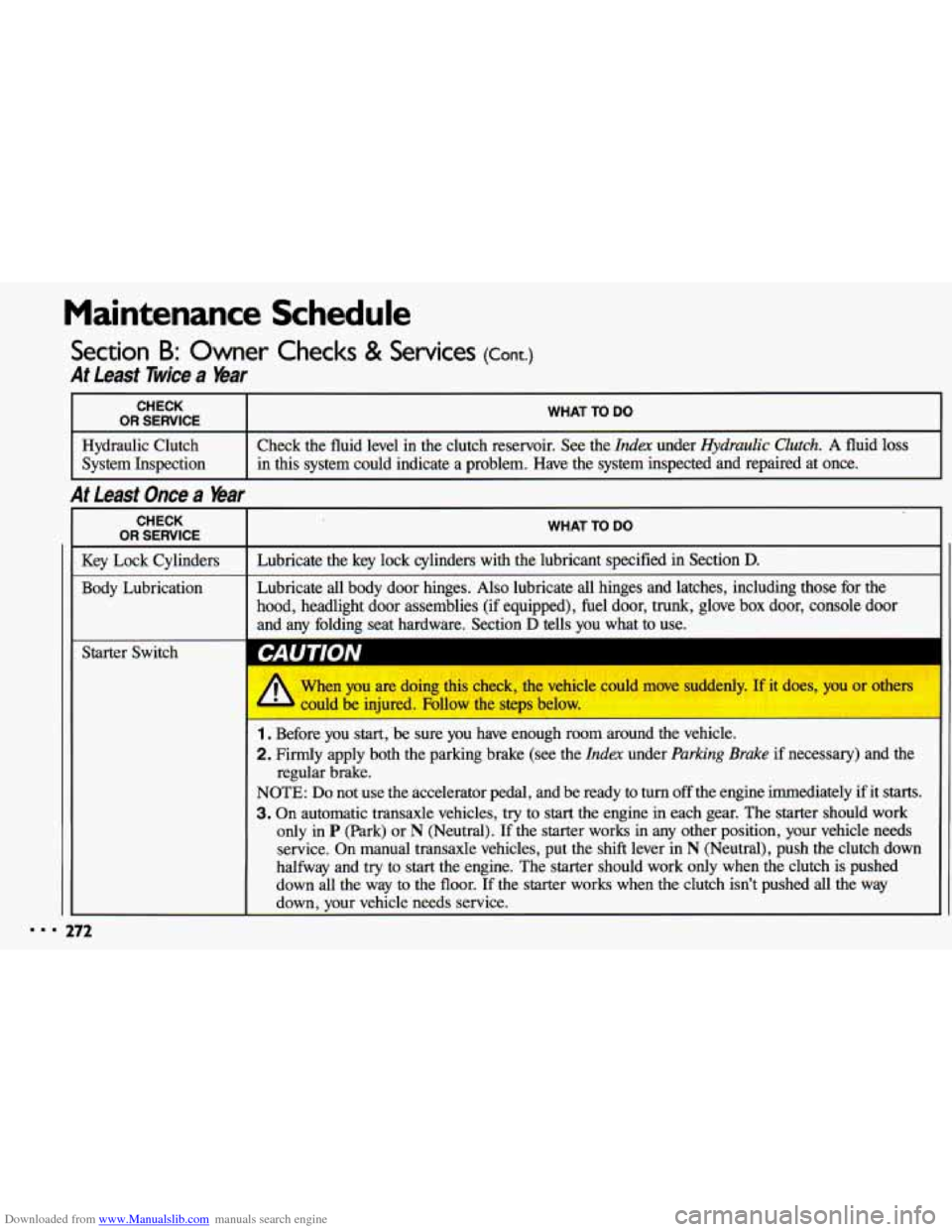
Section B: Owner Checks & Services (Cont.)
At Least Twice a Year
... L
CHECK
I OR SERVICE I WHAT TO DO
Hydraulic Clutch
in this system could indicate a problem. Have the system inspected and repaired at once. System Inspection
Check
the fluid level in the clutch reservoir. See the Index under Hydraulic Clutch. A fluid loss
At Least Once a Year
CHECK
I OR SERVICE I WHAT TO DO
I
Key Lock Cylinders I Lubricate the key lock cylinders with the lubricant specified in Section D.
Body Lubrication Lubricate all body
door hinges. Also lubricate all hinges and latches, including those \
for the
hood, headlight door assemblies (if equipped), fuel door, trunk, glove box door, console door
and any folding seat hardware. Section
D tells you what to use.
L
272
I CAUTION
1. Before you start, be sure you have enough room around the vehicle.
2. Firmly apply both the parking brake (see the Index under Parking Brake if necessary) and the
NOTE:
Do not use the accelerator pedal, and be ready to turn off the engine immediately if it starts.
3. On automatic transaxle vehicles, try to start the engine in each gear. The starter should work
only in P (Park) or N (Neutral). If the starter works in any other position, your vehicle needs
service. On manual transaxle vehicles, put the shift lever in
N (Neutral), push the clutch down
halfway and
try to start the engine. The starter should work only when the clutch is pushed
down all the way to the floor. If the starter works when the clutch isn’t pushed all the way
down, your vehicle needs service.
regular brake.
I
Page 277 of 308
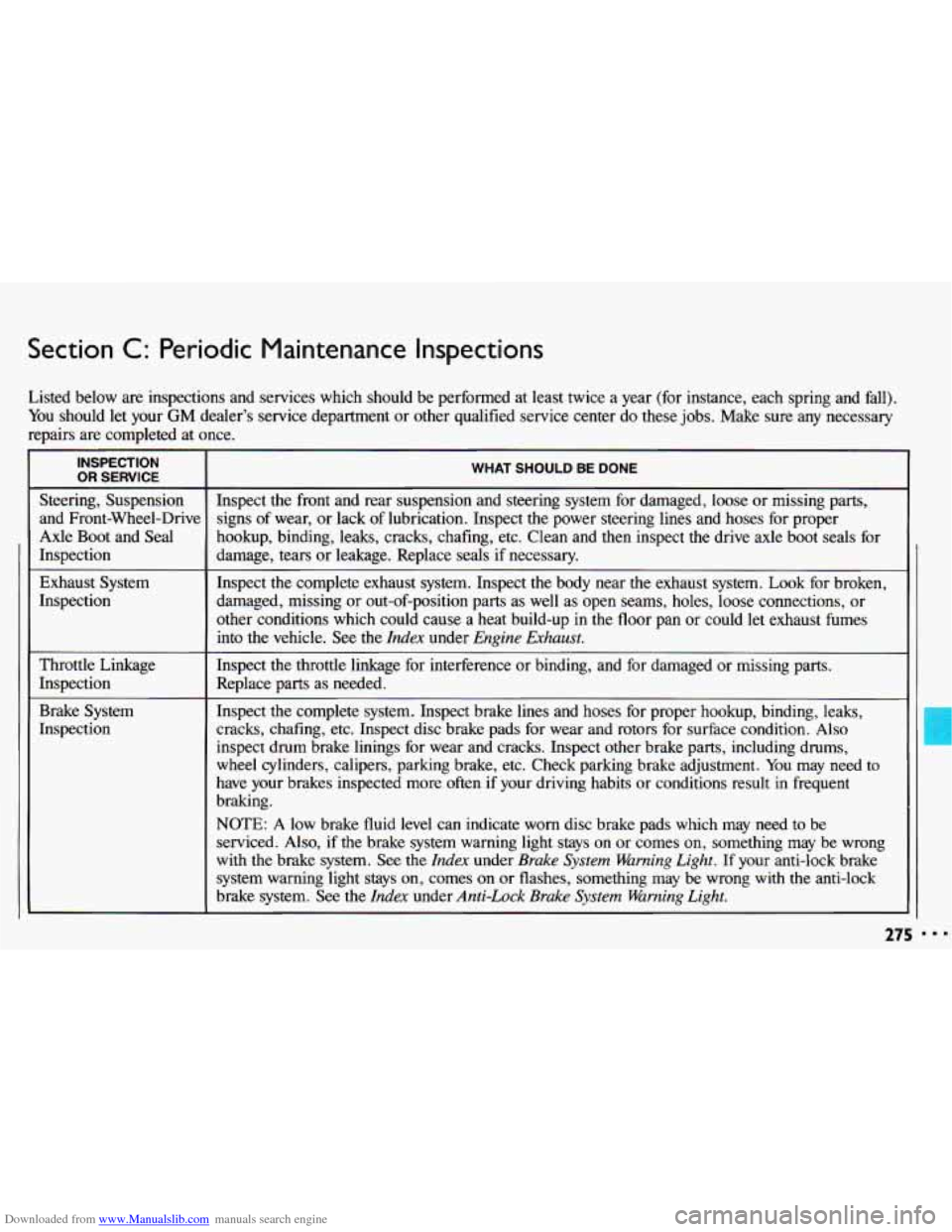
Downloaded from www.Manualslib.com manuals search engine Section C: Periodic Maintenance Inspections
Listed below are inspections and services which should be performed at least twice a year (for instance, each spring and fall).
You should let your GM dealer’s service department or other qualified service center do these jobs. Make sure any necessary
repairs are completed at once.
INSPECTION
I OR SERVICE
Steering, Suspension
and Front-Wheel-Drive
Axle Boot and Seal
1 Inspection
Exhaust System
Inspection
Throttle Linkage
Inspection
WHAT SHOULD BE DONE
Inspect the front and rear suspension and steering system for \
damaged, loose or missing parts,
signs of wear, or lack of lubrication. Inspect the power steering lines and hoses for proper
hookup, binding, leaks, cracks, chafing, etc. Clean and then in\
spect the drive axle boot seals for
damage, tears or leakage. Replace seals
if necessary.
Inspect the complete exhaust system. Inspect the body near
the exhaust system. Look for broken,
damaged, missing or out-of-position parts as well as open seams, holes, loose connections, or
other conditions which could cause a heat build-up in the floor pan or could let exhaust fumes
into the vehicle. See the
Index under Engine Exhaust.
Inspect the throttle linkage for interference or binding, and for damaged or missing parts.
Replace parts
as needed.
Inspect the complete system. Inspect brake lines and hoses for \
proper hookup, binding, leaks,
cracks, chafing, etc. Inspect disc brake pads for wear and rotors for \
surface condition. Also
inspect drum brake linings for wear and cracks. Inspect other brake parts, including drums,
wheel cylinders, calipers, parking brake, etc. Check parking brake adjustment. You may need to
have your brakes inspected more often
if your driving habits or conditions result in frequent
braking.
NOTE: A low brake fluid level can indicate worn disc brake pads which \
may need to be
serviced. Also,
if the brake system warning light stays on or comes on, something may be wrong
with the brake system. See the
Index under Brake System Warning Light. If your anti-lock brake
system warning light stays on, comes on or flashes, something may be wrong with the anti-lock
brake system. See the
Index under Anti-Lock Brake System Warning Light.
275 . .
Page 290 of 308
Downloaded from www.Manualslib.com manuals search engine Customer Assistance Information
4 Service Publicatz'ons
Information on how to obtain Product
Service Publications and Indexes as
described below is applicable only in
the
fifty U.S. states (and the District of
Columbia) and only for cars and light
trucks with
GVWR less than 10,000
pounds (4 536 kg).
In Canada, information pertaining to
Product Service Bulletins and Indexes
can be obtained by writing to:
General Motors
of Canada Limited
Service Publications Department
1908 Colonel Sam Drive
Oshawa, Ontario
L1H 8P7
!88
Chevrolet regularly sends its dealers
useful service bulletins about Chevrolet
products. Chevrolet monitors product
performance in the field. We then
prepare bulletins for servicing our products better. Now, you can get these
bulletins too.
Bulletins cover various subjects. Some
pertain to the proper use and care of
your vehicle. Some describe costly repairs. Others describe inexpensive repairs which, if done
on time with the
latest parts, may avoid future costly
repairs. Some bulletins tell a technician
how to repair a new or unexpected
condition. Others describe a quicker
way to fix your vehicle. They can help a
technician service your vehicle better. Most bulletins apply to conditions
affecting a small number
of cars or
trucks. Your Chevrolet dealer or
a
qualified technician may have to
determine
if a specific bulletin applies to
your vehicle.
Page 291 of 308
Downloaded from www.Manualslib.com manuals search engine Individual PSP’S
If you don’t want to buy all the PSP’s
issued
by Chevrolet for all car or truck
models in the model year, you can buy individual PSP’s, such as those which
may pertain to a particular model. To do
this, you will first need to see our index
of PSP’s. It provides a variety of
information. Here’s what you’ll find in
the index and how
you can get one:
What bu’ll Find in the Index
A list of all PSPs published by
Chevrolet in a model year (1989 or
later). PSP’s covering
all models of
Chevrolet cars or light trucks (less
than
l0,OOO pounds (4 536 kg)
GVWR) are listed in the same index.
Ordering information so you can buy
the specific PSP’s you may want.
Price information for the PSP’s you
may want to buy.
How bu Can Get an Index
Indexes are published periodically. Most
of the PSPs which could potentially
apply to the most recent Chevrolet
models will be listed in the most recent
publication for that model year. This
means you may want to wait until the
end of the model year before ordering
an index, if you are interested
in buying
PSP’s pertaining to a current model year
car or truck.
Some PSP’s pertaining to a particular
model year vehicle may be published in
later years, and these would be listed in
the later year’s index. When you order
an index for a model year that is not
over yet, we’ll send you the most
recently published issue. Check the
ordering form for indexes for earlier
model years.
289 I..