horn CHEVROLET CAVALIER 1993 1.G Owners Manual
[x] Cancel search | Manufacturer: CHEVROLET, Model Year: 1993, Model line: CAVALIER, Model: CHEVROLET CAVALIER 1993 1.GPages: 308, PDF Size: 15.62 MB
Page 11 of 308
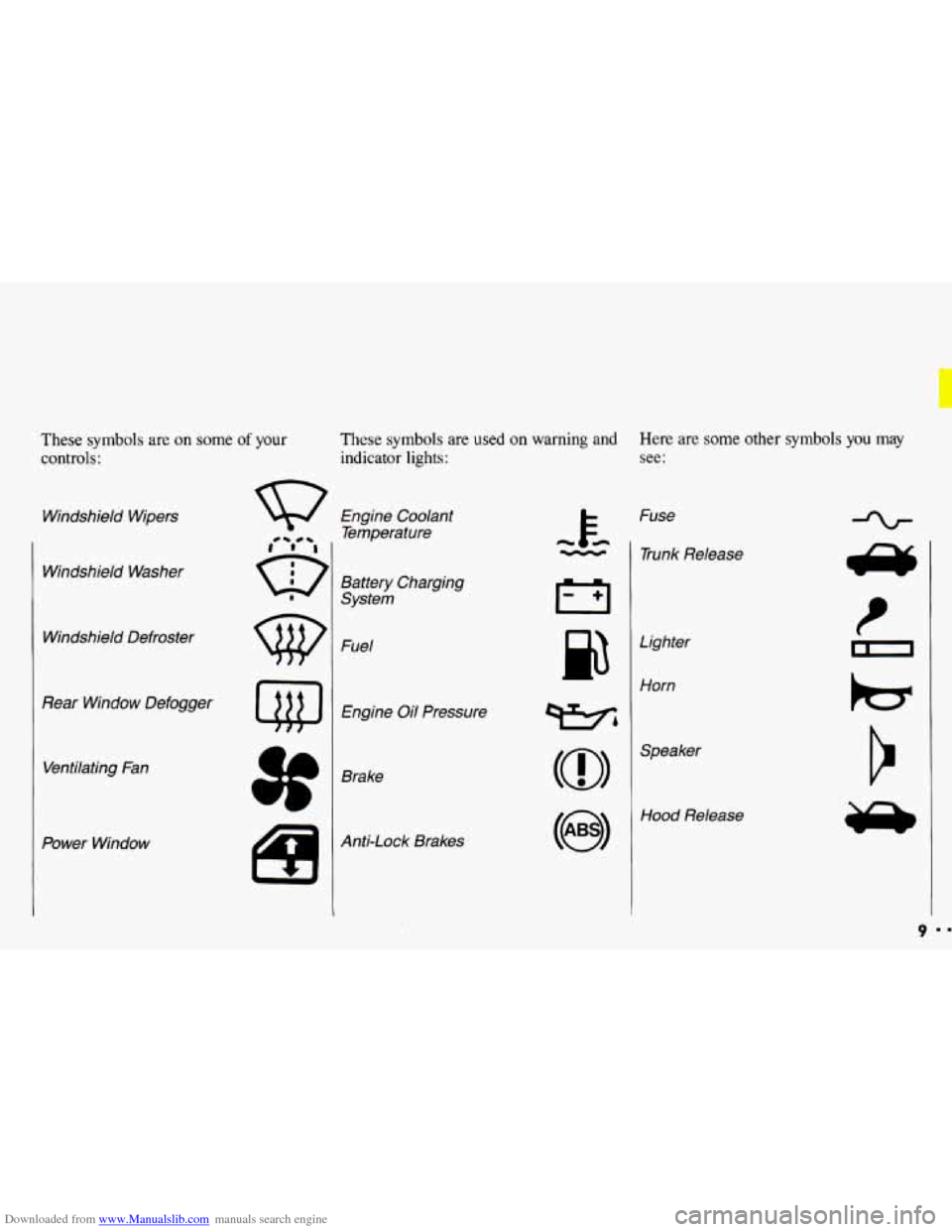
Downloaded from www.Manualslib.com manuals search engine These symbols are on some of your
controls:
Windshield Wipers
Windshield Washer
Windshield Defroster
Rear Window Defogger Ventilating Fan
Power Window
These symbols are used on warning and Here are some other symbols you may
indicator lights: see:
Engine Coolant
Temperature
Battery Charging
System
Fuel
Engine Oil Pressure
Brake
Anti-Lock Brakes Fuse
- 1 Trunk Release
cc
Lighter
Horn
wbl
(@I
Hood Release
9
Page 74 of 308
Downloaded from www.Manualslib.com manuals search engine Features & Controls
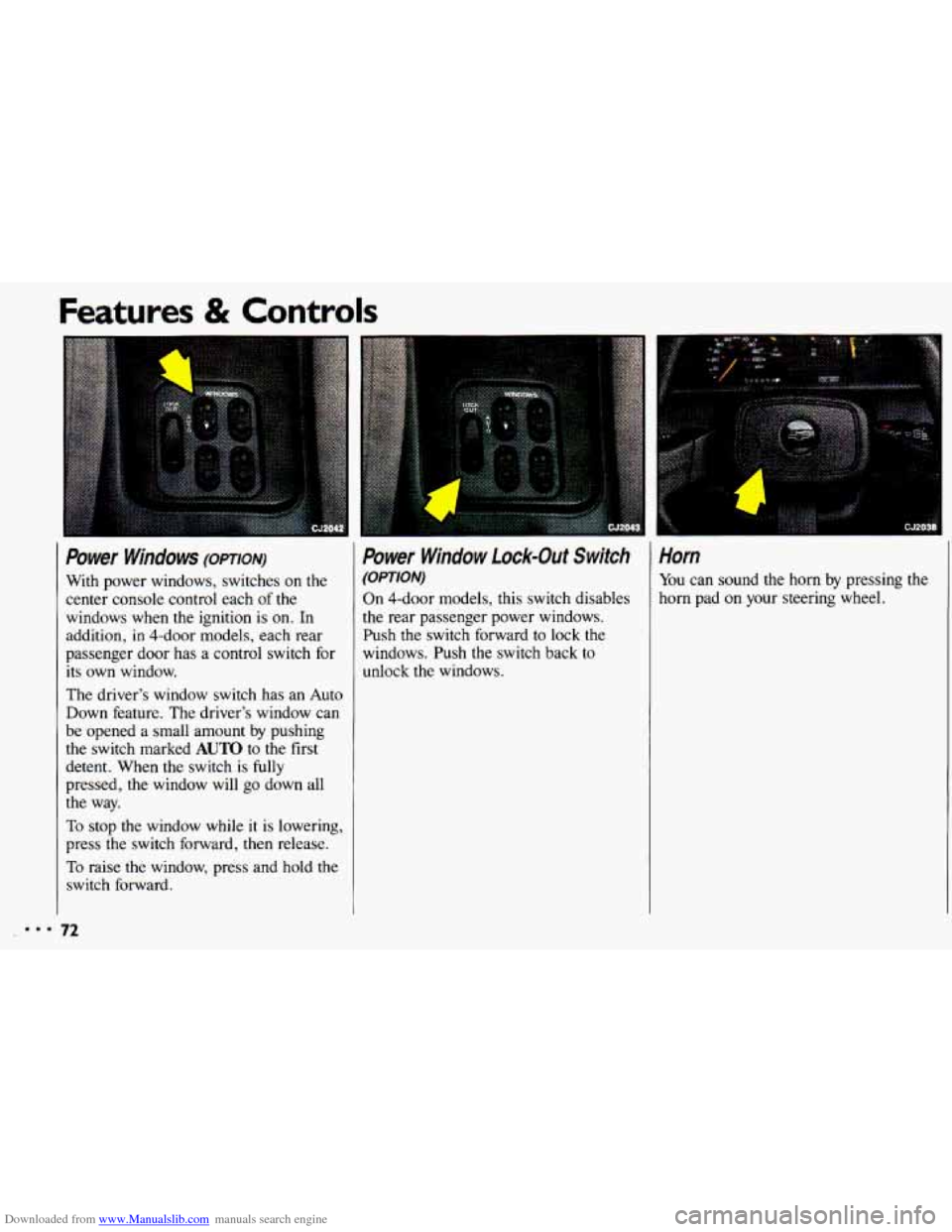
I Power Windows (opTIoN)
With power windows, switches on the
center console control each
of the
windows when the ignition is
on. In
addition, in 4-dOOr models, each rear
passenger door has a control switch for
its own window.
The driver’s window switch has an Auto
Down feature. The driver’s window can
be opened a small amount by pushing
the switch marked
AUTO to the first
detent. When the switch
is fully
pressed, the window will go down all
the way.
To stop the window while it is lowering,
press the switch forward, then release.
To raise the window, press and hold the
switch forward.
Power Window Lock-Out Switch
(OPTION)
On 4-dOOr models, this switch disables
the rear passenger power windows.
Push the switch forward to lock the
windows. Push the switch back to
unlock the windows.
1
i . :i .............. : ....... ,~,.
Horn
You can sound the horn by pressing the
horn pad
on your steering wheel.
:.. 72
Page 95 of 308
Downloaded from www.Manualslib.com manuals search engine The lnstrument Panel-
Your information System
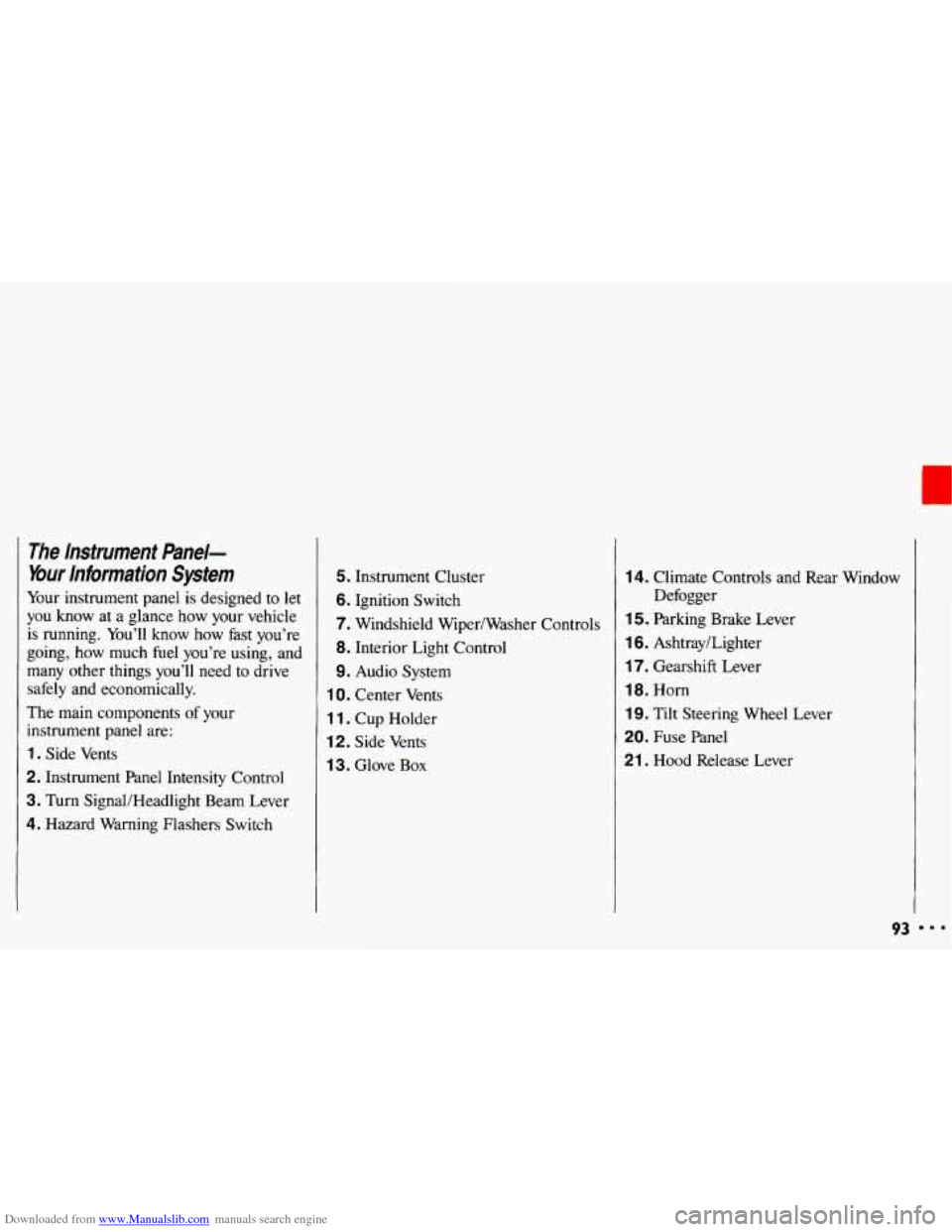
Your instrument panel is designed to let
you know at a glance how your vehicle
is running. You’ll know how fast you’re
going, how much fuel you’re using, and
many other things you’ll need to drive
safely and economically.
The main components
of your
instrument panel are:
1. Side Vents
2. Instrument Panel Intensity Control
3. Turn SignaVHeadlight Beam Lever
4. Hazard Warning Flashers Switch
5. Instrument Cluster
6. Ignition Switch
7. Windshield Wiper/Washer Controls
8. Interior Light Control
9. Audio System
1 0. Center Vents
1 1. Cup Holder
12. Side Vents
1 3. Glove Box
14. Climate Controls and Rear Window
1 5. Parking Brake Lever
16. Ashtray/Lighter
17. Gearshift Lever
18. Horn
19. Tilt Steering Wheel Lever
20. Fuse Panel
21 . Hood Release Lever Defogger
93 I..
Page 143 of 308
Downloaded from www.Manualslib.com manuals search engine If you suspect that the driver of the
vehicle
you want to pass isn’t aware of
your presence, tap the horn a couple
of times before passing.
Do not get too close to the vehicle you
want
to pass while you’re awaiting an
opportunity. For one thing, following
too closely reduces your area
of
vision, especially if you’re following a
larger vehicle. Also, you won’t have
adequate space if the vehicle ahead suddenly slows or stops. Keep back a
reasonable distance.
When it looks like a chance to pass is
coming up, start to accelerate but stay
in the right lane and don’t get too
close. Time your move
so you will be
increasing
speed as the time comes to
move into the other lane.
If the way is
clear to pass, you will have a “running
start” that more than makes up for the
distance you would lose by dropping
back. And
if something happens to
cause you
to cance1,your pass, you
need only slow down and drop back
again and wait for another opportunity.
slow vehicle, wait your turn. But take
care that someone isn’t trying
to pass
you as you pull out to pass the slow
vehicle. Remember to glance over
your shoulder and check the blind
spot.
Check your mirrors, glance over your
shoulder, and
start your left lane
change signal before moving out of the
right lane to pass. When you are far
enough ahead of the passed vehicle to
see its front in your inside mirror,
activate your right lane change signal
If other cars are lined up to pass a and
move back into the right lane.
(Remember that your right outside
mirror is convex. The vehicle you just
passed may
seem to be further away
from you than it really
is.)
Try not to pass more than one vehicle
at a time on two-lane roads.
Reconsider before passing the next
vehicle.
vehicle too rapidly. Even though the
brake lights are not flashing, it may be
slowing down or starting to
turn.
If you’re being passed, make it easy
for the following driver to get ahead of
you. Perhaps you can ease a
little to
the right.
Don’t overtake a slowly moving
I41
Page 151 of 308
Downloaded from www.Manualslib.com manuals search engine something between you and moving
vehicles-space, trees, telephone poles,
a private driveway, anything that
removes you from other traffic.
zf visibility is near zero and you must
stop but are unsure whether you are
away from the road, turn your lights on,
start your hazard warning flashers, and
sound your horn at intervals or when
you hear approaching traffic.
Pass other vehicles in fog only if you
can see far enough ahead to pass safely.
Even then, be prepared to delay your
pass if you suspect the
fog is worse up
ahead. If other vehicles try to pass
you,
make it easy for them.
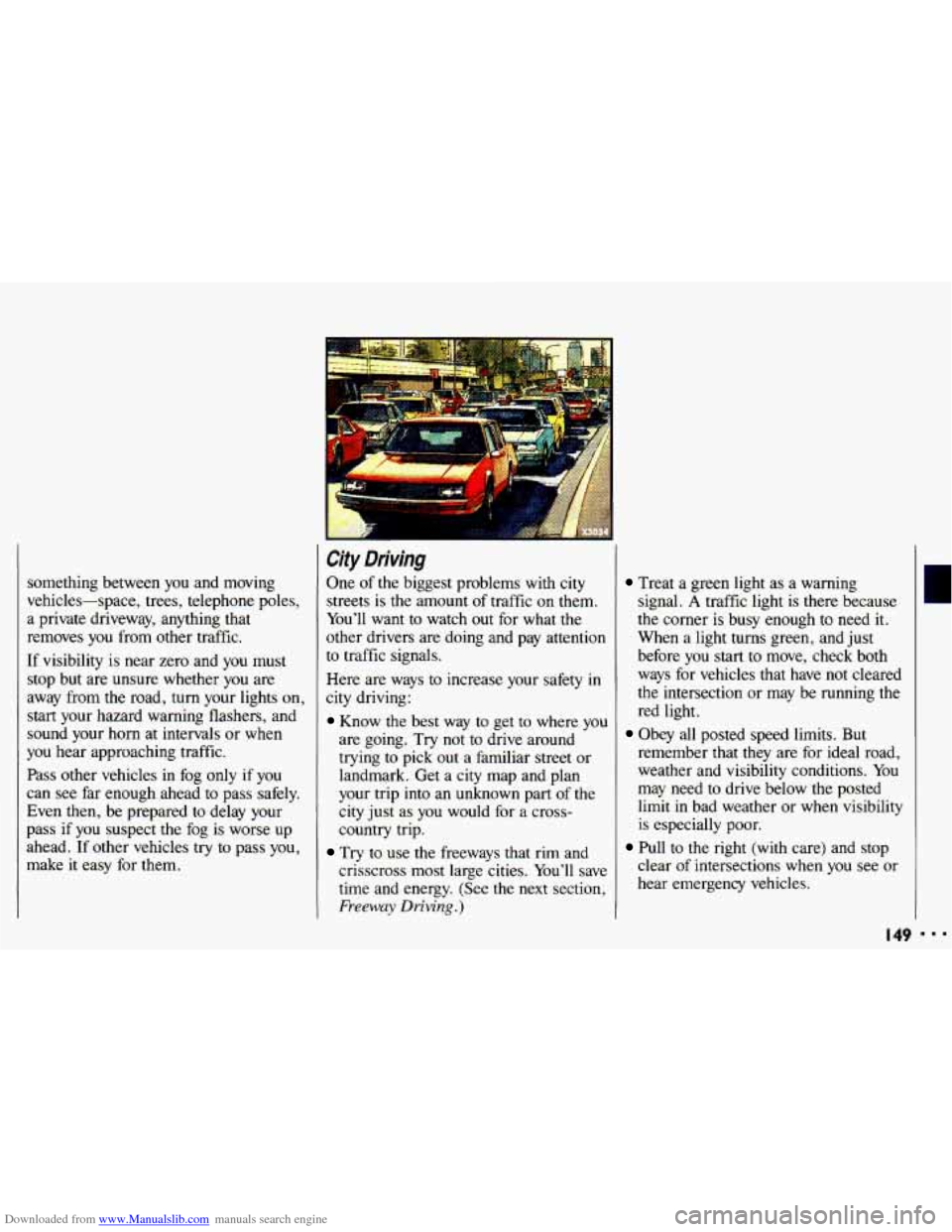
City Driving
One of the biggest problems with city
streets is the amount
of traffic on them.
You’ll want to watch out for what the
other drivers are doing and pay attention
to traffic signals.
Here are ways to increase your safety in
city driving:
Know the best way to get to where you
are going. Try not to drive around
trying to pick out a familiar street or
landmark. Get a city map and plan
your trip into an unknown part
of the
city just as
you would for a cross-
country trip.
Try to use the freeways that rim and
crisscross most large cities. You’ll save
time and energy. (See the next section,
Freeway Driving.)
Treat a green light as a warning
signal.
A traffic light is there because
the corner is busy enough to need it.
When
a light turns green, and just
before you
start to move, check both
ways for vehicles that have not cleared
the intersection or may be running the
red light.
remember that
they are for ideal road,
weather and visibility conditions. You
may need to drive below the posted
limit
in bad weather or when visibility
is especially poor.
clear
of intersections when you see or
hear emergency vehicles.
Obey all posted speed limits. But
Pull to the right (with care) and stop
I49 BIB
Page 250 of 308
Downloaded from www.Manualslib.com manuals search engine Service & Appearance Care
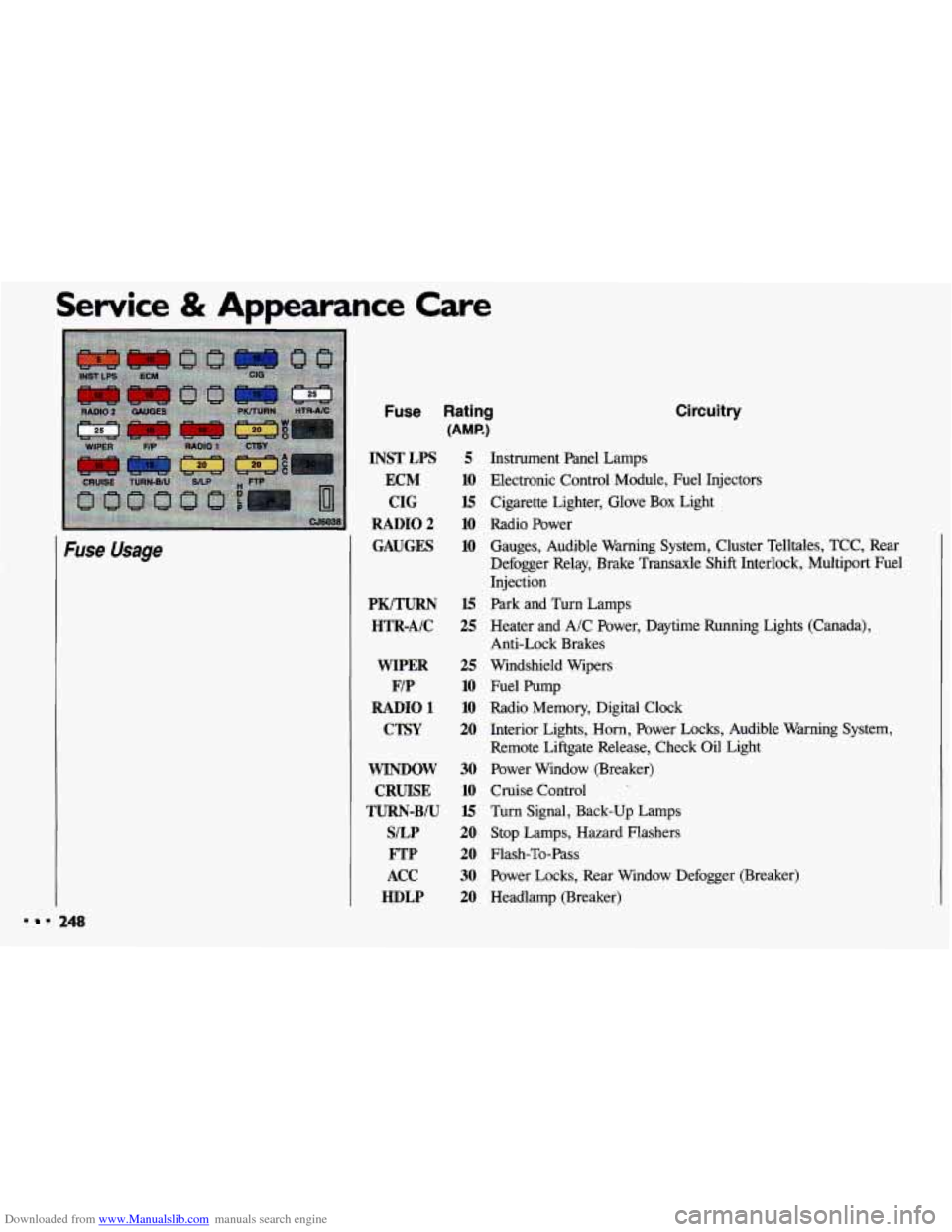
Fuse Usage
Fuse Rating
(AMP.)
INSTLPS 5
ECM 10
CIG 15
RADIO2 10
GAUGES 10
PK/TURN HTR-AIC
WIPER
F/P
RADIO 1
CTSY
WINDOW CRUISE
TURN-BIU
S/LP FTP
ACC
HDLP
15
25
25
10
10
20
30
10
15
20
20
30
20
Circuitry
Instrument Panel Lamps
Electronic Control Module, Fuel Injectors Cigarette Lighter, Glove
Box Light
Radio Power Gauges, Audible Warning System, Cluster Telltales, TCC, Rear
Defogger Relay, Brake Transaxle Shift Interlock, Multiport Fuel
Injection
Park and Turn Lamps
Heater and A/C Power, Daytime Running Lights (Canada),
Anti-Lock Brakes
Windshield Wipers
Fuel Pump
Radio Memory, Digital Clock
Interior Lights, Horn, Power Locks, Audible Warning System,
Remote Liftgate Release, Check Oil Light
Power Window (Breaker)
Cruise Control
Turn Signal, Back-up Lamps Stop Lamps, Hazard Flashers
Flash-To-Pass
Power Locks, Rear Window Defogger (Breaker)
Headlamp (Breaker)
248
Page 300 of 308
Downloaded from www.Manualslib.com manuals search engine Flash-to-Pass ................... 81
Flat Tire
...................... 184
Flooded Engine
................. 58
Fluid Brake
................. .221. 252
Capacities
................... 250
Hydraulic Clutch
......... .2l5. 252
Power Steering
...... .219. 251. 252
Transaxle
Automatic
........ .211. 250. 252
Manual
.......... .2l3. 250. 252
Windshield Washer
....... .220. 252
Fluids
& Lubricants ............. 252
Fog. Driving in
................. 148
Folding Rear Seats
............... l5
Freeway Driving ................ 150
French Language Manual .......... 2
Fuel
......................... 197
Alcohol in Fuel
............... 198
Capacity
............... .197. 251
Exhaust Warnings
.............. 70
Filling Your Tank
........ .200. 251
Fuels with Alcohol
............ 198
Gage
........................ 96
In Foreign Countries ........... 199
Requirements
................ 197
198
Fuse Usage ................... 248
Fuses
& Circuit Breakers ......... 247
Gaies Coolant Temperature
........... 97
Fuel
........................ 96
Oil Pressure
.................. 99
Tachometer
................... 95
Gasoline
...................... 197
Gasoline Tank. -Filling Your
............. .200. 251
Gas Station Information
.......... 304
Gear Positions
Gearshift Lever
Glove Box
.................... i., . 53
Graphic Equalizer (see
Audio Systems)
(see Shlfing the Transaxle)
(see Shifting the Transaxle)
Halogen Bulbs ........... .224. 253
Hazard Warning Flashers
........ -164
Head Restraints
................. 13
Headlight & Taillight. Removing and
Replacing
.......... .224. 225. 253
Headlights
..................... 78
Flash-to-Pass
.................. 81
High-Low Beam Changer
........ 81
Instrument Panel Intensity Control
............. 81
“On” Reminder
............... 79
Replacement Bulb
... .224. 225. 253
Wiring
..................... 249
(see
Comfort Controls)
Heater Heater. Engine Block
........ .59. 208
High Beams
............... .81. 144
Highway Hypnosis
.............. 153
Hill and Mountain Roads
......... 154
Hills. Parking on
........... .a. 155
Hood Release .................. 201
Engine
.................... 174
Horn
......................... 72
Hot Engine. Safety
Warnings
............... .174. 202
How to Use
this Manual ........... 6
Hydraulic Clutch .......... .2l5. 252
Hydroplaning
.................. 147
Warning. Overheated