windshield wipers CHEVROLET CAVALIER 1993 1.G Owners Manual
[x] Cancel search | Manufacturer: CHEVROLET, Model Year: 1993, Model line: CAVALIER, Model: CHEVROLET CAVALIER 1993 1.GPages: 308, PDF Size: 15.62 MB
Page 11 of 308
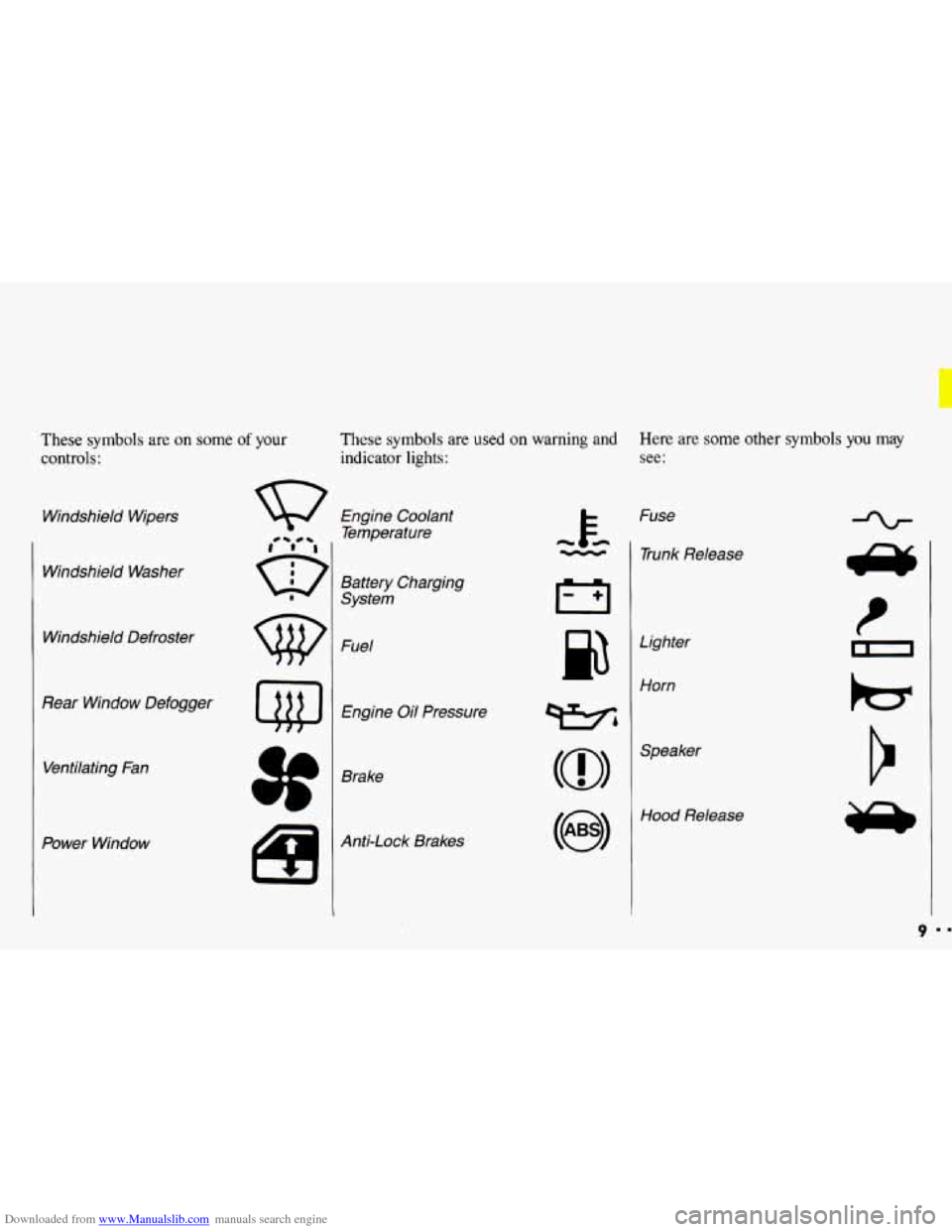
Downloaded from www.Manualslib.com manuals search engine These symbols are on some of your
controls:
Windshield Wipers
Windshield Washer
Windshield Defroster
Rear Window Defogger Ventilating Fan
Power Window
These symbols are used on warning and Here are some other symbols you may
indicator lights: see:
Engine Coolant
Temperature
Battery Charging
System
Fuel
Engine Oil Pressure
Brake
Anti-Lock Brakes Fuse
- 1 Trunk Release
cc
Lighter
Horn
wbl
(@I
Hood Release
9
Page 49 of 308
Downloaded from www.Manualslib.com manuals search engine ..
.; . I
Here you can learn about the
many standard and optional features
on your Chevrolet. and information
on starting. shifting and braking
.
Also explained are the instrument
panel and the warning systems that
tell you
if everything is working
properly-and what to
do if you have
a problem
.
Part 2
Features & Controls
Keys ............................................................ 48
Locks ........................................................... 49
GloveBox ....................................................... 53
Ignition ......................................................... 55
StartingYourEngine ............................................... 56
Engine Block Heater ............................................... 59
Shifting the Transaxle
.............................................. 60
ParkingBrake .................................................... 66
ShiftingintoPark .................................................. 67
Windows
........................................................ 71
Turn SignaVHeadlight Beam Lever
................................... -73
Cruisecontrol
.................................................... 74
Headlights
....................................................... 78
Interior Lights
.................................................... 81
Windshield Wipers
................................................ 83
Windshield Washer
................................................ 84
Mirrors
......................................................... 85
Ashtrays and Lighter
............................................... 87
Sunroof ......................................................... 88
Instrumentpanel .................................................. 93
Warning Lights, Gages and Indicators
.................................. 96
47
c
...
Page 81 of 308
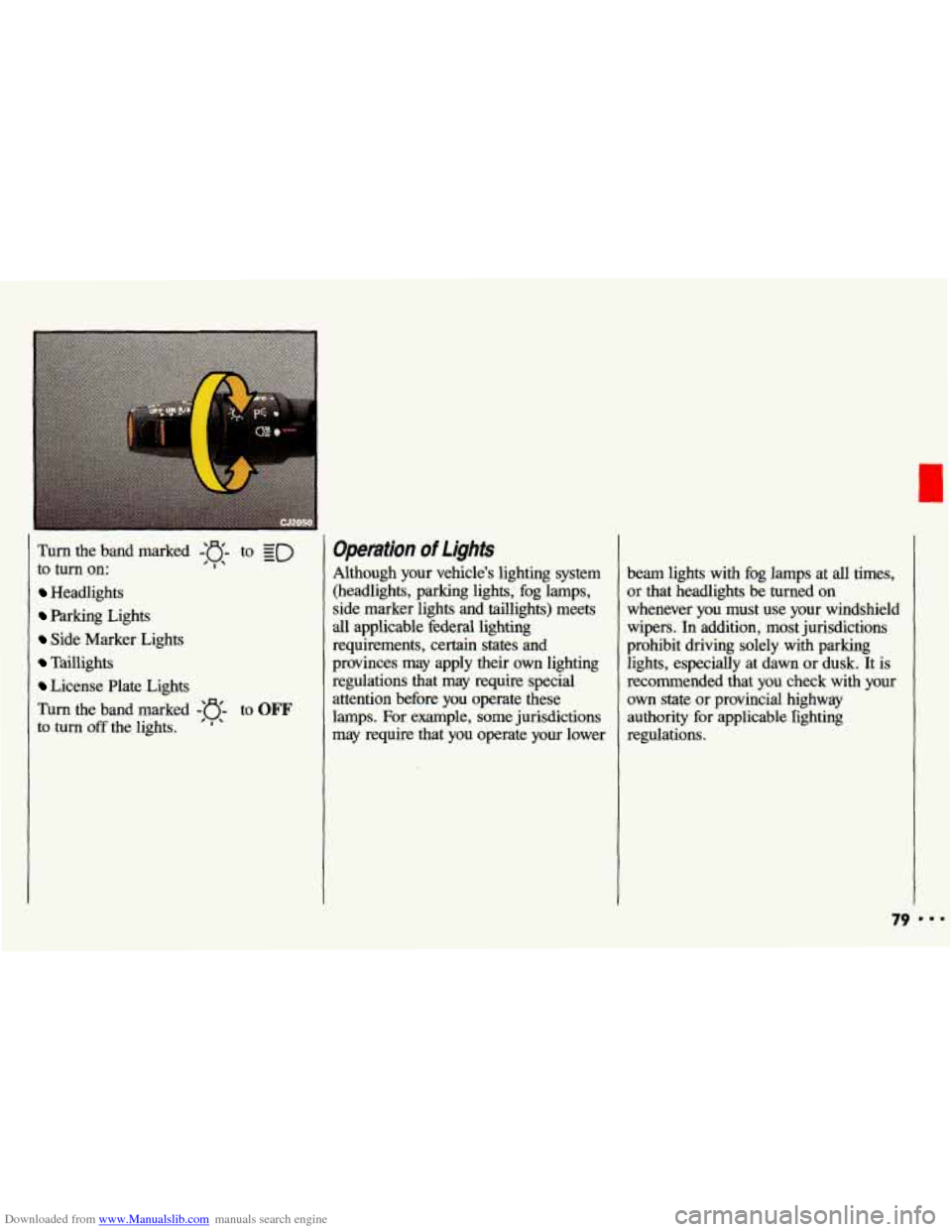
Downloaded from www.Manualslib.com manuals search engine Turn the band marked -'o- to ED
to turn on: ' I' -
Headlights
Parking Lights
Side Marker Lights
Taillights
License Plate Lights
Turn the band marked
-'e- to OFF
to turn off the lights. ' ' '
Operation of lights
Although your vehicle's lighting system (headlights, parking lights, fog lamps,
side marker lights and taillights) meets
all applicable federal lighting
requirements, certain states and
provinces may apply their own lighting
regulations that may require special
attention before you operate these
lamps. For example, some jurisdictions
may require that you operate your lower beam lights with
fog lamps at all times,
or that headlights be
turned on
whenever you must use your windshield
wipers.
In addition, most jurisdictions
prohibit driving solely with parking
lights, especially at dawn or dusk. It is
recommended that you check with your
own state or provincial highway
authority for applicable righting
regulations.
79 ...
Page 85 of 308
Downloaded from www.Manualslib.com manuals search engine L
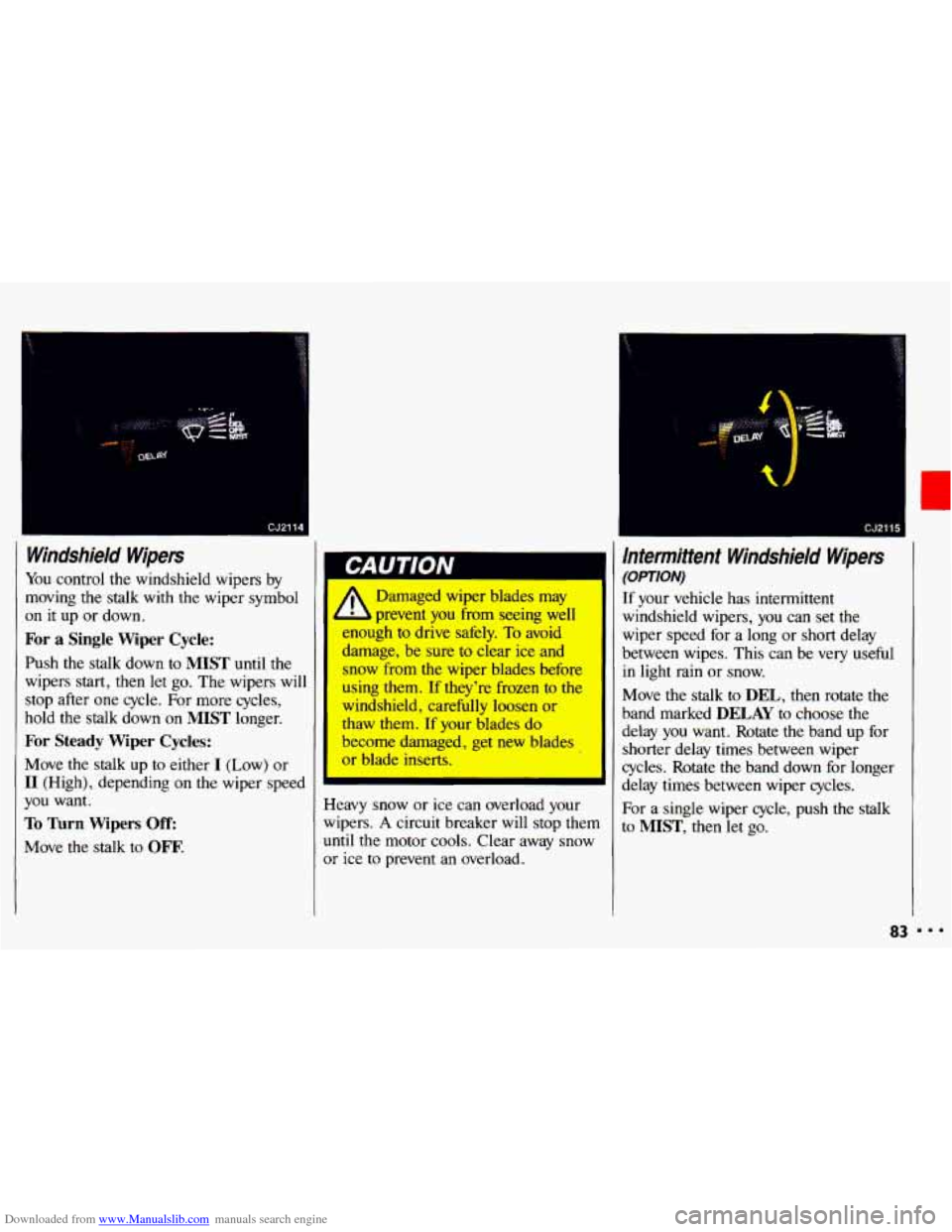
Windshield Wipers 1
You control the windshield wipers by
moving
the stalk with the wiper symbol 1 , Damaged wiper blades may
on
it up or down.
For a Single Wiper Cycle:
Push the stalk down to MIST until the
wipers start,
then let go. The wipers will
stop after one cycle. For more cycles,
hold the stalk down on
MIST longer.
For Steady Wiper Cycles:
Move the stalk up to either I (Low) or
I1 (High), depending on the wiper speed
you want.
To Turn Wipers Off
Move the stalk to OFF-
I CIUU I IWIV
5 prevent you from seeing well
enough
to drive safely. To avoid
damage, be sure to clear ice and
snow from
the wiper blades before
using them. If they're frozen to the
windshield, carefully loosen or
thaw them. If your blades do
become damaged, get new blades
or blade inserts.
Heavy snow
or ice can overload your
wipers.
A circuit breaker will stop then
until the motor cools. Clear away snow
or ice to prevent an overload.
Intermittent Windshield Wipers
(OPTION)
If your vehicle has intermittent
windshield wipers, you can set the
wiper speed for a long or short delay
between wipes. This can be very useful
in light rain or snow.
Move the stalk to
DEL, then rotate the
band marked
DELAY to choose the
delay you want. Rotate the band up for
shorter delay times between wiper
cycles. Rotate
the band down for longer
delay times between wiper cycles.
For a single wiper cycle, push the stalk
to
MIST, then let go.
83 mm.
Page 86 of 308
Downloaded from www.Manualslib.com manuals search engine Features & Controls
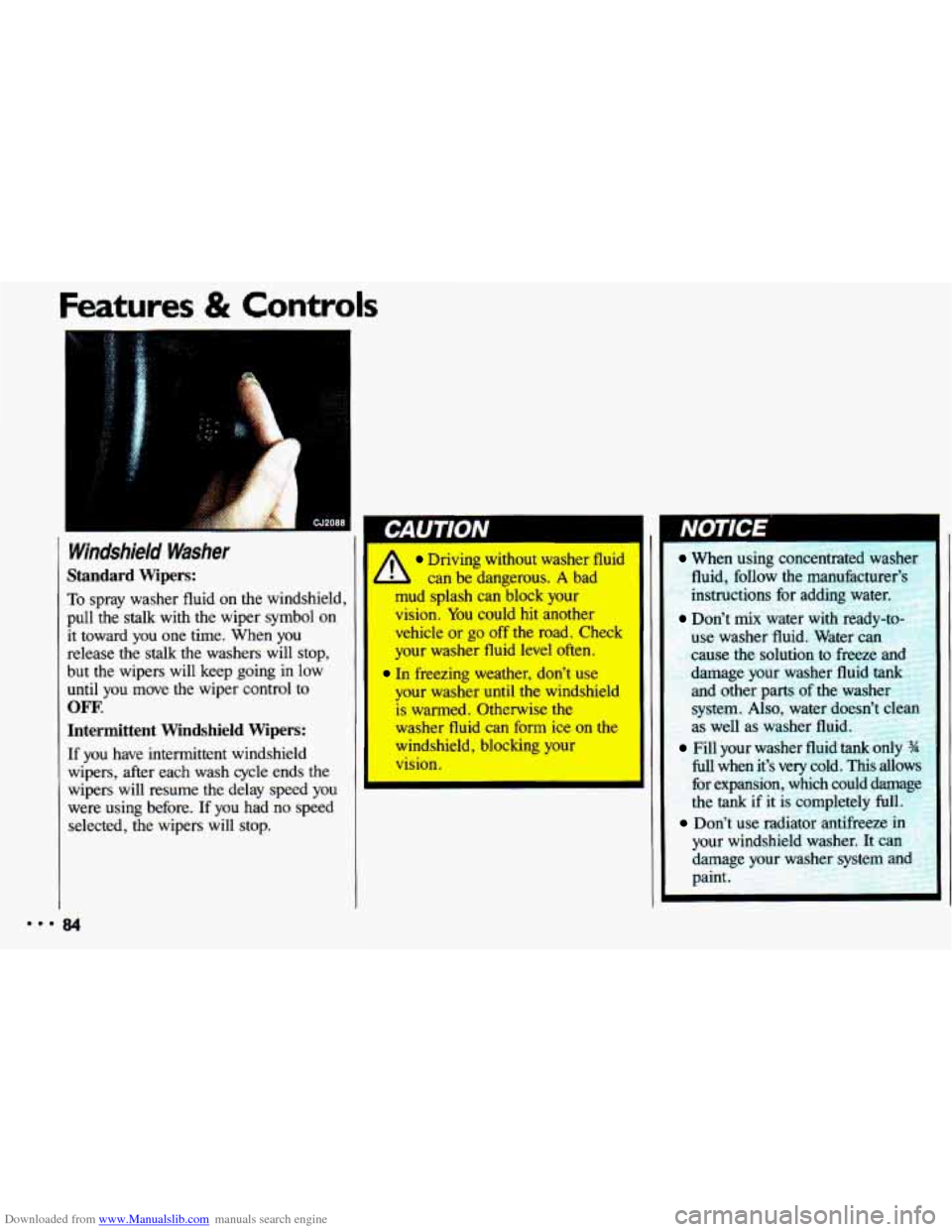
Windshield Washer
Standard Wipers:
To spray washer fluid on the windshield,
pull the stalk with the wiper symbol on
it toward you one time. When you
release the stalk the washers will stop,
but the wipers will keep going in low
until you move the wiper control to
OFF.
Intermittent Windshield Wipers:
If you have intermittent windshield
wipers, after each wash cycle ends the
wipers will resume the delay speed you were using before. If you had
no speed
selected, the wipers will stop.
I
Driving without washer fluid
A can be dangerous. A bad
mud splash can block your
vision.
You could hit another
vehicle
or go off the road. Check
your washer fluid level often.
In freezing weather, don’t use
your washer until the windshield is warmed. Otherwise the
washer fluid can form ice on the
windshield, blocking your
vision.
When using concentrated washer fluid, follow the manufacture]
instructions for adding
wa
Don’t mix water with readv-
use washer fluid. Water c;
cause the solution
to freeze E
damage your washer fluid tank
and other parts of the washer
system.
Also, water doesn’t cle:
as well as washer fluid.
Fill your washer fluid tank omy
hll when it’s very cold, This allows
for expansion, which could damage
the
tank if it is completely full.
Don’t use radiator antifreeze in
your windshield washer. It can
damage your washer systt
paint.
Page 150 of 308
Downloaded from www.Manualslib.com manuals search engine Your Driving and the Road
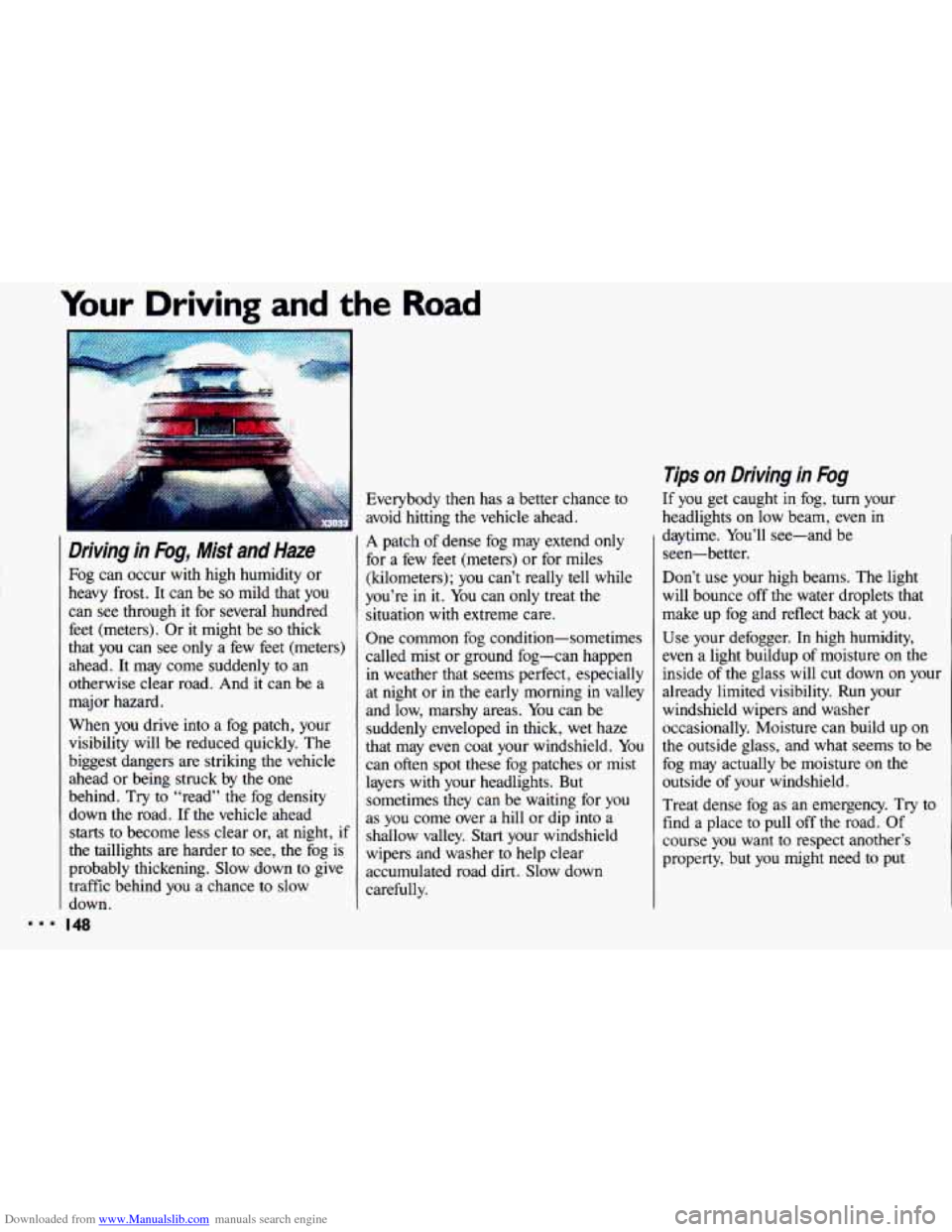
Driving in Fog, Mist and Haze
Fog can occur with high humidity or
heavy frost. It can be
so mild that you
can see through it for several hundred
feet (meters). Or it might be
so thick
that you can see only a few
feet (meters)
ahead. It may come suddenly to an
otherwise clear road. And it can be a
major hazard.
When
you drive into a fog patch, your
visibility will be reduced quickly. The
biggest dangers are striking the vehicle
ahead or being struck by the one
behind. Try to “read” the fog density
down the road.
If the vehicle ahead
starts to become less clear or, at night, if
the taillights are harder to see, the fog is
probably thickening. Slow down to give traffic behind you a chance to slow
down.
I48
Everybody then has a better chance to
avoid hitting the vehicle ahead.
A patch of dense fog may extend only
for a
few feet (meters) or for miles
(kilometers); you can’t really tell while
you’re
in it. You can only treat the
situation with extreme care.
One common fog condition-sometimes
called mist or ground fog-can happen
in weather that seems perfect, especially
at night or in the early morning
in valley
and low, marshy areas.
You can be
suddenly enveloped
in thick, wet haze
that may even coat your windshield.
You
can often spot these fog patches or mist
layers with your headlights. But
sometimes they can be waiting for
you
as you come over a hill or dip into a
shallow valley. Start your windshield
wipers and washer to help clear
accumulated road dirt. Slow down
carefully.
Tips on Driving in Fog
If you get caught in fog, turn your
headlights on low beam, even in
daytime. You’ll see-and be
seen-better.
Don’t use your high beams. The light
will bounce
off the water droplets that
make up fog and reflect back at you.
Use your defogger. In high humidity,
even a light buildup of moisture
on the
inside
of the glass will cut down on your
already limited visibility. Run your
windshield wipers and washer
occasionally. Moisture can build up
on
the outside glass, and what seems to be
fog may actually be moisture on the
outside of your windshield.
Treat dense fog as an emergency. Try to
find a place
to pull off the road. Of
course you want to respect another’s
property, but you might need to put
Page 250 of 308
Downloaded from www.Manualslib.com manuals search engine Service & Appearance Care
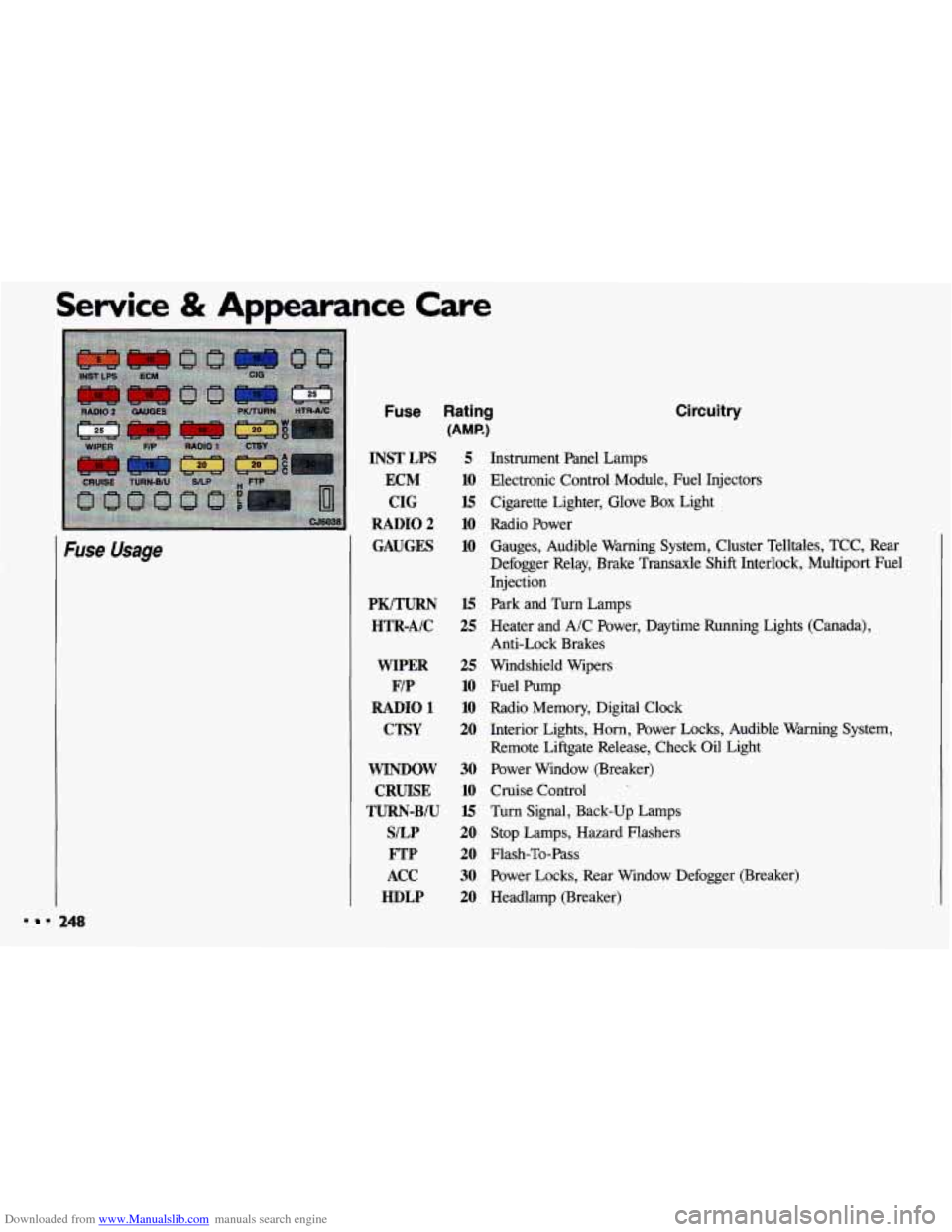
Fuse Usage
Fuse Rating
(AMP.)
INSTLPS 5
ECM 10
CIG 15
RADIO2 10
GAUGES 10
PK/TURN HTR-AIC
WIPER
F/P
RADIO 1
CTSY
WINDOW CRUISE
TURN-BIU
S/LP FTP
ACC
HDLP
15
25
25
10
10
20
30
10
15
20
20
30
20
Circuitry
Instrument Panel Lamps
Electronic Control Module, Fuel Injectors Cigarette Lighter, Glove
Box Light
Radio Power Gauges, Audible Warning System, Cluster Telltales, TCC, Rear
Defogger Relay, Brake Transaxle Shift Interlock, Multiport Fuel
Injection
Park and Turn Lamps
Heater and A/C Power, Daytime Running Lights (Canada),
Anti-Lock Brakes
Windshield Wipers
Fuel Pump
Radio Memory, Digital Clock
Interior Lights, Horn, Power Locks, Audible Warning System,
Remote Liftgate Release, Check Oil Light
Power Window (Breaker)
Cruise Control
Turn Signal, Back-up Lamps Stop Lamps, Hazard Flashers
Flash-To-Pass
Power Locks, Rear Window Defogger (Breaker)
Headlamp (Breaker)
248
Page 251 of 308
Downloaded from www.Manualslib.com manuals search engine Headlight Wiring
The headlight wiring is protected by a
circuit breaker in the fuseblock. An
electrical overload will cause the lights
to go on and
off, or in some cases to
remain
off. If this happens, have your
headlight system checked right away.
To access the headlight circuit breaker,
squeeze the plastic clip together and
remove.
Windsheld Wipers
The windshield wiper motor is protected
by a circuit breaker and a fuse.
If the
motor overheats due to heavy snow, etc.,
the wiper will stop until the motor
cools.
If the overload is caused by some
electrical problem, have it fixed.
Power Windows and Other
Power Options
Circuit breakers in the fuse panel protect
the power windows and other power
accessories. When the current load is
too heavy, the circuit breaker opens and
closes, protecting the circuit until the
problem is fixed.
249
Page 301 of 308
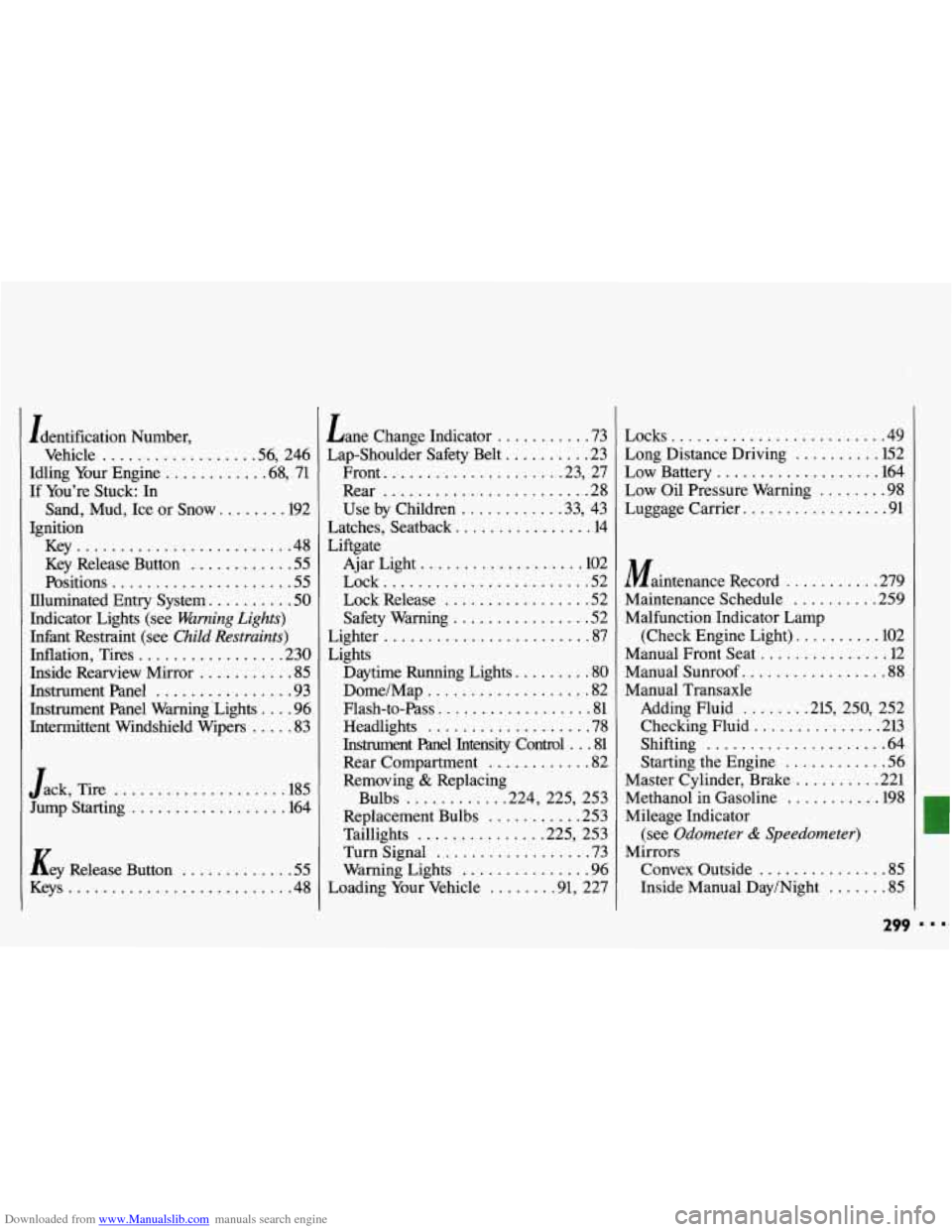
Downloaded from www.Manualslib.com manuals search engine Identification Number.
Vehicle
................. .56. 246
Idling Your Engine
........... .68. 71
Sand. Mud. Ice or Snow
........ 192
If You're Stuck: In
Ignition
Key
......................... 48
Key Release Button ............ 55
Positions
..................... 55
Illuminated Entry System
.......... 50
Indicator Lights (see
Warning Lights)
Infant Restraint (see Child Restraints)
Inflation. Tires ................. 230
Inside Rearview Mirror
........... 85
Instrument Panel ................ 93
Instrument Panel Wming'Lights
.... 96
Intermittent Windshield Wipers
..... 83
.................... J ack. Tire 185
Jump Starting
.................. 164
Key Release Button
............. 55
Keys .......................... 48 Lane
Change Indicator
........... 73
Lap-Shoulder Safety Belt
.......... 23
Front
..................... 23. 27
Rear
........................ 28
Use by Children ........... .33. 43
Latches. Seatback
................ 14
Liftgate Ajar Light
................... 102
Lock
........................ 52
Lock Release
................. 52
Safety Warning
................ 52
Lighter
........................ 87
Dome/Map
................... 82
Headlights
................... 78
Lights
Daytime Running Lights
......... 80
Flash-to-Pass .................. 81
Instrument Panel Intensity Control
... 81
Rear Compartment
............ 82
Removing
& Replacing
Bulbs
........... .224, 225, 253
Replacement Bulbs
........... 253
Taillights
.............. .225. 253
Turn Signal
.................. 73
Warning Lights
............... 96
Loading Your Vehicle
....... .91. 227 Locks
......................... 49
Long Distance Driving
.......... 152
Low Oil Pressure Warning
........ 98
Luggage Carrier
................. 91
Low Battery
................... 164
Maintenance Record
........... 279
Maintenance Schedule
.......... 259
Malfunction Indicator Lamp
(Check Engine Light)
.......... 102
Manual Front Seat
............... 12
Manual Sunroof
................. 88
Manual Transaxle
Adding Fluid
....... .215. 250, 252
Shifting
..................... 64
Master Cylinder. Brake
.......... 221
Methanol in Gasoline
........... 198
Mileage Indicator
Mirrors Checking
Fluid
............... 213
Starting the Engine
............ 56
(see
Odometer & Speedometer)
Convex Outside ............... 85
Inside Manual Day/Night ....... 85
299 m ..
Page 305 of 308
Downloaded from www.Manualslib.com manuals search engine Vehicle Damage Warnings ......... 7
Vehicle Identification Number
Vehicle Loading
............ .91. 227
Vehicle Storage
................ 223
Vehicles First Sold in Canada
...... 23
VIN
...................... 56. 246
Visor Vanity Mirror
.............. 86
(VIN) .................. .56. 246
Ventilation
............ .106. 108. 110
Wagon Folding Rear Seats
............. 16
Liftgate Ajar Light ............ 102
Liftgate
Lock ................. 52
Liftgate Release Button
......... 52
Rear Compartment Light
........ 82
Roof Luggage Carrier
........... 91
Taillight Bulb Replacement
.. .225, 253
Warning Flashers. Hazard
........ 164 Warning Lights
................. 96
Anti-Lock Brake System ........ 101
Battery
..................... lo0
Brake ...................... 100
Charging System .............. lo0
Check Coolant ................ 97
Check Engine
................ 102
Check Gages
................. 103
Liftgate Ajar
................. 102
Low Coolant
.................. 97
Oil ......................... 98
Safety Belt ............... .18, 22
Upshift Indicator
.......... .65, 101
Washer. Windshield
..... .84.220, 252
Weight Gross Axle Rating (GAWR)
..... 227
Gross Vehicle Rating
(GVWR)
.................. 227
Tire Balance
................. 234
Wheel Alignment and Wheel Covers. How to Remove
.... 188
Wheel Nuts
................... 188
Wheel Nut Torque
......... .190. 251
Wheel Replacement
............. 234
Windows Power
.................. .72. 249
Standard
..................... 71
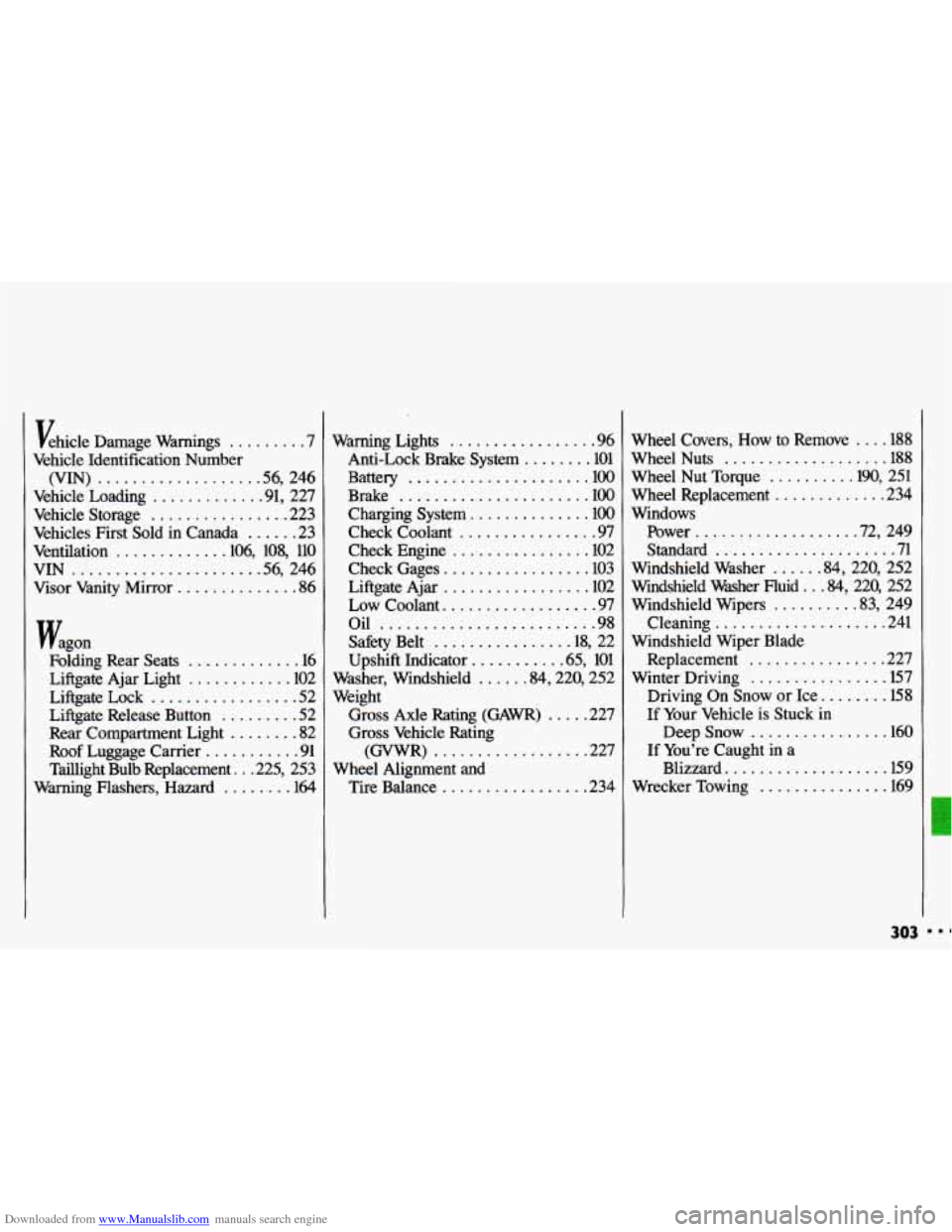
Windshield Washer
..... .84. 220. 252
Windshield Washer Fluid
.. .84. 220. 252
Windshield Wipers
......... .83. 249
Cleaning
.................... 241
Windshield Wiper Blade Replacement
................ 227
Winter Driving
................ 157
Driving
On Snow or Ice ........ 158
If Your Vehicle is Stuck in
Deep Snow
................ 160
If You’re Caught in a
Blizzard
................... 159
Wrecker Towing
............... 169