warning light CHEVROLET CAVALIER 1995 3.G User Guide
[x] Cancel search | Manufacturer: CHEVROLET, Model Year: 1995, Model line: CAVALIER, Model: CHEVROLET CAVALIER 1995 3.GPages: 340, PDF Size: 17.09 MB
Page 126 of 340
Downloaded from www.Manualslib.com manuals search engine These following conditions also may cause the CHECK
ENGINE light to come
on:
0
0
Low Fuel/Out of Fuel: As the vehicle starts to run
out of fuel, the CHECK ENGINE light may come on
as a result of an engine misfire. Filling your fuel tank
should correct this condition. Make sure to install
the
gas cap fully. It will require a few driving trips to
turn the light off.
Poor Quality Fuel: Be sure to fuel your vehicle with
quality fuel. Your engine may
not run efficiently on
poor fuel. Poor fuel may cause stalling, hesitation or
misfire. These conditions may
go away when the
engine
is warmed-up. However, poor quality fuel
may cause the
CHECK ENGINE light to come on.
Have a dealer check the vehicle. If no problems are
found, you may want
to change to another brand of
fuel.
Driving Through Standing Water: Driving your
vehicle through puddles
of deep standing water may
result in
a temporary misfire condition. This
condition will usually correct itself shortly after
the
electrical system dries out. it will require a few
driving trips
to turn the light off.
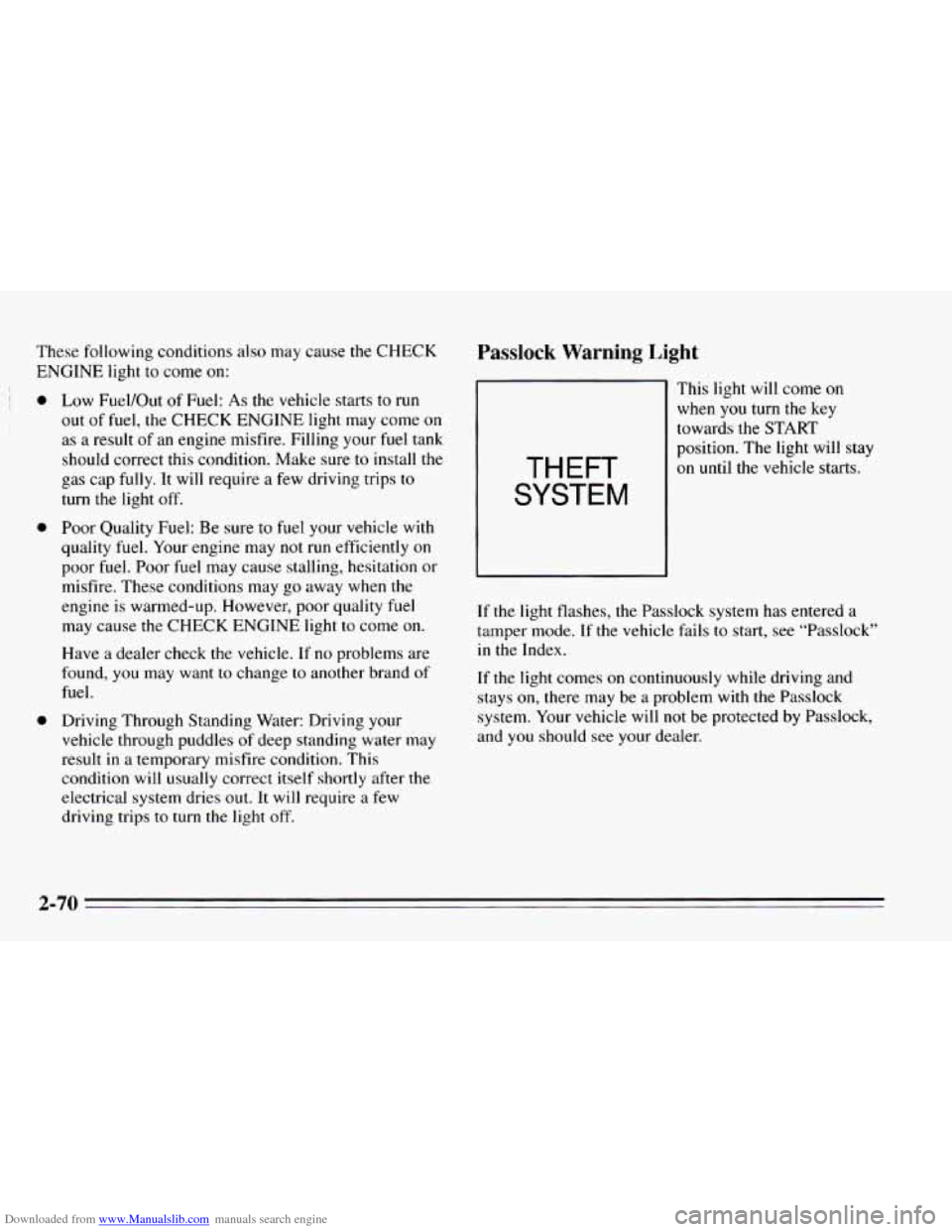
Passlock Warning Light
THEFT
SYSTEM
This light will come on
when you turn the key
towards the
START
position. The light will stay
on until the vehicle starts.
If the light flashes, the Passlock system has entered a
tamper mode.
If the vehicle fails to start, see “Passlock”
in the Index.
If
the light comes on continuously while driving and
stays
on, there may be a problem with the Passlock
system. Your vehicle will not be protected
by Passlock,
and
you should see your dealer.
2-70
Page 146 of 340

Downloaded from www.Manualslib.com manuals search engine Avoid needless heavy braking. Some people drive in
spurts
-- heavy acceleration followed by heavy braking
-- rather than keeping pace with traffic. This is a
mistake. Your brakes may not have time to cool between
hard stops. Your brakes will wear out much faster
if you
do a lot of heavy braking. If you keep pace with the
traffic and allow realistic following distances, you will
eliminate a lot
of unnecessary braking. That means
better braking and longer brake life.
If your engine ever stops while you’re driving, brake
normally but don’t pump
your brakes. If you do, the
pedal may get harder to push down. If your engine
stops,
you will still have some power brake assist. But
you will
use it when you brake. Once the power assist is
used up, it may take longer to stop and the brake pedal
will be harder to push.
Anti-Lock Brakes (ABS)
Your Chevrolet has an advanced electronic braking
system that will help prevent
a braking skid.
This light on
the
instrument panel will
come on briefly when
you start your vehicle.
When you start
your vehicle, or when you begin to drive
away,
you may hear a momentary motor or clicking
noise. And you may even notice that
your brake pedal
moves
a little while this is going on. This is the ABS
system testing itself. If there’s a problem with the
anti-lock brake system,
the anti-lock brake system
warning light will stay
on or flash.
See “Anti-Lock Brake System Warning Light” in the
Index.
Page 157 of 340
Downloaded from www.Manualslib.com manuals search engine City Driving
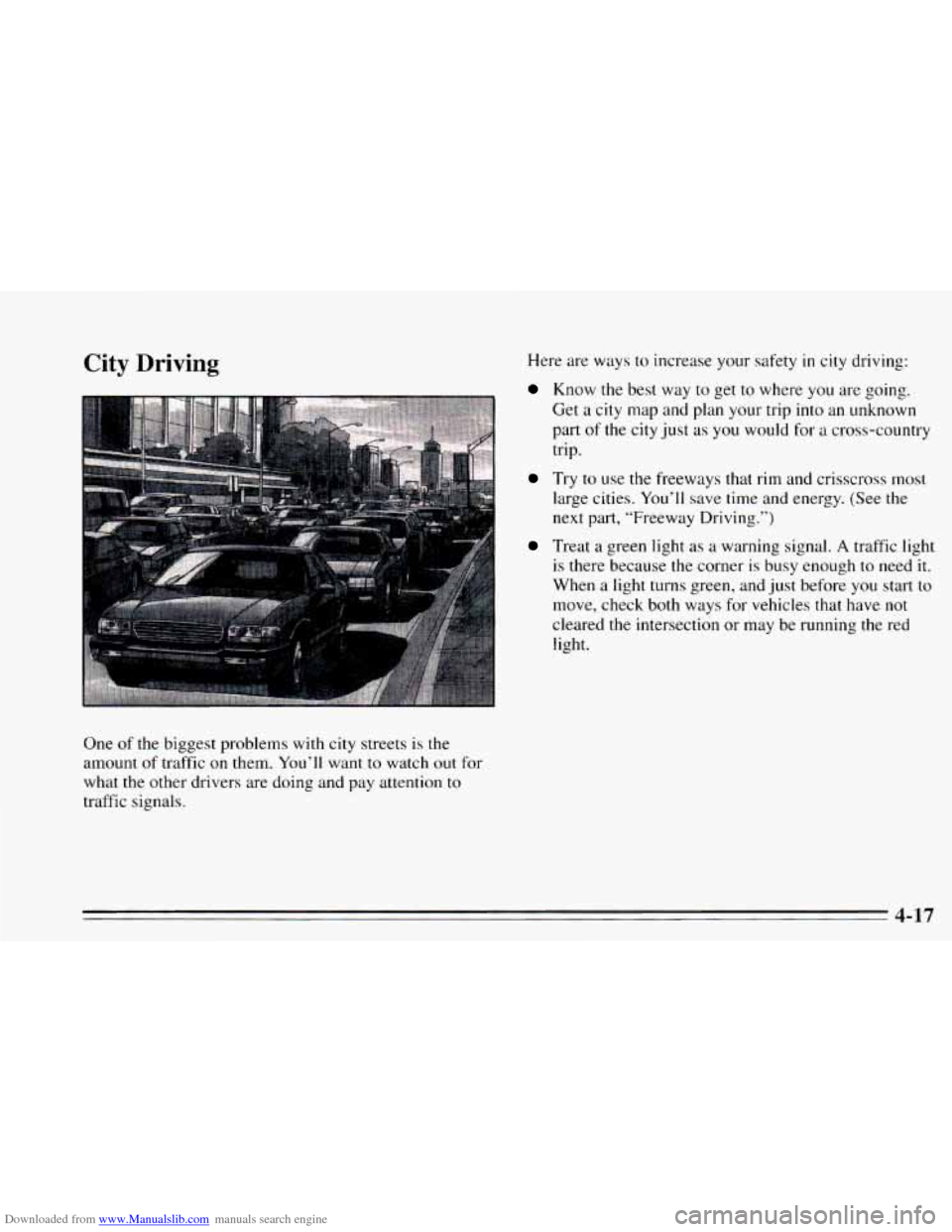
One of the biggest problems with city streets is the
amount of traffic
on them. You’ll want to watch out for
what the other drivers are doing and pay attention
to
traffic signals. Here
are ways to increase your safety
in city driving:
Know the best way to get to where you are going.
Get
a city map and plan your trip into an unknown
part of the city just as you would for a cross-country
trip.
Try to use the freeways that rim and crisscross most
large cities.
You’ll save time and energy. (See the
next part, “Freeway Driving.”)
Treat a green light as a warning signal. A traffic light
is there because the corner is busy enough to need
it.
When a light turns green, and just before you start to
move, check both ways for vehicles that have
not
cleared the intersection or may be running the red
light.
4-17
Page 162 of 340
Downloaded from www.Manualslib.com manuals search engine Winter Driving
Here are some tips for winter driving:
Have your Chevrolet in good shape for winter. Be
sure your engine coolant
mix is correct.
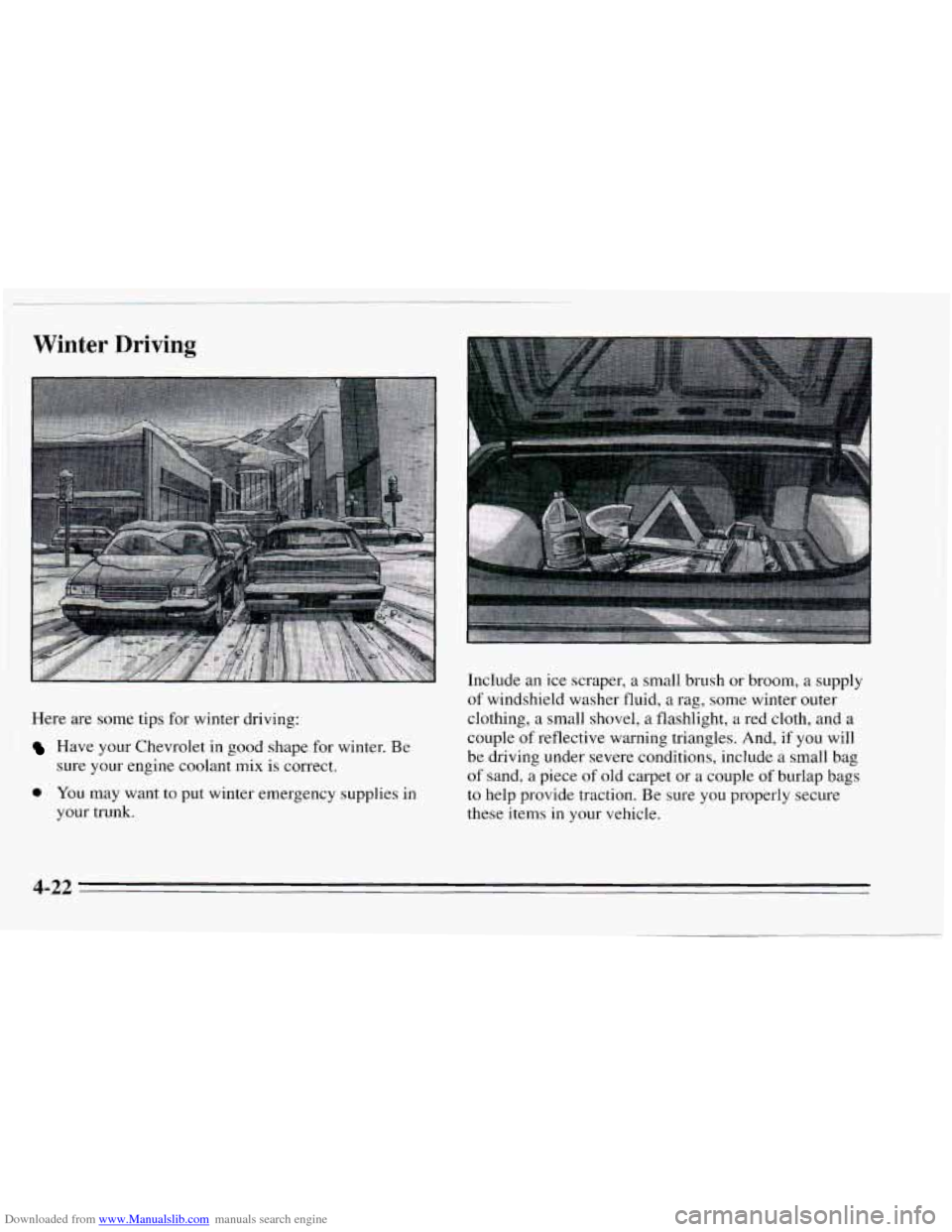
0 YOU may want to put winter emergency supplies in
your trunk. Include
an ice scraper, a small brush or broom, a supply
of windshield washer fluid, a rag, some winter outer
clothing, a small shovel, a flashlight, a red cloth, and a
couple of reflective warning triangles. And, if you will
be driving under severe conditions, include a small bag
of sand, a piece of old carpet or a couple of burlap bags
to help provide traction. Be sure you properly secure
these items in your vehicle.
4-22
Page 177 of 340
Downloaded from www.Manualslib.com manuals search engine 0 Section 5 Problems on the Road
Here you’ll find what to do about some problems that
can occur on the road.
Hazard Warning Flashers
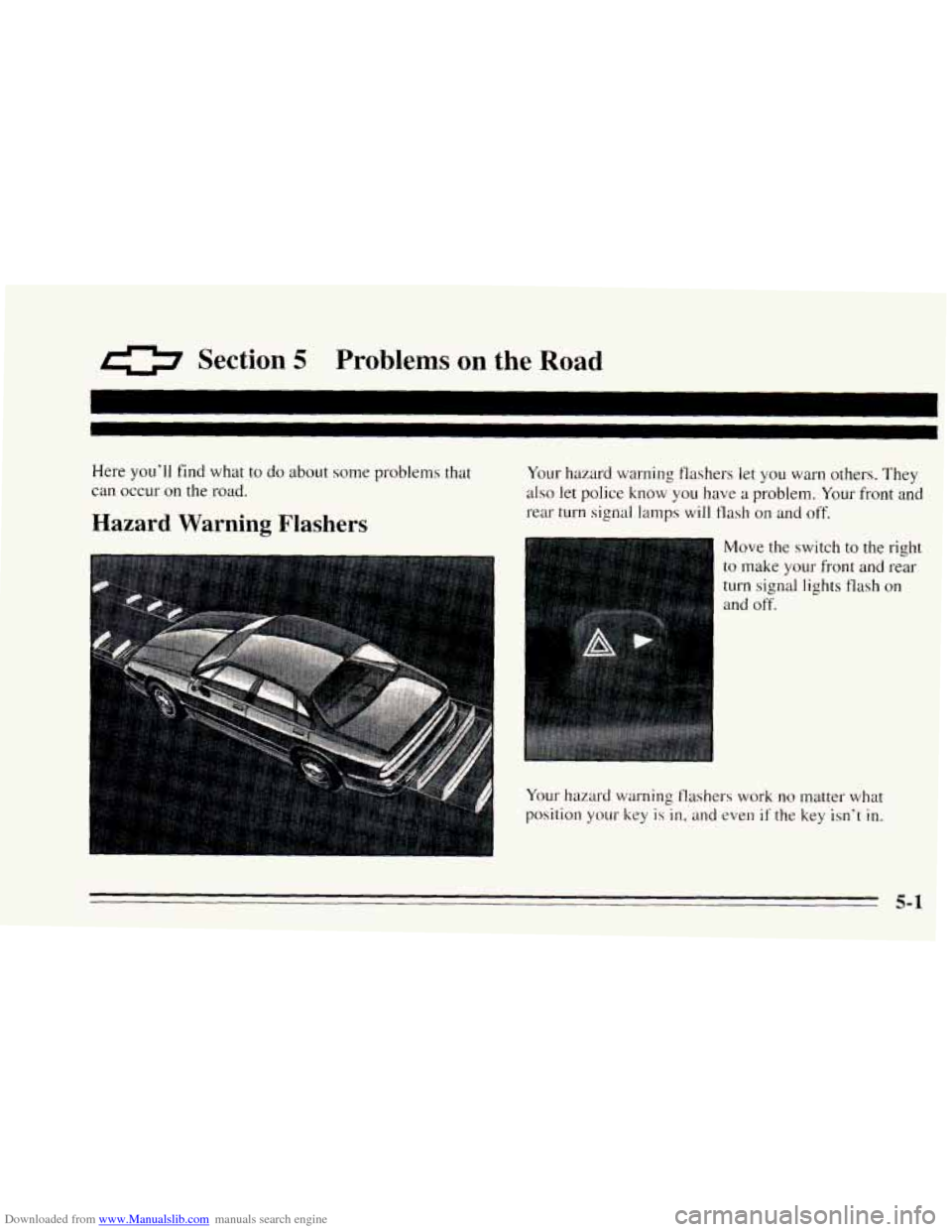
Your hazard warning flashers let you warn others. They
also let police know you have a problem. Your front and
rear turn signal lamps will flash on and off.
Move the switch to the right
to make your front and rear
turn signal lights flash on
and off.
Your hazard warning flashers work
no matter what
position your
key is in, and even if the key isn’t in.
5-1
Page 225 of 340
Downloaded from www.Manualslib.com manuals search engine When to Check and What to Use
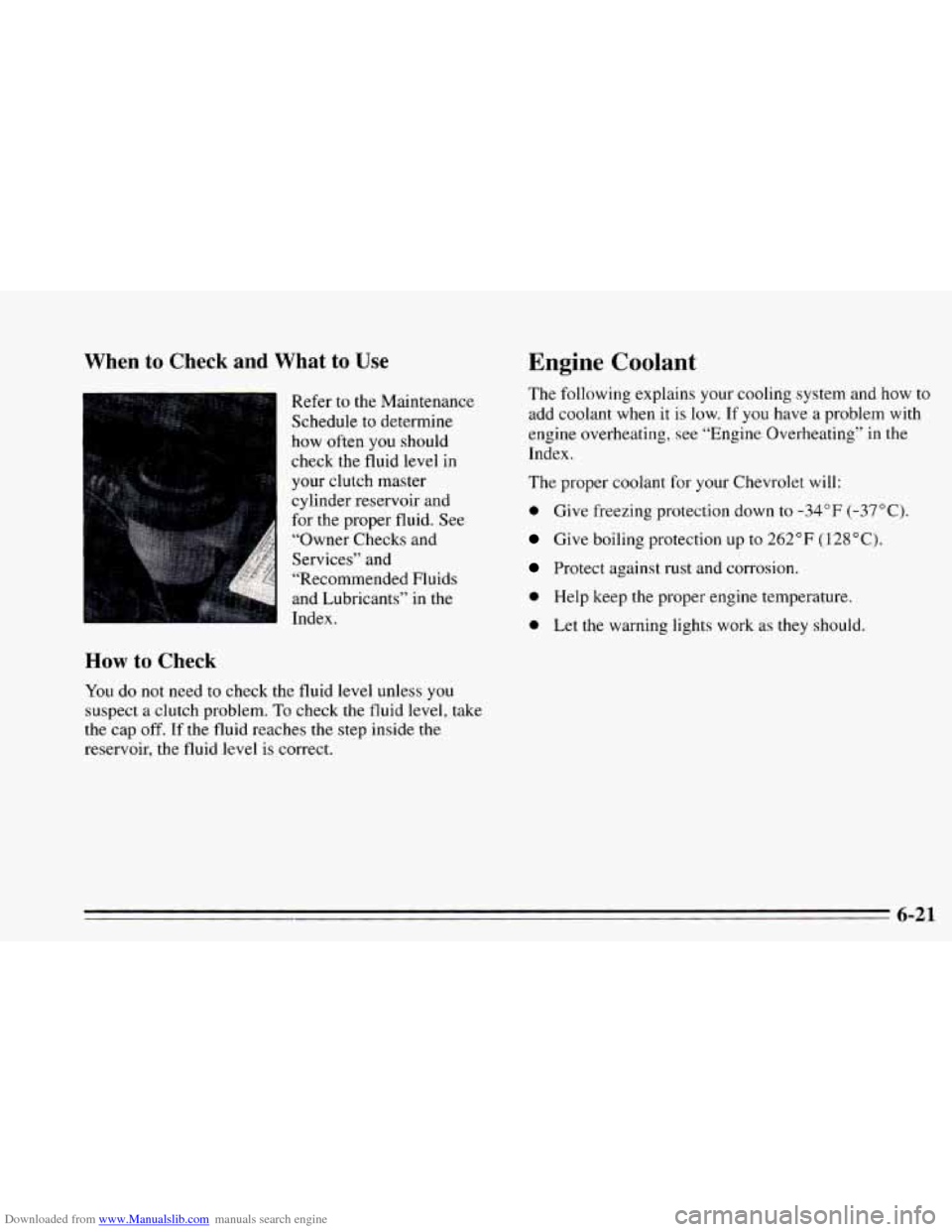
Refer to the Maintenance
Schedule to determine
how often you should
check the fluid level in
your clutch master
cylinder reservoir and
for the proper fluid. See
“Owner Checks and
Services” and
“Recommended Fluids
and Lubricants” in the
Index.
How to Check
You do not need to check the fluid level unless you
suspect a clutch problem. To check the fluid level, take
the cap
off. If the fluid reaches the step inside the
reservoir, the fluid level
is correct.
Engine Coolant
The following explains your cooling system and how to
add coolant when it is low.
If you have a problem with
engine overheating, see “Engine Overheating” in the
Index.
The proper
coolant for your Chevrolet will:
0 Give freezing protection down to -34°F (-37°C).
Give boiling protection up to 262°F (128°C).
Protect against rust and corrosion.
0 Help keep the proper engine temperature.
0 Let the warning lights work as they should.
6-21
Page 230 of 340
Downloaded from www.Manualslib.com manuals search engine Brakes
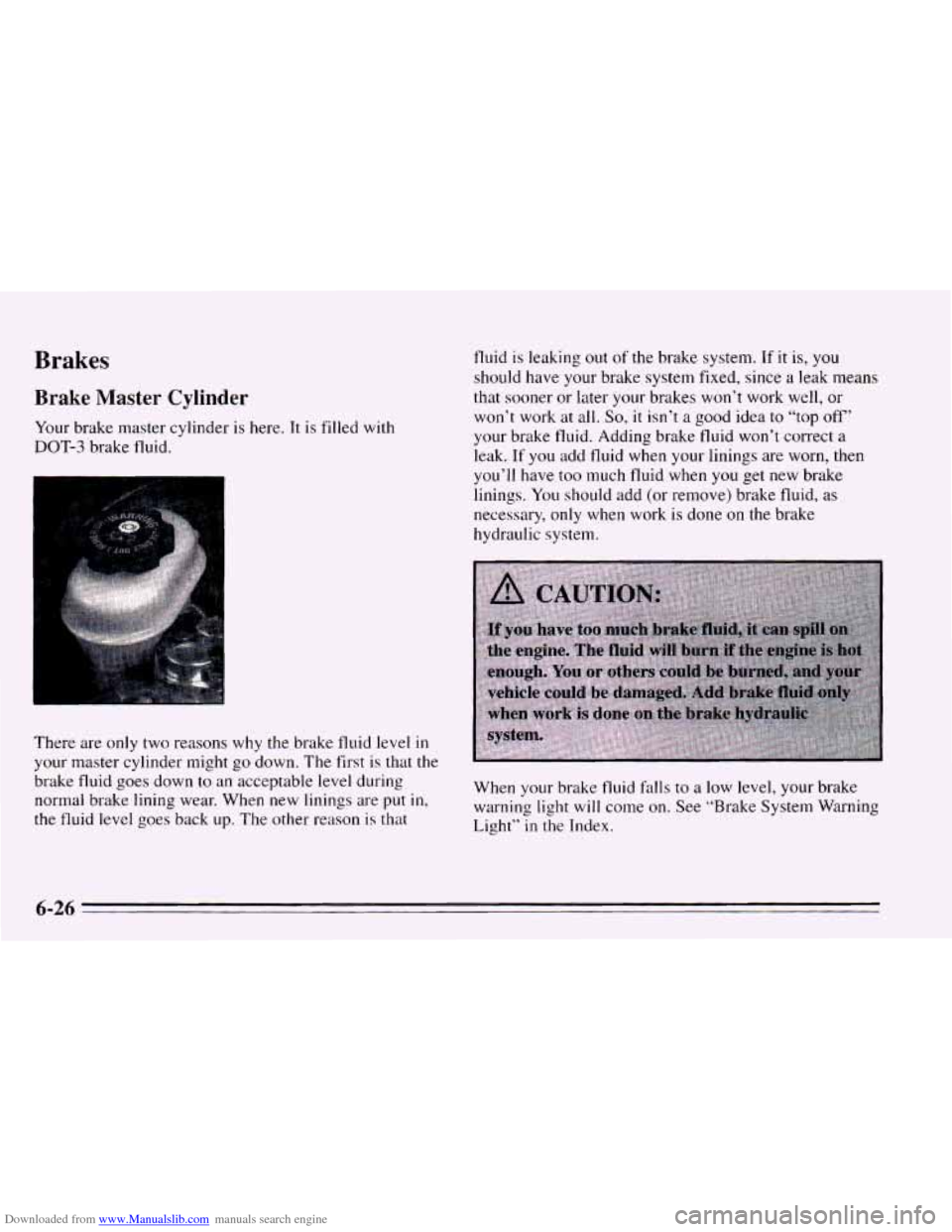
Brake Master Cylinder
Your brake master cylinder is here. It is filled with
DOT-3 brake fluid.
There are only two reasons why the brake
fluid level in
your master cylinder might go down. The first is that the
brake fluid goes down to an acceptable level during
normal brake lining wear. When new linings are put
in,
the fluid level goes back up. The other reason is that fluid
is leaking out
of the brake system. If it is, you
should have your brake system fixed, since a leak means
that sooner or later your brakes won’t work well, or
won’t work
at all. So, it isn’t a good idea to “top off’
your brake fluid. Adding brake fluid won’t correct
a
leak. If you add fluid when your linings are worn, then
you’ll have too much fluid when you get new brake
linings.
You should add (or remove) brake fluid, as
necessary, only when work is done on the brake
hydraulic system.
When your brake fluid falls to a low level, your brake
warning light will come on. See “Brake System Warning
Light”
in the Index,
6-26
Page 257 of 340
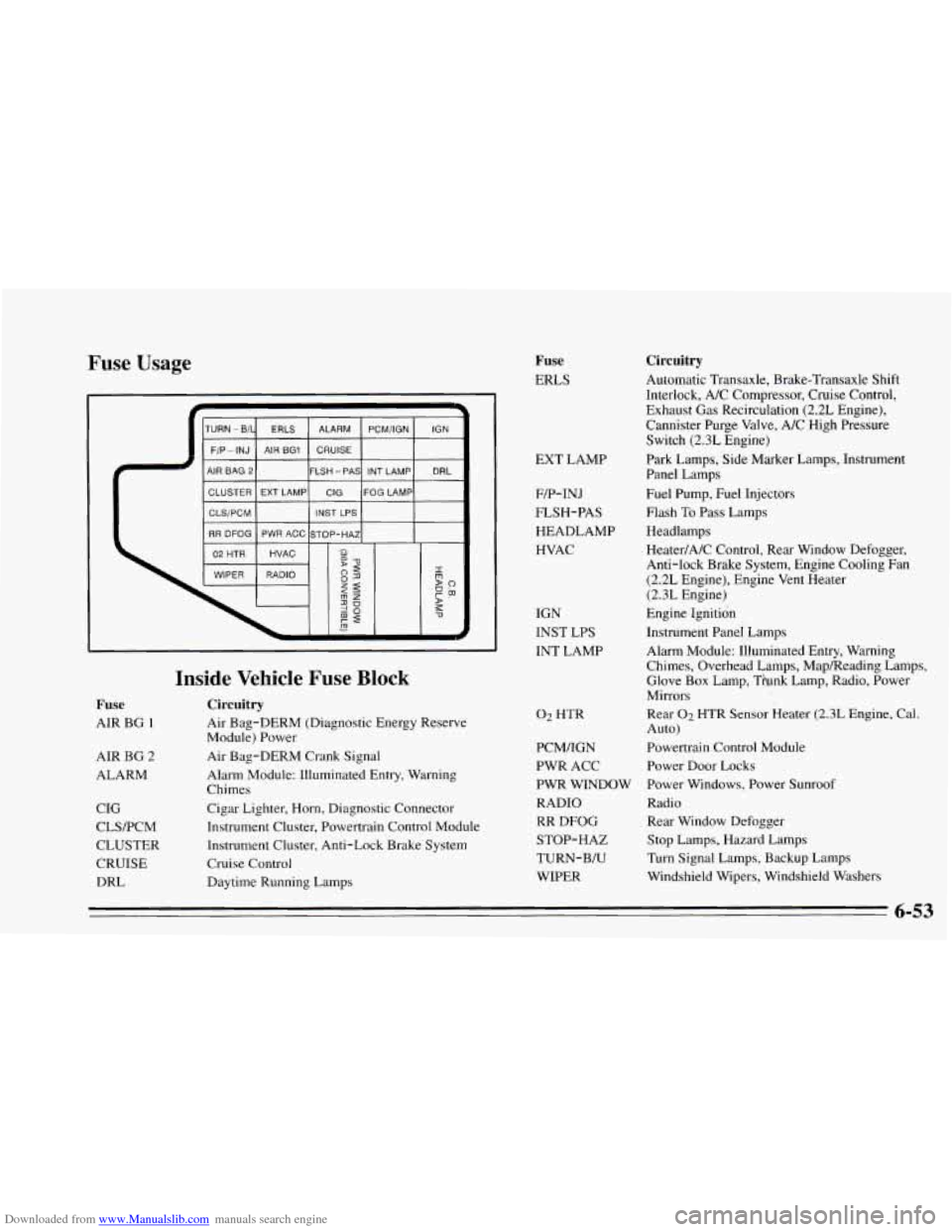
Downloaded from www.Manualslib.com manuals search engine Fuse Usage
S ALARM PCM/IGN IGN
Fuse
AIR BG 1
AIR BG 2
ALARM
CIG
CLSPCM
CLUSTER
CRUISE DRL
Inside Vehicle Fuse Block
Circuitry
Air Bag-DERM (Diagnostic Energy Reserve
Module) Power
Air Bag-DERM Crank Signal
Alarm Module: Illuminated Entry, Warning
Chimes
Cigar Lighter, Horn, Diagnostic Connector
Instrument Cluster, Powertrain Control Module
Instrument Cluster, Anti-Lock Brake System Cruise Control
Daytime Running Lamps IGN
INST
LPS
INT LAMP
Fuse
ERLS
EXT LAMP
F/P-INJ
FLSH-PAS
HEADLAMP
HVAC
Circuitry
Automatic Transaxle, Brake-Transaxle Shift
Interlock, A/C Compressor, Cruise Control,
Exhaust Gas Recirculation (2.2L Engine),
Cannister Purge Valve, A/C High Pressure
Switch (2.3L Engine)
Park Lamps, Side Marker Lamps, Instrument
Panel Lamps
Fuel Pump, Fuel Injectors
Flash To Pass Lamps
Headlamps
Heater/A/C Control, Rear Window Defogger,
Anti-lock Brake System, Engine Cooling Fan
(2.2L Engine), Engine Vent Heater
(2.3L Engine)
Engine Ignition
Instrument PaneiLamps
Alarm Module: 11,luminated Entry, Warning
Chimes, Overhead Lamps, MapReading Lamps,
Glove Box Lamp, Thnk Lamp, Radio, Power
Mirrors
Auto)
02 HTR Rear 02 HTR Sensor keater (2.3L Engine, Cal.
PCM/IGN Powertrain Control Module
PWR ACC Power
Door Locks
PWR WINDOW Power Windows, Power Sunroof
RADIO Radio
RR DFOG Rear Window Defogger
STOP-HAZ Stop Lamps, Hazard Lamps
TURN-B/U Turn
Signal Lamps, Backup Lamps
WIPER Windshield
Wipers, Windshield Washers
6-53
Page 327 of 340
Downloaded from www.Manualslib.com manuals search engine 0 Section 9 Index
Adding Automatic Transaxle Fluid
................ 6- 18. 6- 19
BrakeFluid ................................. 6-27
Electrical Equipment
.......... 2-1 1 , 2- 12, 3- 12, 6-5 1
Engine Coolant ......................... 5- 16, 6-22
Engineoil
.................................. 6-11
Hydraulic Clutch Fluid ........................ 6-20
Manual Transaxle Fluid
....................... 6- 19
Power Steering Fluid ......................... 6-24
SoundEquipment
............................ 3-12
Windshield Washer Fluid
................. 2-32, 6-25
AirBag
....................................... 1-18
How Does
it Restrain ......................... 1-22
Howitworks
............................... 1-20
Location
................................... 1-20
Servicing
................................... 1-24
What Makes
it Inflate ......................... 1-22
What Will You See After it inflates .............. 1-22
When Should
it Inflate ........................ 1-2 1
Air Bag Readiness Light .................... 1-20, 2-61
Aircleaner
.................................... 6-15
Air Conditioning ................................ 3-2
Air Conditioning Compressor Button
................ 3-2
Alignment and Balance, Tires
..................... 6-39
Aluminum Wheels, Cleaning ...................... 6-48
Antenna. Fixed Mast ............................ 3-14
Anti-Lock Brake System Warning Light
......... 2.63. 4.6
Anti-Lock Brakes
............................... 4-6
Anti-Theft Feature.
CD Player .................... 3-10
Antifreeze ..................................... 6-21
Adding
............................... 5.16. 6.22
Checking
................................... 6-23
Appearance Care
............................... 6-42
Appearance Care and Materials
.................... 6-50
Ashtray and Lighter ............................. 2-44
Audiosystems
.................................. 3-5
Auto Down Feature
............................. 2-27
Automatic Transaxle.
Four Speed
Automatic Overdrive
......................... 2-17
First(1)
.................................... 2-18
Neutral
(N) ................................. 2-15
Park(P) .................................... 2-14
Reverse(R)
................................. 2-15
Second(2)
.................................. 2-16
Shifting
.................................... 2-14
Third (3)
................................... 2-17
Drive(D)
................................... 2-16
First(1)
.................................... 2-16
Neutral (N)
................................. 2-15
Automatic Transaxle. Three Speed
9-1
Page 328 of 340
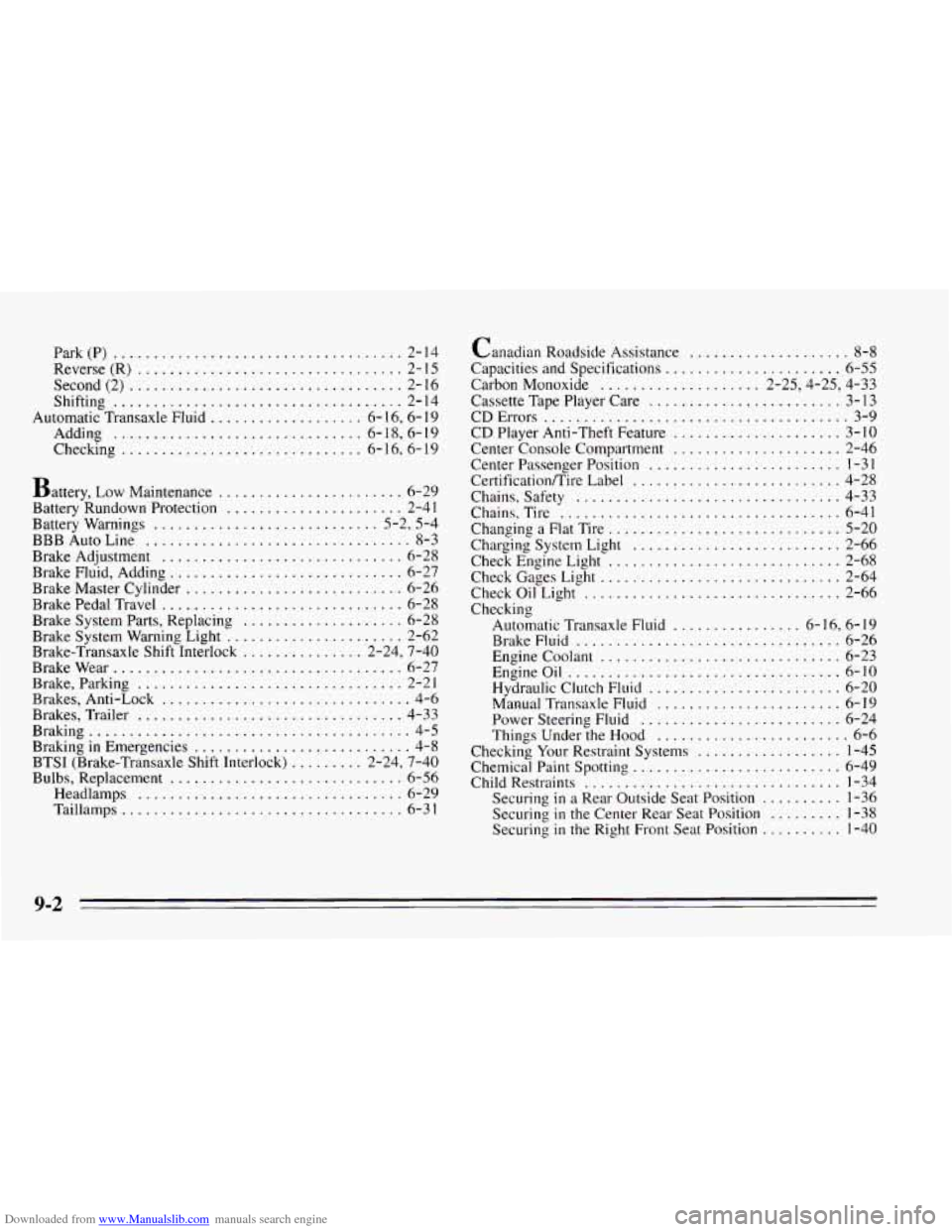
Downloaded from www.Manualslib.com manuals search engine Park(P) .................................... 2-14
Reverse(R)
................................. 2-15
Second(2)
.................................. 2-16
Shifting
.................................... 2-14
Automatic Transaxle Fluid ................... 6- 16. 6- 19
Adding
............................... 6- 18. 6- 19
Checking .............................. 6.16. 6.19
Battery.
LOW Maintenance ....................... 6-29
Battery Rundown Protection
...................... 2-4 1
Battery Warnings ............................ 5.2. 5.4
BBB Auto Line
................................. 8-3
Brake Adjustment
.............................. 6-28
Brake Fluid. Adding
............................. 6-27
Brake Master Cylinder
........................... 6-26
BrakePedalTravel
.............................. 6-28
Brake System Parts. Replacing
.................... 6-28
Brake System Warning Light
...................... 2-62
Brake-Transaxle Shift Interlock
............... 2-24. 7-40
BrakeWear
.................................... 6-27
Brake. Parking
................................. 2-21
Brakes. Anti-Lock
............................... 4-6
Brakes. Trailer
................................. 4-33
Braking
........................................ 4-5
Braking
in Emergencies ........................... 4-8
BTSI (Brake-Transaxle Shift Interlock)
......... 2-24. 7-40
Bulbs, Replacement
............................. 6-56
Headlamps
................................. 6-29
Taillamps
................................... 6-31 Canadian
Roadside Assistance
.................... 8-8
Capacities and Specifications ...................... 6-55
Carbon Monoxide .................... 2.25.4.25. 4.33
Cassette Tape Player Care
........................ 3-13
CDErrors
...................................... 3-9
CD Player Anti-Theft Feature
..................... 3- IO
Center Console Compartment ..................... 2-46
Center Passenger Position
........................ 1-31
Certification/TIre Label
.......................... 4-28
Chains. Safety
................................. 4-33
Chains. Tire
................................... 6-41
Changing a Flat Tire
............................. 5-20
Charging System Light
.......................... 2-66
Check Engine Light
............................. 2-68
Check Gages Light
.............................. 2-64
CheckOilLight
................................ 2-66
Checking Automatic Transaxle Fluid
................ 6- 16. 6- 19
BrakeFluid ................................. 6-26
Enginecoolant
.............................. 6-23
Engineoil
.................................. 6-10
Hydraulic Clutch Fluid
........................ 6-20
Manual Transaxle Fluid
....................... 6-19
Power Steering Fluid
......................... 6-24
Things Under the Hood
........................ 6-6
Checking Your Restraint Systems
.................. 1-45
Chemical Paint Spotting
.......................... 6-49
Child Restraints
................................ 1-34
Securing
in a Rear Outside Seat Position .......... 1-36
Securing
in the Center Rear Seat Position ......... 1-38
Securing
in the Right Front Seat Position .......... 1-40
9-2