light CHEVROLET CAVALIER 1995 3.G Service Manual
[x] Cancel search | Manufacturer: CHEVROLET, Model Year: 1995, Model line: CAVALIER, Model: CHEVROLET CAVALIER 1995 3.GPages: 340, PDF Size: 17.09 MB
Page 204 of 340
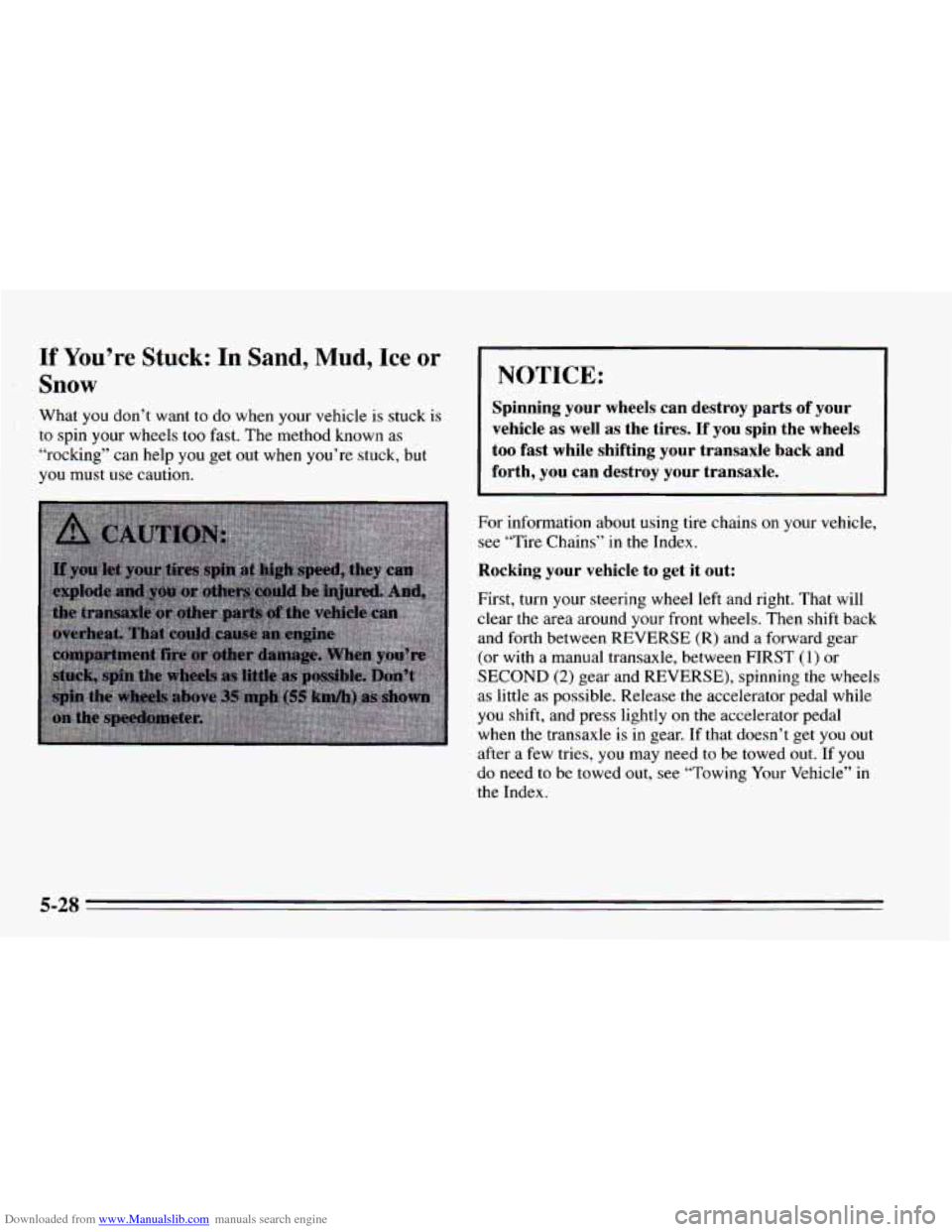
Downloaded from www.Manualslib.com manuals search engine If You’re Stuck: In Sand, Mud, Ice or
Snow
What you don’t want to do when your vehicle is stuck is
to spin your wheels too fast. The method known as
“rocking” can help you get out when you’re stuck, but
you must use caution.
I NOTICE:
Spinning your wheels can destroy parts of your
vehicle as well as the tires.
If you spin the wheels
too fast while shifting your transaxle back and
forth, you can destroy your transaxle.
For information about using tire chains on your vehicle,
see “Tire Chains”
in the Index.
Rocking your vehicle to get it out:
First, turn your steering wheel left and right. That will
clear the area around your front wheels. Then shift back
and forth between REVERSE (R) and a forward gear
(or with a manual transaxle, between FIRST
(1) or
SECOND (2) gear and REVERSE), spinning the wheels
as little as possible. Release the accelerator pedal while
you shift, and press lightly on the accelerator pedal
when the transaxle is in gear. If that doesn’t get
you out
after a few tries, you may need to be towed out. If you
do need to be towed out, see “Towing Your Vehicle” in
the Index.
5-28
Page 214 of 340
Downloaded from www.Manualslib.com manuals search engine Engine Oil
If the CHECK OIL light on the instrument panel comes
on,
it means you need to check your engine oil level
right away. For more information, see “Check Oil
Light” in the Index. You should check your engine oil
level regularly; this is
an added reminder.
It’s a good idea to check your engine oil every time you
get fuel. In order
to get an accurate reading, the oil must
be warm and the vehicle must be on level ground.
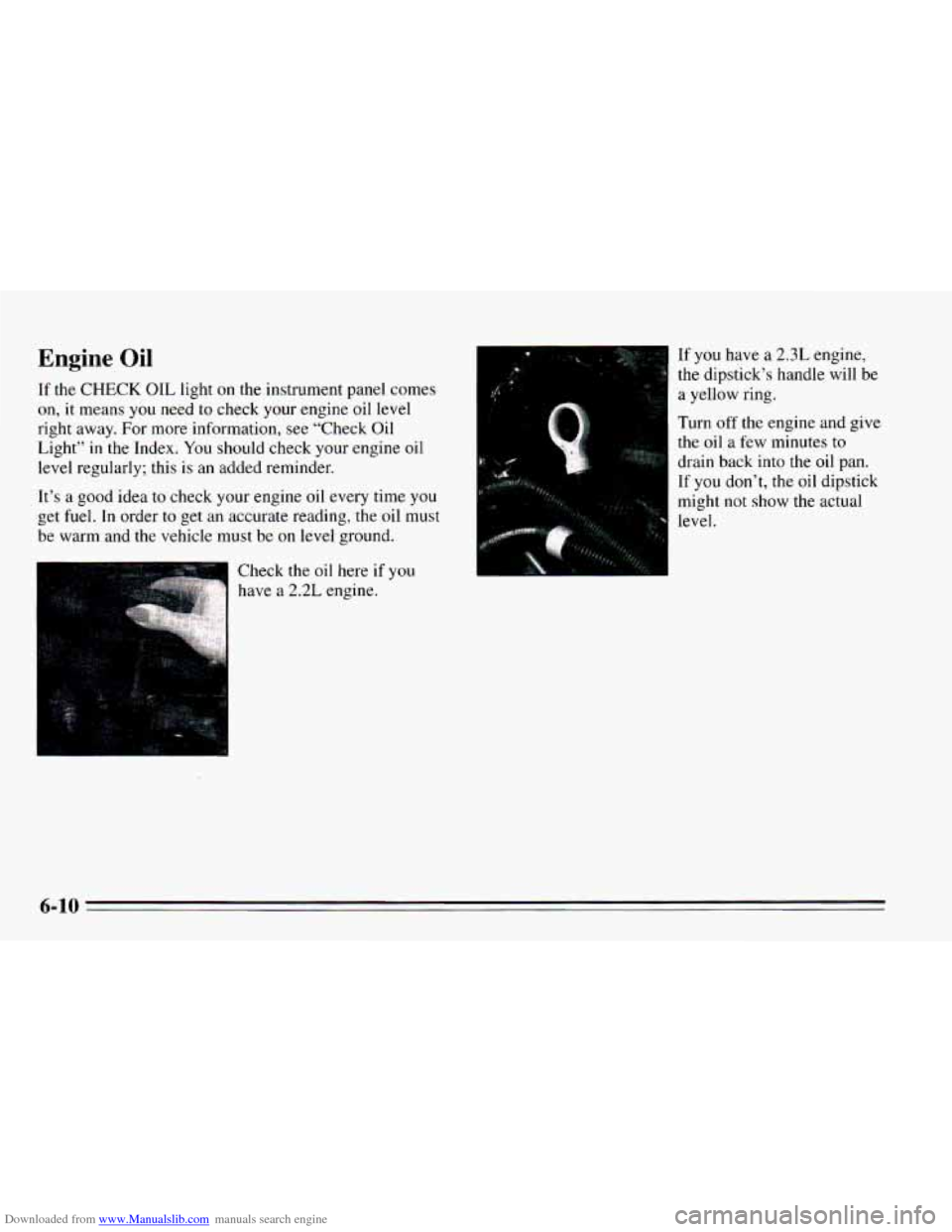
Check
have
a
the oil here if
2.2L engine.
If you have a 2.3L engine,
the dipstick’s handle will be
a yellow ring.
Turn
off the engine and give
the oil a few minutes to
drain back into the oil pan.
If you don’t, the oil dipstick
might not show
the actual
level.
U’IV
Page 225 of 340
Downloaded from www.Manualslib.com manuals search engine When to Check and What to Use
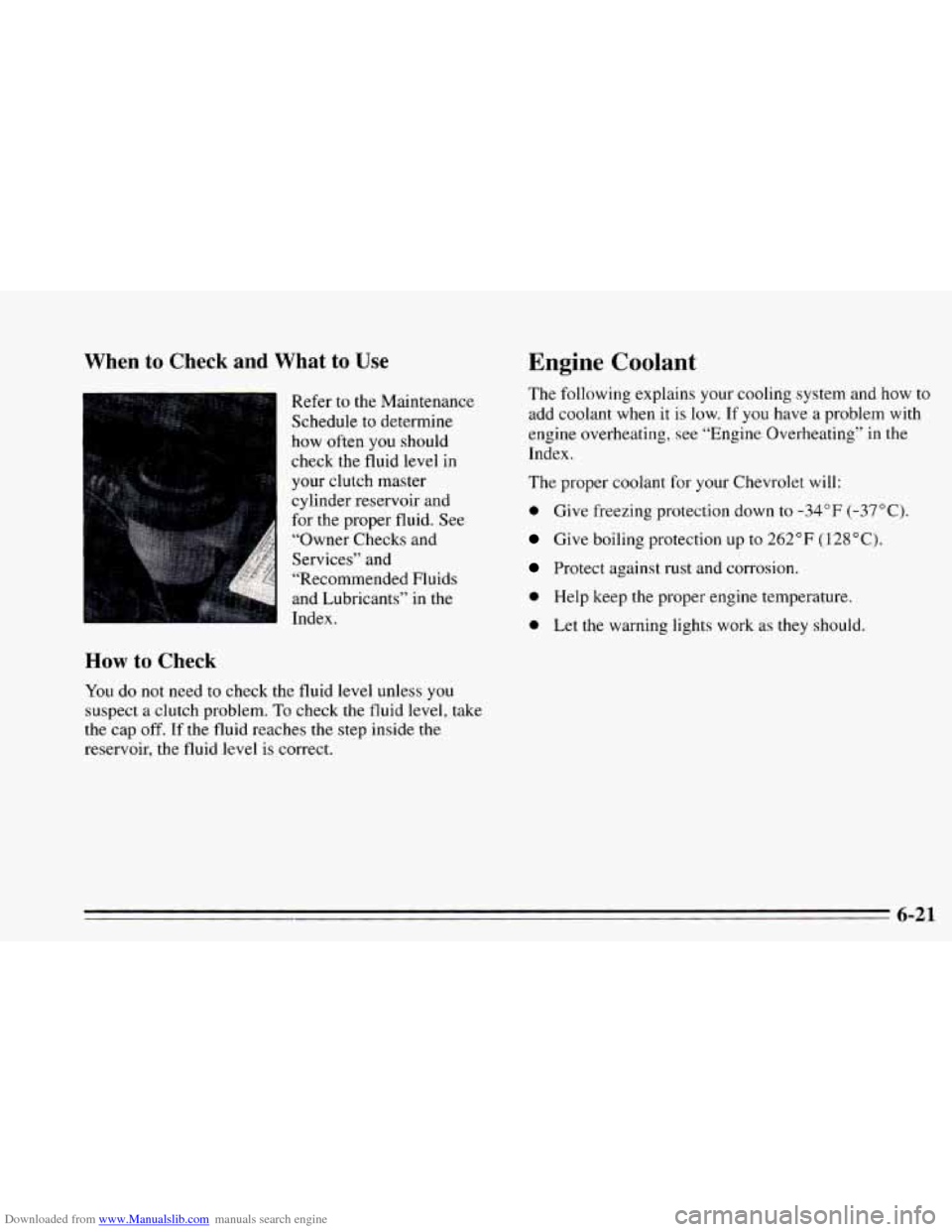
Refer to the Maintenance
Schedule to determine
how often you should
check the fluid level in
your clutch master
cylinder reservoir and
for the proper fluid. See
“Owner Checks and
Services” and
“Recommended Fluids
and Lubricants” in the
Index.
How to Check
You do not need to check the fluid level unless you
suspect a clutch problem. To check the fluid level, take
the cap
off. If the fluid reaches the step inside the
reservoir, the fluid level
is correct.
Engine Coolant
The following explains your cooling system and how to
add coolant when it is low.
If you have a problem with
engine overheating, see “Engine Overheating” in the
Index.
The proper
coolant for your Chevrolet will:
0 Give freezing protection down to -34°F (-37°C).
Give boiling protection up to 262°F (128°C).
Protect against rust and corrosion.
0 Help keep the proper engine temperature.
0 Let the warning lights work as they should.
6-21
Page 227 of 340
Downloaded from www.Manualslib.com manuals search engine To Check Coolant To Add Coolant
If you need more coolant, add the proper mix at the
surge tank, but only when the engine is cool.
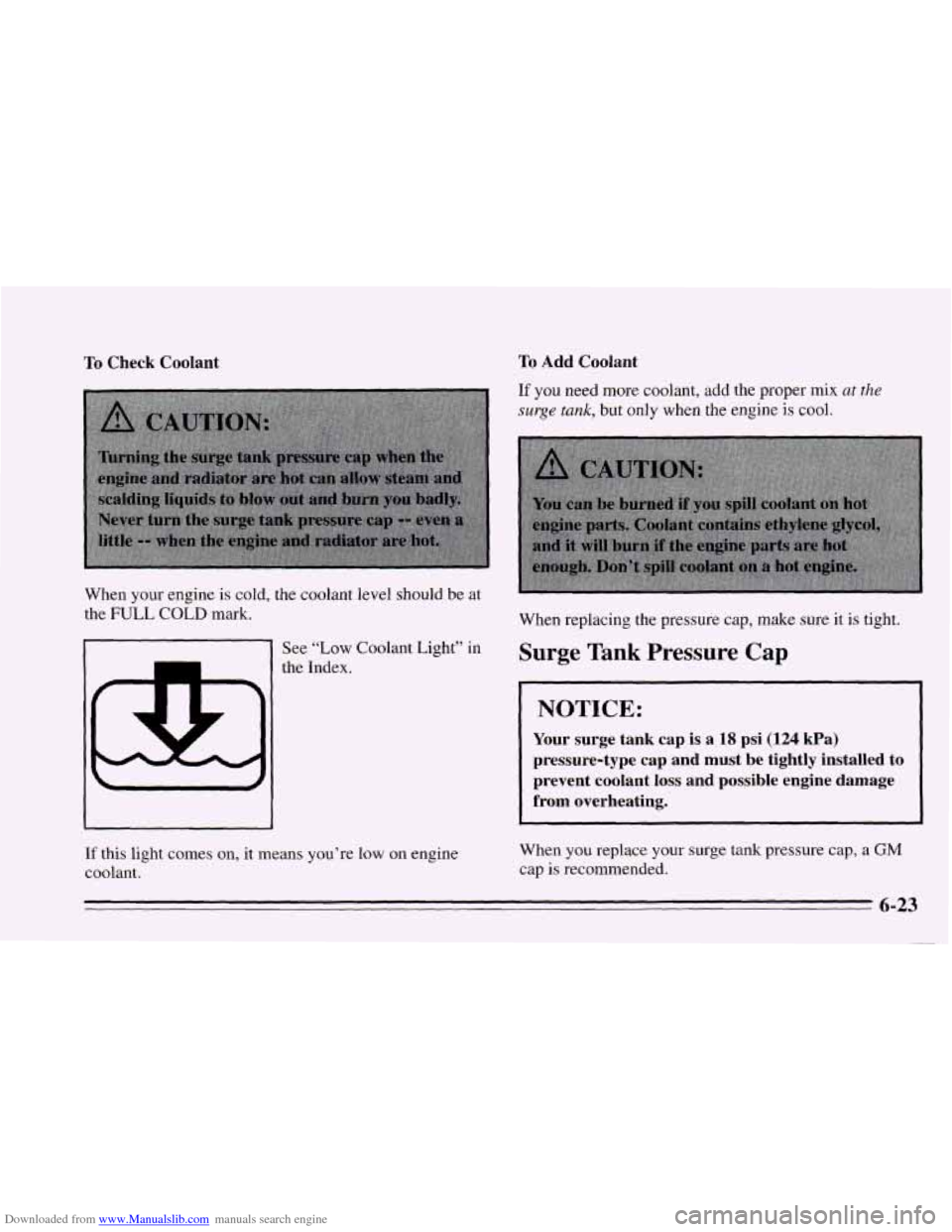
When your engine is cold, the coolant level should be at
the FULL
COLD mark.
See “Low Coolant Light”
in
the Index. When replacing
the pressure
cap, make sure it is tight.
Surge Tank Pressure Cap
NOTICE:
Your surge tank cap is a 18 psi (124 kPa)
pressure-type cap and must be tightly installed to
prevent coolant loss and possible engine damage
from overheating.
If this light comes on, it means you’re low on engine
coolant. When
you replace your surge tank pressure cap, a GM
cap is recommended.
Page 230 of 340
Downloaded from www.Manualslib.com manuals search engine Brakes
Brake Master Cylinder
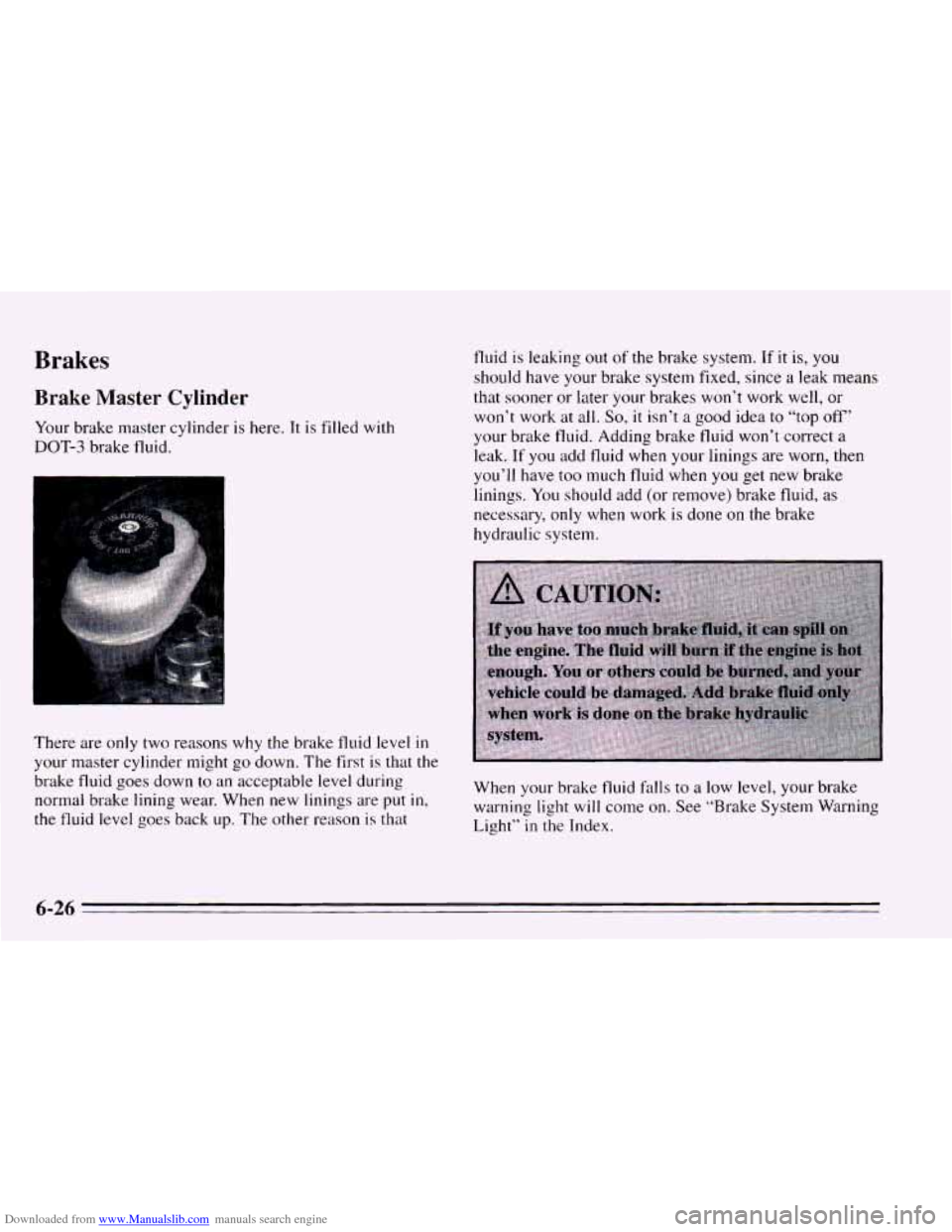
Your brake master cylinder is here. It is filled with
DOT-3 brake fluid.
There are only two reasons why the brake
fluid level in
your master cylinder might go down. The first is that the
brake fluid goes down to an acceptable level during
normal brake lining wear. When new linings are put
in,
the fluid level goes back up. The other reason is that fluid
is leaking out
of the brake system. If it is, you
should have your brake system fixed, since a leak means
that sooner or later your brakes won’t work well, or
won’t work
at all. So, it isn’t a good idea to “top off’
your brake fluid. Adding brake fluid won’t correct
a
leak. If you add fluid when your linings are worn, then
you’ll have too much fluid when you get new brake
linings.
You should add (or remove) brake fluid, as
necessary, only when work is done on the brake
hydraulic system.
When your brake fluid falls to a low level, your brake
warning light will come on. See “Brake System Warning
Light”
in the Index,
6-26
Page 232 of 340
Downloaded from www.Manualslib.com manuals search engine Some driving conditions or climates may cause a brake
squeal when the brakes are first applied or lightly
applied. This does not mean something is wrong with
your brakes.
Your rear drum brakes don’t have wear indicators, but if
you ever hear a rear brake rubbing noise, have the rear
brake linings inspected. Also, the rear brake drums
should be removed and inspected each time the tires are
removed for rotation or changing. When
you have the
front brakes replaced, have the rear brakes inspected, too.
Brake linings should always be replaced as complete
axle sets.
Brake Pedal Travel
See your dealer if the brake pedal does not return to
normal height, or if there is a rapid increase in pedal
travel. This could be a sign of brake trouble.
Brake Adjustment
Every time you make a moderate brake stop, your disc
brakes adjust for wear.
If you rarely make a moderate or
heavier stop, then your brakes might not adjust correctly.
If you drive in that way, then -- very carefully -- make
a few moderate brake stops about every
1,000 miles
(1 600 km), so your brakes will adjust properly. If
your brake pedal goes down farther than normal, your
rear drum brakes may need adjustment. Adjust them
by
backing up and firmly applying the brakes a few times.
Replacing Brake System Parts
The braking system on a modern vehicle is complex. Its
many parts have
to be of top quality and work well
together if the vehicle is to have really good braking.
Vehicles we design and test have top-quality
GM brake
parts in them, as your Chevrolet does when it
is new.
When
you replace parts of your braking system -- for
example, when your brake linings wear down and you
have to have new ones put in
-- be sure you get new
genuine
GM replacement parts. If you don’t, your
brakes may no longer work properly. For example,
if
someone puts in brake linings that are wrong for your
vehicle, the balance between your front and rear brakes
can change
-- for the worse. The braking performance
you’ve come
to expect can change in many other ways if
someone puts in the wrong replacement brake parts.
6-28
Page 247 of 340
Downloaded from www.Manualslib.com manuals search engine Using Foam-Type Cleaner on Fabric
0
0
0
0
0
0
0
0
0
0
Vacuum and brush the area to remove any loose dirt.
Always clean a whole trim panel or section. Mask
surrounding trim along stitch or welt lines.
Mix Multi-Purpose Powdered Cleaner following the
directions
on the container label.
Use suds
only and apply with a clean sponge.
Don’t saturate the material.
Don’t rub
it roughly.
As soon as you’ve cleaned the section, use a sponge
to remove the suds.
Rinse
the section with a clean, wet sponge.
Wipe
off what’s left with a slightly damp paper towel
or cloth.
Then dry it immediately with a blow dryer or a heat
lamp.
NOTICE:
Be careful. A blow dryer may scorch the fabric.
~~~~ ~~ ~~
0 Wipe with a clean cloth.
Using Solvent-Type Cleaner on Fabric
First, see if you have to use solvent-type cleaner at all.
Some spots and stains will clean
off better with just
water and mild soap.
If you need to use a solvent:
0 Gently scrape excess soil from the trim material with
a clean, dull knife or scraper. Use very little cleaner,
light pressure and clean cloths (preferably
cheesecloth). Cleaning should start at
the outside of
the stain, “feathering” toward
the center. Keep
changing to
a clean section of the cloth.
0 When you clean a stain from fabric, immediately dry
the area with
a blow dryer to help prevent a cleaning
ring. (See the previous
NOTICE.)
Fabric Protection
Your Chevrolet has upholstery that has been treated with
Scotchgard
TM Fabric Protector, a 3M product.
Scotchgard” protects fabrics by repelling oil and water,
which are the carriers
of most stains. Even with this
protection,
you still need to clean your upholstery often
to keep
it looking new.
Further information on cleaning is available by calling
1-800-433-3296
(in Minnesota, 1-800-642-6 167).
6-43
Page 248 of 340
Downloaded from www.Manualslib.com manuals search engine Special Cleaning Problems
Greasy or Oily Stains
Stains caused by grease, oil, butter, margarine, shoe
polish, coffee
with cream, chewing gum, cosmetic
creams, vegetable oils, wax crayon, tar and asphalt can
be removed
as follows:
Carefully scrape off excess stain.
Follow the solvent-type instructions described
earlier.
Shoe polish, wax crayon, tar and asphalt will stain if
left on a vehicle seat fabric. They should be removed
as soon as possible. Be careful, because the cleaner
will dissolve them and may cause them to spread.
Non-Greasy Stains
Stains caused by catsup, coffee (black), egg, fruit, fruit
juice,
milk, soft drinks, wine, vomit, urine and blood can
be removed
as follows:
0 Carefully scrape off excess stain, then sponge the
soiled area with
cool water.
If a stain remains, follow the foam-type instructions
described earlier.
If an odor lingers after cleaning vomit or urine, treat
the area with a waterhaking soda solution:
1 teaspoon (5 ml) of baking soda to 1 cup (250 ml)
of lukewarm water.
0 If needed, clean lightly with solvent-type cleaner.
Combination Stains
Stains caused by candy, ice cream, mayonnaise, chili
sauce and unknown stains can be removed as follows:
Carefully scrape off excess stain, then clean with
cool water and allow to dry.
If a stain remains, clean it with solvent-type cleaner.
Cleaning Vinyl
Use warm water and a clean cloth.
Rub with a clean, damp cloth to remove dirt. You
may have
to do it more than once.
0 Things like tar, asphalt and shoe polish will stain if
you don’t get them off quickly. Use a clean cloth and
a
GAM VinyVLeather Cleaner or equivalent product.
6-44
Page 251 of 340
Downloaded from www.Manualslib.com manuals search engine Foreign materials such as calcium chloride and other
salts, ice melting agents, road
oil and tar, tree sap. bird
droppings, chemicals from industrial chimneys, etc. can
damage your vehicle's finish
if they remain on painted
surfaces.
Wash the vehicle as soon as possible. If
necessary, use non-abrasive cleaners that are marked
safe for painted surfices
to remove foreign matter.
Exterior painted surfaces are subject to aging, weather
and chemical fallout that can take their
toll over a period
of years. You can help to keep the paint finish looking
new by keeping your Chevrolet garaged or covered
whenever possible.
Cleaning Your Convertible Top
Your convertible top should be cleaned often. If you use
an automatic car
wash, use one with water jets and
hanging cloths.
When you hand wash the top,
do it in partial shade. Use
a mild soap, lukewarm water and
a soft sponge. A
chamois or cloth may leave lint on the top, and a brush
can chate the tllreads
in the top fabric. Don't use
detergents, harsh cleaners, solvents or bleaching agents. When you
clean the top, put one hand under it
to
support it. Wet the entire vehicle and wilsh the top
evenly to avoid spots or rings. Let the soap remain
on
the fabric for a few minutes. When the top is really dirty,
use a mild foam-type cleaner. Thoroughly rinse the
entire vehicle,
then let the top dry in direct sunlight.
To protect the convertible top:
0 After you wash the vehicle, make sure the top is
completely
dry before you lower it.
0 Don't get any cleaner on the vehicle's painted finish:
it could leave streaks.
0 It' you decide to go through an automatic car wash,
ask the manager
if the equipment could damage your
top. Before entering
a car wash, set the climate
control
to VENT and the fan control to the highest
speed. This
will help to prevent water under high
pressure
from entering around the convertible top.
6-47
Page 257 of 340
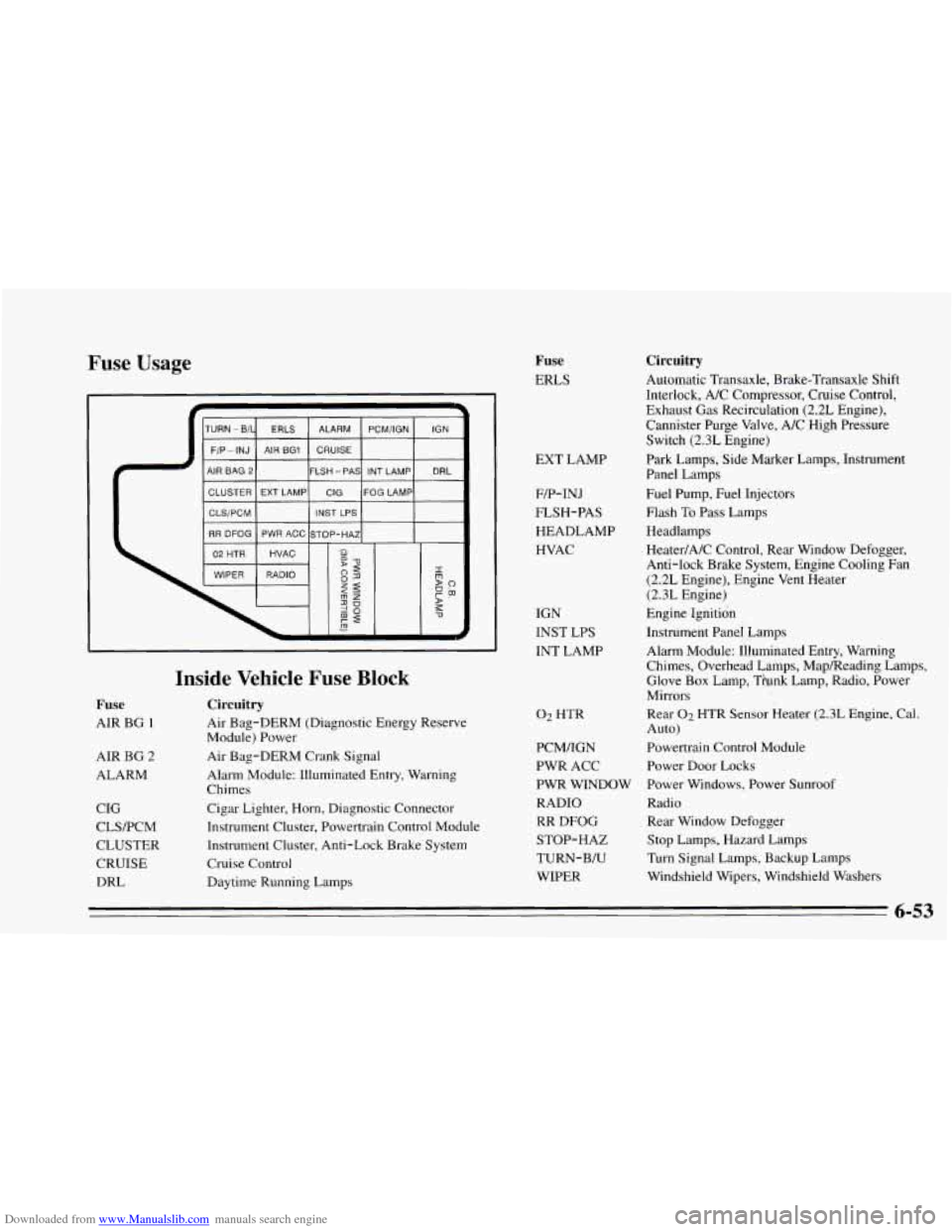
Downloaded from www.Manualslib.com manuals search engine Fuse Usage
S ALARM PCM/IGN IGN
Fuse
AIR BG 1
AIR BG 2
ALARM
CIG
CLSPCM
CLUSTER
CRUISE DRL
Inside Vehicle Fuse Block
Circuitry
Air Bag-DERM (Diagnostic Energy Reserve
Module) Power
Air Bag-DERM Crank Signal
Alarm Module: Illuminated Entry, Warning
Chimes
Cigar Lighter, Horn, Diagnostic Connector
Instrument Cluster, Powertrain Control Module
Instrument Cluster, Anti-Lock Brake System Cruise Control
Daytime Running Lamps IGN
INST
LPS
INT LAMP
Fuse
ERLS
EXT LAMP
F/P-INJ
FLSH-PAS
HEADLAMP
HVAC
Circuitry
Automatic Transaxle, Brake-Transaxle Shift
Interlock, A/C Compressor, Cruise Control,
Exhaust Gas Recirculation (2.2L Engine),
Cannister Purge Valve, A/C High Pressure
Switch (2.3L Engine)
Park Lamps, Side Marker Lamps, Instrument
Panel Lamps
Fuel Pump, Fuel Injectors
Flash To Pass Lamps
Headlamps
Heater/A/C Control, Rear Window Defogger,
Anti-lock Brake System, Engine Cooling Fan
(2.2L Engine), Engine Vent Heater
(2.3L Engine)
Engine Ignition
Instrument PaneiLamps
Alarm Module: 11,luminated Entry, Warning
Chimes, Overhead Lamps, MapReading Lamps,
Glove Box Lamp, Thnk Lamp, Radio, Power
Mirrors
Auto)
02 HTR Rear 02 HTR Sensor keater (2.3L Engine, Cal.
PCM/IGN Powertrain Control Module
PWR ACC Power
Door Locks
PWR WINDOW Power Windows, Power Sunroof
RADIO Radio
RR DFOG Rear Window Defogger
STOP-HAZ Stop Lamps, Hazard Lamps
TURN-B/U Turn
Signal Lamps, Backup Lamps
WIPER Windshield
Wipers, Windshield Washers
6-53