wheel CHEVROLET CAVALIER 1995 3.G Service Manual
[x] Cancel search | Manufacturer: CHEVROLET, Model Year: 1995, Model line: CAVALIER, Model: CHEVROLET CAVALIER 1995 3.GPages: 340, PDF Size: 17.09 MB
Page 239 of 340
Downloaded from www.Manualslib.com manuals search engine Tire Inspection and Rotation
Tires should be inspected every 6,000 to 8,000 miles
(10 000 to 13 000 km) for any signs of unusual wear. If
unusual wear is present, rotate your tires as soon
as
possible and check wheel alignment. Also check for
damaged tires or wheels. See “When It’s Time for New
Tires” and “Wheel Replacement” later in this section for
more information.
The purpose of regular rotation is to achieve more
uniform wear for all tires on the vehicle. The first
rotation is the most important. See “Scheduled
Maintenance Services” in the Index for scheduled
rotation intervals. When
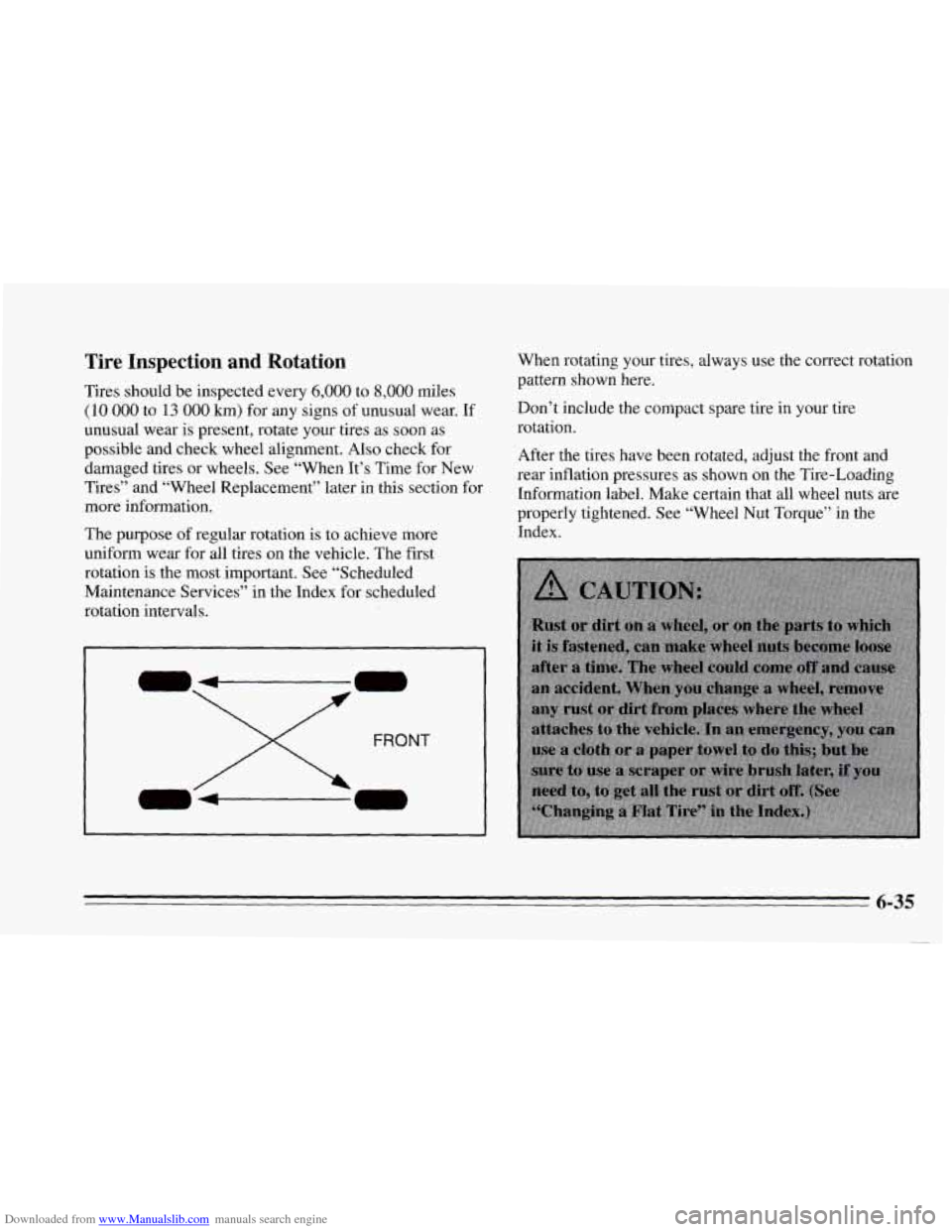
rotating your tires, always use the correct rotation
pattern shown here.
Don’t include the compact spare tire in your tire
rotation.
After the tires have been rotated, adjust the front and
rear inflation pressures as shown on the Tire-Loading
Information label. Make certain that all wheel nuts are
properly tightened. See “Wheel Nut Torque” in the
Index.
FRONT
6-35
Page 243 of 340
Downloaded from www.Manualslib.com manuals search engine Temperature - A, B, C
The temperature grades are A (the highest), B, and C,
representing the tire’s resistance to the generation of
heat and its ability to dissipate heat when tested under
controlled conditions
on a specified indoor laboratory
test wheel. Sustained high temperature can cause the
material
of the tire to degenerate and reduce tire life, and
excessive temperature can lead
to sudden tire hilure.
The grade
C corresponds to a level of performance
which all passenger car tires must meet under the
Federal Motor Vehicle Safety Standard
No. 109. Grades
B and A represent higher levels of performance on the
laboratory test wheel than the minimum required by law.
Wdrning: The temperature grade for this tire
is
established for a tire that is properly inflated and not
overloaded. Excessive speed, underinflation, or
excessive loading, either separately or
in combination,
can cause heat buildup and possible tire failure.
These grades are molded on the sidewalls of passenger
car tires. While the tires
available as standard
or optional
equipment
on General Motors vehicles may vary with
respect to these grades, all such tires meet General
Motors performance standards and
have been approved
for use
on General Motors vehicles. All passenger type
(P Metric) tires must conform to Federal safety
requirements
in addition to these grades.
Wheel Alignment and Tire Balance
The wheels on your vehicle were aligned and balanced
carefully at the hctory to give
you the longest tire life
and best overall performance.
In most cases, you will not need to have your wheels
aligned again. However, if
you notice unusual tire wear
or your vehicle pulling one way or the other, the
alignment may need to be reset.
If you notice your
vehicle vibrating when driving
on a smooth road, your
wheels may need to be rebalanced.
6-39
Page 244 of 340
Downloaded from www.Manualslib.com manuals search engine Wheel Replacement
Replace any wheel that is bent, cracked, or badly rusted
i or corroded. If wheel nuts keep coming loose, the wheel,
' wheel bolts, and wheel nuts should be replaced. If the
wheel leaks air, replace
it (except some aluminum
I wheels, which can sometimes be repaired). See your
Chevrolet dealer if any
of these conditions exist.
Your dealer will know the kind
of wheel you need.
Each new wheel should have the same load carrying
~ capacity, diameter, width, offset, and be mounted the
same way as the
one it replaces.
~ If you need to replace any of your wheels, wheel bolts,
' or wheel nuts, replace them only with new GM original
i equipment parts. This way, you will be sure to have the
~ right wheel, wheel bolts, and wheel nuts for your
Chevrolet model. NOTICE:
The wrong wheel can also cause problems with
bearing life, brake cooling,
speedometer/odometer calibration, headlamp
aim, bumper height, vehicle ground clearance,
and tire or tire chain clearance to the body and
chassis.
Page 245 of 340
Downloaded from www.Manualslib.com manuals search engine Used Replacement Wheels Tire Chains
I NOTICE:
If your Chevrolet has P195/65R15 or P205/55R16
size tires, don’t use tire chains; they can damage
your vehicle.
If you have other tires, use tire chains only where
legal and only when you must. Use only
SAE
Class “S” type chains that are the proper size for
your tires. Install them on the front tires and
tighten them as tightly as possible with the ends
securely fastened. Drive slowly and follow the
chain manufacturer’s instructions.
If you can
hear the chains contacting your vehicle, stop and
retighten them.
If the contact continues, slow
down until it stops. Driving too fast or spinning
the wheels with chains on
will damage your
vehicle.
6-41
Page 252 of 340
Downloaded from www.Manualslib.com manuals search engine Aluminum Wheels (If So Equipped)
Your aluminum wheels have a protective coating similar
to the painted surfice of your vehicle. Don’t use strong
soaps, chemicals, chrome polish, abrasive cleaners or
abrasive cleaning brushes
on them because you could
damage
this coating. After rinsing thoroughly, a wax
may be applied.
NOTICE:
If you have aluminum wheels, don’t use an
automatic vehicle wash that has hard silicon
carbide cleaning brushes. These brushes can take
the protective coating off your aluminum wheels.
Tires
To clean your tires, use a stiff brush with a tire cleaner.
When applying a tire dressing always take care
to wipe
off any overspray or splash from painted surfaces.
Petroleum-based products may damage the paint finish.
Sheet Metal Damage
If your vehicle is damaged and requires sheet metal
repair or replacement, make sure the body repair shop
applies anti-corrosion material to the parts repaired or
replaced to restore corrosion protection.
Finish Damage
Any stone chips, fractures or deep scratches in the finish
should be repaired right away. Bare metal
will corrode
quickly and may develop into a major repair expense.
Minor chips and scratches can be repaired with touch-up
materials available from your dealer or other service
outlets. Larger areas
of finish damage can be corrected
in your dealer’s body and paint shop.
6-48
Page 259 of 340
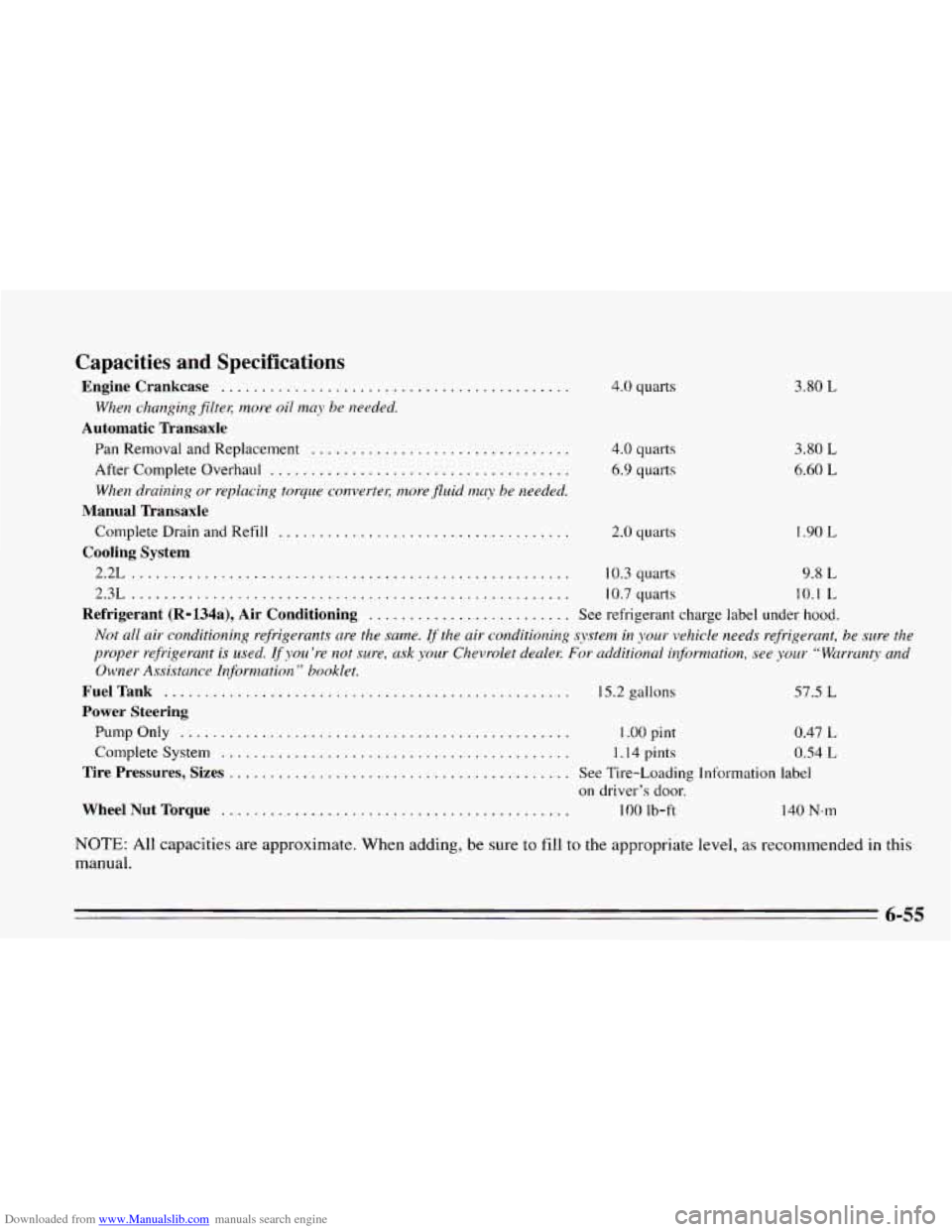
Downloaded from www.Manualslib.com manuals search engine 4.0 quarts 3.80 L
Capacities and Specifications
Enginecrankcase ...........................................
Automatic Transaxle
When chcwging$lte& more oil! rnuy be needed.
Pan Removal and Replacement ................................
When draining or replacing torque convertec 1nore.fluid may be needed.
Complete Drain and Refill ....................................
After Complete Overhaul .....................................
Manual Transaxle
Cooling System
2.2L ...................................................... 10.3 quarts 9.8 L
2.3L
...................................................... 10.7 quarts 10.1 L
Refrigerant (R-l34a), Air Conditioning ......................... See refrigerant charge label under hood.
Not all air conditioning refrigerants are the same. If the air conditioning system in your vehicle needs refrigerant, he sure the
proper refrigerant is used. IJ’you ’re not sure, ask your Chevrolet dealer:
For additionul information, see your “Warrunty and
Owner Assistunce Infixmution, ” booklet.
FuelTank ...............................................
Power Steering
PumpOnly ................................................ 1 .OO pint 0.47 L
Complete System ........................................... 1.14 pints 0.54 L
Tire Pressures, Sizes
.......................................... See Tire-Loading Information label
on driver’s door.
WheelNutTorque ........................................... 100 Ib-ft
4.0 quarts
6.9 quarts
2.0 quarts
15.2 gallons
3.80 L
6.60 L
I .90 L
57.5 L
140 N.m
NOTE: All capacities are approximate. When adding, be sure to fill to the appropriate level, as reconmended in this
manual.
6-55
Page 302 of 340
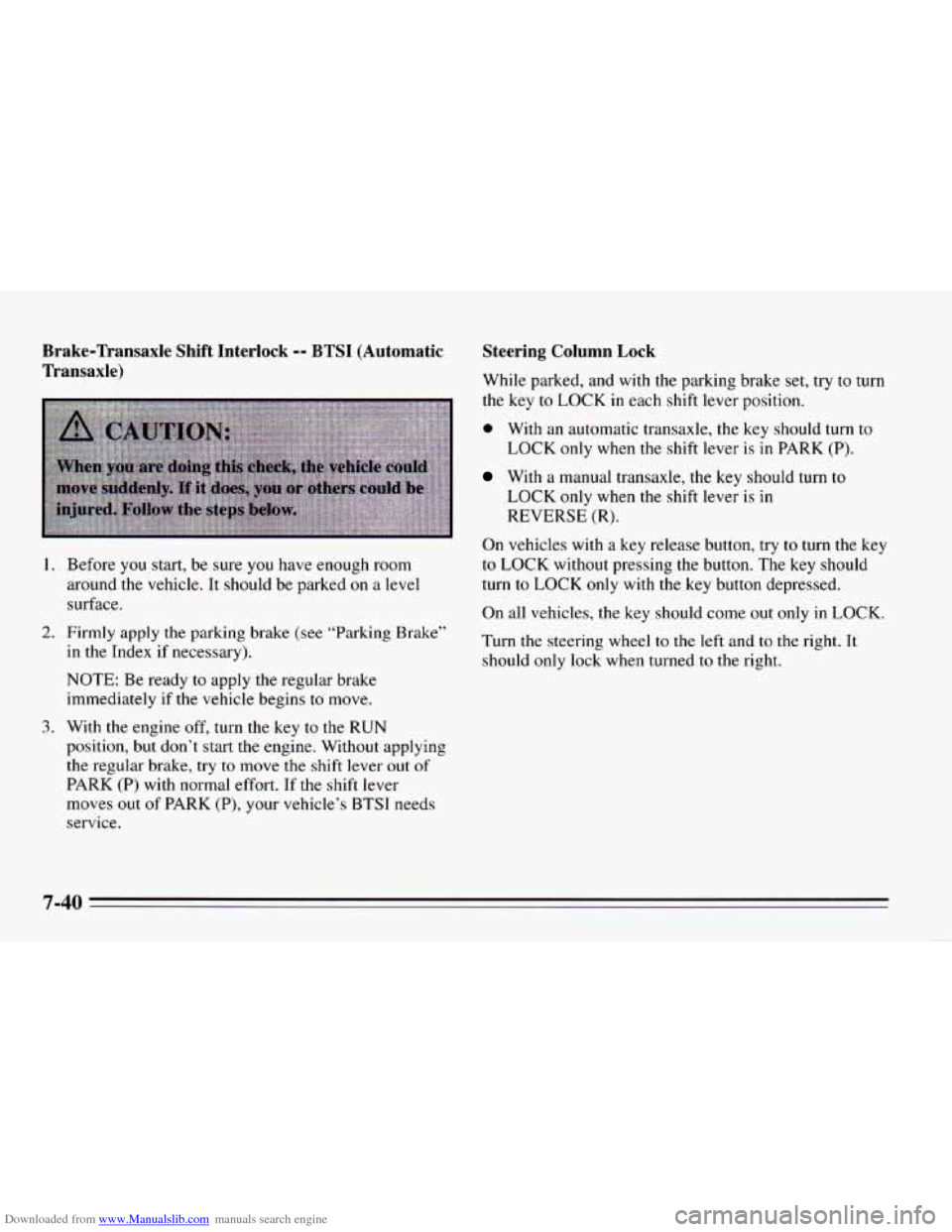
Downloaded from www.Manualslib.com manuals search engine Brake-Transaxle Shift Interlock -- BTSI (Automatic
Transaxle)
1.
2.
3.
Before you start, be sure you have enough room
around the vehicle. It should be parked
on a level
surface.
Firmly apply the parking brake (see “Parking Brake”
in the Index
if necessary).
NOTE: Be ready to apply the regular brake
immediately
if the vehicle begins to move.
With the engine off, turn the key to the RUN
position, but don’t start the engine. Without applying
the regular brake, try
to move the shift lever out of
PARK (P) with normal effort, If the shift lever
moves
out of PARK (P), your vehicle’s BTSI needs
service.
Steering Column Lock
While parked, and with the parking brake set, try to turn
the key to
LOCK in each shift lever position.
0 With an automatic transaxle, the key should turn to
LOCK only when the shift lever
is in PARK (P).
With a manual transaxle, the key should turn to
LOCK only when the shift lever is in
REVERSE
(R).
On vehicles with a key release button, try to turn the key
to LOCK without pressing the button. The key should
turn to
LOCK only with the key button depressed.
On all vehicles, the
key should come out only in LOCK.
Turn the steering wheel to
the left and to the right. It
should only lock when turned
to the right.
7-40
Page 304 of 340
Downloaded from www.Manualslib.com manuals search engine Part C: Periodic Maintenance
Inspections
Listed below are inspections and services which should
be performed at least twice a year (for instance, each
spring and fall). You should let your
GM dealer’s
service department or other qualified service center do
these
jobs. Make sure any necessary repairs are
completed at once.
Restraint Systems
Now and then, make sure all your belts, buckles, latch
plates, retractors, anchorages and reminder systems are
working properly. Look for any loose parts or damage.
If you see anything that might keep a restraint system
from doing its job, have it repaired.
Steering, Suspension and Front-Wheel-Drive
Axle Boot and Seal Inspection
Inspect the front and rear suspension and steering
system for damaged, loose or missing parts, signs
of
wear, or lack of lubrication. Inspect the power steering
lines and hoses for proper hookup, binding, leaks,
cracks, chafing, etc. Clean and then inspect the drive
axle boot seals for damage, tears or leakage. Replace
seals if necessary.
Exhaust System Inspection
Inspect the complete exhaust system. Inspect the body near
the exhaust system.
Look for broken, damaged, missing or
out-of-position
parts as well as open seams, holes, loose
connections, or other conditions which could cause a heat
build-up in the floor pan or could let exhaust fumes into
the vehicle. See “Engine Exhaust”
in the Index.
Throttle Linkage Inspection
Inspect the throttle linkage for interference or binding, and f\
or
damaged or missing parts. Replace parts
as needed.
Accelerator and cruise control cables should not
be lubricated.
Manual Transaxle
Check the transaxle fluid level; add if needed. See
“Manual Transaxle” in the Index.
A fluid loss may
indicate a problem. Check the system and repair
if needed.
Brake System Inspection
Inspect the complete system. Inspect brake lines and
hoses for proper hookup, binding, leaks, cracks, chafing,
etc. Inspect disc brake pads for wear and rotors for
surface condition.
Also inspect drum brake linings for
wear and cracks. Inspect other brake parts, including
drums, wheel cylinders, calipers, parking brake, etc.
Check parking brake adjustment.
You may need to have
your brakes inspected more often if your driving habits
or conditions result in frequent braking.
7-42
~
Page 327 of 340
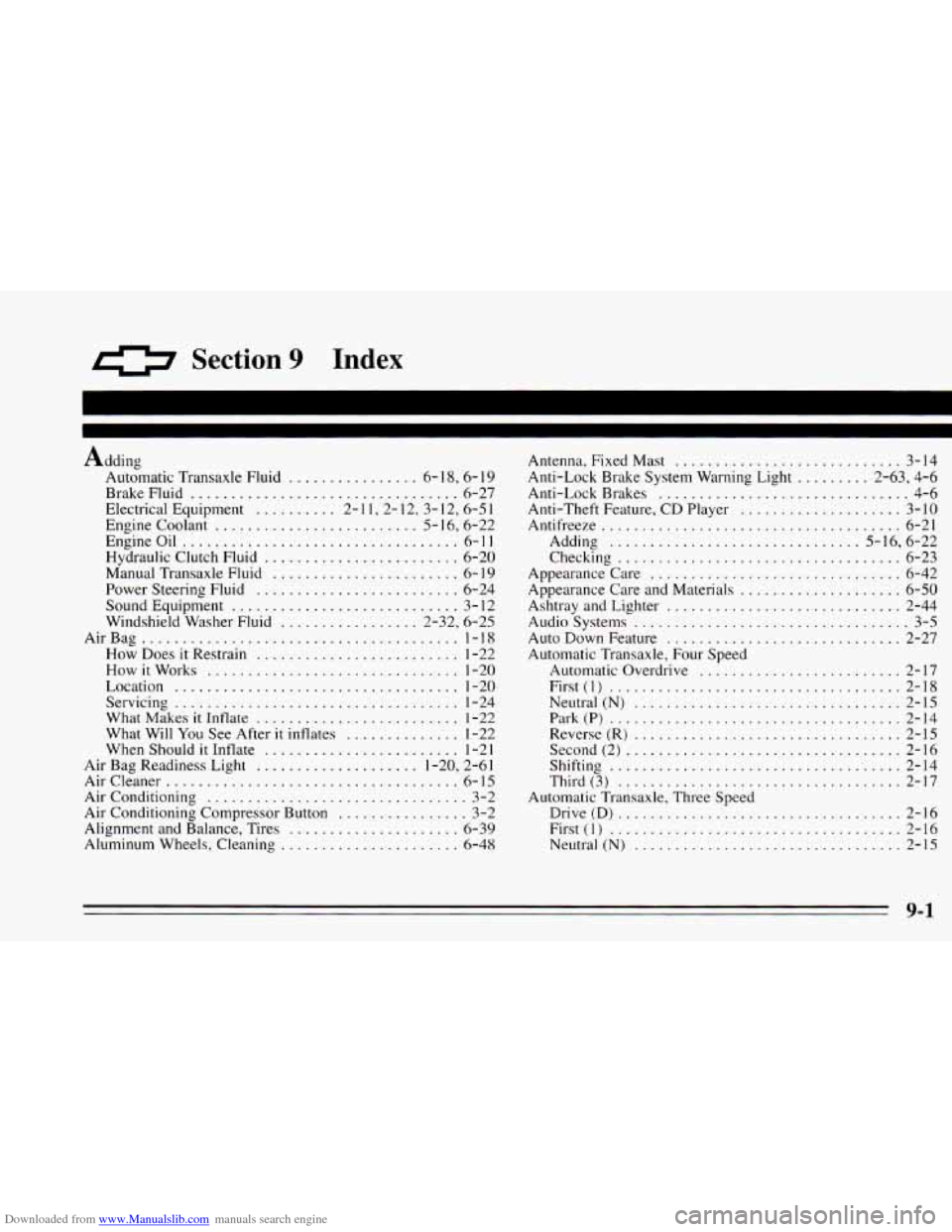
Downloaded from www.Manualslib.com manuals search engine 0 Section 9 Index
Adding Automatic Transaxle Fluid
................ 6- 18. 6- 19
BrakeFluid ................................. 6-27
Electrical Equipment
.......... 2-1 1 , 2- 12, 3- 12, 6-5 1
Engine Coolant ......................... 5- 16, 6-22
Engineoil
.................................. 6-11
Hydraulic Clutch Fluid ........................ 6-20
Manual Transaxle Fluid
....................... 6- 19
Power Steering Fluid ......................... 6-24
SoundEquipment
............................ 3-12
Windshield Washer Fluid
................. 2-32, 6-25
AirBag
....................................... 1-18
How Does
it Restrain ......................... 1-22
Howitworks
............................... 1-20
Location
................................... 1-20
Servicing
................................... 1-24
What Makes
it Inflate ......................... 1-22
What Will You See After it inflates .............. 1-22
When Should
it Inflate ........................ 1-2 1
Air Bag Readiness Light .................... 1-20, 2-61
Aircleaner
.................................... 6-15
Air Conditioning ................................ 3-2
Air Conditioning Compressor Button
................ 3-2
Alignment and Balance, Tires
..................... 6-39
Aluminum Wheels, Cleaning ...................... 6-48
Antenna. Fixed Mast ............................ 3-14
Anti-Lock Brake System Warning Light
......... 2.63. 4.6
Anti-Lock Brakes
............................... 4-6
Anti-Theft Feature.
CD Player .................... 3-10
Antifreeze ..................................... 6-21
Adding
............................... 5.16. 6.22
Checking
................................... 6-23
Appearance Care
............................... 6-42
Appearance Care and Materials
.................... 6-50
Ashtray and Lighter ............................. 2-44
Audiosystems
.................................. 3-5
Auto Down Feature
............................. 2-27
Automatic Transaxle.
Four Speed
Automatic Overdrive
......................... 2-17
First(1)
.................................... 2-18
Neutral
(N) ................................. 2-15
Park(P) .................................... 2-14
Reverse(R)
................................. 2-15
Second(2)
.................................. 2-16
Shifting
.................................... 2-14
Third (3)
................................... 2-17
Drive(D)
................................... 2-16
First(1)
.................................... 2-16
Neutral (N)
................................. 2-15
Automatic Transaxle. Three Speed
9-1
Page 329 of 340
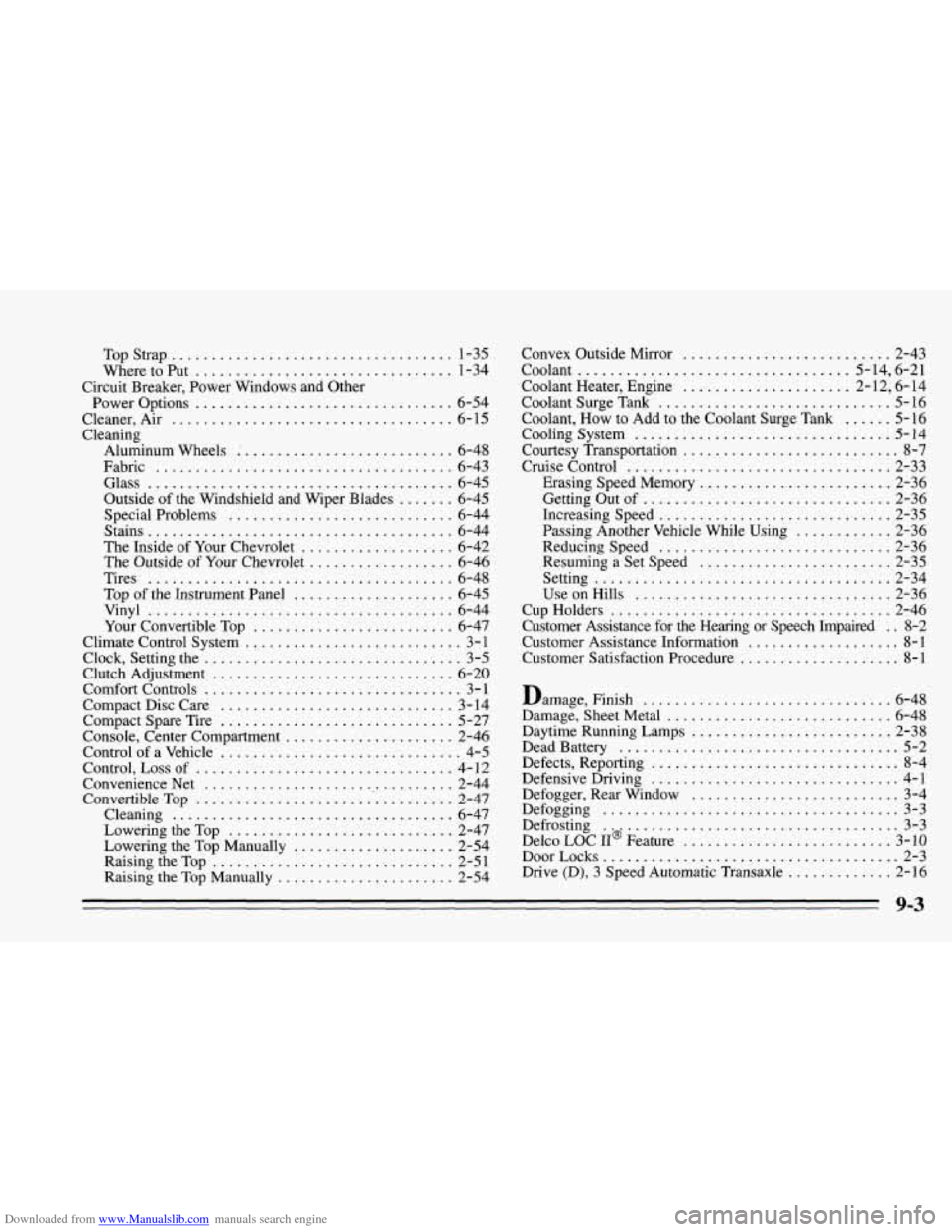
Downloaded from www.Manualslib.com manuals search engine TopStrap ................................... 1-35
Wheretoput
................................ 1-34
Circuit Breaker. Power Windows and Other
Power Options
................................ 6-54
Cleaner. Air
................................... 6-15
Cleaning Aluminum Wheels
; .......................... 6-48
Fabric
..................................... 6-43
Glass
...................................... 6-45
Outside of the Windshield and Wiper Blades
....... 6-45
Special Problems
............................ 6-44
Stains
...................................... 6-44
The Inside of Your Chevrolet
................... 6-42
The Outside
of Your Chevrolet .................. 6-46
Tires
...................................... 6-48
Top of the Instrument Panel .................... 6-45
Vinyl
...................................... 6-44
YourConvertibleTop
......................... 6-47
Climate Control System
........................... 3-1
Clock, Setting
the ................................ 3-5
Clutch Adjustment
.............................. 6-20
Comfort Controls
................................ 3-1
Compact Disc Care
............................. 3-14
Compact Spare Tire
............................. 5-27
Console, Center Compartment
..................... 2-46
Control of a Vehicle
.............................. 4-5
Control,
Lossof ................................ 4-12
Convenience Net
................................ 2-44
Convertible Top
................................ 2-47
Cleaning
................................... 6-47
LoweringtheTop
............................ 2-47
Lowering the Top Manually
.................... 2-54
Raising
the Top .............................. 2-51
Raising the Top Manually
...................... 2-54 Convex Outside Mirror
.......................... 2-43
Coolant .................................. 5- 14.
6.21
Coolant Heater. Engine
..................... 2- 12. 6. 14
Coolant Surge Tank
............................. 5-16
Coolant.
How to Add to the Coolant Surge Tank ...... 5-16
Cooling System
................................ 5-14
Courtesy Transportation ........................... 8-7
Cruise Control
................................. 2-33
Erasing Speed Memory
........................ 2-36
Getting Out of
............................... 2-36
Increasing Speed
............................. 2-35
Passing Another Vehicle While Using
............ 2-36
ReducingSpeed
............................. 2-36
Resuming a Set Speed
........................ 2-35
Setting
..................................... 2-34
UseonHills
................................ 2-36
Customer Assistance for the Hearing or Speech Impaired
. . 8-2
Customer Assistance Information
................... 8-1
Customer Satisfaction Procedure
.................... 8-1
Damage. Finish
............................... 6-48
Damage. Sheet Metal
............................ 6-48
Daytime Running Lamps
......................... 2-38
Dead Battery
................................... 5-2
Defects. Reporting
............................... 8-4
Defensive Driving
............................... 4-1
Defogger. Rear Window
.......................... 3-4
Defogging
..................................... 3-3
Defrosting
. 's' .................................. 3-3
Delco LOC I1 Feature
.......................... 3-10
DoorLocks
..................................... 2-3
Drive (D). 3 Speed Automatic Transaxle
............. 2-16
CupHolders
................................... 2-46
9-3