key CHEVROLET CAVALIER 1996 3.G User Guide
[x] Cancel search | Manufacturer: CHEVROLET, Model Year: 1996, Model line: CAVALIER, Model: CHEVROLET CAVALIER 1996 3.GPages: 372, PDF Size: 19.73 MB
Page 67 of 372
Downloaded from www.Manualslib.com manuals search engine Passlock TM
Your vehicle is equipped with the Passlock
theft-deterrent system.
Passlock is a passive theft-deterrent system. The system is armed once the key is removed from the ignition. Passlock
enables fuel if the ignition lock cylinder is turned with a
valid key.
If a correct key is not used, fuel is disabled.
During normal operation, the THEFT SYSTEM light will
go off after the engine
is started. In the unlikely event that
the engine stalls and the THEFT SYSTEM light flashes,
wait until the light stops flashing before trying to restart
the engine. Remember to release the key from the START position as soon as the engine starts. If after several tries the vehicle still does not start, the vehicle
may need service. At this time, you may also want to
check the fuses (see “Fuses and Circuit Breakers” in the\
Index). See your Chevrolet dealer for service.
If the THEFT SYSTEM light comes on while the engine
is running, a problem has been detected and the system
may need service.
See your dealer for service.
In
an emergency, call the Chevrolet Roadside Assistance
Program at
1-800-CHEV-USA I 1-800-243-8872.
New Vehicle LLBreak-InT’
NOTICE:
Your modern Chevrolet doesn’t need an
elaborate “break-in.” But it will perform better
in the long run if you follow these guidelines:
Don’t drive at any one speed -- fast or
slow -- for the first 500 miles (804 km).
Don’t make full-throttle
starts.
200 miles (322 km) or so. During this time
your new brake linings aren’t yet broken
in. Hard stops with new linings can mean
premature wear and earlier replacement.
Follow this breaking-in guideline every
time you get new brake linings.
See “Towing
a Trailer” in the Index for
more information.
Avoid making hard stops for the first
Don’t tow a trailer during break-in.
2-9
Page 68 of 372
Downloaded from www.Manualslib.com manuals search engine Ignition Switch
A E
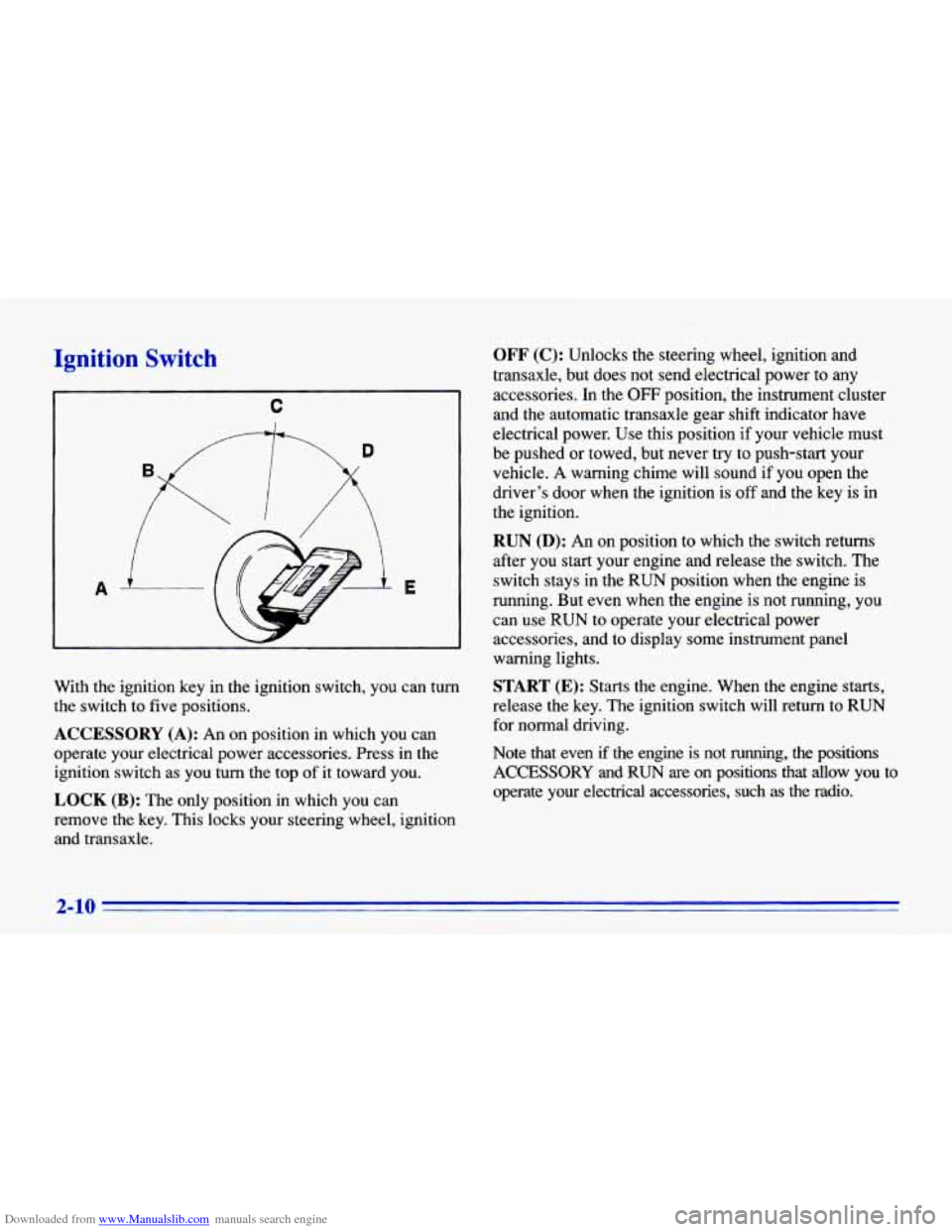
With the ignition key in the ignition switch, you can turn
the switch to five positions.
ACCESSORY (A): An on position in which you can
operate your electrical power accessories. Press in the
ignition switch as you turn the top of it toward you.
LOCK (B): The only position in which you can
remove the key. This locks your steering wheel, ignition
and transaxle.
OFF (C): Unlocks the steering wheel, ignition and
transaxle, but does not send electrical power to any
accessories.
In the OFF position, the instrument cluster
and the automatic transaxle gear shift indicator have
electrical power. Use this position if your vehicle must
be pushed or towed, but never try to push-start your
vehicle.
A warning chime will sound if you open the
driver’s door when the ignition is
off and the key is in
the ignition.
RUN (D): An on position to which the switch returns
after you start your engine and release the switch. The
switch stays in the RUN position when the engine is
running. But even when the engine is not running, you can use RUN to operate your electrical power
accessories, and to display some instrument panel
warning lights.
START (E): Starts the engine. When the engine starts,
release the key. The ignition switch will return to RUN
for normal driving.
Note that even if the engine is not running, the positions
ACCESSORY and RUN are on positions that allow you to
operate your electrical accessories, such
as the radio.
2-10
Page 69 of 372
Downloaded from www.Manualslib.com manuals search engine On manual transaxle vehicles, turning the key to
LOCK will lock the steering column and result in
a loss of ability to steer the vehicle. This could
cause
a collision. If you need to turn the engine
off while the vehicle is moving, turn the key only
to
OFF. Don’t press the key release button while
the vehicle is moving.
NOTICE:
If your key seems stuck in LOCK and you can’t
turn it,
be sure it is all the way in. If it is, then
turn
the steering wheel left and right while you
turn the key hard. But turn the key only with
your hand. Using
a tool to force it could break
the key or
the ignition switch. If none of this
works, then your vehicle needs service.
Key Release Button (Manual Transaxle)
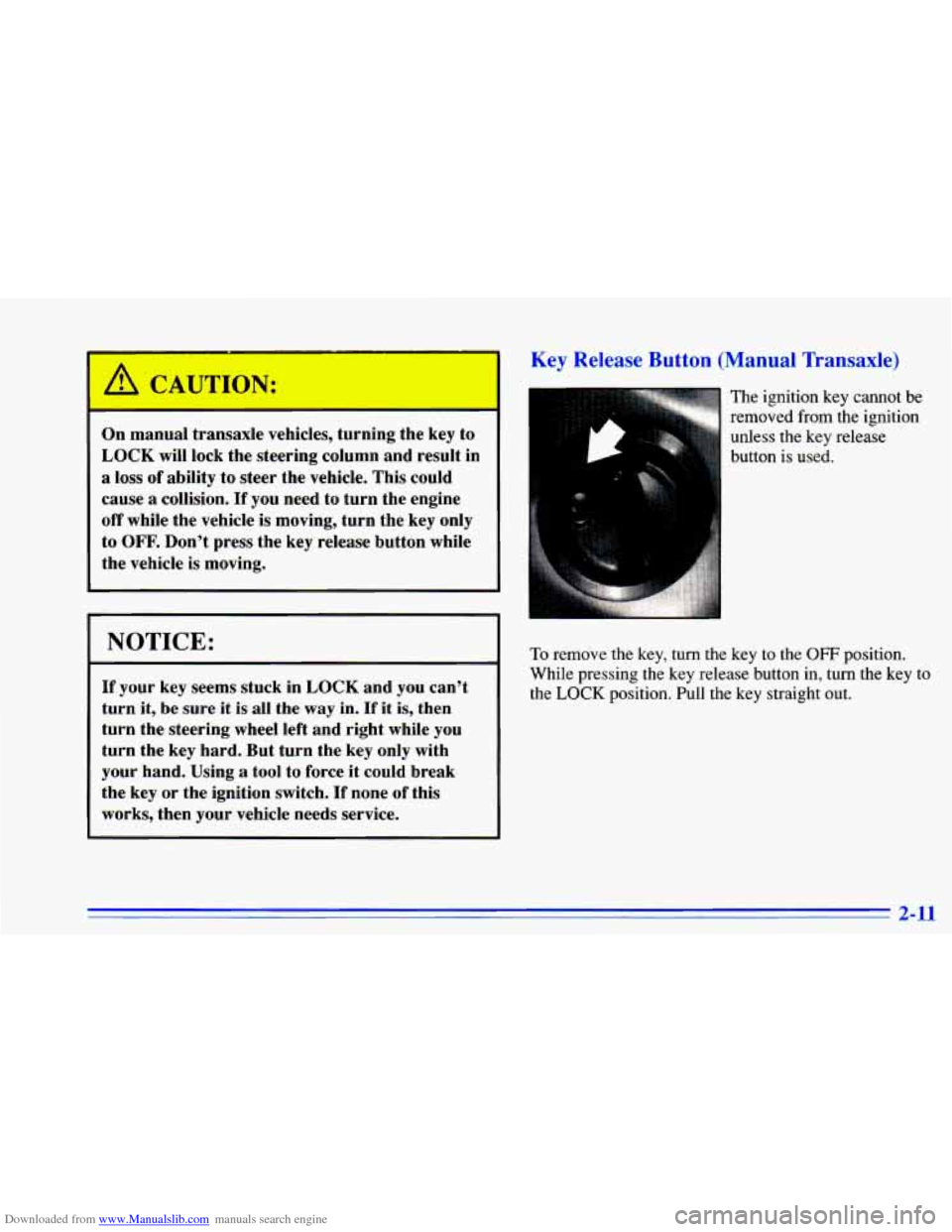
The ignition key cannot be
removed from the ignition
unless the key release
I button is used.
To remove the key, turn the key to the OFF position.
While pressing the key release button in, turn the
key to
the
LOCK position. Pull the key straight out.
2-11
Page 70 of 372
Downloaded from www.Manualslib.com manuals search engine Starting Your Engine
Engines start differently. The 8th digit of your Vehicle
Identification Number (VIN) shows the code letter or
number for your engine. You will find the VIN at the top
left of your instrument panel. (See “Vehicle
Identification Number” in the Index.) Follow the proper
steps to start the engine.
Automatic transaxle
Move your shift lever to PARK (P) or NEUTRAL (N).
Your engine won’t start in any other position -- that’s a
safety feature.
To restart when you’re already moving,
use
NEUTRAL (N) only.
NOTICE:
Don’t try to shift to PARK (P) if your Chevrolet
is moving.
If you do, you could damage the
transaxle. Shift to PARK
(P) only when your
vehicle is stopped.
Manual transaxle
The gear selector should be in NEUTRAL (N). Hold the
clutch pedal to the floor and start the engine. Your
vehicle won’t start if the clutch pedal is not all
the way
down
-- that’s a safety feature.
Starting Your 2.2 Liter Engine
1. Without pushing the accelerator pedal, turn your
ignition key to START. When the engine starts, let
go
of the key. The idle speed will go down as your
engine gets warm.
I NOTICE:
r
Holding your key in START for longer than
15 seconds at a time will cause your battery to
be drained much sooner. And the excessive heat
can damage your starter motor.
2. If your engine still won’t start (or starts but then
stops), it could be flooded with too much gasoline.
Try pushing your accelerator pedal all the way to the
floor and holding it there as you hold
the key in
START for about three seconds. If the vehicle starts
2-12
Page 71 of 372
Downloaded from www.Manualslib.com manuals search engine briefly but then stops again, do the same thing, but
this time keep the pedal down for five or six seconds.
This clears the extra gasoline from the engine.
NOTICE:
Your engine is designed to work with the
electronics in your vehicle.
If you add electrical
parts or accessories, you could change the way
the engine operates. Before adding electrical
equipment, check with your dealer.
If you don’t,
your engine might not perform properly.
If you ever have to have your vehicle towed, see
the part of this manual
that tells how to do it
without damaging your vehicle, See “Towing
Your Vehicle” in the Index.
Starting Your 2.4 Liter Engine
1. Without pushing the accelerator pedal, turn your
ignition key to START. When the engine starts, let
go of the key. The idle speed will go down as your
engine gets warm.
I NOTICE:
Holding your key in START for longer than
15 seconds at a time will cause your battery to
be drained much sooner. And the excessive heat
can damage your starter motor.
2.
3.
If it doesn’t start right away, and if the weather is
very cold (below
-20°F or -29”C), push the
accelerator pedal about one-quarter of the way down
while you turn the key to START.
Do this until the
engine starts.
As soon as it does, let go of the key.
If your engine still won’t start (or starts but then
stops), it could be flooded with too much gasoline.
Try pushing your accelerator pedal all the way to the
floor and holding it there as
you hold the key in
START for about three seconds. This clears the extra
gasoline from the engine. If the vehicle starts briefly
but then stops again, do the same thing, but this time
keep the pedal about one-quarter
of the way down
for five
or six seconds.
2-13
Page 75 of 372
Downloaded from www.Manualslib.com manuals search engine PARK (P): This locks your front wheels. It’s the best
position to use when you start your engine because your
vehicle can’t move easily.
It is dangerous to get out of your vehicle if the
shift lever is not fully in PARK
(P) with the
parking brake firmly set. Your vehicle can roll.
Don’t leave your vehicle when the engine is
running unless you have to.
If you have left the
engine running, the vehicle can move suddenly.
You or others could be injured. To be sure your
vehicle won’t move, even when you’re on fairly
level ground, always
set your parking brake and
move the shift lever to
PARK (P).
See “Shifting Into PARK (P)” in the Index. If
you’re pulling
a trailer, see “Towing a Trailer’’ in
the Index.
Ensure the shift lever
is fully in PARK (P) range before
starting the engine. Your Chevrolet has a brake-transaxle
shift interlock. You have to fully
apply your regular
brakes
before you can shift from PARK (P) when the ignition key
is in the RUN position. If you cannot shift
out
of PARK (P), ease pressure on the shift lever -- push
the shift lever all the way into PARK (P) and also
release the shift lever button
on floor shift console
models as you maintain brake application. Then move
the shift lever into the gear you wish. (Press the shift
lever button before moving the shift lever.) See
“Shifting Out of PARK
(P)” in the Index.
REVERSE (R): Use this gear to back up.
NOTICE:
Shifting to REVERSE (R) while your vehicle is
moving forward could damage your transaxle.
Shift
to REVERSE (R) only after your vehicle
is stopped.
To rock your vehicle back and forth to get out of snow,
ice or sand without damaging your transaxle, see “If
You’re Stuck: In Sand, Mud, Ice or Snow” in the Index.
NEUTRAL
(N): In this position, your engine
doesn’t connect with the wheels.
To restart when you’re
already moving, use NEUTRAL
(N) only. Also, use
NEUTRAL
(N) when your vehicle is being towed.
2-17
Page 82 of 372
Downloaded from www.Manualslib.com manuals search engine 1
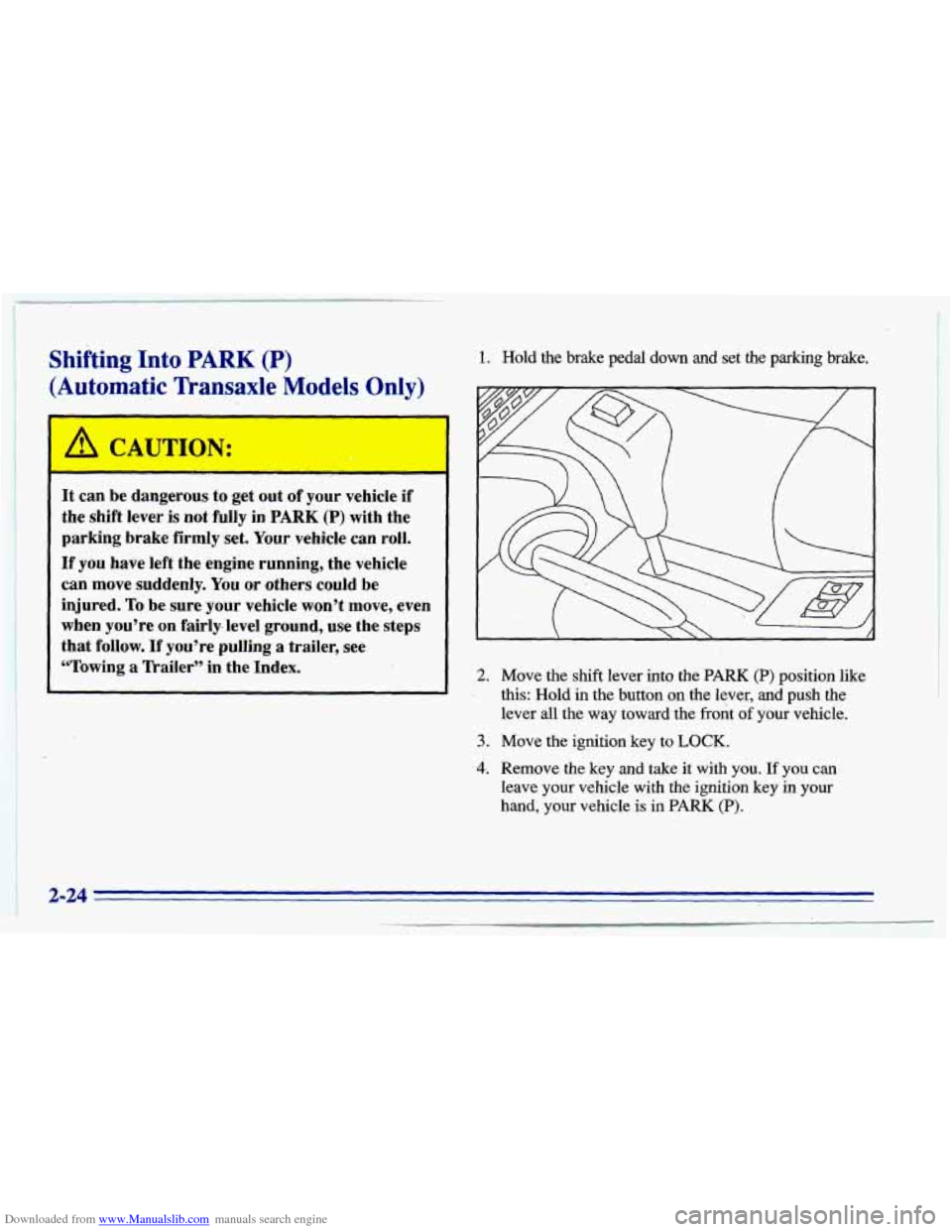
Shifting Into PARK (P)
(Automatic Transaxle Models Only)
1. Hold the brake pedal down and-set the parking brake.
D
It can be dangerous to get out of your vehicle if
the shift lever is not fully in PARK (P) with the
parking brake firmly set. Your vehicle can roll.
If you have left the engine running, the vehicle
can move suddenly. You or others could be
injured.
To be sure your vehicle won’t move, even
when
you’re on fairly- level ground, use the steps
that follow.
If you’re pulling a trailer, see
“Towing
a lkailer” in the Index. 2. Move the shift lever into the PARK (P) position like
this: Hold
in the button on the lever, and push the
lever all the way toward the front
of your vehicle,.
3. Move the ignition key to LOCK.
4. Remove the key and take it with you. If you can
leave your vehicle with the ignition key in your
hand, your vehicle is in
PARK (P).
2;-24
Page 84 of 372
Downloaded from www.Manualslib.com manuals search engine Shifting Out of PARK (P)
(Automatic Transaxle)
Your Chevrolet has a brake-transaxle shift interlock.
You have to fully appZy your regular brakes before you
can shift from PARK (P) when the ignition is in
the
RUN position. See “Automatic Transaxle” in the Index.
If you cannot shift out of PARK
(P), ease pressure on
the shift lever
-- push the shift lever all the way into
PARK (P) and also release the shift lever button
on floor
shift console models as you maintain brake application.
Then move the shift lever into the gear you wish. (Press
the shift lever button before moving the shift lever.) If you
ever hold the brake pedal down but still
can’t
shift out of PARK (P), try this:
1. Turn the key to OFF.
2. Apply and hold the brake until the end of Step 4.
3. Shift to NEUTRAL (N). ,
4. Start the vehicle and then shift to the drive gear
5. Have the vehicle fixed as soon as you can. yowwant.
Parking Your Vehicle
(Manual lkansaxle)
Before you get out of your vehicle, put your manual transaxle
in REVERSE (R) and firmly apply the parking brake.
Page 100 of 372
Downloaded from www.Manualslib.com manuals search engine Illuminated Entry
When you open either front door, or open a rear door,
the lamps inside
your vehicle will go on. These lamps
will fade
off after about 40 seconds, or when the ignition
is turned
on after all the doors have been closed.
If the ignition has been off for less than two minutes,
the lamps inside
your vehicle will stay on for about
15 seconds to provide an illuminated exit when you
remove the key from the ignition.
After you exit the vehicle and all of the doors have been
closed, the lamps will stay
on for an additional four
seconds before fading
off. These lamps will also go on
when
you press the DOOR or UNLOCK button on the
optional Keyless Entry Transmitter.
Front Reading Lamps (Models with
Sunroof or Convertible Top)
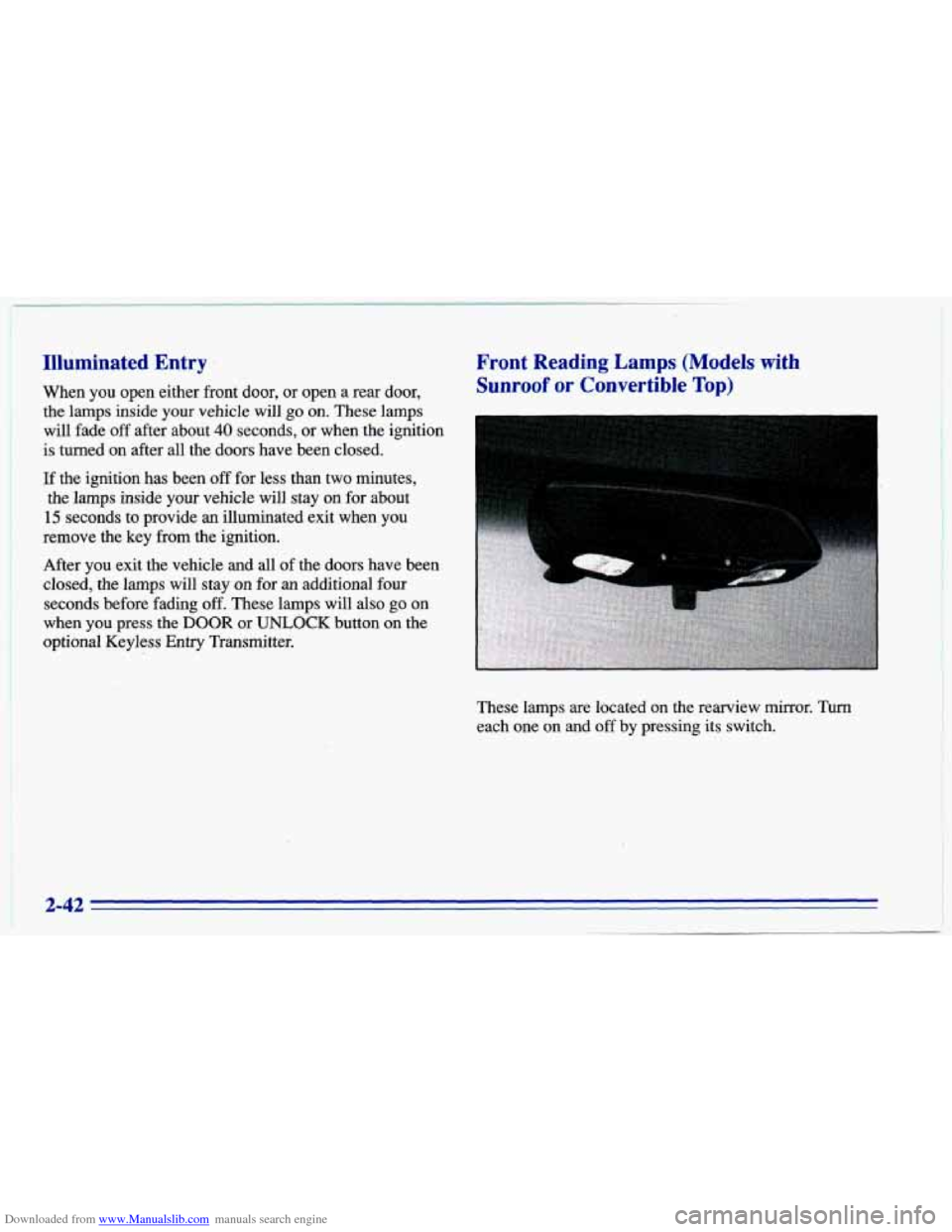
These lamps are located on the rearview mirror. Turn
each one on and off by pressing its switch.
2-42
1
Page 123 of 372
Downloaded from www.Manualslib.com manuals search engine Warning Lights, Gages and
Indicatl
IS
This part describes the warning lights and gages that
may be on your vehicle. The pictures will help you
locate them.
Warning lights and gages can signal that something
is
wrong before it becomes serious enough to cause an
expensive repair or replacement. Paying attention to
your warning lights and gages could also save you or
others from injury.
Warning lights come on when there may be or is a
problem with one of your vehicle’s functions.
As you
will see in the details on the next few pages, some
warning lights come on briefly when you start the
engine just to let you know they’re working.
If you are
familiar with this section, you should not be alarmed
when this happens.
Gages can indicate when there may be or is a problem with one of your vehicle’s functions. Often gages and
warning lights work together to
let you know when
there’s a problem with your vehicle. When
one of the warning lights
comes on and stays on
when you are driving, or when one of the gages shows
there may be a problem, check the section that tells you
what to do about it. Please fallow this manual’s advice.
Waiting to do repairs can be costly
-- and even
dangerous.
So please get to know your warning lights
and gages. They’re a big help.
Safety Belt Reminder Light
When the key is turned to RUN or START, a chime will
come on for about eight seconds to remind people to
fasten their safety belts, unless the driver’s safety belt i\
s
already buckled.
The safety belt light will
also come on and stay on
for about
20 seconds, then
it will flash for about
55 seconds. If the driver’s
belt is already buckled,
neither the chime nor the
light will come on.
2-65