lock CHEVROLET CAVALIER 1996 3.G Repair Manual
[x] Cancel search | Manufacturer: CHEVROLET, Model Year: 1996, Model line: CAVALIER, Model: CHEVROLET CAVALIER 1996 3.GPages: 372, PDF Size: 19.73 MB
Page 192 of 372
Downloaded from www.Manualslib.com manuals search engine 5. Clamp the steering wheel in a straight-ahead position
6. Release the parking brake.
When you
are finished towing, make sure you replace
the CLS/PCM fuse in the instrument panel fuse block.
with a clamping device designed for towing.
Towing Your Vehicle from the Front
(Four-Speed Automatic
or Five-Speed
Manual Transaxles Only)
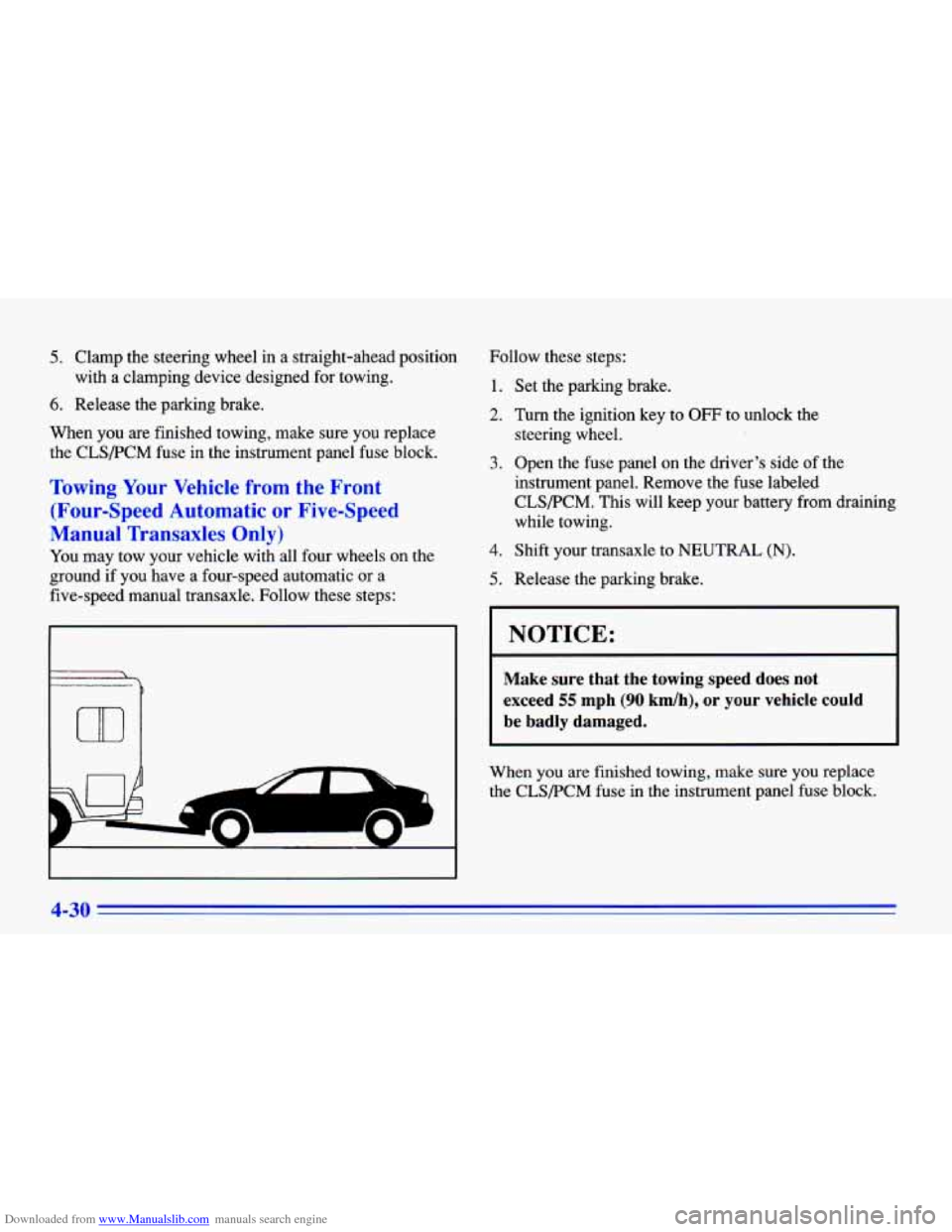
You may tow your vehicle with all four wneels on the
ground
if you have a four-speed automatic or a
five-speed manual transaxle. Follow these steps:
r
m
.
*-
Follow these steps:
1. Set the parking brake.
2. Turn the ignition key to OFF to unlock the
3. Open the fuse panel on the driver’s side of the
instrument panel. Remove the fuse labeled
CLS/PCM. This will keep your battery from draining
while towing. steering wheel.
4. Shift your transaxle to NEUTRAL (N).
5. Release the parking brake.
NOTICE:
Make sure that the towing speed does not
exceed
55 mph (90 km/h), or your vehicle could
be badly damaged.
When you are finished towing, make sure you replace
the CLS/PCM fuse in the instrument panel fuse block.
4-30
Page 199 of 372
Downloaded from www.Manualslib.com manuals search engine Hitches
It’s important to have the correct hitch equipment.
.Crosswinds, large trucks going by and rough roads are a
’ few reasons why you’ll need the right hitch. Here are
some rules to follow:
Safety Chains
0 Will you have to make any holes in the body of your
vehicle when you install a trailer hitch?
If you do,
then be sure to seal the holes later when you remove
the hitch.
If you don’t seal them, deadly carbon
monoxide (CO) from your exhaust can get into your
vehicle (see “Carbon Monoxide” in the Index). Dirt
and water can, too.
for hitches.
Do not attach rental hitches or other
bumper-type hitches to them. Use only a
frame-mounted hitch that does not attach to
the bumper.
The bumpers on your vehicle are not intended You
should always attach chains between your vehicle
and your trailer. Cross the safety chains under the tongue
of the trailer
so that the tongue will not drop to the road
if it becomes separated from the hitch. Instructions
about safety chains may be provided by the hitch
manufacturer or by the trailer manufacturer. Eollow the
manufacturer’s recommendation for attaching safety
chains and do not attach them to the bumper. Always
leave just enough slack
so you can twn with your rig.
And, never allow safety chains to drag on the ground.
Trailer Brakes
Does your trailer have its own brakes? Be sure to read
and follow the instructions for the trailer brakes
so
you’ll be able to install, adjust and maintain them
properly. Because you have anti-lock brakes, do not
try
to tap into your vehicle’s brake system. If you do, both
brake systems won’t work well, or at all.
4-37
Page 212 of 372
Downloaded from www.Manualslib.com manuals search engine -- IO Iontinut I I
Never get under your vehicle after it has
been lifted by the tow truck.
Always secure the vehicle on each side with
separate safety chains when towing it.
Never use J-hooks. Use T-hooks instead.
When
your vehicle is being towed, have the ignition
key OFF. The steering wheel should be clamped in a
straight-ahead position, with a clamping device
designed
for towing service. Do not use the vehicle’s
steering column lock for this. The transaxle should be
in
NEUTRAL (N) and the parking brake released.
A CAUTION:
I
A vehicle can fall from a car carrier if it isn’t
adequately secured. This can cause
a collision,
serious personal injury and vehicle damage. The
vehicle should be tightly secured with chains or
steel cables before it is transported.
Don’t
use substitutes (ropes, leather straps,
canvas webbing, etc.) that can be cut by sharp
edges underneath the towed vehicle. Always use
T-hooks inserted in the T-hook slots. Never use
J-hooks. They will damage drivetrain and
suspension components.
5-8
Page 225 of 372
Downloaded from www.Manualslib.com manuals search engine If a Tire Goes Flr Changing a Flat Tire
It’s unusual for a tire to “blow out” while you’re driving,
especially if you maintain your tires properly.
If air goes
out of a tire, it’s much more likely to leak out slowly.
But if you should ever have a “blowout,”
here are a few
tips about what to expect and what to do:
If a front
tire fails, the flat tire will create a drag that
pulls the vehicle toward that side. Take your foot off the
accelerator pedal and grip the steering wheel firmly.
Steer to maintain lane position, and then gently brake to
a stop well out of the traffic lane.
A rear blowout, particularly on a curve, acts much like a
skid and may require the same correction you’d use in a
skid. In any rear blowout, remove your foot from the
accelerator pedal. Get the vehicle under control by
steering the way you want the vehicle to
go. It may be
very bumpy and noisy, but you can still steer. Gently
brake
to a stop -- well off the road if possible.
If a tire goes flat, the next
part shows how to use your
jacking equipment to change a flat tire safely.
If a tire goes rlat, avoid further tire and wheel damage
by driving slowly to a level place. Turn on your hazard
warning flashers.
I
Changing a tire can cause an injury. The vehicle
can slip
off the jack and roll over you or other
people. You and they could be badly injured.
Find
a level place to change your tire. To help
prevent the vehicle from moving:
1. Set the parking brake firmly.
2. Put an automatic transaxle shift lever in
PARK (P), or shift a manual transaxle to
FIRST
(1) or REVERSE (R).
3. lbrn off the engine.
To be even more certain the vehicle won’t move,
you can put blocks
at the front and rear of the
tire farthest away from the one being changed.
That would be the tire on the other side of the
vehicle,
at the opposite end.
5-21
Page 226 of 372
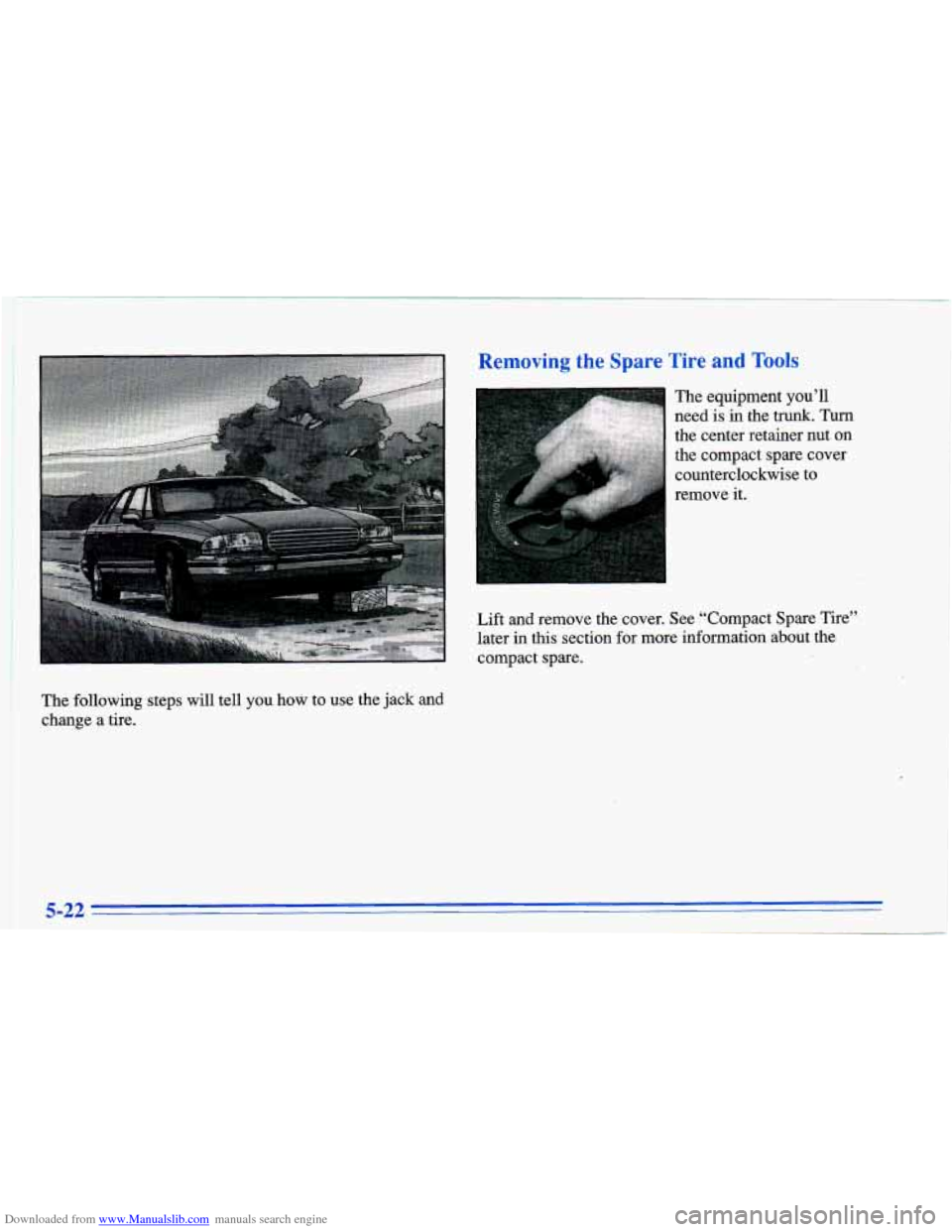
Downloaded from www.Manualslib.com manuals search engine need is in the t&. Turn
the center retainer nut
on
the compact spare cover
counterclockwise to
remove it.
Lift
and remove the cover. See “Compact Spare Tire”
later in this section for more information about the
compact spare.
The following steps will tell
you how to use the jack and
change a tire.
5-22
Page 227 of 372
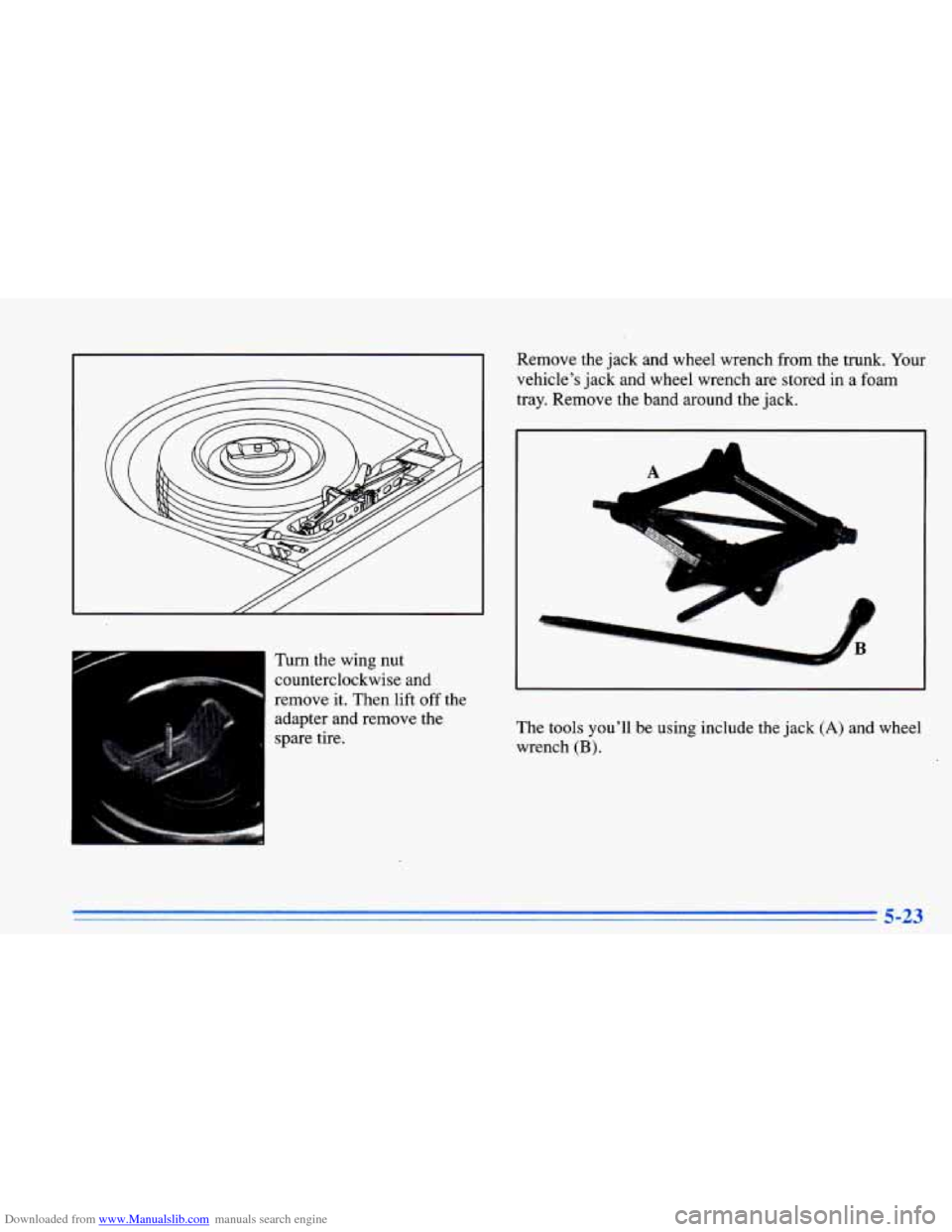
Downloaded from www.Manualslib.com manuals search engine Turn the wing nut counterclockwise and
remove it. Then lift
off the
adapter and remove the
spare tire. Remove the
jack and wheel wrench
from the trunk. Yo1
vehicle’s jack and wheel wrench are stored in a foam
tray. Remove the band around the jack.
The tools you’ll be using include the jack
(A) and wheel
wrench
(B).
5-23
Page 230 of 372
Downloaded from www.Manualslib.com manuals search engine I NOTICE:
I I
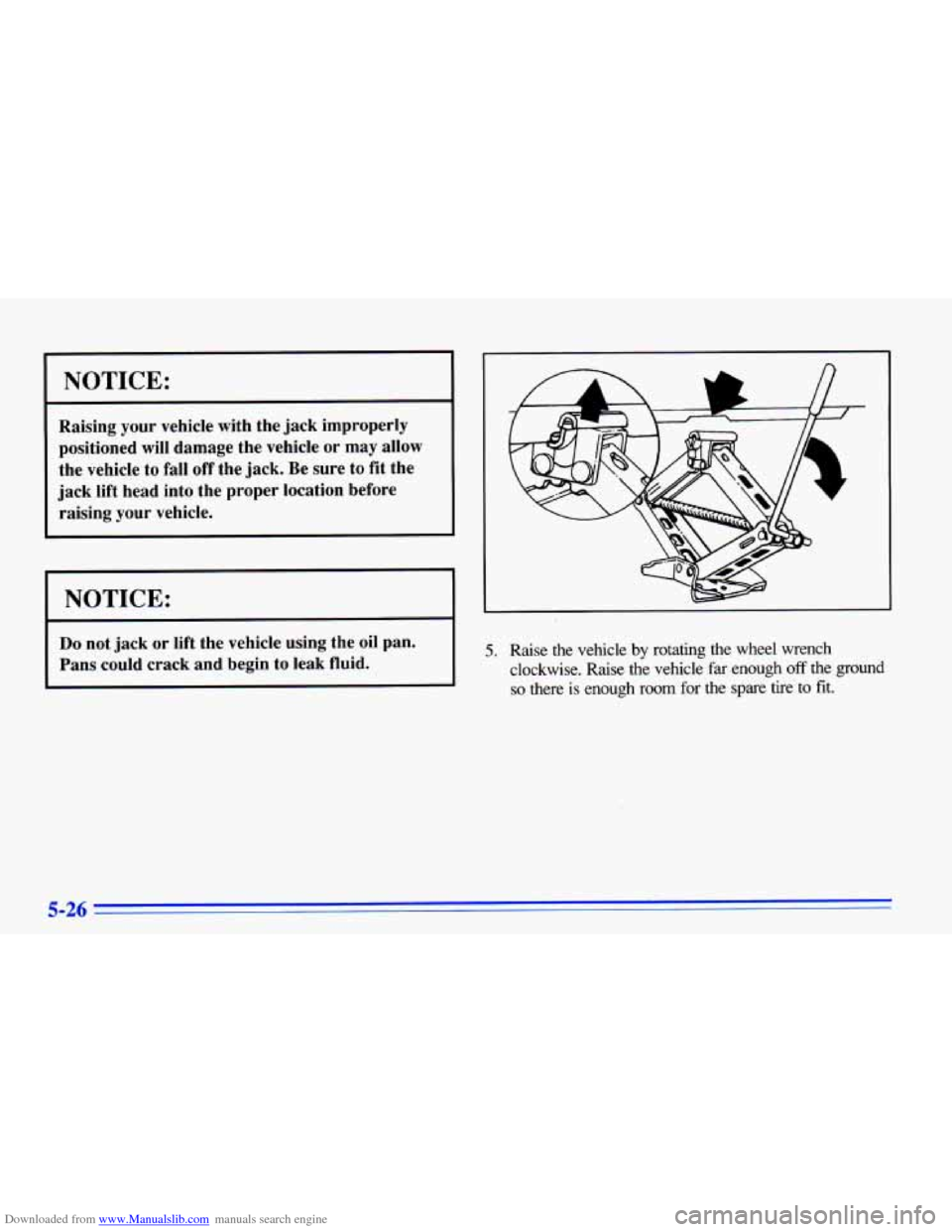
Raising your vehicle with the jack improperly
positioned will damage the vehicle or may allow
the vehicle to fall off the jack. Be sure to fit the
jack lift head into the proper location before
raising your vehicle.
Do not jack or lift the vehicle using the oil pan.
Pans could crack and begin to leak fluid.
1
A
n
5. Raise the vehicle by rotating the wheel wrench
clockwise. Raise the vehicle far enough
off the ground
so there is enough room for the spare tire to fit.
5-26
Page 232 of 372
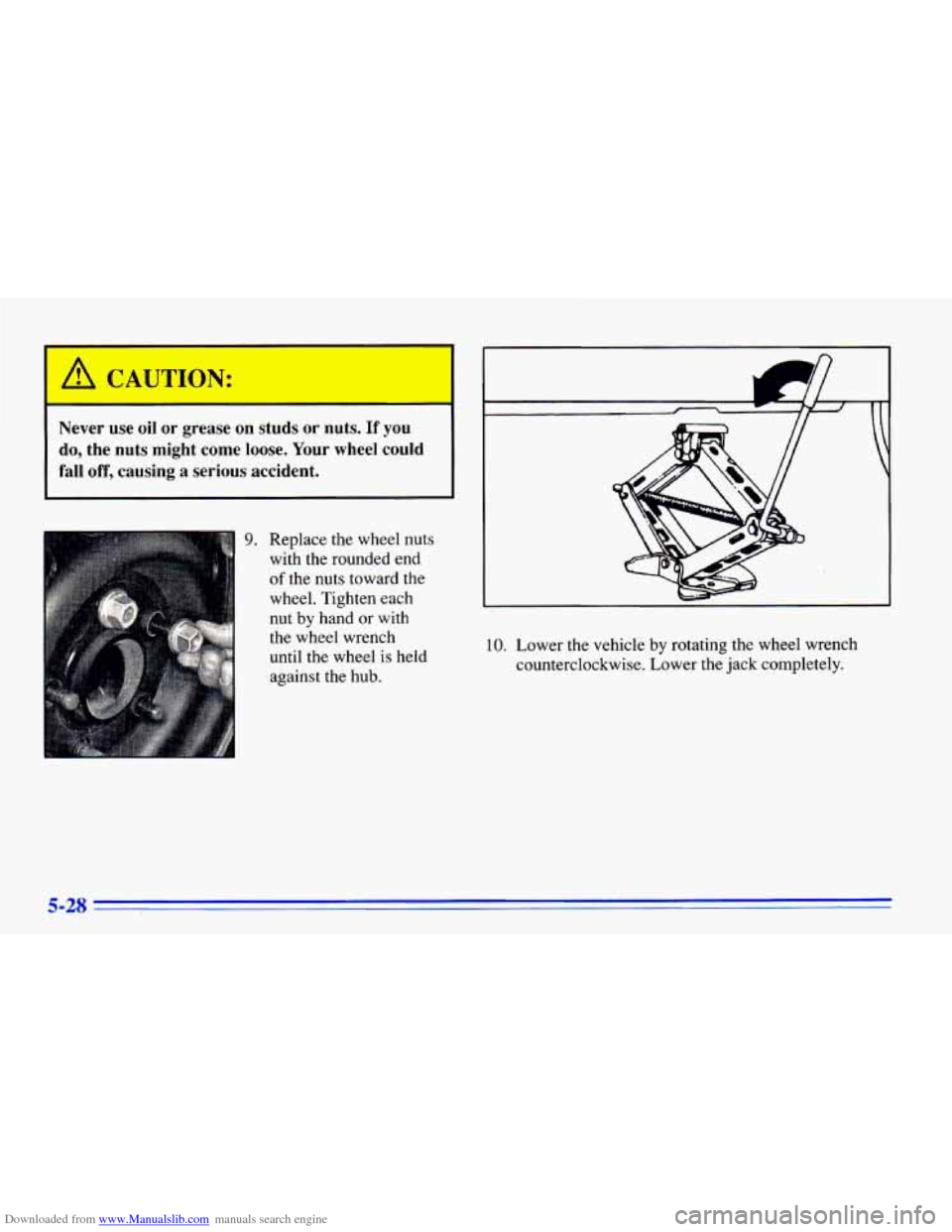
Downloaded from www.Manualslib.com manuals search engine Never use oil or grease on stud! r nuts. If you
do, the nuts might come loose. Your wheel could
fall off, causing a serious accident.
Replace the wheel nuts
with the rounded end
of the nuts toward the
wheel. Tighten each
nut by hand or with
the wheel wrench
until the wheel is held
against the hub.
10. Lower the vehicle by rotating the wheel wrench
counterclockwise. Lower the jack completely.
Page 242 of 372
Downloaded from www.Manualslib.com manuals search engine Filling Your Tank
Gasoline vapor is highly flammable. It burns
violently, and that can cause very bad injuries. Don't smoke if you're near gasoline or refueling
your vehicle. Keep sparks, flames, and smoking
materials away from gasoline.
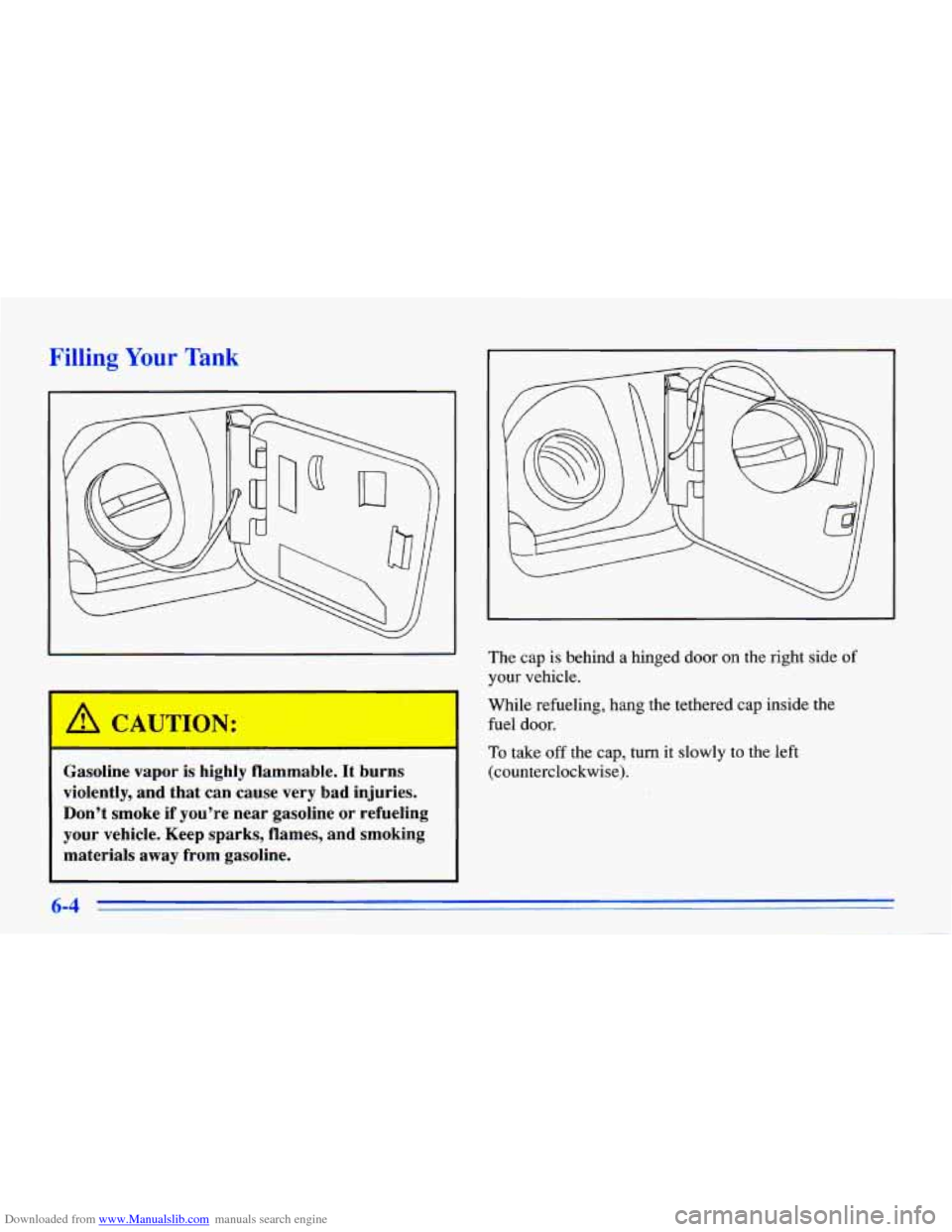
The cap is behind a hinged door on the right side of
your vehicle.
While refueling, hang the tethered cap inside the
fuel door.
To take off the cap, turn it slowly to the left
(counterclockwise).
6-4
-
Page 259 of 372
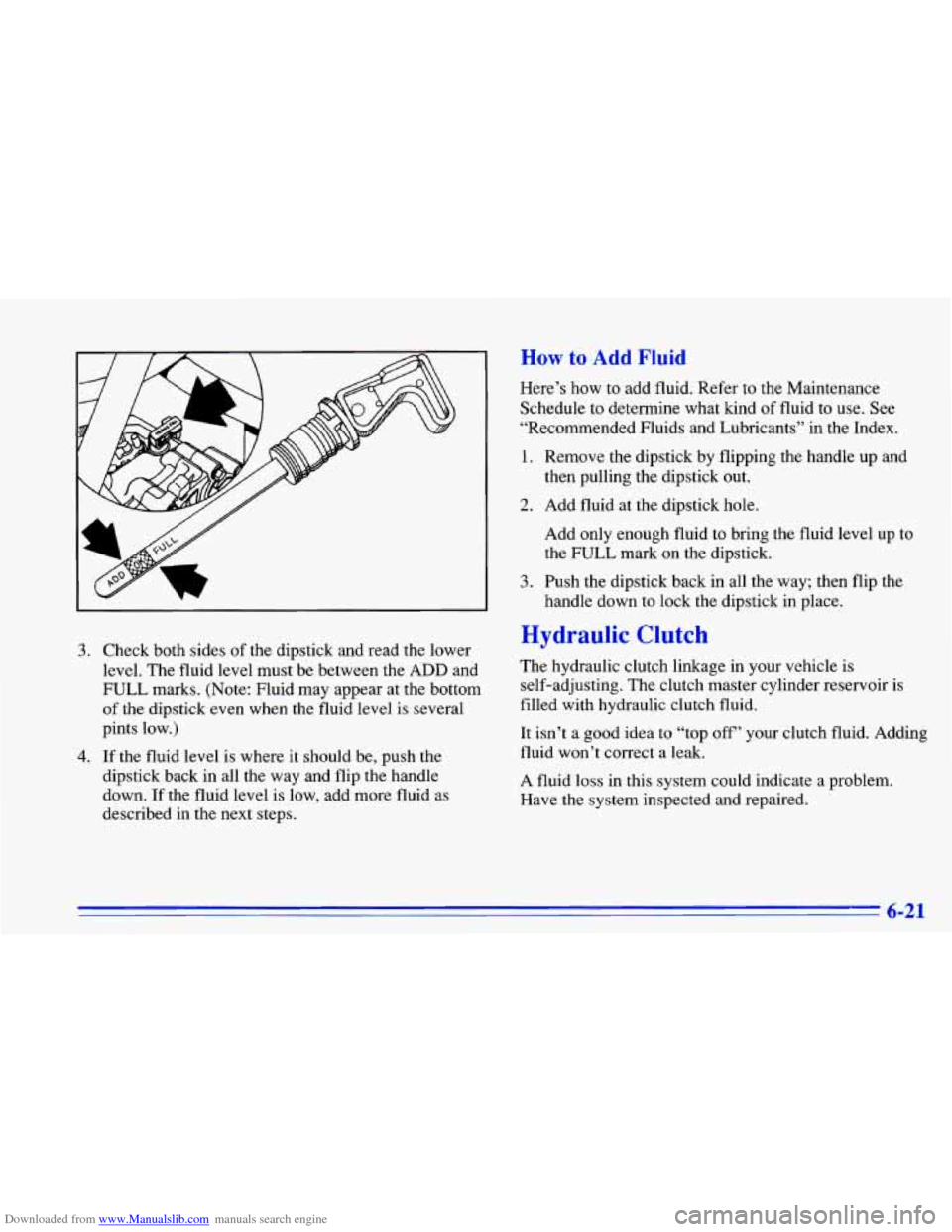
Downloaded from www.Manualslib.com manuals search engine 3. Check both sides of the dipstick and read the lower
level. The fluid level must be between the
ADD and
FULL marks. (Note: Fluid may appear at the bottom
of the dipstick even when the fluid level is several
pints low.)
4. If the fluid level is where it should be, push the
dipstick back in all the way and flip the handle
down. If the fluid level
is low, add more fluid as
described in the next steps.
How to Add Fluid
Here’s how to add fluid. Refer to the Maintenance
Schedule to determine what kind of fluid
to use. See
“Recommended Fluids and Lubricants” in the Index.
1. Remove the dipstick by flipping the handle up and
then pulling the dipstick
out.
2. Add fluid at the dipstick hole.
Add only enough fluid to bring the fluid level up to
the
FULL mark on the dipstick.
handle down to lock the dipstick in place.
3. Push the dipstick back in all the way; then flip the
Hydraulic Clutch
The hydraulic clutch linkage in your vehicle is
self-adjusting. The clutch master cylinder reservoir is
filled with hydraulic clutch fluid.
It isn’t a good idea
to “top off’ your clutch fluid. Adding
fluid won’t correct a leak.
A fluid loss in this system could indicate a problem.
Have the system inspected and repaired.
6-21