seats CHEVROLET CAVALIER 1997 3.G User Guide
[x] Cancel search | Manufacturer: CHEVROLET, Model Year: 1997, Model line: CAVALIER, Model: CHEVROLET CAVALIER 1997 3.GPages: 388, PDF Size: 20 MB
Page 141 of 388
Downloaded from www.Manualslib.com manuals search engine Air Conditioning (If Equipped)
On very hot days, open the windows long enough to let hot,
inside
air escape. This reduces the time it takes for your
vehicle to cool down, which should help fuel economy.
For quick cool-down on very hot days, use
MAX with
the temperature knob all the way in the blue area.
If this
setting is used for long periods
of time, the air in your
vehicle may become too dry.
For normal cooling on hot days, use
VENT with the
temperature knob in the blue area and the
A/C button
pushed in. The system will bring in outside air and
cool it.
On cool, but sunny days, the sun may warm your upper
body, but your lower body may not be warm enough.
You can use
BI-LEVEL with the temperature knob in
the middle and the A/C button pushed
in. The system
will bring
in outside air and direct slightly warmer air to
your lower body. You may notice this temperature
difference more at some times than others.
Heating
On cold days, use FLOOR with the temperature knob all
the way in the red area. The system will bring in outside
air, heat it and send it
to the floor ducts.
Your vehicle has heat ducts that are directed toward
the rear seat. Keep the area under the front seats clear
of obstructions
so the heated air can reach the rear
seat passengers.
If your vehicle has an engine coolant heater, you can
use
it to help your system provide warm air faster when it’s
cold outside
(0°F (-18°C) or lower). An engine
coolant heater warms the coolant your engine and
heating system use to provide heat. See “Engine
Coolant Heater” in the Index.
Page 142 of 388
Downloaded from www.Manualslib.com manuals search engine Ventilation Tips Ventilation System
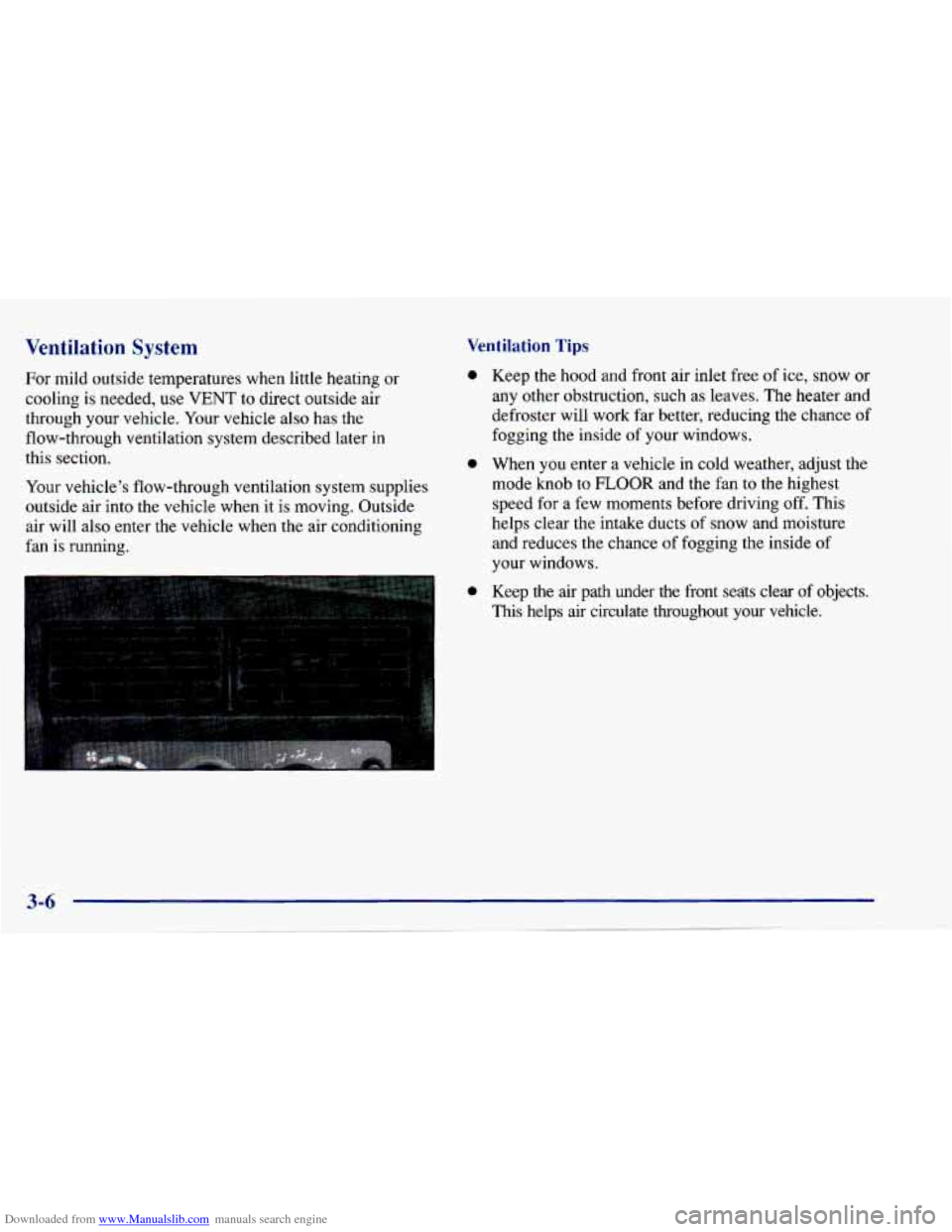
For mild outside temperatures when little heating or
cooling is needed, use
VENT to direct outside air
through your vehicle. Your vehicle also has the
flow-through ventilation system described later in
this section.
Your vehicle's flow-through ventilation system supplies
outside air into the vehicle when it is moving. Outside
air will also enter the vehicle when the air conditioning
fan is running.
0
0
Keep the hood and front air inlet free of ice, snow or
any other obstruction, such
as leaves. The heater and
defroster will work far better, reducing the chance of
fogging the inside of your windows.
When you enter a vehicle in cold weather, adjust the mode knob
to FLOOR and the fan to the highest
speed for a few moments before driving off. This
helps clear the intake ducts of
snow and moisture
and reduces the chance of fogging the inside
of
your windows.
Keep the
air path under the front seats clear of objects.
This helps air circulate throughout your vehicle.
Page 197 of 388
Downloaded from www.Manualslib.com manuals search engine /! CAUTION:
Things you put inside your vehicle can strike
and injure people in
a sudden stop or turn,
or in
a crash.
Put things in the trunk or rear area of your
vehicle. In
a trunk, put them as far forward
as you can. Try to spread the weight evenly.
If you have fold-down rear seats, you’ll
find four anchors on the back wall
of your
trunk.
You can use these anchors to tie
down lighter loads. They’re not strong
enough
for heavy things, however, so put
them
as far forward as you can in the trunk
or rear area.
CAUTION: (Continued) CAUTION: (Continued)
e Never stack heavier things, like suitcases,
inside the vehicle
so that some of them are
above the tops of the seats.
a Don’t leave an unsecured child restraint in
your vehicle.
When you carry something inside the
vehicle, secure it whenever you can.
Don’t leave a seat folded down unless you
need to.
Page 383 of 388
Downloaded from www.Manualslib.com manuals search engine Safety Defects. Reporting ........................ 8-10
Safety Warnings and Symbols
....................... vi
Scheduled Maintenance Services .................... 7-3
Seatback Latches
...................................... 1-5
Reclining Front
............................... 1-4
Seats EasyEntry
................................... 1- 6
Manual Front
................................. 1-2
Manual Lumbar Support
........................ 1-3
Rear
........................................ 1-6
Restraint Systems
.............................. 1 - 1
Seatcontrols ................................. 1-2
Securing a Child Restraint
...................... 1-39
Second Gear. Automatic Transaxle
............ 2-21. 2-22
Second Gear. Manual Transaxle
................... 2-24
Security System
................................ 2- 11
Bulletins, Ordering
............................ 8- 12
Manuals, Ordering
............................ 8- 12
Parts Identification Label
....................... 6-58
Publications, Ordering
......................... 8- 12
Work, Doing Your Own
......................... 6-2
Service and Appearance Care
...................... 6-1
Service and Owner Publications
................... 8- 12
Publications. Ordering in Canada
................ 8-1 1
Service Publications ............................. 8- 12
Servicing Your Air Bag-Equipped Chevrolet
......... 1-27
Sheet Metal Damage
............................ 6-55
Shift Lever
............................... 2- 19, 2-23
Shiftspeeds
................................... 2-25
Shifting Automatic Transaxle
.......................... 2- 19
Service ........................................ 6-2 Into
Park (P)
................................. 2-27
Manual Transaxle
............................. 2-23
OutofPark
.................................. 2-29
Shoulder Belt Height Adjuster
..................... 1-16
Signaling Turns
................................ 2-34
Skidding
...................................... 4-14
Sound Equipment. Adding
........................ 3-23
Spare Tire. Compact
............................. 5-34
Specifications. Engine
........................... 6-64
Speech Impaired. Customer Assistance
............... 8-4
Speedometer
................................... 2-66
SRS
......................................... 1-22
Stains. Cleaning
................................ 6-50
Starter Switch Check
............................ 7-43
Starting Your Engine
.................. 2-14.2-15. 2- 16
Steam
........................................ 5-14
Steering
...................................... 4-10
In Emergencies
............................... 4-11
Power
................................. 4-10, 6-29
Tips
........................................ 4-10
Wheel, Tilt
.................................. 2-33
Storage Compartments
........................... 2-48
Storage, Vehicle
................................ 6-35
Stuck: In Sand, Mud, Ice or Snow
.................. 5-35
Sunvisors
.................................... 2-50
Sunroof
....................................... 2-51
Supplemental Restraint System
.................... 1-22
Surge Tank, Coolant
............................. 5-16
Surge Tank Pressure Cap
......................... 6-28 ...
Specifications and Capacities ...................... 6-63
Symbols, Vehicle
................................ vm