seats CHEVROLET CAVALIER 1997 3.G Owners Manual
[x] Cancel search | Manufacturer: CHEVROLET, Model Year: 1997, Model line: CAVALIER, Model: CHEVROLET CAVALIER 1997 3.GPages: 388, PDF Size: 20 MB
Page 3 of 388
Downloaded from www.Manualslib.com manuals search engine 0 The 1997 Chevrolet Cavalier Owner’s Manual
1-1
2-1
3-1 4-1
5-1
6-1
7-1
8-1
9- 1
Seats and Restraint Systems
This section tells you how to use your seats and safety belts properly. It also explains the “SRS” system.
Features and Controls
This section explains how to start and operate your Chevrolet.
Comfort Controls and Audio Systems
This section tells you how to adjust the ventilation and comfo\
rt controls and how to operate your audio system.
Your Driving and the Road
Here you’ll find helpful information and tips about the road\
and how to drive under different conditions.
Problems on the Road
This section tells what to do if you have a problem while driving, such as a flat tire or overheat\
ed engine, etc.
Service and Appearance Care
Here the manual tells you how to keep your Chevrolet running properly and looking good.
Maintenance Schedule
This section tells you when to perform vehicle maintenance and \
what fluids and lubricants to use.
Customer Assistance Information
This section tells you how to contact Chevrolet for assistance \
and how to get service and owner publications.
It also gives you information on “Reporting Safety Defects” on page
8- 10.
Index
Here’s an alphabetical listing of almost every subject in this manual. You can use it to quickly find
something you want to read.
i
Page 11 of 388
Downloaded from www.Manualslib.com manuals search engine Section 1 Seats and Restraint Systems
Here you’ll find information about the seats in your Chevrolet and how to use your safety belts properly. You can also
learn about some things you should nut do with air bags and safety belts.
1-2
1-7
1-12
1-13
1-13
1-21 1-22
1-22
1-28 Seats
and Seat Controls
Safety Belts: They’re for Everyone
Here Are Questions Many People Ask About
Safety Belts
-- and the Answers
How to Wear Safety Belts Properly
Driver Position
Safety Belt Use During Pregnancy
Right Front Passenger Position
Supplemental Restraint System (SRS)
Rear Seat Passengers 1-3 1
1-33 1-35
1-37
1-45
1-48
1-48 1-48 Rear Safety
Belt Comfort Guides for Children
and Small Adults
Center Passenger Position
Children
Child Restraints
Larger Children Safety Belt Extender
Checking Your Restraint Systems
Replacing Restraint System Parts After
a Crash
1-1
Page 12 of 388
Downloaded from www.Manualslib.com manuals search engine Seats r---d Seat Controls
This section tells you about the seats -- how to
adjust them
-- and also about reclining seatbacks and
head restraints.
Manual Front Seats
A CAUTION:
You can lose control of the vehicle if you try to
adjust
a manual driver’s seat while the vehicle is
moving. The sudden movement could startle and
confuse you,
or make you push a pedal when you
don’t want to. Adjust the driver’s seat only when
the vehicle is not moving. Lift
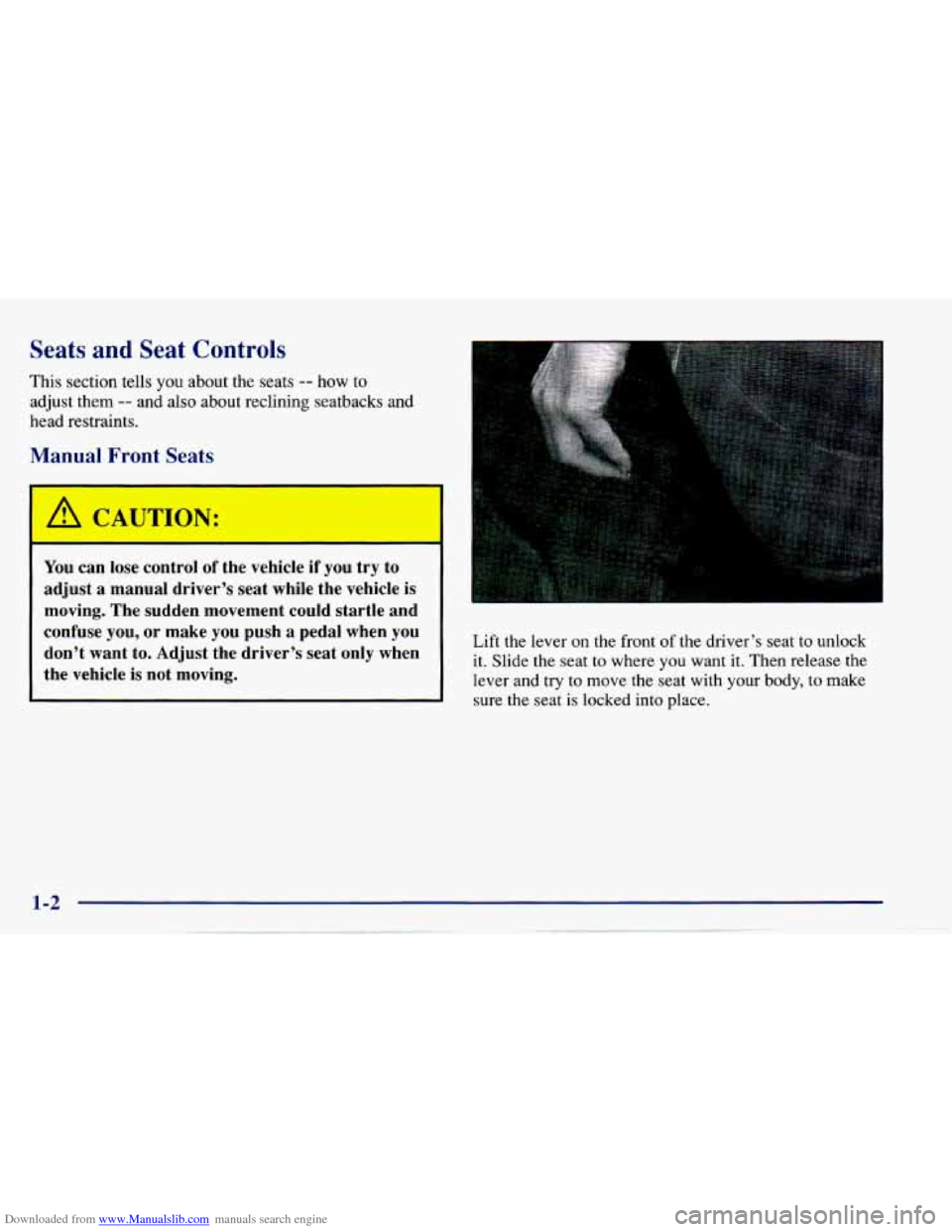
the lever on the front of the driver’s seat to unlock
it. Slide the seat to where you want it. Then release the
lever and try to move the seat with your body, to make
sure the seat is locked into place.
Page 13 of 388
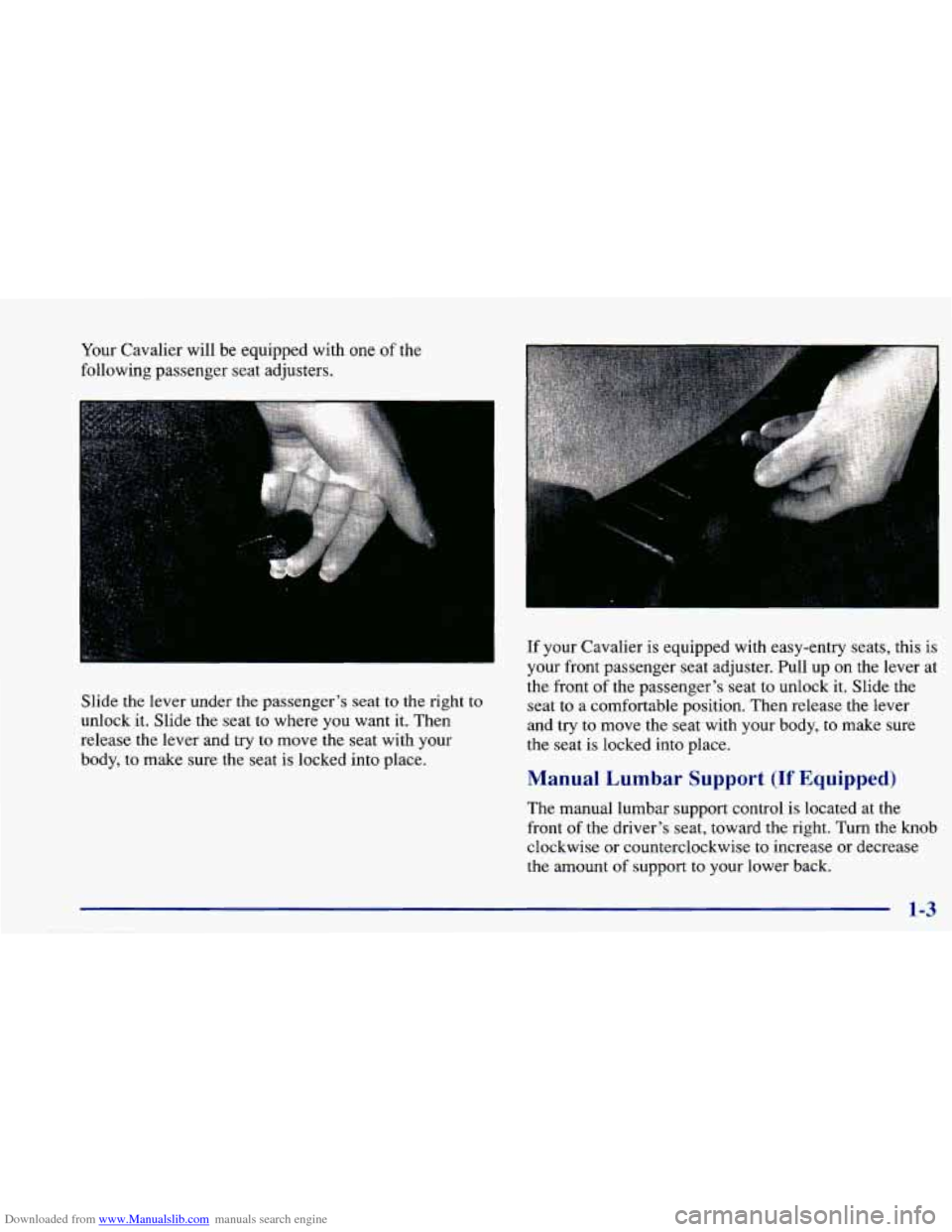
Downloaded from www.Manualslib.com manuals search engine Your Cavalier will be equipped with one of the
following passenger seat adjusters.
Slide the lever under the passenger's seat
to the right to
unlock it. Slide the seat to where you want it. Then
release the lever and try
to move the seat with your
body,
to make sure the seat is locked into place.
If your Cavalier is equipped with easy-entry seats, this is
your front passenger seat adjuster. Pull up on the lever at
the front
of the passenger's seat to unlock it. Slide the
seat to a comfortable position. Then release the lever
and try
to move the seat with your body, to make sure
the seat is locked into place.
Manual Lumbar Support (If Equipped)
The manual lumbar support control is located at the
front
of the driver's seat, toward the right. Turn the knob
clockwise or counterclockwise to increase or decrease
the amount of support to your lower back.
1-3
Page 16 of 388
Downloaded from www.Manualslib.com manuals search engine Easy Entry Seat (If Equipped)
If an easy entry right front seat isn’t locked, it
can move. In a sudden stop or crash, the person
sitting there could be injured. After you’ve used
it, be sure to push rearward on an easy entry seat
to be sure it is locked.
Rear Seats
Folding the Rear Seat
On some two-door models, the right front seat of your
vehicle makes
it easy to get in and out of the rear seat.
Tilt the right front seatback completely forward and the whole seat will slide forward.
Move the right front seatback to its original position after someone gets into the rear seat area. Then move
the seat rearward until it locks.
Tilt the seatback completely forward again to get out. To
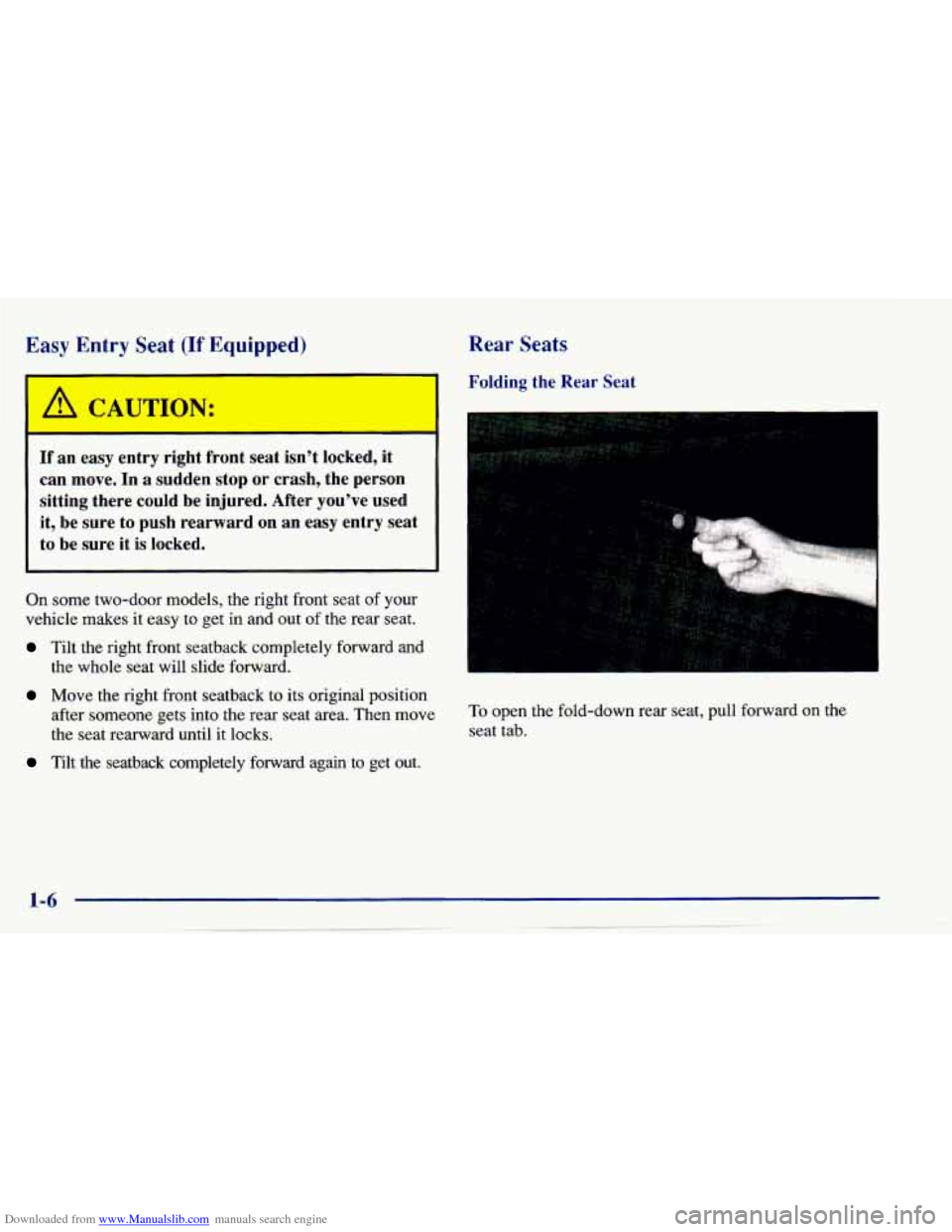
open the fold-down rear seat, pull forward on the
seat tab.
Page 18 of 388
Downloaded from www.Manualslib.com manuals search engine It is extremely dangerous to ride in a cargo area,
inside
or outside of a vehicle. In a collision,
people riding in these areas are more likely to be
seriously injured or killed.
Do not allow people to
ride in any area
of your vehicle that is not
equipped with seats and safety belts. Be sure
everyone in your vehicle is in
a seat and using a
safety belt properly.
Your vehicle has a light that
comes on as a reminder to
buckle up. (See “Safety Belt Reminder Light”
in the Index.) In most states and Canadian provinces, the law says
to
wear safety belts. Here’s why:
They work.
You never know if you’ll be in a crash. If you do have a
crash, you don’t know if it will be a bad one.
A few crashes are mild, and some crashes can be so
serious that even buckled up a person wouldn’t survive.
But most crashes are in between. In many
of them,
people who buckle up can survive and sometimes walk
away. Without belts they could have been badly hurt
or killed.
After more than
25 years of safety belts in vehicles,
the facts are clear. In most crashes buckling up
does
matter ... a lot!
Why Safety Belts Work
When you ride in or on anything, you go as fast as
it goes.
Page 23 of 388
Downloaded from www.Manualslib.com manuals search engine How to Wear Safety Belts Properly
Adults
This part is only for people of adult size.
Be aware that there
are special things to know about
safety belts and children. And there are different rules for
smaller children and babies.
If a child will be riding in
your Chevrolet, see the part
of this manual called
“Children.” Follow those rules for everyone’s protection,
First, you’ll want to know which restraint systems your
vehicle has.
We’ll start with the driver position.
Driver Position
This part describes the driver’s restraint system.
Lap-Shoulder Belt
The driver has a lap-shoulder belt. Here’s how to wear
it properly.
1. Close and lock the door.
2. Adjust the seat (to see how, see “Seats” in the Index)
so you can sit up straight.
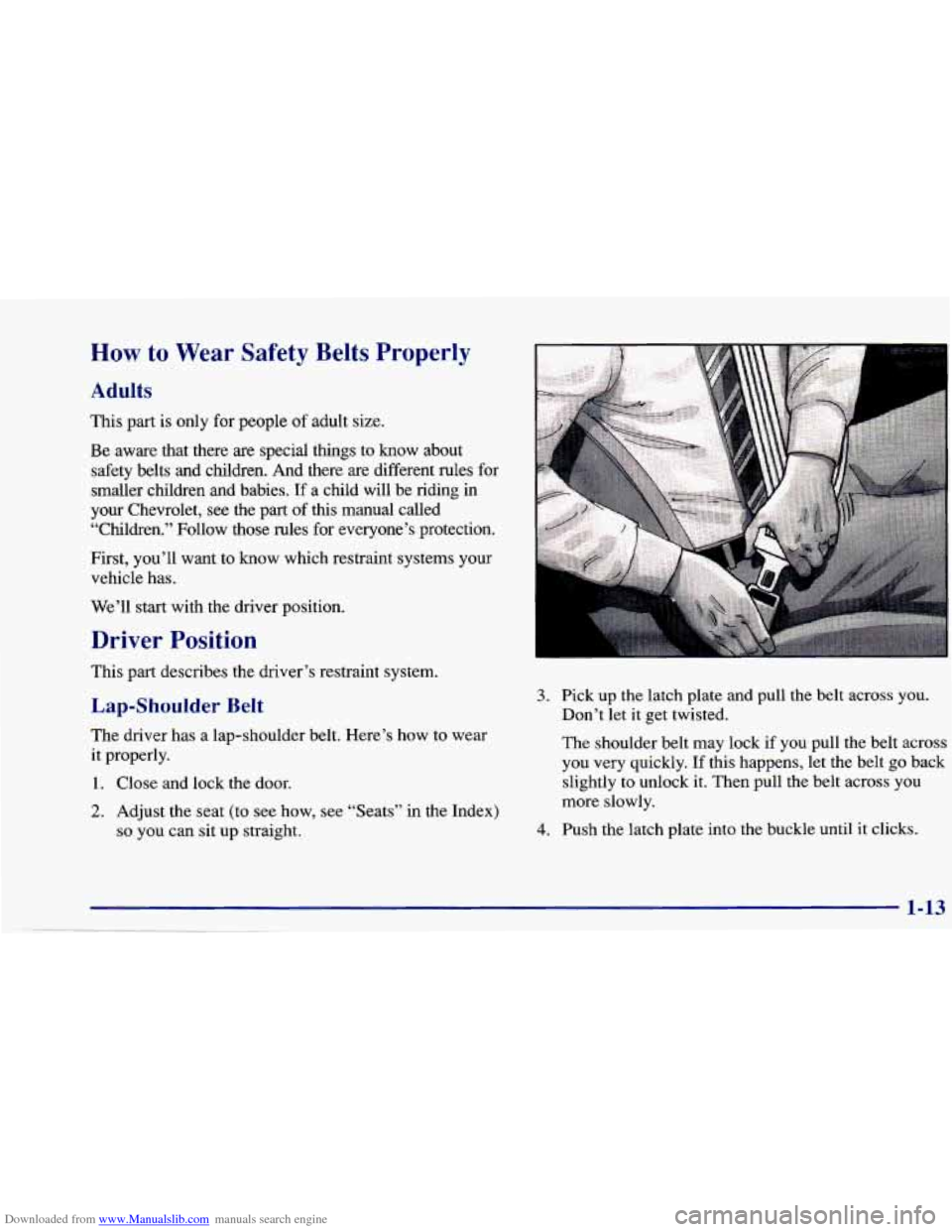
3. Pick up the latch plate and pull the belt across you.
Don’t let it get twisted.
The shoulder belt may lock if
you pull the belt across
you very quickly. If this happens, let the belt go back
slightly to unlock it. Then pull the belt across you
more slowly.
4. Push the latch plate into the buckle until it clicks.
1-13
Page 53 of 388
Downloaded from www.Manualslib.com manuals search engine A child in a rear-facing child restraint can be
seriously injured if the right front passenger’s
air bag inflates. This is because the back of
a
rear-facing child restraint would be very close to
the inflating air bag. Always secure a rear-facing
child restraint
in the rear seat.
You’ll be using the lap-shoulder belt. See the earlier part
about the top strap if the child restraint has one.
1. Because your vehicle has a right front passenger air
bag, always move the seat
as far back as it will go
before securing a fonvard-facing child restraint. (See
“Seats” in the Index.)
2. Put the restraint on the seat. Follow the instructions
for the child restraint. Tilt the
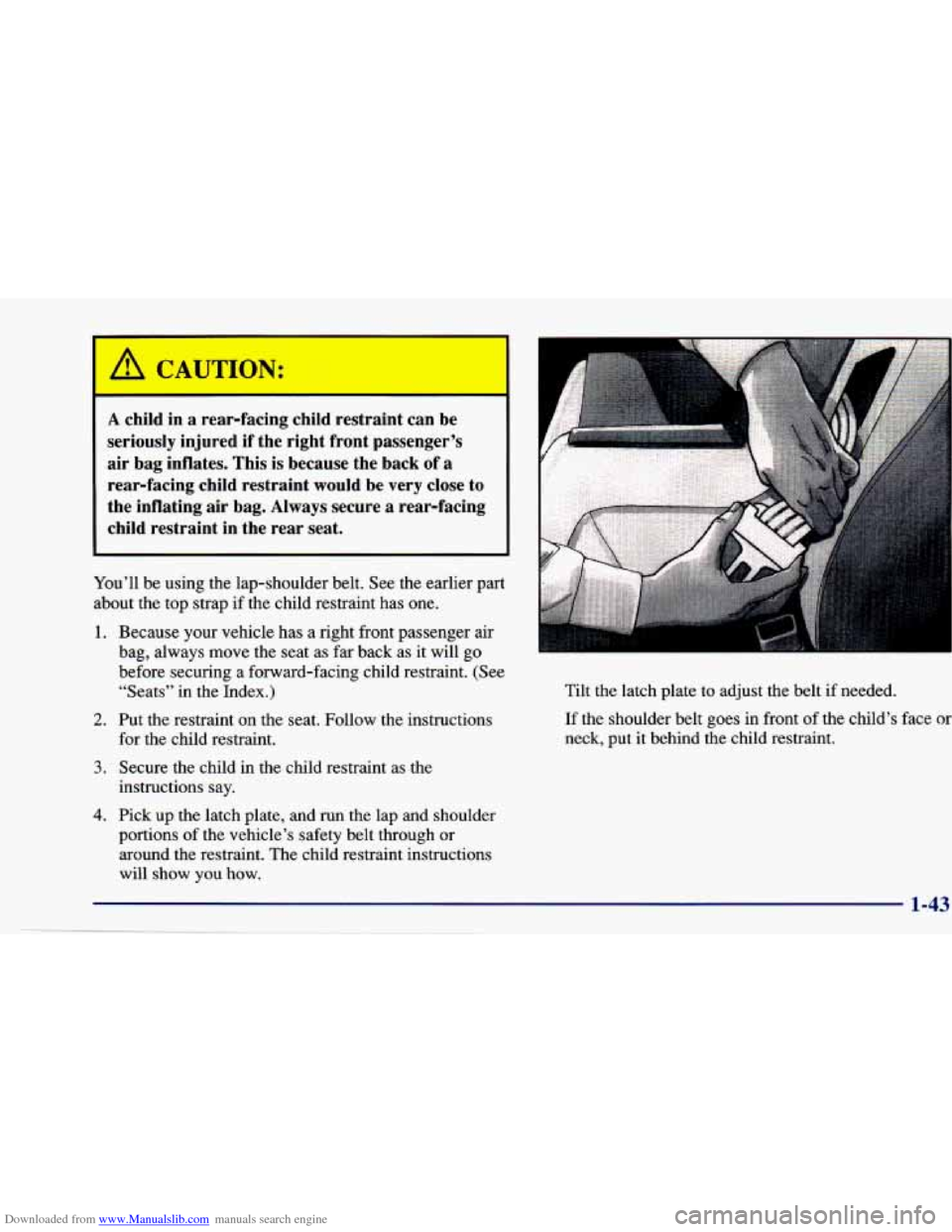
latch plate to adjust the belt if needed.
If the shoulder belt goes in front of the child’s face or
neck, put it behind the child restraint.
3. Secure the child in the child restraint as the
instructions say.
4. Pick up the latch plate, and run the lap and shoulder
portions
of the vehicle’s safety belt through or
around the restraint. The child restraint instructions
will show you
how.
Page 76 of 388
Downloaded from www.Manualslib.com manuals search engine To Use the Coolant Heater
1. Turn off the engine.
2. Open the hood and unwrap the electrical cord.
3. Plug it into a normal, grounded
1 10-volt AC outlet.
I
Plugging the cord into an ungrounded outlet
could cause an electrical shock. Also, the wrong kind
of extension cord could overheat and cause
a fire. You could be seriously injured. Plug the
cord into a properly grounded three-prong
110-volt
AC outlet. If the cord won’t reach, use a
heavy-duty three-prong extension cord rated for
at least
15 amps.
4. Before starting the engine, be sure to unplug and store
the cord
as it was before to keep it away from moving
engine parts.
If you don’t, it could be damaged.
How long should you keep the coolant heater plugged
in? The answer depends on the outside temperature, the
kind of oil you have, and some other things. Instead of trying
to list everything here, we ask that you contact
your Chevrolet dealer in the area where you’ll be
parking your vehicle. The dealer can give you the best
advice for that particular area.
Automatic Transaxle Operation
Your Chevrolet may be equipped with a three-speed
automatic
or a four-speed automatic transaxle. The
shift lever is located on the console between the seats.
There are six different positions for the shift lever on the
three-speed automatic and seven positions for the
four-speed automatic transaxles. While PARK
(P),
REVERSE (R) and NEUTRAL (N) operate identically
for both transaxles, the forward gear positions represent
different gearing and operation.
See “Forward Gears
(3-Speed)” or “Forward-Gears (4-Speed)” later in
this section.
Page 84 of 388
Downloaded from www.Manualslib.com manuals search engine Parking Brake
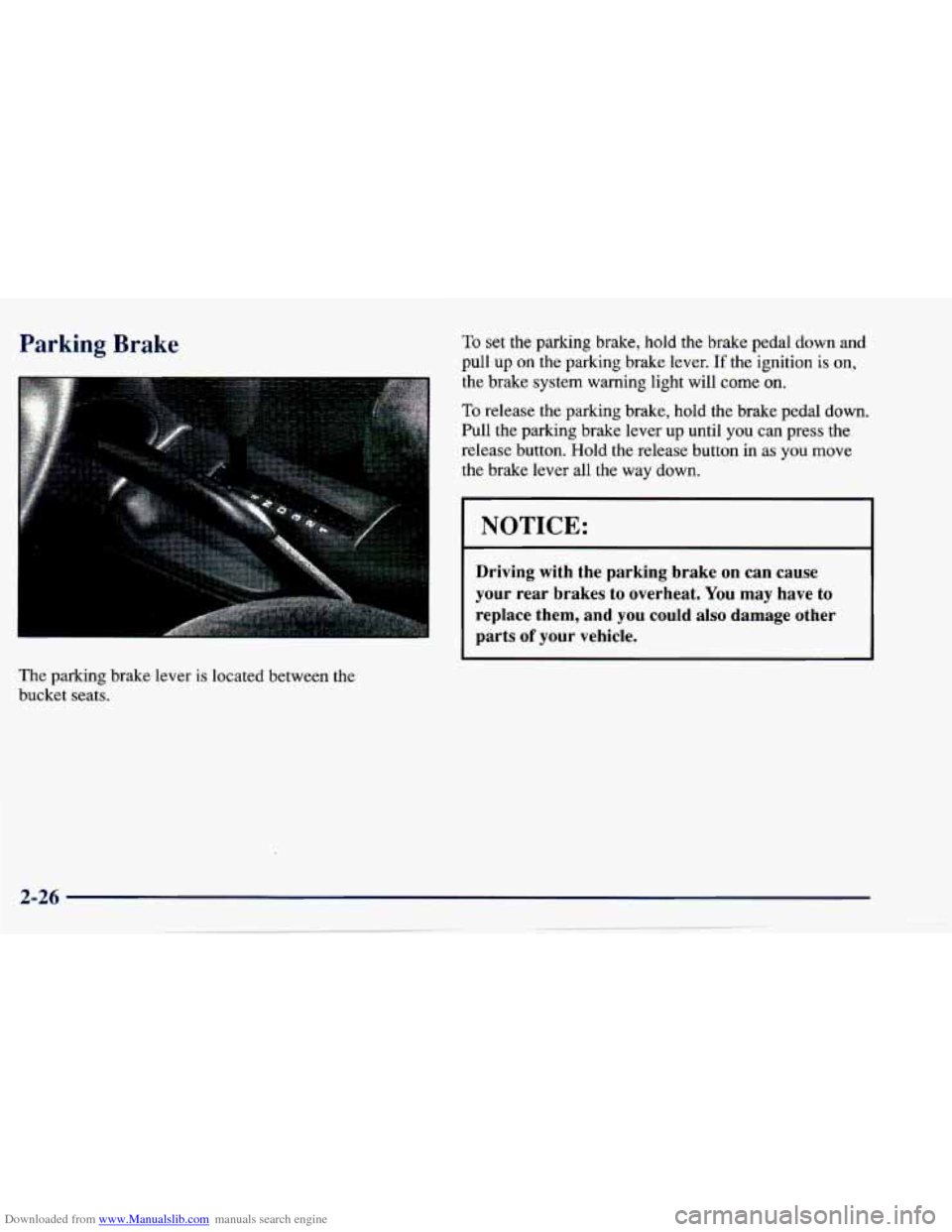
The parking brake lever is located between the
bucket seats.
To set the parking brake, hold the brake pedal down and
pull up on the parking brake lever. If the ignition is on,
the brake system warning light will
come on.
To release the parking brake, hold the brake pedal down.
Pull the parking brake lever up until you can press the
release button. Hold the release button
in as you move
the brake lever all the way down.
NOTICE:
Driving with the parking brake on can cause
your rear brakes to overheat. You may have to
replace them, and you could also damage other
parts
of your vehicle.