wheel CHEVROLET CAVALIER 1997 3.G User Guide
[x] Cancel search | Manufacturer: CHEVROLET, Model Year: 1997, Model line: CAVALIER, Model: CHEVROLET CAVALIER 1997 3.GPages: 388, PDF Size: 20 MB
Page 78 of 388
Downloaded from www.Manualslib.com manuals search engine Ensure the shift lever is fully in PARK (P) range before
starting the engine. Your Chevrolet has
a brake-transaxle
shift interlock. You have to fully apply your regular
brakes
before you can shift from PARK (P) when the
ignition key is in the
RUN position. If you cannot shift
out of PARK
(P), ease pressure on the shift lever -- push
the
shift lever all the way into PARK (P) and also release
the shift lever button on floor shift console models
as you
maintain brake application. Then move the shift lever
into the gear you wish. (Press the shift lever button before
moving the shift lever.) See “Shifting Out
of PARK (P)”
in the Index.
REVERSE (R): Use this gear to back up.
I NOTICE:
Shifting to REVERSE (R) while your vehicle is
moving forward could damage your transaxle.
Shift to REVERSE (R) only after your vehicle
is stopped.
To rock your vehicle back and forth to get out of snow,
ice or sand without damaging your transaxle, see
“If
You’re Stuck: In Sand, Mud, Ice or Snow” in the Index. NEUTRAL
(N):
In this position, your engine doesn’t
connect with the wheels.
To restart when you’re
already moving, use
NEUTRAL (N) only. Also, use
NEUTRAL (N) when your vehicle is being towed.
Shifting out of PARK
(P) or NEUTRAL (N) while
your engine is “racing” (running at high speed) is
dangerous. Unless your foot is firmly on the
brake pedal, your vehicle could move very
rapidly. You could lose control
and hit people or
objects. Don’t shift out of PARK
(P) or
NEUTRAL
(N) while your engine is racing.
I NOTICE:
Damage to your transaxle caused by shifting out
of
PARK (P) or NEUTRAL (N) with the engine
racing isn’t covered
by your warranty.
2-20
Page 79 of 388
Downloaded from www.Manualslib.com manuals search engine Forward Gears (3-Speed)
DRIVE (D): This position is for normal driving.
SECOND
(2): This position gives you more power but
lower fuel economy. You can use SECOND
(2) on hills.
It can help control your speed as you go down steep
mountain roads, but then you would also want to use
your brakes
off and on.
NOTICE:
Don’t drive in SECOND (2) for more than
25 miles (41 km), or at speeds over 55 mph
(88 kdh), or you can damage your transaxle.
Use DRIVE (D)
as much as possible. Don’t shift
into SECOND
(2) unless you are going slower
than
65 mph (105 km/h), or you can damage
your engine. FIRST
(1): This position gives you even more power (but
lower
fuel economy) than SECOND (2). You can use it on
very steep
hills, or in deep snow or mud. lf the selector
lever is put in
F’IRST (l), the transaxle won’t shift into
fist gear until the vehicle is going slowly enough.
NOTICE:
If your front wheels can’t rotate, don’t try to
drive. This might happen if you were stuck in
very deep sand
or mud or were up against a solid
object.
You could damage your transaxle. Also,
if you stop when going uphill, don’t hold your
vehicle there with only the accelerator pedal. This
could overheat and damage the transaxle. Use
your brakes or shift into PARK
(P) to hold your
vehicle in position on a
hill.
2-21
Page 81 of 388
Downloaded from www.Manualslib.com manuals search engine FIRST (1): This position gives you even more power (but
lower fuel economy)
than SECOND (2). You can use it on
very steep hills, or in deep snow or mud. If the selector
lever
is put in FIRST (l), the transaxle won’t shift into
fxst
gear until the vehicle is going slowly enough.
I NOTICE:
If your front wheels can’t rotate, don’t try to
drive. This might happen
if you were stuck in
very deep sand or mud or were up against
a solid
object. You could damage your transaxle. Also,
if you stop when going uphill, don’t hold your
vehicle there with only the accelerator pedal. This
could overheat and damage the transaxle. Use
your brakes
or shift into PARK (P) to hold your
vehicle in position
on a hill.
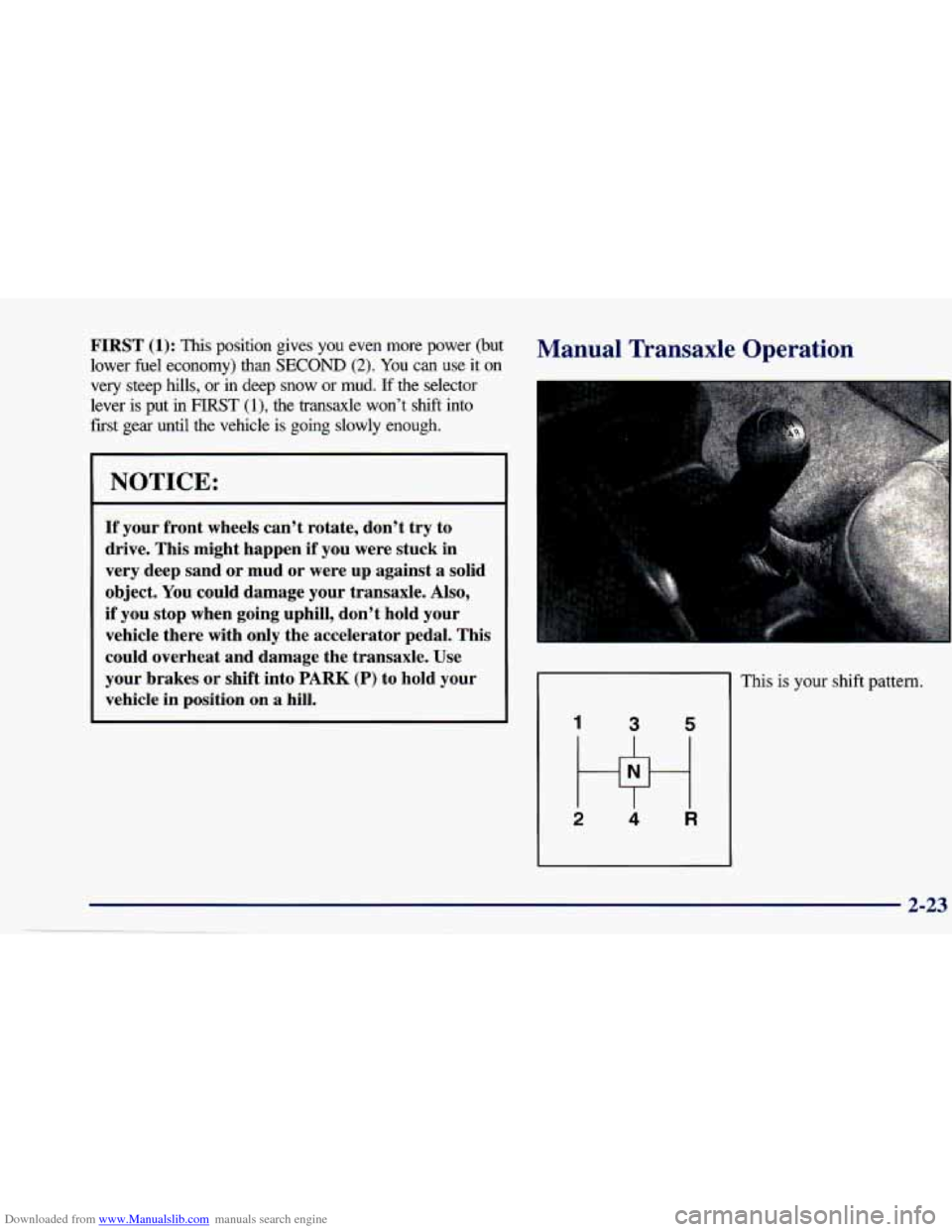
Manual Transaxle Operation
:
This is your shift pattern.
2-:
Page 90 of 388
Downloaded from www.Manualslib.com manuals search engine Windows
I On a vehicle with manual windows, use the window
crank to open and close each window.
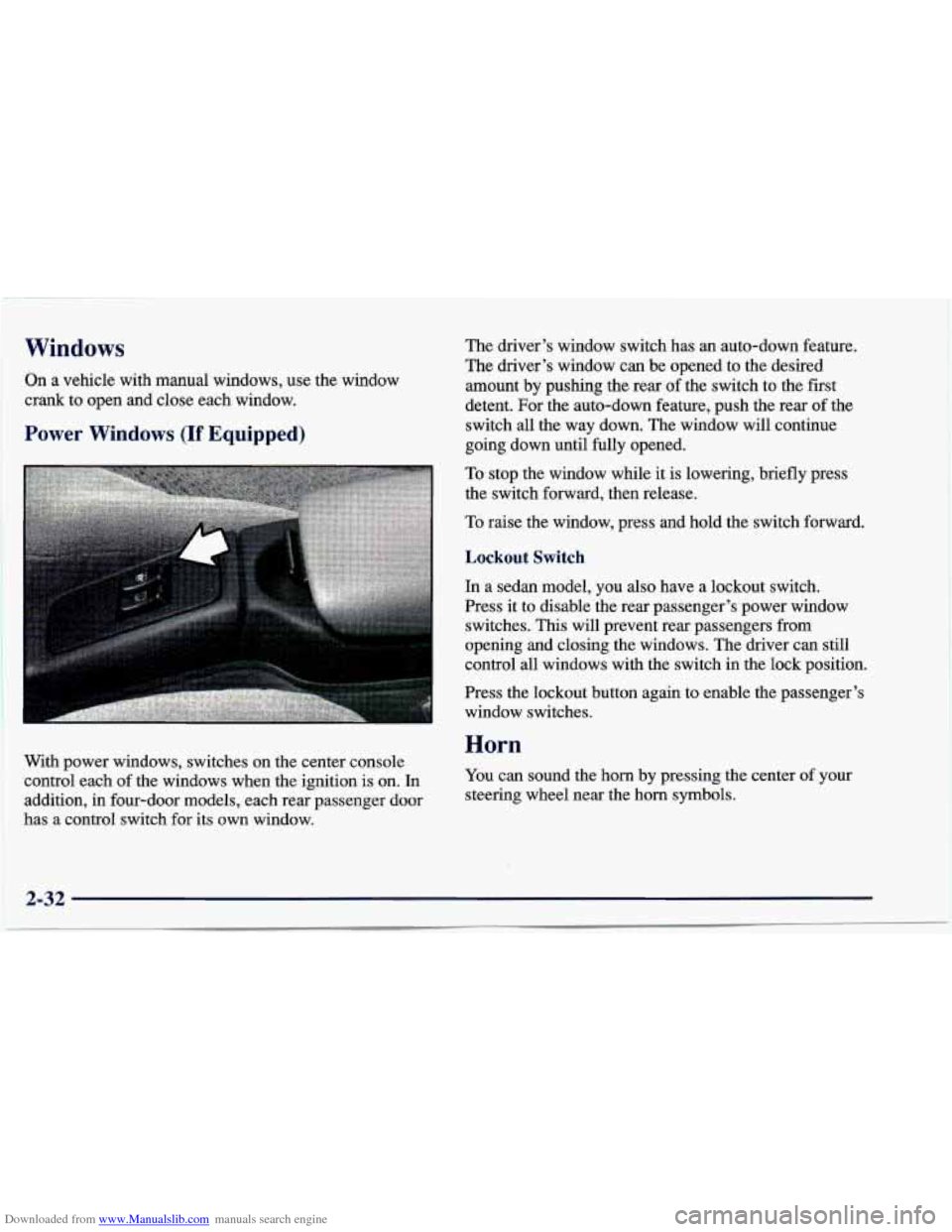
Power Windows (If Equipped)
The driver’s window switch has an auto-down feature.
The driver’s window can be opened to the desired
amount by pushing the rear
of the switch to the first
detent. For the auto-down feature, push the rear
of the
switch all the way down. The window will continue
going down until fully opened.
To stop the window while it is lowering, briefly press
the switch forward, then release.
To raise the window, press and hold the switch forward.
With power windows, switches on the center console
control each of the windows when the ignition is on. In
addition, in four-door models, each rear passenger door
has a control switch for its own window.
Lockout Switch
In a sedan model, you also have a lockout switch.
Press it to disable the rear passenger’s power window
switches.
This will prevent rear passengers from
opening and closing the windows. The driver can still
control
all windows with the switch in the lock position.
Press the lockout button again
to enable the passenger’s
window switches.
Horn
You can sound the horn by pressing the center of your
steering wheel near the horn symbols.
2-32
Page 91 of 388
Downloaded from www.Manualslib.com manuals search engine Tilt Steering Wheel (If Equipped) Turn Signal/Multifunction Lever
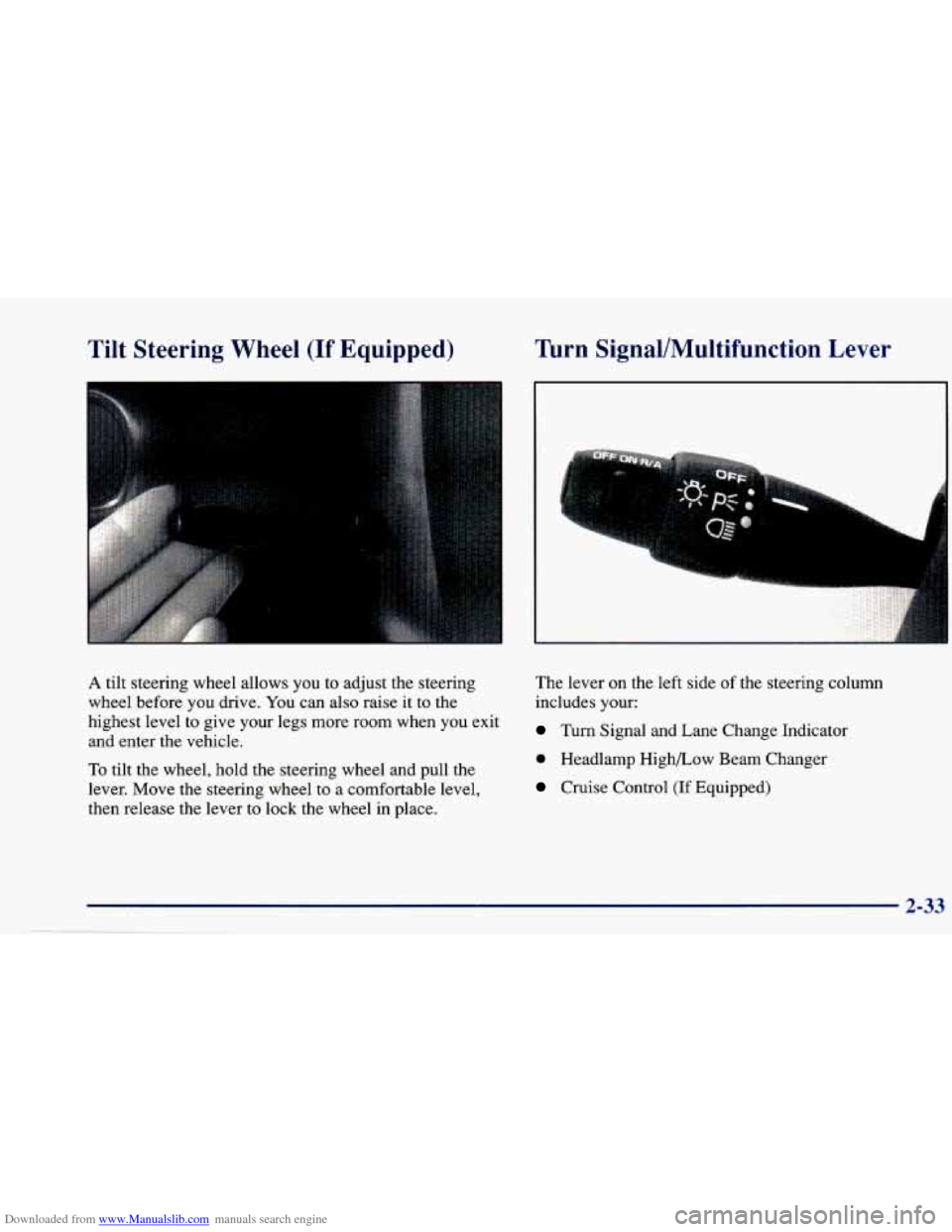
A tilt steering wheel allows you to adjust the steering
wheel before you drive.
You can also raise it to the
highest level to give your legs more room when you exit
and enter the vehicle.
To tilt the wheel, hold the steering wheel and pull the
lever. Move the steering wheel to a comfortable level,
then release the lever to lock the wheel in place. The
lever on the left side
of the steering column
includes your:
Turn Signal and Lane Change Indicator
0 Headlamp Highbow Beam Changer
Cruise Control (If Equipped)
2-33
Page 96 of 388
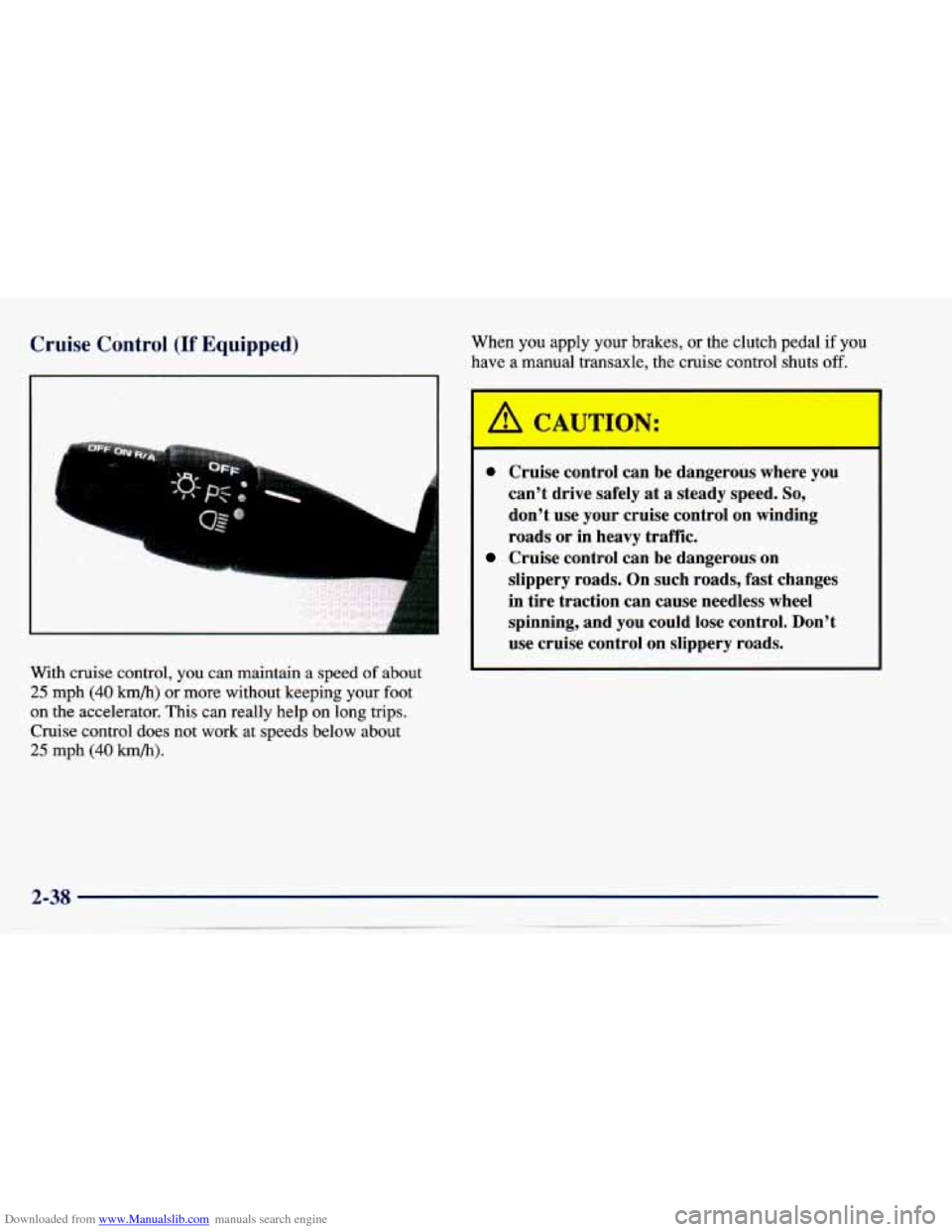
Downloaded from www.Manualslib.com manuals search engine Cruise Control (If Equipped) When you apply your brakes, or the clutch pedal if you
have a manual transaxle, the cruise control shuts off.
With cruise control, you can maintain a speed
of about
25 mph (40 kmh) or more without keeping your foot
on the accelerator. This can really help
on long trips.
Cruise control does not work at speeds below about
25 mph (40 km/h).
0 Cruise control can be dangerous where you
can’t drive safely at
a steady speed. So,
don’t use your cruise control on winding
roads or in heavy traffic.
slippery roads. On such roads, fast changes
in tire traction can cause needless wheel
spinning, and you could lose control. Don’t
use cruise control
on slippery roads.
Cruise control can be dangerous on
Page 121 of 388
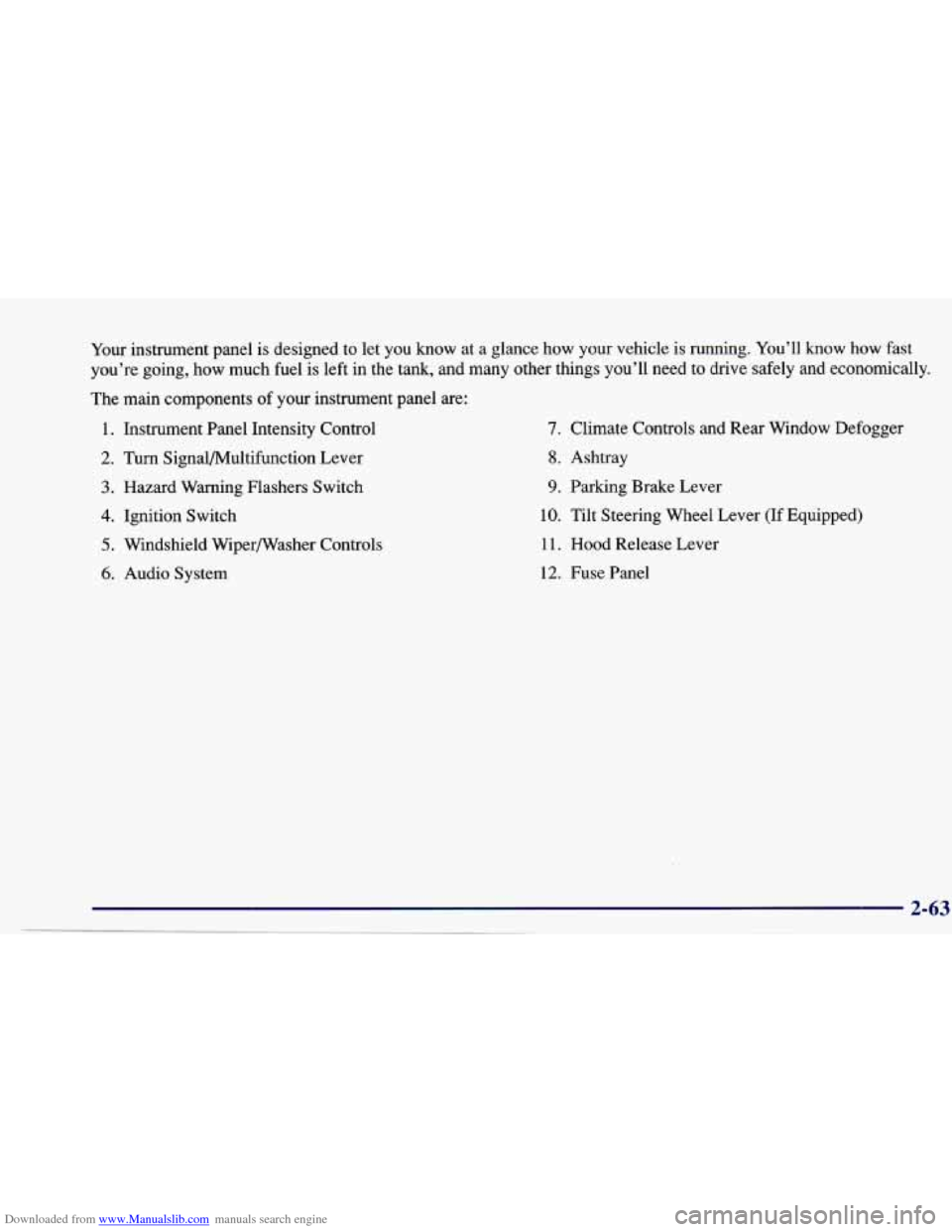
Downloaded from www.Manualslib.com manuals search engine Your instrument panel is designed to let you know at a glance how your vehicle is running. You’ll know how fast
you’re going, how much fuel is left
in the tank, and many other things you’ll need to drive safely and economically.
The main components
of your instrument panel are:
1. Instrument Panel Intensity Control
2. Turn Signal/Multifunction Lever
3. Hazard Warning Flashers Switch
4. Ignition Switch
5. Windshield Wipermasher Controls
6. Audio System
7. Climate Controls and Rear Window Defogger
8. Ashtray
9. Parking Brake Lever
10. Tilt Steering Wheel Lever (If Equipped)
1 1. Hood Release Lever
12. Fuse Panel
Page 129 of 388
Downloaded from www.Manualslib.com manuals search engine Enhanced Traction System Warning Light
(If Equipped)
ETS
OFF
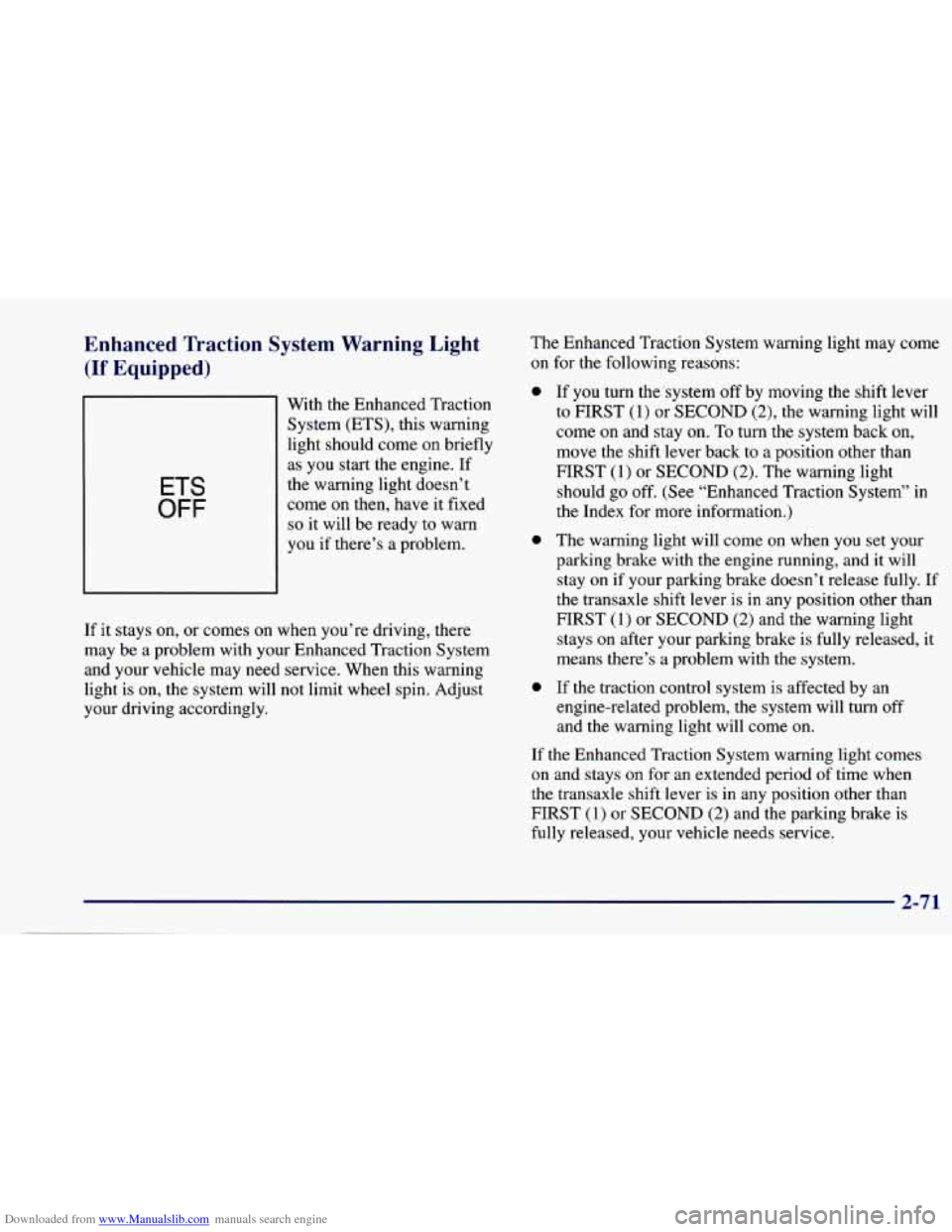
With the Enhanced Traction System (ETS), this warning
light should come on briefly
as you start the engine. If
the warning light doesn’t
come on then, have it fixed
so it will be ready to warn
you
if there’s a problem.
If it stays on, or comes on when you’re driving, there
may be a problem with your Enhanced Traction System
and your vehicle may need service. When this warning
light is on, the system will
not limit wheel spin. Adjust
your driving accordingly. The
Enhanced Traction System warning light may come
on for the following reasons:
a
0
0
If you turn the ‘system off by moving the shift lever
to FIRST (1) or SECOND (2), the warning light will
come on and stay on.
To turn the system back on,
move the shift lever back to a position other than
FIRST
(1) or SECOND (2). The warning light
should go off. (See “Enhanced Traction System” in
the Index for more information.)
The warning light will come on when you set your
parking brake with the engine running, and it will
stay on if your parking brake doesn’t release fully. If
the transaxle shift lever is in any position other than
FIRST (1) or SECOND
(2) and the warning light
stays on after your parking brake is fully released,
it
means there’s a problem with the system.
If the traction control system is affected by an engine-related problem,
the system will turn off
and the warning light will come on.
If the Enhanced Traction System warning light comes
on and stays
on for an extended period of time when
the transaxle shift lever is in any position other than
FIRST (1) or SECOND (2) and the parking brake is
fully released, your vehicle needs service.
2-71
Page 130 of 388
Downloaded from www.Manualslib.com manuals search engine Enhanced Traction System Active Light
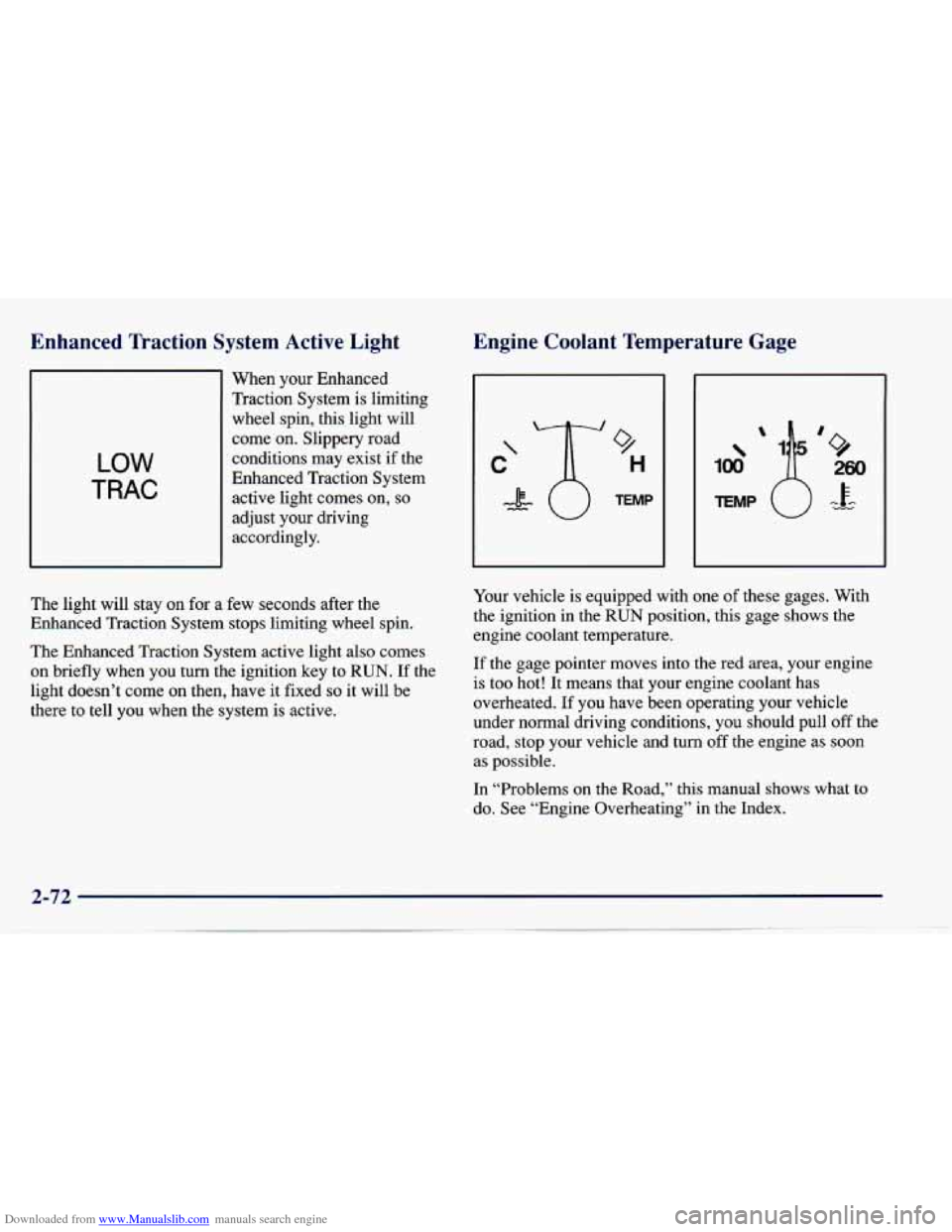
LOW
TRAC
When your Enhanced
Traction System is limiting
wheel spin, this light will
come on. Slippery road
conditions may exist if the
Enhanced Traction System active light comes on,
so
adjust your driving
accordingly.
The light will stay
on for a few seconds after the
Enhanced Traction System stops limiting wheel spin.
The Enhanced Traction System active light also comes
on briefly when you turn the ignition key to
RUN. If the
light doesn’t come
on then, have it fixed so it will be
there
to tell you when the system is active.
Engine Coolant Temperature Gage
9
H
TEMP
Your vehicle is equipped with one of these gages. With
the ignition in the
RUN position, this gage shows the
engine coolant temperature.
If the gage pointer moves into the red
area, your engine
is too hot! It means that your engine coolant has
overheated.
If you have been operating your vehicle
under normal driving conditions,
you should pull off the
road, stop your vehicle and turn off the engine as soon
as possible.
In “Problems on the Road,” this manual shows what to
do. See “Engine Overheating” in the Index.
Page 170 of 388
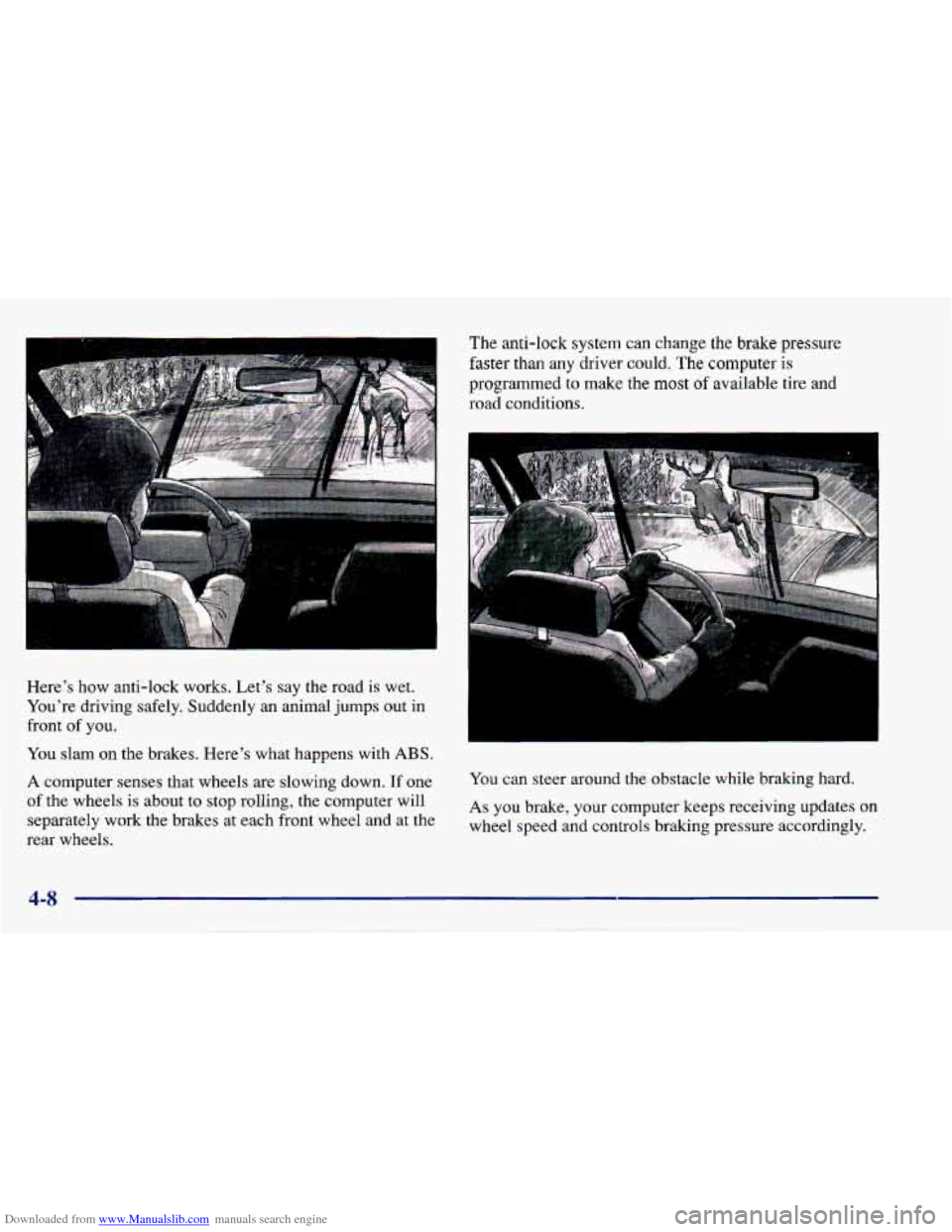
Downloaded from www.Manualslib.com manuals search engine The anti-lock system can change the brake pressure
I faster than any driver could. The computer is
programmed
to make the most of available tire and
road conditions.
Here’s how anti-lock works. Let’s say the road is wet.
You’re driving safely. Suddenly an animal jumps out in
front of you.
You slam on the brakes. Here’s what happens with
ABS.
A computer senses that wheels are slowing down. If one
of the wheels is about to stop rolling, the computer will
separately
work the brakes at each front wheel and at the
rear wheels. You
can steer around the obstacle while braking hard.
As you brake, your computer keeps receiving updates on
wheel speed and controls braking pressure accordingly.
4-8