ECU CHEVROLET CAVALIER 1998 3.G User Guide
[x] Cancel search | Manufacturer: CHEVROLET, Model Year: 1998, Model line: CAVALIER, Model: CHEVROLET CAVALIER 1998 3.GPages: 400, PDF Size: 20.74 MB
Page 65 of 400
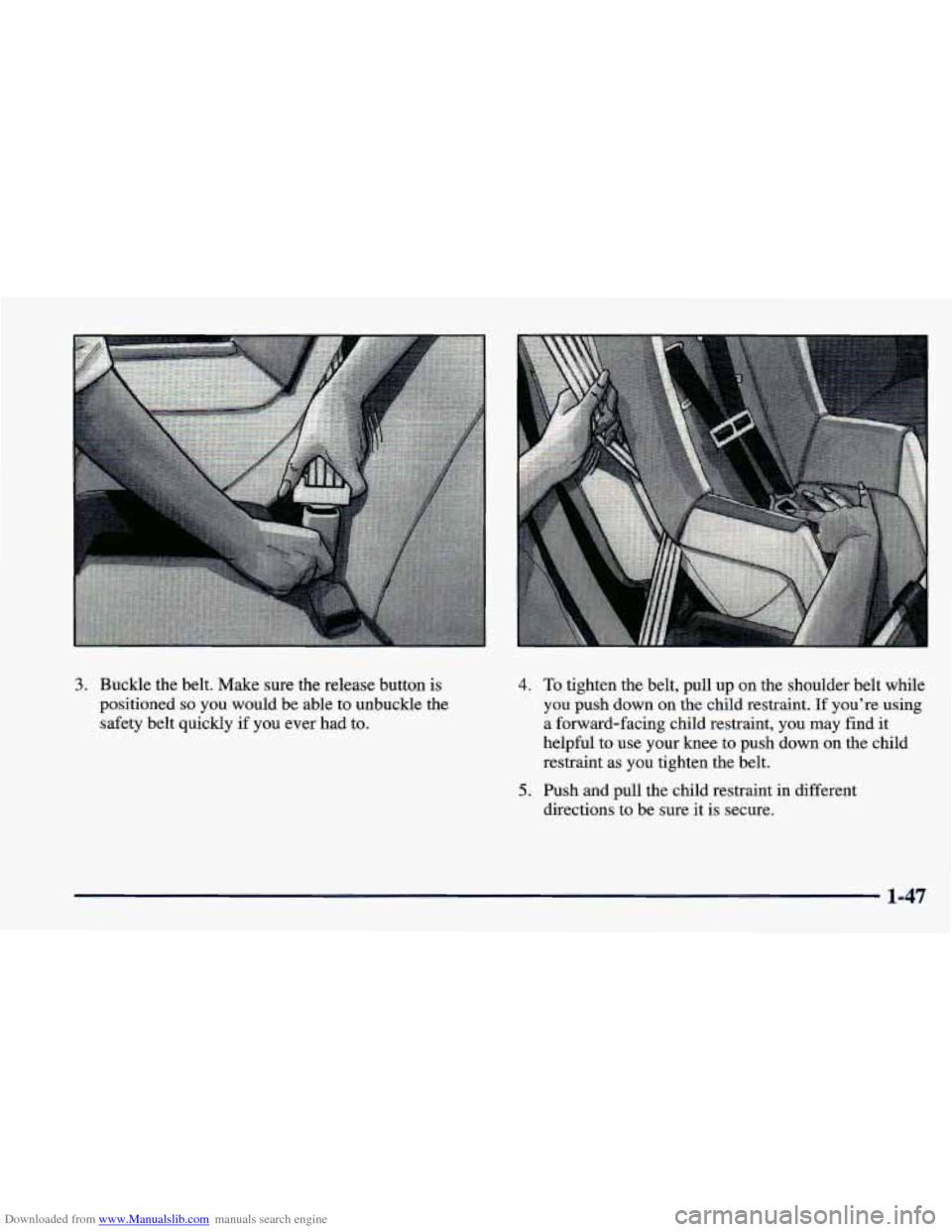
Downloaded from www.Manualslib.com manuals search engine 3. Buckle the belt. Make sure the release button is
positioned
so you would be able to unbuckle the
safety belt quickly if you ever had to.
4. To tighten the belt, pull up on the shoulder belt while
you push down on the child restraint.
If you’re using
a forward-facing child restraint, you may find it
helpful to use your knee to push down on the child
restraint as you tighten the belt.
5. Push and pull the child restraint in different
directions to be sure it is secure.
1-47
Page 66 of 400
Downloaded from www.Manualslib.com manuals search engine To remove the child restraint, just unbuckle the vehicle’s
safety belt and let it go back all the way. The safety belt
will move freely
again and be ready to work for an adult
or larger child passenger.
Securing a Child Restraint in the Center
Rear Seat Position
You’ll be using the lap belt. Be sure to follow the
instructions that came with the child restraint. Secure
the child in the child restraint when and as the
instructions say.
See the earlier part about the top strap
if the child
restraint has one.
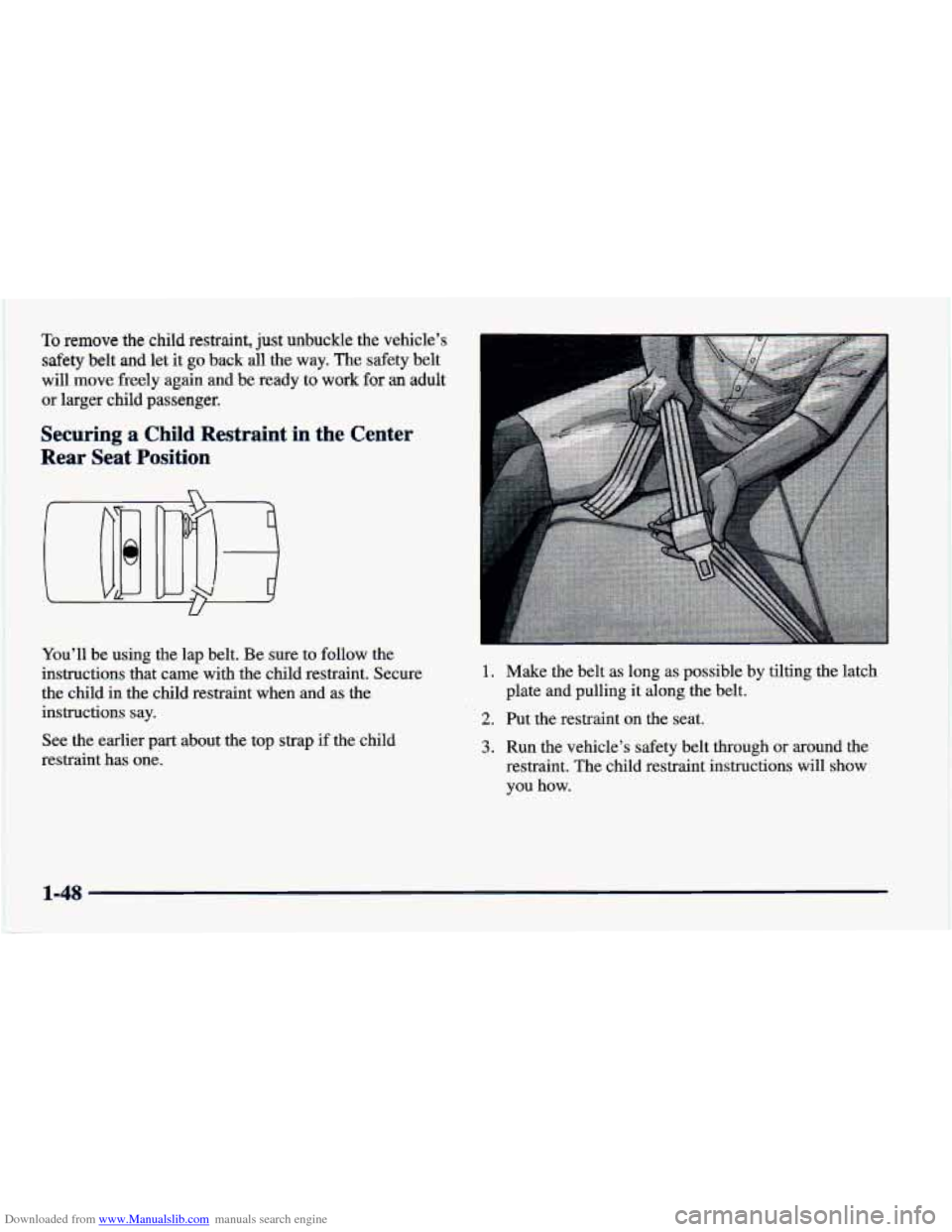
1. Make the belt as long as possible by tilting the latch
plate and pulling it along the belt.
2. Put the restraint on the seat.
3. Run the vehicle’s safety belt through or around the
restraint. The child restraint instructions will show
you how.
1-48
Page 67 of 400
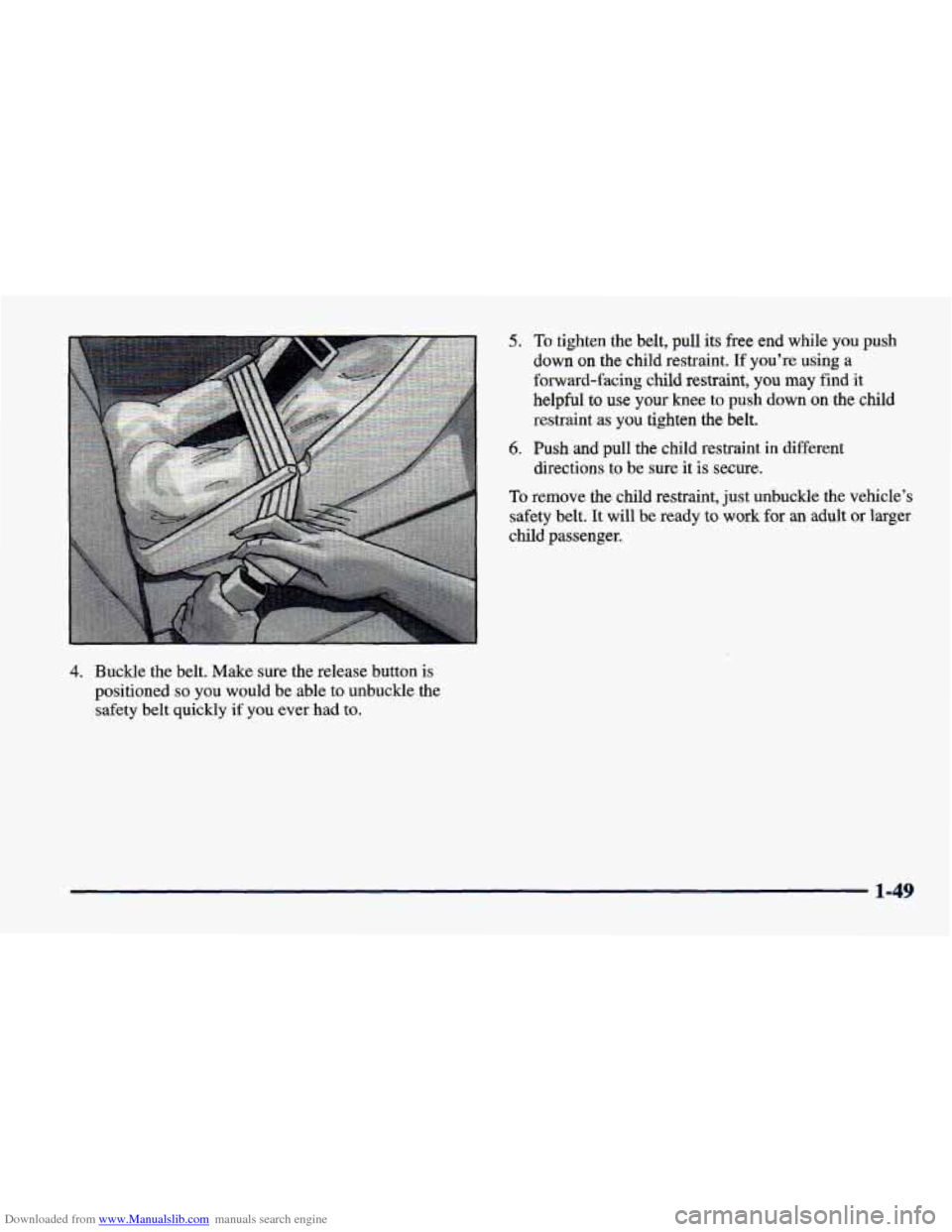
Downloaded from www.Manualslib.com manuals search engine 4. Buckle the belt. Make sure the release button is
positioned
so you would be able to unbuckle the
safety
belt quickly if you ever had to.
5. To tighten the belt, pull its free end while you push
down on the child restraint. If you’re using a
forward-facing child restraint,
you may find it
helpful to use your knee to push down on the child
restraint as
you tighten the belt.
directions to be sure it is secure.
6. Push and pull the child restraint in different
To remove the child restraint, just unbuckle the vehicle’s
safety belt. It will be ready to
work for an adult or larger
child passenger.
1-49
Page 68 of 400
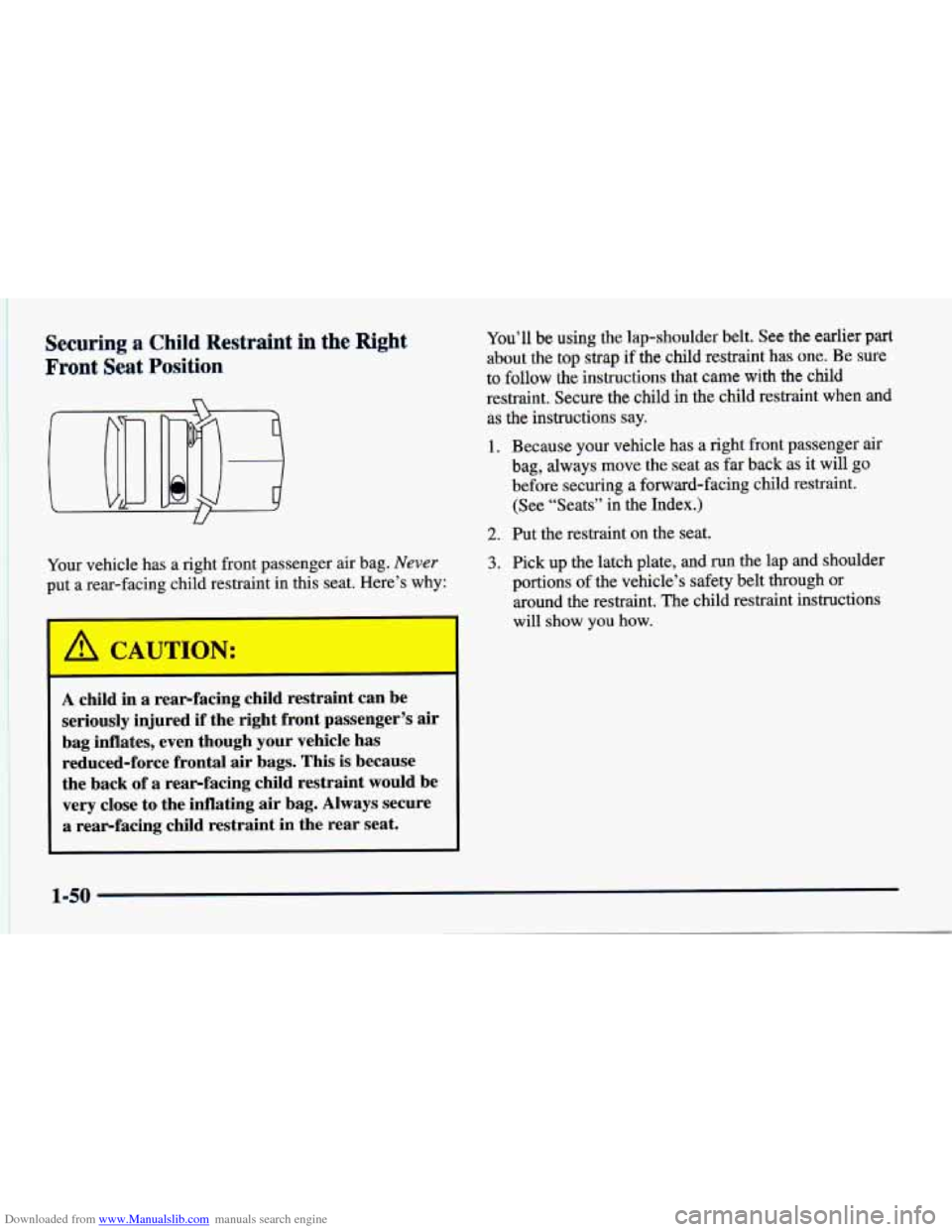
Downloaded from www.Manualslib.com manuals search engine Securing a Child Restraint in the Right
Front Seat Position
Your vehicle has a right front passenger air bag. Never
put a rear-facing child restraint in this seat. Here’s why: \
I
A CAUTION:
A child in a rear-facing child restraint can be
seriously injured if the right front passenger’s air
bag inflates, even though your vehicle has reduced-force frontal
air bags. This is because
the back
of a rearfacing child restraint would be
very close to the inflating air bag. Always secure
a rearfacing child restraint in the rear seat.
You’ll be using the lap-shoulder belt. See the earlier part
about the top strap if the child restraint has one. Be sure
to follow the instructions that came with the child
restraint. Secure the child in the child restraint when
and
as the instructions say.
1. Because your vehicle has a right front passenger air
bag, always move the seat as far back as it will go
before securing a forward-facing child restraint.
(See “Seats”
in the Index.)
2. Put the restraint on the seat.
3. Pick up the latch plate, and run the lap and shoulder
portions of the vehicle’s safety belt through or
around the restraint. The child restraint instructions
will show you how.
Page 70 of 400
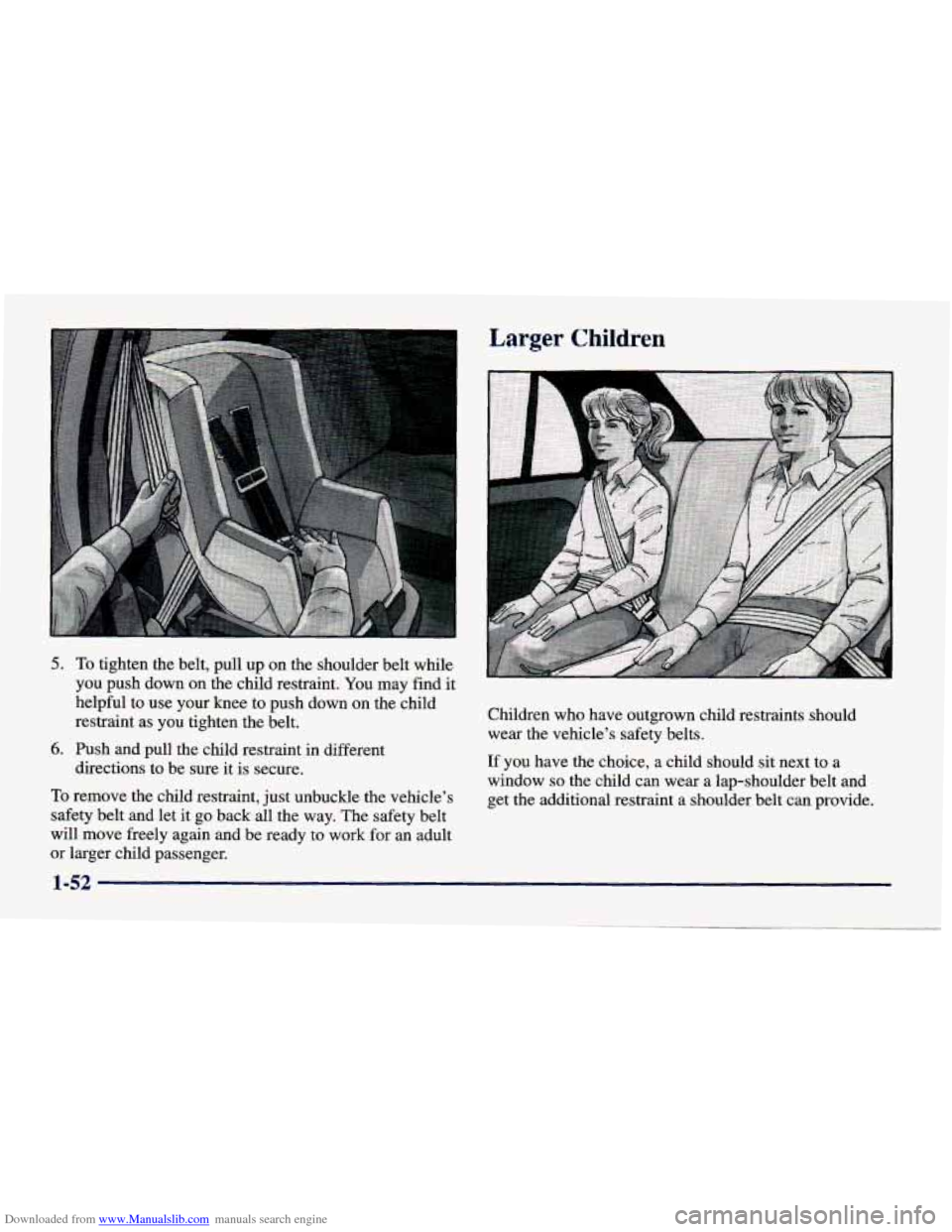
Downloaded from www.Manualslib.com manuals search engine 5. To tighten the belt, pull up on the shoulder belt while
you push down on the child restraint. You may find it
helpful to use your knee to push down on the child
restraint as you tighten the belt.
directions to be sure it is secure.
6. Push and pull the child restraint in different
To remove the child restraint, just unbuckle the vehicle’s
safety belt and let it
go back all the way. The safety belt
will move freely again and be ready to work
for an adult
or larger child passenger.
Larger Children
Children who have outgrown child restraints should
wear the vehicle’s safety belts.
If you have the choice, a child should sit next to a
window
so the child can wear a lap-shoulder belt and
get the additional restraint a shoulder belt can provide.
1-52
Page 81 of 400
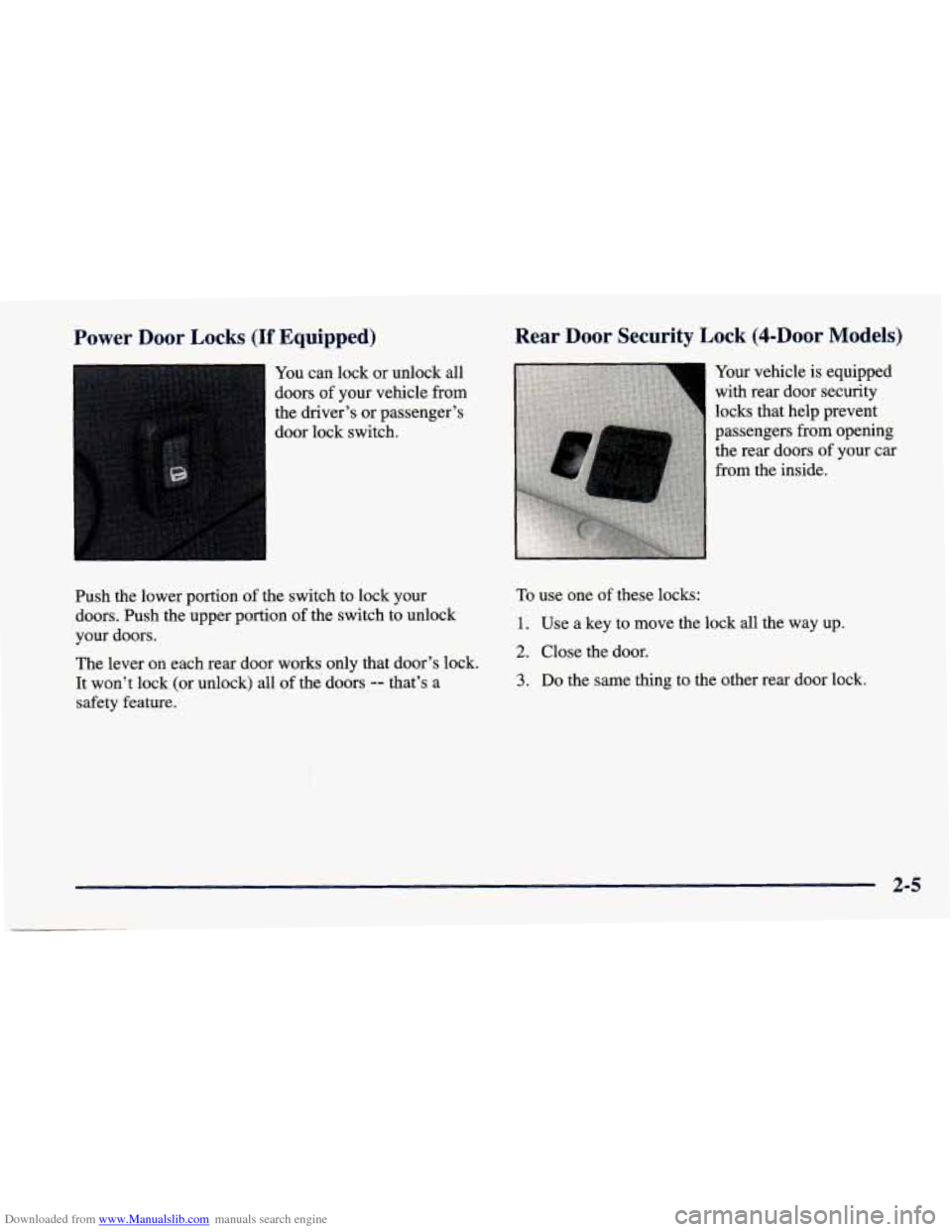
Downloaded from www.Manualslib.com manuals search engine Power Door Locks (If Equipped) Rear Door Security Lock (4-DoOr Models)
You
can lock or unlock all
doors
of your vehicle from
the driver’s or passenger’s
door lock switch.
Push the lower portion of the switch to lock your
doors. Push the upper portion of the switch to unlock
your doors.
The lever on each rear door works only that door’s lock.
It won’t lock (or unlock) all
of the doors -- that’s a
safety feature. Your vehicle is equipped
with rear door security
locks that help prevent
passengers from opening
the rear doors
of your car
from the inside.
To use one
of these locks:
1. Use a key to move the lock all the way up.
2. Close the door.
3. Do the same thing to the other rear door lock.
2-5
Page 82 of 400
Downloaded from www.Manualslib.com manuals search engine The rear doors of your vehicle cannot be opened from
the inside when this feature is in use. If you want to
open a rear door when the security lock is on:
1. Unlock the door from the inside.
2. Then open the door from the outside.
If you don’t cancel the security lock feature, adults or
older children who ride in the rear won’t be able to open
the rear door from the inside.
You should let adults and
older children know how to cancel the locks.
To cancel the rear door lock:
1. Unlock the door from the inside and open the door
from the outside.
2. Use a key to move the lock all the way down.
3. Do the same for the other rear door.
The rear door lock will now work normally.
Leaving Your Vehicle
If you are leaving the vehicle, open your door and
set the locks from the inside. Then
get out and close
the door.
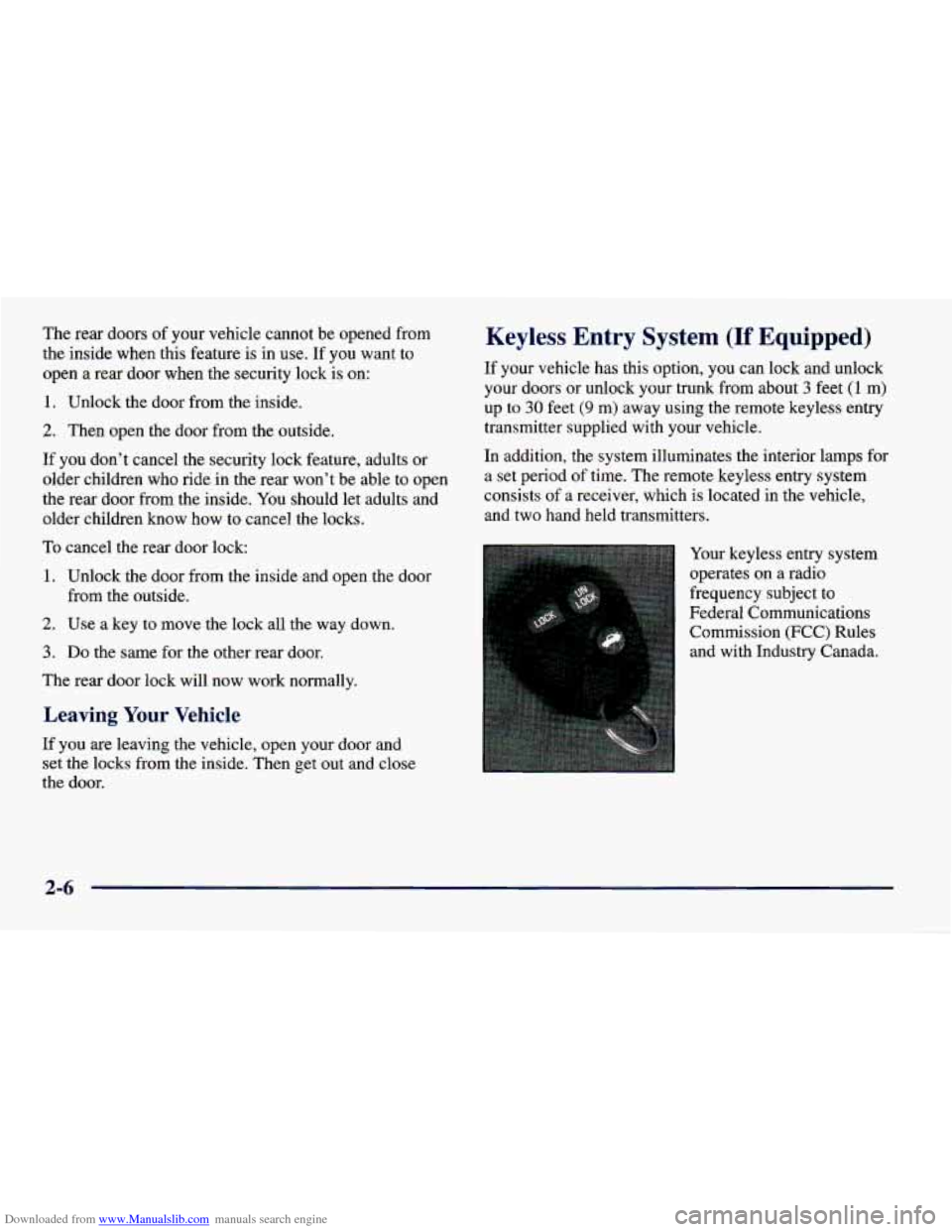
Keyless Entry System (If Equipped)
If your vehicle has this option, you can lock and unlock
your doors or unlock your trunk from about
3 feet (1 m>
up to 30 feet (9 m) away using the remote keyless entry
transmitter supplied with your vehicle.
In addition, the system illuminates the interior lamps for
a set period
of time. The remote keyless entry system
consists
of a receiver, which is located in the vehicle,
and two hand held transmitters.
Your keyless entry system
operates on a radio
frequency subject to
Federal Communications
Commission (FCC) Rules
and with Industry Canada.
2-6
Page 86 of 400
Downloaded from www.Manualslib.com manuals search engine 4. Put the two halves back together. Make sure the cover is on tightly,
so water won’t get in.
5. Check the operation of the transmitter with your
vehicle. If the transmitter does not work, try
synchronizing the transmitter with the receiver.
Synchronization
Your remote keyless entry system is equipped with a
security system that prevents anyone from recording and
playing back your signal. The transmitter does not send
the same signal twice to the receiver. The receiver will
not respond to
a signal that has been sent to it more
than once.
To resynchronize your transmitter and receiver, follow
these directions:
1. Stand close to your vehicle.
2. Press and hold the LOCK and UNLOCK buttons on
the transmitter at the same time.
3. Hold the buttons for at least five seconds. During
this time, the doors should lock and unlock once.
This confirms the resynchronization.
If the doors do
not lock and unlock, see your dealer for service.
Trunk
It can be dangerous to drive with the trunk lid
open because carbon monoxide
(CO) gas can
come into your vehicle. You can’t see or smell
CO.
It can cause unconsciousness and even death.
If you must drive with the trunk lid open or if
electrical wiring or other cable connections must
pass through the seal between the body and the
trunk lid:
Make sure all windows are shut.
0 Turn the fan on your heating or cooling
system to its highest speed with the setting
on any airflow selection except
MAX. That
will force outside
air into your vehicle. See
“Comfort Controls” in the Index.
0 If you have air outlets on or under the
instrument panel, open them all the way.
See “Engine Exhaust” in the Index.
2-10
Page 123 of 400
Downloaded from www.Manualslib.com manuals search engine Storage Compartments
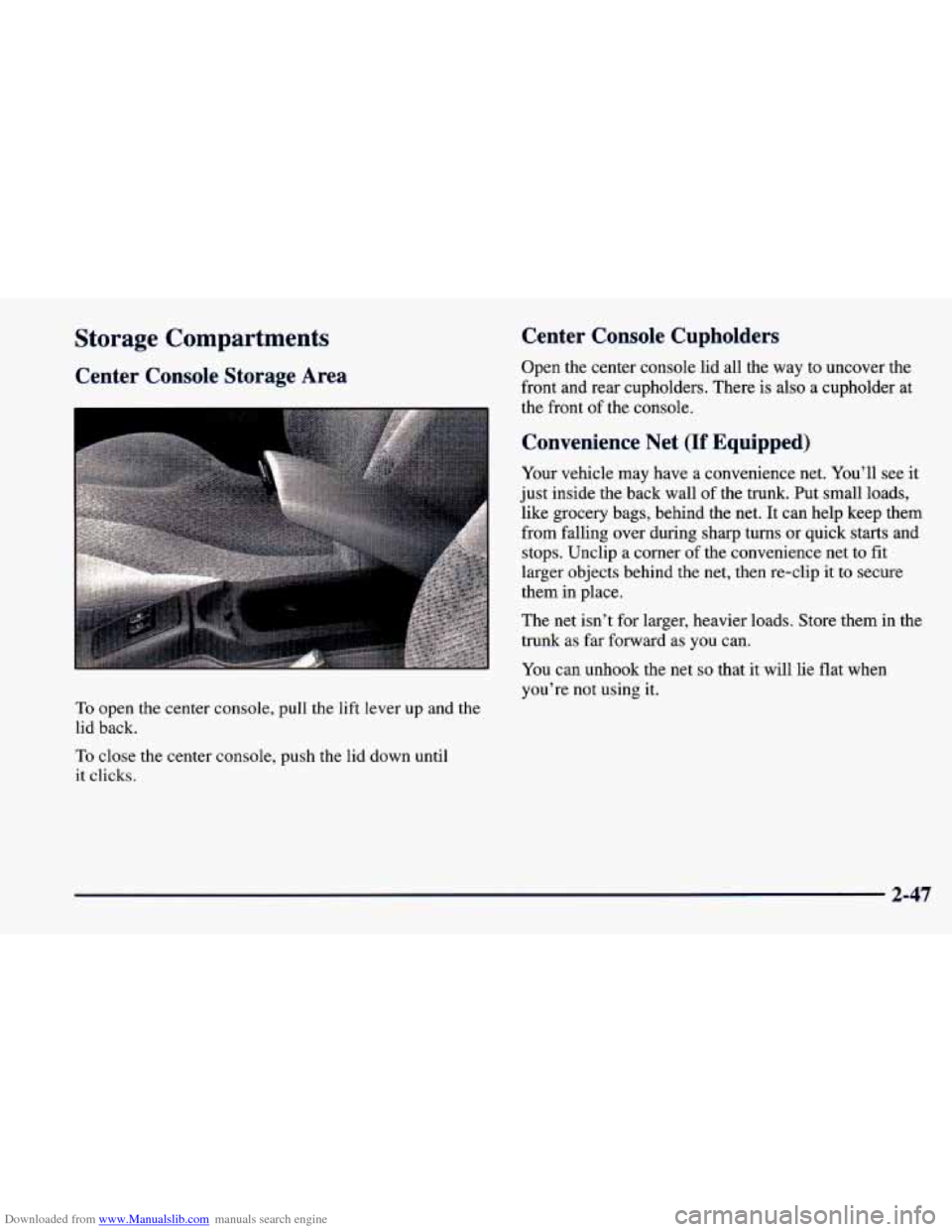
Center Console Storage Area
To open the center console, pull the lift lever up and the
lid back.
To close the center console, push the lid down until
it clicks.
Center Console Cupholders
Open the center console lid all the way to uncover the
front and rear cupholders. There is also a cupholder at
the front
of the console.
Convenience Net (If Equipped)
Your vehicle may have a convenience net. You’ll see it
just inside the back wall
of the trunk. Put small loads,
like grocery bags, behind the net. It can help keep them
from falling over during sharp turns or quick starts and
stops. Unclip a corner of the convenience net
to fit
larger objects behind the net, then re-clip it to secure
them in place.
The net isn’t for larger, heavier loads. Store them in the
trunk as far forward as you can.
You can unhook the net
so that it will lie flat when
you’re not using it.
2-47
Page 125 of 400
Downloaded from www.Manualslib.com manuals search engine Sunroof (If Equipped)
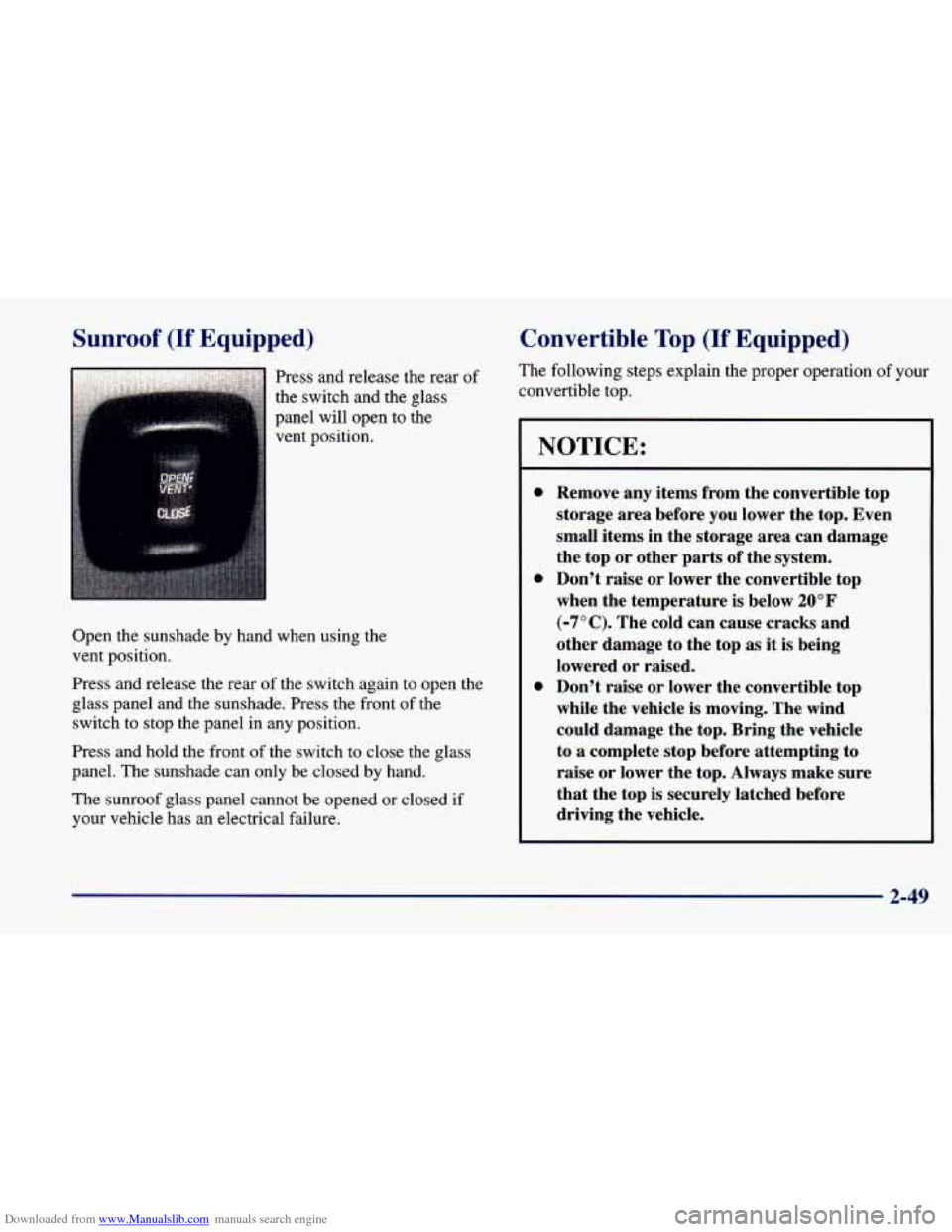
Press and release the rear of
the switch and the glass
panel will open to the
vent position.
Open the sunshade by hand when using the
vent position.
Press and release the rear
of the switch again to open the
glass panel and the sunshade. Press the front
of the
switch to stop the panel in any position.
Press and hold the front
of the switch to close the glass
panel. The sunshade can only be closed by hand.
The sunroof glass panel cannot be opened or closed if
your vehicle has an electrical failure.
Convertible Top (If Equipped)
The following steps explain the proper operation of your
convertible top.
NOTICE:
0
0
0
Remove any items from the convertible top
storage area before you lower the top. Even
small items in the storage area can damage
the top or other parts of the system.
Don’t raise or lower the convertible top
when the temperature is below
20°F
(-7°C). The cold can cause cracks and
other damage to the top
as it is being
lowered or raised.
Don’t raise or lower the convertible top
while the vehicle is moving. The wind
could damage the top. Bring the vehicle
to a complete stop before attempting to
raise or lower the top. Always make sure
that the top is securely latched before
driving the vehicle.
2-49