warning CHEVROLET CAVALIER 1998 3.G User Guide
[x] Cancel search | Manufacturer: CHEVROLET, Model Year: 1998, Model line: CAVALIER, Model: CHEVROLET CAVALIER 1998 3.GPages: 400, PDF Size: 20.74 MB
Page 141 of 400
Downloaded from www.Manualslib.com manuals search engine I’achometer (If Equipped)
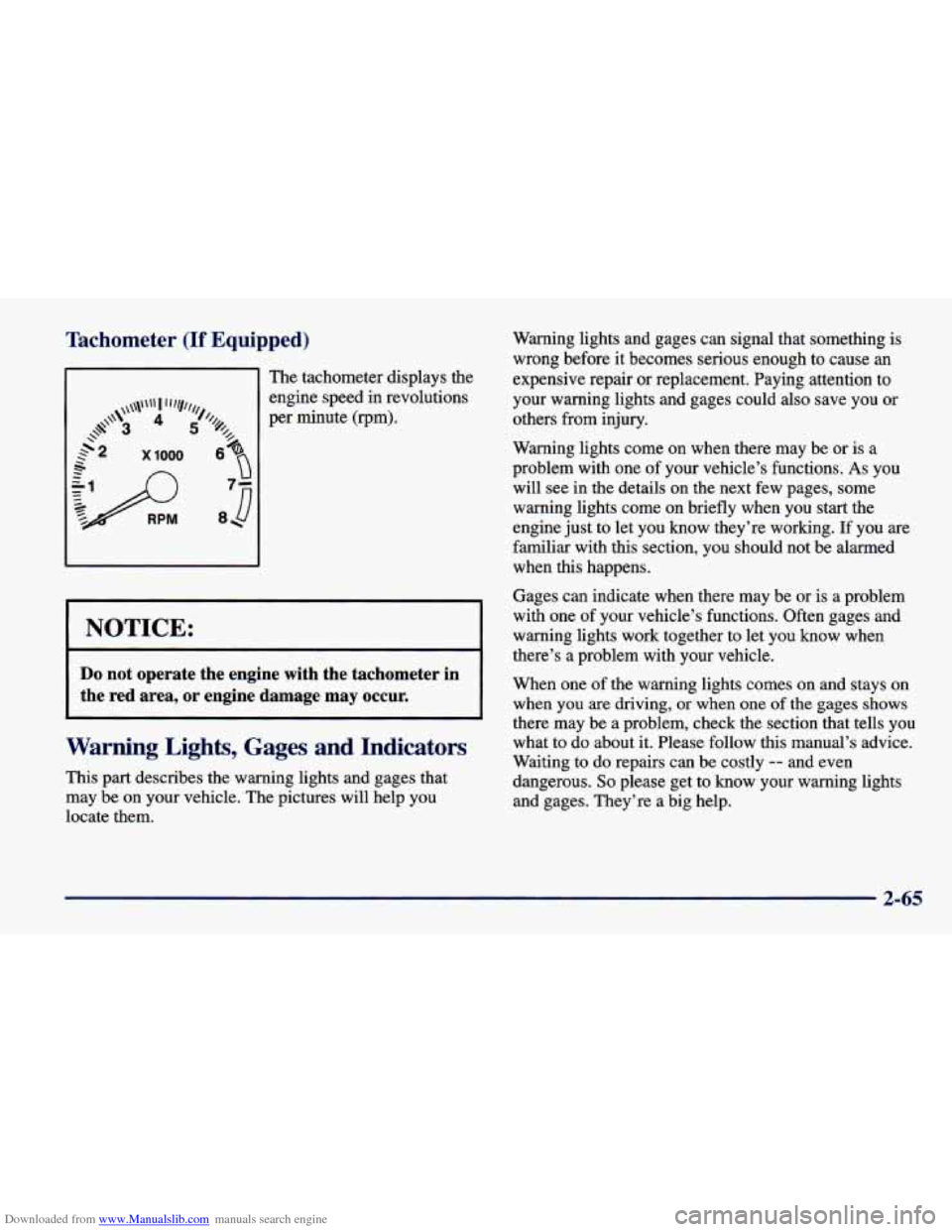
The tachometer displays the
engine speed
in revolutions
per minute (rpm).
I NOTICE:
Do not operate the engine with the tachometer in
the red area, or engine damage may occur.
Warning Lights, Gages and Indicators
This part describes the warning lights and gages that
may be on your vehicle. The pictures will help you
locate them. Warning lights and gages can signal that something
is
wrong before
it becomes serious enough to cause an
expensive repair or replacement. Paying attention
to
your warning lights and gages could also save you or
others from injury.
Warning lights come on when there may be or is a
problem with one of your vehicle’s functions.
As you
will see in the details on the next few pages, some
warning lights come on briefly when you start the
engine just
to let you know they’re working. If you are
familiar with this section, you should not be alarmed
when this happens.
Gages can indicate when there may be or is
a problem
with one of your vehicle’s functions. Often gages and
warning lights work together to let you know when
there’s a problem with your vehicle.
When one of the warning lights comes on and stays on
when you are driving, or when one
of the gages shows
there may be a problem, check the section that tells you
what to do about it. Please follow this manual’s advice.
Waiting to do repairs can be costly
-- and even
dangerous.
So please get to know your warning lights
and gages. They’re a big help.
2-65
Page 143 of 400
Downloaded from www.Manualslib.com manuals search engine Charging System Light
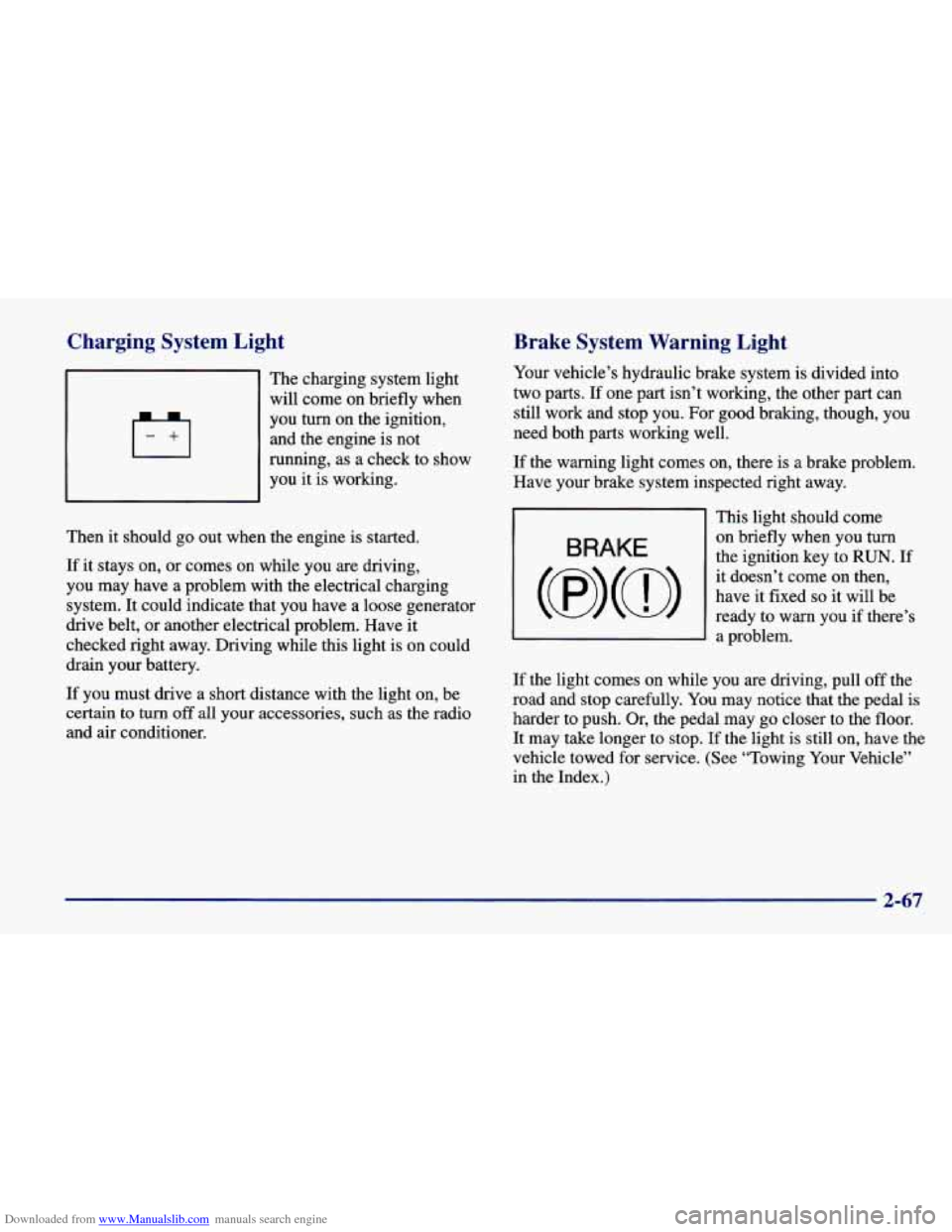
The charging system light
will come on briefly when
you turn on the ignition,
and the engine is not
running, as a check to show
you it is working.
Then
it should go out when the engine is started.
If it stays on, or comes on while you are driving,
you may have a problem with the electrical charging
system. It could indicate that you have a loose generator
drive belt, or another electrical problem. Have it
checked right away. Driving while this light is on could
drain your battery.
If you must drive a short distance with the light on, be
certain to turn
off all your accessories, such as the radio
and air conditioner.
Brake System Warning Light
Your vehicle’s hydraulic brake system is divided into
two parts.
If one part isn’t working, the other part can
still work and stop you. For good braking, though, you
need both parts working well.
If the warning light comes on, there is a brake problem.
Have your brake system inspected right away.
BRAKE
This light should come
on briefly when you
turn
the ignition key to RUN. If
it doesn’t come on then,
have it fixed
so it will be
ready to warn you if there’s
3 a problem.
If the light comes on while you are driving, pull off the
road and stop carefully. You may notice that the pedal
is
harder to push. Or, the pedal may go closer to the floor.
It may take longer to stop. If the light is still on, have the
vehicle towed for service. (See “Towing Your Vehicle”
in the Index.)
2-67
Page 144 of 400
Downloaded from www.Manualslib.com manuals search engine Your brake system may not be working properly
if the brake system warning light is on. Driving
with the brake system warning light
on can lead
to an accident. If the light is still on after you’ve
pulled
off the road and stopped carefully, have
the vehicle towed for service.
When the ignition is on, the brake system warning light
will also come on when you set your parking brake. The
light will stay on if your parking brake doesn’t release
fully. If it stays on after your parking brake is fully
released, it means you have
a brake problem.
Anti-Lock Brake System Warning Light
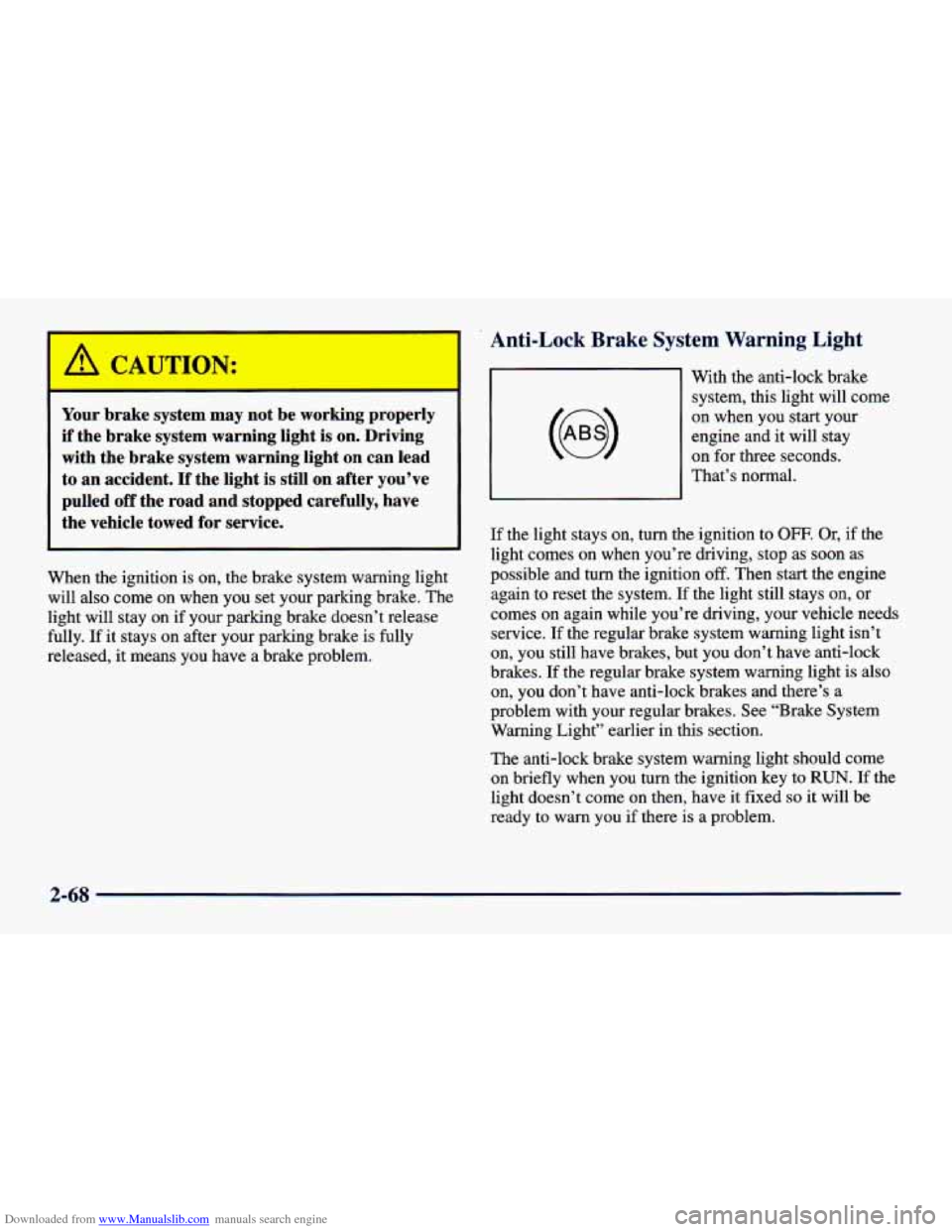
I With the anti-lock brake
system, this light will
come
on when you start your
engine and it will stay
on for three seconds.
That’s normal.
If the light stays
on, turn the ignition to OFF. Or, if the
light comes on when you’re driving, stop as
soon as
possible and
turn the ignition off. Then start the engine
again to reset the system. If the light still stays on, or
comes on again while you’re driving, your vehicle needs
service.
If the regular brake system warning light isn’t
on, you still have brakes, but you don’t have anti-lock
brakes. If the regular brake system warning light is also
on, you don’t have anti-lock brakes and there’s a
problem with your regular brakes. See “Brake System
Warning Light’’ earlier in this section.
The anti-lock brake system warning light should come
on briefly when you turn the ignition key to
RUN. If the
light doesn’t come on then, have it fixed
so it will be
ready to warn you if there is a problem.
2-68
Page 145 of 400
Downloaded from www.Manualslib.com manuals search engine Enhanced Traction System Warning Light
(If Equipped)
ETS
OFF
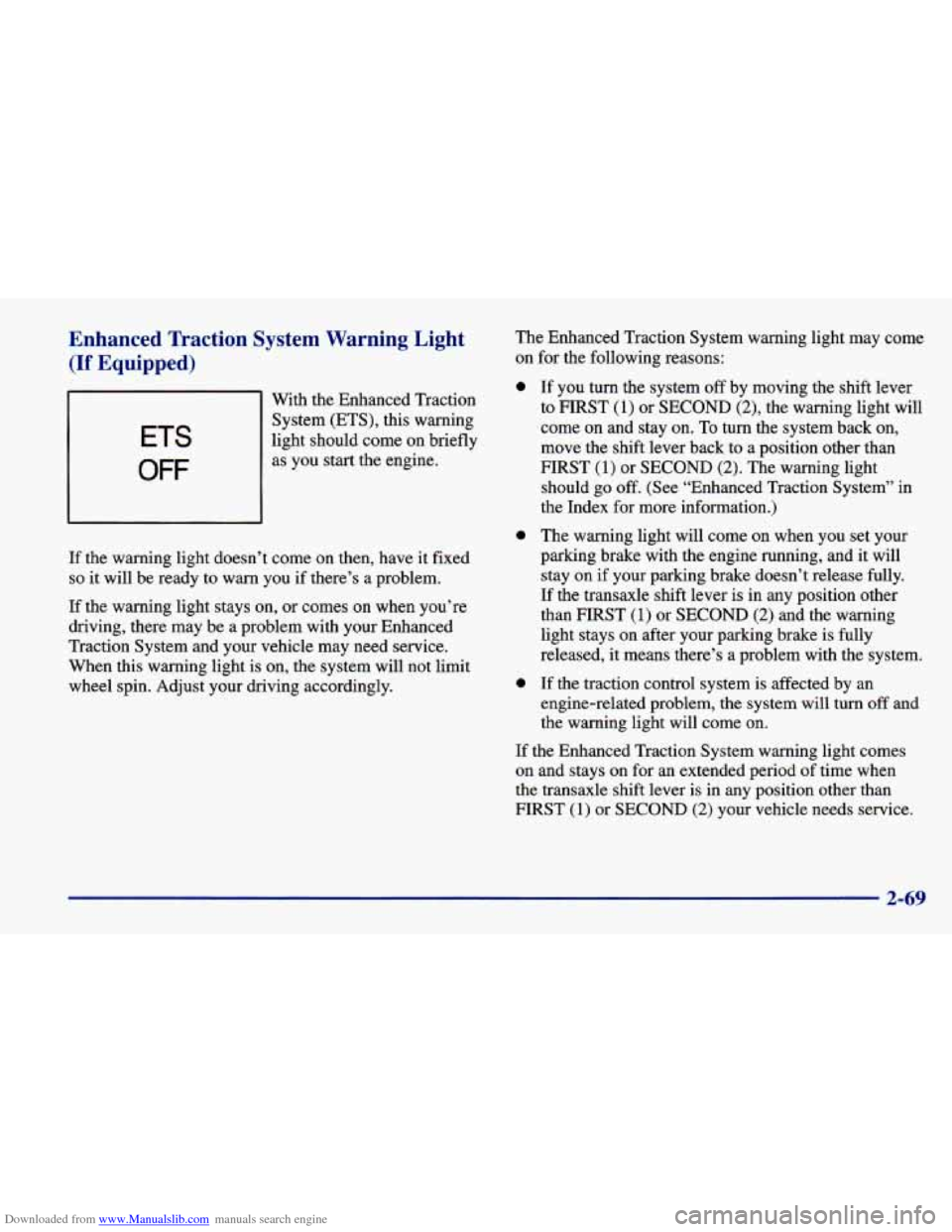
With the Enhanced Traction
System (ETS), this warning
light should come on briefly
as you start the engine.
If the warning light doesn’t come on then, have it fixed
so it will be ready to warn you if there’s a problem.
If the warning light stays on, or comes on when you’re
driving, there may be a problem with your Enhanced
Traction System and your vehicle may need service.
When this warning light is on, the system will not limit
wheel spin. Adjust your driving accordingly. The
Enhanced Traction System warning light may come
on for the following reasons:
0
a
0
If you turn the system off by moving the shift lever
to FIRST (1) or
SECOND (2), the warning light will
come on and stay on. To turn the system back on,
move the shift lever back to a position other than
FIRST
(1) or SECOND (2). The warning light
should
go off. (See “Enhanced Traction System” in
the Index for more information.)
The warning light will come on when you set your
parking brake with the engine running, and it will
stay
on if your parking brake doesn’t release fully.
If the transaxle shift lever is in any position other
than FIRST
(1) or SECOND (2) and the warning
light stays on after your parking brake is fully
released, it means there’s a problem with the system.
If the traction control system is affected by an
engine-related problem, the system will turn
off and
the warning light will come on.
If the Enhanced Traction System warning light comes
on and stays on for an extended period of time when
the transaxle shift lever is in any position other than
FIRST
(1) or SECOND (2) your vehicle needs service.
2-69
Page 147 of 400
Downloaded from www.Manualslib.com manuals search engine Low Coolant Warning Light
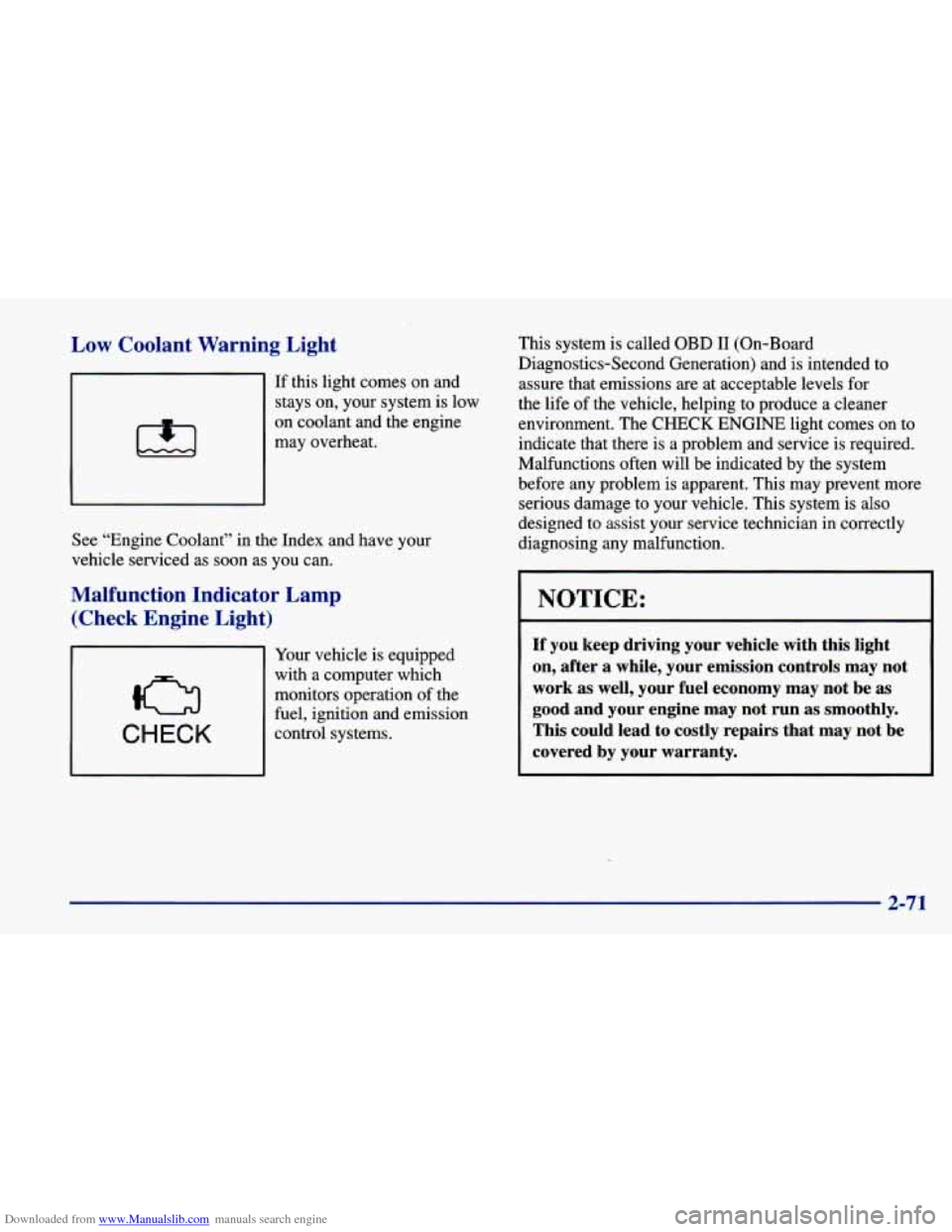
If this light comes on and
stays on, your system is low
on coolant and the engine
may overheat.
See “Engine Coolant” in the Index and have your
vehicle serviced as soon as you can.
Malfunction Indicator Lamp
(Check Engine Light)
CHECK
Your vehicle is equipped
with a computer which
monitors operation of the
fuel, ignition and emission
control systems. This system is called
OBD I1 (On-Board
Diagnostics-Second Generation) and is intended to assure that emissions are at acceptable levels for
the life
of the vehicle, helping to produce a cleaner
environment. The
CHECK ENGINE light comes on to
indicate that there is a problem and service is required.
Malfunctions often will be indicated by the system
before any problem is apparent. This may prevent more serious damage to your vehicle. This system is also
designed to assist your service technician in correctly
diagnosing any malfunction.
NOTICE:
If you keep driving your vehicle with this light
on, after a while, your emission controls may not
work as well, your fuel economy may not be as
good and your engine may not run
as smoothly.
This could lead to costly repairs that may not be
covered by your warranty.
2-71
Page 151 of 400
Downloaded from www.Manualslib.com manuals search engine Passlock Warning Light
THEFT
SYSTEM
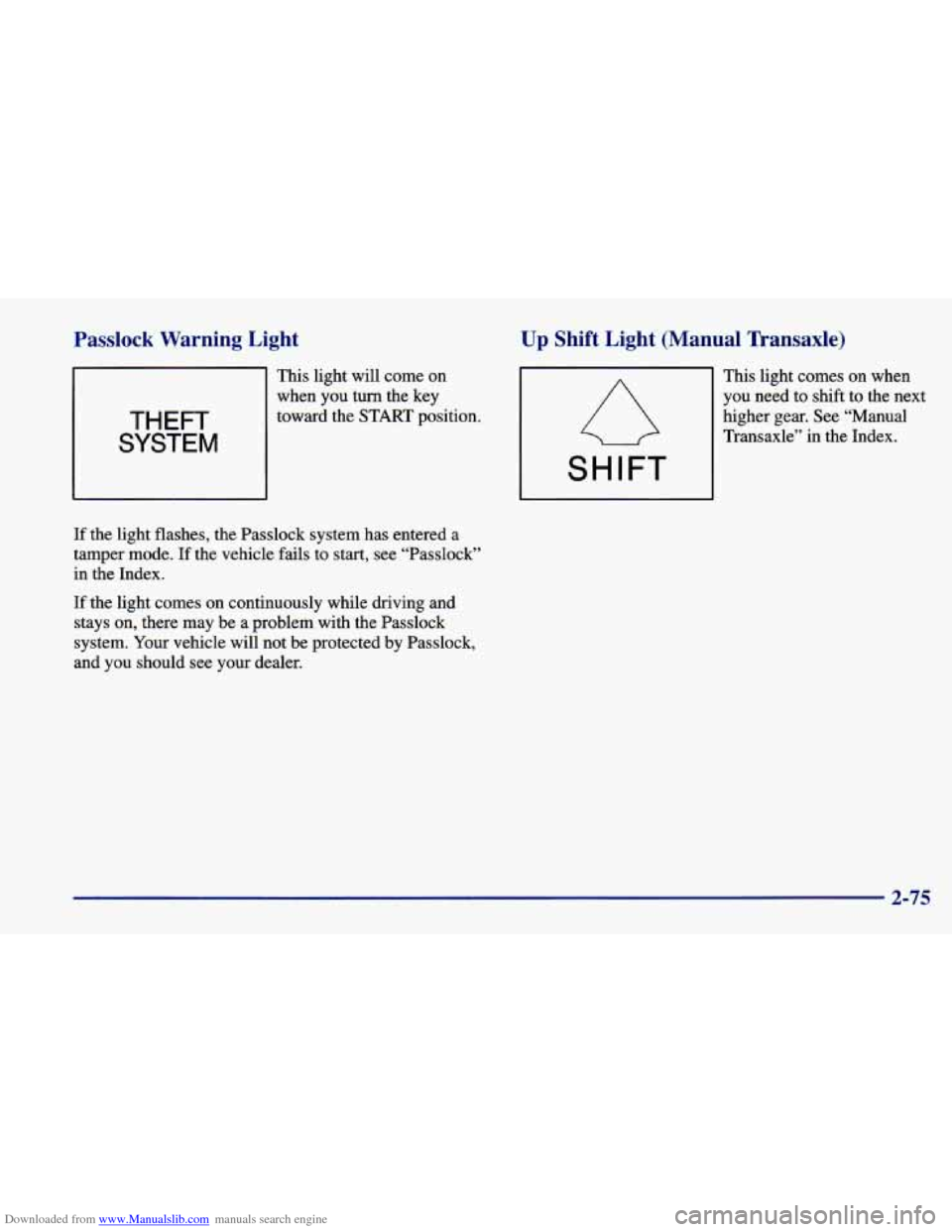
This light will come on
when you
turn the key
toward the
START position.
If the light flashes, the Passlock system has entered a
tamper mode. If the vehicle fails to start, see “Passlock”
in the Index.
If the light comes on continuously while driving and
stays on, there may be a problem with the Passlock
system. Your vehicle will not be protected by Passlock,
and you should see your dealer.
Up Shift Light (Manual Transaxle)
This light comes on when
you need to shift to the next
higher gear. See “Manual
Transaxle” in the Index.
SHIFT
2-75
Page 152 of 400
Downloaded from www.Manualslib.com manuals search engine Check Gages Light
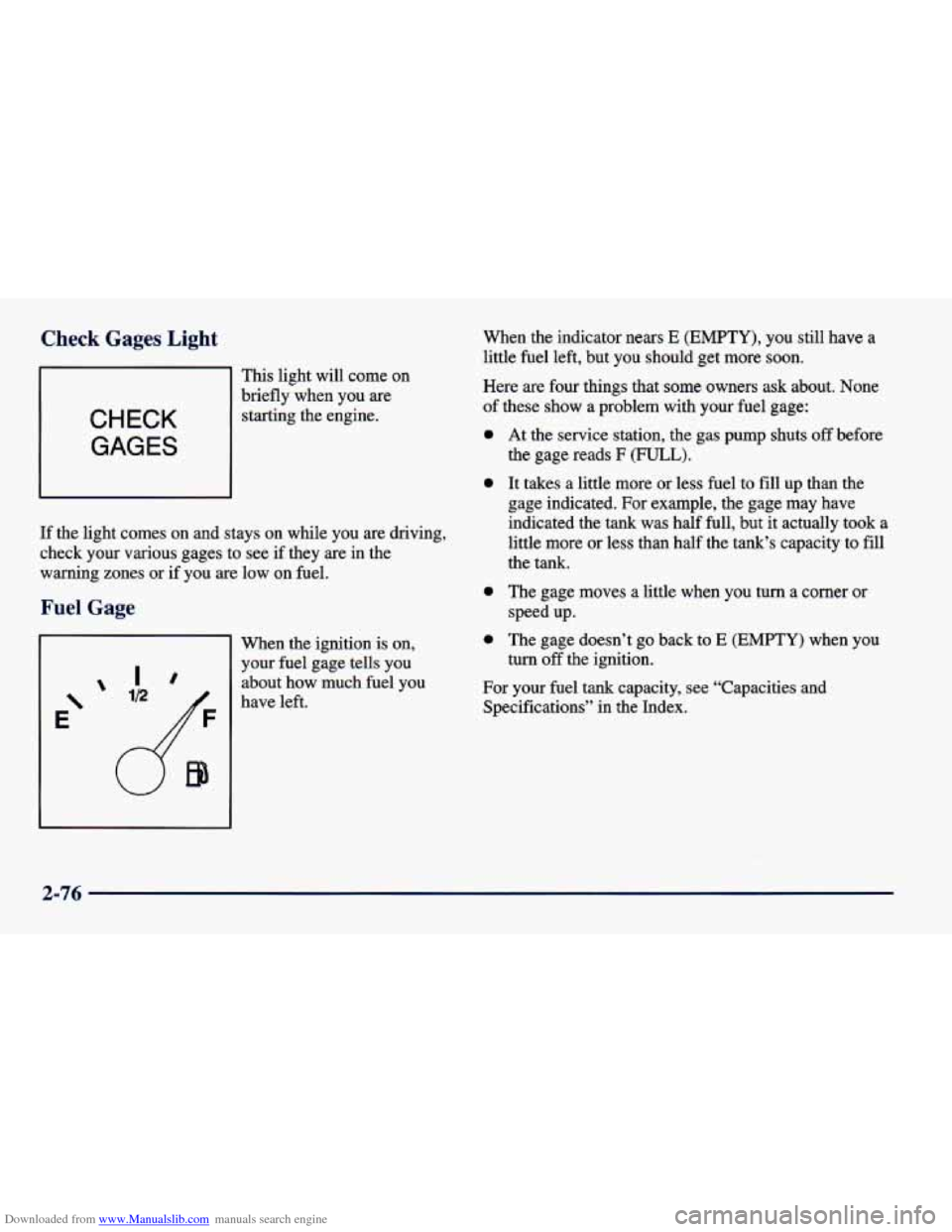
This light will come on
CHECK
GAGES
brieflywhen you are
starting the engine.
If the light comes on and stays on while you are driving,
check your various gages to see if they are in the
warning zones or if you
are low on fuel.
:age
Ir
E‘
’ ID
When the ignition is on,
your fuel gage tells you about how much fuel you
have left. When the indicator nears
E (EMPTY), you
still have a
little fuel left, but you should get more soon.
Here are four things that
some owners ask about. None
of these show a problem with your fuel gage:
0
0
0
0
At the service station, the gas pump shuts off before
the gage reads
F (FULL).
It takes a little more or less fuel to fill up than the
gage indicated.
For example, the gage may have
indicated the tank was half full, but it actually
took a
little more or less than half the tank’s capacity to
fill
the tank.
The gage moves a little when you turn a comer or
speed up.
The gage doesn’t go back to
E (EMPTY) when you
turn
off the ignition.
For your fuel tank capacity, see “Capacities and
Specifications” in the Index.
2-76
Page 187 of 400
Downloaded from www.Manualslib.com manuals search engine Anti-Lock Brakes (ABS)
Your vehicle has anti-lock brakes (ABS). ABS is an
advanced electronic braking system that will help
prevent
a braking skid.
wnen
you start your engine, or when you begin to drive
away, your anti-lock brake system will check itself. You
may hear a momentary motor
or clicking noise while
this test is going on, and you may even notice that your
brake pedal moves or pulses a little. This is normal.
If there’s a problem with the
anti-lock brake system, this
warning light will stay on.
See “Anti-Lock Brake
System Warning Light” in
the Index.
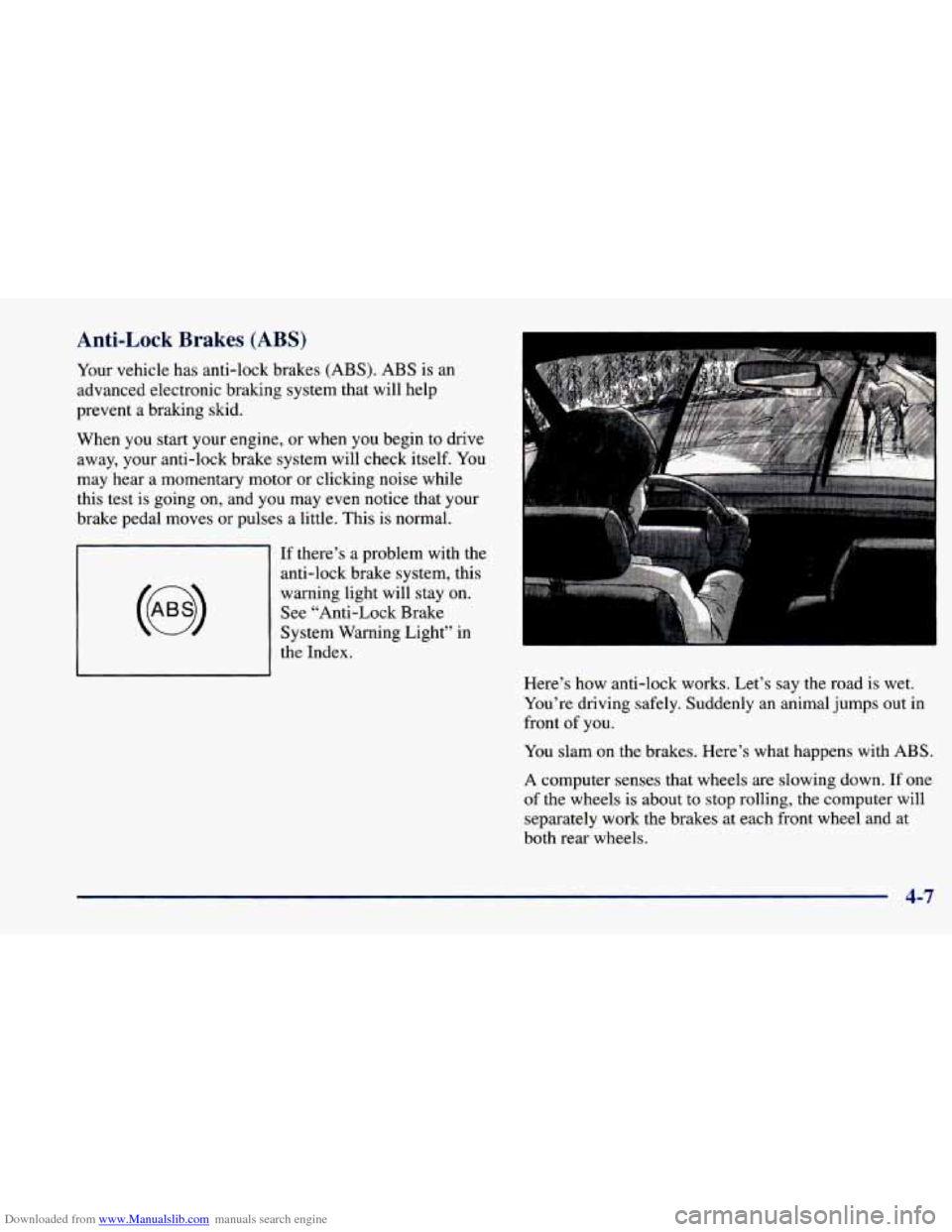
Here’s how anti-lock works. Let’s say the road is wet.
You’re driving safely. Suddenly an animal jumps out in
front
of you.
You slam on the brakes. Here’s what happens with ABS.
A computer senses that wheels are slowing down. If one
of the wheels is about to stop rolling, the computer will
separately work the brakes at each front wheel and at
both rear wheels.
4-7
Page 189 of 400
Downloaded from www.Manualslib.com manuals search engine LOW
TRAC
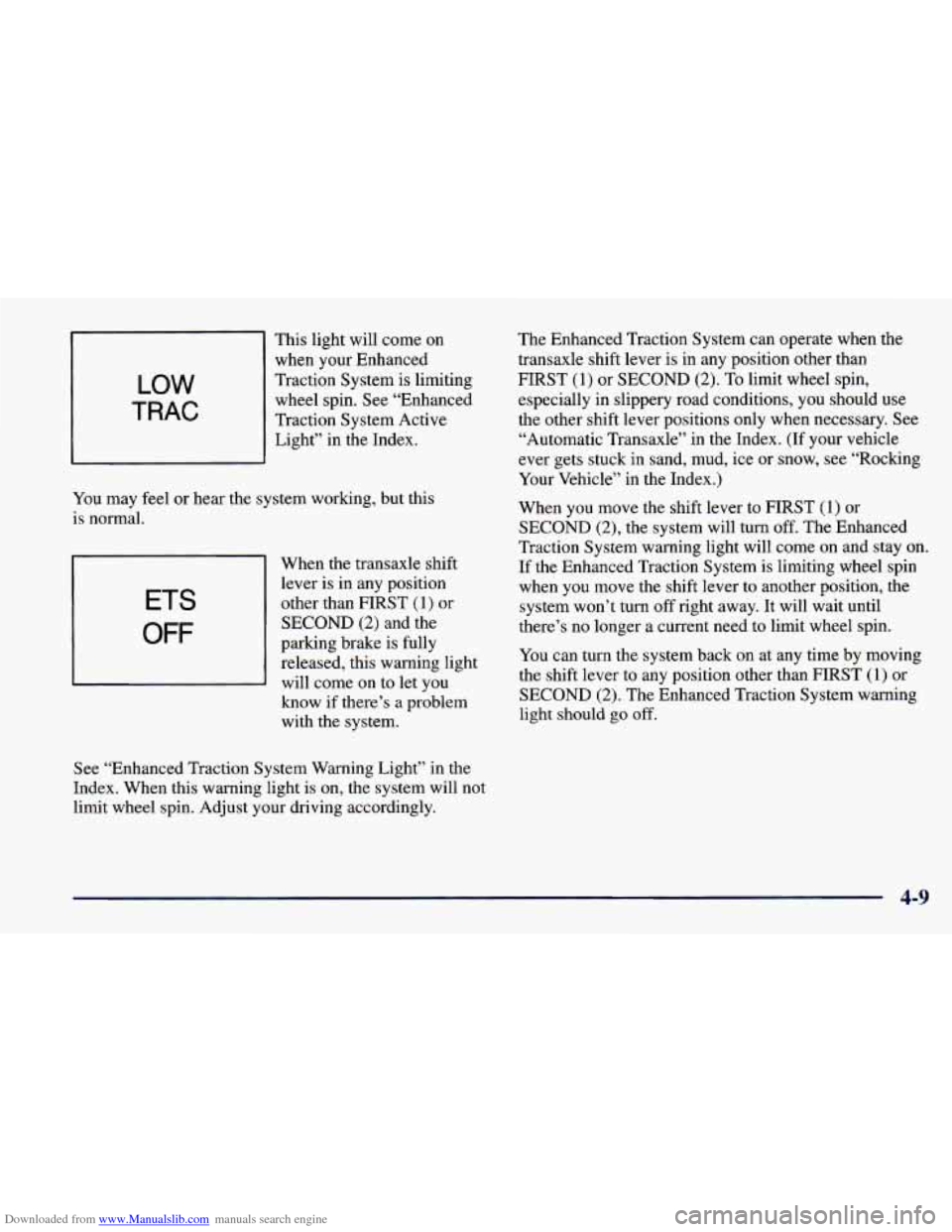
This light will come on when your Enhanced
Traction System is limiting
wheel spin. See “Enhanced
Traction System Active Light” in the Index.
You may feel or hear the system working, but this
is normal.
7- 1 When the transaxle shift
I
lever is in any position
ETS other than FIRST (1) or
OFF
SECOND (2) and the
parking brake is fully
released, this warning light will come on to let you
know if there’s a problem
with the system.
See “Enhanced Traction System Warning Light” in the
Index. When this warning light is on, the system will not
limit wheel spin. Adjust your driving accordingly. The
Enhanced Traction System can operate when the
transaxle shift lever is in any position other than
FIRST (1) or SECOND
(2). To limit wheel spin,
especially in slippery road conditions, you should use
the other shift lever positions only when necessary. See
“Automatic Transaxle” in the Index.
(If your vehicle
ever gets stuck in sand, mud, ice or snow, see “Rocking
Your Vehicle” in the Index.)
When you move the shift lever to FIRST
(1) or
SECOND
(2), the system will turn off. The Enhanced
Traction System warning light will come
on and stay on.
If the Enhanced Traction System is limiting wheel spin
when you move the shift lever to another position, the system won’t turn
off right away. It will wait until
there’s no longer a current need to limit wheel spin.
You can turn the system back on at any time by moving
the shift lever to any position other than FIRST
(1) or
SECOND (2). The Enhanced Traction System warning
light should go off.
4-9
Page 194 of 400
Downloaded from www.Manualslib.com manuals search engine Loss of Control
Let’s review what driving experts say about what
happens when the three control systems (brakes, steering
and acceleration) don’t have enough friction where the
tires meet the road to do what the driver has asked.
In any emergency, don’t give up. Keep trying to
steer and constantly seek an escape route or area of
less danger.
Skidding
In a skid, a driver can lose control of the vehicle.
Defensive drivers avoid most skids by taking reasonable
care suited to existing conditions, and by not “overdriving”
those conditions. But skids
are always possible.
The three types of skids correspond to your vehicle’s
three control systems. In the braking skid, your wheels
aren’t rolling. In the steering or cornering skid, too
much speed or steering in a curve causes tires to slip and
lose cornering force. And in the acceleration skid, too
much throttle causes the driving wheels to spin,
A cornering skid is best handled by easing your foot off
the accelerator pedal.
If you have the Enhanced Traction System, remember:
It
helps avoid only the acceleration skid.
If you do not have the Enhanced Traction System, or if
the transaxle shift lever is not in the OVERDRIVE (0)
position, then an acceleration skid is also best handled
by easing your foot off the accelerator pedal.
If your vehicle starts to slide, ease your foot off the
accelerator pedal and quickly steer the way you want the
vehicle to go.
If you start steering quickly enough, your
vehicle may straighten out. Always be ready
for a
second skid if it occurs.
Of course, traction is reduced when water, snow, ice,
gravel or other material is on the road. For safety, you’ll
want to slow down and adjust your driving to these
conditions. It is important to slow down on slippery
surfaces because stopping distance will be longer and
vehicle control more limited.
While driving on a surface with reduced traction, try
your best to avoid sudden steering, acceleration or
braking (including engine braking by shifting to a lower
gear). Any sudden changes could cause the tires to
slide. You may not realize the surface is slippery until
your vehicle is skidding. Learn
to recognize warning
clues
-- such as enough water, ice or packed snow on
the road
to make a “mirrored surface” -- and slow down
when you have any doubt.
Remember: Any anti-lock brake system (ABS) helps
avoid only the braking
skid.
4-14