warning CHEVROLET CAVALIER 1998 3.G Owner's Manual
[x] Cancel search | Manufacturer: CHEVROLET, Model Year: 1998, Model line: CAVALIER, Model: CHEVROLET CAVALIER 1998 3.GPages: 400, PDF Size: 20.74 MB
Page 199 of 400
Downloaded from www.Manualslib.com manuals search engine City Driving
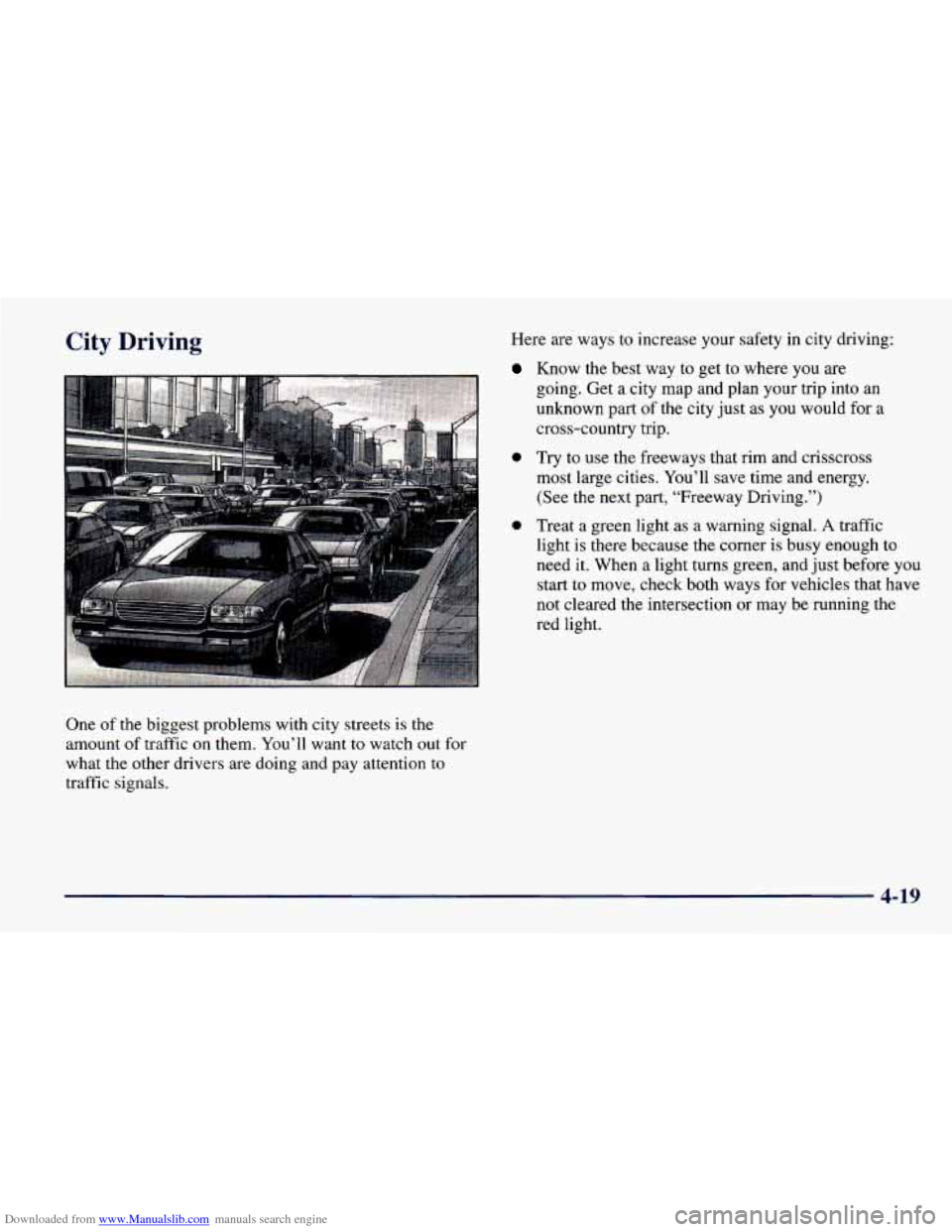
One of the biggest problems with city streets is the
amount of traffic on them. You’ll want
to watch out for
what the other drivers are doing and pay attention to
traffic signals. Here are ways
to increase your safety in city driving:
Know the best way to get to where you are
going. Get a city
map and plan your trip into an
unknown part
of the city just as you would for a
cross-country trip.
0 Try to use the freeways that rim and crisscross
most large cities. You’ll save time and energy.
(See the next part, “Freeway Driving.”)
0 Treat a green light as a warning signal. A traffic
light is there because the corner is busy enough to
need it. When a light turns green, and just before you
start to move, check both ways for vehicles that have
not cleared the intersection or may be running the
red light.
4-19
Page 204 of 400
Downloaded from www.Manualslib.com manuals search engine Winter Driving
Here are some tips for winter driving:
0 Have your vehicle in good shape for winter.
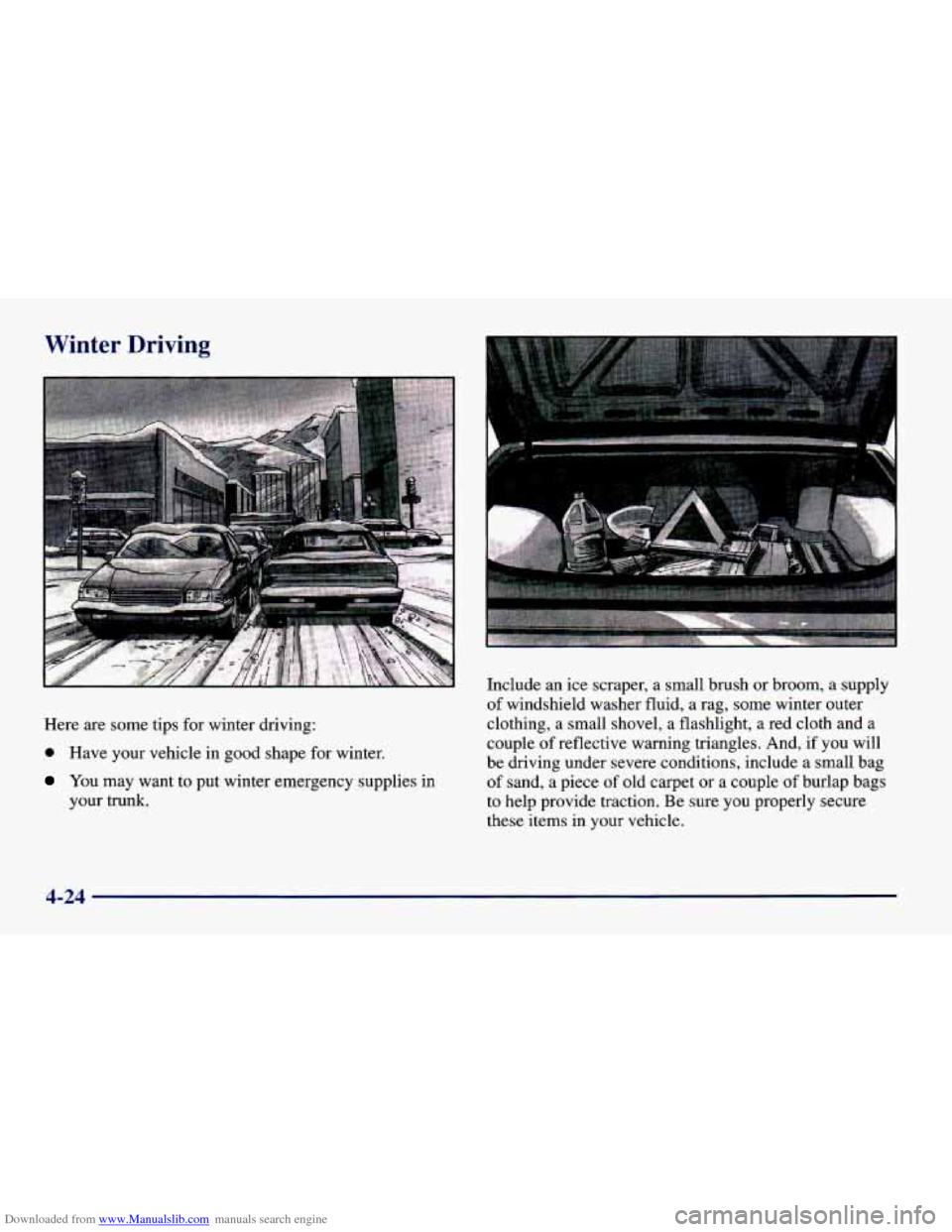
You may want to put winter emergency supplies in
your
trunk.
Include an ice scraper, a small brush or broom, a supply
of windshield washer fluid, a rag, some winter outer
clothing, a small shovel, a flashlight, a red cloth and a
couple of reflective warning triangles. And, if you will
be driving under severe conditions, include
a small bag
of sand, a piece of old carpet or a couple of burlap bags
to help provide traction. Be sure you properly secure
these items in your vehicle.
4-24
Page 223 of 400
Downloaded from www.Manualslib.com manuals search engine 0 Section 5 Problems on the Road
Here you’ll find what to do about some problems that can occur on the road.
5-2
5-3
5-3
5-8
5-14
Hazard Warning Flashers
Other Warning Devices
Jump Starting
Towing Your Vehicle
Engine Overheating
5- 16
5-23
5-23
5-33
5-34
Cooling System
If a Tire Goes Flat
Changing a
Flat Tire
Compact Spare Tire
If You’re Stuck: In Sand, Mud,
Ice or Snow
5-1
Page 224 of 400
Downloaded from www.Manualslib.com manuals search engine Hazard Warning Flashers
L
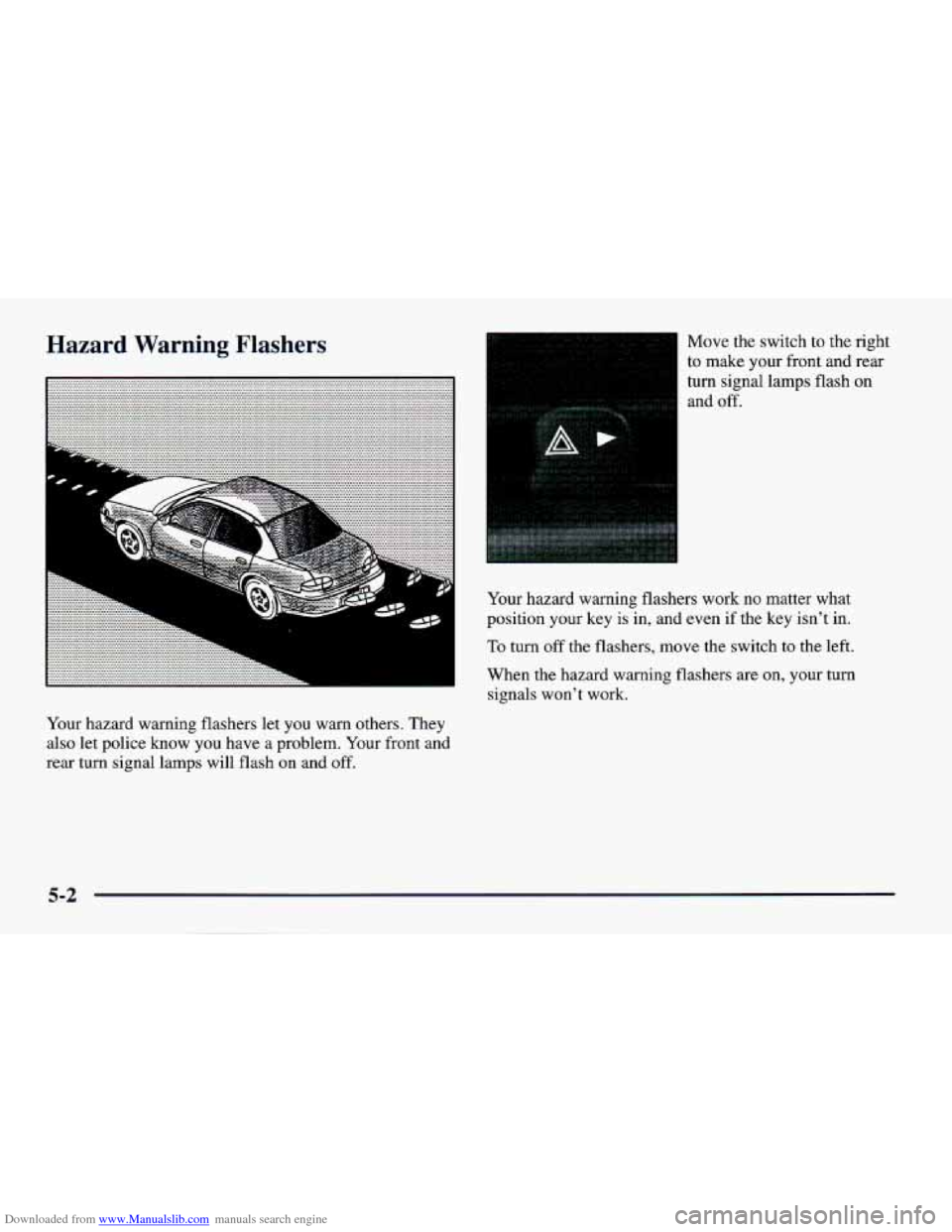
Your hazard warning flashers let you warn others. They
also let police know you have
a problem. Your front and
rear
turn signal lamps will flash on and off.
Move the switch to the right
to make your front and rear
turn signal lamps flash
on
and off.
Your hazard warning flashers work no matter what
position your key
is in, and even if the key isn’t in.
To turn off the flashers, move the switch to the left.
When the hazard warning flashers are
on, your turn
signals won’t work.
5-2
Page 225 of 400
Downloaded from www.Manualslib.com manuals search engine Other Warning Devices
If you carry reflective triangles, you can set one up at
the side
of the road about 300 feet (100 m) behind
your vehicle.
Jump Starting
If your battery has run down, you may want to use
another vehicle and some jumper cables to start your
vehicle. But please follow the steps below
to do
it safely.
NOTICE:
Ignoring these steps could result in costly damage
to
your vehicle that wouldn’t be covered by
your warranty.
Trying to start your vehicle by pushing or puang
it won’t work, and it could damage your vehicle.
1. Check the other vehicle. It must have a 12-volt
battery with a negative ground system.
Batteries can hurt you. They can be
dangerous because:
They contain acid that can burn you.
They contain gas that can explode or ignite.
They contain enough electricity to
If you don’t follow these steps exactly, some
or all
of these things can hurt you.
burn
you.
I NOTICE: I
If the other system isn’t a 12-volt system with a
negative ground, both vehicles can be damaged.
I
5-3
Page 230 of 400
Downloaded from www.Manualslib.com manuals search engine Towing Your Vehicle
Try to have a Chevrolet dealer or a professional towing
service tow your vehicle. They can provide the right
equipment and know how to tow your vehicle without
damage. (See “Roadside Assistance” in the Index.)
If your vehicle has been changed or modified since it
was factory-new by adding aftermarket items like fog
lamps, aero skirting, or special tires and wheels, these
instructions and illustrations may not be correct.
Before you do anything, turn
on the hazard
warning flashers.
When you call, tell the towing service:
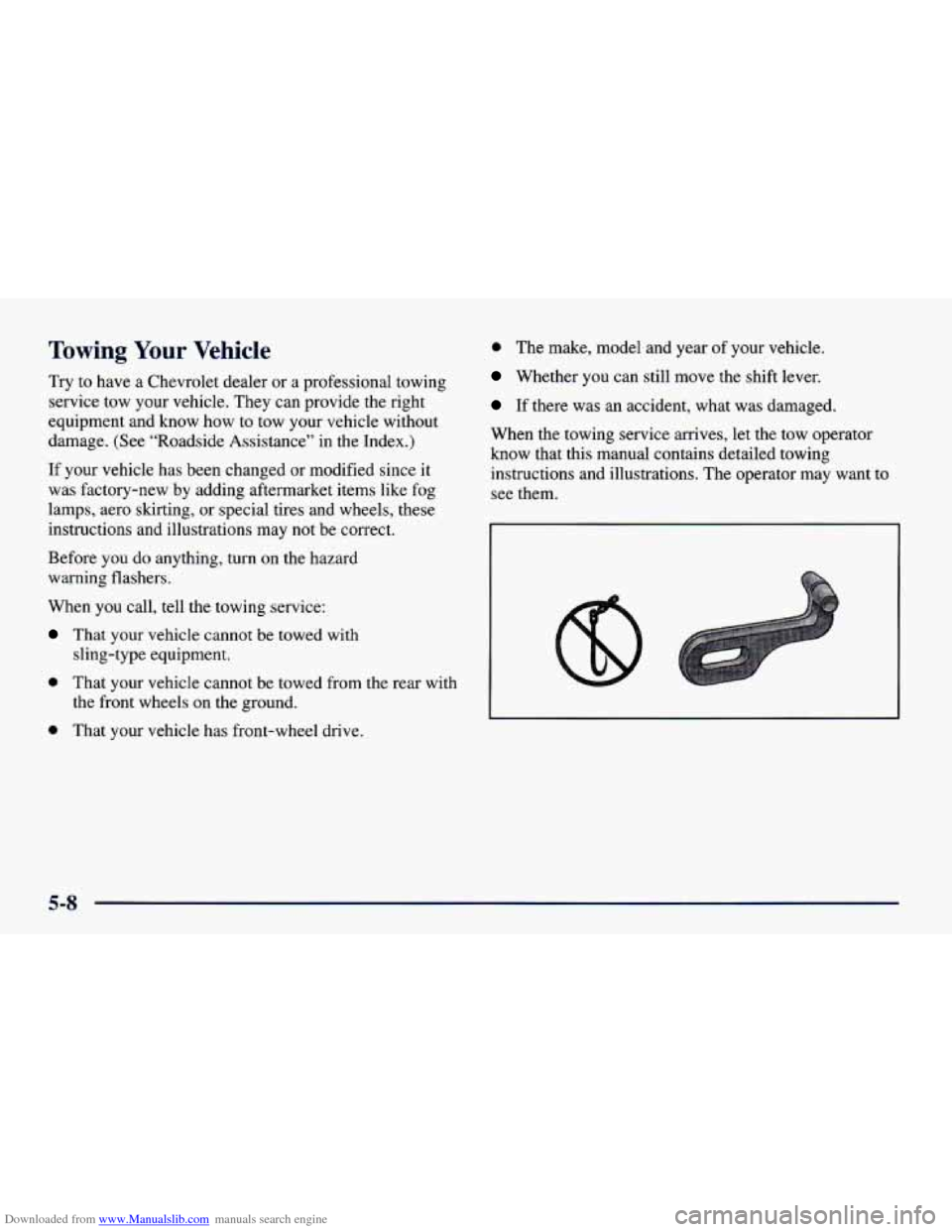
That your vehicle cannot be towed with
sling-type equipment.
0 The make, model and year of your vehicle.
Whether you can still move the shift lever.
If there was an accident, what was damaged.
When the towing service arrives, let the tow operator
know that this manual contains detailed towing
instructions and illustrations. The operator may want to
see them.
I I
0 That your vehicle cannot be towed from the rear with
the front wheels on the ground.
0 That your vehicle has front-wheel drive.
5-8
Page 236 of 400
Downloaded from www.Manualslib.com manuals search engine Engine Overheating
You will find a coolant temperature gage and a low
coolant warning light on your vehicle’s instrument
panel. See “Engine Coolant Temperature Gage” and
“Low Coolant Warning Light’’ in the Index.
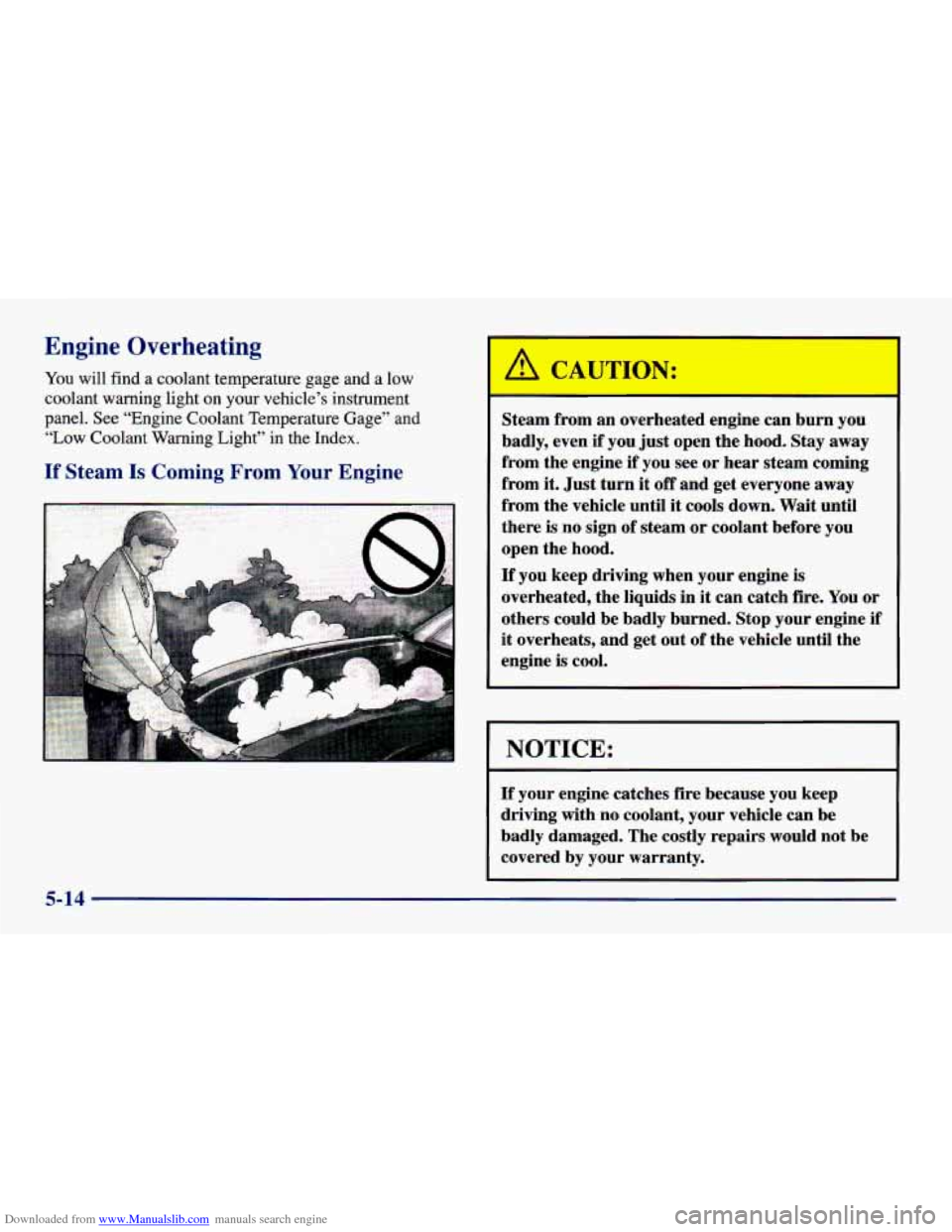
If Steam Is Coming From Your Engine
Steam from an overheated engine can burn you
badly, even if you just open the hood. Stay
away
from the engine if you see or hear steam coming
from it. Just turn it
off and get everyone away
from the vehicle until it cools down. Wait until
there is no sign
of steam or coolant before you
open the hood,
If you keep driving when your engine is
overheated, the liquids in
it can catch fire. You or
others could be badly burned. Stop your engine
if
it overheats, and get out of the vehicle until the
engine is cool.
NOTICE:
If your engine catches fire because you keep
driving with
no coolant, your vehicle can be
badly damaged, The costly repairs would not be
covered by your warranty.
5-14
Page 237 of 400
Downloaded from www.Manualslib.com manuals search engine If No Steam Is Coming From Your Engine
If you get the overheat warning but see or hear no
steam, the problem may not be too serious. Sometimes
the engine can get a little too hot when you:
Climb a long hill on a hot day.
0 Stop after high-speed driving.
0 Idle for long periods in traffic.
0 Tow a trailer.
If you get the overheat warning with no sign of steam,
try this for a minute or
so:
1. If you have an air conditioner, turn it off.
2. Turn on your heater to full hot at the highest fan
speed and open the window as necessary.
3. If you’re in a traffic jam, shift to NEUTRAL (N);
otherwise,
shift to the highest gear while
driving
-- AUTOMATIC OVERDRIVE (D) for
four-speed automatic or DRIVE
(D) for three-speed
automatic transaxles. If you no longer have the overheat warning, you can
drive. Just to be safe, drive slower for about
10 minutes.
If the warning doesn’t come back on, you can drive normally.
If the warning continues, pull over, stop, and park your
vehicle right away.
If there’s still no sign of steam, you can idle the engine
for two or three minutes while you’re parked,
to see if
the warning stops. But then,
if you still have the
warning,
turn oflthe engine and get everyone out of the
vehicle
until it cools down.
You may decide not to lift the hood but to get service
help right away.
5-15
Page 241 of 400
Downloaded from www.Manualslib.com manuals search engine 1
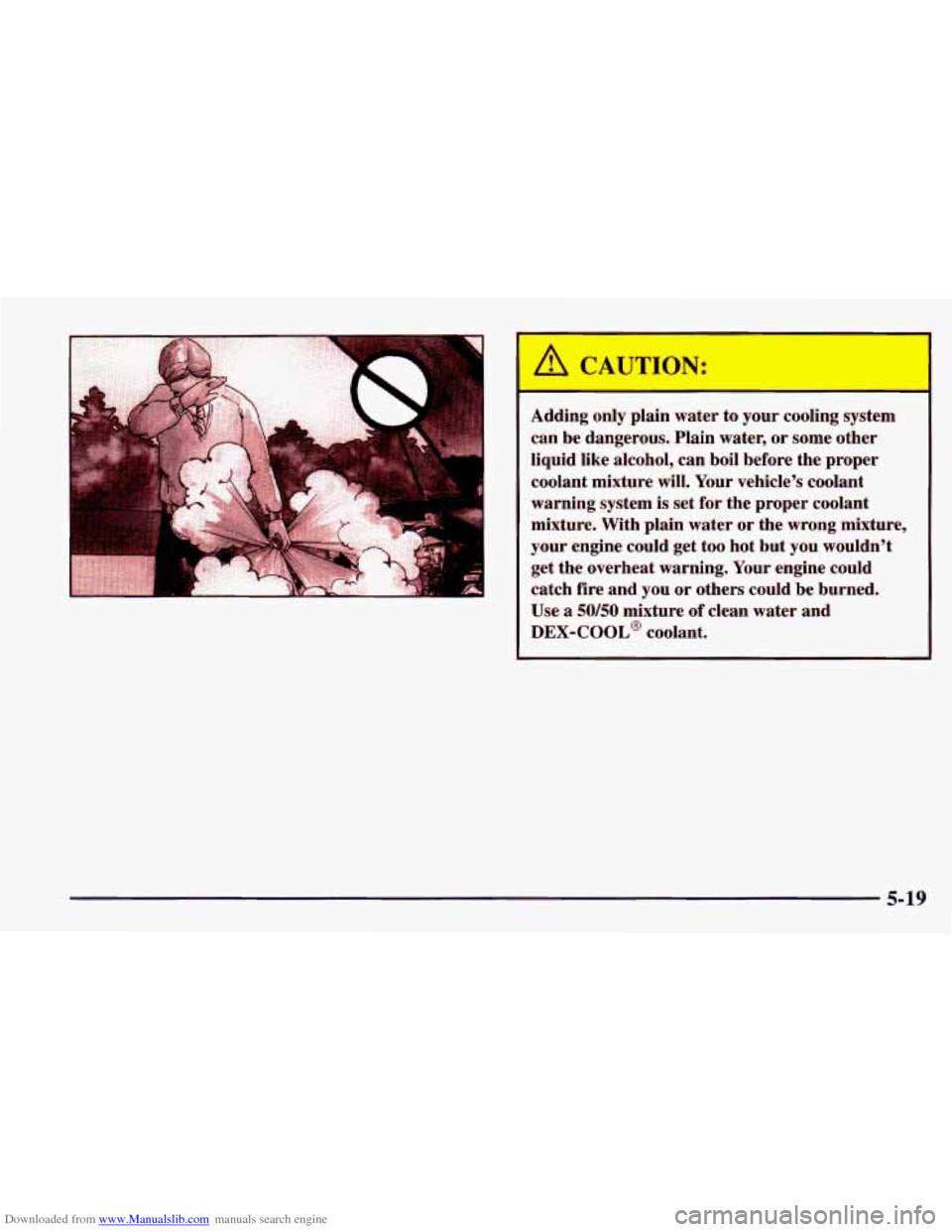
Adding only plain wirccr to your cooling system
can be dangerous. Plain water, or some other
liquid like alcohol, can boil before the proper
coolant mixture will. Your vehicle's coolant
warning system
is set for the proper coolant
mixture. With plain water or the wrong mixture,
your engine could get too hot but you wouldn't
get the overheat warning. Your engine could
catch fire and you or others could be burned.
Use
a 50/50 mixture of clean water and
DEX-COOL@ coolant.
5-19
Page 274 of 400
Downloaded from www.Manualslib.com manuals search engine Engine Oil Additives
Don’t add anything to your oil. Your dealer is ready to
advise
if you think something should be added.
When to Change Engine Oil
If any one of these is true for you, use the short tripkity
maintenance schedule:
e
e
0
0
e
Most trips are less than 5 to 10 miles (8 to 16 km).
This
is particularly important when outside
temperatures are below freezing.
Most trips include extensive idling (such as frequent
driving in stop-and-go traffic).
Most trips
are through dusty areas.
You frequently tow a trailer
or use a carrier on top of
your vehicle.
The vehicle is used for delivery service, police, taxi
or other commercial application.
Driving under these conditions causes engine oil
to
break down sooner. If any one of these is true for your
vehicle, then you need
to change your oil and filter
every
3,000 miles (5 000 km) or 3 months -- whichever
occurs first.
If none of them is true, use the long triphighway
maintenance schedule. Change the oil and filter every
7,500 miles (12 500 km) or 12 months -- whichever
occurs first. Driving a vehicle with a fully warmed
engine under highway conditions causes engine oil to
break down slower.
Wh .~: 1 I Do with Used Oil
Did you know that used engine oil contains certain
elements that may be unhealthy for your skin and could
even cause cancer? Don’t let used
oil stay on your skin
for very long. Clean your
skin and nails with soap and
water, or a good hand cleaner. Wash
or properly throw
away clothing
or rags containing used engine oil. (See
the manufacturer’s warnings about the use and disposal
of oil products.)
Used oil can be a real threat to the environment. If you
change your own oil, be sure
to drain all free-flowing oil
from the filter before disposal. Don’t ever dispose of
oil
by putting it in the trash, pouring it on the ground, into
sewers, or into streams or bodies of water. Instead,
recycle it by taking
it to a place that collects used oil. If
you have a problem properly disposing of your used oil,
ask your dealer, a service station or a local recycling
center for help.
6-16