seats CHEVROLET CAVALIER 2003 3.G User Guide
[x] Cancel search | Manufacturer: CHEVROLET, Model Year: 2003, Model line: CAVALIER, Model: CHEVROLET CAVALIER 2003 3.GPages: 364, PDF Size: 2.44 MB
Page 43 of 364
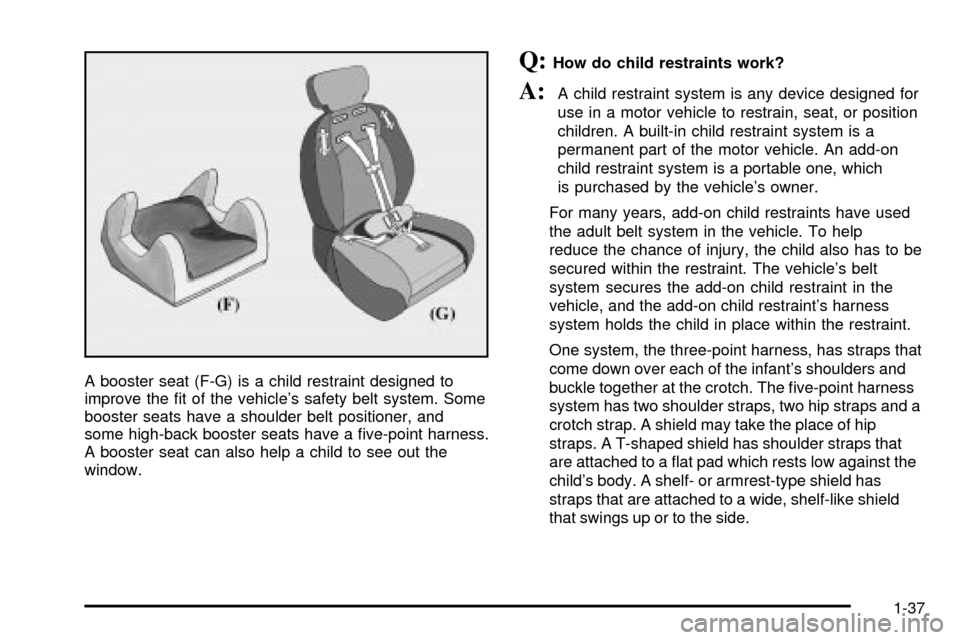
A booster seat (F-G) is a child restraint designed to
improve the ®t of the vehicle's safety belt system. Some
booster seats have a shoulder belt positioner, and
some high-back booster seats have a ®ve-point harness.
A booster seat can also help a child to see out the
window.
Q:How do child restraints work?
A:A child restraint system is any device designed for
use in a motor vehicle to restrain, seat, or position
children. A built-in child restraint system is a
permanent part of the motor vehicle. An add-on
child restraint system is a portable one, which
is purchased by the vehicle's owner.
For many years, add-on child restraints have used
the adult belt system in the vehicle. To help
reduce the chance of injury, the child also has to be
secured within the restraint. The vehicle's belt
system secures the add-on child restraint in the
vehicle, and the add-on child restraint's harness
system holds the child in place within the restraint.
One system, the three-point harness, has straps that
come down over each of the infant's shoulders and
buckle together at the crotch. The ®ve-point harness
system has two shoulder straps, two hip straps and a
crotch strap. A shield may take the place of hip
straps. A T-shaped shield has shoulder straps that
are attached to a ¯at pad which rests low against the
child's body. A shelf- or armrest-type shield has
straps that are attached to a wide, shelf-like shield
that swings up or to the side.
1-37
Page 52 of 364
Securing a Child Restraint in the
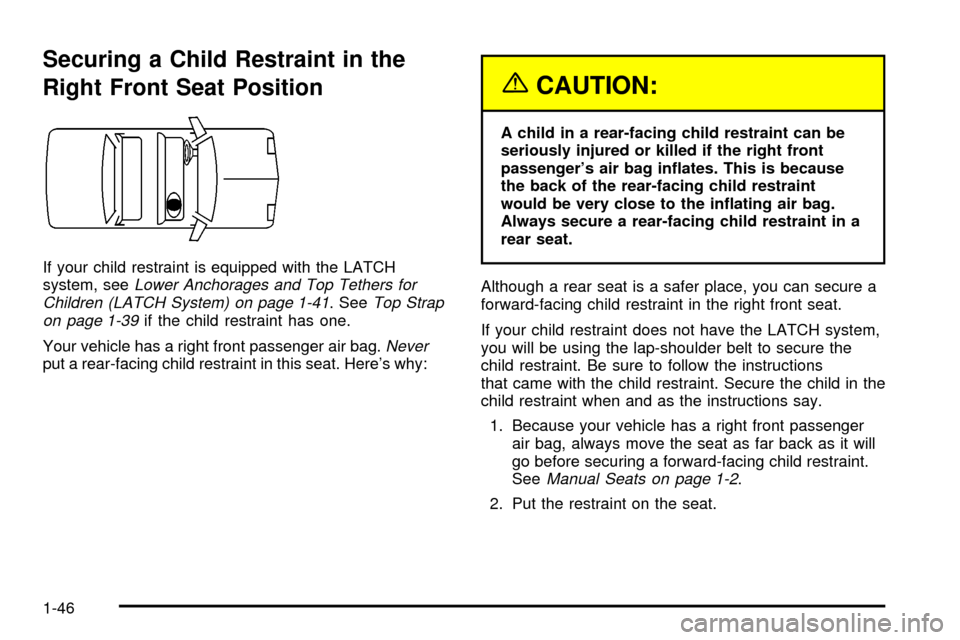
Right Front Seat Position
If your child restraint is equipped with the LATCH
system, seeLower Anchorages and Top Tethers for
Children (LATCH System) on page 1-41. SeeTop Strap
on page 1-39if the child restraint has one.
Your vehicle has a right front passenger air bag.
Neverput a rear-facing child restraint in this seat. Here's why:
{CAUTION:
A child in a rear-facing child restraint can be
seriously injured or killed if the right front
passenger's air bag in¯ates. This is because
the back of the rear-facing child restraint
would be very close to the in¯ating air bag.
Always secure a rear-facing child restraint in a
rear seat.
Although a rear seat is a safer place, you can secure a
forward-facing child restraint in the right front seat.
If your child restraint does not have the LATCH system,
you will be using the lap-shoulder belt to secure the
child restraint. Be sure to follow the instructions
that came with the child restraint. Secure the child in the
child restraint when and as the instructions say.
1. Because your vehicle has a right front passenger
air bag, always move the seat as far back as it will
go before securing a forward-facing child restraint.
See
Manual Seats on page 1-2.
2. Put the restraint on the seat.
1-46
Page 88 of 364
How long should you keep the coolant heater plugged
in? The answer depends on the outside temperature, the
kind of oil you have, and some other things. Instead
of trying to list everything here, we ask that you contact
your dealer in the area where you'll be parking your
vehicle. The dealer can give you the best advice for that
particular area.
Automatic Transaxle Operation
If your vehicle is equipped with an automatic transaxle,
the shift lever is located on the console between the
seats.
There are seven different positions for the automatic
transaxle. See ªForward Gearsº later in this section.
PARK (P):This position locks your front wheels. It's the
best position to use when you start your engine
because your vehicle can't move easily.
{CAUTION:
It is dangerous to get out of your vehicle if the
shift lever is not fully in PARK (P) with the
parking brake ®rmly set. Your vehicle can roll.
Don't leave your vehicle when the engine is
running unless you have to. If you have left the
engine running, the vehicle can move
suddenly. You or others could be injured. To
be sure your vehicle won't move, even when
you're on fairly level ground, always set your
parking brake and move the shift lever to
PARK (P). See ªShifting Into Park (P)º in the
Index. If you're pulling a trailer, see ªTowing a
Trailerº in the Index.
2-22
Page 92 of 364
Shift Speeds
{CAUTION:
If you skip a gear when you downshift, you
could lose control of your vehicle. You could
injure yourself or others. Don't shift down
more than one gear at a time when you
downshift.
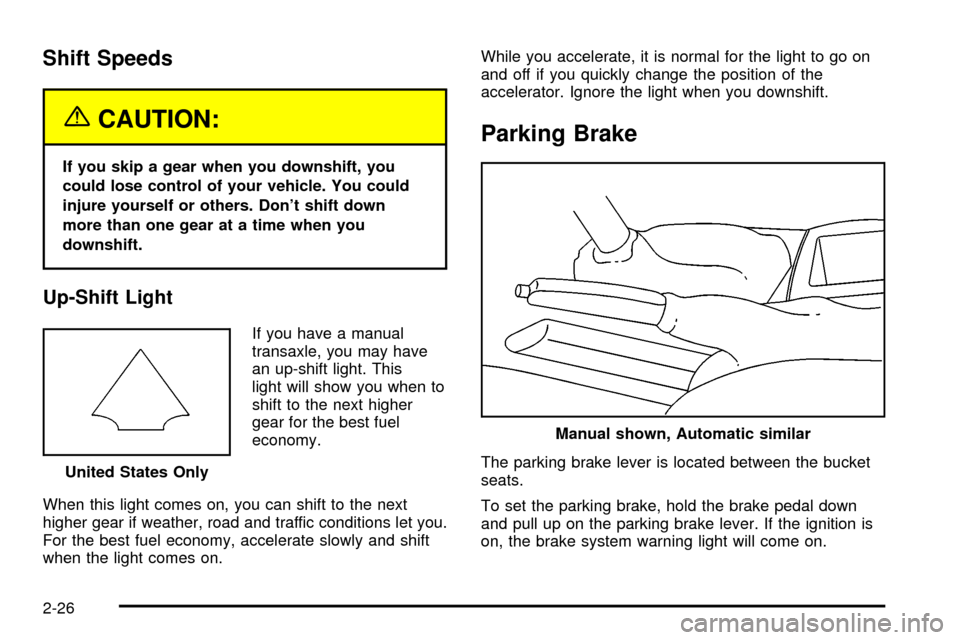
Up-Shift Light
If you have a manual
transaxle, you may have
an up-shift light. This
light will show you when to
shift to the next higher
gear for the best fuel
economy.
When this light comes on, you can shift to the next
higher gear if weather, road and traffic conditions let you.
For the best fuel economy, accelerate slowly and shift
when the light comes on.While you accelerate, it is normal for the light to go on
and off if you quickly change the position of the
accelerator. Ignore the light when you downshift.
Parking Brake
The parking brake lever is located between the bucket
seats.
To set the parking brake, hold the brake pedal down
and pull up on the parking brake lever. If the ignition is
on, the brake system warning light will come on. United States Only
Manual shown, Automatic similar
2-26
Page 122 of 364
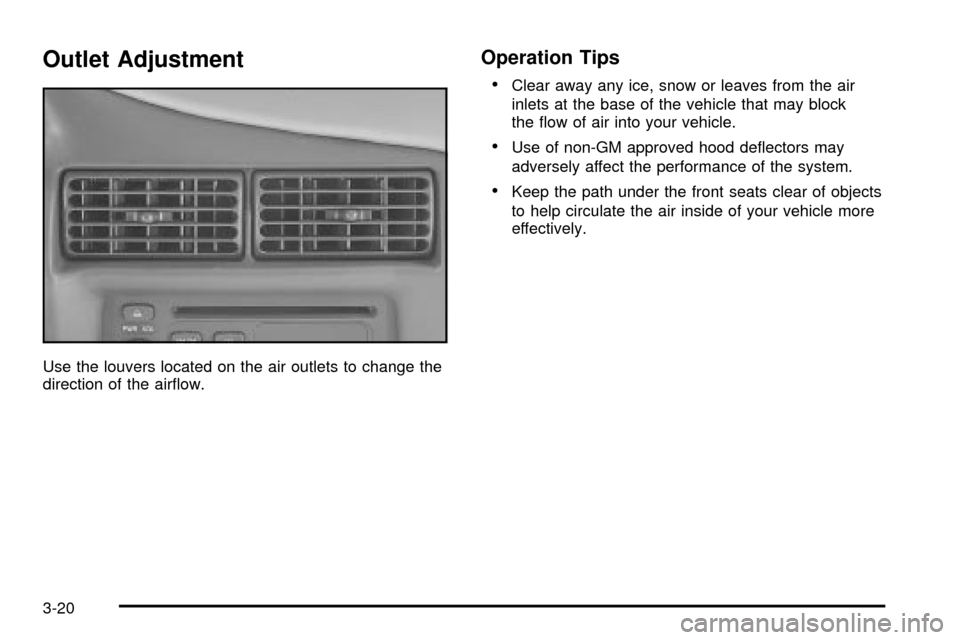
Outlet Adjustment
Use the louvers located on the air outlets to change the
direction of the air¯ow.
Operation Tips
·
Clear away any ice, snow or leaves from the air
inlets at the base of the vehicle that may block
the ¯ow of air into your vehicle.
·Use of non-GM approved hood de¯ectors may
adversely affect the performance of the system.
·Keep the path under the front seats clear of objects
to help circulate the air inside of your vehicle more
effectively.
3-20
Page 215 of 364
{CAUTION:
Do not load your vehicle any heavier than the
GVWR, or either the maximum front or rear
GAWR. If you do, parts on your vehicle can
break, and it can change the way your vehicle
handles. These could cause you to lose
control and crash. Also, overloading can
shorten the life of your vehicle.
If you put things inside your vehicle ± like suitcases,
tools, packages, or anything else ± they will go as fast
as the vehicle goes. If you have to stop or turn
quickly, or if there is a crash, they'll keep going.
{CAUTION:
Things you put inside your vehicle can strike
and injure people in a sudden stop or turn, or
in a crash.
·Put things in the trunk or rear area of your
vehicle. In a trunk, put them as far forward
as you can. Try to spread the weight
evenly. If you have fold-down rear seats,
you'll ®nd four anchors on the back wall of
your trunk. You can use these anchors to
tie down lighter loads. They're not strong
enough for heavy things, however, so put
them as far forward as you can in the
trunk or rear area.
·Never stack heavier things, like suitcases,
inside the vehicle so that some of them
are above the tops of the seats.
·Don't leave an unsecured child restraint in
your vehicle.
·When you carry something inside the
vehicle, secure it whenever you can.
·Don't leave a seat folded down unless you
need to.
4-33
Page 357 of 364

Maintenance Schedule (cont.)
Part E - Maintenance Record........................6-27
Selecting the Right Schedule.......................... 6-5
Short Trip/City Scheduled Maintenance............. 6-6
Steering, Suspension and Front Drive Axle
Boot and Seal Inspection..........................6-23
Throttle System Inspection............................6-23
Using Your................................................... 6-4
Your Vehicle and the Environment................... 6-2
Maintenance When Trailer Towing.....................4-40
Making Turns.................................................4-38
Malfunction Indicator Light................................3-30
Manual Seats................................................... 1-2
Manual Transaxle Check..................................6-20
Manual Transaxle............................................2-19
Fluid..........................................................5-20
Operation...................................................2-25
Manual Windows............................................2-14
Map Lamps....................................................3-15
Matching Transmitter(s) to Your Vehicle............... 2-6
Mexico, Central America and Caribbean Islands/
Countries (Except Puerto Rico and U.S. Virgin
Islands) ± Customer Assistance....................... 7-5
Mirrors..........................................................2-32
Manual Rearview Mirror................................2-32
Outside Breakaway Mirror.............................2-33Mirrors (cont.)
Outside Convex Mirror.................................2-33
Outside Power Mirrors..................................2-32
Outside Remote Control Mirror......................2-32
MyGMLink.com................................................ 7-3
N
New Vehicle Break-In......................................2-17
Normal Maintenance Replacement Parts............5-86
O
Odometer......................................................3-23
Off-Road Recovery..........................................4-12
Oil ................................................................5-14
Engine.......................................................5-14
Pressure Light.............................................3-33
Older Children, Restraints................................1-29
Online Owner Center........................................ 7-3
OnStar
žPersonal Calling.................................2-35
OnStaržServices............................................2-34
OnStaržSystem.............................................2-34
OnStaržVirtual Advisor....................................2-35
Opening a Rear Door When the Security
Lock is On................................................... 2-9
9
Page 360 of 364

S
Safety Belt.....................................................3-24
Reminder Light............................................3-24
Safety Belts...................................................5-74
Care of......................................................5-74
Driver Position............................................1-14
How to Wear Safety Belts Properly................1-14
Questions and Answers About Safety Belts.....1-13
Rear Safety Belt Comfort Guides for
Children and Small Adults.........................1-26
Rear Seat Passengers.................................1-23
Right Front Passenger Position......................1-23
Safety Belt Extender....................................1-28
Safety Belt Use During Pregnancy.................1-22
Safety Belts Are for Everyone......................... 1-9
Safety Chains.................................................4-37
Safety Warnings and Symbols.............................. iii
Seatback Latches............................................. 1-6
Seat............................................................... 1-5
Head Restraints............................................ 1-5
Seats.............................................................. 1-7
Easy Entry Seat............................................ 1-7
Manual........................................................ 1-2
Rear Seat Operation...................................... 1-8
Reclining Seatbacks...................................... 1-4
Seatback Latches.......................................... 1-6Securing a Child Restraint................................1-43
Designed for the LATCH System...................1-43
Rear Seat Position......................................1-43
Right Front Seat Position..............................1-46
Selecting the Right Schedule, Maintenance.......... 6-5
Service Bulletins.............................................7-10
Service Manuals.............................................7-10
Service........................................................... 5-3
Adding Equipment to the Outside of Your
Vehicle..................................................... 5-4
Doing Your Own Work................................... 5-3
Engine Soon Light.......................................3-30
Publications Ordering Information...................7-10
Vehicle Soon Light.......................................3-35
Setting Preset Stations............3-38, 3-41, 3-51, 3-65
Setting the Time.............................................3-36
Radios with Radio Data Systems (RDS).........3-36
Radios without Radio Data Systems (RDS).....3-36
Setting the Tone
(Bass/Treble)......................3-38, 3-42, 3-52, 3-66
Sheet Metal Damage.......................................5-77
Shift Speeds..................................................2-26
Shifting Into Park (P).......................................2-27
Shifting Out of Park (P)...................................2-29
Short Trip/City De®nition.................................... 6-5
Short Trip/City Intervals..................................... 6-5
Short Trip/City Scheduled Maintenance................ 6-6
12