clutch CHEVROLET CAVALIER 2003 3.G Owners Manual
[x] Cancel search | Manufacturer: CHEVROLET, Model Year: 2003, Model line: CAVALIER, Model: CHEVROLET CAVALIER 2003 3.GPages: 364, PDF Size: 2.44 MB
Page 85 of 364
Key Release Button (Manual Transaxle)
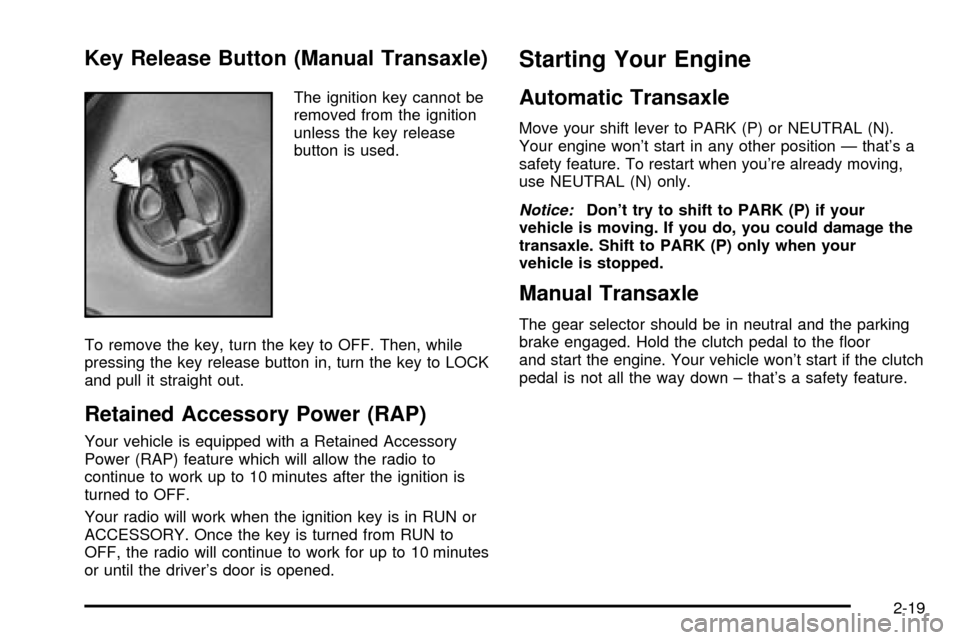
The ignition key cannot be
removed from the ignition
unless the key release
button is used.
To remove the key, turn the key to OFF. Then, while
pressing the key release button in, turn the key to LOCK
and pull it straight out.
Retained Accessory Power (RAP)
Your vehicle is equipped with a Retained Accessory
Power (RAP) feature which will allow the radio to
continue to work up to 10 minutes after the ignition is
turned to OFF.
Your radio will work when the ignition key is in RUN or
ACCESSORY. Once the key is turned from RUN to
OFF, the radio will continue to work for up to 10 minutes
or until the driver's door is opened.
Starting Your Engine
Automatic Transaxle
Move your shift lever to PARK (P) or NEUTRAL (N).
Your engine won't start in any other position Ð that's a
safety feature. To restart when you're already moving,
use NEUTRAL (N) only.
Notice:Don't try to shift to PARK (P) if your
vehicle is moving. If you do, you could damage the
transaxle. Shift to PARK (P) only when your
vehicle is stopped.
Manual Transaxle
The gear selector should be in neutral and the parking
brake engaged. Hold the clutch pedal to the ¯oor
and start the engine. Your vehicle won't start if the clutch
pedal is not all the way down ± that's a safety feature.
2-19
Page 91 of 364

Manual Transaxle Operation
Five-Speed
This is your shift pattern.
Here's how to operate your transaxle:
FIRST (1):Press the clutch pedal and shift into
FIRST (1). Then, slowly let up on the clutch pedal as
you press the accelerator pedal.
You can shift into FIRST (1) when you're going less
than 20 mph (32 km/h). If you've come to a complete
stop and it's hard to shift into FIRST (1), put the
shift lever in NEUTRAL (N) and let up on the clutch.
Press the clutch pedal back down. Then shift into
FIRST (1).SECOND (2):Press the clutch pedal as you let up on
the accelerator pedal and shift into SECOND (2).
Then, slowly let up on the clutch pedal as you press the
accelerator pedal.
THIRD (3), FOURTH (4) and FIFTH (5):Shift into
THIRD (3), FOURTH (4) and FIFTH (5), the same way
you do for SECOND (2). Slowly let up on the clutch
pedal as you press the accelerator pedal.
To stop, let up on the accelerator pedal and press the
brake pedal. Just before the vehicle stops, press
the clutch pedal and the brake pedal, and shift to
NEUTRAL (N).
NEUTRAL (N):Use this position when you start or idle
your engine.
REVERSE (R):To back up, press down the clutch
pedal, lift up the ring on the shift lever and shift
into REVERSE (R). Let up on the clutch pedal slowly
while pressing the accelerator pedal.
Notice:Shift into REVERSE (R) only after your
vehicle is stopped. Shifting into REVERSE (R) while
your vehicle is moving could damage your
transaxle. The repairs would not be covered by your
warranty.
Also, use REVERSE (R), along with the parking brake,
for parking your vehicle.
2-25
Page 95 of 364

Shifting Out of Park (P)
(Automatic Transaxle)
Your vehicle has an automatic transaxle shift lock
control system. You have to fully apply your regular
brakes before you can shift from PARK (P) when
the ignition is in RUN. See
Automatic Transaxle
Operation on page 2-22.
If you cannot shift out of PARK (P), ease pressure on
the shift lever Ð push the shift lever all the way
into PARK (P), as you maintain brake application. Then
move the shift lever into the gear you wish. (Press
the shift lever button before moving the shift lever).
If you ever hold the brake pedal down but still can't shift
out of PARK (P), try this:
1. Turn the key to OFF.
2. Apply and hold the brake until the end of Step 4.
3. Shift to NEUTRAL (N).
4. Start the vehicle and then shift to the drive gear
you want.
5. Have your vehicle ®xed as soon as you can.
Parking Your Vehicle
(Manual Transaxle)
Before leaving your vehicle, fully press the clutch pedal
in, move the shift lever into REVERSE (R), and ®rmly
apply the parking brake. Once the shift lever has
been placed in REVERSE (R) with the clutch pedal
pressed in, you can turn the ignition key to OFF, remove
the key and release the clutch.
See
Manual Transaxle Operation on page 2-25.
2-29
Page 110 of 364
Windshield Washers
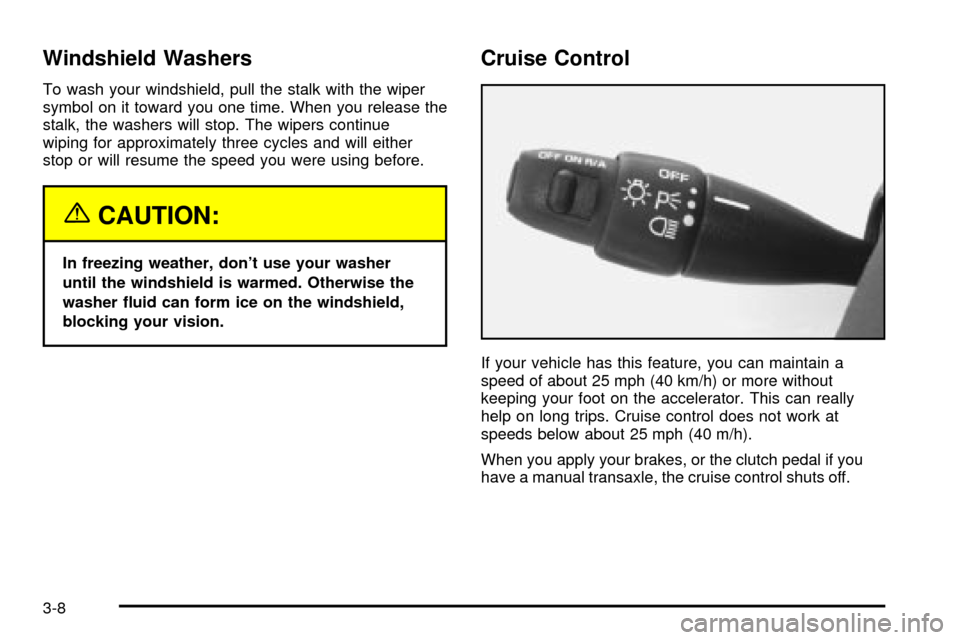
To wash your windshield, pull the stalk with the wiper
symbol on it toward you one time. When you release the
stalk, the washers will stop. The wipers continue
wiping for approximately three cycles and will either
stop or will resume the speed you were using before.
{CAUTION:
In freezing weather, don't use your washer
until the windshield is warmed. Otherwise the
washer ¯uid can form ice on the windshield,
blocking your vision.
Cruise Control
If your vehicle has this feature, you can maintain a
speed of about 25 mph (40 km/h) or more without
keeping your foot on the accelerator. This can really
help on long trips. Cruise control does not work at
speeds below about 25 mph (40 m/h).
When you apply your brakes, or the clutch pedal if you
have a manual transaxle, the cruise control shuts off.
3-8
Page 112 of 364

Resuming a Set Speed
Suppose you set your cruise control at a desired speed
and then you apply the brake or clutch pedal. This,
of course, shuts off the cruise control. But you don't
need to reset it. Once you're going about 25 mph
(40 km/h) or more, you can brie¯y move the cruise
control switch from ON to R/A.
You'll go right back up to your chosen speed and stay
there.
If you hold the switch at R/A longer, the vehicle will
keep going faster until you release the switch or apply
the brake or clutch pedal. So unless you want to go
faster, don't hold the switch at R/A.
Increasing Speed While Using Cruise
Control
There are two ways to go to a higher speed:
·Use the accelerator pedal to get to a higher speed.
Push the SET button at the end of the lever, then
release the button and the accelerator pedal.
You'll now cruise at the higher speed.
·Move the cruise control switch from ON to R/A.
Hold it there until you get up to the speed you
want, and then release the switch. To increase your
speed in very small amounts, brie¯y move the
switch to R/A then release it. Each time you do this,
your vehicle will go about 1 mph (1.6 km/h) faster.
3-10
Page 113 of 364

Reducing Speed While Using Cruise
Control
There are two ways to reduce your speed while using
cruise control:
·Push in the button at the end of the lever until you
reach the lower speed you want, then release it.
·To slow down in very small amounts, brie¯y press
the button. Each time you do this, you'll go about
1 mph (1.6 km/h) slower.
Passing Another Vehicle While Using
Cruise Control
Use the accelerator pedal to increase your speed.
When you take your foot off the pedal, your vehicle will
slow down to the cruise control speed you set earlier.
Using Cruise Control on Hills
How well your cruise control will work on hills depends
upon your speed, load and the steepness of the
hills. When going up a steep hill, you may have to step
on the accelerator pedal to maintain your speed.
When going downhill, you may have to brake or shift to
a lower gear to keep your speed down. Of course,
applying the brake or clutch pedal takes you out
of cruise control. Many drivers ®nd this to be too much
trouble and don't use cruise control on steep hills.
Ending Cruise Control
There are several ways to turn off the cruise control:
·Step lightly on the brake pedal, or push the
clutch pedal, if you have a manual transaxle, or
·move the cruise switch to OFF.
Erasing Speed Memory
When you turn off the cruise control or the ignition, your
cruise control set speed memory is erased.
3-11
Page 223 of 364

Service............................................................5-3
Doing Your Own Service Work.........................5-3
Adding Equipment to the Outside of Your
Vehicle......................................................5-4
Fuel................................................................5-4
Gasoline Octane............................................5-4
Gasoline Speci®cations....................................5-5
California Fuel...............................................5-5
Additives.......................................................5-5
Fuels in Foreign Countries...............................5-6
Filling Your Tank............................................5-7
Filling a Portable Fuel Container.......................5-9
Checking Things Under
the Hood....................................................5-10
Hood Release..............................................5-10
Engine Compartment Overview.......................5-12
Engine Oil...................................................5-14
Engine Air Cleaner/Filter................................5-18
Automatic Transaxle Fluid..............................5-20
Manual Transaxle Fluid..................................5-20
Hydraulic Clutch...........................................5-21
Engine Coolant.............................................5-22
Coolant Surge Tank Pressure Cap..................5-24
Engine Overheating.......................................5-25
Cooling System............................................5-27Power Steering Fluid.....................................5-33
Windshield Washer Fluid................................5-34
Brakes........................................................5-35
Battery........................................................5-39
Jump Starting...............................................5-40
Bulb Replacement..........................................5-45
Halogen Bulbs..............................................5-45
Headlamps..................................................5-45
Front Turn Signal and Parking Lamps..............5-47
Taillamps and Turn Signal Lamps...................5-48
Back-Up Lamps............................................5-49
Replacement Bulbs.......................................5-49
Windshield Wiper Blade Replacement..............5-50
Tires..............................................................5-51
In¯ation -- Tire Pressure................................5-52
Tire Inspection and Rotation...........................5-53
When It Is Time for New Tires.......................5-54
Buying New Tires.........................................5-55
Uniform Tire Quality Grading..........................5-56
Wheel Alignment and Tire Balance..................5-57
Wheel Replacement......................................5-57
Tire Chains..................................................5-59
If a Tire Goes Flat........................................5-60
Changing a Flat Tire.....................................5-61
Compact Spare Tire......................................5-70
Section 5 Service and Appearance Care
5-1
Page 235 of 364

A. Coolant Surge Tank
B. Engine Oil Dipstick
C. Engine Oil Fill Cap
D. Brake Fluid Reservoir
E. Power Steering Fluid ReservoirF. Clutch Master Cylinder Reservoir
(If Equipped) (Not Shown)
G. Battery
H. Engine Air Cleaner/Filter
I. Windshield Washer Fluid Reservoir
5-13
Page 243 of 364
Hydraulic Clutch
The hydraulic clutch linkage in your vehicle is
self-adjusting. The master cylinder reservoir is ®lled with
hydraulic ¯uid.
It is not necessary to regularly check the ¯uid unless
you suspect there is a leak in the system. Adding ¯uid
won't correct a leak.
A ¯uid loss in this system could indicate a problem.
Have the system inspected and repaired.
When to Check and What to Use
Refer to the Maintenance
Schedule to determine
how often you should
check the ¯uid level in your
master cylinder reservoir
and for the proper
¯uid. See
Part B: Owner
Checks and Services
on page 6-19
andPart D:
Recommended Fluids
and Lubricants on
page 6-25
.
How to Check and Add Fluid
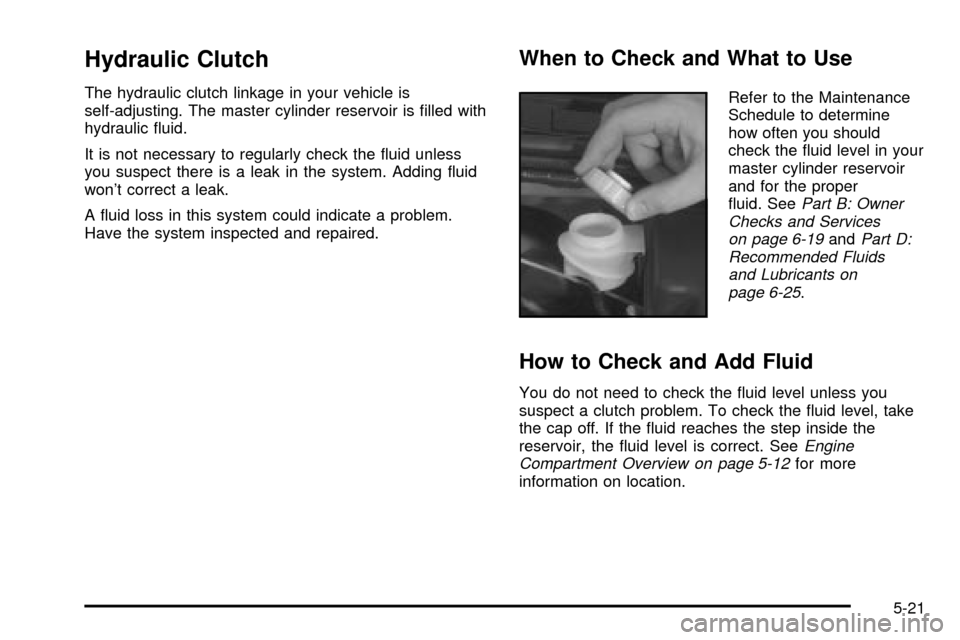
You do not need to check the ¯uid level unless you
suspect a clutch problem. To check the ¯uid level, take
the cap off. If the ¯uid reaches the step inside the
reservoir, the ¯uid level is correct. See
Engine
Compartment Overview on page 5-12for more
information on location.
5-21
Page 328 of 364

Wiper Blade Check
Inspect wiper blades for wear or cracking. Replace
blade inserts that appear worn or damaged or that
streak or miss areas of the windshield. Also see
Cleaning the Outside of Your Vehicle on page 5-74.
Weatherstrip Lubrication
Silicone grease on weatherstrips will make them last
longer, seal better, and not stick or squeak. Apply
silicone grease with a clean cloth. During very cold,
damp weather more frequent application may be
required. See
Part D: Recommended Fluids and
Lubricants on page 6-25.
Manual Transaxle Check
It is not necessary to check the transaxle ¯uid level.
Check for leaks. A ¯uid leak is the only reason for ¯uid
loss. Have the system inspected and repaired if
needed.
Automatic Transaxle Inspection
It is not necessary to check the transaxle ¯uid level. A
transaxle ¯uid leak is the only reason for ¯uid loss.
Check for leaks. If a leak occurs, take the vehicle to your
dealer and have it repaired as soon as possible.
Hydraulic Clutch System Check
Check the ¯uid level in the clutch reservoir. SeeHydraulic Clutch on page 5-21. A ¯uid loss in this
system could indicate a problem. Have the system
inspected and repaired at once.
At Least Once a Year
Key Lock Cylinders Service
Lubricate the key lock cylinders with the lubricant
speci®ed in Part D.
Body Lubrication Service
Lubricate all hood latch assemblies, secondary latch,
pivots, spring anchor, release pawl, hood and body door
hinges, rear compartment and any folding seat
hardware. Part D tells you what to use. More frequent
lubrication may be required when exposed to a corrosive
environment.
6-20