wiper blades CHEVROLET CAVALIER 2003 3.G Owners Manual
[x] Cancel search | Manufacturer: CHEVROLET, Model Year: 2003, Model line: CAVALIER, Model: CHEVROLET CAVALIER 2003 3.GPages: 364, PDF Size: 2.44 MB
Page 109 of 364
Windshield Wipers
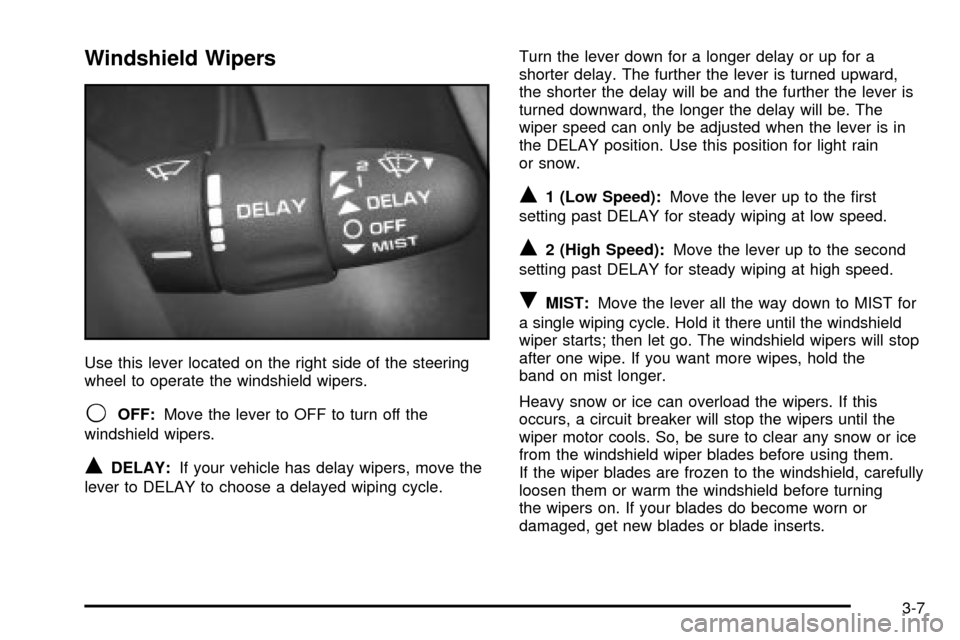
Use this lever located on the right side of the steering
wheel to operate the windshield wipers.
9OFF:Move the lever to OFF to turn off the
windshield wipers.
QDELAY:If your vehicle has delay wipers, move the
lever to DELAY to choose a delayed wiping cycle.Turn the lever down for a longer delay or up for a
shorter delay. The further the lever is turned upward,
the shorter the delay will be and the further the lever is
turned downward, the longer the delay will be. The
wiper speed can only be adjusted when the lever is in
the DELAY position. Use this position for light rain
or snow.
Q1 (Low Speed):Move the lever up to the ®rst
setting past DELAY for steady wiping at low speed.
Q2 (High Speed):Move the lever up to the second
setting past DELAY for steady wiping at high speed.
RMIST:Move the lever all the way down to MIST for
a single wiping cycle. Hold it there until the windshield
wiper starts; then let go. The windshield wipers will stop
after one wipe. If you want more wipes, hold the
band on mist longer.
Heavy snow or ice can overload the wipers. If this
occurs, a circuit breaker will stop the wipers until the
wiper motor cools. So, be sure to clear any snow or ice
from the windshield wiper blades before using them.
If the wiper blades are frozen to the windshield, carefully
loosen them or warm the windshield before turning
the wipers on. If your blades do become worn or
damaged, get new blades or blade inserts.
3-7
Page 199 of 364
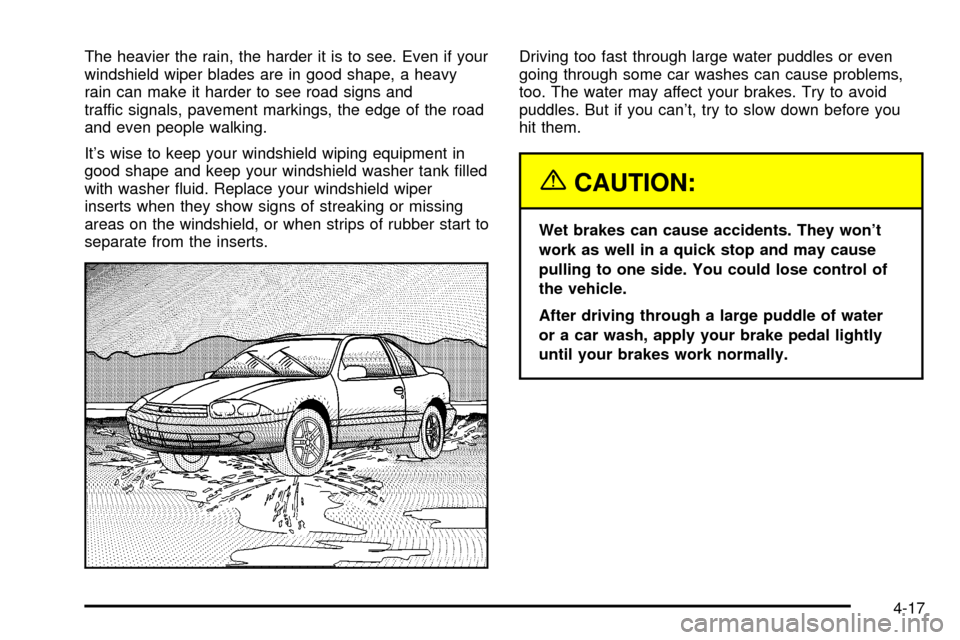
The heavier the rain, the harder it is to see. Even if your
windshield wiper blades are in good shape, a heavy
rain can make it harder to see road signs and
traffic signals, pavement markings, the edge of the road
and even people walking.
It's wise to keep your windshield wiping equipment in
good shape and keep your windshield washer tank ®lled
with washer ¯uid. Replace your windshield wiper
inserts when they show signs of streaking or missing
areas on the windshield, or when strips of rubber start to
separate from the inserts.Driving too fast through large water puddles or even
going through some car washes can cause problems,
too. The water may affect your brakes. Try to avoid
puddles. But if you can't, try to slow down before you
hit them.
{CAUTION:
Wet brakes can cause accidents. They won't
work as well in a quick stop and may cause
pulling to one side. You could lose control of
the vehicle.
After driving through a large puddle of water
or a car wash, apply your brake pedal lightly
until your brakes work normally.
4-17
Page 203 of 364
Once you are moving on the freeway, make certain you
allow a reasonable following distance.
Expect to move slightly slower at night.
When you want to leave the freeway, move to the
proper lane well in advance. If you miss your exit, do
not, under any circumstances, stop and back up. Drive
on to the next exit.
The exit ramp can be curved, sometimes quite sharply.
The exit speed is usually posted. Reduce your speed
according to your speedometer, not to your sense
of motion. After driving for any distance at higher
speeds, you may tend to think you are going slower
than you actually are.
Before Leaving on a Long Trip
Make sure you're ready. Try to be well rested. If you
must start when you're not fresh Ð such as after a day's
work Ð don't plan to make too many miles that ®rst
part of the journey. Wear comfortable clothing and shoes
you can easily drive in.Is your vehicle ready for a long trip? If you keep it
serviced and maintained, it's ready to go. If it needs
service, have it done before starting out. Of course,
you'll ®nd experienced and able service experts in GM
dealerships all across North America. They'll be
ready and willing to help if you need it.
Here are some things you can check before a trip:
·Windshield Washer Fluid:Is the reservoir full? Are
all windows clean inside and outside?
·Wiper Blades:Are they in good shape?
·Fuel, Engine Oil, Other Fluids:Have you checked
all levels?
·Lamps:Are they all working? Are the lenses clean?
·Tires:They are vitally important to a safe,
trouble-free trip. Is the tread good enough for
long-distance driving? Are the tires all in¯ated to the
recommended pressure?
·Weather Forecasts:What's the weather outlook
along your route? Should you delay your trip a
short time to avoid a major storm system?
·Maps:Do you have up-to-date maps?
4-21
Page 272 of 364
Windshield Wiper Blade
Replacement
Windshield wiper blades should be inspected at least
twice a year for wear or cracking. See ªWiper Blade
Checkº under
Part B: Owner Checks and Services on
page 6-19for more information.
Replacement blades come in different types and are
removed in different ways. For proper type and length,
see
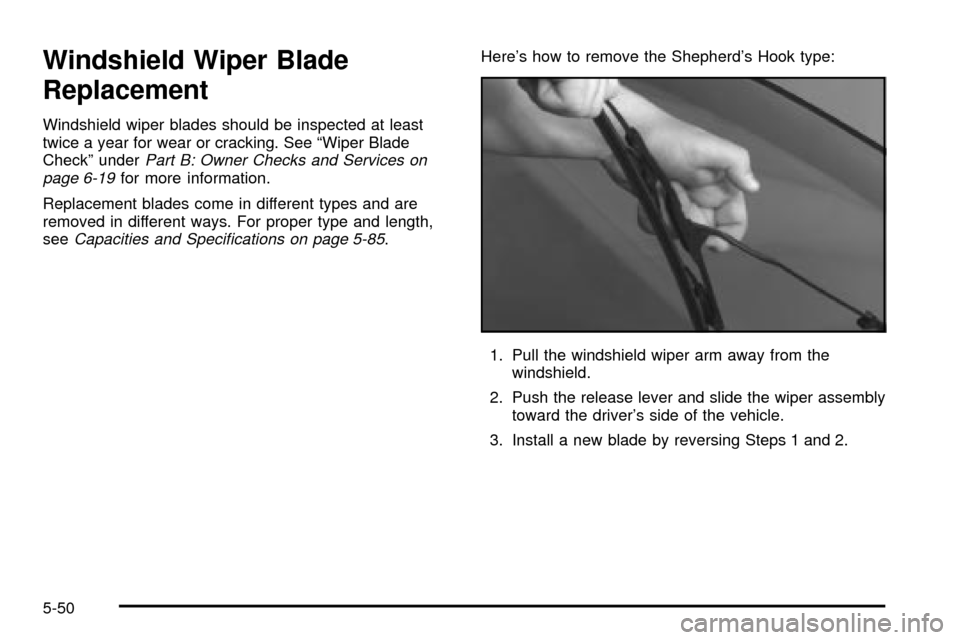
Capacities and Speci®cations on page 5-85.Here's how to remove the Shepherd's Hook type:
1. Pull the windshield wiper arm away from the
windshield.
2. Push the release lever and slide the wiper assembly
toward the driver's side of the vehicle.
3. Install a new blade by reversing Steps 1 and 2.
5-50
Page 298 of 364
Cleaning Windshield and Wiper Blades
If the windshield is not clear after using the windshield
washer, or if the wiper blade chatters when running,
wax, sap or other material may be on the blade
or windshield.
Clean the outside of the windshield with a full-strength
glass cleaning liquid. The windshield is clean if beads do
not form when you rinse it with water.
Grime from the windshield will stick to the wiper blades
and affect their performance. Clean the blade by
wiping vigorously with a cloth soaked in full-strength
windshield washer solvent. Then rinse the blade
with water.
Check the wiper blades and clean them as necessary;
replace blades that look worn.
Cleaning Aluminum or Chrome-Plated
Wheels
Your vehicle may be equipped with either aluminum or
chrome-plated wheels.
Keep your wheels clean using a soft clean cloth with
mild soap and water. Rinse with clean water. After
rinsing thoroughly, dry with a soft clean towel. A wax
may then be applied.
The surface of these wheels is similar to the painted
surface of your vehicle. Don't use strong soaps,
chemicals, abrasive polishes, abrasive cleaners,
cleaners with acid, or abrasive cleaning brushes on
them because you could damage the surface. Do not
use chrome polish on aluminum wheels.
Use chrome polish only on chrome-plated wheels, but
avoid any painted surface of the wheel, and buff off
immediately after application.
Don't take your vehicle through an automatic car wash
that has silicone carbide tire cleaning brushes. These
brushes can also damage the surface of these wheels.
5-76
Page 328 of 364
Wiper Blade Check
Inspect wiper blades for wear or cracking. Replace
blade inserts that appear worn or damaged or that
streak or miss areas of the windshield. Also see
Cleaning the Outside of Your Vehicle on page 5-74.
Weatherstrip Lubrication
Silicone grease on weatherstrips will make them last
longer, seal better, and not stick or squeak. Apply
silicone grease with a clean cloth. During very cold,
damp weather more frequent application may be
required. See
Part D: Recommended Fluids and
Lubricants on page 6-25.
Manual Transaxle Check
It is not necessary to check the transaxle ¯uid level.
Check for leaks. A ¯uid leak is the only reason for ¯uid
loss. Have the system inspected and repaired if
needed.
Automatic Transaxle Inspection
It is not necessary to check the transaxle ¯uid level. A
transaxle ¯uid leak is the only reason for ¯uid loss.
Check for leaks. If a leak occurs, take the vehicle to your
dealer and have it repaired as soon as possible.
Hydraulic Clutch System Check
Check the ¯uid level in the clutch reservoir. SeeHydraulic Clutch on page 5-21. A ¯uid loss in this
system could indicate a problem. Have the system
inspected and repaired at once.
At Least Once a Year
Key Lock Cylinders Service
Lubricate the key lock cylinders with the lubricant
speci®ed in Part D.
Body Lubrication Service
Lubricate all hood latch assemblies, secondary latch,
pivots, spring anchor, release pawl, hood and body door
hinges, rear compartment and any folding seat
hardware. Part D tells you what to use. More frequent
lubrication may be required when exposed to a corrosive
environment.
6-20
Page 351 of 364
Checking Coolant............................................5-23
Checking Engine Oil........................................5-14
Checking Things Under the Hood......................5-10
Checking Your Restraint Systems......................1-58
Check...........................................................3-30
Engine Light...............................................3-30
Gages Warning Light...................................3-34
Chemical Paint Spotting...................................5-77
Child Restraints..............................................1-35
Child Restraint Systems...............................1-35
Infants and Young Children...........................1-32
Lower Anchorages and Top Tethers for
Children (LATCH System)..........................1-41
Older Children.............................................1-29
Securing a Child Restraint Designed for
the LATCH System...................................1-43
Securing a Child Restraint in a Rear
Seat Position...........................................1-43
Securing a Child Restraint in the Right
Front Seat Position...................................1-46
Top Strap Anchor Location............................1-40
Top Strap...................................................1-39
Where to Put the Restraint...........................1-38
Chime Level Adjustment..................................3-79
Cigarette Lighter.............................................3-16
Cleaning Aluminum or Chrome-Plated Wheels.....5-76
Cleaning Exterior Lamps/Lenses.......................5-75
Cleaning Fabric/Carpet....................................5-71
Cleaning Glass Surfaces..................................5-73Cleaning Interior Plastic Components.................5-73
Cleaning the Top of the
Instrument Panel.........................................5-73
Cleaning Tires................................................5-77
Cleaning Vinyl................................................5-73
Cleaning Windshield and Wiper Blades..............5-76
Cleaning........................................................5-71
Inside of Your Vehicle..................................5-71
Outside of Your Vehicle................................5-74
Underbody Maintenance...............................5-77
Weatherstrips..............................................5-74
Climate Control System...................................3-17
Outlet Adjustment........................................3-20
Clutch, Hydraulic.............................................5-21
Compact Disc Messages.................3-48, 3-63, 3-75
Compact Spare Tire........................................5-70
Content Theft-Deferrent....................................2-15
Control of a Vehicle.......................................... 4-5
Convenience Net............................................2-36
Coolant.........................................................3-29
Engine Temperature Gage............................3-29
Heater, Engine............................................2-21
Low Warning Light.......................................3-30
Surge Tank Pressure Cap.............................5-24
Cooling System..............................................5-27
Cruise Control.................................................. 3-8
Cupholder(s)..................................................2-35
Current and Past Model Order Forms................7-11
3