ESP CHEVROLET CITY EXPRESS 2016 User Guide
[x] Cancel search | Manufacturer: CHEVROLET, Model Year: 2016, Model line: CITY EXPRESS, Model: CHEVROLET CITY EXPRESS 2016Pages: 297, PDF Size: 4.52 MB
Page 136 of 297
Black plate (19,1)Chevrolet City Express Owner Manual (GMNA-Localizing-U.S./Canada-
7707496) - 2015 - CRC - 11/26/14
Infotainment System 7-192. The system responds with
“ Showing Manual Options. ”
3. Browse the menu by
pressing
Q TUNE/FF-REW
FOLDER
R up or down. The
system will speak the current
menu option. Depending on the
audio display, it will also show
the current menu option.
4. Press
g V to select the menu
option.
5. Press
V to go back to the
previous menu.
6. Press and hold
V for
five seconds to exit. Trademarks and
License Agreements FCC Information
See Radio Frequency Statement on
page 13-12 .
“ Made for iPod ” and “ Made for
iPhone ” mean that an electronic
accessory has been designed to
connect specifically to iPod or
iPhone and has been certified by
the developer to meet Apple
performance standards. iPod and iPhone are trademarks of
Apple Computer, Inc., registered in
the U.S. and other countries.
Bluetooth The Bluetooth ®
word mark and
logos are owned by the Bluetooth ®
SIG, Inc. and any use of such marks
by General Motors is under license.
Other trademarks and trade names
are those of their respective owners.
Page 146 of 297
Black plate (5,1)Chevrolet City Express Owner Manual (GMNA-Localizing-U.S./Canada-
7707496) - 2015 - CRC - 11/26/14
Driving and Operating 9-53. Turn the steering wheel to go
straight down the roadway.
Loss of Control Skidding There are three types of skids that
correspond to the vehicle's three
control systems: .
Braking Skid — wheels are not
rolling. .
Steering or Cornering Skid —
too much speed or steering in a
curve causes tires to slip and
lose cornering force. .
Acceleration Skid — too much
throttle causes the driving
wheels to spin.
Defensive drivers avoid most skids
by taking reasonable care suited to
existing conditions, and by not
overdriving those conditions. But
skids are always possible. If the vehicle starts to slide, follow
these suggestions: .
Ease your foot off the
accelerator pedal and steer the
way you want the vehicle to go.
The vehicle may straighten out.
Be ready for a second skid if it
occurs. .
Slow down and adjust your
driving according to weather
conditions. Stopping distance
can be longer and vehicle
control can be affected when
traction is reduced by water,
snow, ice, gravel, or other
material on the road. Learn to
recognize warning clues — such
as enough water, ice, or packed
snow on the road to make a
mirrored surface — and slow
down when you have any doubt. .
Try to avoid sudden steering,
acceleration, or braking,
including reducing vehicle speed
by shifting to a lower gear. Any
sudden changes could cause
the tires to slide. Remember: Antilock brakes help
avoid only the braking skid.
Driving on Wet Roads Rain and wet roads can reduce
vehicle traction and affect your
ability to stop and accelerate.
Always drive slower in these types
of driving conditions and avoid
driving through large puddles and
deep ‐ standing or flowing water.
{ WarningWet brakes can cause crashes.
They might not work as well in a
quick stop and could cause
pulling to one side. You could
lose control of the vehicle.
After driving through a large
puddle of water or a car/vehicle
wash, lightly apply the brake
pedal until the brakes work
normally.
(Continued)
Page 149 of 297
Black plate (8,1)Chevrolet City Express Owner Manual (GMNA-Localizing-U.S./Canada-
7707496) - 2015 - CRC - 11/26/14
9-8 Driving and Operating Warning (Continued)cannot be seen or smelled. It can
cause unconsciousness and even
death.
If the vehicle is stuck in the snow: .
Clear away snow from around
the base of your vehicle,
especially any that is blocking
the exhaust pipe. .
Check again from time to
time to be sure snow does
not collect there. .
Open a window about 5 cm
(2 in) on the side of the
vehicle that is away from the
wind to bring in fresh air. .
Fully open the air outlets on
or under the instrument
panel. .
Adjust the climate control
system to a setting that
circulates the air inside the
(Continued) Warning (Continued) vehicle and set the fan speed
to the highest setting. See
“ Climate Control Systems. ”
For more information about
carbon monoxide, see Engine
Exhaust on page 9-17 .
To save fuel, run the engine for only
short periods as needed to warm
the vehicle and then shut the engine
off and close the window most of
the way to save heat. Repeat this
until help arrives but only when you
feel really uncomfortable from the
cold. Moving about to keep warm
also helps.
If it takes some time for help to
arrive, now and then when you run
the engine, push the accelerator
pedal slightly so the engine runs
faster than the idle speed. This
keeps the battery charged to restart
the vehicle and to signal for help
with the headlamps. Do this as little
as possible to save fuel. If the Vehicle Is Stuck Slowly and cautiously spin the
wheels to free the vehicle when
stuck in sand, mud, ice, or snow.
If stuck too severely for the traction
system to free the vehicle, turn the
traction system off and use the
rocking method. See Traction
Control/Electronic Stability Control
on page 9-25 .
{ WarningIf the vehicle's tires spin at high
speed, they can explode, and you
or others could be injured. The
vehicle can overheat, causing an
engine compartment fire or other
damage. Spin the wheels as little
as possible and avoid going
above 56 km/h (35 mph).
Page 157 of 297
Black plate (16,1)Chevrolet City Express Owner Manual (GMNA-Localizing-U.S./Canada-
7707496) - 2015 - CRC - 11/26/14
9-16 Driving and Operating START position. Release the
key when the engine starts.
If the engine starts, but fails to
run, repeat the above procedure. .
If the engine is very hard to
start in extremely cold
weather or when restarting,
depress the accelerator
pedal a little (approximately
1/3 to the floor) and hold it
and then crank the engine.
Release the key and the
accelerator pedal when the
engine starts. .
If the engine is very hard to
start because it is flooded,
depress the accelerator
pedal all the way to the floor
and hold it. Crank the engine
for five to six seconds.
After cranking the engine,
release the accelerator
pedal. Crank the engine with
your foot off the accelerator
pedal by turning the ignition
key to START. Release the
key when the engine starts. If the engine starts, but fails
to run, repeat the above
procedure.
{ CautionDo not operate the starter for
more than 15 seconds at a time.
If the engine does not start, turn
the key off and wait 10 seconds
before cranking again, otherwise
the starter could be damaged.
4. Allow the engine to idle for at
least 30 seconds after starting.
Do not race the engine while
warming it up. Drive at moderate
speed for a short distance first,
especially in cold weather.
In cold weather, keep the engine
running for a minimum of two to
three minutes before shutting it
off. Starting and stopping the
engine over a short period of
time may make the vehicle more
difficult to start. Note: Care should be taken to
avoid situations that can lead to
potential battery discharge and
potential no-start conditions
such as:
1. Installation or extended use of
electronic accessories that
consume battery power when
the engine is not running (Phone
chargers, GPS, DVD
players, etc.).
2. Vehicle is not driven regularly
and/or only driven short
distances. In these cases, the
battery may need to be charged
to maintain battery health.
Page 163 of 297
Black plate (22,1)Chevrolet City Express Owner Manual (GMNA-Localizing-U.S./Canada-
7707496) - 2015 - CRC - 11/26/14
9-22 Driving and Operating Each time the engine is started,
or when the shift lever is shifted to
any position other than D (Drive),
the Overdrive off mode will be
automatically turned off.
Accelerator Downshift in D
Position For passing or hill climbing, depress
the accelerator pedal to the floor.
This shifts the transmission down
into a lower gear, depending on the
vehicle speed.
Fail Safe
When the fail-safe operation occurs,
the CVT will not be shifted into the
selected driving position.
If the vehicle is driven under
extreme conditions, such as
excessive wheel spinning and
subsequent hard braking, the
fail-safe system may be activated.
The MIL may come on to indicate
the fail-safe mode is activated. See
Malfunction Indicator Lamp on
page 5-11 . This will occur even if all
electrical circuits are functioning properly. In this case, place the
ignition switch in the OFF position
and wait for 10 seconds. Then place
the ignition switch back in the ON
position. The vehicle should return
to its normal operating condition. If it
does not return to its normal
operating condition, have a dealer
check the transmission and repair if
necessary.
{ WarningWhen the high fluid temperature
protection mode or fail-safe
operation occurs, vehicle speed
may be gradually reduced. The
reduced speed may be lower than
other traffic, which could increase
the chance of a collision. Be
especially careful when driving.
If necessary, pull to the side of
the road at a safe place and allow
the transmission to return to
normal operation, or have it
repaired if necessary. Brakes Antilock Brake
System (ABS)
{ Warning .
The ABS is a sophisticated
device, but it cannot prevent
accidents resulting from
careless or dangerous driving
techniques. It can help
maintain vehicle control
during braking on slippery
surfaces. Remember that
stopping distances on
slippery surfaces will be
longer than on normal
surfaces even with ABS.
Stopping distances may also
be longer on rough, gravel or
snow covered roads, or if you
are using tire chains. Always
maintain a safe distance from
(Continued)
Page 164 of 297
Black plate (23,1)Chevrolet City Express Owner Manual (GMNA-Localizing-U.S./Canada-
7707496) - 2015 - CRC - 11/26/14
Driving and Operating 9-23Warning (Continued) the vehicle in front of you.
Ultimately, the driver is
responsible for safety. .
Tire type and condition may
also affect braking
effectiveness. .
When replacing tires, install
the specified size of tires on
all four wheels. .
When installing a spare tire,
make sure that it is the proper
size and type as specified on
the Tire and Loading
Information label. .
For additional information,
refer to “ Wheels and Tires ” in
the “ Vehicle Care ” section of
this manual.
This vehicle has ABS, an advanced
electronic braking system that helps
prevent a braking skid. The ABS operates at speeds above
5 – 10 km/h (3 – 6 mph). The speed
varies according to road conditions.
When the vehicle begins to drive
away, ABS checks itself.
A momentary motor or clicking noise
might be heard while this test is
going on, and it might even be
noticed that the brake pedal moves
a little. This is normal.
Metric English
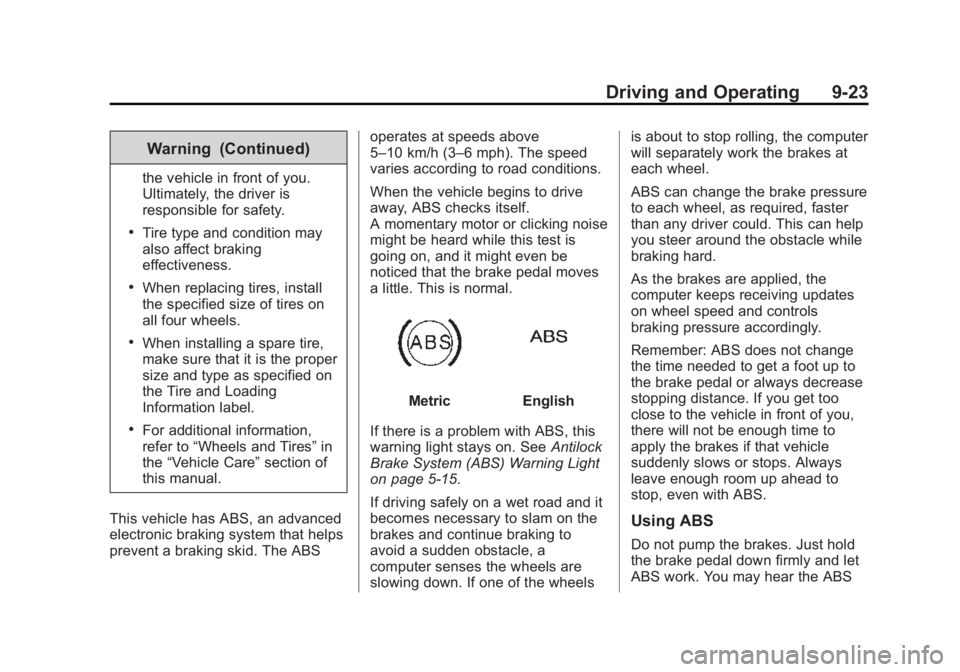
If there is a problem with ABS, this
warning light stays on. See Antilock
Brake System (ABS) Warning Light
on page 5-15 .
If driving safely on a wet road and it
becomes necessary to slam on the
brakes and continue braking to
avoid a sudden obstacle, a
computer senses the wheels are
slowing down. If one of the wheels is about to stop rolling, the computer
will separately work the brakes at
each wheel.
ABS can change the brake pressure
to each wheel, as required, faster
than any driver could. This can help
you steer around the obstacle while
braking hard.
As the brakes are applied, the
computer keeps receiving updates
on wheel speed and controls
braking pressure accordingly.
Remember: ABS does not change
the time needed to get a foot up to
the brake pedal or always decrease
stopping distance. If you get too
close to the vehicle in front of you,
there will not be enough time to
apply the brakes if that vehicle
suddenly slows or stops. Always
leave enough room up ahead to
stop, even with ABS.
Using ABS
Do not pump the brakes. Just hold
the brake pedal down firmly and let
ABS work. You may hear the ABS
Page 166 of 297
Black plate (25,1)Chevrolet City Express Owner Manual (GMNA-Localizing-U.S./Canada-
7707496) - 2015 - CRC - 11/26/14
Driving and Operating 9-252. Pull the parking brake handle up
until you can press the release
button.
3. Hold the release button in as
you move the brake handle all
the way down.
{ CautionDriving with the parking brake on
can overheat the brake system
and cause premature wear or
damage to brake system parts.
Make sure that the parking brake
is fully released and the brake
warning light is off before driving.
Parking Brake Break-in
Break-in the brake shoes whenever
the effect of the parking brake is
weakened or whenever the brake
shoes and/or drums are replaced, in
order to assure the best brake
performance. This procedure can be
performed at the dealer. Ride Control Systems Traction Control/
Electronic Stability
Control System Operation The vehicle has a Traction Control
System (TCS) and Electronic
Stability Control, an electronic
stability control system. These
systems use various sensors to
monitor driver inputs and vehicle
motion. Under certain driving
conditions, the TCS and Electronic
Stability Control systems help to
perform the following functions: .
Control brake pressure to reduce
wheel slip on one slipping drive
wheel so power is transferred to
a non – slipping drive wheel on
the same axle. .
Control brake pressure and
engine output to reduce drive
wheel slip based on vehicle
speed (traction control function). .
Control brake pressure at
individual wheels and engine
output to help the driver maintain
control of the vehicle in the
following conditions:
‐ Understeer (vehicle tends to
not follow the steered path
despite increased steering
input)
‐ Oversteer (vehicle tends to
spin due to certain road or
driving conditions)
TCS and Electronic Stability Control
can help the driver to maintain
control of the vehicle, but cannot
prevent loss of vehicle control in all
driving situations.
When the TCS and Electronic
Stability Control systems operate,
the
d indicator in the instrument
cluster flashes to note the following: .
The road may be slippery or the
system may determine some
action is required to help keep
the vehicle on the steered path.
Page 168 of 297
Black plate (27,1)Chevrolet City Express Owner Manual (GMNA-Localizing-U.S./Canada-
7707496) - 2015 - CRC - 11/26/14
Driving and Operating 9-27noise may be heard and/or a
pulsation in the brake pedal may be
felt. This is normal and is not an
indication of a malfunction.
Adding accessories can affect the
vehicle performance. See
Accessories and Modifications on
page 10-3 .
{ Warning .
The Traction Control System
(TCS) and Electronic Stability
Control (ESC) system are
designed to help the driver
maintain stability but do not
prevent accidents due to
abrupt steering operation at
high speeds or by careless or
dangerous driving
techniques. Reduce vehicle
speed and be especially
careful when driving and
cornering on slippery
surfaces and always drive
carefully.
(Continued) Warning (Continued) .
Do not modify the vehicle ’ s
suspension. If suspension
parts such as shock
absorbers, struts, springs,
stabilizer bars, bushings, and
wheels are not recommended
for your vehicle or are
extremely deteriorated, the
TCS and ESC systems may
not operate properly. This
could adversely affect vehicle
handling performance, and
the
d indicator may flash or
the
d indicator light may
illuminate. .
If brake related parts such as
brake pads, rotors, and
calipers are not
recommended or are
extremely deteriorated, the
TCS and ESC systems may
(Continued) Warning (Continued) not operate properly and the
d indicator light may
illuminate. .
If engine control related parts
are not recommended or are
extremely deteriorated, the
d indicator light may illuminate. .
When driving on extremely
inclined surfaces such as
higher banked corners, the
TCS and ESC systems may
not operate properly and the
d indicator may flash or the
d indicator light may
illuminate. Do not drive on
these types of roads. .
When driving on an unstable
surface such as a turntable,
ferry, elevator, or ramp, the
d indicator may flash or the
d indicator light may illuminate.
(Continued)
Page 186 of 297
Black plate (3,1)Chevrolet City Express Owner Manual (GMNA-Localizing-U.S./Canada-
7707496) - 2015 - CRC - 11/26/14
Vehicle Care 10-3
Accessories and
Modifications Adding non-dealer accessories or
making modifications to the vehicle
can affect vehicle performance and
safety, including such things as
airbags, braking, stability, ride and
handling, emissions systems,
aerodynamics, durability, and
electronic systems like antilock
brakes, traction control, and stability
control. These accessories or
modifications could even cause
malfunction or damage not covered
by the vehicle warranty.
Damage to vehicle components
resulting from modifications or the
installation or use of non-GM
certified parts, including control
module or software modifications, is
not covered under the terms of the
vehicle warranty and may affect
remaining warranty coverage for
affected parts.
GM Accessories are designed to
complement and function with other
systems on the vehicle. See your dealer to accessorize the vehicle
using genuine GM Accessories
installed by a dealer technician.
Also, see Adding Equipment to the
Airbag-Equipped Vehicle on
page 3-29 .
{ WarningAny modifications or alterations of
this vehicle may affect the safety
of the vehicle which may result in
a collision, serious personal injury
or death.
Modifications made to this vehicle
by conversion companies or
dealers may affect the final
certification of the engine, vehicle,
or equipment. The conversion
company or dealer has the
responsibility to certify that the
altered vehicle and equipment
complies or continues to comply
with all applicable motor vehicle
safety standards and emissions
(Continued) Warning (Continued) regulations. The conversion
company or dealer is responsible
for making sure the modifications
or installed equipment does not
affect the safety of the vehicle.
GM does not assume the
responsibility as the final stage
manufacturer for modified or
altered vehicles. GM is not
responsible for the final
certification, product liability
claims, or warranty claims,
resulting from any component,
assembly, or system being
altered. GM is not responsible for
modifications which cause the
vehicle to become non-compliant
with any of the motor vehicle
safety standards, emissions
regulations, or modifications that
cause the vehicle to be or
become defective or unsafe.
(Continued)
Page 216 of 297
Black plate (33,1)Chevrolet City Express Owner Manual (GMNA-Localizing-U.S./Canada-
7707496) - 2015 - CRC - 11/26/14
Vehicle Care 10-33includes the Tire Identification
Number (TIN), an alphanumeric
designator which can also
identify the tire manufacturer,
production plant, brand, and
date of production.
GVWR :
Gross Vehicle Weight
Rating. See Vehicle Load Limits
on page 9-9 .
GAWR FRT :
Gross Axle Weight
Rating for the front axle. See
Vehicle Load Limits on
page 9-9 .
GAWR RR :
Gross Axle Weight
Rating for the rear axle. See
Vehicle Load Limits on
page 9-9 .
Intended Outboard Sidewall :
The side of an asymmetrical tire
that must always face outward
when mounted on a vehicle.
Kilopascal (kPa) :
The metric
unit for air pressure. Light Truck (LT-Metric) Tire :
A
tire used on light duty trucks and
some multipurpose passenger
vehicles.
Load Index :
An assigned
number ranging from 1 to 279
that corresponds to the load
carrying capacity of a tire.
Maximum Inflation Pressure :
The maximum air pressure to
which a cold tire can be inflated.
The maximum air pressure is
molded onto the sidewall.
Maximum Load Rating :
The
load rating for a tire at the
maximum permissible inflation
pressure for that tire.
Maximum Loaded Vehicle
Weight :
The sum of curb
weight, accessory weight,
vehicle capacity weight, and
production options weight. Normal Occupant Weight :
The
number of occupants a vehicle
is designed to seat multiplied by
68 kg (150 lb). See Vehicle Load
Limits on page 9-9 .
Occupant Distribution :
Designated seating positions.
Outward Facing Sidewall :
The
side of an asymmetrical tire that
has a particular side that faces
outward when mounted on a
vehicle. The side of the tire that
contains a whitewall, bears
white lettering, or bears
manufacturer, brand, and/or
model name molding that is
higher or deeper than the same
moldings on the other sidewall
of the tire.
Passenger (P-Metric) Tire :
A
tire used on passenger cars and
some light duty trucks and
multipurpose vehicles.