air condition CHEVROLET CITY EXPRESS 2016 User Guide
[x] Cancel search | Manufacturer: CHEVROLET, Model Year: 2016, Model line: CITY EXPRESS, Model: CHEVROLET CITY EXPRESS 2016Pages: 297, PDF Size: 4.52 MB
Page 139 of 297
Black plate (2,1)Chevrolet City Express Owner Manual (GMNA-Localizing-U.S./Canada-
7707496) - 2015 - CRC - 11/26/14
8-2 Climate Controls
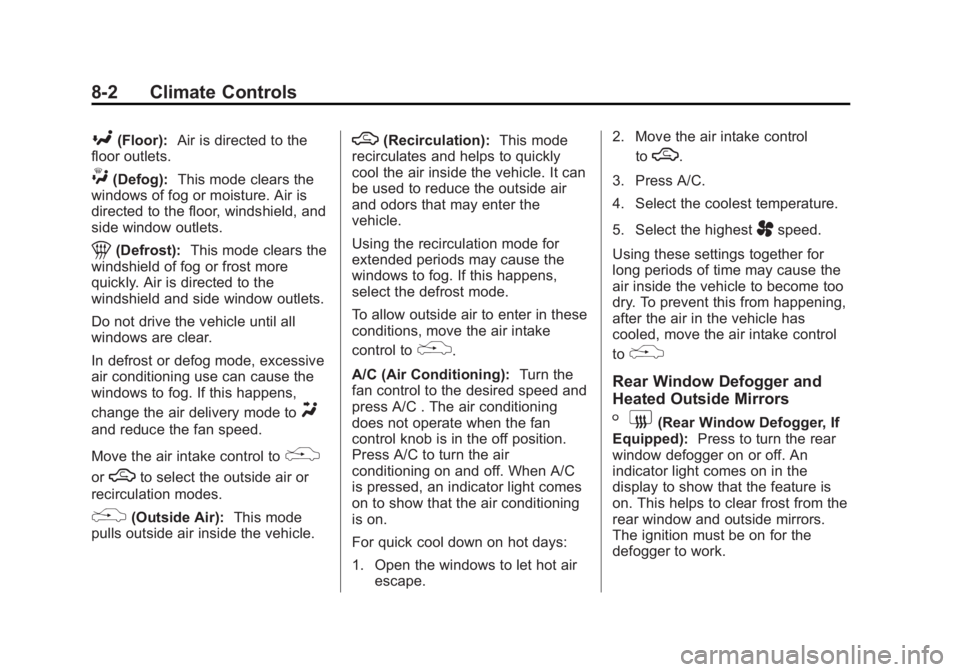
[ (Floor): Air is directed to the
floor outlets.
W (Defog): This mode clears the
windows of fog or moisture. Air is
directed to the floor, windshield, and
side window outlets.
1 (Defrost): This mode clears the
windshield of fog or frost more
quickly. Air is directed to the
windshield and side window outlets.
Do not drive the vehicle until all
windows are clear.
In defrost or defog mode, excessive
air conditioning use can cause the
windows to fog. If this happens,
change the air delivery mode to
Yand reduce the fan speed.
Move the air intake control to
%or
M to select the outside air or
recirculation modes.
% (Outside Air): This mode
pulls outside air inside the vehicle. M (Recirculation): This mode
recirculates and helps to quickly
cool the air inside the vehicle. It can
be used to reduce the outside air
and odors that may enter the
vehicle.
Using the recirculation mode for
extended periods may cause the
windows to fog. If this happens,
select the defrost mode.
To allow outside air to enter in these
conditions, move the air intake
control to
% .
A/C (Air Conditioning): Turn the
fan control to the desired speed and
press A/C . The air conditioning
does not operate when the fan
control knob is in the off position.
Press A/C to turn the air
conditioning on and off. When A/C
is pressed, an indicator light comes
on to show that the air conditioning
is on.
For quick cool down on hot days:
1. Open the windows to let hot air
escape. 2. Move the air intake control
to
M .
3. Press A/C.
4. Select the coolest temperature.
5. Select the highest
A speed.
Using these settings together for
long periods of time may cause the
air inside the vehicle to become too
dry. To prevent this from happening,
after the air in the vehicle has
cooled, move the air intake control
to
% Rear Window Defogger and
Heated Outside Mirrors
N (Rear Window Defogger, If
Equipped): Press to turn the rear
window defogger on or off. An
indicator light comes on in the
display to show that the feature is
on. This helps to clear frost from the
rear window and outside mirrors.
The ignition must be on for the
defogger to work.
Page 141 of 297
Black plate (4,1)Chevrolet City Express Owner Manual (GMNA-Localizing-U.S./Canada-
7707496) - 2015 - CRC - 11/26/14
8-4 Climate Controls Operation Tips .
Clear away any ice, snow,
or leaves from the air inlets at
the base of the windshield that
may block the flow of air into the
vehicle. .
Use of non-GM approved hood
deflectors may adversely affect
the performance of the system. .
Keep the path under the front
seats clear of objects to help
circulate the air inside of the
vehicle more effectively. Maintenance Service This vehicle may have the new
environmentally friendly refrigerant,
R1234yf. This refrigerant has a
significantly reduced global warming
impact on the environment,
compared to the traditional
automotive refrigerant, R-134a. All
vehicles have a label underhood
that identifies the refrigerant used in
the vehicle. The refrigerant system should only
be serviced by trained and certified
technicians. The air conditioning
evaporator should never be repaired
or replaced by one from a salvage
vehicle. It should only be replaced
by a new evaporator to ensure
proper and safe operation.
During service, all refrigerants
should be reclaimed with proper
equipment. Venting refrigerants
directly to the atmosphere is harmful
to the environment and may also
create unsafe conditions based on
inhalation, combustion, frostbite,
or other health-based concerns.
Page 163 of 297
Black plate (22,1)Chevrolet City Express Owner Manual (GMNA-Localizing-U.S./Canada-
7707496) - 2015 - CRC - 11/26/14
9-22 Driving and Operating Each time the engine is started,
or when the shift lever is shifted to
any position other than D (Drive),
the Overdrive off mode will be
automatically turned off.
Accelerator Downshift in D
Position For passing or hill climbing, depress
the accelerator pedal to the floor.
This shifts the transmission down
into a lower gear, depending on the
vehicle speed.
Fail Safe
When the fail-safe operation occurs,
the CVT will not be shifted into the
selected driving position.
If the vehicle is driven under
extreme conditions, such as
excessive wheel spinning and
subsequent hard braking, the
fail-safe system may be activated.
The MIL may come on to indicate
the fail-safe mode is activated. See
Malfunction Indicator Lamp on
page 5-11 . This will occur even if all
electrical circuits are functioning properly. In this case, place the
ignition switch in the OFF position
and wait for 10 seconds. Then place
the ignition switch back in the ON
position. The vehicle should return
to its normal operating condition. If it
does not return to its normal
operating condition, have a dealer
check the transmission and repair if
necessary.
{ WarningWhen the high fluid temperature
protection mode or fail-safe
operation occurs, vehicle speed
may be gradually reduced. The
reduced speed may be lower than
other traffic, which could increase
the chance of a collision. Be
especially careful when driving.
If necessary, pull to the side of
the road at a safe place and allow
the transmission to return to
normal operation, or have it
repaired if necessary. Brakes Antilock Brake
System (ABS)
{ Warning .
The ABS is a sophisticated
device, but it cannot prevent
accidents resulting from
careless or dangerous driving
techniques. It can help
maintain vehicle control
during braking on slippery
surfaces. Remember that
stopping distances on
slippery surfaces will be
longer than on normal
surfaces even with ABS.
Stopping distances may also
be longer on rough, gravel or
snow covered roads, or if you
are using tire chains. Always
maintain a safe distance from
(Continued)
Page 179 of 297
Black plate (38,1)Chevrolet City Express Owner Manual (GMNA-Localizing-U.S./Canada-
7707496) - 2015 - CRC - 11/26/14
9-38 Driving and Operating Some gasolines, mainly high octane
racing gasolines, can contain an
octane-enhancing additive called
methylcyclopentadienyl manganese
tricarbonyl (MMT). Do not use
gasolines and/or fuel additives with
MMT as they will reduce spark plug
life and affect emission control
system. The malfunction indicator
lamp may turn on. If this occurs, see
your dealer for service.
California Fuel
Requirements If the vehicle is certified to meet
California Emissions Standards, it is
designed to operate on fuels that
meet California specifications. See
the underhood emission control
label. If this fuel is not available in
states adopting California Emissions
Standards, the vehicle will operate
satisfactorily on fuels meeting
federal specifications, but emission
control system performance might
be affected. The malfunction
indicator lamp could turn on and the
vehicle may not pass a smog-check test. See Malfunction Indicator
Lamp on page 5-11 . If this occurs,
return to your authorized dealer for
diagnosis. If it is determined that the
condition is caused by the type of
fuel used, repairs may not be
covered by the vehicle warranty.
Fuels in Foreign
Countries If planning to drive in countries
outside the U.S. or Canada, the
proper fuel might be hard to find.
Check regional auto club or fuel
retail brand websites for availability
in the country where driving. Never
use leaded gasoline, fuel containing
methanol, manganese, or any other
fuel not recommended. Costly
repairs caused by use of improper
fuel would not be covered by the
vehicle warranty. Fuel Additives To keep fuel systems clean, TOP
TIER Detergent Gasoline is
recommended. See Fuel on
page 9-37 .
If TOP TIER Detergent Gasoline is
not available, one bottle of Fuel
System Treatment PLUS added to
the fuel tank at every engine oil
change can help. Fuel System
Treatment PLUS is the only
gasoline additive recommended by
General Motors. It is available at
your dealer.
Do not use additives with E85 or
FlexFuel.
Page 194 of 297
Black plate (11,1)Chevrolet City Express Owner Manual (GMNA-Localizing-U.S./Canada-
7707496) - 2015 - CRC - 11/26/14
Vehicle Care 10-11
Continuously Variable
Transmission (CVT) Fluid
{ Caution .
GM recommends using
ACDelco CVT Fluid (Part No.
19260800, in
Canada 19299096) in CVT.
Do not mix with other fluids. .
Do not use Automatic
transmission fluid (AFT) or
Manual Transmission fluid in
a CVT, as it may damage the
CVT. Damage caused by the
use of fluids other than as
recommended is not covered
under the vehicle warranty. .
Using fluids that are not
equivalent to ACDelco CVT
Fluid (Part No. 19260800, in
Canada 19299096) may
damage the CVT. Damage
caused by the use of fluids
(Continued) Caution (Continued) other than as recommended
is not covered under the
vehicle warranty.
When checking or replacement of
CVT fluid is required, see your
dealer for servicing.
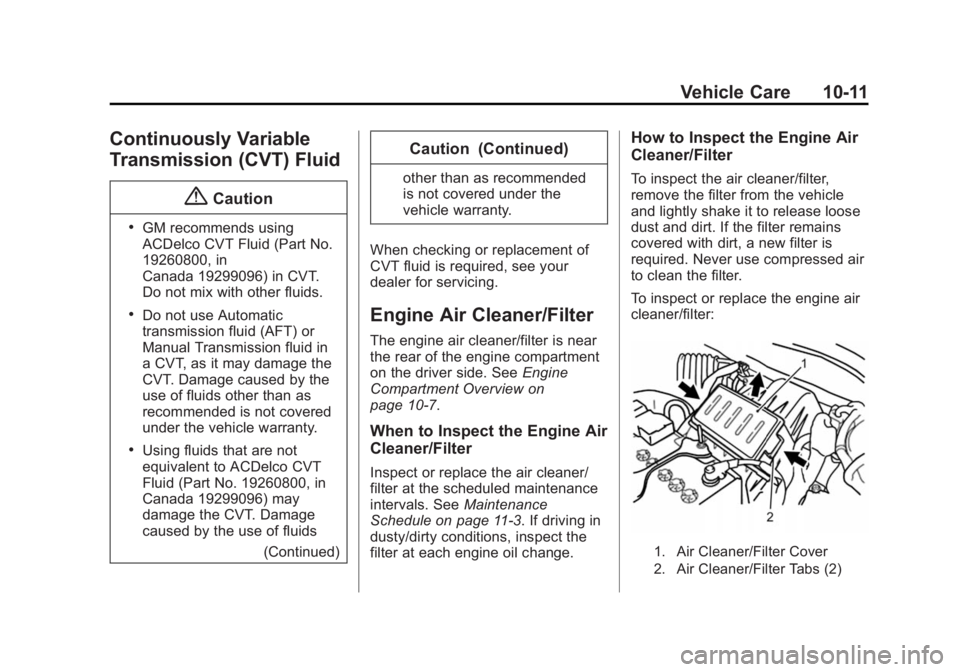
Engine Air Cleaner/Filter The engine air cleaner/filter is near
the rear of the engine compartment
on the driver side. See Engine
Compartment Overview on
page 10-7 .
When to Inspect the Engine Air
Cleaner/Filter
Inspect or replace the air cleaner/
filter at the scheduled maintenance
intervals. See Maintenance
Schedule on page 11-3 . If driving in
dusty/dirty conditions, inspect the
filter at each engine oil change. How to Inspect the Engine Air
Cleaner/Filter To inspect the air cleaner/filter,
remove the filter from the vehicle
and lightly shake it to release loose
dust and dirt. If the filter remains
covered with dirt, a new filter is
required. Never use compressed air
to clean the filter.
To inspect or replace the engine air
cleaner/filter:
1. Air Cleaner/Filter Cover
2. Air Cleaner/Filter Tabs (2)
Page 200 of 297
Black plate (17,1)Chevrolet City Express Owner Manual (GMNA-Localizing-U.S./Canada-
7707496) - 2015 - CRC - 11/26/14
Vehicle Care 10-17If Steam is Coming from the
Engine Compartment
{ WarningSteam from an overheated engine
can burn you badly, even if you
just open the hood. Stay away
from the engine if you see or hear
steam coming from it. Just turn it
off and get everyone away from
the vehicle until it cools down.
Wait until there is no sign of
steam or coolant before you open
the hood.
If you keep driving when the
engine is overheated, the liquids
in it can catch fire. You or others
could be badly burned. Stop the
engine if it overheats, and get out
of the vehicle until the engine
is cool. Overheated Engine
Protection
Operating Mode The engine has an engine
protection mode to reduce the
chance of damage if the coolant
temperature goes too high (for
example, when climbing steep
grades in high temperature with
heavy loads, such as when towing a
trailer). When the engine
temperature reaches a certain level: .
The engine coolant temperature
warning light will illuminate. .
Engine power may be reduced. .
The air conditioning cooling
function may be automatically
turned OFF for a short time (the
blower will continue to operate).
Engine power and under certain
conditions, vehicle speed will
decrease. Vehicle speed can be
controlled with the accelerator
pedal, but the vehicle may not
accelerate at the desired speed. The transmission will downshift or
upshift as it reaches prescribed shift
points. You can also shift manually.
As driving conditions change and
engine coolant temperature is
reduced, vehicle speed can be
increased using the accelerator
pedal, and air conditioning cooling
function will automatically be turned
back ON.
If:
1. The engine coolant temperature
is not reduced.
2. The air conditioning cooling
function does not turn back ON.
3. The engine oil pressure low/
engine coolant temperature high
warning light illuminates, this
may indicate a malfunction.
Move the vehicle off the road in
a safe area and allow the engine
to cool. If after checking the oil
and coolant, the oil pressure
low/engine coolant temperature
Page 202 of 297
Black plate (19,1)Chevrolet City Express Owner Manual (GMNA-Localizing-U.S./Canada-
7707496) - 2015 - CRC - 11/26/14
Vehicle Care 10-19
Brakes Disc brake pads have built-in wear
indicators that make a high-pitched
warning sound when the brake pads
are worn and new pads are needed.
The sound can come and go or be
heard all the time when the vehicle
is moving, except when applying the
brake pedal firmly.
{ WarningThe brake wear warning sound
means that soon the brakes will
not work well. That could lead to
a crash. When the brake wear
warning sound is heard, have the
vehicle serviced.
{ Caution
Continuing to drive with worn-out
brake pads could result in costly
brake repair. Some driving conditions or climates
can cause a brake squeal when the
brakes are first applied or lightly
applied. This does not mean
something is wrong with the brakes.
Properly torqued wheel nuts are
necessary to help prevent brake
pulsation. When tires are rotated,
inspect brake pads for wear and
evenly tighten wheel nuts in the
proper sequence to torque
specifications. See Capacities and
Specifications on page 12-2 .
Brake pads should be replaced as
complete sets.
Brake Pedal Travel See your dealer if the brake pedal
does not return to normal height,
or if there is a rapid increase in
pedal travel. This could be a sign
that brake service may be required.
Replacing Brake System Parts
Always replace brake system parts
with new, approved replacement
parts. If this is not done, the brakes
may not work properly. The braking performance expected can change
in many other ways if the wrong
replacement brake parts are
installed or parts are improperly
installed.
Brake Fluid
The brake master cylinder reservoir
is filled with DOT 3 brake fluid. See
Engine Compartment Overview on
page 10-7 for the location of the
reservoir.
There are only two reasons why the
brake fluid level in the reservoir
might go down: .
The brake fluid level goes down
because of normal brake lining
wear. When new linings are
installed, the fluid level goes
back up.
Page 210 of 297
Black plate (27,1)Chevrolet City Express Owner Manual (GMNA-Localizing-U.S./Canada-
7707496) - 2015 - CRC - 11/26/14
Vehicle Care 10-27Warning (Continued) .
Worn or old tires can
cause a crash. If the tread
is badly worn,
replace them. .
Replace any tires that
have been damaged by
impacts with potholes,
curbs, etc. .
Improperly repaired tires
can cause a crash. Only
the dealer or an
authorized tire service
center should repair,
replace, dismount, and
mount the tires. .
Do not spin the tires in
excess of 56 km/h
(35 mph) on slippery
surfaces such as snow,
mud, ice, etc. Excessive
spinning may cause the
tires to explode. All-Season Tires This vehicle may come with
all-season tires. These tires are
designed to provide good overall
performance on most road surfaces
and weather conditions. Original
equipment tires designed to meet
all-season requirements have MS
molded onto the sidewall. This
symbol can usually be found
following the size designation.
Consider installing winter tires on
the vehicle if frequent driving on
snow or ice-covered roads is
expected. All-season tires provide
adequate performance for most
winter driving conditions, but they
may not offer the same level of
traction or performance as winter
tires on snow or ice-covered roads.
See Winter Tires on page 10-27 .
Winter Tires This vehicle was not originally
equipped with winter tires. Winter
tires are designed for increased
traction on snow and ice-covered roads. Consider installing winter
tires on the vehicle if frequent
driving on ice or snow covered
roads is expected. See your dealer
for details regarding winter tire
availability and proper tire selection.
Also, see Buying New Tires on
page 10-41 .
With winter tires, there may be
decreased dry road traction,
increased road noise, and shorter
tread life. After changing to winter
tires, be alert for changes in vehicle
handling and braking.
If using winter tires: .
Use tires of the same brand and
tread type on all four wheel
positions. .
Use only radial ply tires of the
same size, load range, and
speed rating as the original
equipment tires.
Page 215 of 297
Black plate (32,1)Chevrolet City Express Owner Manual (GMNA-Localizing-U.S./Canada-
7707496) - 2015 - CRC - 11/26/14
10-32 Vehicle Care (6) Load Range :
Load Range.
(7) Service Description :
The
service description indicates the
load index and speed rating of a
tire. If two numbers are given as
in the example, 120/116, then
this represents the load index for
single versus dual wheel usage
(single/dual). The speed rating is
the maximum speed a tire is
certified to carry a load. This
does not apply to Goodyear
LT225/75R16 G949 RSA and
Goodyear LT225/75R16 G933
RSD commercial truck tires; see
the dual tire and single tire
maximum load and load range
letter designations on the tire
sidewall.
Tire Terminology and
Definitions
Air Pressure :
The amount of
air inside the tire pressing
outward on each square inch of the tire. Air pressure is
expressed in kPa (kilopascal)
or psi (pounds per square inch).
Accessory Weight :
The
combined weight of optional
accessories. Some examples of
optional accessories are
automatic transmission, power
windows, power seats, and air
conditioning.
Aspect Ratio :
The relationship
of a tire's height to its width.
Belt :
A rubber coated layer of
cords between the plies and the
tread. Cords may be made from
steel or other reinforcing
materials.
Bead :
The tire bead contains
steel wires wrapped by steel
cords that hold the tire onto
the rim. Bias Ply Tire :
A pneumatic tire
in which the plies are laid at
alternate angles less than
90 degrees to the centerline of
the tread.
Cold Tire Pressure :
The
amount of air pressure in a tire,
measured in kPa (kilopascal)
or psi (pounds per square inch)
before a tire has built up heat
from driving. See Tire Pressure
on page 10-35 .
Curb Weight :
The weight of a
motor vehicle with standard and
optional equipment including the
maximum capacity of fuel, oil,
and coolant, but without
passengers and cargo.
DOT Markings :
A code molded
into the sidewall of a tire
signifying that the tire is in
compliance with the U.S.
Department of Transportation
(DOT) Motor Vehicle Safety
Standards. The DOT code
Page 220 of 297
Black plate (37,1)Chevrolet City Express Owner Manual (GMNA-Localizing-U.S./Canada-
7707496) - 2015 - CRC - 11/26/14
Vehicle Care 10-37The TPMS malfunction indicator is
combined with the low tire pressure
telltale. When the system detects a
malfunction, the telltale will flash for
approximately one minute and then
remain continuously illuminated.
This sequence will continue upon
subsequent vehicle start-ups as
long as the malfunction exists.
When the malfunction indicator is
illuminated, the system may not be
able to detect or signal low tire
pressure as intended. TPMS
malfunctions may occur for a variety
of reasons, including the installation
of replacement or alternate tires or
wheels on the vehicle that prevent
the TPMS from functioning properly.
Always check the TPMS malfunction
telltale after replacing one or more
tires or wheels on your vehicle to
ensure that the replacement or
alternate tires and wheels allow the
TPMS to continue to function
properly.
See Tire Pressure Monitor
Operation on page 10-37 . See Radio Frequency Statement on
page 13-12 .
Tire Pressure Monitor
Operation This vehicle may have a Tire
Pressure Monitor System (TPMS).
The TPMS is designed to warn the
driver when a low tire pressure
condition exists. TPMS sensors are
mounted onto each tire and wheel
assembly, excluding the spare tire
and wheel assembly. The TPMS
sensors monitor the air pressure in
the tires and transmit the tire
pressure readings to a receiver
located in the vehicle.
When a low tire pressure condition
is detected, the TPMS illuminates
the low tire pressure warning light located on the instrument cluster.
If the warning light comes on, stop
as soon as possible and inflate the
tires to the recommended pressure
shown on the Tire and Loading
Information label. See Vehicle Load
Limits on page 9-9 .
A message displays when the low
tire pressure warning light comes on
and low tire pressure is detected.
See Tire Messages on page 5-20 .
The message and low tire pressure
warning light come on at each
ignition cycle until the tires are
inflated to the correct inflation
pressure. The vehicle must be
driven at speeds above 25 km/h
(16 mph) to activate the TPMS and
turn off the low tire pressure
warning light.
The low tire pressure warning light
may come on in cool weather when
the vehicle is first started, and then
turn off as the vehicle is driven. This
could be an early indicator that the